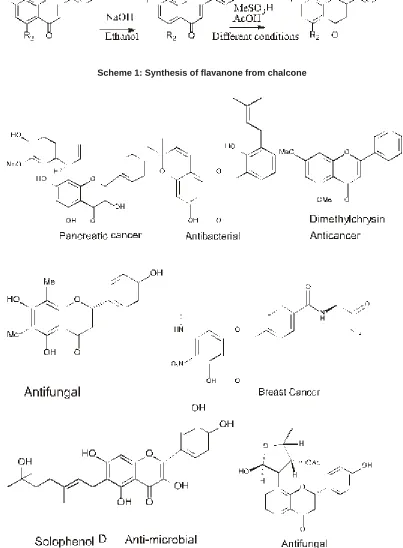
INTRODUCTION
Natural products includes alkaloids, terpenoids, coumarins, amino acid derivatives and flavonoids.Flavonoids are found in plant as a secondary metabolite acts as defence from bacteria and viruses.They also acts as coluring agent in flowers to attract insect,honeybees and butterfy toward flower.Due to which pollination occurs easily in plants.Flavonoids are also important for human health as it present in fruits,vegetables and flowers.Initially it isnamed as Vitamin P.But due to its yellow colour it is named as flavonoids.
www.orientjchem.org
An International Open Free Access, Peer Reviewed Research Journal CODEN: OJCHEG 2014, Vol. 30, No. (2): Pg. 857-862
Synthesis of Flavanones using Methane Sulphonic Acid as
a Greencatalystand Comparision under Different Conditions
R.B. KSHATRIYA
1, J.K. Machhi and G.M. NAZERUDDIN
1*
1Department of Organic Chemistry & Research Centre, Poona College of Arts,
Science and Commerce, (Affiliated to University of Pune). Camp, Maharashtra, India. *Corresponding author E-mail: [email protected]
http://dx.doi.org/10.13005/ojc/300264
(Received: March 02, 2014; Accepted: March 31, 2014)
ABSTRACT
Flavonoids are an important class of natural products with wide range activities. Flavonoids includes flavone, flavanone, flavane & flavanol. The synthetic route invovles synthesis of chalcone followed by ring closing to give flavanone. So many catalysts were mentioned in past literature. But most efficient catalyst is methane sulphonic acid.It is easy to handle,less reaction time &easily available. Flavanones were synthesized from chalcone using methane sulphonic acid under thermal condition, microw wave and ultrasound condition.Flavanones are syntheisized in very less time compared to other conditions.
Key words: Flavanone, Methanesulphonic acid, Thermal, Micro wave, Ultrasound.
Flavonoids aresynthesized by various methods like Clause-Schmidt,Baker-Venkatraman, Ganguly’s method and Robinson’smethod etc.13 Armoatic aldehydes and ketones gives chalcone which on cyclization gives flavanone.In past methods chalcone are cyclized to flavanone by I2/ DMSO15, AcOH/H
2SO4
16, silicagel17, poly phosporic
acid18, TFA19,N-methyl imidazole20,alkali metal carbonates21, KOH/MeOH22, pyridine23, DBU/MW24, HBr/AcOH25, pottasium ferricynide26etc.We synthesized flavanone by using methane sulphonic acid under different conditions.
EXPERIMENTAL
All material purchased from Sigma-Aldrich and solvents from Merck Chemical India.Melting points determined in parafin bath. IR &1HNMR spectra gives structure of compound.
Representative procedure Thermal condition
A mixture of substituted 2- hydroxy chalcone (1mole) was added in RBF.Then arrange the apparatus with thermometer in oil bath.Place apparatus on digital hot plate.Add through neck of RBF acetic acid and then add dropwise MSA (15 mole %).Maitain temperature 105-115°C till completion of reaction.Reaction was monitored by TLC.Pour the reaction mass in water,filter to get solid.Recrystalise with suitable solvent.Calculate yeild, M.P.After checking solubility in suitable solvent it was given for spectral analysis.
Ultra sound condition
A mixture of substituted 2- hydroxy chalcone (1mole) and methane sulphonic acid was added(15 mole %) in RBF. Add acetic acid minimum to dissolve the reaction mass.Then keep RBF in a water bath with ultrasound. Maintain temp. 950C. Carry out reaction for 30 minute under ultrasound. Check TLC.Carry out work up as above.
Under micro-wave condition
A mixture of substituted 2- hydroxy chalcone (1mole) and methane sulphonic acid was added (15 mole %) in RBF.Add acetic acid minimum to dissolve the reaction mass.Then RM subjected to micro-wave.Check TLC.Carry out work up as above.
Spectral Data
2-phenylchroman-4-one (2a) Colour
light yellow/white powder,M.P.-760C,TLC system- Hex+E.A.(7:3),Soluble – CHCl3
IR (KBr) Vmax/cm-11720,1675,1616-1500,1300, 750, 690.
1H NMR (CDCl 3)
5.51(d,1H,J = 7 Hz),3.20(d,2H,J=7 Hz), 7.40 (dd,1H,J = 7.5,1.5 Hz), 7.0(1H,m,J= 7.5,1.5 Hz),7.50(dd,1H,J = 7.5,1.5 Hz),7.15(dd,1H,J = 7.5,1.5 Hz),7.32 (dd,2H,J = 7.5,1.5 Hz),7.25 (dd,1H, J= 7.5,1.5 Hz),7.22(m,1H,J= 7.5,1.5 Hz)
2-(4-hydroxyphenyl)chroman-4-one (2b) Colour
Light yellow powder,M.P.-1800C,TLC system-Hex+E.A.(7:3),Soluble – DMSO
IR (KBr) Vmax/cm-1: 3480,1700,1692, 1608, 1514,754,697.
1H NMR (DMSO)
5 . 5 3 ( d , 1 H , J = 7 H z ) , 3 . 2 8 ( d , 2 H , J = 7 Hz),9.79(s,1H,-OH),6.78(d,2H, J= 7.5,1.5 Hz), 7.33 (dd,2H,J = 7.5,1.5 Hz),7.34(d,1H,J = 7.5,1.5 Hz), 7.046 (m,1H, J=7.5,7.2,1.5 Hz),7.55(dd,1H,J = 7.5,1.5 Hz),7.76(m,1H,J=7.2,7.2,1.5 Hz),7.76(m,1H J = 7.6,7.2,1.5 Hz).
2-(3-hydroxyphenyl)chroman-4-one(2c) Colour
White powder,M.P.-1340C,TLC system-Hex+CHCl3+Acetone.(6:3:1),Soluble– DMSO IR (KBr) Vmax/cm-13400, 1711, 1656, 1610, 1515, 750, 690.
1H NMR (DMSO) 5.70(d,1H,J=7Hz),3.17(d,1H,J = 7Hz),6.75(dd,1H,J = 1.5,1.5 Hz),6.92(m,1H,J= 7.5, 1.5, 1.4 Hz), 7.09(m,1H,J =7.6,1.5,1.5), 7.21 (m,1H, J = 7.5,1.5,1.5 Hz),7.57(dd,1H,J = 7.5,1.5 Hz),7.60 (dd,1H,J = 7.5,1.5 Hz), 7.76(dd,1H,J = 7.5,1.5 Hz),7.78(m,1H,J = 7.5,1.5,1.5 Hz)
2-(3,4-dimethoxyphenyl)chroman-4-one (2d) Colour
light yellow powder,M.P.-1340C,TLC system-Hex+E.A.(7:3),Soluble– DMSO.
= 7 Hz),3.92(s,3H,-OMe) 3.90(s,3H,-OMe), 6.90 (d,1H,J =7 Hz),7.008(d,1H,J=7Hz),7.027(d,1H,J = 1.5 Hz), 7.15(dd,1HJ = 7.5,1.5 Hz),7.52(dd,1H,J = 7.5,1.5 Hz),7.94(m,1H,J= 7.5,1.5,1.5,1.5 Hz)
5-methoxy-2-phenylchroman-4-one (2e) Colour
Yellow powder,M.P.-1410C,TLC system-Benzene+E.A.(9.5+0.5),Soluble–CHCl3.
IR (KBr) Vmax/cm-11720,1654, 1600, 1500, 1300, 980.
1H NMR (CDCl 3)
5.50 (d,1H,J = 7 Hz),3.19(d,2H,J = 7 Hz),2.80(s,3H), 6.72(2H,d,J = 7.5 Hz),7.50(d,1H,J = 7.5 Hz),7.35(s,5 H)
7-hydroxy-2-phenylchroman-4-one (2f) Colour
Yellow powder,M.P.-1880C,TLC system-Hex+E.A.(7:3),Soluble–CHCl3.
IR (KBr) Vmax/cm-13500, 1717, 1660, 1500, 1300, 980.
1H NMR (CDCl 3)
5.51(d,1H,J = 7 Hz),3.40(d,2H,J = 7 Hz),6.46(dd,1H,J=7.5,
1.5 Hz),6.50(d,1H,J = 1.5 Hz),7.50(d,1H,J = 7.5 Hz),7.40(dd,2H,J=7.5,1.5 Hz),
7.35(m,3H,J = 7.5,1.5 Hz).
5,7-dimethoxy-2-phenylchroman-4-one (2g) Colour
White powder,M.P.-1440C,TLC system-CHCl3+ MeOH.(9:1),Soluble – CHCl3
IR (KBr) Vmax/cm-1
17021674, 1608, 1489,1300,943.
1H NMR (CDCl 3)
5.51(d,1H,J = 7 Hz),3.029(d,2H,J= 7Hz), 2.79 (s,3H),2.62 (s,3H),6.16(d,1H,J= 1.5 Hz), 6.10(d,1H,J = 1.5 Hz),7.38(m,1H,J = 1.5,1.5 Hz), 7.41 (m,1H,J = 7.5,1.5,1.5 Hz),7.45(m,1H,J=7.5, 1.5, 1.5, 1.5 Hz)
RESULTS AND DISCUSSION
Methane sulphonic acid is used as an acid catalyst in organic reactions because it is a non-volatile, strong acid that is soluble in organic solvents. Methanesulfonic acid is convenient for industrial applications because it is liquid at ambient temperature, while the closely related to para
toluene sulphonic acid which solid at room temperature. MSA isconsidered asintermediate between sulphuric acid and methyl sulphonyl methane.It maintains PH which is necessary to go reaction smoothly. So many acids like acetic acid, sulphuric acid, pTSA,poly H3PO4,Hydrochloric acid were used in previous method.Sometimes mixture of acids,mixed solvents are used in previous methods.So as per our opinion PH isimportant for the acidic synthesis of flavanone from 2-hydroxy chalcones. We also comparedreaction under various conditions like ultrasound,thermal and microwave conditions.
CONCLUSION
We found cheap,environmental friendly process for the synthesis of flavanones.Methane sulphonic acid is green catalyst compared to other catalysts.We compare different conditions for the reaction.We concluded that reaction under MW will complete in minimum time.
ACKNOWLEDGMENT
We specially thanks to Dr. Rajeshwari Nair, Vice Principal, S.S.R.College of Arts,Commerce & Science, Silvasa (Affiliated to University of Pune) to give lab fascility to carry research.
REFERENCES
1. (a)Abou, E.; Osama, S.; Ashraf, M. Ind. J. Chem. 2005, 44: 1887.
(b)Kshatriya, R.B.; Machhi, J.K.; Nazeruddin, G.M.OIIRJ 2014, IV,196.
2. Biddle, M.M.; Lin,M.; Sheidt,K.A. J.Am. Chem.Soc.2007,129,3830.
3. Soizic, P.;Janin,Y.L.;Brigitte ,Saint-Joanis; Priscille, B.; Sylvie, M.; Koch, M.; Cole,S.T.; François, T.; Pierre-Etienne ,B. Bioorg. Med. Chem. 2007,15,2177.
4. Sherif B Abdel Ghani;Louise W.; Zidan H. Z.; Hussein M. Ali;-C.William-Keevil; Brown. R.C.D.Bioorg. Med. Chem. 2008, 518. 5. Mughal,E.U.; Ayaz, M.; Hussain, Z.;
Hasan,A;Riaz,M; Malik,A.; Hussain,S.; Choudhary.M.I. Bioorg Med Chem. 2006,14,
4704.
6. Pandey,V.K.; Singh,V.K.; Tandon,M.; Joshi,M.N.;Bajpai,S.K. Ind. J. Chem. 2004,
43B,1770.
7. Lin, Y.M.; Zhou, Y.; Flavin, M.T.; Zhou, L. Weiguo, N.; Chen, F.C.Bioorg Med Chem. 2002,10, 2795.
8. Dandia,A.; Singh,R.; Khaturia,S. Bioorg Med Chem. 2006,14,1303.
9. Tapas,A.; Sakarkar, D.; Kakde, R. J.Pharm. and Tech. 2008,1(3)132.
10. Koufaki, M.; Kiziridi, C.; Papazafiri, P.; Vassilopoulos, A.; Varro, A.; Zsolt, N.; Farkas, A.; Makriyannis, A..Bioorg. Med. Chem. 2006,
14, 6666.
Kakde, Res. J.Pharm and Tech.
2008,1(3),132.
12. Agarwal,A.D. Int.J.Of Pharm. Science and Nanotech. 2011, 4,1394.
13. Kshatriya,R.B.;Nazeruddin,G.M.;Shaikh,Y.I.
Orient. J. of Chem.2013, 29(4),1475. 14. Kshatriya, R.B.; Machhi, J.K.; Patil, M.S.; Patel,
A.C.; More, D.B. Int.-Multi. e – Journal 2013, II(X), 67.
15. Kshatriya,R.B.;Machhi,J.K. IJPRR, 2014, 3(2): 47.
16. Lokhande,P.D.; Sakate,S.S.; Taksande,K. N.; Navghare,B. Tet. Lett.2005, 46,1573. 17. Babber, S.; Chandra, S.; Aggarwal, A. K. Indian
J.Chem.1987,26B, 797.
18. Paquette, L. A. Encyclopedia of Reagents for Organic Synthesis; John-Wiley & Sons: New
York, U. S. A. 1995,4172.
19. Chaturvedi, R.; Patil, P. N.; Mulchandani, N. B. ibid.1992,31B, 340.
20. Liu,B. K. , Wu, X. ;Qian,Q.; Lv,D.S. Lin, X. F.
Synthesis 2007,22,2653.
21. Mondal,R. Gupta, A.D.Mallik, A.K. Tet. Lett. 2011, 52, 5020.
22. Vatkar, B.S.; Pratapwar, A.S.; Tapas, A.R.; Butle, S.R.Tiwari,B.Int.J.of Chem.Tech Res. 2010, 21, 504.
23. Dutta, C. P.; Roy, L. P. K. Indian J. Chem. 1975,13, 425.
24. Patonay, T.; Varma, R. S.; Vass, A.; Levai, A.; Dudas, J.Tet. Lett. 2001,42, 1403.
25. Lee,J.I ; Jung, M.G. Bull. Korean Chem. Soc.
2005, 26(12), 2045.