544 | P a g e
STATIC ANALYSIS OF COMPOSITE LEAF SPRING
WITH NONLINEAR PARAMETERS
Yogesh Y. Kamble
1, Prof. Dr. S.H.Sawant
2.
1
PG Student ,
2Professor ,Department of Mechanical Engineering,
Dr. J.J. Magdum College of Engineering, Jaysingpur.(India)
ABSTRACT
In this paper Numerical analysis of composite leaf spring is carried out to find out effect of nonlinearities. For Linear and Nonlinear Finite element analysis ANSYS software is used. Experimental set up is developed in order to find out load-displacement characteristics of Composite Leaf spring. Load- displacement characteristics are studied in order to find out nonlinearities present in composite leaf spring. The present work deals with the numerical analysis of composite leaf spring with nonlinear parameters. In this paper Material and Geometric nonlinearities are considered.
Keywords
:
ANSYS, Composite Leaf Spring, E-Glass/Epoxy, Nonlinearity.
I INTRODUCTION
Composite materials consist of two or more physically dissimilar and instinctively separable components
called reinforcement and matrix. These two components can be mixed in a restricted way to achieve optimum
properties, which are superior to the properties of each individual component. Composite materials have
been widely used in automobile industry because of its high strength and modulus to weight ratio, low cost
and flexibility in material and structure design. The suspension leaf spring is one of the potential items for
weight reduction in automobile as it accounts for ten to twenty percent of the unsprung weight. This helps in
achieving the vehicle with improved riding qualities. Since the strain energy in the spring is inversely proportional
to density and young’s modulus of the material, it is always suggested that the material for leaf spring must have low
density and modulus of elasticity. Many research have been carried out in the direction to replace conventional steel
leaf spring by composites [1]. CAE tools are widely used in the automotive industries. In fact, their usehas enabled
the automakers to reduce product development cost and time while improving the safety, comfort, and durability of
the vehicles they produce. The predictive capability of CAE tools has progressed to the point where much of the
design verification is now done using computer simulation rather than physical prototype testing. Even though
therehave been many advances in CAE and it is widely used in the engineering field, physical testing is still used as
545 | P a g e
therefore the validation of CAE results is important [2].In this analysis the material of mono leaf spring is E- glass
epoxy. There are four layers of material lay up by following way:
The E glass Epoxy is also type of fiber. SiO2 54wt% ,Al2O314wt% ,CaO+MgO 22wt% ,B2 O310wt%, Na2O+K2O
less than 2wt%. The properties of E-glass epoxy material used for the analysis are as follows:
II MATERIAL PROPERTIES OF E-GLASS EPOXY
Sr. No. Property Value
1 Tensile Modulus Along X-Direction 34000MPa
2 Tensile Modulus Along Y-Direction 6530MPa
3 Tensile Modulus Along Z-Direction 6530MPa
4 Tensile Strength of Material 900MPa
5 Compressive Strength of Material 450MPa
6 Shear Modulus Along XY-Direction 2433MPa
7 Shear Modulus Along YZ-Direction 1698MPa
8 Shear Modulus Along ZX-Direction 2433MPa
9 Poisson Ratio Along XY-Direction 0.217
10 Poisson Ratio Along YZ-Direction 0.0366
11 Poisson Ratio Along ZX-Direction 0.217
12 Mass Density 2.6*103Kg/mm3
13 Flexural Modulus 40000MPa
14 Flexural Strength 1200MPa
III
NUMERICAL ANALYSIS
The Finite Element Method (FEM) is practical application often known as Finite Element Analysis (FEA) is a
numerical technique for finding approximate solutions of partial differential equations (PDE) as well as of integral
equations. Finite Element Analysis is a simulation technique which evaluates the behavior of components,
equipment and structures for various loading conditions including applied forces, pressures and temperatures. Thus,
a complex engineering problem with non-standard shape and geometry can be solved using finite element analysis
where a closed form solution is not available. The finite element analysis methods result in the stress distribution,
displacements and reaction loads at supports etc. for the model. The three dimensional model of spring is drawn in
CATIA V5 R16 environment. This geometry is imported to ANSYS environment. 20 node hexahedral element
546 | P a g e
by 10 node tetrahedron element as well but tetrahedron is stiffer as compared to hexahedron element so results in
lower accuracy [3].In this paper linear and nonlinear analysis of composite leaf spring is carried out using ANSYS.
In finite element analysis 3D model of mono leaf spring is developed. After modeling of leaf spring the actual
supporting boundary conditions are given i.e. fixed support and cylindrical support. In fixed support there is no any
degree of freedom i.e. there is no displacement at any direction. But in cylindrical support only vertical excitation or
motion is present and horizontal motion is restricted. This condition is real on TATA-SUMO leaf spring.
Fig.1 Cad Model of Leaf Spring
In ANSYS the Cad Model of composite leaf spring is developed. After that for analysis the Finite element model is
generated. At the point of application of load the fine meshing is done. After meshing we get total 18054 No. of
Nodes and 4198 No. of Elements.
Fig.2 Shows meshed model of composite leaf spring. Fig.3 shows displacement in y direction of linear composite
leaf spring at 50N load.
547 | P a g e
Fig.3 Directional Deformation at 50N of Linear Composite Leaf Spring.
3.1 Nonlinear Finite Element Analysis
Nonlinear Analysis includes Material based non-linearity: Force (stress) Vs. Displacement (strain) curve is
Nonlinear(polynomial).Geometric non-linearity: In real life, the stiffness [K] is a function of displacement [d].This
means in a geometric nonlinear analysis, the stiffness K is re-calculated after a certain predefined
displacement.Contact non-linearity: In Contact analysis, the Stiffness K also changes as a function of displacement
(when parts get into contact or separate). Non-linear analysis deals with true stress and strain (unlike engineering
stress and strain in linear static analysis)[4].
In this paper Material and Geometric nonlinearity is considered to find out load deflection characteristics and
maximum equivalent stress contours (Von Misses Stress plots).
For maximum load acting on leaf spring 46.58 MPa equivalent stress is developed which is far below yield strength
of material, hence design of composite leaf spring is also safe. Fig.4a shows directional deformation at 50 N of
Linear Composite Leaf Spring and Fig.4b shows Maximum equivalent stress in Nonlinear Composite Leaf Spring.
Fig.4a Fig.4b
Fig.4a- Deformation at 50N of Linear Composite Leaf Spring.
548 | P a g e
IV EXPERIMENTAL RESULTS
The experimentation is done by using universal testing machine. The loads are applied by using the universal testing
machine. At various loads the deflection of composite leaf spring is measured. The following results are obtained
during the experimental static analysis of composite leaf spring.
V RESULTS AND DISCUSSIONS
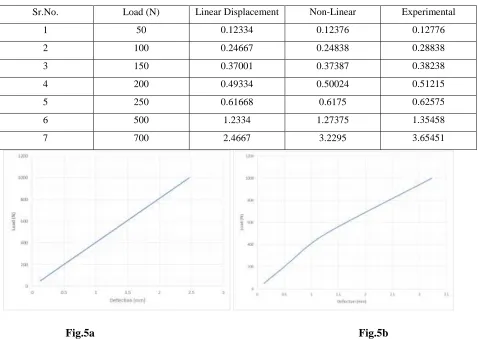
Table 1 shows the Comparative Load-displacement characteristics of Numerical Linear and Nonlinear Composite
Leaf Spring and Experimental Analysis.
Table. 1: Comparative Load-displacement Characteristics
Sr.No. Load (N) Linear Displacement
(mm)
Non-Linear
Displacement (mm)
Experimental
Displacement (mm)
1 50 0.12334 0.12376 0.12776
2 100 0.24667 0.24838 0.28838
3 150 0.37001 0.37387 0.38238
4 200 0.49334 0.50024 0.51215
5 250 0.61668 0.6175 0.62575
6 500 1.2334 1.27375 1.35458
7 700 2.4667 3.2295 3.65451
Fig.5a Fig.5b
Fig.5a- Load Deflection Characteristics of Linear Composite Leaf Spring.
549 | P a g e
Fig.5c-Experimental Load Deflection Characteristics of Composite Leaf Spring.From Experimental Load-Displacement Characteristics it is observed there is good agreement between
load-deflection characteristics of Nonlinear Composite leaf Spring and Experimental Load-Deflection results, therefore in
order to find out non-linear effects included in the spring force fs, it is modeled as third order polynomial function as
Where the co-efficients are obtained by fitting the experimental data, which resulted in k3 = -0.961 N/mm3, k2 =-
39.11 N/mm2, k1= 432.25 N/mm and k0 = -10.465 N. Hence, in order to model the nonlinearities in Leaf spring
above equationwill be used, which includes the nonlinear effects in spring.
V CONCLUSION
Comparative Nonlinear static analysis of Composite Leaf spring used in Medium utility vehicle is carried out.
Nonlinearities present in spring are found out. The numerical results from Nonlinear Finite Element Analysis
showed in general a good agreement with the experimental values. However, differences appear indicating the
necessity to improve the model input data and the experimental procedure. By using nonlinear analysis we can
simulate real life conditions which were not possible in linear analysis, hence it is essential to use nonlinear analysis
to get real life results.
VI ACKNOWLEDGEMENTS
550 | P a g e
REFERENCES
[1]ManjunathH.N.et.al.,“Vibration Analysis of Composite Leaf Spring for a Light Commercial
Vehicle.”International Journal of Scientific Engineering and Technology (ISSN: 2277-1581), Volume No.3 Issue
No.7, pp : 871-875 1 July 2014.
[2]VinkelArora et al. “A Comparative Study of CAE and Experimental Results of Leaf Springs in Automotive
Vehicles”,International Journal of Engineering Science and Technology (IJEST),ISSN : 0975-5462 Vol. 3 No. 9
September 2011.
[3]Mr. Amit A. Hingane, Prof. Dr. S. H. Sawant. “Static Analysis of Helical Compression Spring Used in Vibration
Absorber with Nonlinear Parameters.”International Journal for Scientific Research & Development,| Vol. 2, Issue
04, 2014 | ISSN (online): 2321-0613.
[4]“Practical Aspects of Finite Element Simulation A Student Guide”,2011 Altair Engineering, Inc
[5] M. M. Patunkar, D. R. Dolas. “Modelling and Analysis of Composite Leaf Spring under the Static Load
Condition by Using FEA,” International Journal of Mechanical and Industrial Engineering, Volume 1, Issue 1,