IJEDR1902008 International Journal of Engineering Development and Research (www.ijedr.org) 34
Health Problems And Residence–A Case Study On
High School Students
1Sankara Pitchaiah Podila, 2Nazia Sultana 1Professor, 2Research Scholar
Acharya Nagarjuna University
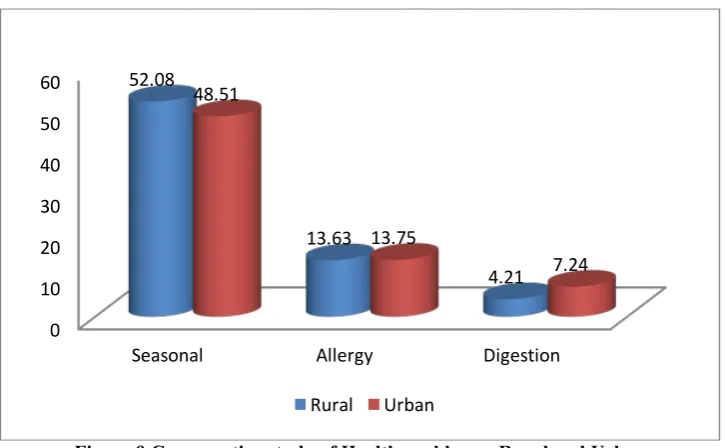
Abstract - Health problems are common among High school students. The present study was aimed to examine the Seasonal, Allergy and Irritable Bowel Syndrome (IBS) health problems in the rural and urban students of Guntur District, Andhra Pradesh, India. It is observed that the Seasonal problems are very high in both rural and urban school students, however, the difference is low (3.57%). Allergy and Digestion problems are comparatively less, and allergy problems are more compared to digestion. Seasonal problems are slightly more in rural students and the digestion in urban students (Difference 3.03%). Allergies are more or less same.
Keywords: Health problems, seasonal, allergy, IBS, rural, urban, high school
I. INTRODUCTION
Health problems have a direct impact on academic achievement. Seasonally, different persons suffer from different health problems. Allergies are common in our society. For ex. allergy of Dust, Cool climate, Metals, Scents, Paper, Scent, Chemicals, Flowers, Cloth smell, Fritz inside smell, etc. Similarly, a considerable number of students are facing Irritable Bowel Syndrome (IBS).
A huge study involving 14 million blood tests examined the allergy (https://www.medical newstoday.com). Food allergy is studied by Kelly and Gangur, (2009). IBS is a common condition, affecting around 12 million people in the UK. The name is a blanket term for a collection of otherwise unexplained symptoms that relate to a disturbance in the bowels – abdominal pain, bloating, constipation, cramping or diarrhea. (https://www.netdoctor.co.uk/). Various reports on IBS were available in literature Caine et al., (2008), (https://www.centraltexasendoscopy.com/) and (https://www.good housekeeping.com/).
The present study assessed the extent of these health problems among High school students in relation to residence.
II. METHODOLOGY
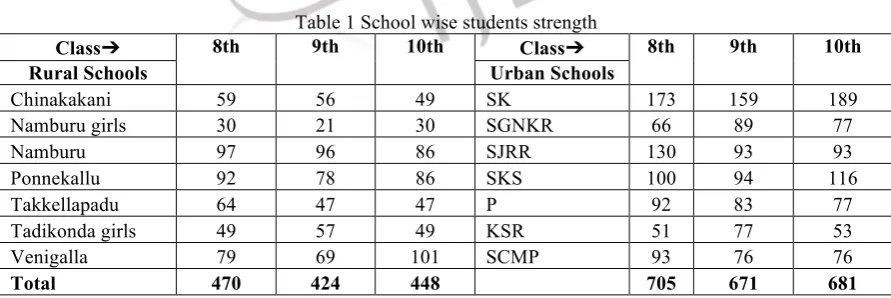
A total of 3399 High school students (8th to 10th) from 14 High schools were selected for the study, out of them 1342 are studying in rural schools and 2057 in urban schools. The details are shown in Table 1. Students were asked them to give their response to a question-“Whether they have Seasonal/ Allergy/ Digestion health problems?” The purpose of the study and the details regarding the health were explained in their mother tongue. Percent variation was observed and presented under results and discussion section
Table 1 School wise students strength
Class 8th 9th 10th Class 8th 9th 10th
Rural Schools Urban Schools
Chinakakani 59 56 49 SK 173 159 189
Namburu girls 30 21 30 SGNKR 66 89 77
Namburu 97 96 86 SJRR 130 93 93
Ponnekallu 92 78 86 SKS 100 94 116
Takkellapadu 64 47 47 P 92 83 77
Tadikonda girls 49 57 49 KSR 51 77 53
Venigalla 79 69 101 SCMP 93 76 76
Total 470 424 448 705 671 681
III. RESULTS AND DISCUSSION
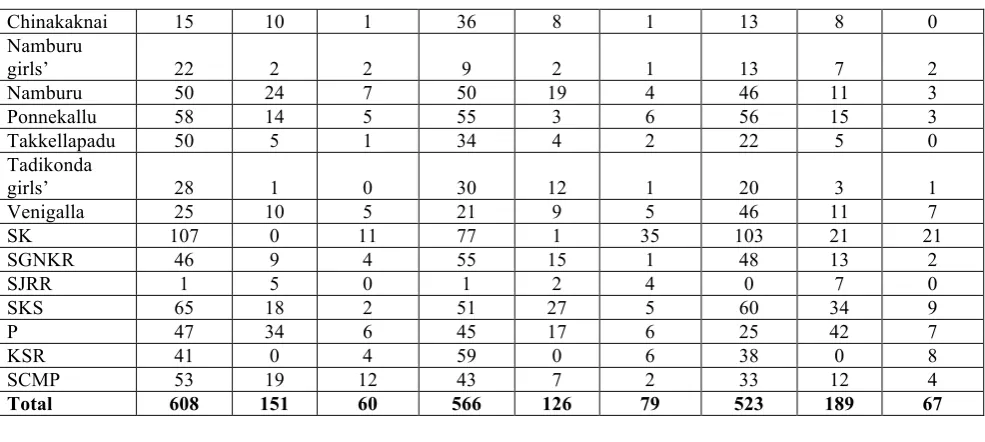
Students suffering from various health problems were shown in table 2 and percentages are shown in table 3 and 4.
Table 2 School wise students suffering from health problems
Class 8th 9th 10th
Health Problems
IJEDR1902008 International Journal of Engineering Development and Research (www.ijedr.org) 35
Chinakaknai 15 10 1 36 8 1 13 8 0
Namburu
girls’ 22 2 2 9 2 1 13 7 2
Namburu 50 24 7 50 19 4 46 11 3
Ponnekallu 58 14 5 55 3 6 56 15 3
Takkellapadu 50 5 1 34 4 2 22 5 0
Tadikonda
girls’ 28 1 0 30 12 1 20 3 1
Venigalla 25 10 5 21 9 5 46 11 7
SK 107 0 11 77 1 35 103 21 21
SGNKR 46 9 4 55 15 1 48 13 2
SJRR 1 5 0 1 2 4 0 7 0
SKS 65 18 2 51 27 5 60 34 9
P 47 34 6 45 17 6 25 42 7
KSR 41 0 4 59 0 6 38 0 8
SCMP 53 19 12 43 7 2 33 12 4
Total 608 151 60 566 126 79 523 189 67
Rural Students
Seasonal Health problems 8th class
Highest percent of Takkellapadu School (78.13) was suffering from Seasonal health problem (Table 3 and Figure 1), followed by Namburu girls’ (73.33%) and Ponnekallu (63.04%). The lowest percent was noticed with Chinakakani students (25.42%).
Table 3 School wise Health problems – Rural (%)
Class 8th 9th 10th
Health Problems
Seasonal Allergy Digestion Seasonal Allergy Digestion Seasonal Allergy Digestion
Rural schools
Chinakaknai 25.42 16.95 1.69 64.29 14.29 1.79 26.53 16.33 0.00
Namburu
girls’ 73.33 6.67 6.67 42.86 9.52 4.76 43.33 23.33 6.67
Namburu 51.55 24.74 7.22 52.08 19.79 4.17 53.49 12.79 3.49
Ponnekallu 63.04 15.22 5.43 70.51 3.85 7.69 65.12 17.44 3.49
Takkellapadu 78.13 7.81 1.56 72.34 8.51 4.26 46.81 10.64 0.00
Tadikonda
girls’ 57.14 2.04 0.00 52.63 21.05 1.75 40.82 6.12 2.04
Venigalla 31.65 12.66 6.33 30.43 13.04 7.25 45.54 10.89 6.93
Table 4 School wise Health problems – Urban (%)
Class 8th 9th 10th
Health Problems
Seasonal Allergy Digestion Seasonal Allergy Digestion Seasonal Allergy Digestion
Urban schools
SK 61.85 0.00 6.36 48.43 0.63 22.01 54.50 11.11 11.11
SGNKR 69.70 13.64 6.06 61.80 16.85 1.12 62.34 16.88 2.60
SJRR 0.77 3.85 0.00 1.08 2.15 4.30 0.00 7.53 0.00
SKS 65.00 18.00 2.00 54.26 28.72 5.32 51.72 29.31 7.76
P 51.09 36.96 6.52 54.22 20.48 7.23 32.47 54.55 9.09
KSR 80.39 0.00 7.84 76.62 0.00 7.79 71.70 0.00 15.09
SCMP 56.99 20.43 12.90 56.58 9.21 2.63 43.42 15.79 5.26
9th class
IJEDR1902008 International Journal of Engineering Development and Research (www.ijedr.org) 36 Figure 1 Seasonal problems in Rural students
10th class
Seasonal problems are high in Ponnekallu students (65.12%), followed by Namburu (53.49%). The problem is low in Chinakakani school students (26.53%).
Allergy Problem 8th class
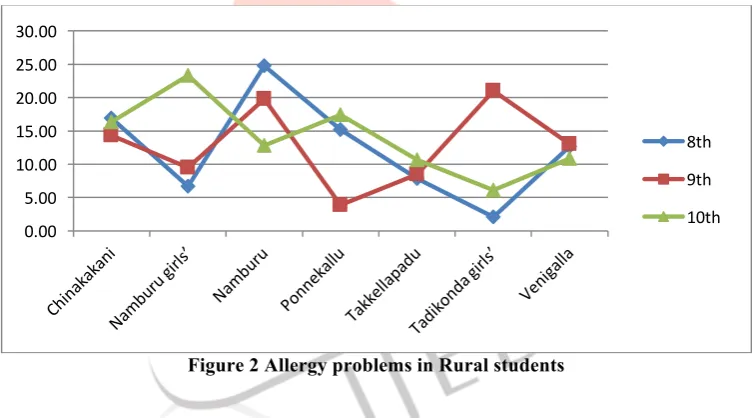
Highest percent of Namburu students (24.74) suffering from Allergy problem (Table 3 and Figure 2), followed by Chinakakani (16.95%) and Ponnekallu (15.22%). The lowest percent was noticed with Tadikonda girls’ students (2.04%).
Figure 2 Allergy problems in Rural students
9th class
21.05% of Tadikonda girls’ students were suffering, followed by Namburu (19.79%) and Chinakakani (14.29%). The lowest percent was observed in Ponnekallu school students (3.85%).
10th class
Allergy problems are high in Namburu girls’ students (23.33%), followed by Ponnekallu (17.44%) and Chinakakani (16.33). The problem is low in Tadikonda girls’ school students (6.12%).
Digestion
8th class
The Highest percent of Namburu coed school students (7.22) suffering from Digestion problem (Table 3 and Figure 3), followed by Namburu girls’ (6.67%) and Venigalla (6.33%). No student was opted the problem in Tadikonda girls’ high school.
9th class
7.69% of Ponnekallu students were suffering with the problem, followed by Venigalla (7.25%). The lowest percent was observed in Tadikonda girls’ (1.75) and Chinakakani (1.79) school students.
0.00 10.00 20.00 30.00 40.00 50.00 60.00 70.00 80.00 90.00
8th 9th 10th
0.00 5.00 10.00 15.00 20.00 25.00 30.00
IJEDR1902008 International Journal of Engineering Development and Research (www.ijedr.org) 37 Figure 3 Digestion problems in Rural students
10th class
Digestion problems are high in Venigalla students (6.93%), followed by Namburu girls’ (6.67%). No student was opted the problem in Chinakakani and Takkellapadu high school.
Urban Students
Seasonal Health Problems 8th class
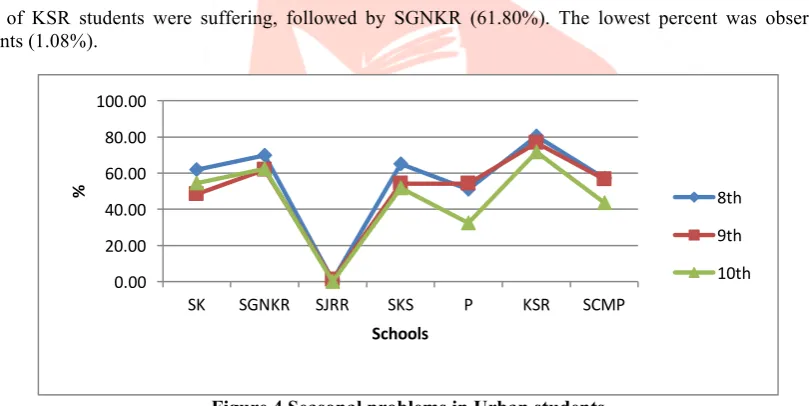
Highest percent of KSR school (80.39) was suffering from Seasonal health problem (Table 4 and Figure 4), followed by SGNKR (69.70%) and SKS (65.00%). The lowest percent was noticed with SJRR students (0.77%).
9th class
76.62% of KSR students were suffering, followed by SGNKR (61.80%). The lowest percent was observed in SJRR school students (1.08%).
Figure 4 Seasonal problems in Urban students
10th class
Similarly, Seasonal problems are high in KSR students (71.70%), followed by SGNKR (62.34%). No student was chosen the seasonal problem in SJRR.
Allergy 8th class
Highest percent of P students (36.96) suffering from Allergy problem (Table 4 and Figure 5), followed by SCMP (20.43%) and SKS (18.00%). SK and KSR School students are not expressed the problem.
9th class
28.72% of SKS students were suffering, followed by P (20.48%) and SGNKR (16.85%). No student was marked the problem from KSR School.
0.00 1.00 2.00 3.00 4.00 5.00 6.00 7.00 8.00 9.00
8th 9th 10th
0.00 20.00 40.00 60.00 80.00 100.00
SK SGNKR SJRR SKS P KSR SCMP
%
Schools
8th 9th
IJEDR1902008 International Journal of Engineering Development and Research (www.ijedr.org) 38 Figure 5 Allergy problems in Urban students
10th class
Allergy problem is high in P students (54.55%), followed by SKS (29.31%) and SGNKR (16.88). KSR school students were not chosen the problem.
Digestion
8th class
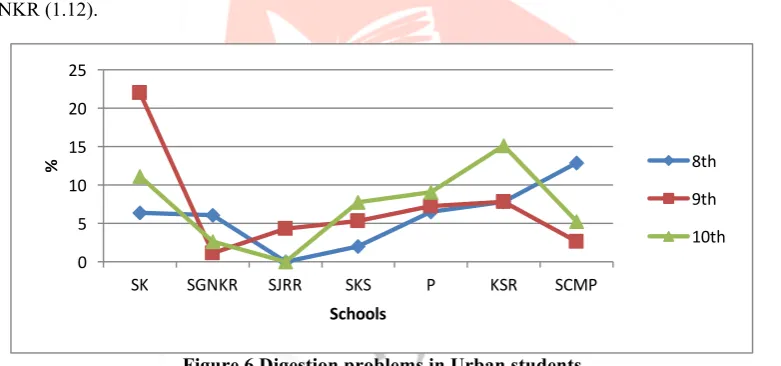
Highest percent of SCMP (12.90) suffering from Digestion problem, followed by KSR (7.84%) and P (6.52%). No student was opted the problem in SJRR high school (Table 4 and Figure 6).
9th class
22.01% of SK students were suffering, followed by KSR (7.79%) and P school students (7.23). The lowest percent was observed in SGNKR (1.12).
Figure 6 Digestion problems in Urban students
10th class
Digestion problems are high in KSR students (15.09%), followed by SK (11.11%) and P students (9.09). No student was opted the problem in SJRR high school.
Comparative Study
Rural Students
Various health problems are studied with reference to rural schools. It is observed that the seasonal health problems are high in all the schools compared to the other two. Next to seasonal allergy problems are more in all the schools, followed by digestion (Figure 7).
Urban Students
Except in SJRR, seasonal problems are high. Similarly, next to seasonal, except SK and KSR schools, all other schools are recorded with more allergy problems. Digestion problem I slow compared to other two (Figure 8).
0 10 20 30 40 50 60
SK SGNKR SJRR SKS P KSR SCMP
%
Schools
8th 9th 10th
0 5 10 15 20 25
SK SGNKR SJRR SKS P KSR SCMP
%
Schools
IJEDR1902008 International Journal of Engineering Development and Research (www.ijedr.org) 39 Figure 7 Comparative study of Health problems - Rural
Figure 8 Comparative study of Health problems - Urban
Rural and Urban
Among the three health problems studied seasonal problems are more in rural and urban, followed by allergy and digestion. Seasonal problems are comparatively more in rural and the IBS (digestion) is comparatively less in rural students. Allergy problems are more or less similar in both students (Figure 9).
Figure 9 Comparative study of Health problems –Rural and Urban
IV. CONCLUSION
The results found that a high percent of the High school students are suffering from seasonal problems. Health problem influence the moods and situations of student’s life. These problems also affect the efficiency of the students and their academic achievement. As all the schools have been running under the Government control, it is suggested to
0.00 10.00 20.00 30.00 40.00 50.00 60.00 70.00 80.00
%
Schools
Seasonal Allergy
Digestion
0.00 10.00 20.00 30.00 40.00 50.00 60.00 70.00 80.00 90.00
SK SGNKR SJRR SKS P KSR SCMP
%
Schools
Seasonal Allergy Digestion
0 10 20 30 40 50 60
Seasonal Allergy Digestion
52.08
13.63
4.21 48.51
13.75
7.24
IJEDR1902008 International Journal of Engineering Development and Research (www.ijedr.org) 40 arrange the free health checkup periodically. The difference in the incidence of health problems between rural and urban is not significant.
REFERENCES
[1] Cain, K. C., Jarrett, M. E., Burr, R. L., Rosen, S., Hertig, V. L., & Heitkemper, M. M. (2008). Gender Differences in Gastrointestinal, Psychological, and Somatic Symptoms in Irritable Bowel Syndrome. Digestive Diseases and Sciences, 54(7), 1542–1549.
[2] Kelly Caleb and Venu Gangur (2009) Sex Disparity in Food Allergy: Evidence from the PubMed Database, Hindawi Publishing Corporation, Journal of Allergy Volume, Article ID 159845, 7 pages.
[3] https://www.medicalnewstoday.com/articles/226507.php