ACCESS CONTROL AND SECURE DATA
RETRIEVAL BASED ON CIPHERTEXT POLICY
ATTRIBUTE-BASED ENCRYPTION IN
DECENTRALIZED DTNS
Dhiren Kumar Dalai
1, Arunram Ravi
2 1, 2Department of CSE, Anna University, (India)
ABSTRACT
Mobile Nodes in some challenging network scenarios such as disaster recovery areas, military battlefields,
hostile region or urban sensing applications suffer from intermittent connectivity and frequent partitions.
Disruption Tolerant Network (DTN) Technologies are becoming challenging and successful solution for End To
End communication between wireless devices. This allow nodes to communicate with each other in extreme
terrestrial networking environments, or planned networks in space .In this Scenario Data to be stored and
retrieved from the storage nodes ,since the data is sensitive data one needs to consider the security policies.
The attribute-based encryption (ABE) is a promising approach that full fills the requirements for secure data
retrieval in DTN .the existing system involves some challenging issues like fine grain access control to contents
stored in storage nodes within a DTN. In this paper, we propose an access control scheme which is based on the
Ciphertext Policy Attributed-Based Encryption (CP-ABE) approach which provides a scalable way of
encrypting data such that the encrypter defines the attribute set that the decrypted needs to process for
decrypting the cipher text. Since the problem of applying CP-ABE in decentralized structure of DTN results
inseveral security and privacy challenges with regards to the attribute revocation of all nodes, key escrow and
coordination of attributes issued from various authorities. So, data retrieval scheme must be secured for using
CP-ABE for decentralized DTNs where multiple key authorities manage their attributes independently, in
addition to that geographical routing is also used for finding the location of the nodes to reduce complexity ,
communication cost and to increase security. Wealso provide some performance results from our
implementation.
Index Terms: Disruption Tolerant Networking (DTN), Node Location, Access Control, Attribute
Based Encryption (ABE) Secure Data Retrieval.
I. INTRODUCTION
Now days many computing devices e.g. PDAs, smart-phones, sensors have wireless interfaces and hence can
form ad hoc networks. Wireless adhoc networks allow nodes to communicate with one another without relying
on any fixed infrastructure. These rapidly deployable networks are very useful in several scenarios e.g. [1]
military network environments, connections of wireless devices carried by soldiers may be temporarily
disconnected by environmental factors, jamming and mobility, especially when they operate in terrestrial
environments. Disruption- tolerant network (DTN) technologies are becoming successful solutions that allow
nodes to communicatewith each other in these extreme terrestrial environments [2]-[4]. Typically, when there is
to wait in the intermediate nodes for a substantial amount of time until the connection would be eventually
established.For storage and replicate the data storage node is introduced [5][6]where authorized mobile nodes
can access the necessary information quickly. Many military applications require increased protection of
confidential data including access control methods that are cryptographically enforced [7], [8]. In many cases, it
is desirable to provide differentiated access services such that data access policies are defined over user
attributes or roles, which are managed by the key authorities. Multiple key authorities manage their attribute
independently in DTN [9], [10]. The concept of attribute-based encryption (ABE) [11]–[14] is a promising
approach that fulfils the requirements for secure data retrieval in DTNs. ABE features a mechanism that enables
an access control over encrypted data using access policies and ascribed attributes among private keys and
ciphertexts. Especially, ciphertext-policy ABE (CP-ABE) provides a scalable way of encrypting data such that
the encryptor defines the attribute set that the decryptor needs to possess in order to decrypt the ciphertext [13].
Thus, different users are allowed to decrypt different pieces of data per the security policy. However, the
problem of applying the ABE to DTNs introduces several security and privacy challenges. Since some users
may change their associated attributes at some point (for example, moving their region), or some private keys
might be compromised, key revocation (or update) for each attribute is necessary in order to make systems
secure. However, this issue is even more difficult, especially in ABE systems, since each attributes conceivably
shared by multiple users (henceforth, we refer to such a collection of users as an attribute group). This implies
that revocation of any attribute or any single user in an attribute group would affect the other users in the group.
For example, if a user joins or leaves an attribute group, the associatedattribute key should be changed and
redistributed to all the other members in the same group for backward or forward secrecy. It may result in
bottleneck during rekeying procedure or security degradation due to the windows of vulnerability if the previous
attribute key is not updated immediately.
One more challenging issue is Key escrow problems ,CP-ABE, authority's master secret key is used to generates
private keys of users associated set of attributes. So, the key authority can decrypt every cipher text addressed to
specific users by generating their attribute keys. If the key authority is compromised by adversaries when
deployed in the hostile environments, this could be a potential threat to the data confidentiality or privacy
especially when the data is highly sensitive. The key escrow is an inherent problem even in the
multiple-authority systems as long as each key multiple-authority has the whole privilege to generate their own attribute keys with
their own master secrets. Since such a key generation mechanism based on the single master secret is the basic
method for most of the asymmetric encryption systems such as the attribute- based or identity-based encryption
protocols removing escrow in single or multiple-authority CP-ABE is a pivotal problem. The last challenge is
the coordination of attributes issued from different authorities. When multiple authorities manage and issue
attribute keys to users independently with their own master secrets, it is very hard to define fine-grained access
policies over attributes issued from different authorities. For example, suppose that attributes “role 1” and
“region 1” are managed by the authority A, and “role 2” and “region 2” are managed by the authority B. Then, it is impossible to generate an access policy ((“role 1” OR “role 2”) AND (“region 1” or “region 2”)) in the
previous schemes because the OR logic between attributes issued from different authorities cannot be
implemented. This is due to the fact that the different authorities generate their own attribute keys using their
own independent and individual master secret keys. Therefore, general access policies, such as “ -out-of- ”
logic, cannot be expressed in the previous schemes, which is a very practical and commonly required access
Objectives: 1.Immediate attribute revocation enhances backward/forward secrecy of confidential data by
reducing the windows of vulnerability.
2.Encryptor’s can define a fine-grained access policy using any monotone access structure under attributes
issued from any chosen set of authorities.
3. The key escrow problem is resolved by an escrow-free key issuing protocol that exploits the characteristic of
the decentralized DTN architecture.
4. Location tracking to reduce communication cost.
A. Related Work
ABE comes in two flavors called key-policy ABE (KP-ABE)andciphertext-policy ABE (CP-ABE). In KP-ABE,
the encryptor only gets to label a ciphertext with a set of attributes. The key authority chooses a policy for each
user that determines which ciphertexts he can decrypt and issues the key to each user by embedding the policy
into the user’s key. However the roles of the ciphertexts and keys are reversed in CP-ABE. In CP-ABE, the
ciphertext is encrypted with an access policy chosen by an encryptor, but a key is simply created with respect to
an attributes set. CP-ABE is more appropriate to DTNs than KP-ABE because it enables encryptorssuch as a
commander to choose an access policy on attributes and to encrypt confidential data under the access structure
via encrypting with the corresponding public keys or attributes [4], [7], [15] location of node tracked to reduce
overhead [18].
II. OVERVIEW OF THE SYSTEM
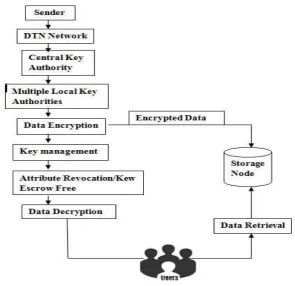
The proposed system to develop the CP-ABE is a promising cryptographic solution to the access control issues
shown in Figure 1.
Fig. 1: System Architecture
System Description and Assumptions
1) Key Authorities: They are key generation centres that generate public/secret parameters for CP-ABE. The
key authorities consist of a central authority and multiple local authorities. We assume that there are secure and
reliable communication channels between a central authority andeach local authority during the initial key setup
and generation phase. Each local authority manages different attributes and issues corresponding attribute keys
to users.They grant differential access rights to individual users based on the users’ attributes. The key
authorities are assumed to be honest-but-curious. That is, they will honestly execute the assigned tasks in the
system; however they would like to learn information of encrypted contents as much as possible. 2) Storage
node: This is an entity that stores data from senders and provide corresponding access to users. It may be mobile
or static [4], [5]. Similar to the previous schemes, we also assume the storage node to be semi trusted, that is
honest-but-curious.
3) Sender: This is an entity who owns confidential messagesOr data (e.g., a commander) and wishes to store
them into the external data storage node for ease of sharing or for reliable delivery to users in the extreme
networking environments. A sender is responsible for defining (attribute based) access policy and enforcing it
on its own data by encrypting the data under the policy before storing it to the storage node.
4) User: This is a mobile node who wants to access the data stored at the storage node (e.g., a soldier). If a user
possesses a set of attributes satisfying the access policy of the encrypted data defined by the sender, and is not
revoked in any of the attributes, then he will be able to decrypt theciphertext and obtain the data.
5) Attribute Revocation: Revocation of users in cryptosystems is a well studied but nontrivial problem.
Revocation is even more challenging in attribute-based systems, given that each attribute possibly belongs to
multiple different users, whereas in traditional PKI systems public/private key pairs are uniquely associated with
a single user. In principle, in an ABE system, attributes, not users or keys, are revoked. Backward and forward
Secrecy: In the context of ABE, backward secrecy means that any user who comes to hold an attribute (that
satisfies the access policy) should be prevented from accessing the plaintext of the previous data exchanged
before he holds the attribute. On the other hand, forward secrecy means that any user who drops an attribute
should be prevented from accessing the plaintext of the subsequent data exchanged after he drops the attribute,
unless the other valid attributes that he is holding satisfy the access policy.
Since the key authorities are semi-trusted, they should be deterred from accessing plaintext of the data in the
storage node; meanwhile, they should be still able to issue secret keys to users. In order to realize this somewhat
contradictory requirement, the central authority and the local authorities engage in the arithmetic 2PC protocol
with master secret keys of their own and issue independent key components to users during the key issuing
phase. The 2PC protocol prevents them from knowing each other’s master secrets so that none of them can
generate the whole set of secret keys of users individually. Thus, we take an assumption that the central
authority does not collude with the local authorities (otherwise, they can guess the secret keys of every user by
sharing their master secrets).
6) Location Tracking: A simple scheme is presented for geographic forwarding that is similar to Cartesian
routing. Each node determines its own geographic position using a mechanism such as GPS; positions consist of
latitude and longitude. A node announces its presence, position, and velocity to its neighbours (other nodes
within radio range) by broadcasting periodic HELLO packets. Each node maintains a table of its current
neighbours‟ identities and geographic positions. The header of a packet destined for a particular node contains the destination’s identity as well as its geographic position. When node needs to forward a packet toward
packet to that neighbour, which itself applies the same forwarding algorithm. The packet stops when it reaches
the destination.
III. PROPOSED SCHEME
In this section, we provide a multiauthority CP-ABE scheme for secure data retrieval in decentralized DTNs.
Each local authority issues partial personalized and attribute key components to a user by performing secure
2PC protocol with the central authority. Each attribute key of a user can be updated individually and
immediately. Thus, the scalability and security can be enhanced in the proposed scheme
Scheme Construction
The concept of CP-ABE is
• Private key assigned to “attributes”
• Cipher text associated with “access policy”
• Can decrypt only when attributes satisfy policy.
Central key Authority:
1. Choose a random exponent β∈ R Z*p.
Let h=g β
2. Masters (secret key)/public key
PKCA=h MKCA=β.
Local Key Authority
1. Choose a random exponent αi∈ R Z*p.
2. Masters (secret key)/public key pair is
PKAi=e (g,g)αi,MK Ai=αi.
An efficient and secure data retrieval method using CP-ABE is used for decentralized DTNs where multiple key
authorities manage their attributes independently. The inherent key escrow problem is resolved such that the
confidentiality of the stored data is guaranteed even under the hostile environment where key authorities local
and central might be compromised or not fully trusted.
Key Generation: (MK, L): The key generation algorithm runs by CA. It takes as input the Master key of CA and
the set of attributes L for user, then generate the secret key SK
3.1 Algorithm for Key Generation
A trusted party chooses and publishes a (large) prime p and an integer ghaving large prime order in F*p
1. Select a large prime number p.
i. Choose a secret integer a.
ii. Compute A ≡ ga(mod p).
iii. Choose a secret integer b.
iv. Compute B ≡ gb(mod p).
2. Masters (secret key)
Compute the number Ba(mod p). Compute the number Ab(mod p).
The shared secret value is Ba ≡ (gb)a ≡ gab ≡ (ga)b ≡ Ab(mod p).
Data Encryption: Here when a sender wants to deliver its confidential data M, he defines the tree access
structure T over the universe of attributes L, encrypts the data under to enforce attribute-based access control on
parameter PK and access structure A over the universe of attributes. Generate the output CT such that only those
users who had valid set of attributes that satisfy the access policy can only able to decrypt. Assume that the CT
implicitly contains access structure A.
Data Decryption: When a user receives the ciphertext from the storage node, the user decrypts the ciphertext
with its secret key. The decrypt algorithm run by user takes input the public parameter, the ciphertext CT
contains access structure A and the secret key SK contain of user attribute set S. If S satisfies the access tree
then algorithm decrypt the CT and give M otherwise gives “ϕ”.
Key Update (MK, SK, old value, new value): The key updating algorithm runs by CA. It takes as input the
master key of CA, old SK and old attribute value old value, and then updates the secret key SK by updating
(add/delete/update) old value with new value.
3.2 CP-ABE for Data Retrieval
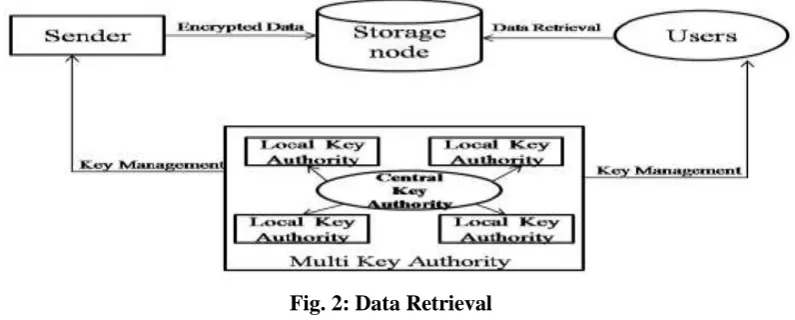
We provide a multi authority CP-ABE scheme for secure data retrieval in decentralized DTNs. Each local
authority Issues partial personalized and attribute key components to a user by performing secure 2PC protocol
with the central authority. Data confidentiality on the stored the data against unauthorized users can be trivially
guaranteed .Which shown in Fig.2
Fig. 2: Data Retrieval
3.3 Location Tracking
Apart from this location of nodes also detected and intimates the position to neighbour nodes. Each node
determines its own geographic position using a mechanism such as GPS; positions consist of latitude and
longitude. A node announces its presence, position, and velocity to its neighbours by broadcasting periodic
HELLO packets. Each node maintains a table of its current neighbour’s identities and geographic positions. The
header of a packet destined for a particular node contains the destination’s identity as well as its geographic
position. When node needs to forward a packet toward location, the node consults its neighbour table and
chooses the neighbour closest to it. It then forwards the packet to that neighbour, which itself applies the same
forwarding algorithm. The packet stops when it reaches the destination.
IV. RESULTS
The proposed system Access control and Secure data retrieval based on CP-ABE implemented in NS2Simulator.
Here we perform access control and secure data retrieval by CP-ABE as well as location of node also tracked by
using geographical routing protocols .which helps to identify the position on nodes and to control the access of
data .Table 1shows all evaluation factors calculated values like communication cost end to end delay,
Table 1(Evaluation Values)
Fig. 4:Performance Graph
V. CONCLUSION
Disruption Tolerant Network (DTN) Technologies are becoming challenging and successful solution for End To
End communication between wireless devices. Now DTN are becomes successful solution in hostile area like
military applications that allows wireless devices .Confidential data can be access by using external storage
nodes .CP-ABE is a successful cryptographic solution to access control and secure data retrieval in
decentralized DTN networks where multiple key authorities manage their attributes independently. The inherent
key escrow problem is resolved such that the confidentiality of the stored data is guaranteed even under the
hostile environment where key authorities might be compromised or not fully trusted. In addition, the
fine-grained key revocation can be done for each attribute group. In the proposed system location of node also
identified using geographical routing protocol, which improve performance and reduce communication cost.
REFERENCES
[1] J. Burgess, B. Gallagher, D. Jensen, and B. N. Levine, “Maxprop:Routing for vehicle-based disruption
tolerant networks,” in Proc.IEEE INFOCOM, 2006, pp. 1–11.
[2] M.Chuah and P. Yang, “Node density-based adaptive routing scheme for disruption tolerant networks,” in
[3] JunbeomHur and Dong Kun Noh, “Attribute-Based Access Control with EfficientRevocation in Data
Outsourcing Systems” IEEE Transactions On Parallel And Distributed Systems, Vol. 22, NO. 7, JULY
2011,pp.1214-1221
[4] M. Chuah and P. Yang, “Performance evaluation of content-based information retrieval schemes for
DTNs,” in Proc. IEEE MILCOM,2007, pp. 1–7.
[5] M. Chase and S. S. M. Chow, “Improving privacy and security in multi authority attribute- based
encryption,” in Proc. ACM Conf. Comput. Common Security, 2009, pp. 121–130.
[6] Improving Security and Efficiency in Attribute-Based Data Sharing JunbeomHur IEEE Transactions on
Knowledge And Data Engineering, VOL. 25, NO. 10, OCTOBER 2013.pp.2271-2282
[7] M. M. B. Tariq, M. Ammar, and E. Zequra, “Mesage ferry route design for sparse ad hoc networks with
mobile nodes,” in Proc. ACMMobiHoc, 2006, pp. 37–48.
[8] M. Chase and S. S. M. Chow, “Improving privacy and security in multiauthority attribute-based
encryption,” in Proc. ACM Conf. Comput.Commun. Security, 2009, pp. 121–130.
[9] D. Huang and M. Verma, “ASPE: Attribute-based secure policy enforcement in vehicular ad hoc
networks,” Ad Hoc Netw., vol. 7, no. 8,pp. 1526–1535, 2009.
[10] A. Lewko and B. Waters, “Decentralizing attribute-based encryption,”CryptologyePrint Archive: Rep.
2010/351, 2010.
[11] A. Sahai and B. Waters, “Fuzzy identity-based encryption,” in Proc.Eurocrypt, 2005, pp. 457–473.
[12] V. Goyal, O. Pandey, A. Sahai, and B. Waters, “Attribute-based encryption for fine-grained access control
of encrypted data,” in Proc. ACM Conf. Comput. Commun. Security, 2006, pp. 89–98.
[13] J. Bethencourt, A. Sahai, and B. Waters, “Ciphertext-policy attribute based encryption,” in Proc. IEEE
Symp. Security Privacy, 2007, pp. 321–334.
[14] S. Yu, C. Wang, K. Ren, and W. Lou, “Attribute based data sharing with attribute revocation,” in Proc.
ASIACCS, 2010, pp. 261–270.
[15] D. Huang and M. Verma, “ASPE: Attribute-based secure policy enforcement in vehicular ad hoc
networks,” Ad Hoc Netw., vol. 7, no. 8,pp. 1526–1535, 2009.
[16] J. Bethencourt, A. Sahai, and B. Waters, “Ciphertext-policy attribute based encryption,” in Proc. IEEE
Symp.Security Privacy, 2007, pp.321–334.
[17] M.Chuah and P. Yang, “Node density-based adaptive routing scheme for disruption tolerant networks”, in
Proc. IEEE MILCOM, pp.1–11, 2006.
[18] Rong Ding and Lei Yang,” A Reactive Geographic Routing Protocol for Wireless Sensor Networks”, in
Computer Science Department, Beihang University, Beijing, pp.1-11, 2006
BIOGRAPHY
1Dhiren Kumar Dalai received his B.E (CSE) degree from Anna University, India in 2010. He is
pursuing M.E. in Computer Science, College of Engineering, Guindy, Anna University,Chennai.
His research interests are in the area of Network Security.
2Arunram Ravi received his B.E (ECE), from Anna University in Nov 2013. He is pursuing
M.E. in Computer Science, College of Engineering, Guindy, Anna University,Chennai. Analog