1
Identifying Potential Critical Risks in the Construction Supply
Chain – An Empirical Study in Ghana
Darko1, A., Owusu-Manu2, D., Pärn3, E. and Edwards4, D.J.,
1Department of Building and Real Estate
Hong Kong Polytechnic University Email: [email protected]
2Department of Building Technology,
Koforidua University of Technology, Ghana Email: [email protected]
3Faculty of Technology Environment and Engineering
Birmingham City University Email: Erika.Pä[email protected]
4Faculty of Technology Environment and Engineering Birmingham City University
Email: [email protected] ABSTRACT
Risk management is an important tool for organizations operating in a global environment. Hence, this
paper seeks to identify potential critical risks existing in the construction supply chain (SC) in order to aid
risk management processes. From the literature, 11 risks factors that may affect the construction SC were
identified. A questionnaire survey based upon these factors was then carried out and 49 responses were
received from contractors and suppliers in Ghana. The mean score analysis was used together with the
one-sample t-test to identify potential risks in the construction SC. The K-S test was used to investigate
any differences between ratings given by the two groups of respondents for a particular risk factor. The
internal consistency and reliability of the risk factors was assessed using the Cronbach’s alpha coefficient
(α).The results show that fluctuations in prices, changes in interest rates, shortage of materials, frequent
changes in SC inputs and unexpected changes in demand are potential critical risks. Generally, there was
no statistical difference between the perceptions of the stakeholders on the ranking of the risk factors.
Using the research presented, readers are able to identify potential risks in the construction SC for risk
2
risk management, few studies have attempted to identify risks in the construction SC – this research goes
some way to fill that void.
KEYWORDS: Construction, Risk Management, Risk Typology, Supply Chain, Supply Chain
Management
INTRODUCTION
Risk permeates every aspect of life and is encountered and managed in every dimension on a daily basis. It is not surprising therefore that the subjects of risk and risk management have received extensive attention within the academic discourse. In most fields of management control and decision making, risk management has emerged as an important aspect of modern construction management (Giannakis et al., 2004; Mallman, 1996). In the field of supply chain (SC)1 management (SCM), Brindley (2004) evaluated the evolution and nature of risk management and its contributory factors, and suggested that the adoption of risk management approaches could be beneficial to organizations that are seeking technological advancements, global competition and competitive advantage; a view supported by Christopher and Lee (2004). In order to devise/ develop appropriate performance measures and metrics to educate, evaluate and direct organizational strategic decisions, it is imperative to underline these developments within supply chain risk management (SCRM) (Ritchie and Brindley, 2007). Many firms in recent times operate within global environments and are reliant upon SCRM (Manuj and Mentzer, 2008; Norrman and Lindroth, 2004; Christopher and Lee, 2004). However, the management of risks has become increasingly arduous because market globalization has created
1 The supply chain (SC) is defined as a network of organizations that are involved, through upstream and
3
greater uncertainties in demand and supply and shorter technology and product lifecycles (Rao and Goldsby, 2009; Christopher and Lee, 2004).
SCRM aims at identifying the potential sources of risks and implementing suitable actions to contain or avoid vulnerability (Ritchie and Brindley, 2007). Jüttner et al. (2003) proposed four key constructs of the SCRM concept that can allow the identification of critical aspects of this managerial concept: “i) assessing the risk sources for the supply chain; ii) identifying the risk concept of the supply chain by defining the most relevant risk consequences; iii) tracking the risk
4
potential risks posed by a new project, this useful information is rarely documented into reusable information (Kumar and Viswanadham, 2007). This makes risk(s) identification and management throughout the SC difficult or impossible to manage effectively and efficiently. According to Kumar and Viswanadham (2007), following contract signature, the problem of dealing with risks in the SC, at various operational and strategic levels, is twofold. First, preventive risk management has to be implemented and this involves: identification of potential risks, prioritization of the risks and developing approaches for minimizing the probability of their occurrence. Second, SC members have to implement ‘interceptive risk management’ in which appropriate and effective decisions must be made on the best action to be taken when a risk event occurs in order to contain loss.
A systematic approach to identifying emergent risks in the construction SC represents a critical step for the SC members to effectively manage risks; however, there is scant reliable information that can assist in such a process (Rao and Goldsby, 2009; Aloini et al., 2012; Vrijhoef and Koskela, 2000). Therefore, this paper aims to investigate potential risks in the construction SC using a combination of literature synthesis and a questionnaire survey in developing country of Ghana. The objectives are: to provide researchers and practitioners with information on general risks posed within in the construction SC; and augment the efficiency and effectiveness of any future control measures implemented to mitigate these.
SUPPLY CHAIN AND SUPPLY CHAIN MANAGEMENT
5
through a stream of materials and a stream of data.” Indeed, the chain includes all activates ranging from raw materials extraction through to delivering of the final product. It can also be defined as the strategic and systematic balance of companies commercial activities, and the utilization of processes between commercial activities to improve long-term company performance (ibid). The origin of SCM dates back to the 1980s when it was first introduced by the manufacturing industry, primarily for the control of logistics. Shingo (1988) implemented one of the earliest applications of SCM via Just-In-Time (JIT) delivery systems as part of the Toyota production plant. SCM literature has since developed at an exponential rate and has been applied to a myriad of industrial settings. Regardless of industrial setting or application, the overarching aims of SCM are to reduce cost and ensure that every member of the SC attains profit. However, to be successful or efficient, the SCM system must take into account, integration hence, the need for collaboration, cooperation, trust, technology and information sharing and partnerships vis-a-vis managing functional processes individually (Akkermans et al., 1999; Chan and Qi, 2003; Ashish and Ravi, 2002).
6
decisions may not be achieved even after ensuring that decision makers are integral to the SC (McGuffog and Wadsley, 1999). Given this, the implementation of SCM can be problematic and barriers impeding the successful implementation of SCM include:
• Information processing barriers: Distortions in demand information that can lead to an increased variability in SC orders, due to the movement of information between the various stages of the SC.
• Incentive barriers: Actions resulting from offering of incentives to SC members can lead to increased variability/ uncertainty and a reduction in overall SC profits.
• Pricing barriers: When pricing policies of a product seem to affect the variability of orders placed.
• Behavioral barriers: Problems related to learning within organizations that contribute to what is known as the bullwhip effect; such problems are normally caused by faulty communication between different SC stages and the manner in which the SC is organized.
• Operational barriers: Operational barriers refer to those actions involved in the filing and placing of orders that lead to an increased order variability (Sunil and Peter, 2004).
Supply chain management in construction
Tommelein et al. (2003, pp.1) mentioned that SCM is: “recognized as a leading process improvement, cost saving and revenue-enhancing business strategy practiced in today’s business
world. All disciplines within a business (conceptual design, engineering, procurement,
7
involved in SCM.” Accordingly, SCM practices have been applied extensively in the construction sector. A number of SCM initiatives launched by the construction industry since the end of the 1980s often kindle two main discussions on the SCM concept, namely: increased economic weight of the construction SC; and lagging productivity development (Vrijhoef and Koskela, 2000). Typically, the construction SC includes the entire construction process, from the initial owner/ client’s demands through to planning, design and construction, to operations and maintenance and eventual disposal of projects (Albaloushi and Skitmore, 2008). However, it also includes all the firms and stakeholders involved in the construction process such as designers, contractors/developers, owner, suppliers and subcontractors (Saad et al., 2002).
Similarly, construction SCM has been described as: “a practice of a group of companies and individuals working collaboratively in a network of interrelated processes structured to best
satisfy end-customer needs while rewarding all members of the chain. While SCM may be
practiced on a single project, its greatest potential benefits come when it is practiced at the
enterprise level, when it involves multiple companies, and when it becomes applied to multiple
8
Understanding risk and supply chain risk management
Within in the SCM literature, the origin of the term risk itself has been subjected to numerous debates. While some researchers argue that the the term’s origin can be traced back to the Arabic word ‘risq’ (which means ‘gift from God’) (Norrman and Lindroth, 2004), others suggest that it was derived from the Italian word ‘risicare’ (which means ‘to dare’) (Khan and Burnes, 2007; Bernstein, 1996). Previous systematic studies on risk could be traced to mathematicians such as Fermat and Pascal, who made an attempted to apply purely mathematical models to gambling (Khan and Burnes, 2007). However, recent studies have attempted to employ psychology-based methods and human behavior to appreciate risk and its responses (Thaler, 1985; Kahneman and Taversky, 1979). Many researchers have defined risk in various ways (March and Shapira, 1987; Rowe, 1980, Lowrance, 1980; Rao and Goldsby, 2009); however, one of the simplest and commonest definitions is “risk refers to the possibility of loss.” Risk has also been said to be
“the potential for unwanted consequences to arise from an event or activity” (Rowe, 1980, cited in Rao and Goldsby, 2009, pp. 99). Another more organizational-related definition of risk was suggested by March and Shapira (1987): “risk refers to the negative variation in business outcome variables such as revenues, costs, profits, etc.” In the context of construction project management, risk has been defined as: “an uncertain event or condition that, if it occurs, has a negative effect on project objectives” (Aloini et al., 2012, pp. 736).
9
definitions only focus upon negative connotations that affect performance. This is not surprising because most of the time, managers are more concerned about the downside possibility and not the upside (Khan and Burnes, 2007). Moreover, Wagner and Bode (2008) reported that in the SCM context, it is merely the downside that reflects the reality of business more accurately. Therefore, as this study falls within the scope of managerial research, risk will herein be referred to within the context of a downside possibility.
Managing risk in construction SCs remains a current topic of research interests and both researchers and practitioners have conducted several key studies on SCRM (Jüttner, 2005; Khan and Burnes, 2007; Wagner and Bode, 2008; Seshadri and Subrahmanyam, 2005). For example, Tang (2006, pp. 453) proposed that SCRM is: “the management of supply chain risks through coordination or collaboration among the supply chain partners so as to ensure profitability and
10
described various causes of construction projects’ delay from the perspective of developing countries; and Tah and Carr (2001), who employed a knowledge engineering approach to present a qualitative risk analysis framework using object modeling for managing SC risks in construction projects.
Identification of risks in the supply chain
11
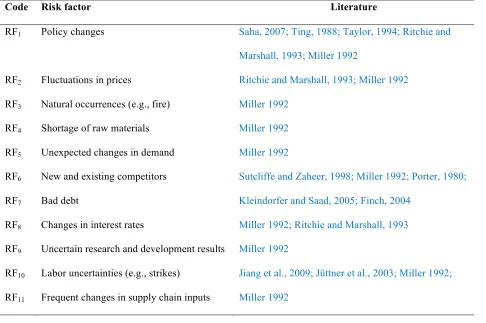
Taylor, 1994; Ritchie and Marshall, 1993; Miller 1992; Ting, 1988). In developing the SC risk typology, Rao and Goldsby (2009) took into account the general risk literature (i.e. both risk management literature in relation to SCM and those outside SCRM) to identify events that initiate risks. That is, the development of the typology was based on an in-depth review of the risk literature, that synthesizes the extant literature in various areas of research, such as strategy and international business (Miller, 1992; Oxelheim and Wihlborg, 1987), operations management (Wu et al., 2006), risk management (Ritchie and Marshall, 1993) and SCM itself (Manuj and Mentzer, 2008; Zsidsin et al., 2004; Aloini et al., 2012). Given the comprehensiveness of Rao and Goldsby’s (2009) literature review, it would be inappropriate to repeat similar details here and hence, their work can be adopted and tested in a new context (i.e. construction). Such analysis will provide valuable insights for researchers and practitioners who are interested in construction SCM. Hence, 11 risk factors (Table 1) that may suit construction SC in the Ghanaian setting were identified.
<Insert Table 1 about here>
RESEARCH METHODOLOGY
12
questionnaire explained relevant definitions, provided contact details and clarified the study’s objectives. The questionnaire itself comprised of two sections: ‘Section A’ requested background information of the respondents, whereas in ‘Section B’, respondents were asked to express their views on the criticality of risks (as defined in Table 1) in their SCM systems, based on a five-point Likert item rating (where 1 represented ‘not critical’, 3 represented ‘neutral’, and 5 represented ‘very critical’). With the provision of a qualitative text box, respondents were given the opportunity to express their views on extra risk factors, if any.
13
2015. As an incentive to encourage higher response rate and participation, respondents were promised a summary of the findings upon completion of the research.
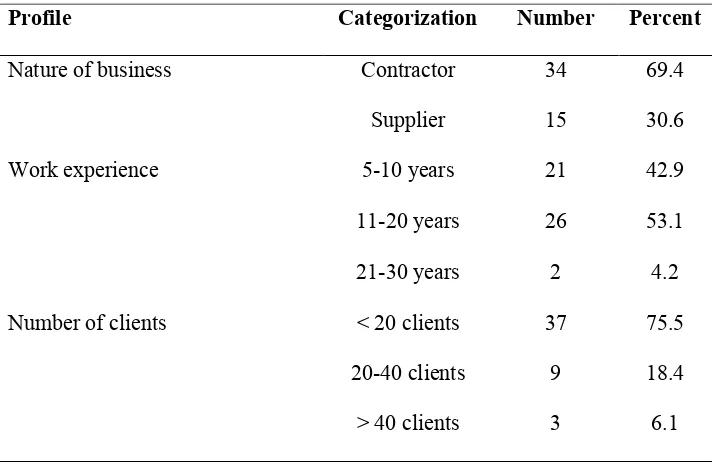
Table 2 summarizes the profile of the respondents and it can be determined that 69.4% of the respondents were contractors and the rest were suppliers – both of which are important players within the construction SC (Vrijhoef and Koskela, 2000). Regarding experience, a majority of respondents (53.1%) had 11-20 years of working experience in the construction industry but 75.5% work with less than 20 clients. The respondents’ profiles illustrate that they had accrued sufficient experience of working in the industry (a subjective observation) and therefore, data collected from them should be reliable and representative.
<Insert Table 2 about here>
Method of data analysis
14
Research has shown that though data obtained from Likert item responses are recognized as ordinal data, they could be analyzed using parametric data analysis techniques such as the t-test (Zhao et al., 2016; Hwang et al., 2014; Binder, 1984) and two-sample Kolmogorov-Smirnov (K-S) test (Shi et al., 2013; Lam et al., 2009). Nunnully (1975) argued that parametric statistical analysis results from ordinal data are reasonably reliable. This is because the level of flexibility and power allowed by parametric techniques can offset the few biases that they may entail (O’Brien, 1979; Allan, 1976). Parametric techniques allow easier interpretations and conclusions to provide more relevant information (Allen and Seaman, 2007). For these reasons, the one-sample t-test was adopted for data analysis. Moreover, since it is difficult, if not impossible, to just assume, with a fair degree of sureness, the statistical distribution of responses from different groups of stakeholders, the K-S test was used to investigate any differences between ratings given by the two groups of respondents for a particular risk factor (Siegel and Castellan, 1998). The study also used the descriptive analysis method mean analysis technique. Aside from the simplicity in terms of data presentation and interpretation from mean analysis, this method is suitable for investigating the importance and criticality of survey factors (Lam et al., 2009). For this specific work, the mean analysis and the one-sample t-test were used in this study to identify critical risks in the construction SC. The mean scores of the risk factors were computed and ranked, such that the higher the rank, the more critical the risk.
SURVEY RESULTS AND DISCUSSION
15
responses, representing a response rate of 59.8%. Many researchers (Ling et al., 2009; Ott and Longnecker, 2001) suggest that a minimum sample size of 30 is appropriate for statistical analysis, as it is considered representative of any group. Thus, the response rate obtained in this study was considered valid.
Risks in the construction supply chain
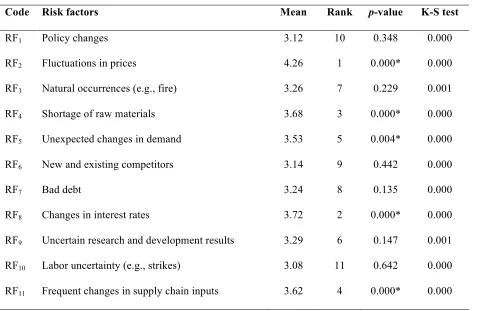
Table 3 summarizes the results of mean ranking analysis, one-sample t-test, and K-S tests among the respondents for the risks in the Ghanaian construction SC. The one-sample t-test was performed to test the means of all the responses to the risks, that is, to check whether the respondents’ ratings for a particular risk were significant. The two-sample K-S test’s results indicate that there was no statistical difference between the perceptions toward the potential risks in the construction SC (i.e. significance values being equal to or less than a threshold of 0.05) among the two groups of respondents. For research rigor, only risk factors with mean scores above 3.00 and p-values less than 0.05 are treated as critical. Consequently, as shown in Table 3, five risks (i.e. i) fluctuations in prices; ii) changes in interest rates; iii) shortage of materials; iv)
frequent changes in supply chain inputs; and v) unexpected changes in demand) received significant ratings from the professionals.
Fluctuations in prices (RF2) is ranked as the most critical risk (with a total mean score of 4.26),
16
of goods and services (general price inflation), and movements in the relative prices of inputs (such as labor and raw materials). Indeed, in a construction project, price fluctuations have a significant detrimental impact upon overall project cost and thereby jeopardize project success. Hence, it is not surprising to find that in a developing and an economically unstable country like Ghana, where frequent changes in prices of goods and services is a common trend, stakeholders significantly perceive price fluctuations as a critical risk in the construction SC. This highlights the need for construction organizations to incorporate price fluctuations into their risk assessment framework.
Miller (1992) stated that changes in interest rates (e.g. a very high increment in interest rates within a short period of time) is a major risk in SCs. In this study, changes in interest rates (RF8)
was ranked as the second most critical risk (mean = 3.72), thus underscoring the perceived importance of this risk factor. This could be due to the fact that in Ghana, almost every construction project is pre-financed by bank loans, which are affected by interest rates. Thus, because interest rates affect the amount of interest paid on bank loans, interest rate increases have an adverse and destabilizing impact upon contracts and specifically company liquidity. The high rank of this factor was also in line with the high rank of RF2 (i.e. fluctuations in prices)
because they are all macroeconomic issues that can have direct cost implications on the success of the SC. It can therefore be assumed that macroeconomic uncertainties (Miller, 1992) present the greatest sources of risk.
Shortage of raw materials (RF4) was ranked third (mean = 3.68), implying that stakeholders
17
is because a dearth of materials halts project progress and causes significant project delays. This risk is very likely to be greatest when there is a single organized group or supplier responsible for the supply of critical raw materials to the firm (Miller, 1992), which is often the case in the Ghanaian construction environment. Normally, firms prefer to select specific suppliers based upon past experience with the supplier or because of personal relationships – this subjects the SC to the risk of the unique supply.
A fourth critical risk in the construction SC is frequent changes in supply chain inputs (RF11)
(mean = 3.62). This risk is linked to changes in quality of the SC inputs and it is believed to have an impact on the overall operations of the SC (Ritchie and Marshall, 1993; Miller, 1992).
Unexpected changes in demand (RF5) was ranked as the fifth critical risk in the construction SC (mean = 3.53). This risk is a type of product market uncertainty that affects the performance of SCs (Miller, 1992) and relates to the predictability of the demand for a product. Rao and Goldsby (2009) argued that this shift may occur due to the availability of substitute products or due to change in customer’s taste. This risk can affect contractors, especially firms offering high cost products, in the sense that they would have to write off inventory when demand slows down (Ritchie and Brindley, 2004). On the contrary, one key issue is the low rank of policy changes
(RF1 - ranked tenth). This risk has been found to be a non-critical risk in the Ghanaian
18 IMPLICATIONS AND CONTRIBUTIONS
It has been argued that risk management is an important organizational function (Giannakis et al., 2004; Mallman, 1996). Being able to identify and understand the potential risks in the SC is the first and most important step for SC risk managers. The paper has adopted and tested risk factors that have been reported within the wider literature. A major contribution of this study, is that it provides information that may be useful for the identification of potential risks in the Ghanaian construction SC. From a pragmatic perspective, construction SCRM efforts can better focus upon the risk factors that show the highest possibility of affecting the SC (i.e. the most critical risks identified in this paper). Management must recognize and quantify these risks, together with their overall impacts if productivity and performance (and ultimately profitability) is to be augmented. The study contributes to the risk management literature in two aspects. First, it adds to the so far limited literature on construction SCRM; and second, it expands the generic literature on SCRM. It is anticipated that this study will offer a basis for developing the knowledge further, by assessing the actual impacts of the risks on the Ghanaian construction SC and and extending the work to other developing countries. However, future work is required to validate the findings of this study.
CONCLUSIONS
19
Eleven risk factors were adopted from the literature for designing the survey questionnaire. It was found that five out of the eleven risks are deemed critical, namely: i) fluctuations in prices, ii) changes in interest rates, iii) shortage of materials, iv) frequent changes in supply chain inputs; and v) unexpected changes in demand. Non-critical risks were found to include policy changes. This could be because government policies in Ghana have very little to do with construction activities.
This study has several limitations that the future research would seek to address. Though studies on construction SC risks are lacking in Ghana, considering only 11 risk factors is not enough to reflect the overall risk conditions in the construction SC. Future research is recommended to incorporate more relevant risk factors (including construction specific factors) to broaden the understanding on them. Also, the relatively small sample size is a limitation of this study; albeit such was valid to conduct statistical analysis. A wider range of professional disciplines, including architectural firms, consulting firms, developers and owners (and from other developing countries) should also be involved in future work.
It is believed that the information provided in this paper will allow the reader to identify important risks in the construction SC and thereby facilitate the risk management process. In line with the purpose of this study (i.e. to test general SC risks in the construction context), most risk factors that are more specific to construction projects (see, for example, Aloini et al., 2012) have been reserved for future research.
20
We wish to acknowledge Mr. Ntiforo Kofi Afriyie and Mr. Acheamfour Victor Karikari for the invaluable contribution to the research.
REFERENCES
Akkermans, H., Bogerd, P., and Vos, B. (1999) Virtuous and Vicious Cycles on the Road Towards International Supply Chain Management. International Journal of Operations and Production Management, Vol. 11, No. 5/6, pp. 565-82.
Albaloushi, H., and Skitmore, M. (2008) Supply Chain Management in the UAE Construction
Industry. International Journal of Construction Management, Vol. 8, No. 1, pp. 53-71.
Ali, G. (2014) Supply Chain Management in Construction Industry. Advances in Management,
Vol. 7, No. 8, p. 17.
Allan, G. B. (1976) Ordinal-scaled Variables and Multivariate Analysis: Comment on Hawkes. American Journal of Sociology, pp. 1498-1500.
Allen, I. E., & Seaman, C. A. (2007) Likert Scales and Data Analyses. Quality Progress, Vol. 40, No. 7, pp. 64.
Aloini, D., Dulmin, R., Mininno, V., and Ponticelli, S. (2012) Supply Chain Management: A
Review of Implementation Risks in the Construction Industry. Business Process
Management Journal, Vol. 18, No. 5, pp. 735-761.
Arrow, K. (1970) Essays in the Theory of Risk-Bearing, Markham, Amsterdam.
Ashish, A., and Ravi, S. (2002) Analyzing Alternatives for Improvement in Supply Chain Performance. Work Study, Vol. 51, pp. 32-37.
Bernstein, P. (1996) Against the Gods – The Remarkable Story of Risk. Wiley, Chichester.
21
Brindley, C.S. (Ed.). (2004) Supply Chain Risk, Ashgate Publishing, Aldershot.
Briscoe, G., Dainty, A. R., and Millett, S. (2001) Construction Supply Chain Partnerships: Skills,
Knowledge and Attitudinal Requirements. European Journal of Purchasing and Supply
Management, Vol. 7, No. 4, pp. 243-255.
Chan, F. T. S., and Qi, H. J. (2003) An Innovative Performance Measurement for Supply Chain Management. Supply Chain Management: an International Journal, Vol. 8, No. 3, pp. 209-23.
Christopher, M. (1992) Logistics and Supply Chain Management: Strategies for Reducing Costs and Improving Service. Pitman Publishing, London.
Christopher, M., and Lee, H. (2004) Mitigating Supply Chain Risk Through Improved
Confidence. International Journal of Physical Distribution and Logistics Management,
Vol. 34, No. 5, pp. 388-396.
Christopher, M.G. (2002) Supply Chain Vulnerability, report for Department of Transport, Local Government and the Regions, Cranfield University, Cranfield.
Finch, P. (2004) Supply Chain Risk Management. Supply Chain Management – an International Journal, Vol. 9 No. 2, pp. 183-96.
Frosdick, S. (1997) The Techniques of Risk Analysis are Insufficient in Themselves. Disaster Prevention and Management: An International Journal, Vol. 6, No. 3, pp. 165-177.
Giannakis, M., Croom, S., and Slack, N. (2004) Supply Chain Paradigms, in New, S. and
Westbrook, R. (Eds), Understanding Supply Chains, Oxford University Press, Oxford,
22
Hwang, B. G., Zhao, X., and Goh, K. J. (2014). Investigating the Client-related Rework in Building Projects: The Case of Singapore. International Journal of Project Management, Vol. 32, No. 4, pp. 698-708.
Jiang, B., Baker, R. C., and Frazier, G. V. (2009) An Analysis of Job Dissatisfaction and Turnover to Reduce Global Supply Chain Risk: Evidence from China. Journal of Operations Management, Vol. 27, No. 2, pp. 169-184.
Jüttner, U. (2005) Supply Chain Risk Management: Understanding the Business Requirements from a Practitioner Perspective. The International Journal of Logistics Management, Vol. 16, No. 1, pp. 120-141.
Jüttner, U., Peck, H., and Christopher, M. (2003) Supply Chain Risk Management: Outlining an Agenda for Future Research. International Journal of Logistics: Research and Applications, Vol. 6, No. 4, pp. 197-210.
Kahneman, D., and Tversky, A. (1979) Prospect Theory: An Analysis of Decision Under Risk.
Econometrica: Journal of the Econometric Society, pp. 263-291.
Khan, O., and Burnes, B. (2007) Risk and Supply Chain Management: Creating a Research
Agenda. The International Journal of Logistics Management, Vol. 18, No. 2, pp. 197-216.
Kleindorfer, P. R., and Saad, G. H. (2005) Managing Disruption Risks in Supply Chains. Production and Operations Management, Vol. 14, No. 1, pp. 53-68.
23
Kumar, V., and Viswanadham, N. (2007) A CBR-based Decision Support System Framework for Construction Supply Chain Risk Management. In Automation Science and Engineering, 2007. CASE 2007. IEEE International Conference on (pp. 980-985). IEEE.
Lam, P. T., Chan, E. H., Chau, C. K., Poon, C. S., and Chun, K. P. (2009) Integrating Green
Specifications in Construction and Overcoming Barriers in their Use. Journal of
Professional Issues in Engineering Education and Practice, Vol. 135, No. 4, pp. 142-152.
Ling, F. Y. Y., Low, S. P., Wang, S. Q., and Lim, H. H. (2009) Key Project Management Practices Affecting Singaporean Firms’ Project Performance in China. International Journal of Project Management, Vol. 27, No. 1, pp. 59-71.
Long, N. D., Ogunlana, S., Quang, T., and Lam, K. C. (2004) Large Construction Projects in Developing Countries: A Case Study from Vietnam. International Journal of project management, Vol. 22, No. 7, pp. 553-561.
Lowrance, W.W. (1980) The Nature of Risk, in Schwing, R.C. and Albers, W.A. (Eds), How
Safe is Safe Enough? Plenum Press, New York, NY.
Mallman, C. (1996). Risk and Organizational Behaviour: A Research Model. Disaster Prevention
and Management, Vol. 5 No. 2, pp. 12-26.
Manuj, I., and Mentzer, J.T. (2008) Global Supply Chain Risk Management. Journal of Business Logistics, Vol. 29 No. 1, pp. 133-56.
March, J. G., and Shapira, Z. (1987) Managerial Perspectives on Risk and Risk Taking.
Management Science, Vol. 33, No. 11, pp. 1404-1418.
McGuffog, T., and Wadsley, N. (1999) The General Principles of Value Chain Management.
24
Miller, K. D. (1992) A Framework for Integrated Risk Management in International Business. Journal of International Business Studies, Vol. 23, No. 2, pp. 311-331.
Muya, M., Price, A. D. F., and Thorpe, A. (1999) Contractor's Supplier Management. In
Proceedings of CIB W55165 Joint Triennial Symposium, Customer Satisfaction: A Focus
for Research and Practice in Construction (pp. 5-10).
Norrman, A., and Lindroth, R. (2004) Categorization of Supply Chain Risk and Risk Management. Supply Chain Risk, pp. 14-27.
Nunnally, J. C. (1975) The Study of Change in Evaluation Research: Principles Concerning Measurement, Experimental Design and Analysis. Handbook of Evaluation Research, Vol. 1, pp. 101-137.
Nunnally, J. C. (1978) Psychometric Theory, McGraw-Hill, New York.
O'Brien, R. M. (1979) The Use of Pearson's with Ordinal Data. American Sociological Review, pp. 851-857.
O’Brien, W. J. (1999) Construction Supply-chain Management: A Vision for Advanced Coordination, Costing and Control. In NSF Berkeley-Stanford Construction Research Workshop, Stanford, California.
Ott, R. L., and Longnecker, M. (2001) Statistical Methods and Data Analysis Duxbury Publishing Company. Pacific Grove, CA.
Oxelheim, L., and Wihlborg, G.C. (1987) Macroeconomic Uncertainty: International Risks & Opportunities for the Corporation. John Wiley and Sons, New York, NY.
25
Porter, M.E. (1980) Competitive Strategy: Techniques for Analyzing Industries and Competitors. The Free Press, New York, NY.
Rao, S., and Goldsby, T. J. (2009) Supply Chain Risks: A Review and Typology. The
International Journal of Logistics Management, Vol. 20, No. 1, pp. 97-123.
Ritchie, B., and Brindley, C. (2007) Supply Chain Risk Management and Performance: A Guiding Framework for Future Development. International Journal of Operations and Production Management, Vol. 27, No. 3, pp. 303-322.
Ritchie, B., and Marshall, D. (1993) Business Risk Management, Chapman & Hall, London Ritchie, R.L., and Brindley, C. S. (2004) Risk Characteristics of the Supply Chain – A
Contingency Framework, in Brindley, C.S. (Ed.), Supply Chain Risk, Ashgate, Aldershot.
Rowe, W.D. (1980) Risk Assessment: Approaches and Methods, in Conrad, J. (Ed.), Society,
Technology and Risk Assessment, Academic Press, London.
Saad, M., Jones, M., and James, P. (2002) A Review of the Progress Towards the Adoption of
Supply Chain Management (SCM) Relationships in Construction. European Journal of
Purchasing and Supply Management, Vol. 8, No. 3, pp. 173-183.
Saha, P.M. (2007) Asia-Pacific Supply Chain Management: Weak Links in Bangladesh, The Ethical Corporation Magazine, available at: www.ethicalcorp.com/content. asp?ContentID¼4865.
26
Seshadri, S., and Subrahmanyam, M. (2005) Introduction to the Special Issue on Risk Management in Operations. Production and Operations Management, Vol. 14, No. 1, pp 1-4.
Sheffi, Y. (2005) The Resilient Enterprise: Overcoming Vulnerability for Competitive Advantage, MIT Press, Cambridge, MA.
Shi, Q., Zuo, J., Huang, R., Huang, J., and Pullen, S. (2013) Identifying the Critical Factors for Green Construction – An Empirical Study in China. Habitat International, Vol. 40, pp. 1-8.
Shingo, S. (1988) Non-Stock Production. Productivity Press, Cambridge.
Siegel, S., and Castellan, N. J. (1988) Nonparametric Statistics for the Behavioural Sciences (2nd ed.). New York: McGraw-Hill.
Sunil, C., adn Peter, M. (2004) Supply Chain Management: Strategy, Planning and Operation. New Jersey, Pearson education International.
Sutcliffe, K. M., and Zaheer, A. (1998) Uncertainty in the Transaction Environment: An Empirical Test. Strategic Management Journal, Vol. 19, No. 1, pp. 1-23.
Tah, J. H. M., and Carr, V. (2001) Towards a Framework for Project Risk Knowledge Management in the Construction Supply Chain. Advances in Engineering Software, Vol. 32, No. 10, pp. 835-846.
Tang, C. S. (2006) Perspectives in Supply Chain Risk Management. International Journal of
Production Economics, Vol. 103, No. 2, pp. 451-488.
27
Taylor, J., and Bjornsson, H. (1999) Construction Supply Chain Improvements Through Internet Pooled Procurement. In Proceedings of IGLC (Vol. 7, pp. 26-28).
Thaler, R. (1985) Mental Accounting and Consumer Choice. Marketing Science, Vol. 4, No. 3,
pp. 199-214.
Ting, W. (1988) Multinational Risk Assessment and Management, Greenwood, Westport, CT. Tommelein, I. D., Akel, N., and Boyers, J. C. (2003) Capital Projects Supply Chain
Management: SC Tactics of a Supplier Organization. In American Society of Civil
Engineers, Construction Research Congress In Construction, Wind of Change:
Integration and Innovation.
Trkman, P., Stemberger, M.I., Jaklic, J., and Grosnik, A. (2007) Process Approach to Supply
Chain Management. Supply Chain Management: an International Journal, Vol. 12, No. 2,
pp 116-29.
Turban, E., Mclean, E., and Wetherbe, J. (2004) Information Technology for Management, 4th
ed., Wiley, New York, NY.
Vrijhoef, R., and Koskela, L. (2000) The Four Roles of Supply Chain Management in
Construction. European Journal of Purchasing and Supply Management, Vol. 6, No. 3,
pp. 169-178.
Wagner, S. M., and Bode, C. (2008) An Empirical Examination of Supply Chain Performance Along Several Dimensions of Risk. Journal of Business Logistics, Vol. 29, No. 1, pp. 307-325.
28
Wong, A. (1999) Total Quality Management in the Construction Industry in Hong Kong: A
Supply Chain Management Perspective. Total Quality Management, Vol. 10, No. 2, pp.
199-208.
Wu, T., Blackhurst, J., and Chidambaram, V. (2006) A Model for Inbound Supply Risk Analysis. Computers in Industry, Vol. 57, No. 4, pp. 350-365.
Zhao, X., Hwang, B. G., and Lee, H. N. (2016) Identifying Critical Leadership Styles of Project Managers for Green Building Projects. International Journal of Construction Management, pp. 1-11.
29
Table 1: Eleven potentialrisks in the construction supply chain.
Code Risk factor Literature
RF1 Policy changes Saha, 2007; Ting, 1988; Taylor, 1994; Ritchie and Marshall, 1993; Miller 1992
RF2 Fluctuations in prices Ritchie and Marshall, 1993; Miller 1992
RF3 Natural occurrences (e.g., fire) Miller 1992
RF4 Shortage of raw materials Miller 1992
RF5 Unexpected changes in demand Miller 1992
RF6 New and existing competitors Sutcliffe and Zaheer, 1998; Miller 1992; Porter, 1980;
RF7 Bad debt Kleindorfer and Saad, 2005; Finch, 2004
RF8 Changes in interest rates Miller 1992; Ritchie and Marshall, 1993
RF9 Uncertain research and development results Miller 1992
RF10 Labor uncertainties (e.g., strikes) Jiang et al., 2009; Jüttner et al., 2003; Miller 1992;
30 Table 2: Profiles of respondents.
Profile Categorization Number Percent
Nature of business Contractor 34 69.4
Supplier 15 30.6
Work experience 5-10 years 21 42.9
11-20 years 26 53.1
21-30 years 2 4.2
Number of clients < 20 clients 37 75.5
20-40 clients 9 18.4
31 Table 3: Risks in the construction supply chain.
Code Risk factors Mean Rank p-value K-S test
RF1 Policy changes 3.12 10 0.348 0.000
RF2 Fluctuations in prices 4.26 1 0.000* 0.000
RF3 Natural occurrences (e.g., fire) 3.26 7 0.229 0.001
RF4 Shortage of raw materials 3.68 3 0.000* 0.000
RF5 Unexpected changes in demand 3.53 5 0.004* 0.000
RF6 New and existing competitors 3.14 9 0.442 0.000
RF7 Bad debt 3.24 8 0.135 0.000
RF8 Changes in interest rates 3.72 2 0.000* 0.000
RF9 Uncertain research and development results 3.29 6 0.147 0.001
RF10 Labor uncertainty (e.g., strikes) 3.08 11 0.642 0.000
RF11 Frequent changes in supply chain inputs 3.62 4 0.000* 0.000