288
Automatic Text Summarization For Bengali
Language Including Grammatical Analysis
Ratul Sikder, Md. Monowar Hossain, F.M. Rahat Hasan Robi
Abstract: Text summarization is a process of summarize any text or document. There are many summarization tools for English language. There are also a few works for automated Bengali text or document summarization. The tools are seemed not much appropriate from application point of view. Summarization is categorized in two ways: extractive and abstractive approach. Most of the summarizer methods for Bengali text summarization are extractive. Those proposed methods can‘t extract whole theme of a text document. Reader can be satisfied about summary if it gives full important information of input document. Our proposed method introduces an enhanced summarization method that can improved the quality of outputs. The proposed method is modeled combining a set mathematical rules and Bengali grammatical rules. This method also solves many problems of extractive summarizer and it also introduces the path of abstractive summarization methods. Although the method has been developed for Bengali language, it is a generic and platform independent approach and can flexible be extended for other languages.
Index Terms: Bengali text summarization, Term frequency, Sentence scoring, Sentence ranking, Cosine similarity, Sentence relevancy, Sentence joining, Bengali grammar, Abstractive Summarization,NLP.
————————————————————
1
INTRODUCTION
Day by day the amount of information is increasing with the development of the technology, lifestyle of human and other main factor of social changes. So, to learn the information of all sectors it is hard to read whole text of topics with time limitation. Automated summarization process of text is only way to know about the topics with small length of texts. There are many established summarization methods for English language. But for the Bengali language the number is too low and not very effective. There are two types of summarization process. One is extractive and another is abstractive. Extractive method extracts sentences from document according to their rank calculated by their score. Abstractive method generates sentences like human being. Most of the Bengali summarization methods follow extractive approach. So, extracted summary expresses inconsistent meaning and sometime extraction makes loss of data. Those methods are also unable to generate a simple sentence from related sequenced sentences. Extractive summarization is favorite than abstractive for its low complexity. The problems are happened when the language like Bengali. For structure of Bengali sentence, extracted summary is redundant. If we use grammatical rules along with mathematical rules to generate sentence, it can reduce this redundancy problem in summary. On the other hand, generating new and simple sentence from two or more related sentences can able to reduce the length of summary.
This simplification of sentences using grammar also creates a path of abstractive summarization. Summary that doesn‘t contain full theme losses its value and usefulness. So, it is mandatory to fix those problems to get perfect summary. Our enhanced method has been developed focusing on those problems. Bengali is one of the richest languages in structural concern. A single sentence can be formed in different ways. Also same sentence can express different meaning in different situations. For perfect summary, we have to face complex processing. Besides, grammatical structure of Bengali language is also complex. We have to collect a lot of data set and have to create more than one dictionary sets for better analysis and batter output. This construction is more complex for Bengali language than others. Joining sentences using grammar also a hard process. Our proposed method is supposed to solve all those described problems. Firstly, a summary is generated using statistical and mathematical approaches. Then using grammatical approach there generated final summary. We have defined grammar using few automation processes. The summary is generated from them. Many researchers had contributed in this area. Their proposed works primarily in English language. Methods for Bengali text summarizer cannot generate precise summary. In those methods Summary only extract by the rank of sentence. So, it cannot reflect the total view of whole document. But our proposed method gives priority to maintain whole theme of document in summary and sentences construction structures. So, summary can mirror the whole document in short length with consistent meaning. The rest of the paper is explained as follows: In section 2, related works is discussed, which contains the previous research summary of Bengali Text summarization done by other researchers. In section 3, described about proposed new extractive approach [4] [5] for Bengali text with quantitative assessments is discussed. Lastly, section 4 and 5 details about the experimental results with discussion and conclusion respectively.
2
RELATED WORK
Many researchers had worked on summarization. They had released methods that gives the beat result than before works. Till now, many extraction based techniques have been published. Our method is the first attempt to expand and introducing the new idea of extraction method including _______________________________
Ratul Sikder, Dept. of CSE, Bangabandhu Sheikh Mujibur Rahman Science and Technology University, Goplalganj, Bangladesh
Md. Monowar Hossain, Lecturer, Department of CSE, Bangabandhu Sheikh Mujibur Rahman Science and Technology University, Gopalganj, Bangladesh,
F.M. Rahat Hasan Robi, Lecturer, Department of CSE, Bangabandhu Sheikh Mujibur Rahman Science and Technology University, Gopalganj, Bangladesh,
289 Bengali grammatical view. Rafel, et al. told all the basic
requirements of extractive summarizer. That method has three features: Text analysis, Sentence scoring and summarizing [1]. There were told about fifteen sentence scoring method. Those methods were mainly for news, blogs and different articles. Every word was scored in six different ways. In that case, word co-occurrences were analyzed using n-gram based process [8] and lexical similarities were identified. There also include some analysis to get sentences score with traditional procedure. [2] present multi document summarization method. They described about extractive summarization where the score computation and relevancy calculation task are proved to be least complex as compared to existing approaches. TextRank method first introduces in [11]. This method is graph based model for text processing. Their method has described two innovative methods for keyword and sentence extraction. Lexrank is a stochastic graph based method for computing relative importance of textual units for NLP. The system described computing sentence importance based on vector concept [10]. In [4][5], there is talked about abstractive method. [4] gives a review on abstractive summary. There is talked about the existing methods and important terms. Development of Treebank for the Abstract Meaning Representation (AMR) was described in [5]. The model of our proposed system is motivated [6][10], but our method differs in the following ways:
Instead of generate final summary, there were generate a primary summary using sentence ranking method.
We use standard quantity of Bengali grammatical rules for sentences transformation.
We also work with structure of passages and sentences of Bangla grammar.
In this paper, we proposed a complete and improved method for Bengali text summarizer than other existing systems. Redundancy, relevancy and sentences joining are the most imperative features for a good summary. The main contributions of the paper are: sentence relevancy, sentences meaning analysis, sentences joining, eliminating odd sentences. This proposed method gives more care to meaning of sentences than sentence score for producing a good summary of Bengali text.
3
PROPOSED METHOD
Text summarizer generates summary of a text following some mathematical theory and graph. Our proposed method also follows those including grammatical rules. The method consists of three different steps. Those can be defined by following: (i) Preprocessing –This step break the passage into sets of sentences and words. Unnecessary words, punctuations and stop word removed here for further analysis. In short, it can be called elimination round of Bengali language processing. (ii) Sentence Ranking – This portion consists of operations finding sentences ranking. After those two steps there generates a primary summary according to sentences ranking and position. To make the test of abstraction in summary, there is another analysis part of the summary generation; (iii) Generate summary - This portion defines the ways of constructing new sentences from related consecutive sentences. This is also the final step of summary generation. There will generate a
passage containing old and regenerated sentences. The final output will generate after rearranging all sentences using their appropriate position.
3.1 Preprocessing
Bengali language is full of complex grammatical structure for sentences, words and passage. Words used in a passage with suffix, prefix or with other word‘s variants. Sentences can be formed in different structure. So, sentences contain many words those have less impact on sentences meaning. Those are called stop word. There is much punctuation in Bengali language. In the preprocessing task, those punctuation, stop words and suffixes – prefixes will removed for next analysis advantages. For the analysis, the whole document should be preprocessed first. Briefly preprocessing steps are described in rest of the paper.
3.1.1 Text and Word Tokenization
The texts of a Bengali document may be in structure or not. For working purpose, the sentences and words should be tokenized. Sentences are tokenized with double/single quotation after finding sentences completing punctuations. Also sentences make a set. The elements number of the set is the total number of sentences. Words are tokenizes with quotation finding white space of a word‘s end. There also a group of sets of tokenized words for each sentences. Sets of tokenized words helpful for eliminate unused portions. On the other side, tokenized sentences are used for sentence scoring and other analyzing processes.
3.1.2 Punctuations Removal
Punctuations can hamper the word scoring process. We know that Bengali language has more than eight punctuation marks. So, punctuations are removed earlier. Then method run its next automated functions.
3.1.3 Stop Words Removal
In computing, stop words are words which are filtered out before or after processing of natural language data (text)[3]. Briefly, stop words means the common and the mostly used words. Stop words are chosen for a certain purpose. In Bengali language, words those are used only for structural purpose are considered as stop words. So, stop words are unnecessary elements for scoring words and sentences. Stop words elimination will reduce the analysis complexity. So, stop words are eliminated. We collect stop words from [7]. Some example of stops words:
3.1.4. Stemming
290 while computing frequency of a term. After stemming, the
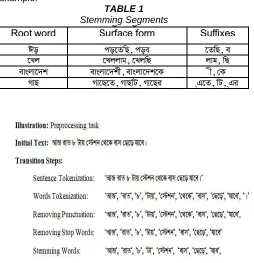
word is divided in two parts: root and suffix. Root part is main part of word meaning. The proposed method only works with stem (root) part.
Example:
TABLE 1
Stemming Segments
Figure 1: Illustration of preprocessing steps
3.2 Sentence Ranking
After an input document is formatted and stemmed, it is time to work with the sentences. This part is the most important part of the automated summarization process. The processed summary will be ready to generate after this analysis. Some steps of sentence analysis are described rest of the part.
3.2.1 Word Score Generation
In this section, there is calculates score for all words. This is called term frequency (TF), appearances time of distinct words. Term frequency is an important term for a passage. The most appearance word is the most important for the passage. When calculation of term frequency is completed, next part of the method can be executed.
3.2.2 Sentence Score Generation
Here the pre-counted TF values are used. The score of a sentence is the sum of all frequencies of words belongs to the sentence [6].
∑
Where, i= 1,…, n ,n is the number of sentences.
With equation (1), score of the big length sentences is higher than other. In Bengali language, smaller sentence may be important also. To solve this problem, we can sort
all words according to their frequencies in descending order. Then we chose a variable T indicates the total number of the words of document. The function of sentence score[6] like below:
∑
Here, = position of word in sorted list. And i=1, …….,n indicates sentences sequence from first to last position; n = total number of sentences in corpus. We find the score of all sentences using equation (3).
3.2.3 Sentences Relevancy
The similar sentences of summary can make redundancy in meaning. The similarities between sentences are counted by cosine similarity operation. Here, every sentences of primary summary are suppose the vectors. Similarity between two sentences and counted with following equation [6].
| || |
In the summarization method, sentence will be eliminated that has 95% or more similarity with one or more high scored sentences.
TABLE 2
Sentences similarity values
S1 S2 S3 S4 S5
S1 1 0.578 0.875 0.955 0.348
S2 0.578 1 0.052 0.663 0.257
S3 0.875 0.052 1 0.000 0.862
S4 0.955 0.663 0.000 1 0.037
S5 0.348 0.257 0.862 0.037 1
3.2.4 Sentence Position
Sentences position is also a big factor for Bengali language. Without proper positioning, meaning of a passage will be inconsistence. Position value of a sentence is counted in such way that the first sentence has the highest score and the value decreasing for next sentences to end. The last sentence has the lowest value. The formula for the position score [9]:
‗i‘ indicates the initial position of sentences of whole document.
3.2.5 Primary Summary Generation
A primary summary generates according to the score and position of the sentences. Here the system extracts sentences with 70% or more of max score. According to Bengali Grammar the summary of a Bengali passage will be 30-35% in length of main passage.
3.3 Generate Summary
291 sentences. Finally, rearranging all new generated
sentences we get final output.
3.3.1 POS tagging
Here sentences of primary summary are tokenized first. The tokenized every words. Then classify every words with their parts of speech. After this steps there will generate a list of words and corresponding parts of speech.
3.3.2 Defining Grammar
This is the complex and important part of grammatical analysis. We defines some common sentence simplification rules of Bengali language. We collect rules from[13]. Besides those rules, we define sentences joining rules. Those rules based on ways human do for sentences joining/linking.
3.3.3 Sentences Joining
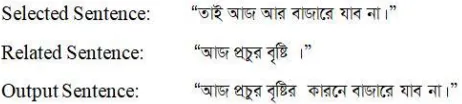
This is the final step of summarization method. Firstly, find the related nearest sentences of each single sentence of primary summary from the main document. Then find the structures of all related sentences of a sentence of primary summary . Finally, there will generate simplified sentences for each sentences and place in its appropriate position . This process is happened for all sentences of primary summary. For example, the sentences contain conjunctions like are related to one or more sentences before it. For example,
Here the sentence is related to sentences before it. When primary summary contain such sentence, the function back to the main document and takes related sentences before it. Then combine two or more sentences using suitable rule and generate a simple meaningful sentence.
Example:
Figure 2: Illustration of sentence joining using simplification
After described all functions have been completed, there generates a perfect summary that can mirror the input document.
4 Results
The main goal of the method generates a summary that is more precise and contain total think of input document. Here are taken six documents, different in topic. We take a few standard human generated summaries of the six documents. And then compare the system generated summary with manual summary. The bar diagram of the experiments is:
Figure 3: Accuracy text result of manual generated and system generated summary.
The experimental result is calculated using Python programming language and NLTK (Natural language toolkit).
Example:
Original Text –
Human Generated Summary-
System Generated Summary-
5 CONCLUSION
292 for farther development in the extractive summarization
method. This method also helpful for developing abstractive summarization for Bengali language. Nonetheless there are lots of improvements required for an enhanced summarizer. English language is better for further development because of its easy structure of sentences. Abstractive summary is more perfect than extractive. Abstractive can reduce the length of the summary with perfect meaning advantage. The problem of making abstractive summarization method requires development in many areas. For the Bengali text, it is harder. We hope our work can indicate the path for abstractive method. We think hybrid approaches is the future of Bengali summarization. Furthermore, We wish for validate the proposed method for introducing generation of sentences taking grammatical help along with statistical and mathematical techniques. Moreover, as the methodology followed in this approach is generic and platform independent, it can be extended for other language as well as Bengali language.
REFERENCES
[1]. Rafael Ferreira et al. ―Assessing Sentence Scoring Techniques for Extractive Text Summarization‖, Elsevier Ltd., Expert Systems with Applications 40 (2013) 5755-5764.
[2]. Ani Nenkova, Kathleen McKeown , ―A survey of text summarization techniques‖, Springer Science+Business Media, LLC 2012
[3]. wikipedia.org/wiki/Stop_words.
[4]. Atif Khan and Naomie Salim, ―A Review on Abstractive Summarizati on Methods‖, Journal of Theoretical and Applied Information Technology, Vol. 59, No. 1, January 2014.
[5]. F. Liu, J. Flanigan, S. Thomson, N. Sadeh and N. A. Smith, ―Toward Abstractive Summarization Using Semantic Representations‖ (2015).
[6]. Md. Ashraf Uddin , Kazi Zakia Sultana, Md. AKibul Alam. ―A Multi-Document Text Summarization for Bengali Language.‖
[7]. Stop Words List. website of Forum for Information
Retrieval Evaluation (FIRE)
(https://www.isical.ac.in/~fire).
[8]. Mariòo, José B., Banchs, Rafael E., Crego, Josep M., Gispert, Adrià, Lambert, Patrik, Fonollosa, José A. R.,etal. (2006). N-gram-based machine translation. Computational Linguistics, 32(4), 527– 549.
[9]. K. Sarkar, ―Bengali text summarization by sentence extraction,‖ In Proceedings of International Conference on Business and Information Management (ICBIM-2012), NIT Durgapur, pp. 233 - 245, 2012.
[10]. Lin, Z., Kan, M. Y. ―Timestamped Graph:Evolutionary models of text for multidocument summarization‖, HLTNAACL 2007 Workshop on TextGraph-2, 2007
[11]. Mihalcea, R., Mani, P. T. ―TextRank: Bringing Order into Text‖, the Conference on Empirical Methods in Natural Language Processing, Barcelona, Spain, 2004
[12]. Amitava Das,Sivaji Bandyopadhyay, ―Morphological Stemming Cluster Identification for
Bangla‖, Jadavpur University, Kolkata 700032, India, 2011.