INTRODUCTION
The kinetics and mechanism of oxidation of chromium (VI) has been well studied, chromic acid being one of the most versatile available oxidizing agents, reacting with diverse substrates. Now a day the development of newer chromium
www.orientjchem.org
CODEN: OJCHEG 2011, Vol. 27, No. (4): Pg. 1735-1741
Est. 1984
An International Open Free Access, Peer Reviewed Research Journal
Kinetics of Oxidation of Secondary Alcohol by
Polymer-Supported Oxidizing reagent Chloramine-T.
VILAS Y. SONAWANE and NANDINI P. HILAGE*
Department of Chemistry, B.Raghunath Arts, Commerce and Science, College, Parbhani - 434 401(India).
*Department of Chemistry, Shivaji University, Kolhapur, Maharashtra. *Corresponding author: E-mail: Sonawane_vy @rediff mail.com
(Received: October 05, 2011; Accepted: November 18, 2011)
ABSTRACT
Requirements in the pharmaceutical industry for parallel synthesis of libraries for organic compounds has led to the development of simple, high yielding chemical transformations using polymer-supported reagents ,scavengers, catalysts and ‘catch and release’ reagents that are amenable to automation. After reactions using insoluble polymer-supported species a simple filtration process allows the product in solution to be recovered with high yield and purity. Recovery of the spent reagent retained on the support allows recycling, thus fulfilling the requirements of environmentally friendly chemistry.
The oxidation of 1- Phenylethanol has been studied spectrophotometrically to compare the polymer substrate supported reagent with a commercially available cross-linked polymeric reagent. The reagent supported on anion exchange resin was found to be more efficient in the oxidation reaction. The reagent is very easily separated from the reaction mixture and can be manually removed from the reaction mixture, which remains clear during and after the reaction. The kinetic of oxidation of 1-Phenylethanol with chromic acid supported on anion exchange resin like Chloramine T in 1, 4-dioxane has been studied. The reaction is found to be of zero order each in concentration of alcohol and oxidant. The oxidation product was confirmed by its derivative, UV and FT-IR and C13 NMR spectral, LC-ESI-MS studies. The effect of substituent’s on the rate of
oxidation and the activation parameters were determined with respect to slow step of mechanism. Key words: Kinetics, Oxidation, Polymer- supported chromic acid,
Oxidation, 1-Phenylethanol, Chloramine -T.
usually non toxic, where as Cr (VI) is a highly toxic for the metal to the
Organism .In the present investigation, we now report the oxidation of 1- Phenyl ethanol by polymer- supported chromic acid. Chloramine T is the strong anion exchange resin are supported on chromium (VI) oxide and used as an oxidant.
EXPERIMENTAL
Preparation of supported oxidizing agent The supported oxidizing agent was
prepared by reported method 8-10. The chloride form of Chloramine T [a macro reticular anion exchange resin] containing a quaternary ammonium group [20 x 10-3 kg] was stirred with a saturated solution of chromium trioxide [20 x 10-3 dm3] in water [120 x10 -3 dm3] for 45 min at room temperature using a
magnetic stirrer. The chloride ion was readily displaced and HCrO4- form of resin was obtained in 45 min. The resin was successively rinsed with water, acetone and THF and finally dried in vaccum at 363 K for 5h. The dried form of the resin was stored and used throughout the kinetic study.
P
N
P
+
N
+
HCrO
4
X
aq.
CrO
3[X = Cl] Polymer supported oxidizing agent
Determination of the capacity of chromate form of the polymeric reagent
The capacity of the chromate form of Chloramine T polymeric reagent was determined by iodometrically. The capacity of the chromate form of resin was 7.45 mmol/g and used for kinetic study throughout work. The loading was also determined by elemental nitrogen analysis and was found to be 7.35 mmol/g.
Chemicals and Reagents
All chemicals and reagents used were of Analytical Grade and double distilled water was used throughout the work.
Method of kinetics of oxidation procedure The reaction mixture for the kinetic run was prepared by mixing alcohol, oxidant and solvent. The reaction was carried out either constant stirring using magnetic stirrer and at a constant temperature 318 ±1 K. At different time interval, the reaction mixture was withdrawn using a micropipette. The aliquot thus withdrawn was taken in a stoppered test tube containing 10 x 10-3 dm3 of 1, 4-dioxane and subjected to spectral analysis. The absorbance of the product formed was measured using SL 159 UV-visible spectrophotometer. Duplicate kinetic runs
showed that the rate constants were reproducible to within ±5 %.
Induced polymerization test
Mixing oxidant, alcohol and solvent at 318 K with continuous stirring did initiation of reaction. After 30 min, the reaction mixture was withdrawn in a test tube and acrylonitrile was added. The mixture after dilution with distilled water formed a copious precipitate. The precipitate for med, due to polymerization of acrylonitrile, indicates formation of a free radical species in the reaction 11. It was also confirmed by ESR spectral analysis as well as on diluting the reaction mixture with acidified methanol, a precipitate formed, suggested the possibility of free radical interventation in the reaction.
Product analysis
96%. The product also identified either by comparison with authentic samples or by UV, FT-IR spectral, LC-ESI-MS and elemental analysis. The IR spectra were recorded on a Jasco FT-IR spectrophotometer using KBr pellets. The melting point of 2, 4-dinitrophenylhydrazone derivative of 1-Phenylethanol is 510 K.
UV spectrum λλλλλmax 245 nm. IR data
A sharp band at 1686 cm-1 for -C = O stretching mode, 1587 cm-1 aromatic (- C = C-), 3062 cm-1 (-C- H stretch).
RESULTS AND DISCUSSION Effect of varying weights of oxidant
The order with respect to weights oxidant is zero, as the plots of absorbance against time were linear in all runs and observed rate constant are fairly constant between 50 to 80 x 10-6 kg of oxidant at constant concentration of solvent (1, 4-dioxane, 10x 10-3 dm3) and 1-Phenylethanol (25.0 x 10⁻³ mol/dm-3), the effect of varying weights of oxidant on zero order rate constant as shown in Table-1.
Effect of varying concentrations of 1-Phenylethanol
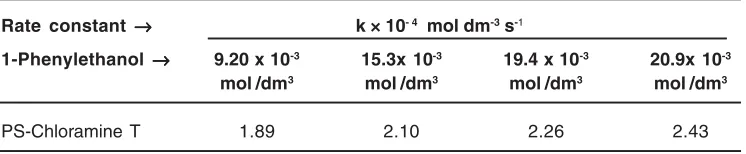
At a varying concentration of 1-Phenylethanol [16.20 to 40.4 x 10⁻³mol/dm3], constant weights of oxidant [70 x 10-6 kg] and constant concentration of solvent [1,4-dioxane, 5 x 10⁻³dm3], zero order rate constant [Table- 2] was found.
Effect of varying dielectric permittivity of the medium on the reaction rate
It was found that as the dielectric constant of the medium increased, this including r* < r [Where r* and r refer to the radii of the reactant species and activated complex respectively] at constant concentration of 1-Phenylethanol [12.3 x 10⁻³ mol/ dm3] and constant concentration of oxidant [70x 10 -6 Kg], solvent [5 x 10⁻³dm3] as shown in Table-3.
Effect of varying temperature on the reaction rate
The reaction was carried out at four
different temperatures under otherwise similar reaction conditions to study the effect of temperatures on the rate of reaction. It was observed that, the rate of reaction increased with an increase in the temperature [Table 4]. The thermodynamic quantities for different equilibrium in Scheme IV canbe evaluated as follows.
A Van’t Hoff ’s plot was made for the variation of k1 with temperature [i.e. log k1 versus 1/ T] and the values of the enthalpy of reaction ∆H, entropy of reaction ∆S, and the free energy of reaction ∆G, were calculated. These values are also given in Table 5.A comparison of the values with those obtained for the slow step of the reaction shows that, these values mainly refer to the rate limiting step, supporting the fact that the reaction before the rate determining step is fairly slow and involves high activation energy.
The negative value of ∆S suggests that, the intermediate complex is more ordered than the reactants.
Effect of repeated use of supported oxidizing agent
The resin was filtered after the reaction and washed with 0.1 M HCl and 0.2M NaOH successively to remove CrO2 deposition on the resin. The resin was then regenerated by stirring with chromic acid, followed by washing with water methanol and drying in vacuum at 333K for 5h.
These regenerated beads were used for the reaction under identical reaction conditions. The conversion of 1-Phenylethanol was found to decrease slightly with the repeated use. There is a likelihood of having less supported agents on the resin whose pore structure could be altered by some dehydration of HCrO3- leading to the formation of CrO2 which remains inside blocking some channels. Therefore, during the third use the reduced chromate bound to the resin was directly treated with excess of chromic acid. There was an improvement in the reactivity of the supported oxidizing reagent. This suggests that the chromate salts can be effectively used on polymer supports.
1-Table 1: Effect of varying weights of oxidant on reaction rate at 318 K Rate constant →→→→→ k × 10- 4 mol dm-3 s-1
Oxidant x 10- 6 kg →→→→→ 50 60 70 80
PS-Chloramine T 2.55 2.59 2.61 2.66
Table 2: Effect of varying concentrations of 1- Phenylethanol on the reaction rate at 318 K Rate constant →→→→→ k × 10- 4 mol dm-3 s-1
1-Phenylethanol →→→→→ 9.20 x 10⁻³ 15.3x 10⁻³ 19.4 x 10⁻³ 20.9x 10⁻³
mol /dm3 mol /dm3 mol /dm3 mol /dm3
PS-Chloramine T 1.89 2.10 2.26 2.43
Table 3: Effect of varying dielectric permittivity of the medium on the reaction rate at 318 K Rate constant →→→→→ k x 10- 4 mol dm-3 s-1
Solvent [5 x10⁻³dm3] →→→→→ C
6H12 CCl4 1,4-dioxane CHCl3
Dielectric constant →→→→→ 2.00 2.17 2.28 4.81
PS-Chloramine T 1.47 1.79 2.46 2.66
Table 4: Effect of varying temperature on the reaction rate Rate constant →→→→→ k × 10- 4 mol dm-3 s-1
Temperature K →→→→→ 313 318 323 328
PS-Chloramine T 2.22 2.62 2.95 3.25
Phenylethanol and change in solvent were carried out. The reaction was found to be zero order. The proposed path for the reaction of chromium (IV) then makes possible a different mechanism for oxidation of alcohols. According to Westheimer and Watanable [12], subsequent steps must involve chromium (IV) as shown in Scheme (II) and (III).
Scheme (II)
Cr IV + Cr VI→ 2CrV ...(1)
CrV + R
2CHOH → R2 C = O + Cr
III + 2H+ ...(2)
Scheme (III)
2Cr V → CrIII + Cr V ...(3)
Cr V +Red → Cr III + oxi ...(4)
Westheimer then proposed that the oxidation of secondary alcohols proceeded via acid chromate ester intermediates.
R2CHOH + HCrO4 + H+→R
2CHOCrO3H + H2O....(5)
R2CHOCrO3H + H+ →R
2CHOCrO3H2
+ ...(6)
R2CHOCrO3H → R2C=O + CrIV ...(7) R2CHOCrO3H2+→ R
2 C = O +Cr
IV ...(8)
If the oxidant supported on polymer, which has certain advantages over homogeneous reaction, the intermediate chromium (IV) will further oxidize another molecule of alcohol to form a free radical species. Thus based on experimental results, obtained for the oxidation of 1-Phenylethanol by polymer support, the reaction was found to be 0th order. Initially Cr (VI) is reduced to Cr (IV). It is likely to react with another Cr (VI) to generate Cr (V) which is then reduced in a fast step to the ultimate product Cr (III). Such a sequence of reactions in Cr (VI) oxidation is well known 13-15. The mechanism is suggested in Scheme (IV) and involves ester formation.
1) The polymer supported reagent reacts with a molecule of alcohol to form a chromate ester.
N(CH3)3HCrO4
P R1CHOHR2
N (CH3)O Cr O O
O
R
P CH R
+
-+
+
+
-1 2 H2O
3
N (CH3)O Cr O O
O
R P
P N (CH
3)3(Cr) R C R H
O CH R
+
-k, slow
IV +
+
1 2+
+1 2
3 2) The ester formed will decompose into ketone and the intermediate chromium (IV)
3) The intermediate chromium (IV) thus reacts with another alcohol molecule to produce a free radical species. The free radical species formation in the reaction was confirmed by
the polymerization of added acrylonitrile or addition of acidified methanol into the reaction mixture.
R1CHOHR2
C
OH R R
P N CH
3 3
( ) CrIV
+
fast
P N CH
3 3
( ) CrIII
+
+
H+ .2 1
+
+
4) Subsequently the free radical will react with another oxidant site in the polymeric reagent
in a fast step leading to the formation of chromium (V).
N(CH
3)
3(Cr)
R
1COR
2N (CH
3)
3HCrO
4C
OH
R
R
V
+
H
+
+
+
+
-+
.
1
2
fast
P
P
5) The intermediate chromium (V) in the last step reacts with 1-Phenylethanol produce acetophenone. The test for formation of chromium (V) and (IV) by the characteristic
induced oxidation of iodide 16 and manganese (II) 17 were not probably due to heterogeneity of the reaction mixture.
P
N(CH
3)
3(Cr)
P
N(CH
3)
3(Cr)
H
O
R
1CHOHR
2+
+
III
+
R
2
+
+
1
C
R
2
V
fast
+
[ R1= CH3- C6H4- and R2 = - CH3 ] Scheme 4:
CONCLUSION
The linearity of absorbance against time plots and constancy of the zero order rate constants indicate that the reaction neither depends on the polymeric reagents nor on the alcohol concentration. This anomalous nature of the reaction may be because of the fact that the oxidant is taken in the form of solid supported on polymer. Polymer supported oxidizing agent proved to be exclusively selective towards the oxidation of 1-Phenylethanol, giving acetophenone as the only product.
According to Scheme IV, a second order rate law is expected. But since the first step of ester
formation occurs in solid phase and assuming that this equilibrium does not contribute to the rate of reaction. We obtained zero order dependence with rate constant k of the second slow step in which product acetophenone was obtained. Based on the experimental observations a probable mechanism is suggested.
ACKNOWLEDGEMENTS
The author is thankful to Dr. Sonawane R.S., C-MET, Pune for suppor t for elemental analysis. Also I would like to thank Hon’ble Adv. AshokSoni, President, Godavari Shikshan Prasarak Mandal’s, Parbhani for encouraging the research work.
REFERENCES
1. E. J. Corey and G. Schmidt, Tetrahedron Lett., 20: 399 (1979).
2. M. N. Bhattacharjee, M.K.Choudhari,H. S.Dasgupta,N.Roy and D. T. Khating, Synthesis., 58: 25 (1982).
3. E. J. Corey, E.P.M.Barette and P.A. Margrious, Tetrahedron Lett., 24: 5855 (1985). 4. F. Climinale,M.Camporeale,R.Mello, L.Troisi
and R.Curci , J. Chem.Soc.,Perkon Trans., 2: 417 (1989).
5. G. G. Sharma and M. K. Mahanti , Bull. Soc. Chem. Fr., 128: 449 (1989).
6. K. Balasubramanian and V. Pratibha, Indian J. Chem., Sec. B., 25: 326 (1986).
7. B. Narayana and Tam Cherian , J. Braz. Chem. Soc., 16: 197 (2005).
8. A. J. Buglas and J. S. Waterhouse, J. Chem. Edu., 64: 3712 (1987).
9. G. Cainelli, G. Cardillio, M. Orena and S.
Sardri, J. Am. Chem. Soc., 98: 6767 (1976). 10. T. Brunlet, C. Jouitteau and G. Gelhard, J.
Org. Chem., 51: 4016 (1986).
11. W. A. Mosher, H. Clement and R. L. Hillard , J. Am .Chem. Soci., 29: 565 (1993).
12. W. Watanabe and F. H. Westheimer, J. Chem. Phys., 61: 17 (1979).
13. M. M. Salunke, D. G. Salunke, A. S. Kanade, R. B. Mane and P. P. Wadgaonkar , Synth Commun.,2B: 1143 (1943).
14. J. Matsuo, A. Kawana, K. Pudhon and T. Mukaiyama, Chem. Lett., 250 (2002). 15. R. O. Hutchins, N. R. Natale and W. J. Cook,
Tetrahedron Lett., 4167 (1977).
16. A. J. Buglas and J. S. Waterhouse, J. Chem. Edu., 64: 3712 (1987).