http://Business.ExpertJournals.com
111
Producing Just Papers or Creating Added Value?
Snap-Shot about Quality Systems at
Hungarian SMEs
Emil NYERKI
1*, Róbert LIPPERT
1, Emil NYERKI Jr.
21University of Pannonia, Hungary 2University of Szeged, Hungary
In this paper, a short historical review and the research results are presented, which are focused on the quality management systems used by the Hungarian SME’s. The research was based on an original empirical survey, conducted using a random sample of fifty managers from small and medium sized Hungarian enterprises. All of them use certified quality management systems. The paper presents their current state in the light of their responses, under several aspects. In conclusion, suggestions are given for the problems, such as measurement, development, and education on the research topic.
Keywords: efficiency, management, process, quality, sustainability, quality management system, improvement
JEL Classification: M10, M12
1. Introduction
Currently there are approximately 11.000 companies in Hungary, certified according to ISO 9001. Fifteen years ago, in 2000, this number was only 3280, and thus the increase of the number of certified companies is really impressive (Bálint, 2004). Under this premise, the current research is conducted to provide a better understanding of the companies’ ISO certification process and organizational behavior.
2. ISO Certifications in Hungary
2.1.Possible Reasons of Increase in ISO Certifications
This increase of companies adoption of ISO certification can be explored through the following questions:
- Is the new version of ISO system (ISO 9001:2000) more user-friendly?
- Is the market requesting the certification? Could it be, as in almost all cases, that the supplier evaluation checklists starts with this particular question?
*Corresponding Author:
Emil Nyerki, University of Pannonia, Plant Manager, Szekszárd, Korsófölde u 2 H-7100, Hungary
Article History:
Received 1 July 2014 | Accepted 28 July 2015 | Available Online 03 August 2015
Cite Reference:
Nyerki, E., Lippert, R., Nyerki, E. Jr, 2015. Producing Just Papers or Creating Added Value? Snap-Shot about Quality Systems at Hungarian SMEs.
112
- Is quality system just a fashion phenomenon? Followed by further systems, like environment, IT security, EHS system?
- Does certified quality systems create added value through controlled operations? And is it in a business’s interest to introduce and certify?
Most probably there is no exact answer as all reasons are partly valid. The real answer can be completed from all these aspects. Considering the significant differences between the “old” (Edition 1993) and “new” revision of the ISO 9001 standard, four important factors can be identified:
- The “old” ISO system is quite complicated and for a proper interpretation, deep knowledge is necessary. The ISO 9001: 2001 contains major changes:
- The “new” system is not only applicable for production companies, but usable for service providers and institutions too.
- The modified system is fully customer oriented. Until recently, the continuous level of production was targeted, now the customer is positioned in the middle of the activities (Róth, 2000).
- Requirement of quality system is harmonized with other management systems, enabling the creation of integrated management systems (environment, EHS, IT security).
2.2.Market Requirements
In the last years, the existence of certified quality systems is more and more a requirement for possible suppliers. Is this a reflection of customers’ requirement, or is the profession pushing work towards suppliers? It is much to ask for a certification, than making a detailed and professional process audit, although the causality between professional operation and certified quality system is not always given. There is a number of small family-owned companies, where certification means not only a high cost, but does not influence the daily operations. Technology and staff are given, processes are running, the „management review” was achieved after „Sunday’s lunch" – but it was not called „management review”. Does certified quality systems help making the business results better? Most probably not, but it does help companies to get more business.
2.3.Costs of Certification
According to a study made in 2008, certification cost of a company under 51 employees is between 500.000 - 1 Mil.) HUF (1850-3700 EUR) for 3 years. On average, 11.000 certified companies are generating business of 2.750 Bil. HUF for certification bodies.
2.4.Certification Phase
Market is growing, once it is full, companies will not be interested to get certification anymore. From a business point of view, it is a must to create a new system, set up certification standards and convince big market leaders of a need. Also, it is necessary to certify the whole supply chain from the smallest company up to the biggest one. We are not implying that certified systems are without value, of course, but majority of those systems’ requirements are needed to be fulfilled, as it is a logical must. Let us consider the requirements of the environmental, work safety, and IT rules. Nowadays, energy management systems are under installation.
2.5. Quality Management as a Tool of Business Excellence
Spending 10 years in quality management, the answer is most definitely yes, that the quality management as a tool of business excellence. If during the establishment of the system’s business efficiency was set as a major goal, keeping procedures resulted „automatically” in business success. If it is a bureaucracy or a copied system, the requirements of „real life” and the quality systems are never meet.
Glaser-Segura, Peinado and Reis Greml (2009) presented the results of a survey conducted via managers from 248 companies from Argentina, Brazil and Romania. They measured practices related to quality, waste reduction and supplier management, as well as their managerial and HR support practices. The result of their study shows that the achievements in emerging and transition economies are not as good as they are in developed countries.
Ebert, Tanner and Tutures (1998) carried out an extensive survey involving Romania’s manufacturers, which are adopting lean manufacturing and quality systems in order to improve their competitiveness, faced with the fierce conditions of the global market. They argued for the need to change the syllabus of operation management and other engineering subjects taught in the country’s schools.
113
government dictated the levels of quality, prices, production volumes, logistics programming and other decisions related to the production strategy. Marinescu and Toma (2008) produced a case study which pointed out that lean production could be successfully applied to Eastern European countries, such as Romania. The main achievements of lean implementations are: waste reduction, increased productivity and better teamwork.
3. Methodology of Research
The questionnaire-based quantitative survey was carried out involving employees and managers, represented mainly from the capital city and western side of Hungary in 2010. Until the closing of the survey, we received 55 answers, out of which 50 responses were gathered from the targeted and researched company size, namely small and medium size enterprises. Additionally, personal structural interviews have been conducted with 5 partners. These interviews assisted as a qualitative method in the formation of the questionnaire, as well as in the evaluation of the findings.
Questions were focused on the following areas:
- Qualified quality system supports the organization to reach business goals. - Instructions are known and followed by employees.
- Complexity of quality system. - Continuous improvement.
- Follow up of key performance indicators. - Preparation of audits.
- Typical tasks of quality organization.
The full research question instrument are listed in Appendix 1.
4. Analysis and Results
4.1.Tasks of Organization’s Quality
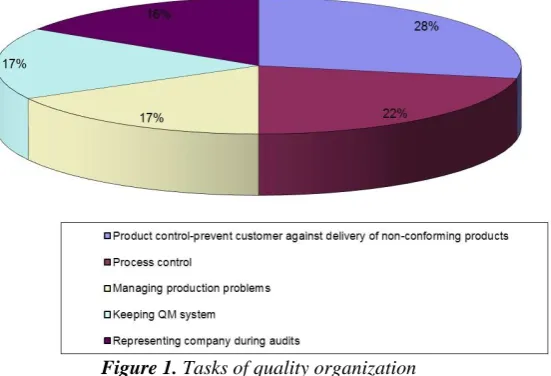
Figure 1. Tasks of quality organization
The number 1 position of the „control function” of quality organization is not a surprise. It was valid 30-40 years ago, when the „perfect quality was equal to more strict control” (Szabó, 2012). Sometimes the opinion „production should produce; quality should control” is coming up in daily operations and the research’s result.
114
4.2. The Use of Certified Systems in Helping to Reach Business Goals
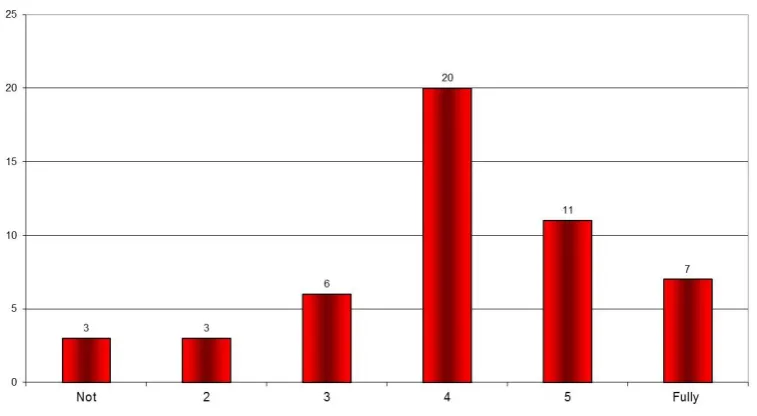
Based on a survey result, the answer to question “Does certified system help to reach business goals?” is close to „yes”, as figure 2 shows.
Figure 2. Effect of certified quality system to the business result
The average of the answers is 4.04 and the distribution is asymmetric as the majority of responses are on the positive (4-6) side. This reflects the opinion of leaders and it shows the good news that the decision makers are convinced about the business advantages of a quality system. It can be supposed that necessary resources will be provided for the quality team to build up and maintain a quality system.
In this framework, we aimed to answer the question “Is not it valid for the lower level of organization, too?” to exhibit the inclusion of employees in the quality service. The results are presented in figure 3.
Figure 3. Are procedures known by the employees?
115
The next surveyed topic regards the following of rules: the reached 3.55 shows the same value, as in a previous question, but the distribution of answers is more asymmetric, 57% of the answers falling into the negative pole of the response. This is an indication that there is a gap between real life and quality system requirements. Some people do not even know what procedures to follow, but there is a portion that knows, but fails to do so.
Figure 4. Following of quality procedures
One possible reason for non-following rules is the complexity of the rules and procedures. This particular topic highlighted the following results:
Figure 5. Is QM system complex?
According to 61% of the respondents, the answer is „no”, which means the system is not complicated. Worryingly, the remaining 39% of the responses showed that due to the complexity of the system, there is no possibility to use it. In this case, quality management system is a fascinating aspect, known by some special skilled people.
116
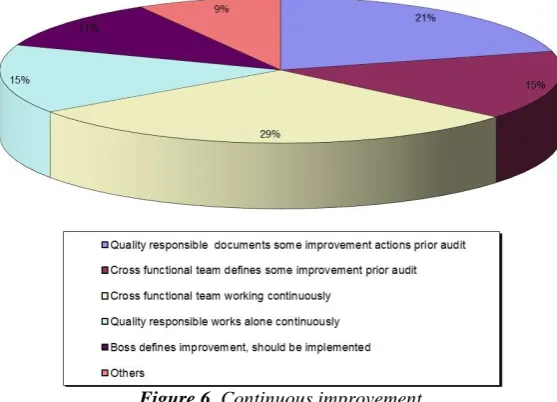
Figure 6. Continuous improvement
Improvement is really continuous according to 29% of the researched companies’ respondents. 15% are doing an improvement, prior to audit, and further 15% of responses show that there is a „lonely hero” effect in creating things if they can be sold throughout the organization, and this means that he can win. If not, the process will work only on paper. „Continuous improvement” as mandatory task for audits is 36%, and in 11% of cases the boss is bringing ideas in and they should be realized.
4.2.The Need for a Quality System
It was almost agreed, that certified quality systems support companies to improve the business results, but based on the opinion about the main purpose of the system, 2 groups can be identified: for group 1, the system really helps; for group 2, it is crucial to „survive” audits so that companies can publish certifications for customers.
Therefore, the last research question asked the opinion about the main purpose of quality systems. In figure 7 we can observe the outcomes. Thus, 28.6% of the researched companies stated that quality system is a supporting tool, 32.7% said it could be a good tool if it worked properly. For 26%, a quality system is a mandatory task requested by customers, and for 6%, it is not necessary.
In the best case scenario, with ratio 40:60, the quality system is a tool and not a goal.
117 5. Discussion, Conclusions, and Proposals
The research has confirmed that there is a measurable gap between written procedures and the daily operations of companies. Seeing the development of quality management systems in Hungary, the behavior is almost natural. Until 1971, quality work was equal with quality control (Szabó, 2012). Quality systems were initiated by the government from 1980, with the support of Professor Shiba from Japan. When governmental support and financing stopped, companies interrupted the development of the quality systems (Kovács & Uden, 2012). After the regime change in 1990, joint ventures and multinational companies were grounded, and from that time, it was a natural task to build up and certify quality systems (Szabó 2012).
In order to keep the system as part of the usual daily operations, authors are proposing to establish:
a. Measurement. For this aspects, companies should operate under the idea of “Get measured – get improved”. Establishing KPI metrics and following them up frequently. It is recommended, that not only “quality related items” should be measured, but also the expression of all parameters in relation to business influence. Sometimes asking quality staff, what is the „re-payment” rate of their salaries?
b. Development. With support of upper management, this development suggestion could be implemented by starting a process review, and if necessary, adjusting the process. Involving the management is the key: if they are treating the action as „investment into the future” it will be easier to convince the staff about the project.
c. Training. The basic rule: quality management is not equal to quality control, and should be deployed during all possible sessions. It must be clear for all employees, that structured operations and „data-based” decisions are necessary not because of the audit, but because they are in the best interest of the company.
References
Bálint, J., 2004. Minőség. Tanuljuk és tanítsuk. (Quality for teaching and doing). Terc Kft Begriffe zum Qualitätsmanagement. DGQ-Schrift 11-04. Beuth Verlag GmbH, 1995
Ebert, R J., Tanner, G. and Tutures, M., 1998. Building the POM curriculum for a privatizing economy: an evaluation from manufacturers’ perspectives. Production and Operations Management. v. 7. n. 2.
Summer 1998. Retrieved January 23.2009 from
http://www.atyponlink.com/POMS/doi/pdf/10.5555/ijop.1998.7.2.171?cookieSet=1.
Glaser-Segura, D., Peinado, J. and Reis Greml, A., 2009. Manufacturing Processes and Management: Lean Manufacturing Adoption Patterns in Industrial Organizations in Three Emerging Countries. Presented at the 2009 POMS Conference, Orlando, Florida, May 1 to May 4, 2009.
Glaser-Segura, D. and Anghel, L., 2003. Empirical Study of Institutions: Romania. Conference proceedings 12th Annual International Purchasing and Supply Education and Research Association IPSERA Conference (refereed), Budapest University of Economic Sciences and Public Administration Hungary, April 14 - 16, 2003
Goldratt, E.M. and Jeff C., 1984. The Goal: A Process of Ongoing Improvement. Great Barrington, MA.: North River Press
Kovács, Z., Uden, L., 2010. Conceptual model of service systems; KMO 2010. Knowledge Conference, Veszprém, Hungary
Marinescu, P. and Toma, S. G., 2008. Implementing Lean Management in the Romanian Industry. IFIP Advances in Information and Communication Technology, Volume 257, pp. 269-276
MSZ EN ISO 9000:2001 Quality management standard
MSZ EN ISO 9001:1993 Quality management standard
MSZ EN ISO 9001:2001 Quality management standard
Róth, A., 2000. ISO 9000:2000 Quality system. Verlag Dashöfer.
118 Appendix 1
Research Questions of the Measurement Instrument
What are the main tasks of a quality organization?
Do you think, that certified quality system support reaching business goals? Are quality procedures known by all employees of the company?
Are quality procedures followed by all employees of the company?
Do you think that the installed quality system at your company is complex? How are you performing continuous improvement actions?