Page 215
UTILIZATION OF THE EXPERIMENT WITHIN THE CLASSROOM. SEEKING TO DEVELOP UNDERSTANDING OVER LOVE TOWARDS CHEMISTRY
Anastasia Koumoutsi1, Alcmene Soulioti2, Pericles Akrivos2 1Geniko Lykeio Agrias, Magnesia, Greece
2Aristotle University of Thessaloniki, Department of Chemistry, Thessaloniki, Greece
Abstract
A series of simple experiments is described, for presentation in the secondary school classroom aiming at the development of understanding Chemistry by the students rather than provoking “love” for the topic. The experiments present modifications of known procedures adaptable to practically any point of secondary education and to any level of sophistication provided by the school facilities. The simplicity, clarity of the procedures and security of the students are the factors considered as central relative to thrilling which has been a distractor in many related projects. Emphasis is placed on solutions, and especially the description of their concentration and the understanding of the meaning of the various forms this description may possess. The experiments are also related to discussions and queries which are designed to promote active thinking and develop both practical and mental skills among the students.
Keywords: secondary education, solutions, solution concentration, laboratory experiments
1. INTRODUCTION
Following our previous recent studies on the misconceptions related to Chemistry in the Greek high-school as to their origin and factors of their conservation (Katsikis et al 2015, Vandoulaki et al 2016, Kontopoulou et al 2017) it seemed reasonable to investigate the extent to which such ideas may be confronted and negated in the classroom. It is generally agreed that students even at an early age try to amend aspects of science lessons in such a way as to align them with their previously acquired or formulated ideas and notions rather than the opposite. Furthermore, it is well documented that the task of confronting and attempting to modify preconceptions is never going to be easy since they have often been incorporated securely into a cognitive structure at a relatively early age (Driver & Easley 1978, Gunstone et al 1981). Such preconceptions are harder to deal with, especially at a later age since it has been argued and to large extent proved that in many cases it does not matter how long or how intensely somebody is taught about a specific topic (Ahtee & Varjola 1998, Bodner 1991) because the previous inherent models are going to be retained and at the most, it will be possible to admit recently acquired facts into a self-made and self-explanatory model based on the existing preconceptions. Science in general is described both as an ‘‘activity in context’’ and as a ‘‘modelling activity’’ while it is historically known to have evolved over time to its present status through consecutive steps of observation, experimentation, data accumulation and law formulation and adaptation to the studied phenomena and processes. All of these aspects have to be taken into account in the process of teaching science to secondary education classes. In such a process application of the topics described in the lectures has also to be introduced besides the traditional contexts of discovery and justification (Izquierdo-Aymerich 2012) in order for the teaching to have the desirable effect. To aid this, the general acceptance that significant meaningful knowledge cannot be transmitted directly from teacher to student, but rather that learning is a process of reconstruction of knowledge (Taber 2000, Wollman 2014) could be cited. In this respect, Chemistry offers the possibility of presenting both tabulated, cited and raw material to the students in the form of lectures aided by the addition and execution of suitably organized experiments.
Page 216
traced in the internet, are interesting and may promote understanding of chemical aspects, especially those related to indicators where color changes are indeed fascinating. Several of them however, are simply related to combustion processes which are by far the least safe to carry out in a classroom and far more so in a not fully equipped classroom. A few of them, the most profound being the so called “chemical volcanoes” are totally unnecessary since they do not offer much to the understanding of the way chemical phenomena occur and can only serve the purpose of momentarily taking the students aback at the visual effect produced. Even if such a behavioral reaction is considered as a true learned and justified positive feeling towards science (Koballa & Crawley 1985), in other words a positive attitude, there are references in the literature indicating that there exists only low or moderate correlation between initially expressed positive attitude and later achievement in science studies (Freedman 1997, Germann 1988). On the contrary, a single such demonstration may provoke the building up of expectations for analogous ones in future lectures, falling therefore into the field of simply “making science fun” rather than understood. Analogous proposals are widespread and aim at the attraction of young people to the realm of science with a prospect of involving them into the market rather as workers for “technically centered jobs” than as “routine skill jobs”, something reportedly declining in the recent past, at least in the USA (Cox).
Our aim is to try developing a positive attitude of secondary education students towards Chemistry based on understanding of its functionality rather than epidermal and short-lived “love” for it. In our belief, the presentation of some experiment, spectacular in effect but bare from underlying chemical concepts is not something that could or would promote intrinsic motivation among the students (Glynn et al 2005). Instead, this would impose a wrong perception of the role of science in everyday life, relegating it to a technique of producing cinema visual effects. This in fact, is partly true and can be demonstrated with a few simple examples of reactions but is altogether indifferent to the understanding of basic science principles. Our idea lies towards the opinion expressed by Stefanova in the form of “people graduating school must be able to understand scientific information, to apply scientific knowledge, to explain the phenomena of the surrounding reality. For the future life of adolescent their scientific education will allow them to live and work useful in a society influenced by the ideas and values of science” (Stefanova 2014).
Solution preparation, behaviour and properties should range among the main target knowledge topics of any Chemistry curriculum for secondary education, whatever its construction and general aims might be. However it has been manifested that understanding of solution chemistry especially regarding solution concentration is problematic at practically every level of education (Devetak et al 2009, deBerg 2012). Based on these arguments as well as on observations directly related to the reality of the Greek educational system, we describe the case of utilization of some simple, safe and didactic experiments which can be carried out in the high-school classroom and promote understanding of some key aspects of solution concentration within the students attending it. This is certainly not a “laudable curriculum goal” which even then would not be sufficient to ensure firm and complete understanding by the students (Taber 2008), we are certain however, that it represents a descent approach towards the understanding of the basic properties of solutions and especially of the expression of their concentration. This is also, not a case of class “flipping” which has been proposed as an alternative in effecting better knowledge assimilation, although discussion is initiated and search over the internet promoted and expected, however the outcome is expected to be positive for the students since they are asked to present and discuss their findings and work in small groups interchanging information between them (Johnson & Johnson 1999).
1.1 Overview of the Greek secondary educational system
Page 217
most current version of the curriculum, three ‘directions’ are formed, termed humanitarian, positive and economy & informatics. At this grade chemistry is taught only to students following the “positive direction”. Teaching of science in Greek secondary education is considered generally as limited and within it Chemistry appears as even more limited since it consists of a single weekly hour of teaching for grades B and C of junior high school and two weekly hours for grades A and B for senior high school. Only students who choose to follow the positive direction in their final senior high school year attend Chemistry classes at a three weekly hour rate. The general directions issued on a yearly basis describe a series of experiments which are expected to be carried out in all but the last year of the curriculum. However their number is far too great to be accomplished and they are not described as obligatory and in this respect, when the school premises and facilities permit it, a selected number of them is attempted.
1.2 Solutions and concentrations within the Chemistry curriculum
At the second grade of junior high school the students are introduced to the percentage description of solution concentration, and are expected to
interpret the different types of solutions’ percentage calculate the solutions’ percentage using quantitative data
calculate the amount of the solvent and of the dissolved substance of a solution with known percentage
prepare a solution of given percentage
Solutions are explicitly studied in the first grade of senior high school where types of concentration expressions like molarity, ppm and ppb are introduced as well as dilution and mixing of solutions. The aims of the specific course are for the students to be able to
claim what is solution, solvent, dissolved substance and define the different types of solutions’ percentage
describe and apply the concept of concentration (molarity)
calculate the concentration or the volume of a solution at its dilution or mixing with other solutions
2. DESCRIPTION AND AIMS OF THE EXPERIMENTS
2.1 Solution concentration expressed as %w/v
The solution the preparation of which is desired is described in the introduction of the laboratory period as 15% w/v NaCl in water.
This experiment is expected to be presented to junior high-school students at an early stage of the secondary education chemistry curriculum. The materials required are solid sodium chloride, a small volume volumetric flask (preferably 50 or 100 mL) and a balance. In the first stage the students are asked to work out the required amount of NaCl required to prepare the solution and then they are provided with time to weigh and transfer it to a small beaker. Complete and informative instructions are given about the correct use of the flask in order for the solution to be actually the desired one. Alternatively, in the absence of flasks, the instructor may calibrate larger beakers to the point they will hold 100 (or 50) mL of solution and in the absence of accessible balance may also use pre-weighed samples of the solid. The experiment, with its several variations, is being used worldwide for a long period of time and is among the most simple, cheap and most safe to carry out.
Page 218
upon boiling off the water of the container. The short discussion that can be initiated at this point may serve as a resumption of the distinction made in the very first lessons of Chemistry between physical and chemical phenomena. Following the categorization of the dissolution of table salt in water as a physical phenomenon and not a change of state, it becomes obvious that at the end of boiling off the solvent will result in the retrieval of the salt dissolved will be possible, whereupon the total volume of the solutions is easily worked out and the total amount of salt contained in it is derived by using the percentage expression known from the initial statement of the experiment (in the above described case of 5 groups of students a total of 5x50 = 250 mL and a content of 15%x250 = 37.5 g of NaCl).
2.2 Solution concentration expressed as %w/w
At this point, the actual advance is proposed in relation to the process determined by the education authorities. In order to allow students to get acquainted with a variety of compounds, it is advised that some other solution (usually sugar, another well-known commodity of the household) be used in order to exemplify the per weight percentage concentration of a solution. However, to our knowledge, this presents a constant source of misunderstanding among students who tend to “transfer” it to their undergraduate higher education studies where often bewilderment is expressed as of whether the same solution can be described in different ways, i.e. per weight and per volume percent concentration. To circumvent this problem we propose the use of the above NaCl solution for the purpose of describing a solution in various formats.
In order for the experiment to be carried out correctly, there is need to record the weight of the empty flask prior to and the filled up after the preparation of the above mentioned solution. At this point it becomes apparent why the initial per volume concentration had to be of this magnitude; it is related to the availability of balances of specific precision. In our case we have used 50 mL flasks and a single decimal point precision balance where the recorded values made it possible to evaluate the two concentrations as different numbers (in our case, the per weight concentration average was 13.7%). Connection with “real life” which is an ever-sought target in science teaching (Gabel 1999, Aikenhead 2003) can be achieved at this stage by discussing the salinity of water bodies and especially of the well-known Dead Sea. Any available data either in printed documents or in the web can retrieve information about this specific water body were salt concentration is or will easily be transcribed as 34.2% w/w and given the density of it, cited as 1.24 kg/L transformed to 42.4% w/v. Discussion may be carried out on the mean value of ocean salinity which is almost an order of magnitude smaller (3.5% w/w with d= 1.025 kg/L). Furthermore, although the initial setup of the experiment seems purely artificial and therefore not bound to attract the interest of the students, it turns out to provide grounds for some productive thinking and some mental workout to interconnect laws, units and expressions, an activity much demanded by the needs of contemporary science teaching at this level of education (Wollman 2014). Note should be taken at this point that the combination of the two phases of the above experiment is expected to help students understand the meaning and utilization of density which is only superficially referred to and almost never used in secondary school Chemistry while it is just mentioned at some point in the corresponding Physics curriculum giving rise to various more general misconceptions centered around it (Horton 2007).
2.3 Solution concentration expressed in terms of molarity
Page 219
curriculum and further relate the above discussion to the concept of stoicheiometry which is yet another one suffering from under-development in the Greek secondary education curriculum.
2.4 Dilution to a desired concentration
An introduction may be used giving examples of food additives and preservatives or agrochemicals, the action of which are within the knowledge and understanding of the students. At this point specific examples may be discussed and the limit values of the concentrations set by the local law retrieved from literature or the authorities. Next, a set of the same or analogous commercial products which are packed and delivered in bulk, normally in the form of a dense syrup can be brought into the conversation and the task set forward for preparing, for example an aqueous solution of 0.3% w/v in a tank of several m3, from a syrup of 9.0% w/w constitution (in our case we used the example of calcium lactate pentahydrate for which the reported values are the actual ones).
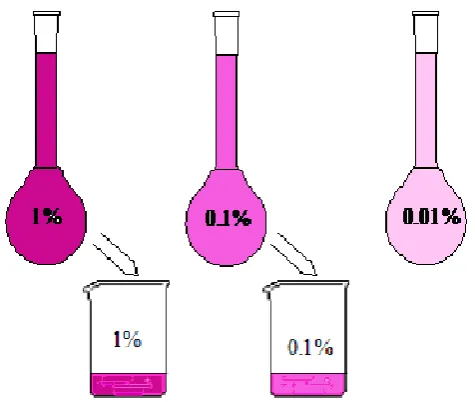
The experimental part consists of the dilution of an initial potassium permanganate solution to some desired concentrations. The chemical is rather cheap at around 0.05 € per g and due to its intense color an initial 1 millimolar solution is good enough for the demonstration. We found that this initial solution makes it very easy to identify the change in intensity when diluted by one or two orders of magnitude. In a typical presentation, a millimolar solution of potassium permanganate is given and the task is presented of diluting it into two or more volumetric flasks. In our case we chose to term the initial solution as being 1% w/v in order to avoid excess calculations for the junior high school students. The flasks used were 50 mL and some simple mathematics was required in order to determine the amount needed to prepare, initially 50 mL of 0.1% solution. Tips about the correct, safe and accurate use of the provided burettes were given at this point and the students were given time to transfer the calculated amount of solution and then to dilute it in the provided flask. Following, the question was given of how much was the quantity of the compound transferred. At this point it was clarified that the simple mathematical tasks performed formulate the tabulated dilution law which is generally expressed as CinitialVinitial = CfinalVfinal. In order for the second more diluted solution to be prepared a short discussion revealed that it is more practical to proceed with steps of successive dilutions rather than attempt a direct 1:100 dilution of the initial solution given the limitations of the burettes provided. During the process it was understood that each of the diluted solutions possessed the tenth of the amount of KMnO4 present in the previous solution. To serve this purpose an additional amount of each solution used for the preparation of the more diluted one was kept in a beaker next to the volumetric flasks where direct comparison could be made regarding the intensity of the color (and therefore concentration) and quantity used.
Page 220
Of course, for grade A senior high school students the same procedure can be carried out using the molar concentration form for the description of the expression and the accurate concentration of the initial solution used.
3. GENERAL OUTCOME OF THE EFFORT
The above described actions can be carried out in the course of a single laboratory period in direct and close connection to a lecture period on the subject of solutions and the expression of their concentration. Within this short module the students are asked to perform some simple and safe experiments in the lab, relate them to everyday life through discussion and text or webpage content, are encouraged to work in groups, investigate, take notes and perform simple mathematical procedures, relate different ways of expressing the constitution of a solution and get introduced into the topic of density which is overlooked and underdeveloped in the secondary education science curriculum. This is also achieved avoiding falling into the “asphalt pits” of using the uncontrollably emerging and distributed video sources in the internet and the ever-growing unconvincing use of computers and computer programs. Furthermore students are encouraged to use their abilities to perform some simple mathematical procedures and substitute this achievement in place of the usual algorithm recall which does not promote conceptual evolution (Petkov 2017).
REFERENCES
Aikenhead, GS 2003, “Chemistry and physics instruction: Integration, ideologies, and choices”, Chemical Education: Research and Practice, vol. 4, pp. 115-130.
Ahtee, M, Varjola, I 1998, “Students' Understanding of Chemical Reactions” International Journal of
Science Education, vol. 20, no. 3, pp. 305-316.
Bodner, GM 1991, “I have found you an argument: the conceptual knowledge of beginning chemistry graduate students”, Journal of Chemical Education, vol.68, pp. 385-388.
Cox, J, How to motivate students to love science, viewed 10 January 2018, <http://www.teachhub.com/how-motivate-students-love-science>
de Berg, KC 2012, “A study of first-year chemistry students' understanding of solution concentration at the tertiary level”, Chemistry Education Research and Practice, vol. 13, pp. 8-16.
Devetak I, Vogrinc J, Glazar SA., 2009, “Assessing 16-Year-Old Students’ Understanding of Aqueous Solution at Submicroscopic Level”, Research in Science Education, vol. 39, pp. 157–179.
Driver, R, Easley, J 1978, “Pupils and paradigms: A review of literature related to concept development in adolescent science students”, Studies in Science Education, Vol. 5, pp. 61-84.
Freedman, MP 1997, “Relationship among laboratory instruction, attitude toward science and achievement in science knowledge”, Journal of Research in Science Teaching, vol. 43, pp. 343–357. Gabel, D 1999, “Improving Teaching and Learning through Chemistry Education Research: A Look to the Future”, Journal of Chemical Education, vol. 76, pp. 548-554.
Germann, P J 1988. Development of the attitude toward science in school assessment and its use to investigate the relationship between science achievement and attitude toward science in school.
Journal of Research in Science Teaching, 25, 689–703
Glynn, SM, Aultman, LP, Owens, AM 2005, “Motivation to learn in general education programs”,
The Journal of General Education, vol. 54, pp. 150-170.
Gunstone, RF, Champagne, AB , Klopfer, LE 1981, “Instruction for understanding: A case study”.
Page 221
Horton, C 2007, “Student Alternative Conceptions in Chemistry”, California Journal of Science
Education, vol. 7, no. 2, pp. 1-78.
Izquierdo-Aymerich, M, 2012, “School Chemistry: An Historical and Philosophical Approach”,
Science and Education, vol. 22, pp.1633–1653
Johnson, DW & Johnson, RT 1999, “Making cooperative learning work”, Theory into practice, vol. 38, pp. 67-73.
Katsikis, H, Savvidou, E, Schizodimou, A, Akrivos, PD, Keloglou, G 2015, “Student misconceptions in the 21st century. Chemistry related conceptions of Greek senior high school students”, Educational
Alternatives, vol. 13, pp. 384-394.
Koballa, T.R, Crawley, FE 1985, “The influence of attitude on science teaching and learning”, School
Science and Mathematics, vol. 85, pp. 222–232.
Kontopoulou, A, Katsikis, H, Akrivos, PD 2017, “Living with preconceptions. Does more teaching and lab experimenting help to improve chemical principles assimilation?”, Educational Alternatives, vol. 13, pp. 291-302.
Petkov, G 2017, “Test of depth of knowledge for the mathematical concepts and principles for children”, Educational Alternatives, vol. 15, pp. 90-99.
Stefanova, UP 2014, “The students’ attitude towards science subjects studied in school”, Educational
Alternatives, vol. 12, pp. 685-697.
Taber, KS 2000, ”Chemistry Lessons for Universities? A Review of Constructivist Ideas”, University
Chemistry Education, vol. 4, pp. 26–35.
Taber, KS 2008, “Towards a Curricular Model of the Nature of Science”, Science & Education vol. 17, pp.179–218.
Vandoulaki, M, Karageorgiou, S, Katsikis, H, Akrivos, PD 2016, “Promethean response of Greek high-school students to the Protean changes of the Chemistry curriculum”, Educational Alternatives, vol. 14, pp. 199-210.