Page 28
SOCIETY’S INFLUENCE ON LANGUAGE EDUCATION Jana Bérešová
Trnava University, Hornopotočná 23, Trnava 918 43, Slovakia
Abstract
Many countries, notably in Europe, officially claim that their national curricula and school-leaving examinations are linked to the CEFR. However, working with English teachers in Slovakia for a number of years results in our assumption that language teachers do not analyse approaches to language acquisition presented in the CEFR and are not aware of a variety of methods used in language education along with communicative approaches, emphasised in the framework. In our research, we addressed local teachers of English to see how the CEFR had affected their teaching. According to our survey, quite a large number of teachers have not changed their teaching procedures and techniques, although their teaching is based on the national curricula that are officially claimed to be linked to the CEFR. In our study, the focus is based on the analysis of the questionnaire provided to language teachers in order to find out their language competence as well as their approach to teaching English in the country.
Keywords: an action-oriented approach, language policy, national curricula for languages
1. INTRODUCTION
It is obvious that the Common European Framework of Reference for Languages: Learning, Teaching, Assessment (CEFR, 2001) has influenced language education not only in Europe, but beyond its borders as well, for example, Canada and Malaysia. The CEFR as the framework is usually called is based on language concepts that are related to communicative approaches and an action-oriented approach. As far as communicative approaches are concerned, language education is aimed at achieving communicative language competence comprising linguistic, socio-linguistic and pragmatic competences that cover intercultural competence, strategic competence and so on. While previous concepts emphasised mostly linguistic accuracy, present-day concepts focus on language use and the ability of language learners who are realistically language users to use target languages for real life situations in a variety of contexts effectively. Therefore aspects referring to socio-linguistic and pragmatic competences play an important role in language acquisition as they influence our communication significantly.
The CEFR views language as a medium of communication and therefore a traditional classification (listening, reading, speaking and writing) is replaced by four modes of communication (reception, production, interaction and mediation). Four modes of communication are based on language communicative activities that are to be performed competently in case that language learners/users have developed their language communicative strategies and apply them reasonably with intent to get all the information needed and to convey their messages clearly and comprehensibly for their partners of communication. In the multilingual world, mediation plays an important role as language learners are mediators at the same time, for example, while reading a text written in another language or transferring information achieved from a person whose mother tongue or language of communication is different from theirs. The aspects of formal and informal registers or messages hidden in the text due to different cultural backgrounds of language users and interlocutors belong to mediation activities and require mediation strategies for achieving effective communication.
Page 29
As the European Commission and the Council of Europe support language education, focusing on the concepts of plurilinguism and multiculturalism, the member states have developed their language policies that match their local contexts and accomplish their programs accordingly. Analysing different concepts adopted by European countries in their educational programs with regard to learning English, it is possible to summarize them as follows:
a) English traditionally viewed as the first language (from the first year of primary education), later a choice of other languages (one or two languages) – Denmark, Sweden, Norway, the Netherlands, etc.
b) English officially claimed as the first foreign language, influencing the intensity of learning other foreign languages – Slovakia, Latvia, Greece, etc.
c) any foreign language as the first one, completed by another one – Croatia, Slovenia, Poland, Hungary, Lithuania, etc.
English chosen as the first language prevails over other languages, its position is different in the European countries, from English beyond the concept of other languages (Norway) to English as one choice from the list of languages the country officially offers to their students in primary education (Hungary). These different conceptual approaches resulted from language policy each country has adopted.
2. RESEARCH
Analysing the document concerning language policy in Slovakia, officially written by the National Institute for Education in Bratislava and approved by the Ministry of Education, we decided to verify its implementation in the country. The reason for this decision was the assumption that language teachers are not familiar with the concept of language learning based on the CEFR and language policy, officially adopted by the country.
For our data analysis, the questionnaire containing 10 items was distributed to 50 language teachers who teach English as the questionnaire was written in English and most foreign language teachers can speak only one foreign language, the one they studied at university as their major. The number of questionnaires the results of which we have analysed for the purposes of this article is 30. Despite the fact that the total number of questionnaires returned voluntarily counted 33, it was necessary to exclude 3 that could not be taken into account due to validity concerns.
The questionnaire contains items that enabled language teachers to mark their answers as well as to express their views based on their personal experience or teaching practice. All the data were presented to teachers who had taken an active part in our survey during their in-service teacher training workshop in June 2018. Teachers were asked to work in six groups and comment on every question the data of which had been shown. After 10 minutes, their secretaries presented either their explanations to the selection of particular items or raised more questions based on their teaching experience. It became obvious that their professional backgrounds – ELT education at universities – significantly influenced their choices. Some of them added more options in case of multiple-choice questions.
Apart from closed questions, the questionnaire entails a number of open-ended questions. Only those that seem to be relevant to our study will be commented on in this paper. All the teachers’ comments were carefully listened to, analysed and discussed. To convince those who did not accept presented viewpoints, evidence directly taken from the previously mentioned documents was pointed out. 2.1 An analysis of questions related to the CEFR
Page 30
speaking (spoken production and oral interaction) and writing sections. The curricula are divided into two parts: performance standards and content standards. While the performance standards comprise illustrative descriptors related to competences and language communicative activities, the content standards involve 25 competences that read illustrative samples for functions, interactional schemata, linguistic, pragmatic and intercultural dimensions. The last two dimensions are optional and they are presented with intent to provide teachers with a complete picture of a particular competence framework. Therefore, most teachers do not intensively focus on descriptors presented in these dimensions. What is more, some of the presented descriptors are either vague or ambiguous, therefore teachers prefer using their course books, teacher’s books of which clearly guide teachers what to do and how to do it.
In the following lines, an analysis of teachers’ answers to particular questions will be commented on. The first question concerns different aspects of teaching English and teachers were expected to choose those they prioritise during their teaching.
Grammar Vocabulary Communicative skills Intercultural communication Other
16.66% 23.33% 43.33% 6.66% 3.33%
5 7 13 2 1
Table 1. Teachers’ focus in English class
Although the national curricula focus on communicative skills, a large number of teachers consider focusing on language (39.99%) very important. In comparison with other studies (Bérešová, 2014a; Bérešová, 2014b), teaching vocabulary (23.33%) prevails over teaching grammar (16.66%). Discussion after presenting statistical data to the respondents revealed that teachers usually follow the course books rather than curricula and teach all the material that is presented in particular units. Vocabulary is considered the most important as its mastery influences both comprehension and any production or interaction. However, most teachers voted for communicative skills as it is prescribed in the national curricula. One teacher proposed that pronunciation be supported. In his opinion, the pronunciation of many students is incomprehensible, which effects their spoken production as well as spoken interaction.
In question 2, more than 50% of the respondents (16) circled the answer related to a frequent use of English and Slovak in their English class. The reason for this choice was teachers’ experience that they are required to translate sentences while reading articles or isolated sentences while dealing with grammar practice, not only by their students, but also by their parents in teacher-parent meetings. Some teachers mentioned parents as the major factor of influencing their teaching, pointing out at their learning English, which was quite traditional and based on the grammar-translation method. Nowadays, many publishers in Slovakia publish books that contain short stories, which have original text and translation side by side.
Page 31
A1 A2 B1 B2 C1 C2
- - - 26.66% 53.33% 20.00%
- - - 8 16 6
Table 2. English proficiency of Slovak teachers – teachers’ estimation
Most teachers (53.33%) assessed themselves as C1 English speakers, and quiet a large number (20%) as C2 on the contrary with those who saw them as B2 English users (26.66%) apologizing that they teach only in primary schools where it is not necessary to master the language. 83.33% of respondents were not able to provide any evidence about their language competence as they were not familiar with the self-assessment grid (Council of Europe, 2001, pp. 26-27) and could not use proper descriptors related to particular proficiency levels. This resulted in teachers’ common response that they did not know that the CEFR promotes the idea of profiling. However, they admitted that language learners/users are usually better at receptive skills than productive skills. It was necessary to emphasise that acquiring language communicative activities (listening, reading, spoken production, spoken interaction and writing) can be achieved at different proficiency levels as language users use target languages for a variety of reasons and therefore it is natural that they focus on those skills they will use in their future education or career. The idea of uneven profiles is difficult to be incorporated into testing practice.
Issue 7 was an open-ended question answered in a different way as some of the teachers (43.33%) were not sure what sociolinguistic and pragmatic competences cover and their definitions were either vague or mixed, using their own words for characterising them. The last issue concerning teachers’ familiarity with the CEFR was issue 8. Teachers were not sure about the exact meaning of the expression four modes of communication and 86.66% of them mentioned four communicative skills, 6.66% four different competences and only 3.33% answered the question correctly.
All the participants were recommended to read the main parts of the CEFR in the original language as English terminology seemed to be more comprehensible for Slovak teachers of English due to their use of course books published in the United Kingdom, which makes them familiar with the English terms regarding ELT. Several tasks regarding familiarization with the CEFR descriptors and illustrative samples were presented at the end of the workshop and attendees working in groups were asked to summarize key aspects of the CEFR for teaching and learning
2.2 An analysis of questions related to language policy
Page 32
Lev/lang English German Russian French Spanish Italian
B1 20,229 2,655 670 3 1 -
B2 13,637 442 114 29 12 3
C1 1,565 126 26 - - -
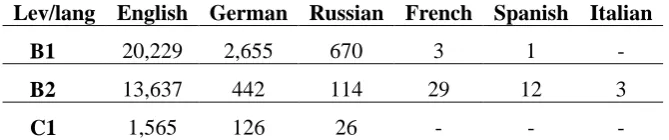
Table 3. Numbers of students taking school-leaving examinations in foreign languages
Last year, Slovakia introduced language examinations in English and German at CEFR level C1. It was a request of bilingual school head teachers who wanted their students to prove their language competence after studying these languages intensively in bilingual schools or bilingual sections in secondary schools. This year, Russian was added into the list of C1 language examinations.
In general, Slovak teachers of English could not give any examples of the country’s support for language education. Some of them expressed their demotivation as no institution in Slovakia offers summer courses in English-speaking countries, on the contrary with educational or cultural institutions promoting their language and/or culture (e. g. the Goethe Institute, Institute Français, etc.)Those teachers of English who are not satisfied with their level of language competence usually attend extra classes in language schools or private lessons with native speakers. Some of them (33.33%) regularly travel to the UK with their students for a short educational or excursion trip. They spend a lot of time organising them with intent to be in regular contact with real language and target culture. The respondents were critical to the issues related to watching films in the original language and were negative about extra costs for buying extended offers of channels from the internet providers if they want to have channels such as BBC, Sky News or CNN.
During discussions teachers presented their own experiences either with addressing people in the street asking them questions in a foreign language or with the school management. It is possible to conclude that there is still a large number of people that claim themselves as not speaking any foreign language or not being satisfied with the level of proficiency they could achieve during their primary and secondary school education. On the other hand, it is important to mention that it is still quite common that when applying for a job, applicants are not required to provide evidence about their proficiency level in English or any chosen foreign language. A similar situation seems to be recognisable in government offices when a large number of employees do not speak fluent English, even the official representatives of universities or the school management do not need to justify their language competence when being interviewed.
Teachers were not aware of the official document concerning language policy, knowing nothing about the documents in which language policy is based on supporting mother tongue acquisition. The European documents support plurilingualism and the Slovak national curriculum introduces English in primary education and two languages are requested in lower-secondary education. The expected levels of proficiency at the end of lower-secondary education in foreign languages are: English at CEFR level A2 and the second foreign language at A1. Despite the fact that the concept of plurilingualism is supported by the European Union, teachers of foreign languages feel confident mostly in one language and do not apply plurilinguistic approaches to language teaching in their language class.
3. CONCLUSIONS
Page 33
This goal is achievable through putting great emphasis on language acquisition, which in many countries is to be supported by official language education. The aims of language education should be clearly set in national curricula for languages. According to the data taken from the questionnaires, Slovak teachers of English have heard about CEFR levels, but have not been trained to become familiar with particular descriptors and specific scales referring to communicative language activities. Their awareness of proficiency levels is based on their teaching experience rather than descriptors or illustrative samples. The CEFR means a paradigm shift in the whole of language education, bringing a new, empowering vision of the learner. It is a tool to assist the planning of language curricula, courses and examinations by working backwards from what the learners need to be able to do in the language (CEFR CV, 2017). However, Slovak teachers use course books published in target countries, therefore they trust the reference levels their course books are labelled with on the basis of the CEFR proficiency scale. Many times course books replace national curricula as the latter are considered ambiguous. Thus teachers’ language syllabi are linked to the content of the course book rather than to the national curriculum. Some international publishers provide teachers with their own syllabi based on the material used in their course books.
Language policy should be based on society’s approach either to language acquisition or language learning. In case of language acquisition it is relevant to mention that Scandinavian countries such as Norway, Sweden or Denmark naturally support English acquisition as they do not dub films and every inhabitant can be exposed to a natural language spoken in English-speaking societies. This governmental support has resulted in no language learning in private language schools as languages are acquired naturally and systemised in school education.
Another good example is seen in the Netherlands where university courses offered in English prevail over those delivered in Dutch. Students are prepared for international communication in their field of study and do not need to attend extra ESP classes, in which special language related to their specialisation is provided.
In all the countries mentioned above, most people addressed in the streets use English fluently without being taken by surprise. It seems to be natural for them to learn English due to their historical contacts with the United Kingdom or their admiration of British culture. In recent years, it seems to be useful to learn English for a variety of reasons. English is spoken in every continent of the world and is entitled the ‘lingua franca’ of business, travel and international relations. Others call it world language number one.
On the other hand, the necessity to master English or other languages does not seem to be much emphasised in the Slovak context. Theoretically, Slovakia followed all the necessary steps. The documents essential for language education have been prepared and recognised by the ministry of education, however, without any visible impact on language acquisition. The number of language classes per week has increased in the national educational programme, but students are exposed to languages only during their language classes. Outside school, there is only one possibility to be exposed to languages – taking extra classes in private language schools, which is not affordable for every student due to fees.
Slovakia officially supports the EU concept of plurilingualism and multiculturalism. Nevertheless, in practice teachers of foreign languages are not prepared for using several languages in class as they usually study one foreign language in combination with other scientific disciplines, for example, History, Biology, Chemistry, etc. Using other languages apart from the mother tongue should become natural for the whole society, which has to require its social agents to use them effectively in everyday conversation, schooling and professional discussions.
Page 34 REFERENCES
Common European Framework of Reference for Languages: Learning, teaching, assessment 2001, Council of Europe, Strasbourg and Cambridge University Press, Cambridge.
Common European Framework of Reference for Languages: Learning, teaching, assessment. Companion Volume with New Descriptors, 2017, Council of Europe, Strasbourg.
Bérešová, J 2014a, ‘Teaching and testing are interrelated. But to what extent?’ Procedia – social and behavioural sciences, vol. 136, pp. 175-180.
Bérešová, J 2014b, ‘Assessing grammar and vocabulary – yes or no?’ Language, Individual & Society, vol. 8, pp. 158-166.
Page 35 APPENDIX A. QUESTIONNAIRE
Please, answer the questions by circling the most appropriate answer for you. If needed, describe your situation, using the space provided.
1) What do you consider most important in your teaching English? a) Grammar
b) Vocabulary
c) Communicative skills d) Intercultural communication e) Other
If your preference is e), please specify
2) How much of English do you use in your English class? a) I use only English
b) I switch from one language to another from time to time c) I switch from English to Slovak quite often
d) I use Slovak a lot due to a low level of proficiency of my students
e) I use Slovak a lot as I do not feel enough confident to use English all the time
3) Have you been ever trained as far as the CEFR is concerned? YES NO If yes – describe, please.
__________________________________________________________________________________ _______________________________________________________________________________ __________________________________________________________________________________
4) What are the concepts behind an action oriented approach? Define an action-oriented approach. __________________________________________________________________________________ _______________________________________________________________________________ __________________________________________________________________________________
5) What does the CEFR focus on?
Page 36 6) Assess yourself your proficiency level of the CEFR: A1 A2 B1 B2 C1 C2
Provide evidence to your claim
__________________________________________________________________________________ _______________________________________________________________________________ __________________________________________________________________________________
7) Define two competences, using your own words a) sociolinguistic
__________________________________________________________________________________ __________________________________________________________________________________
b) pragmatic
__________________________________________________________________________________ __________________________________________________________________________________
8) Indicate four modes of communication
__________________________________________________________________________________
9) How much are you familiar with the document concerning language policy in Slovakia?
a) very much b) certain parts c) have heard something d) do not care
10) Does the country support language education in general? YES/NO Identify