Page 287
UNIVERSITY FACULTY BELIEFS ABOUT STUDENTS WITH LEARNING DISABILITIES Nikolaos Trimmis, Andreas Bessas
Technological Educational Institute of Western Greece, Department of Speech Language Therapy, M. Alexandrou 1 - Koukouli, 26334, Patra, Greece
Abstract
The goal of this study was to determine the attitudes and beliefs of faculty members regarding the academic success of college students with learning disabilities. Ten faculty members from three universities in Greece completed an anonymous questionnaire. Analysis of the results revealed that most faculty members believe that students with learning disabilities can be successful at the college level when provided with appropriate interventions. Future studies should include larger faculty samples and evaluation of intervention outcomes in college students with learning disabilities.
Key words: faculty members, learning disabilities, questionnaire
1. INTRODUCTION
Today, as a result of legal reforms, more students with learning disabilities are entering higher education in Greece. Although these students still comprise a subgroup of the non-disabled population, their exact number is not known. In addition, there is a group of students with learning disabilities who choose not to disclose their disability for fear of stigma or discrimination. As a result, new challenges have emerged for postsecondary faculty members, particularly regarding accommodation requests for students with learning disabilities.
The provisions of Law 3699/2008, as amended by Article 28 of the Law 4186/2013, regulate the special education and training of candidates with disabilities and special educational needs or learning difficulties and mandate their rights to attend institutions of higher education. By Law 3699/2008 dyslexia was officially recognized as a disability in Greece and students holding a formal diagnosis of dyslexia are now able to be examined orally for entry to higher education.
Based on the above Laws, students and candidates of higher education with specific learning difficulties such as dyslexia, dysgraphia and dyscalculia are examined orally on request. Also, orally are examined students with complex cognitive, emotional and social problems, delinquent behavior due to abuse, parental neglect and abandonment or domestic violence.
Although these significant advancements have been made in Greece for providing access for students with disabilities in higher education settings, these students face a number of barriers during their studies that can result in longer time to complete their degree programs or higher dropout rate than students without disabilities.
These students are facing difficulties relating to spelling, writing, copying and numbers (McLoughlin et al., 1994). There are also weaknesses associated with time management, memorizing and recall of information, expression (especially written expression), or in taking notes during lectures (Gilroy and Miles, 1996), or in the writing of assignments or exams (Mortimore and Crozier, 2006).
Page 288
preparedness to teach the growing number of students with learning disabilities attending community colleges in Ontario and across Canada.
University faculty beliefs about students with learning disabilities are an important factor regarding the struggle that these students face in post-secondary education. Students with learning disabilities have indicated that university faculty does not understand the issues they face in pursuing a college education (Cook, Gerber, & Murphy, 2000).
The beliefs of university instructors regarding students with learning disabilities shape their behaviors that are important determinants of the quality of higher education experiences for these students. Therefore, the beliefs and behaviors of university faculty members are crucial for the success of students with learning disabilities in higher education. For example, the traditional methods of instruction and testing in higher education institutions do not accord with the learning needs of many students with learning disabilities. Therefore, faculty members are required to make various reasonable teaching and examination accommodations for these students such as allowing extra credit through assignments, overlooking misspellings or incorrect grammar and lecture recording. On the other hand, some university faculty members could perceive these accommodations as providing an unfair advantage to students with learning disabilities. Without a basic understanding of the characteristics of learning disabilities, faculty members may believe that learning-disabled students are trying to take advantage of or cheat the system (Williams & Ceci, 1999).
The objective of this study was guided by the above issues and attempted to determine the attitudes and perceptions of faculty members towards the academic success of college students with learning disabilities. It is the authors’ opinion that this effort is necessary because it has been shown that university education for learning disabled people helps to highlight their assets and positive features, which are required by science and society in general when they enter the market.
2. METHODOLOGY 2.1. Participants
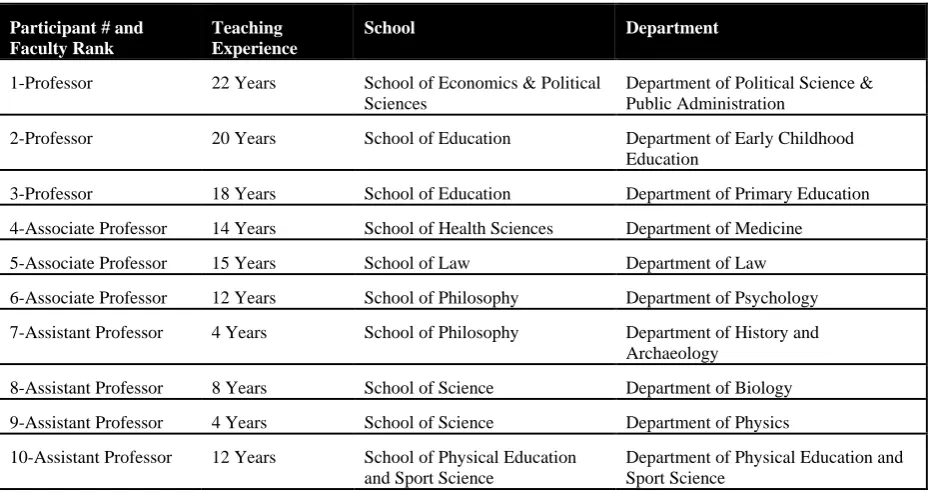
Page 289 Participant # and
Faculty Rank
Teaching Experience
School Department
1-Professor 22 Years School of Economics & Political
Sciences
Department of Political Science & Public Administration
2-Professor 20 Years School of Education Department of Early Childhood
Education
3-Professor 18 Years School of Education Department of Primary Education
4-Associate Professor 14 Years School of Health Sciences Department of Medicine
5-Associate Professor 15 Years School of Law Department of Law
6-Associate Professor 12 Years School of Philosophy Department of Psychology
7-Assistant Professor 4 Years School of Philosophy Department of History and
Archaeology
8-Assistant Professor 8 Years School of Science Department of Biology
9-Assistant Professor 4 Years School of Science Department of Physics
10-Assistant Professor 12 Years School of Physical Education
and Sport Science
Department of Physical Education and Sport Science
Table 1. Representation of faculty sample included in the study
2.2. Procedure
An email invitation to participate in the survey questionnaire was sent out twice to all 24 permanent full-time instructors. All of the instructors informed that they should not participate if they had not an experience of a minimum of several students identified with learning disabilities. Teachers who do not have personal experience with learning-disabled individuals are less likely to deal with the issues learning-disabled students face or provide personalized support (Matthews, et al., 1987).
A letter of information and the questionnaire were attached to the invitation to participate. Completion of the survey was not required and considered voluntary. Due to sensitive content and the potential risk of instructors to give dishonest responses, the instructors were informed that the survey was anonymous and none of their responses would be linked to their names. According to Paulhus (1984), anonymity on survey questionnaires reduces social pressure, and thus may likewise reduce social desirability bias.
In order to verify the clarity of the questionnaire items and the time required to complete, the questionnaire was administered to two instructors who were not part of the data collection group. As a result, none of the items was changed. The average length of time for completion of the survey should take about 10 minutes.
2.3. Material
Page 290
A five point Likert Scale, ranging from 1 (strongly agree) to 5 (strongly disagree), was adopted for each item. A Likert Scale is an ordinal scale that measures levels of agreement/disagreement in order to obtain quantitative data.
1 I believe that students with documented learning disabilities can be successful at the university level.
2 I believe that all students can learn the course material regardless of their individual needs.
3 Providing accommodations to students with disabilities will ensure equal opportunity and success in postsecondary education settings.
4 I believe that all students with documented learning disabilities will benefit from recording class sessions when necessary.
5 It is fair to change the method of responding on exams (e.g., from written to oral) for students with documented learning disabilities.
6 Students with learning disabilities should be allowed to use accommodations in class even when such accommodations are not permitted for use by students without disabilities.
7 I believe that I should incorporate some flexibility in my evaluation methods, such as providing different exam formats for learning-disabled students.
Table 2. The seven items of the survey questionnaire that indicate positive attitudes.
8 I believe that students with learning disabilities use the disability as an excuse when they are not doing well in class.
9 I believe that students with learning disabilities cannot perform as well as the rest of the students in higher education classes.
10 Faculty members feel overloaded when students with learning disabilities request accommodations.
11 Faculty members feel that it's too late to help learning-disabled students in higher education settings by providing accommodations.
12 Providing teaching and/or exam accommodations to students with learning disabilities is unfair to students without disabilities.
13 I believe that accommodations, such as extended time on exams or use of assistive technology, are not helpful for students who have documented learning disabilities.
14 Faculty members are not necessarily required to provide requested accommodations to students with learning disabilities.
Table 3. The seven items of the survey questionnaire that indicate negative attitudes.
15 I believe that the syllabus should include a statement regarding students with learning disabilities to discuss their needs with the teacher.
16 All faculty members should meet with students with learning disabilities to discuss their disability-related accommodation needs.
17 Faculty members should make a statement in class inviting students with disabilities to discuss their needs with their instructors.
Table 4. The three items of the survey questionnaire that point out the importance of communicating with learning-disabled students.
18 I believe that I have the necessary skills to teach students with learning disabilities.
19 I believe that faculty members will be more responsive to the needs of students with learning disabilities, by receiving official training related to understanding and teaching students with disabilities.
20 I believe that I do not have sufficient knowledge to ensure equal opportunity for students with learning disabilities.
Page 291 3. RESULTS
The Likert scale scores from the questionnaire were imported from the survey spreadsheet to Microsoft Excel and visually screened for missing data. Figures 1 and 2 present the visualization of participant responses for questionnaire items 1-7 and 8-14 respectively.
Figure 1. Participant responses for questionnaire items 1 through 7.
Figure 2. Participant responses for questionnaire items 8 through 14.
Of all the instructors-responses (n=70) in the first seven questionnaire items that indicate positive attitudes of faculty members toward students with learning disabilities (Figure 1), 68.6% (n=48) were positive (agree strongly and agree), 12,85% (n=11) were undecided (neutral) and 12,85% (n=11) were negative (disagree and strongly disagree).
Page 292
that 72,85% (n=51) of the responses were negative, 12,85 (n=9) were undecided and 14,3% (n=10) were positive.
Figure 3 presents the cumulative results of the positive (items 1-7) versus the negative attitudes (items 8-14) responses of the 10 instructors that participated in the present survey.
Figure 3. Cumulative responses for items 1-7 (positive attitudes) and 8-14 (negative attitudes) respectively.
The next three statements of the questionnaire (items 15-17) explore the significance of understanding the importance of contacting students with learning disabilities as a strategy to support them in order to improve their success in higher education (Figure 4). Most of the responses on these items (83,3%, n=25) agreed on inviting students to discuss their needs.
Figure 4. Responses for items 15, 16 and 17 of the questionnaire.
Page 293
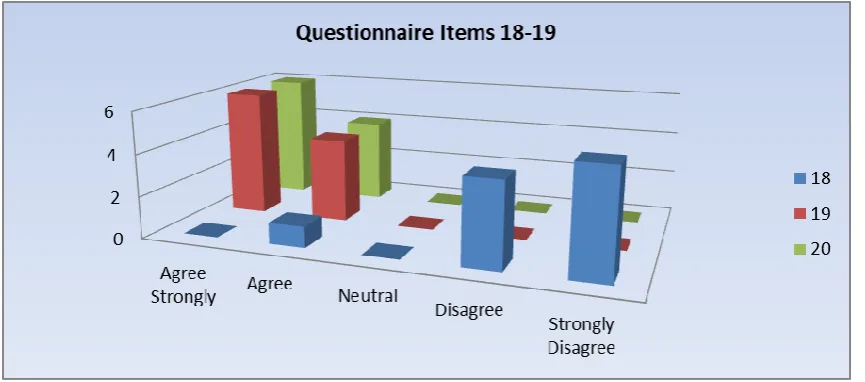
(n=10) responded positively (agree strongly and agree), which means that they feel unprepared for this task (Figure 5).
Figure 5. Responses for items 18-20 of the questionnaire.
Also of interest is that all participants (n=10) responded positively on the Likert Scale item 19 “I believe that faculty members will be more responsive to the needs of students with learning disabilities, by receiving official training related to understanding and teaching students with disabilities”. This response rate indicates that specialized training to acquire knowledge about students with learning disabilities and/or how to teach them is essential in higher education.
4. DISCUSSION
An important objective of each post-secondary institution should be the integration of learning-disabled individuals and the successful completion of their studies. Today, the need for professional and social improvement guides more and more young people, including those with learning disabilities, to seek admission to institutions of higher education. Graduates of a university program have greater earning power and rates of employment than those who have not attended post-secondary school (Hansen, 2013).
The purpose of this study was to explore the attitudes and perceptions of faculty members in Greece towards the academic success of college students with learning disabilities. The results of the study included the development of a questionnaire to measure higher education instructors’ attitudes and perceived knowledge regarding students with learning disabilities. The instrument is originally comprised of 20 items divided in four parts.
The quantitative findings of this research on higher education teachers showed that the vast majority of teachers have positive attitudes toward students with learning difficulties. Also, most of them felt that students with learning disabilities could be successful when provided with accommodations. It is interesting to note that responses on the fifth questionnaire item, regarding oral examination instead of written, were not unanimous despite corresponding legislation.
Page 294
Another interesting finding is that most teachers agreed on the significance to communicate with learning-disables students in order to facilitate their needs. Teachers who have experience with a learning-disabled student are more likely to recognize learning-disability in other students and to provide support, which further enhance their understanding of learning disability issues. It is important for educators to develop empathy, to understand the learning difficulties, frustrations and stress that a student with dyslexia faces daily (Wadlington et al., 2008). Students feel successful in courses where clear, consistent expectations are set from the beginning of the course and a variety of instructional strategies are employed by the professor. Institutions of higher education must provide teachers information on the legislation and on the policy of the institution, in order to raise their awareness as to how that can facilitate the needs of learning-disabled students (Quinlan et al., 2012).
Moreover, all of the participants believed that they don`t have the appropriate knowledge and training to offer support to students with learning disabilities. Of the ten instructors, only one (10%) stated that he/she felt prepared to teach students with learning disability, perhaps through experience and educational background. The instructors felt that that professional development information and training would be valuable to them. These results stress the lack of information and education of the faculty for learning disabilities issues. Post-secondary education teachers need further training and education through a continuous, lifelong process to contribute effectively in the teaching of learning-disabled students.
It is important that the findings of this investigation be considered in the context of a number of limitations. It appears that there are issues that merit further investigation. Sample size and the fact that all participants involved in the survey were located in Athens. The findings may not generalize to other locations or populations. Further research seems warranted to more adequately describe the knowledge of contemporary university faculty members regarding students with learning disabilities. Evaluation and intervention outcomes in students with learning disabilities should also be included. Although the straightforward nature of the statements supports face validity, a next step would be to verify the validity and reliability of the questionnaire on a wider population of university instructors. Also, another thing that needs to be examined in future studies is the differences that may exist between educators’ beliefs and their actual practices. Schumm and Vaughn (1991) reported that K-12 teachers did not actually make accommodations for students with disabilities at the same levels as their beliefs and skills.
However, despite the above limitations, the present study shows evidence that this questionnaire can be used as a tool for assessing university faculty attitudes and perceptions of learning disability. It may be used by higher education administrators as a tool to examine instructors` willingness to provide accommodations and to adjust their instruction on the needs of the learning-disabled students.
5. CONCLUSION
The questionnaire developed in this study is short and easy to administer. The use of this instrument opens several avenues for further investigation. The present results reveal that more could be done to support students with learning disabilities and the faculty that teach them.
It is clear from this study that university instructors are underprepared for the task of teaching students with learning disabilities, despite having positive attitudes towards them. This is especially important considering the increased number of students with learning disabilities enrolling in higher education in Greece.
Page 295 REFERENCES
Cameron, H. and Nunkoosing, K. (2012). Lecturer perspectives on dyslexia and dyslexic students within one faculty at one university in England. Teaching in Higher Education, 17, 341-352.
Cook, B. G., Gerber, M. M., & Murphy, J. (2000). Backlash against inclusion of students with learning disabilities in higher education: Implications for transitions to post-secondary environments. Work: A Journal of Prevention, Assessment, & Rehabilitation, 14, 31-40.
Gilroy, D.E. and Miles T.R. (1996). Dyslexia at college (2nd ed). Abingdon: Routledge.
Hansen, D. Kathryn (2013). “College instructors’ preparedness to teach students with learning disabilities”, Master thesis, The University of Western Ontario, Canada.
Lombardi, A.R. & Murray, C. (2011). Measuring university faculty attitudes toward disability: Willingness to accommodate and adopt Universal Design principles. Journal of Vocational Rehabilitation, 34, 43-56.
Matthews, P. R, Anderson, D. W., & Skolnick, B. D. (1987). Faculty attitudes toward accommodations for college students with learning disabilities. Learning Disabilities Focus, 3, 46-52.
McLoughlin, D., Fitzgibbon, G., and Young, V. (1994). Adult dyslexia: assessment counselling and training. London: Whurr.
Mortimore, T. and Crozier, W.R. (2006). Dyslexia and difficulties with study skills in higher education. Studies in Higher Education, 31, 235-251.
Murray, C. Wren, C.T. & Keys, C. (2008) University faculty perceptions of students with learning disabilities: correlates and group differences. Learning Disability Quarterly, 31, 95-113.
Paulhus, D. L. (1984). Two-component models of socially desirable responding. Journal of personality and social psychology, 46(3), 598.
Quinlan, M.M., Bates, B.R. and Angell, M.E. (2012). What can I do to help? Postsecondary students with learning disabilities perceptions of instructors. Journal of Research in Special Educational Needs, 12, 224-233.
Quinlan, M.M., Bates, B.R. and Angell, M.E. (2012). What can I do to help? Postsecondary students with learning disabilities perceptions of instructors. Journal of Research in Special Educational Needs, 12, 224-233.
Schumm, J. S., & Vaughn, S. (1991) Making adaptations for mainstreamed students: General classroom teachers’ perspectives. Remedial and Special Education, 12, 18-27.
Taylor, M.J., Duffy, S. and England, D. (2009). Teaching students with dyslexia in higher education. Education & Training, 51, 139-149.
Vogel, S.A., Holt, J.K., Sligar, S., & Leake, E. (2008) Assessment of campus climate to enhance student success. Journal of Post-secondary Education and Disability, 21, 15-31.
Wadlington, E., Elliot, C. and Kirylo, J. (2008). The dyslexia simulation: impact and implications. Literacy Research and Instruction, 47, 264-272.