by P. Byde*
Recent decades have witnessed both the expansion of old established professions and the emergence of new ones, providing an ever-broadening range of services. Within the context of an increasingly industrial, technological and socially-conscious society, potential clientele for the modern lawyer ranges from the multinational organisation to the individual minority-group member. Moreover, since legal expertise rests in an aggregate of decisions concerning social behaviour and values, rather than a techno-scientiflc base, as for other professions, social change further compounds the complexity of the lawyers task. As Sexton and Maher summarize:
Lawyers have occupied a more important social, political and economic position than most other occupational groups in the community. And they are dealing with a commodity — justice — that lies at the heart of our social system. (1982:179) This crucial position of professionals in society, especially that of lawyers, has been the source of considerable controversy for some time. The professional group is granted freedom, self-regulation and status, in trust that it will operate both ethically and efficiently on behalf of society. Definitions of professionalism include such factors as: formally qualified knowledge, autonomy, organised codes of conduct, monetary and symbolic rewards for practice, and work directed towards community or cultural benefit (Maley, cited Boreham et al, 1970 p.6). It is this last dimension of service-orientation which has been examined most critically during recent decades of social reform, when operation within a highly developed and competitive market economy has led to a tenuous balance between community service and individual reward.
In his classic, functionalist appraisal of the professions, Parsons emphasised the 'strategic significance in our society of a set of occupational groups which are not either in their own opinion or by and large in the public estimation, devoted mainly to the goal of their own profit, but rather in some sense to "service" namely the professions' (1964:370-371). Within this framework he described the role of lawyers as follows:
They are expected to provide a "service" to the public within limits without regard to immediate self-interest. The lawyer has a position of independent responsibility, so that he is neither a servant only of the client, though he represents his interests, nor of any other group, in the lawyers case, of public authority. (1964:381)
By contrast, Marxist and conflict critiques have challenged this 'myth' of service, emphasising the structural constraints and power pressures of negotiation within a capitalist, free enterprise economy (Johnson, 1972; O'Malley, 1980). Tomasic identifies 'cynical realism' as the prevailing ideology among modern lawyers, an orientation which he describes as:
far more in keeping with capitalist society than the aristocratically-based ideal of service. This may tend to limit the responsiveness of lawyers in broader social problems, as they have continued primarily to serve middle class and business interests. (1983:473)
In general, then, there are two approaches to the study of professionals: one which sees them as functional for society, performing tasks in a disinterested and collectively
*B.A. (N.Z.), B.Ed. (Hons.) (Camb.), M.Ed.St. (Qld).
orientated manner, and the other perceiving them as agents of those who exercise powei and whose work is, to an important degree, legitimating rather than appraising the powei bases of society. The system of law can be seen as either the legitimated form of social order or as a rationalisation for infrastructural power relationships and competing interests within society.
Whatever the dominant orientation of the group, it is the process of professional socialization which ensures the transmission of professional sub-cultures to successive generations of practitioners. Legal socialization involves not only learning the significance^ of legal decisions and the skills through which they are achieved, but also internalizing the; central codes and values of the legal community. In order to examine this learning process, Anderson and Western commenced a longitudinal study of the professional socialization of students in the fields of law, medicine, engineering and teaching in 1965. The study: investigated the social origins of students, their reasons for choosing their careers, thej development of career and role expectations and attitudinal profiles of the four groups, j Research is still being conducted among members of the original sample of 645 lawyersf who were enrolled for their first year at the Australian National University and the! Universities of Melbourne, Monash, New South Wales, Queensland and Western Australia!
twenty years ago. I At that time, the social profile of the trainee lawyers showed them as coming fromj
predominantly middle and upper class backgrounds. Over sixty per cent of trainee lawyers f came from professional or managerial backgrounds, with more than double the proportion j of students being from the homes of owners and managers of large business than in the j other faculties. Over twenty per cent of the students were from homes where the income 1 was over $8000 ($37,254 by C.P.I, in June, 1985). Lawyers were more likely than their j contemporaries in other faculties to have parents with university education, a third of the j group had been to independent schools and slightly more than a quarter had been to Catholic schools.
It seemed that the nature of professional services might be considerably influenced by j the fact that most trainee professionals came from a background far removed from that of j the majority of their clients. Furthermore, attitudes to professional practice varied ]
considerably. j The choice of law as a career centred round two factors identified as 'status concern' — a j
desire for a high status career, and 'professional orientation' — a desire to practise and an ! interest in the role of law in society — (Anderson, Western and Boreham, 1978), a dichotomy which seems to reflect the previously discussed dimensions of professionalism. The researchers concluded:
Profiles were obtained from statements made very early in their courses but, interestingly, they persisted and the two major dimensions were seen as orienting a great deal of the students' activities... Status concern had to do essentially with extrinsic rewards which were likely to derive from professional practice, while professional orientation concerned matters of more intrinsic nature to the profession. (Anderson, Western and Williams, 1982:13)
Since the time of the original study, the growth of the professions has been accompanied by a parallel growth in tertiary courses for professional trainees. Moreover the intent of 'democratization' of education has led to changes, such as the restructuring of the tertiary sector, the abolition of fees, introduction of TEAS, encouragement of minority and 'disadvantaged' groups, all of which might be expected to have produced a broadening in the social origins of recruits with some accompanying effect on their perceptions of their 'status' and 'service' professional roles.
new type of student. In contrast to the university courses, it was explained, the colleges were established to 'offer courses at the tertiary level in the technologies which dominate the day-to-day practice of their specialities' to students who had already chosen their careers (Richardson, 1972:3). The most recent report of the Commonwealth Tertiary Education Commission for, 1985-87, again states that 'the Commission reiterates that the primary role of the C.A.E.'s is to provide vocationally oriented courses.' (1984:50) The colleges have a specific task of professional socialization. In the light of these changes, it was considered of interest to seek some measure of comparison between the original group of university lawyers and a sample of students enrolled at a College of Advanced Education, in order to discover any differences in the social origins and professional orientations of beginning trainees. It was hoped also to obtain a first year university law sample so that university and CAE students could be compared, but this was unsuccessful.
The CAE course to be studied was established in 1975, and the first LL.B students were enrolled in 1977. A Graduate Diploma in Legal Practice was introduced in 1978. There are more than 1,000 students enrolled in the course, studying full or part time, or externally. The minimum tertiary entrance scores for entrance to the course in 1985 were 935 (F.T.) and 937 (P.T. and External). The aims of the Law School are to provide courses in legal concepts, principles and moral responsibilities, as well as broadening the general educational abilities and experience of the students. In line with the mandate of the CAEs, one crucial aim is 'to provide as practical an education as possible', a theme which was echoed in students explanations of why they chose the course, for a quarter of those who said that the CAE course was their first preference mentioned the importance of its practical nature.
An updated version of the original Anderson and Western questionnaire was administered to students during the first week of their second semester. The structure of the present sample according to type of enrolment, is similar to that of the original group, although, in fact, the CAE has a far larger proportion of part-time and external students overall.
TABLE 1
COMPARISON OF 1965 AND 1985 GROUPS BY ENROLMENT
(Column percentages)1965 1985 (n = 646) (n= 143)
Full-time Part-time External
77 19 4
74 13 13
having previous experience as law clerks — 23 per cent in 1985 in comparison to 9 per cenf in 1965 — is probably due to the larger numbers of external students in the current sample. J
i
SOCIAL CHARACTERISTICS OF STUDENTS ENTERING LAW |
Proportions of males and females enrolled J
The difference between the two groups which is most immediately apparent is in thet balance between the sexes. Although the participation of women in CAEs has accelerate^ over the last two decades, conventional distinctions between traditionally 'masculine' and 'feminine' fields have remained more marked in CAEs than in the Universities. (Andersoni & Vervoorn, 1983:57) Between 1970 and 1981, for example, the proportion of women in! commerce and business studies has risen from 9.5 per cent to 27.6 per cent, while! proportions enrolled in engineering rose from .4 to 1.7 per cent in the same period, f
Separate figures for women enrolled in Law in CAEs are not available, but the proportion! of women enrolled in Law at universities rose from 11.4 per cent to 34.6 per cent betweenj
1965 and 1980 (Anderson and Vervoorn, 1983:52). This shift in proportions is clearlyf
reflected in a comparison between the original and present groups being studied: j
TABLE 2 1
CHANGES IN GENDER FROM 1965 TO 1985 I
(Column percentages) I
1965 1985
(n = 619) (n= 138)
Male 89 61
Female 11 39
A relevant finding from the Anderson and Vervoorn study of women's place in higher j education, which may relate to both parents and the present generation, is that 'women j students are more interested than men in those courses and occupations which offer |
opportunities for social service and working with people' (1983:3) j
Socio-economic backgrounds of students enrolled in Law
The current serious debate concerning the funding and availability of higher education j centres on the issue of access by candidates from all levels of the community. Attempts to) broaden opportunity through reforms in selecting and funding students have been counterbalanced by the effect of the economic recession since the late seventies, with the ever-increasing imposition of entry quotas for limited numbers of places and anxiety about employment influencing the choice of tertiary education. Although the numbers of students undertaking higher education have increased, both social-structural and motivational constraints have meant that the social backgrounds of students have not changed markedly over the years. Anderson and Vervoorn conclude:
institutions... Given the changes that have taken place in Australia since World War II, and in higher education especially, one might reasonably have expected participation to have become more representative of all social groups... Yet despite all these changes, the growth of numbers and demand for education is accounted for by greater participation from the middle ranking groups in society; there has been a slight reduction in the proportion drawn from the upper-class groups, but they remain over-represented by a factor of about 6. (Anderson and Vervoorn, 1983:170)
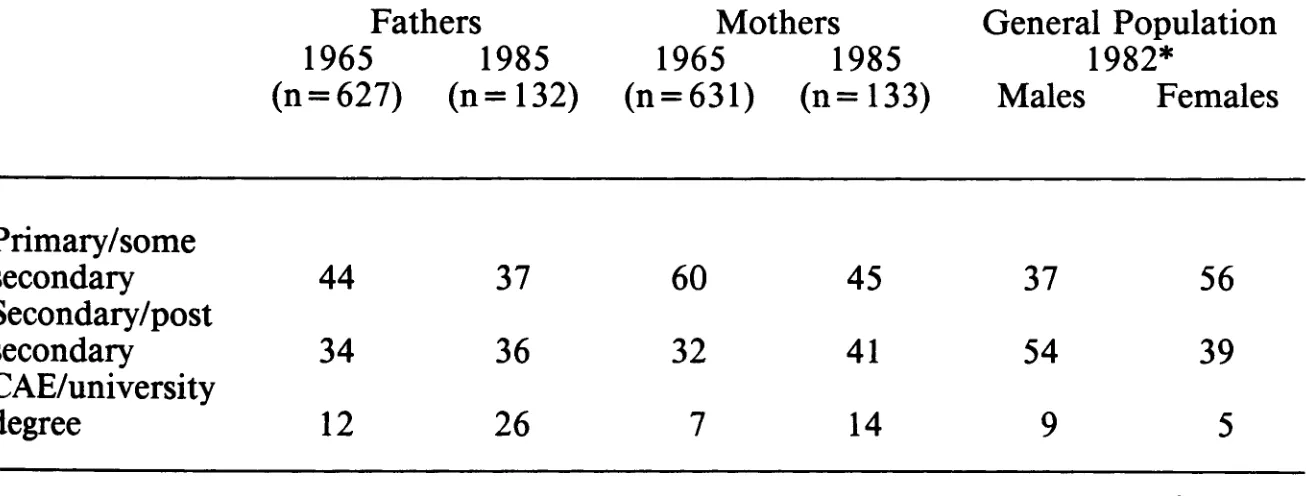
To determine if there have been changes in the social composition of law students from 20 years to the present day, the factors of parental education, occupation and income levels were re-examined. Table 3 presents the education levels of parents of the two samples.
TABLE 3
EDUCATION LEVELS OF PARENTS OF LAW STUDENTS FROM 1965 TO
1985
(Column percentages)
Fathers Mothers General Population
1965 1985 1965 1985 1982* (n = 627) (n= 132) (n = 631) (n=133) Males Females
Primary/some
secondary 44 37 60 45 37 56
Secondary/post
secondary 34 36 32 41 54 39
CAE/university
degree 12 26 7 14 9 5
*(A.B.S.) Clearly the proportions of parents with higher education for both mothers and fathers is larger today than it was two decades ago. The data indicates that mothers of the 1985 sample are still less likely than fathers to gain a tertiary qualification, however, proportionally more of them are likely to be in the secondary/post secondary category than fathers. Both parents have educational attainment levels well above the average for the general population.
TABLE 4
INCOME LEVELS OF PARENTS OF 1985 QIT LAW STUDENTS (Column percentages)
Fathers (n = 120)
Mothers (n = 124)
Less than 20,000 20,001 — 32,000 32,000 +
14
26
40
77 19 4
Despite the apparent drop in income levels, when considering father's occupation if 1965 and 1985, the data indicate that the proportion of students froii managerial/professional backgrounds has in fact increased by 5 per cent, with a decline in the proportion of entrants from blue-collar backgrounds. One must bear in mind, however, that there have been changes in the occupational structure, with blue collar occupations declining and lower white collar occupations increasing. Unfortunately, data concerning mothers' occupations was not collected in 1965, when approximately 30 per cent of married women were in the work force. The current data indicates that 32 per cent of mothers are working in a managerial or professional capacity, while in the broade^ population, among the 47 per cent of working women, only about 18 per cent are employed! at this level. (Bureau of Census and Statistics, 1985) Only twenty-three per cent of mothers! are not in some kind of paid employment, indicating that, not only are the mothers of thisl sample more likely to be employed, but also that they are employed at a far higher level!
than is usual for females. I TABLE 5
PARENTAL OCCUPATION OF 1965 AND 1985 LAW STUDENTS (Column percentages)
Managerial/professional Clerical/sales/service Blue collar
Domestic duties
1965
Fathers Mothers (n = 622)
65
11
24
Fathers 1985 Mothers (n= 136) (n= 133)
70 13 15
32 35 9 23 Levels of Religiosity among Students
As religiosity has been shown to be related to aspirations of altruism respondents were asked questions regarding their belief in the existence of God and Z " S S S T S S S attendance at religious services. Responses to these two items were then combmed to form
^ r f y ^ o n ^ s t e n t ^ T h ^
ll^T
6^ ^^oAt^^^
TABLE 6
LEVEL OF RELIGIOSITY OF LAW STUDENTS FOR 1965 AND 1985 (Column percentage)
1965 1985
(n = 392) (n= 133)
Low 36 35
Medium 26 31
High 38 35
Ethnicity
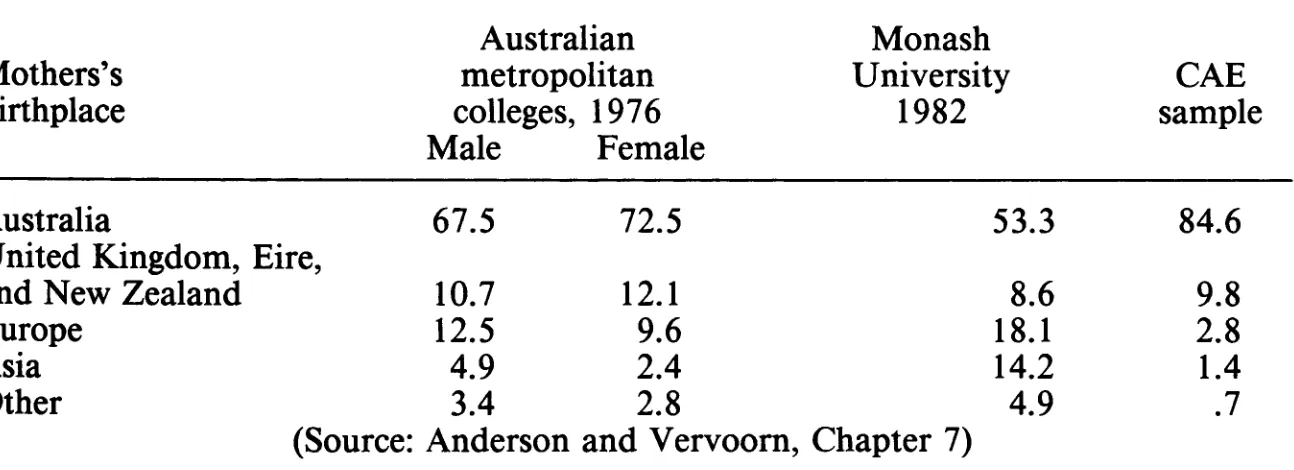
As in the original study, the great majority of students are Australian-born and came from Australian backgrounds. Researchers in the area have found that mother's
1 background is the most accurate measure of ethnicity, since it is she who tends to dominate ! cultural and linguistic family habits (Anderson and Vervoorn, 111). Using the measure of
mother's country of birth, our sample can be compared with other available data on student enrolments.
TABLE 7
PROPORTIONS OF NEW STUDENTS WITH SPECIFIC NATIONAL BACKGROUNDS
Australian Monash
Mothers's metropolitan University CAE
birthplace colleges, 1976 1982 sample
Male Female
Australia 67.5 72.5 53.3 84.6
United Kingdom, Eire,
and New Zealand 10.7 12.1 8.6 9.8
Europe 12.5 9.6 18.1 2.8
Asia 4.9 2.4 14.2 1.4
Other 3.4 2.8 4.9 .7
(Source: Anderson and Vervoorn, Chapter 7)
Even allowing for local population variations, students with other ethnic backgrounds seem under-represented in this sample (ethnicity was not asked in the 1965 sample). Family Contacts
Since Law is identified as a 'familial' profession, a final basis upon which the two samples were compared was the strength of family connections in the profession. Again, results were very similar to those of the earlier group, but there was a slight drop in proportions of respondents stating that they had either family members or close friends who were solicitors, (33 per cent in 1965 to 30 per cent in 1985) barristers, (22 per cent in
1965 to 19 per cent in 1985) and judges, (9 per cent in 1965 to 7 per cent in 1985). REASONS FOR ENTERING LAW
possibly important factors, including impressions of the profession, their scholastij performance and the influence of others upon their decision to study law, and were asked t| indicate the level of importance of each factor in their decision to commence a law course. J Results for both examples are remarkably similar, considering the twenty year tim| difference. Over two-thirds of students indicated that the subject matter of law, financii attractiveness, a desire for professional career and a desire to practice law had all beet major factors in their decision.
Approximately one half of students also said that a desire to be independent of bosses, at interest in the maintenance of individual liberties and civil rights, a desire to use law as stepping stone into politics, business or government, a good performance in appropriate school subj ects and the high social standing of the legal profession had been important.
The major shifts in opinion over time have occurred with judgement of the important of'high social standing of the profession' and 'interest in debating and similar activities.' Ii the former instance the percentage indicating that professional status is very/somewhat| important has increased by 20 per cent to 64.3 per cent in 1985; while the latter ha|
declined in importance by 13 per cent to 36.4 per cent. I Generally speaking, factors such as failure to gain admission to course of first preference;!
lack of qualifications for other courses; influence of relatives other than parents, closef family friend or friends, teachers at school and careers advisors are not important!
considerations when the decision to study law is made. | To determine if there were any underlying independent structures in the data, whereby^
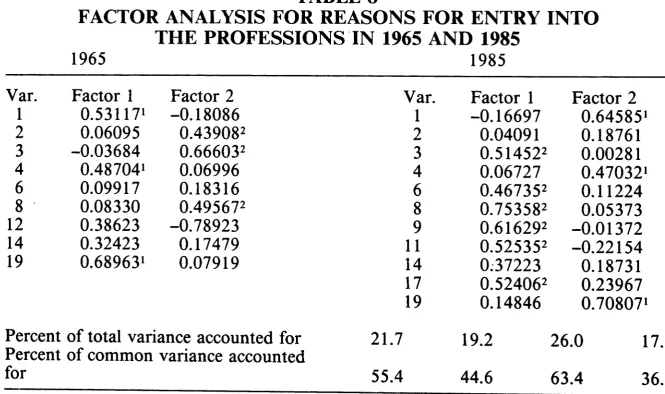
groups of items could be combined to measure a single concept, these 19 items were! subjected to factor analysis for both 1965 and 1985 data. Principal components were! sought, and 'skewed' items eliminated, allowing for a two-factor solution. Table 8 shows
the two factors and loadings of each variable after varimax rotation; \ i
TABLE 8 1 FACTOR ANALYSIS FOR REASONS FOR ENTRY INTO
THE PROFESSIONS IN 1965 AND 1985
1965 1985
Var. Factor 1 Factor 2 1 0.531171 -0.18086
2 0.06095 0.439082
3 -0.03684 0.666032
4 0.487041 0.06996
6 0.09917 0.18316 8 0.08330 0.495672
12 0.38623 -0.78923 14 0.32423 0.17479 19 0.689631 0.07919
Percent of total variance accounted for Percent of common variance accounted for
F1 = professional service
F2 = professional pragmatism
Var. Factor 1 Factor 2 1 -0.16697 0.645851
2 0.04091 0.18761 3 0.514522 0.00281
4 0.06727 0.470321
6 0.467352 0.11224
8 0.753582 0.05373
9 0.616292 -0.01372
11 0.525352 -0.22154
14 0.37223 0.18731 17 0.524062 0.23967
19 0.14846 0.708071
21.7 19.2 26.0 17.1
, At first glance it would appear that there are two different structures underlying the t analyses at the two time periods. However, closer inspection suggests hat there is a
similarity. The first factor for 1965 has three variables with loadings above .4 and these e items correspond exactly to the items extracted for the second factor of the 1985 factor : analysis; an interest in the subject matter of law, an interest in the maintenance of i individual liberties and civil rights and a desire to practice law. In combination, this factor
was identified as a 'professional service' orientation,
i The second factor for 1965 has three items; a desire to be independent of bosses, the i financial attractiveness of legal practice and the relatively high social standing of the legal
profession, of which the last two correspond to the first factor of 1985. This factor now includes the further dimensions of good performance in appropriate school subjects, desire for a professional career, the influence of parents and admiration for persons in the legal profession, (perhaps reflecting the influence of quota restrictions and employment concerns). The second factor was labelled as 'professional pragmatism', since it shows less interest in the actual process and the social role of law than in the rewards of practice. Thus, at both times, we have been able to identify what we have called a professional/service orientation and a pragmatic orientation to law.
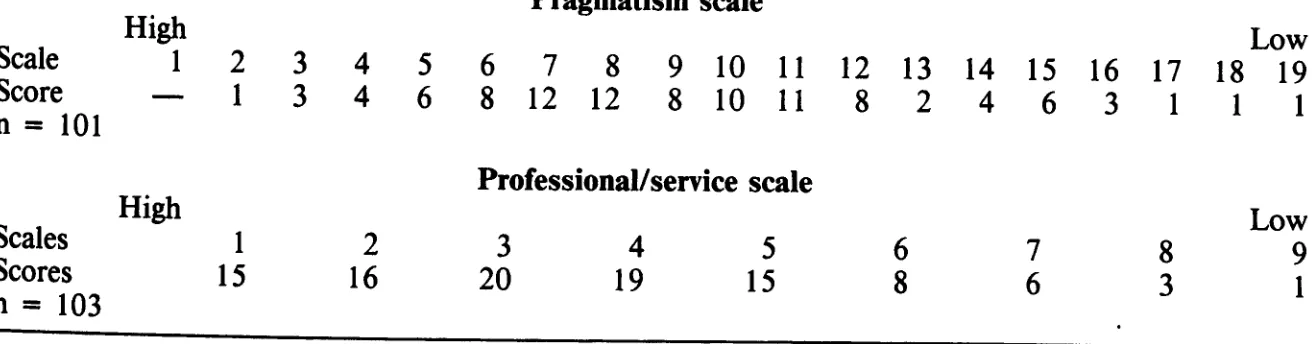
As we are particularly interested in the 1985 sample, it was decided to create two scales from the two sets of items extracted from the factor analysis of the 1985 reasons for entry as a basis for future analysis.
Items were coded to measure strength of response and tested for scaleability by inter-item correlation and cronbach alpha. (Pragmatism, cronbach alpha = .73033, Service, cronbach alpha = .61929). A nineteen point scale was structured measuring Pragmatism and a ten point scale indicated Service orientation.
The distributions are shown below in Table 9.
TABLE 9
DISTRIBUTION OF STUDENT SCORES ACROSS THE TWO SCALES
Pragmatism scale
c i Hig!1 . L o w
S c a l e 1 2 3 4 5 6 7 8 9 10 11 12 13 14 15 16 17 18 19
Score — 1 3 4 6 8 12 12 8 10 11 8 2 4 6 3 1 1 1 n = 101
High
n = 103
Professional/service scale
Low
Scales 1 2 3 4 5 6 7 8 9
Sc°res 15 16 20 19 15 8 6 3 l
The motivation of sub-groups within the sample
We next attempted to determine whether different sub-groups within the sample systematically showed different reasons for deciding to enter law. To rationalise measurement, each scale was collapsed into three categories: high, medium, low, with approximately equal numbers in each category and gender, socio-economic status, and religiosity were cross-tabulated to seek relationships with the two scales measuring reasons for entry into the profession.
There was no significant differences on the two scales with regard to parents' education, occupation or income. Religiosity was not related to either measure. However, there were differences between the sexes. Table 10 presents the data.
TABLE 10
SEX OF THE RESPONDENT AND THE SCORE ON THE TWO SCALES (Column percentages)
Males Females
Pragmatism scale
High 29 11
Medium 24 43
Low 48 46
Professional/service scale
High 47 56
Medium 32 32
Low 21 13
The cross-tabulations show that a much higher proportion of males than females (29 per cent compared to 11 per cent of females) indicated pragmatic reasons for entering law. This trend is reversed slightly for the professional/service measure. Fifty-six per cent of females indicated this concept as very important compared to 47 per cent of males. Not only do these findings give evidence of the continuing differences between male and females with regard to career-orientation and, perhaps, assumed 'breadwinner' roles, but they also reflect noted propensity for females to opt for the service-related and people-oriented professions (Anderson and Vervoorn, 1983:54). Since gender is the key factor influencing orientation, and since there is a steady increase in the number of females entering the legal profession, an interesting line for future studies would be to invesitgate whether the influx of females changes the profile of the profession or whether females become more pragmatically oriented as they become an established sub-group.
IMAGES OF SUCCESSFUL PRACTITIONERS
It was considered that choice of profession and expectations about terms and conditions of practice would be influenced by the image which trainees have of 'successful' professionals.
Table 11
PERCENTAGE OF STUDENTS INDICATING THAT LISTED ITEMS WERE VERY IMPORTANT CHARACTERISTICS FOR A SUCCESFUL
PRACTITIONER IN 1965 AND 1985
1965 1985 Barrister Solicitor Barrister Solicitor
Status qualities % % % %
Attendance at Private School 7 5 17 12
Male 21 11 15 8
Australian born 4 2 12 8
Family background in field 2 2 6 4
Being married 5 5 4 4
Protestant 1 1 1 1
Personal qualities
Honesty and intergrity 69 75 52 52
Wisdom and maturity 48 42 50 46
Professional style
Able to communicate ideas 84 44 80 49
Meticulous attention to detail 61 62 48 45
Sustain hard work 55 48 56 51
Pleasing manner 52 40 60 44
Appearance of confidence 74 46 68 44
Knowledge and skills
Knowledge of history and
philosophy of law 34 21 20 5
Good academic record 17 11 21 13
Broad cultural knowledge 22 16 14 10
Administrative ability 9 25 5 25
Social relations
Ability to gain respect and
confidence of clients 69 73 65 66
Numerous professional contacts 49 41 41 36
Good relations with colleagues 45 41 31 30
Contribution to wider community
Active in community affairs 10 13 6 8
Concerns of community well being 31 31 23 21
Interest in people 44 41 27 29
Status factors
Personal qualities and professional style
While there has been virtually no change in the item concerning wisdom and maturity there has been a decline in the importance of honesty and integrity. For the professional style items, only in one instance concerning meticulous attention to detail, has there been any change in importance between 1965 and 1985. In 1985 the student lawyers saw this factor as more important for a success than in 1965.
Knowledge and skills
Two of the four items concerning knowledge and skills have declined in importance over the two decades. These items are 'knowledge of history and philosophy of law' and 'broad cultural knowledge'. There has been very little difference in the perceptions of importance of a good academic record and administrative ability.
Social relations
With regard to social relations, 'good relations with colleagues' has declined slightly in importance while there has been a slight decline in importance for the other two items in this group.
The wider community
Two of the variables concerned with the wider community have declined in their level of importance for success. Concern for the well-being of the community and an interest in people are not regarded as important for success as either a barrister or a solicitor for law students today compared to students enrolled in 1965 (which rose from 7 to 17 per cent for barristers and from 5 to 12 per cent for solicitors).
In general, there have been large changes in reductions of perceived importance, while increases are marginal, (in the order of between 1 and 7 per cent) except for the status item, attendance at private school.
It is of some interest that students place a very low value on the status measures yet the reality of their situation is very different. If we consider responses to various status characteristics for success as solicitor we find that 12 per cent of the sample in 1985 indicated that attendance at a private school was very important for success yet 51 per cent actually attended a private school; 8 per cent indicated being Australian-born was very important for success yet 90 per cent are actually Australian-born; and 4 per cent indicated a family background in the legal profession as important for success, yet 34 per cent of the sample actually have a relative in the profession.
This difference, between values and situational characteristics, raises the question of the relationship between structural and causal influences upon educational opportunities. Although students do not value the elements of their advantage, the structural constraints operating upon their career paths mean that those who have them are far more likely to accrue the added benefits of higher education.
Conclusion
Perhaps the most noticeable finding to emerge from these preliminary analyses is the remarkable continuity with the past. Socio-economic backgrounds are little different over 20 years, reasons for choice of the profession are little different and, with few exceptions, images of successful practitioners are much the same.
Western (1983) found the social backgrounds of medical students in 1979 was no different from a 1966 intake. He concluded:
there is no reason to suspect that Queensland medical students are atypical in terms of their social background. It is clear... that they are still a highly privileged group, and that access to prestigious professions is still very much class determined. (1983:59)
Social reform is in the control of those professions to whom the community has given both the freedom of autonomy and the trust of guardianship. A constant social background of privilege has vital implications for the role of the profession, in perceiving the need for change and being willing to invoke it. Certainly the factors identified in motivation to study law and the characteristics of success judged by these trainee lawyers illustrate the duality of the status and service dimensions of professionalism.
At this stage however, we were able to identify a clear 'service orientation' among these students, which offers the potential that future motivation on behalf of clients and the community may compensate for a lack of broad social experience. In preparation for practice in a social environment dominated by economic enterprise, the nurturing of this service role would seem a crucial part of the process of professional socialization. Or must we accept that, since the social backgrounds of the group have not changed, neither will the practice of law?
REFERENCES
Anderson, D.S, Western, J.S. and P. Boreham, 'Law and the Making of Legal Practitioners' in R. Tomasic,
Understanding Lawyers, Law Foundation of N.S.W., Sydney, 1978.
Anderson, D., Western, J.S. and T.H. Williams, Professional Socialization in Training and Work, paper delivered at Sociologyof Work Tenth World Congress of Sociology, Mexico, August, 1982.
Anderson, D. and A.E. Vervoorn, Access to Privilege: patterns of participation in Australian post-secondary education,
A.N.U. Press, 1983.
Boreham, P., Pemberton, A. and P. Wilson (eds.), The Professions in Australia: a critical appraisal, U. of Q. Press, 1976.
Cattell, R.B., 'The Screen Test for the Number of Factors' Multivariate Behavioural Research, 1966, 1, 245-276. Commonwealth Tertiary Education Commission, Report for 1985-87 Triennium, April, 1984.
Johnson, T.J., Professions and Power, London, Macmillan, 1972.
O'Malley,, P., 'Theories of Structural Versus Causal Determination: Accounting for Legislative Change in Capitalist Societies' in R. Tomasic (ed.), Legislation and Society in Australia', Law Foundation of N.S.W. and Angus and Robertson, 1980.
Parsons, T., 'A Sociologist Looks at the Legal Profession' in Essays in Social Theory, The Free Press, 1964. Richardson, S.S. 'A Role and Purpose for the CAEs' in G.S. Harman and C. Selby Smith (eds.), Australian Higher
Education, Angus and Robertson, Sydney, 1972, pp. 1-15.
Sexton, M. and L.W. Maher, The Legal Mystique: the role of lawyers in Australian Society, Angus and Robertson, Sydney, 1982.
Tabachnick, B.G. and L.S. Fidell, Using Multivariate Statistics, Harper and Row, New York, 1983.
Tomasic, R., 'Social Organisation Amongst Australian Lawyers', ANUS, 19(3), November 1983, pp. 447-473. Western, J., Social Inequality in Australian Society, Melbourne, Macmillan Company of Australia, Melbourne, 1983.