** Professor, Department of Mechanical Engineering,
Tatyasaheb Kore Institute of Engineering & Technology, Warananagar - 416113, Maharashtra (India) [email protected]
Abstract
Leaf spring are of the oldest suspension component they are still frequently used. The current leaf spring is multiple leaf spring types with a steel material. It has high weight, low natural frequency, high corrosion, more noise. Therefore current multiple leaf spring is replaced by mono composite (E- Glass epoxy) leaf spring which has high natural frequency, low weight etc. The maximum stress produced at the cylindrically joint than fixed joint. Therefore stress analysis of composite material mono leaf spring is carried out. The result of finite element method is verified with analytical calculation. Also compare the natural frequency by FFT analyzer with FEA. Key words: Leaf spring, FEM, natural frequency.
1 Introduction
In order to conserve natural resources and economize energy, weight reduction has been the main focus of automobile manufacturers in the present scenario. Weight reduction can be achieved primarily by the introduction of better material, design optimization and better manufacturing processes. The suspension leaf spring is one of the potential items for weight reduction in automobiles as it accounts for 10% - 20% of the unstrung weight. This achieves the vehicle with more fuel efficiency and improved riding qualities. The introduction of composite materials was made it possible to reduce the weight of leaf spring without any reduction on load carrying capacity and stiffness. Since, the composite materials have more elastic strain energy storage capacity and high strength to weight ratio as compared with those of steel, multi-leaf steel springs are being replaced by mono-leaf composite springs. The composite material offer opportunities for substantial weight saving but not always are cost-effective over their steel counter parts. The leaf spring should absorb the vertical vibrations and impacts due to road irregularities by means of variations in the spring deflection so that the potential Energy is stored in spring as strain energy and then released slowly. So, increasing the energy storage capability of a leaf spring ensures a more compliant suspension system.
According to the studies made a material with maximum strength and minimum modulus of elasticity in the longitudinal direction is the most suitable material for a leaf spring. Fortunately, composites have these characteristics. In the present work, a seven-leaf steel spring used in passenger cars is replaced with a composite multi leaf spring made of glass/epoxy composites. The dimensions and the number of leaves for both steel leaf spring and composite leaf springs are considered to be the same. The primary objective is to compare their load carrying capacity, stiffness and weight savings of composite leaf spring. Finally, fatigue life of steel and composite leaf spring is also predicted using life data. The objective of this paper is to calculate stresses, strength to weight ratio, dynamic loading condition, and stiffness & compare those with conventional steel leaf spring. For the accurate evaluation of above factor we use Finite Element Method. In Static analysis, there is no variation of force with respect to time. Output in the form of stress, displacement, etc. with respect to time is not taken into account. Modal analysis of leaf spring is conducted to study the natural frequencies.
2 Design Parameter
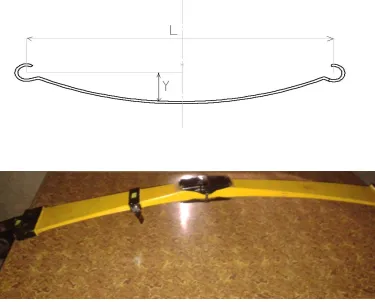
Actual mono Leaf spring
Dimension of actual leaf spring:
Table 1. Design Parameter
Parameter
Length in mm
1. Length of leaf spring from Eye to Eye(L) 1270mm
2. Width at both end 120mm
3. Width at center 60mm
4. Thickness at End both 10mm
5. Thickness at Center 30mm
6. Eye Dia. closed 50mm
3 Composite Material
In this analysis the material of mono leaf spring is E- glass epoxy used. There are four layers of material is lay up by following way:
The E glass Epoxy is also type of fiber. SiO2 54wt%
Al2O3 14wt%
CaO+MgO 22wt% B2O3 10wt%
Na2O+K2O less then 2wt%.
10 Poisson ratio along YZ-direction 0.366MPa
11 Poisson ratio along ZX-direction 0.217MPa
12 Mass density of the material 2.6×10³Kg/mm3
13 Flexural modulus of the material 40000MPa
14 Flexural strength of the material 1200MPa
4 Methodologies
4.1 Finite element analysis
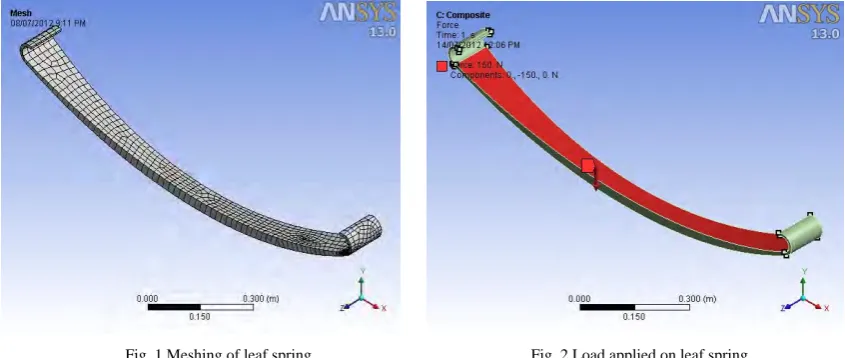
In finite element analysis 3D model of mono leaf spring is developed. After modeling of leaf spring then give the actual supporting boundary condition i.e. fixed support and cylindrical support. In fixed support there is no any degree of freedom i.e. there is no displacement at any direction. But in cylindrical support only vertical excitation or motion is present and horizontal motion is restricted. This condition is real on TATA-SUMO leaf spring. After giving the support meshing of leaf spring is done by giving element size 100 for better results. Here the number of time meshing was done ie at 50element size ,70 element size, 75 element size, 85 element size , 95 element size but at 100 and 95 element size the result that is natural frequency and stresses are does not change. Therefore element size taken as 100 for better result. The following meshing is done in ANSYS it is similar to both conventional as well as composite material leaf springs
.
Fig. 1 Meshing of leaf spring Fig. 2 Load applied on leaf spring
Fig. 3 Steel leaf spring Fig. 4 Composite leaf spring
4.2Natural Frequency Analysis
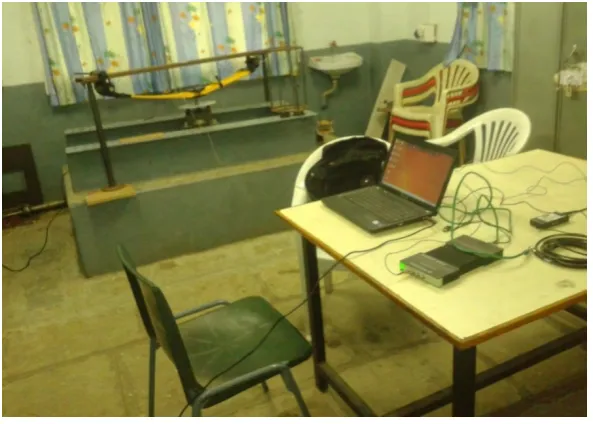
Normally road natural frequency is 12HZ. Therefore the natural frequency of leaf spring is more required. But the conventional steel leaf spring frequency is nearer to road frequency. Therefore calculating natural frequency of composite leaf spring is important and for that we use FFT analyzer and compare the result with FEA results
Fig. 5 FFT Experimental setup
The first three natural frequency of composite and steel leaf spring:
Table 3. Experimental results of natural frequency
F(HZ)
1 2 3
Steel 30.06 52.34 93.56
Composite
33.844 57.188 102.14
Table 4. Finite Element Analysis results of natural frequency
F(HZ)
1 2 3
Steel 31.40 51.999
92.871
0 5 10 15 20 25 30 35 40 45 50 [Hz]
0 0.4
Autospectrum(1 Scalar,) (Magnitude) \ FFT
First Natural frequency:-
0 5 10 15 20 25 30 35 40 45 50
[Hz] 0 0.2 0.4 0.6 0.8 1 1.2 1.4 1.6 1.8
2 Cursor values
X: 33.844 Hz Y: 2.233 m/s²
Autospectrum(1 Scalar,) (Magnitude) \ FFT
Peak after first natural frequency
0 5 10 15 20 25 30 35 40 45 50
[Hz] 0 0.2 0.4 0.6 0.8 1 1.2 1.4 1.6
1.82 Cursor values
X: 35.969 Hz Y: 1.668 m/s²
Autospectrum(1 Scalar,) (Magnitude) \ FFT
4.4 Analytical analysis
For analytically calculation following formula is used by assuming leaf spring as a simply supported beam:
═3
4
Table 3. Comparison between stresses of Analytical and FEA
Sr. No. Load (N) Length(mm) Analytical FEA
Stress (MPa) Stress (MPa)
1 50 127 50.40 52.36
2 100 333 288.77 230.33
3 150 560 217.77 220.45
5. Result and Discussion:
Under the dynamic load conditions natural frequency and stresses of steel leaf spring and composite leaf spring are found with the great difference. Here also the natural frequency of composite material is high than the steel leaf spring. Conventional steel leaf spring was found to weigh 23Kg. whereas E-Glass/Epoxy mono leaf spring weighs only 3.59 Kg. Indicating reductions in weight by 84.40% same level of performance. Conventional Leaf spring shows failure at eye end only. Composite leaf spring can be used on smooth roads with very high performance expectations. However on rough road conditions due to lower chipping resistance failure from chipping of composite leaf spring is highly probable. That is the composite leaf spring is having greater vibration absorbing capacity than conventional steel leaf spring. Also the stress of composite leaf spring is higher than conventional steel leaf spring. Because of using only mono leaf spring space also reduced. The corrosion resistance of composite leaf spring is higher i.e. it will work in environmental condition than conventional steel leaf spring.
References:
[1] M.Senthil and S Vijayranjan “Static Analysis and Fatigue life pediction of steel and composite Leaf spring.” Journal of scientific Steel and Industrial Research Vol66, Feb2007, pp128-134.
[2] M. M. Patunkar, D. R. Dolas “Modelling and Analysis of Composite Leaf Spring under the Static Load Condition by using FEA” International Journal of Mechanical & Industrial Engineering, Volume 1 Issue 1-2011,pp1-4.
[3] T.Rangaswamy, S. Vijayarangan “Optimal Design And Analysis Of Automotive Composite Drive Shaft” International Symposium of Research Students on Materials Science and Engineering December 2002-04, pp 1-9.
[4] K. K. Jadhao “Experimental Investigation & Numerical Analysis Of Composite Leaf Spring” International Journal of Engineering Science and Technology. (IJEST) Vol. 3 No. 6 June 2011, pp4759-64.
[5] Mahmood M. Shokrieh , Davood Rezaei “Analysis and optimization of a composite leaf spring.” Composite Structures 60 (2003) pp 317–325.
[6] Senthil kumar and Vijayarangan, “Analytical and Experimental studies on Fatigue life Prediction of steel leaf spring and composite leaf multi leaf spring for Light Passanger Vehicles Using Life Data Analysis” Material science Vol. 13 No.2 2007.
[7] Shiva Shankar and Vijayarangan “Mono Composite Leaf Spring for Light Weight Vehicle Design, End Joint, Analysis and Testing” Material Science Vol. 12, No.3, 2006.
[8] Gulur Siddaramanna Shiva Shankar “Mono Composite Leaf Spring for Light Weight Vehicle – Design, End Joint Analysis and Testing.” MATERIALS SCIENCE Vol.12, No3, 2006, pp220-225.
[9] Peiyong Qin, Glenn Dentel, and Mikhail Mesh “Multi-Leaf Spring and Hotchkis Suspension CAE Simulation.” 2002 ABAQUS Users Conference.
[10] Introduction to Finite Elements in Engineering- Ashok. D. Belegundu. [11] Practical Finite Element Analysis- N. S. Gokhale, S. S. Deshpande.