EFFICIENT DATA AGGREGATION
FOR MOBILE SAMPLING IN
WIRELESS SENSOR NETWORKS
K. SIVAKUMAR 1
Assistant Professor, Department of Computer Science and Engineering, Hindusthan Institute of Technology, Coimbatore -32.
email: [email protected]
DR. T. RAVICHANDRAN 2
Principal, Hindusthan Institute of Technology, Coimbatore – 32. email: [email protected]
Abstract:
Mobile objects can be used to gather samples from a sensor field. Civilian vehicles or even human beings equipped with proper wireless communication devices can be used as mobile sinks that retrieve sensor-data from sampling points within a large sensor field. A key challenge is how to gather the sensor data in a manner that is energy efficient with respect to the sensor nodes that serve as sources of the sensor data. In this paper, an algorithmic technique called Band-based Directional Broadcast is introduced to control the direction of broadcasts that originate from sensor nodes. The goal is to direct each broadcast of sensor data toward the mobile sink, thus reducing costly forwarding of sensor data packets. The technique is studied by simulations that consider energy consumption and data deliverability.
Introduction
The concept of employing mobile objects (sometimes referred to as mobile sinks) to query a sensor network has been proposed [6], [17], [18], [21], [25],[32]. Applications can exploit this mobility to dynamically sample a sensor field. One high-level application scenario is illustrated in Fig. 1.
A mobile object (car) is traveling along a path and at some time and location (for example, T0) it decides to take a sample of the sensor field, i.e., collect sensor data from “near-by” sensor nodes. The larger circle denotes the sampling region. Each sensor in that region will consequently be activated and reply with its locally sensed data. As the mobile object continues its travel, it reaches another location at time T1 from which it initiates another sampling task.There are three interesting features associated with the task of sensor field data sampling.
First, due to the mobility of the sampling object, there are many options for selecting a sampling region, as opposed to the static sampling region associated with a static sink.
Second, it is possible to employ commonly existing mobile objects, for example, taxis or buses, to help increase the coverage of the sensor field. So, it is possible to deliberately choose a mobile object and finely tailor its sampling regions to optimize a sampling task.
Finally, in comparison to sensor nodes, mobile objects have relatively large (and adjustable) transmission ranges.
sufficient for “local sampling” applications. For more “remote querying” of sensor data, an alternative scheme based on mobile-to-mobile node cooperation can be used. However, there are also challenges that arise from using these mobile sinks to gather sampled sensor data. One challenge is in controlling the process that sensors use to respond to a request for sensor data from a mobile sink. Because sensor nodes have a significantly smaller transmission range than mobile objects, sensor nodes must rely on multi hop transmission of sensor data when they respond to the single-hop reception of the mobile object’s sampling signal. This asymmetric communication property prevents sensor nodes from using a straightforward routing technique like reverse path forwarding. The fact that the mobile object continues to move after injecting its sampling signal further complicates the use of any explicit destination oriented routing.
Furthermore, general routing-tree based protocols are not well suited for this situation because route discovery implies high energy cost, and a discovered route might not be easily reused when faced with a series of highly dynamic sampling tasks. Also, because sensor networks are typically very large in scale, they do not naturally allow for a global IP address for each sensor node. This impedes use of traditional IP-based routing methods used in classical communication and wireless ad hoc networks. In addition, power and cost constraints make it impractical to assume GPS capability for very low-cost sensors needed for large-scale sensor network applications, and efficient accurate localization techniques are still in the research stage. Thus, for sampling large-scale sensor networks, it is not desirable to depend on routing protocols that require sensors to be location-aware, such as location-based GAF (Geographic Adaptive Fidelity), and cluster-based LEACH (Low-Energy Adaptive Clustering Hierarchy).
Finally, an implied requirement for sensor field sampling is that there is a time constraint imposed by the mobility of the sink object. To facilitate the collection of sensor data from the sampling region, it is helpful if all sensor data can be routed to the mobile object before the object has deviated significantly from the location at which it initiated the sampling task. This suggests that sensors should respond quickly upon receiving a sampling request, and the sensor data propagation method should be highly efficient.
In this paper, we make no assumptions about the nature of the sensor data, allowing for the possibility that sensors are heterogeneous with regard to data type (e.g., each sensor measures a different environmental property). Thus, deliver ability of sensor data takes priority over performance of data aggregation operations. The approach used in this paper is based on traditional software-based broadcast. Although it is understood that broadcast is to be generally avoided in sensor networks due to the problems associated with message flooding, there are significant advantages to using this basic mechanism, especially for the application at hand, sensor field sampling: broadcast is simple and does not require that sensor nodes be configured with special dedicated hardware; broadcast can be initiated immediately after receiving the sampling task since it requires no routing table or tree setup; and broadcast can naturally handle the mobile sink scenario since a sensor-data packet can reach the mobile object as long as the object is within transmission range of some broadcast, or rebroadcast, of that packet. The primary problem with using broadcast for gathering sensor data is that broadcast does not consider direction, and left unchecked would flood an excessively large geographic region. Note that this flooding could even extend beyond the intended sampling region, which means the omni-directional broadcast suffers from very low energy efficiency.
These bands are used to help control the direction of data flow of sensor data packets, without the need for sensor nodes having any sophisticated directional antenna. The key idea is that our approach will reduce the propagation of packets that flow away from the sink mobile object—thus reducing broadcast events and sensor node energy consumption. This is accomplished by preventing packets that originate from a sensor in any band from being propagated(rebroadcast) by sensors in a higher numbered band. We know that media access control plays an important role in sensor node routing protocols. This is in part due to the fact that sensor nodes are low-power and have only a single signal-reception channel.
AODV Routing
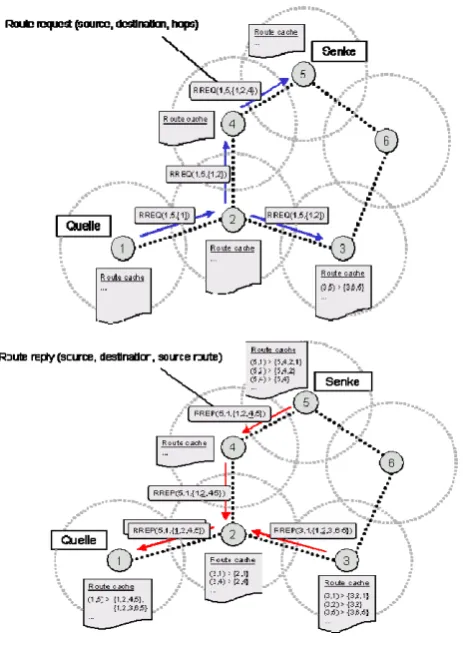
Routing in AODV consists of two phases: Route Discovery and Route Maintenance. When a node wants to communicate with a destination, it looks up in the routing table. If the destination is found, node transmits data in the same way as in DSDV. If not, it start Route Discovery mechanism: Source node broadcast the Route Request packet to its neighbor nodes, which in turns rebroadcast this request to their neighbor nodes until finding possible way to the destination. When intermediate node receives a RREQ, it updates the route to previous node and checks whether it satisfies the two conditions: (i) there is an available entry which has the same destination with RREQ (ii) its sequence number is greater or equal to sequence number of RREQ. If no, it rebroadcast RREQ. If yes, it generates a RREP message to the source node. When RREP is routed back, node in the reverse path updates their routing table with the added next hop information. If a node receives a RREQ that it has seen before (checked by the sequence number), it discards the RREQ for preventing loop. If source node receives more than one RREP, the one with greater sequence number will be chosen. For two RREPs with the same sequence number, the one will less number of hops to destination will be chosen. When a route is found, it is maintained by Route Maintenance mechanism. Each node periodically send Hello packet to its neighbors for proving its availability.
Fig .3.AODV Routing
When Hello packet is not received from a node in a time, link to that node is considered to be broken. The node which does not receive Hello message will invalidate all of its related routes to the failed node and inform other neighbor using this node by Route Error packet. The source if still want to transmit data to the destination should restart Route Discovery to get a new path. AODV has advantages of decreasing the overhead control messages, low processing, quick adapt to network topology change, more scalable up to 10000 mobile nodes. However, the disadvantages are that AODV only accepts bi-directional link and has much delay when it initiates a route and repairs the broken link.
Dynamic Source Routing Protocol
For restricting the bandwidth, the process to find a path is only executed when a path is required by a node (On-Demand-Routing). In DSR the sender (source, initiator) determines the whole path from the source to the destination node and deposits the addresses of the intermediate nodes of the route in the packets.
Compared to other reactive routing protocols like ABR or SSA, DSR is beacon-less which means that there are no hello-messages used between the nodes to notify their neighbors.
Fig .4.DSR Protocol
DSR was developed for MANETs with a small diameter between 5 and 10 hops and the nodes should only move around at a moderate speed. DSR is based on the Link-State-Algorithms which mean that each node is capable to save the best way to a destination. Also if a change appears in the network topology, then the whole network will get this information by flooding.
In DSR every node is responsible for confirming that the next hop in the Source Route receives the packet. Also each packet is only forwarded once by a node (hop-by-hop routing). If a packet can’t be received by a node, it is retransmitted up to some maximum number of times until a confirmation is received from the next hop.
Only if retransmission results then in a failure, a RouteError message is sent to the initiator that can remove that Source Route from its Route Cache. So the initiator can check his Route Cache for another route to the target. If there is no route in the cache, a RouteRequest packet is broadcasted.
1. If node C does not receive an acknowledgement from node D after some number of requests, it returns a Route Error to the initiator A.
2. As soon as node receives the Route Error message, it deletes the broken-link-route from its cache. If A has another route to E, it sends the packet immediately using this new route.
3. Otherwise the initiator A is starting the Route Discovery process again.
efficiently to reduce the control overhead. The initiator only tries to find a route if actually no route is known (in cache). Current and bandwidth saving because there are no hello messages needed (beacon-less).
TORA (Temporary Ordered Routing Algorithm)
TORA is based on link reversal algorithm. Each node in TORA maintains a table with the distance and status of all the available links.Route Creation: TORA uses the "height" concept for discovering multiple routes to a destination. Communication in TORA network is downstream, from higher to lower node. When source node does not have a route to destination, it starts Route Creation by broadcasting the Query messages (QRY). QRY is continuing broadcasted until reaching the destination or intermediate node that have the route to the destination. The reached node then broadcast Update (UPD) message which includes its height. Nodes receive this UPD set a larger height for itself than the height in UPD, append this height in its own UPD and broadcast. This mechanism is called reversal algorithm and is claimed to create number of direct links from the originator to the destination.
Conclusion
We proposed a simple, energy-efficient protocol to aid sensor-field sampling by a mobile object. The protocol exploits the concept of bands to limit the propagation of sensor data broadcasting, providing a form of directional broadcast based on software control. Methods for defining and using bands were presented. Extensive simulations under the communication models were conducted to evaluate the performance and trade-offs of our band-based scheme. The communication model assumed no collisions and a binary sensor to-sensor communication model. The simulations indicated that the band-based scheme is quite efficient in directional broadcast, and moreover, performs much better than default omnidirectional broadcast.
References
[1] R. Ananthakrishna, S. Chaudhuri, and V. Ganti, “Eliminating Fuzzy Duplicates in Data Warehouses,” Proc. 28th Int’l Conf. VeryLarge Data Bases, pp. 586-597, 2002.
[2] R. Baeza-Yates and B. Ribeiro-Neto, Modern Information Retrieval. ACM Press, 1999.
[3] R. Baxter, P. Christen, and T. Churches, “A Comparison of Fast Blocking Methods for Record Linkage,” Proc. KDD Workshop Data Cleaning, Record Linkage, and Object Consolidation, pp. 25-27, 2003.
[4] O. Bennjelloun, H. Garcia-Molina, D. Menestrina, Q. Su, S.E.Whang, and J. Widom, “Swoosh: A Generic Approach to Entity Resolution,” The VLDB J., vol. 18, no. 1, pp. 255-276, 2009.
[5] M. Bilenko and R.J. Mooney, “Adaptive Duplicate Detection Using Learnable String Similarity Measures,” Proc. ACM SIGKDD, pp. 39-48, 2003.
[6] S. Chaudhuri, K. Ganjam, V. Ganti, and R. Motwani, “Robust and Efficient Fuzzy Match for Online Data Cleaning,” Proc. ACM SIGMOD, pp. 313-324, 2003.
[7] S. Chaudhuri, V. Ganti, and R. Motwani, “Robust Identification of Fuzzy Duplicates,” Proc. 21st IEEE Int’l Conf. Data Eng., pp. 865- 876, 2005.
[8] P. Christen, “Automatic Record Linkage Using Seeded Nearest Neighbour and Support Vector Machine Classification,” Proc. ACM SIGKDD, pp. 151-159, 2008.
[9] P. Christen, T. Churches, and M. Hegland, “Febrl A Parallel Open Source Data Linkage System,” Advances in Knowledge Discovery and Data Mining, pp. 638-647, Springer, 2004.
[10] P. Christen and K. Goiser, “Quality and Complexity Measures for Data Linkage and Deduplication,” Quality Measures in Data Mining, F. Guillet and H. Hamilton, eds., vol. 43, pp. 127-151, Springer, 2007.
[11] W.W. Cohen, H. Kautz, and D. McAllester, “Hardening Soft Information Sources,” Proc. ACM SIGKDD, pp. 255-259, 2000. [12] W.W. Cohen and J. Richman, “Learning to Match and Cluster Large High-Dimensional Datasets for Data Integration,” Proc. ACM
SIGKDD, pp. 475-480, 2002.
[13] A. Culotta and A. McCallum, “A Conditional Model of Deduplication for Multi-Type Relational Data,” Technical Report IR-443, Dept. of Computer Science, Univ. of Massachusetts Amherst, 2005.
[14] F. DeComite, F. Denis, and R. Gilleron, “Positive and Unlabeled Examples Help Learning,” Proc. 11th Int’l Conf. Algorithmic Learning Theory, pp. 219-230, 1999.
[15] F. Denis, “PAC Learning from Positive Statistical Queries,” Proc. 10th Int’l Conf. Algorithmic Learning Theory, pp. 112-126, 1998. [16] X. Dong, A. Halevy, and J. Madhavan, “Reference Reconciliation in Complex Information Spaces,” Proc. ACM SIGMOD, pp.
85-96, 2005.
[17] A.K. Elmagarmid, P.G. Ipeirotis, and V.S. Verykios, “Duplicate Record Detection: A Survey,” IEEE Trans. Knowledge and Data Eng., vol. 19, no. 1, pp. 1-16, Jan. 2007.
[18] L. Gravano, P.G. Ipeirotis, H.V. Jagadish, N. Koudas, S. Muthukrishnan, and D. Srivastava, “Approximate String Joins in a Database” Proc. 27th Int’l Conf. Very Large DataBases, pp. 491-500, 2001.
[19] B. He and K.C.-C. Chang, “Automatic Complex Schema Matching Across Web Query Interfaces: A Correlation Mining Approach,”ACM Trans. Database Systems, vol. 31, no. 1, pp. 346-396, 2006.
[20] M.A. Hernandez and S.J. Stolfo, “The Merge/Purge Problem for Large Databases,” ACM SIGMOD Record, vol. 24, no. 2, pp. 127-138, 1995.