_____________________________________________________________________________________________________ 3(3): 1-12, 2019; Article no.SAJSSE.49445
ISSN: 2581-821X
Analysis of Strategic Variables for Ecotourism
Development; an Application of Micmac
Nafiah Ariyani
1*and Akhmad Fauzi
21
Faculty of Economic and Business, Sahid University Jakarta, Indonesia.
2Faculty of Economic and Management, Bogor Agricultural Institute, Indonesia.
Authors’ contributions
This work was carried out in collaboration between both authors. Author NA designed the study, performed the statistical analysis, wrote the protocol and wrote the first draft of the manuscript. Author AF managed the analyses of the study and managed the literature searches. Both authors read and approved the final manuscript.
Article Information
DOI: 10.9734/SAJSSE/2019/v3i330107
Editor(s):
(1) Dr. Velan Kunjuraman, Lecturer, Faculty of Hospitality, Tourism and Wellness, University Malaysia Kelantan (UMK), Kelantan, Malaysia. (2)Dr. John M. Polimeni, Associate Professor, Department of Economics, Albany College of Pharmacy and Health Sciences, Albany, New York, USA.
Reviewers:
(1)Chew, Matthew Ming-tak, Hong Kong Baptist University, China. (2)Margarita Išoraitė, Vilniaus kolegija/University Applied Sciences, Lithuania. Complete Peer review History:http://www.sdiarticle3.com/review-history/49445
Received 20 March 2019 Accepted 03 June 2019 Published 07 June 2019
ABSTRACT
This study aims to determine strategic factors and its relationship in developing ecotourism areas. This research uses prospective structural approach. The analytical method uses Micmac to identify the most influential variables and its relation to Kedung Ombo ecotourism development. The results of analysis which realize the typology of strategic variables based on the strength of influence found 6 classifications of variable, namely: 1. The dominant variable consists of: regulation, and governance; 2. Key variable (Relay variable) consists of: institutional coordination, apparatus role, tourism marketing and tourism promotions. 3. Autonomous variable consists of: natural beauty, accessibility, potential of market tourism, local awareness of tourism. 4. The output variable consists of: funds for community, preservation of local wisdom, preservation of forest sustainability, conservation of reservoir function. 5. Regulators variable consists of: special permit policy for investment, retribution policy, tax policy, allowance policy, tourist attractions. 6. Secondary variable consists of: availability of tourism infrastructure, tourist interest of ecotourism, involvement of local community. The results of this study show a variety of information sources for policy makers in Kedung Ombo ecotourism development in a sustainable manner.
Keywords: Ecotourism; strategic variables; structural prospective; Micmac.
1.INTRODUCTION
Tourism is one of sectors that are expected to become a new economic power in the future as availability of natural resources decreases. Tourism is considered as the fastest growing, environmentally friendly sector and has a high level of effectiveness in creating employment and high income. Based on this condition, developing a tourist destination requires comprehensive analysis about strategic variables related to the current situation and the future perspective to anticipate the uncertainties and unexpected future.
Tourism is a complex, systemic and evolutionary system. Tourism is also a socio-economic phenomenon that is spatially separated and bound by the attractiveness of local conditions. It is a phenomenon that requires high coordination and cooperation from all stakeholders [1]. So, to produce comprehensive scientific knowledge in the future, it cannot be judge tourism as merely sum of its constituent parts, as in traditional approach [2]. A tool is needed to take into account heterogeneous constituent elements, non-linear linkages, dynamic nature, and consider all the effects of changes in constituent elements, as well as being able to describe future situations. To achieve this goal, prospective analysis is needed.
One potential area that can become a tourist attraction is reservoir area.Utilizing reservoir area and its resource for tourism was a rational thing. This matter had been quite successful in several cases in China and other countries [3]. This research recommended that development of tourism around reservoir could be done as long as it could realize a harmonization between human, nature, social and economic development in a sustainable manner. This is to ensure that the important task of the reservoir must be maintained well, such as: flood storage and disposal, water volume adjustment, electricity generation, water supply for industry and agriculture and life in the city. If tourism arrangement in this area was not appropriate, the serious consequences would not be measurable anymore.Therefore, it was necessary to have an appropriate planning supported by a future comprehensive analysis in order to realize a sustainable tourism.
In Indonesia, Kedung Ombo Reservoir is one of the largest dams in Southeast Asia, with an
inundation area of ± 4,500 acre with volume of 723 million cubic, the reservoir area has a natural beauty. However, this dam has experienced massive siltation (an average of 0.87 cubic per year) since 2003 due to significant sedimentation. The sedimentation occurs as a result of conversion of land around the dam and other economic activities of local residents in the dam. This will disrupt the sustainability of the main function of the dam. Therefore, it is necessary to look for an alternative activity that can provide economic benefits but safe for the sustainability of the reservoir function. For these reason, we alternatively propose a developing ecotourism area in the dam surrounding area.
Since officially announced in 1989, the development of Kedung Ombo area as a real tourist destination has begun, but it has not succeeded yet until now. The main obstacle that can be identified is a number of parties involved in management but not accompanied by strong coordination and cooperation, each party tends to maintain its own interests. This is contrary to the statement that tourism is a phenomenon that requires high coordination and cooperation from all stakeholders [4]. Tourism is a heterogeneous form of relationship between stakeholders that forms a hybrid network having benefits for all members [5]. The success of ecotourism development is determined by several dimensions, like; the existence of product driven constraints, market understanding (market driven), institutional factors, and policy support [6]. Therefore, this reserch was conducted to provide input for decision makers about strategic variable conserning on developing Kedung Ombo ecotourism. The results of the study allow of arrangement of quality long-term policy recommendations, avoiding of problems and encouraging for future thinking.
2. THEORITICAL BACKGROUND
2.1 Ecotourism Concept
Ariyani and Fauzi; SAJSSE, 3(3): 1-12, 2019; Article no.SAJSSE.49445
Some experts convey their perspectives from the aspect of travel to natural areas, while others emphasize on the form of tourism.
There are at least three notions of ecotourism which are formulated in the context of trips to natural areas as summarized by Drumm and Moore (2005: 15) and Wood (2002: 9) [6], namely: 1) ecotourism is a trip that is responsible for natural areas to preserve environment and improve welfare of the local community (The International Ecotourism Society, 1990), 2) ecotourism is a trip to a vulnerable, untouched and protected area but has a small scale impact. Ecotourism educates tourists to provide funds for conservation, direct benefits for economic development and empowering local communities, and having priority respect for cultural differences and human rights (Martha Honey, 1999), 3) ecotourism is a journey of being environmentally responsible and visits to natural areas, in order to enjoy and appreciate nature (as well as all past and present cultural traits) to promote conservation, have little impact and actively encourage socio-economic involvement of local communities as beneficiaries "(IUCN, 1996) [6]. As a form of tourism, ecotourism is defined as a form of nature-based tourism that seeks to preserve it ecologically, socio-culturally and economically by providing opportunities for appreciation and learning about the natural environment or other specific elements (Weaver 2001: 105) [6]. However, ecotourism is generally defined as a form of nature-based tourism that seeks to preserve ecologically, socio-culturally and economically by providing opportunities for appreciation and learning about the natural environment or other specific elements [6]. The failure of ecotourism development can be seen in the context of the tourism system itself, namely the existence of product driven constraints, lack of market understanding, many institutional constraints, and lack of policy support [6]. In this study, these four dimensions are used to determine strategic variables in the development of the Kedung Ombo ecotourism area.
2.2 Prospective Structural Approach
Prospective structural analysis is a method that is based on the development of future scenario based on the historical trends of a system. Prospective structural analysis is a robust method to identify key variables (driver domain) and study the relationship between dependent and independent variables of a system [2,7]. The main purpose of this method is to reduce future
uncertainties, build possible or desired scenarios and encourage the action needed to achieve them. Prospective analysis will be able to capture the existence of complex strategic factors and its independent relationships, which is needed to realize a long-term quality.
Prospective analysis techniques assume that the future is different from the past and not forced, but can be built. Prospective structural analysis techniques will analyze the complexity of the elements, factors and its relationship and understand the key variables of system in the current and future situations. The relationship between these variables is a rich source of information that will determine thinking about some problems in this future context (Guzmán, Malaver, and Rivera, 2009) in [8]. Through structural analysis, many variable functions will be identified so that makes it easier for decision makers to determine the right policies.
Prospective structural analysis is carried out by a work committee consisting of actors and experts from the field under study without excluding external advisors [9]. Structural analysis has distinctive advantages from other analyzes in such factors, like: allowing expert groups to find methods for sharing ideas among group members, giving group members the opportunity to explain views and thoughts about certain problems [8]. Structural analysis method was very useful as a decision making support, operational planning, impact determining strategy and the future alternative evaluation and it was operated in a matrix form. The structural analysis was structured in three stages.
Structural analysis was initially philosophical and qualitative, but later, changed and operationalized into a variety of quantitative methods [10]. Through structural analysis, many variable functions will be identified so that makes it easier for decision makers to determine the right policies. Structural analysis method was very useful as a decision making support, operational planning, impact determining strategy and the future alternative evaluation and it was operated in a matrix form.
3. RESEARCH METHOD
3.1 Research Design
3.2 Data Collection
Data collection method was carried out focus on group discussion and workshop, that needed in prospective structural analysis. The discussions were held using world café method, which will drive knowledge sharing and experience transfer processes among participants. The focus of group discussions was aimed to identify and determine strategic variables in development Kedung Ombo ecotourism area. The scope of strategic variables in ecotourism systems is very broad. In this study, the strategic variables of ecotourism are: product driven, market driven, institutional and public policy support [6].
Participants who involve in a group discussion represented stakeholders of Kedung Ombo dam, that was Operational Director of Balai Besar Wilayah Sungai (BBWS) Pemali Juana, Regional Development Planning Agency officials, Head of Sports and Tourism Youth Services Department from Grobogan, Boyolali and Sragen District, lecturers of Solo Sahid Tourism College, students, tourism service business and community around reservoir. Before that, some interviews were held with Head of Balai Besar Wilayah Sungai (BBWS) Pemali Juana, Administrator of Perhutani Public Company, Head of Geyer- nearest village of the reservoir, community around reservoir and visitor the reservoir, to explore the possibility of development Kedung Ombo ecotourism idea and all participants stated agree with this idea.
3.3 Data Analysis
Data analysis was carried out based on the concept of prospective structural analysis using Micmac method. Micmac is a software compiled to perfect prospective structural analysis such as AHP (Analytical Hierarchy Process) and ISM (Interpretive Structural Modeling). Micmac method was developed by the Institute d'Innovation Informatique pour I'Etreprise in 1986, under the supervision of the Laboratory of Investigation in Prospective Start and Organization (LIPSOR) (Godet, 1999 in [8]; [9]. This software has changed future strategic analysis through a variety of quantitative methods which previously almost all future analyzes were qualitative [10]. According to Jimenez, 2009 [8], Micmac allows to analyze qualitative variables and explores diverse and uncertain futures.
Micmac aims to identify and analyze the main variables of a system, relationships and
hierarchies based on stakeholders' perception. Application of Micmac method consists of 3 stages, namely: define problems, identify internal and external variables, and analyze relationships between variables system. The first and two stages were carried out during the workshop while the third carried out by operating the Micmac software. Relationship level of mobility variables was assessby scale: 0 = none relationship, 1 = weak, 2 = moderate, 3 = strong, P = potential.
The results of this qualification will identify variable relationship into 3 classifications: direct influence, indirect influence, and potential influence. Direct influence occurs if variable A has an effect on variable B. Indirect effects occur if variable A affects variable B and variable B affects variable C. With the transitivity process, C is indirectly influenced by A. Potential effects occur if the influence of variable A is against to B. If there is no direct influence from one variable on another variable, it is called no influence (Portillo and Ortega, 2004). This comparison between the classification of direct and indirect influences confirms the importance of certain variables and reveals that these variables may have long-term effects. Mobility and dependency between variables analysis was determined the location of variable indicators at Input-Output Quadrant (Fig. 1).
5. RESULT AND DISCUSSION
Focus group discussion (FGD) has identified factors that are considered as strategic variables of development of Kedung Ombo ecotourism. These variables are grouped into categories according to dimensions in the context of eco-tourism (Table 1).
Ariyani and Fauzi; SAJSSE, 3(3): 1-12, 2019; Article no.SAJSSE.49445
strong direct influence on other variables and there are several variables that have a little.
This mapping also shows that variable actions will have an impact on other variables and also
as feedback on these variables. The results of the analysis of the MDI matrix obtained a typology map of the direct influenced variables in Fig. 2.
Fig. 1. Variable classification based on input-output and strategic logic
Source: Godet (2001) in Delgado, et al. (2015), Zali, et al. (2015)
Table 1. List strategic variable of development Kedung Ombo Ecotourism
No. Variable Short label
Dimension No Variable Short Label
Dimension
1 Natural Beauty NB Product Driven
12 Funds for Community
FC Policy
2 Local Awareness of Tourism
LA Product Driven
13 Allowance Policy AC Policy
3 Involvement of Local Community
ILC Product Driven
14 Preservation of Forest Sustainability
FS Policy
4 Accesibility AC Market
Driven
15 Concervation of Reservoir Function
RF Policy
5 Availabality of Tourism Infrastructure
AI Market Driven
16 Tax Policy TP Policy
6 Potential of Tourism Market
PTM Market Driven
17 Special Permit Policy for Investment
SPI Policy
7 Tourism Attraction TA Market Driven
18 Preservation of Local Wisdom
LW Policy
8 Tourist Interest of Ecotourism
TI Market Driven
19 Governance Gov Institutional
9 Tourism Promotion TP Market Driven
20 Regulation Reg Institutional
10 Tourism Marketing TTM Market Driven
21 Institutional Coordination
IC Institutional
11 Retribution Policy RP Policy 22 Apparatus Role AR Institutional
Based on Fig. 2, typology of strategic variable in Kedung Ombo ecotourism development can be grouped into the six qualifications as follow:
1. Input variable (Dominant variable) consist of: regulation, and governance.
2. Key variable (Relay variable) consist of: institutional coordination, apparatus role, tourism marketing and promotions.
3. Autonomous variable consist of: natural beauty, accessibility, potential of tourism market, local awareness of tourism. 4. Output variable consist of: funds for
community, preservation of local wisdom, preservation of forest sustainibility, conservation of reservoir function.
5. Regulator variable consist of: special permit policy for investment, retribution policy, tax policy, allowance policy, tourist attractions.
6. Secondary variable consist of: availability of tourism infrastructure, tourist interest of ecotourism, involvement of local community.
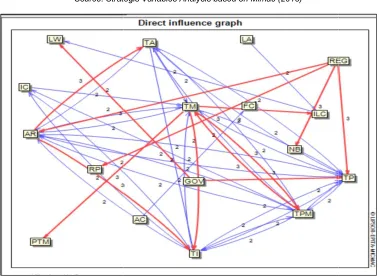
Furthermore, we can see the intensity of the variable influence from the strongest to the weakest. Intensity of the influence of variables is indicated by the color of e connecting line intervariable, namely: 1) red line indicated that influence was very strong; 2) thick blue line indicated that influence was relatively strong; 3) thin blue line indicated that the influence was moderate; 4) black line indicated that the influence was weak; and 5) dashed line indicated that influence was very weak. (Fig. 3 in percentage 10%). Information of the direct influence variable qualification is very important for policy makers. The result of this analysis could be a direction for the decision makers to focus on variables having the strongest influence, because these variables will determine directly to the behavior of other variables. Based on Fig. 3, we know that tourism promotion, governance, regulation, institutional coordination, as the strongest variable influenced preservation of local wisdom as one of the goals of ecotourism. The intensity of the influence to other variables as a whole can be seen in Direct Influence Graph with a percentage of 100% at Micmac Software.
To test stability, results of variables classification based on direct influence, re-identification is carried out based on indirect influences. The process of analyzing indirect effects is further
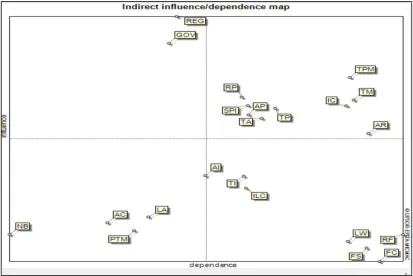
explained in the matrix MII (Matrix of Indirect Inflations). Results of indirect effects analysis will show more satisfying stability in terms of qualifying variables. Output of indirect classification model will confirm of system stability. If there are many changes in the position of the variable from the map of direct influence, then the system has a low stability. The results of indirect effect analysis indicate that there is no change in the position of the variable from the direct effect classification (Fig. 4). These results indicate that the system and the typology of variables that have been classified in the direct effect are stable.
However, viewed from the intensity of its influence, the classification of variables based on indirect influences experience significant changes. This can be seen from the colour change of the line that connects to the variable (Fig. 5). From Fig. 5, it can be seen that compared to the direct influence, the analysis of indirect effects is obtained by more variables which have very strong influence, while in the direct influence analysis, there are more variables which have a relative strong influence.
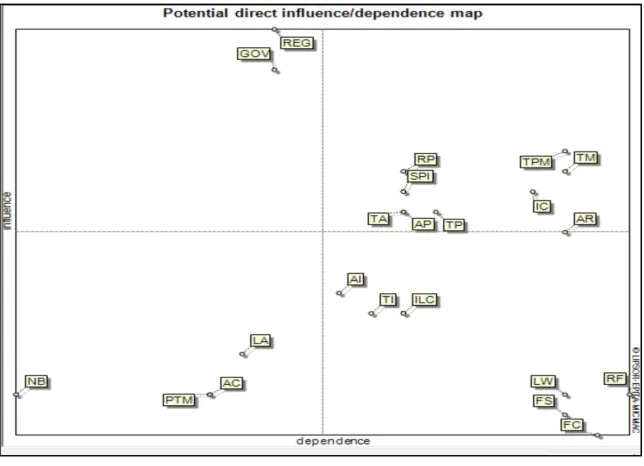
Furthermore, the MicMac method provides an analysis of potential direct influences that illustrate the possibility of variable classification changes if certain actions are taken on the system, which is called aspotential influence. Results of potential influences analysis are explained in the Direct Effect Potential Matrix (MPDI) in Fig. 6. Based on Fig. 6, it can be seen that there is no change in position of the direct variable influence (Matrix of Direct Influence-MDI) or Matrix of Indirect Influence (MII). Base on this analysis it can be said that the grouping of variables based on direct influence is stable.
Fig. 2.
Source: Strategis Variables Analysis based on Mimac (2018)
Fig. 3. Intensity of
Source: Strategis Variables Analysis based on Mimac (2018)
Ariyani and Fauzi; SAJSSE, 3(3): 1-12, 2019; Article no.
. 2. Map of direct infleunce (MDI)
Source: Strategis Variables Analysis based on Mimac (2018)
Intensity of direct influence variable
Source: Strategis Variables Analysis based on Mimac (2018)
Fig. 4. Map of indirect infleunce (MII)
Source: Strategis Variables Analysis based on Mimac (2018)
Fig. 5. Intensity of indirect influence variable
Ariyani and Fauzi; SAJSSE, 3(3): 1-12, 2019; Article no.SAJSSE.49445
From the various carried out analysis, the overall results show that the variable grouping in the development of ecotourism area at Kedung Ombo Dam built in this study is stable. This is indicated by the absence of significant changes in typology of variables from the initial analysis, which is based on direct influence, as well as indirect effects to potential direct effects and potential indirect effects, not significantly changing. Based on these findings, we can finally find out the level of influence variables in development Kedung Ombo ecotourism as
shown in Tabel 2. This finding is very helpful for policy makers to develop Kedung Ombo ecotourism area in determining the priority scale of which variables should be added in its development rather than other variables. Variables that have a top level must be prioritized gradually before the other variables which are in the next ranked. Based on Table 2, the variable that must be prioritized in the development of Kedung Ombo ecotourism area is that governance and new regulations continue to focus on other variables.
Fig. 6. Map of potential direct influence (MPDI)
Source: Strategis Variables Analysis based on Mimac (2018)
Table 2. Level of influence variables
Rangking Variable Rangking Variable
1 12 - Government (Gov) 12 4 - Availability of Tourism Infrastructure (AI)
2 13 - Regulation (Reg) 13 2 - Involvement of Local Community (ILC)
3 22 - Tourism Promotion (TPM) 14 21 -Tourist Interest of Ecotourism (TI) 4 6 - Retribution Policy (RP) 15 5 - Local Awareeness of Tourism (LA) 5 20 - Tourist Marketing (TM) 16 1 - Natural Beauty (NB)
6 8 - Special Permit Policy for Investment (SPI)
17 3 - Potential of Tourism Market (PTM)
7 16 - Institutional Coordination (IC)
18 11 - Conservation of Reservoir Function (RF)
8 9 - Allowance Policy (AP) 19 14 - Accesibility (AC)
9 18 - Tax Policy (TP) 20 15 - Preservation of Local Wisdom (LW) 10 19 - TaxAllowance (TA) 21 10 - Preservation of Forest Sustainability
(FS)
11 17 - Aparatus Role (AR) 22 7 - Funds for Community (FC)
Fig. 7. Map of potential indirect influence (MPII)
Source: Strategis Variables Analysis based on Mimac (2018)
6. CONCLUSION AND SUGGESTION
6.1 Conclusion
This study has succeeded in identifying 22 variables whic are considered by stakeholders as the most important variable in the development of Kedung Ombo ecotourism area. These variables are spread in four dimensions, namely: supply (product driven), market driven, institutional and public policy support. This finding confirms the statement at the previous study that tourism is a complex system that must be analyzed based on a multidimensional approach and considering its dynamics.
The results of the Micmac analysis of the strategic variables typology based on strength of influence found 6 classifications of variables, namely: 1. The dominant variable consists of: regulation, and governance; 2. Key variable (Relay variable) consists of: institutional coordination, apparatus role, tourism marketing and tourism promotions. 3. Autonomous variable consists of: natural beauty, accessibility, potential of market tourism, local awareness of tourism. 4. The output variable consists of: funds for community, preservation of local wisdom, preservation of forest sustainability, conservation
of reservoir function. 5. Regulators variable consists of: special permit policy for investment, retribution policy, tax policy, allowance policy, tourist attractions. 6. Secondary variable consists of: availability of tourism infrastructure, tourist interest of ecotourism, involvement of local community. This qualification has been tested using the Independent Matrix and Matrix. The potential consistency test for this qualification has also been tested and the results are stable.
Among the 6 typologies of these variables, the dominant variables and relay variables must get greater attention from policy makers than other variables. The dominant variable is the variable that has a very high influence with low dependency, while the relay variable also called the betting factor is a variable that has a high influence and high dependency. This variable will not only provide a boomerang effect but also can be an indication of a potential system breakpoint.
Ariyani and Fauzi; SAJSSE, 3(3): 1-12, 2019; Article no.SAJSSE.49445
and tourism promotions. These findings are suitable with the statement on the background that governance, regulation and coordination are very important factors in the development of projects involving many parties such as tourism. The marketing, promotion and attraction variables representing the marketing driven dimension are also very precise as variable relay, to encourage the development of market orientations that are generally weak in the types of natural tourism.
Other findings from this study are the level of influence variables in development Kedung Ombo ecotourism. This finding is very helpful for policy makers on the development of the Kedung Ombo ecotourism area in determining the priority scale of which variables should be added in its development rather than other variables. Variables that have a top rank must be prioritized before proceeding to other variables which are in the next rank. Based on Table 2, the variable that must be prioritized in the development of the Kedung Ombo ecotourism area is that governance and new regulations continue to focus on other variables.
These findings have implications for policy makers in developing the Kedung Ombo ecotourism region that they must seriously supervise relay variables and direct all managerial efforts to these variables towards the evolutionary path as desired. At the same time, policy makers must also be aware of the relative shortcoming of the current relay variable which is one of the problems must be resolved to achieve the desired results. Based on the results of the qualifications of the variables found in this study, especially in relay variables, the potential of ecotourism in the Kedung Ombo Reservoir can still be optimized without having to worry about disturbing the function of the dam.
This finding is a very strong foundation for all parties involved in policy making to realize a sustainable Kedung Ombo ecotourism area. By understanding the results of this study, all the main stakeholders of the Kedung Ombo reservoir can be involved in the decision making process through the appropriate governance system by economic policies, social policies, land use policies, reservoir conservation policies and a balanced environment. Finally, we state that the method used in this study is a new way in building a systematic analysis of variables role to determine system stability. The application of prospective structural analysis with the Micmac method in the decision-making process that
considers the position and intensity of the influence of variables in the form of direct or indirect influence (and no causal relationship) has clarified the validity and strength of the approach in determining the most desired variable involved in development of Kedung Ombo reservoir ecotourism area as expected in the future.
6.2 Suggestion
1. To guarantee the development of the ecotourism area in Kedung Ombo will run successfully and sustainable, the policy makers must seriously control the dominant and the relay variables and direct all managerial effort toward the desire result. 2. The development policy of Kedung Ombo
ecotourism based on the finding of this study will produce benefits in preservation of forest sustainability, conservation of reservoir functions, availability of funds for community and preservation of local wisdom.
3. All of the main stakeholders of the Kedung Ombo reservoir can be involved in the decision making process through the appropriate governance system which supports economic policies, social policies, land use policies, and environmental policies. 4. For further research, we recommend to
continue the use of the application test of structural analysis methods, especially when it is difficult to obtain published statistical information.
COMPETING INTERESTS
Authors have declared that no competing interests exist.
REFERENCES
Available:https://ieeexplore.ieee.org/docu ment/5893391 -
4. Hermans LM, Thissen W. Actor analysis methods and their use for public policy analysts. Eur J Oper Res [Internet]; 2009.
Available from:
https://www.researchgate.net/.../2234087 12_Actor_analysis_
5. Johannesson GT. Tourism translations: Actor-network theory and tourism research. Tour Stud [Internet]; 2005. Available:https://www.researchgate.net/p ublication/249631333_Tourism_translatio
ns_Actor-Network_Theory_and_tourism_research 6. Asmin F, Layout D, Asmin F, Dan E,
Berkelanjutan P, Dari D, et al. Ekowisata dan pembangunan berkelanjutan: Dimulai dari konsep sederhana [Internet]; 2017.
Available:https://www.academia.edu/3618 1512/Buku_Ekowisata_dan_Pembanguna n_Berkelanjutan_Dimulai_dari_Konsep_S ederhana
7. Godet M. The art of scenarios and strategic planning. Technol Forecast Soc Change [Internet]. 2000;65(1):3–22. Available:http://linkinghub.elsevier.com/re trieve/pii/S0040162599001201
8. Arias MLB. Structural analysis of strategic variables through micmac use: Case study. Miditerraen J Soc Sci. 2016; 7.
9. Omran A. Structural analysis with knowledge-based MICMAC approach; 2014.
10. Go A, Fernandez GS. Foresight analysis of agricultural sector at regional level. Future. 2009;41(2009):313–24.
© 2019 Ariyani and Fauzi; This is an Open Access article distributed under the terms of the Creative Commons Attribution License (http://creativecommons.org/licenses/by/4.0), which permits unrestricted use, distribution, and reproduction in any medium, provided the original work is properly cited.
Peer-review history: