Pertussis Vaccine Effectiveness in the
Setting of Pertactin-Deficient Pertussis
Lucy Breakwell, PhD, a, b Patsy Kelso, PhD, c Christine Finley, APRN, MPH, c Susan Schoenfeld, RN, MSPH, cBrant Goode, RN, MPH, c, d Lara K. Misegades, PhD, b Stacey W. Martin, MSc, b Anna M. Acosta, MDb
abstract
BACKGROUND: In the United States, the proportion of Bordetella pertussis isolates lackingpertactin, a component of acellular pertussis vaccines, increased from 14% in 2010 to 85% in 2012. The impact on vaccine effectiveness (VE) is unknown.
METHODS: We conducted 2 matched case-control evaluations in Vermont to assess VE of the 5-dose diphtheria, tetanus, and acellular pertussis vaccine (DTaP) series among 4- to 10-year-olds, and tetanus, diphtheria, and acellular pertussis vaccine (Tdap) among 11- to 19-year-olds. Cases reported during 2011 to 2013 were included. Three controls were matched to each case by medical home, and additionally by birth year for the Tdap evaluation. Vaccination history was obtained from medical records and parent interviews. Odds ratios (OR) were calculated by using conditional logistic regression; VE was estimated as (1-OR) × 100%. Pertactin status was determined for cases with available isolates.
RESULTS: Overall DTaP VE was 84% (95% confidence interval [CI] 58%–94%). VE within 12 months of dose 5 was 90% (95% CI 71%–97%), declining to 68% (95% CI 10%–88%) by 5–7 years post-vaccination. Overall Tdap VE was 70% (95% CI 54%–81%). Within 12 months of Tdap vaccination, VE was 76% (95% CI 60%–85%), declining to 56% (95% CI 16%–77%) by 2–4 years post-vaccination. Of cases with available isolates, >90% were pertactin-deficient.
CONCLUSIONS: Our DTaP and Tdap VE estimates remain similar to those found in other settings, despite high prevalence of pertactin deficiency in Vermont, suggesting these vaccines continue to be protective against reported pertussis disease.
aEpidemic Intelligence Service, Scientifi c Education and Professional Development Program Offi ce, bMeningitis
and Vaccine Preventable Diseases Branch, Division of Bacterial Diseases, National Center for Immunization and Respiratory Diseases, and dCareer Epidemiology Field Offi cer Program, Division of State and Local Readiness,
Offi ce of Public Health Preparedness and Response, Centers for Disease Control and Prevention, Atlanta, Georgia; and cVermont Department of Health, Burlington, Vermont
Dr Breakwell designed the data collection instruments, coordinated data collection, carried out the initial analyses, drafted the initial manuscript, and reviewed and revised the manuscript; Dr Kelso, Ms Finley, and Ms Schoenfeld reviewed study design, supported coordination of the data collection, and critically reviewed the manuscript; Mr Goode reviewed study design, coordinated and supervised data collection, and critically reviewed the manuscript; Dr Misegades critically reviewed the manuscript; Ms Martin conceptualized and designed the study, and critically reviewed the manuscript; Dr Acosta designed the data collection instruments, coordinated data collection, carried out the initial analyses, reviewed and revised the manuscript, and critically reviewed the manuscript; and all authors approved the fi nal manuscript as submitted.
The fi ndings and conclusions are those of the authors and do not necessarily represent the views of the Centers for Disease Control and Prevention.
DOI: 10.1542/peds.2015-3973 Accepted for publication Feb 17, 2016
Address correspondence to Lucy Breakwell, PhD, Centers for Disease Control and Prevention, 1600 Clifton Rd, MS C25, Atlanta, GA 30333. E-mail: [email protected]
To cite: Breakwell L, Kelso P, Finley C, et al. Pertussis Vaccine Effectiveness in the Setting of Pertactin-Defi cient Pertussis. Pediatrics. 2016;137(5):e20153973
WHAT’S KNOWN ON THIS SUBJECT: The recent resurgence in pertussis disease may be associated with the previously demonstrated waning immunity from acellular vaccines. However, little is known about the impact of genetic changes in the bacteria, such as the loss of pertactin, on vaccine effectiveness.
The US pertussis vaccine program began in the 1940s, with widespread use of diphtheria, tetanus, and whole-cell pertussis vaccine for the 5-dose childhood series. Safety concerns prompted whole-cell vaccine to be replaced with diphtheria toxoid, tetanus toxoid, and acellular pertussis vaccine (DTaP) in 1992 for the fourth and fifth doses given at 15 to 18 months and 4 to 6 years of age, and ultimately for the complete childhood series in 1997, including the primary doses at 2, 4, and 6 months of age.1–3 Due to an increase
of disease among adolescents and adults, a single adolescent booster dose of tetanus toxoid, reduced diphtheria toxoid, and acellular pertussis vaccine (Tdap) was recommended in 2006, with preferred administration at 11 to 12 years of age.4 Although coverage
for both vaccines is high, pertussis incidence is increasing, with 48 000 cases reported in 2012.5–7 Of concern,
the number of cases has increased among fully vaccinated children and adolescents, particularly among those who received only acellular vaccines as children.8–10 Possible
explanations for this include waning immunity, less protective immune responses induced by acellular pertussis vaccines, increased provider awareness and reporting, and more sensitive diagnostic techniques.11–15 Additionally, genetic
changes in the bacteria could have a role in the resurgence of disease. The proportion of pertussis strains in the United States lacking pertactin sharply increased from 14% in 2010 to 85% in 2012.16–18 Pertactin
is an autotransporter potentially involved in bacterial adhesion to the respiratory tract and resistance to neutrophil-induced bacterial clearance.19, 20 It is also a component
of all acellular pertussis vaccines currently administered in the United States.21 Pertactin deficiency may
have evolved in response to acellular vaccine–induced selection pressure,
providing an advantage to the bacteria.18, 22
In 2012, an epidemic year for pertussis in the United States, Vermont reported the second highest pertussis incidence rate (103/100 000 population) in the country.7 During this period, Vermont
Department of Health Laboratory was one of a few laboratories in the nation that routinely cultured all specimens from suspected pertussis cases. This provided a unique opportunity to determine pertactin status for many pertussis cases in Vermont. An initial analysis demonstrated that of those cases with isolates available, >90% were pertactin-deficient.18 It was in this
setting of high pertactin deficiency that we sought to assess vaccine effectiveness (VE) and duration of protection of the 5-dose DTaP childhood series and the adolescent Tdap dose.
METHODS
Study Design and Population
To assess VE and duration of protection of DTaP and Tdap, we conducted 2 matched case-control studies. We included persons aged 4 to 10 years (born 2000–2009) and 11 to 19 years (born 1991–2002) for the DTaP and Tdap evaluations, respectively. All probable and confirmed pertussis cases reported to the Vermont Department of Health with cough onset from January 1, 2011, to December 31, 2013 were included, unless a medical home could not be identified for a case or it was based outside of Vermont. Cases were classified according to Vermont Department of Health definitions, a modified version of the Council of State and Territorial Epidemiologists definitions.23, 24 A clinical case
was considered any person with cough illness lasting ≥2 weeks with paroxysms of coughing, inspiratory “whoop, ” or posttussive vomiting. A confirmed case was defined as any
person with cough plus Bordetella pertussis isolation from a clinical specimen, or a clinical case with either a positive polymerase chain reaction (PCR) result or contact with a laboratory-confirmed case (epidemiologic link). A probable case was defined as a clinical case (ie, not laboratory-confirmed or epidemiologically linked to a laboratory-confirmed case).
Three controls were selected for each case, matched on medical home for the DTaP evaluation, and medical home and birth year for the Tdap evaluation. Controls were not matched on birth year for the DTaP evaluation due to the expected high correlation of age with vaccination status. Controls were randomly selected from patient rosters that included patients in the target age range with at least 1 clinic visit since January 1, 2006. Controls who had an out-of-state home zip code, only had an emergency or specialist visit at the medical home, or were suspected of having had pertussis in the previous 12 months were ineligible. The cough-onset date of the case was used as the enrollment date for each case and its matched controls.
Vaccination Defi nitions
The number of pertussis-containing vaccines received at least 14 days before the enrollment date was determined for each participant, based on vaccination dates
documented in the medical chart or provided by parents. For the 5-dose DTaP series, participants were considered vaccinated on-schedule if they had received doses 1 to 3 at age <1 year, dose 4 at age 1 to <2 years, and dose 5 at age 4 to <7 years.3
Participants who received 5 DTaP doses but did not meet this schedule were considered to be vaccinated off-schedule. Participants who received only 4 DTaP doses were considered vaccinated on a catch-up schedule if they had received doses 1 to 3 at age <4 years and dose 4 at age 4 to <7 years. Participants were considered unvaccinated with DTaP if no pertussis-containing vaccine was documented in their chart and nonreceipt was confirmed by a parent. If receipt of vaccination could not be confirmed for any of the DTaP doses by chart or parent interview, participants were classified with unknown vaccination status. Participants were considered vaccinated with Tdap if they had received 1 Tdap dose at age ≥11 years. They were considered unvaccinated if they had no Tdap documented in their chart and a parent confirmed nonreceipt. Participants without documentation of Tdap vaccination in their chart and for whom the parent interview was inconclusive were classified with unknown vaccination status.
B pertussis Pertactin Defi ciency Determination
During the epidemic period, 66% of reported pertussis cases were confirmed by laboratory testing, and, of these, 80% were tested by the state laboratory, representing
∼50% of all reported pertussis cases. All specimens sent to the state laboratory underwent both
culture and PCR testing; other laboratories conducted only PCR testing. Specimens were cultured per standard procedure, and pertussis-positive cultures (73% of cultured specimens) were tested for pertactin deficiency at the Centers for Disease Control and Prevention (CDC) as described previously.17, 18
Statistical Analyses
Participants were excluded from the analysis if their vaccination history was unknown, or if they had ever been reported to Vermont Department of Health as a previous pertussis case. Specific DTaP analysis exclusion criteria included the following: mis-administration of Tdap, Tdap receipt >14 days before enrollment to exclude individuals that had received both DTaP and Tdap vaccines, receipt of >5 DTaP doses, receipt of 5 DTaP doses off-schedule, or receipt of <5 DTaP doses. Tdap analysis exclusion criteria included the following: mis-administration of DTaP, receipt of >1 Tdap dose, receipt of Tdap before age 11 years, or receipt of Tdap before 2006. Individuals who had received a Tdap dose before 2006 were excluded as the record was likely to be erroneous because Vermont only introduced Tdap in 2006.
Demographics of cases and controls were compared by using matched odds ratios (ORs) from conditional logistic regression analyses; where cells had <5 observations, exact analyses were conducted. The 2-sided Wilcoxon rank-sum test assessed for differences in age-related characteristics.
For the primary analyses, conditional logistic regression was used to determine ORs for the association of pertussis with receipt of (1) 5-dose DTaP series on-schedule or (2) Tdap on-schedule. VE was calculated as (1 − OR) × 100%. Unvaccinated participants were used as the referent for all models. To evaluate duration of protection, ORs were
calculated for time since receipt of fifth DTaP dose (classified as follows: <12, 12–23, 24–35, 36–47, 48–59, or >59 months) or Tdap (classified as follows: <12, 12–23, or >23 months).
To assess stability of the DTaP VE estimates, a number of sensitivity analyses were conducted by restricting the analytic population to the following: a combined group including 5 DTaP doses on-schedule and 4 doses on catch-up schedule; 5 DTaP doses regardless of schedule; 5 DTaP doses on-schedule, excluding public health districts with higher percentages of unvaccinated participants; and confirmed cases only and their matched controls.
Since 1993, the Vermont Immunization Program has purchased all recommended pertussis vaccines for children.26 We
reviewed Immunization Program– provided vaccine distribution data, and determined the transition to acellular pertussis vaccines occurred during 1997, after which we assumed that whole-cell vaccines were no longer available. We verified this assumption by cross-checking study-obtained lot numbers against manufacturer data. The primary analysis for Tdap VE was restricted to participants who had received only acellular vaccines for all childhood series and adolescent doses (born after 1997), although we attempted to evaluate Tdap VE among participants who received a mix of whole-cell and acellular vaccines (born 1997 or earlier). The stability of the Tdap VE estimates was assessed by conducting sensitivity analyses restricting the analytic populations to the following: 5 DTaP doses on-schedule, 5 DTaP doses regardless of schedule, and confirmed cases only and their matched controls.
Ethical Review
This evaluation was determined to be a public health evaluation and designated as nonresearch by CDC Human Research Protection Office and the Vermont Agency of Human Services.
RESULTS
From January 1, 2011, to December 31, 2013, 1252 pertussis cases were reported to Vermont Department of Health. Sixty-eight percent of patients were aged 4 to 19 years (n = 848) and, of these, 73% (n = 624) were reported during 2012. Twenty-eight patients (3%) were ineligible because their medical home was located outside of Vermont (n = 20), could not be determined (n = 7), or declined to participate (n = 1). Data were collected on 820 patients aged 4 to 19 years and 2369 controls from 91 medical homes. For 2673 participants (83.8%), vaccine history was confirmed by medical chart review, for 160 participants (5.0%), nonreceipt or incomplete pertussis vaccine history was verified by parental recall.
Five-Dose DTaP Series VE and Duration of Protection
Data were collected on 382 cases and 1113 controls aged 4 to 10 years to
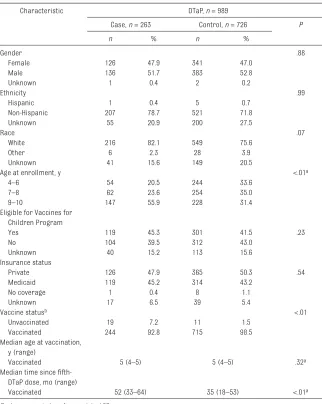
evaluate DTaP VE. Overall, 119 cases (31%) and 387 controls (35%) were excluded from analyses (Table 1). The proportion of cases and controls excluded was similar for nearly all exclusion criteria, except excluded controls were more likely than excluded cases to have received <5 DTaP doses.
Of the 263 cases included in the analysis, 71% (n = 186) were classified as confirmed and 29% (n = 77) as probable. Of confirmed cases, 83% (n = 154) were laboratory-confirmed and 17% (n = 32) were epidemiologically linked. Eighty-five specimens (representing 32% of all cases included in the DTaP analysis) were tested for pertactin deficiency; 83 (98%) of these were pertactin-deficient. Cases and controls had similar demographics, but cases were more likely to be older (P < .01) and unvaccinated (P < .01; Table 2). Age at receipt of fifth DTaP dose was similar for cases and controls (P = .32); however, the median time since receipt of the fifth DTaP dose was longer for cases (P < .01; Table 2).
For the primary analysis, the estimated overall VE of the 5-dose DTaP series on-schedule was 84% (95% confidence interval [CI] 58%– 94%; Table 3). When participants were stratified by time since fifth
DTaP dose receipt, the estimated VE within 12 months was 90% (95% CI 71%–97%). By 60 to 83 months, VE declined to 68% (95% CI 10%– 88%; Table 3). Sensitivity analyses, including VE among confirmed cases only, were not substantially different from the primary analysis, with overlapping confidence intervals noted (Supplemental Table 6).
Tdap VE and Duration of Protection
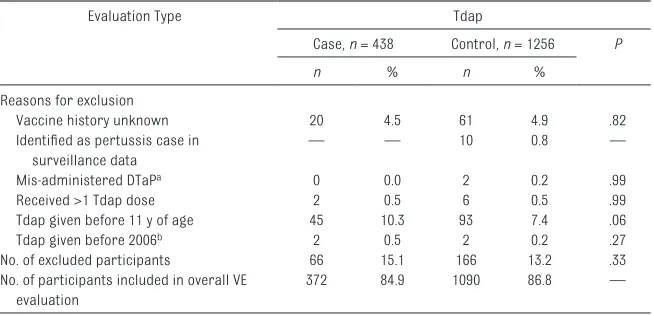
Data were collected on 438 cases and 1256 controls aged 11 to 19 years to evaluate Tdap VE. Overall, 66 cases (15%) and 166 controls (13%) were excluded from analyses (Table 4). The proportion of cases and controls excluded was similar for all reasons.
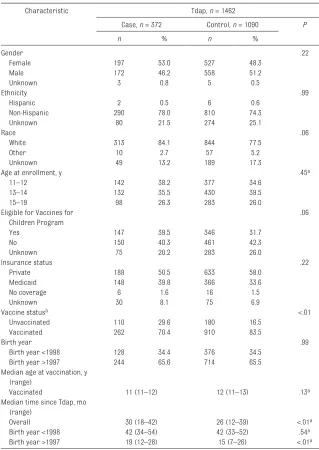
Of the remaining 372 cases, 80% (n = 297) were classified as confirmed and 20% (n = 70) as probable. Of confirmed cases, 90% (n = 266) were laboratory confirmed and 10% (n = 31) epidemiologically linked. A total of 110 specimens (representing 30% of all cases included in the Tdap analysis) were tested for pertactin deficiency and 104 (95%) of these were pertactin-deficient. Cases and controls had similar demographics, but cases were more likely to be unvaccinated (P < .01; Table 5). Age at receipt of Tdap was similar for cases and controls (P = .13); however, median time since Tdap receipt was slightly longer for cases (30 months vs 26 months, P < .01; Table 5).
For the primary analysis of Tdap VE, which comprised participants who received only acellular vaccines, 244 cases (66% of all eligible cases) and 714 controls (66% of all eligible controls) were included. The estimated overall VE of the Tdap was 70% (95% CI 54%–81%; Table 3). When participants were stratified by time since Tdap vaccination, VE within 12 months was 76% (95% CI 60%–85%). By 24 to 46 months, VE declined to 56% (95% CI 16%–77%; Table 3). The Tdap VE estimates remained stable for all sensitivity analyses, including VE among
TABLE 1 Number and Percentage of Participants Who Met the 5-Dose DTaP Series VE Analysis Exclusion Criteria
Evaluation Type DTaP
Case, n = 382 Control, n = 1113 P
n % n %
Reasons for exclusion
Vaccine history unknown 20 5.2 45 4.0 .32
Identifi ed as pertussis case in surveillance data — — 3 0.3 —
Mis-administered Tdapa 1 0.3 4 0.4 .99
Received Tdap as part of catch-up schedule 3 0.8 7 0.6 .75
Received ≤4 of DTaP 50 13.1 203 18.2 .02
Received >5 of DTaP 6 1.6 20 1.8 .77
Received 5 doses of DTaP off-scheduleb 44 11.5 136 12.2 .72
No. of excluded participants 119 31.2 387 34.8 .20
No. of participants included in overall VE evaluation 263 68.1 726 64.4 —
P values are derived from χ2 test unless cell numbers are <5, then Fisher’s exact test was used. If no participants matched
the exclusion criteria or the P value was not determined the cell is blank.
a Tdap given outside of approved age range.
confirmed cases only, with CIs that overlapped those of the primary analysis (Supplemental Table 6). VE among participants who received a mix of whole-cell and acellular vaccines for the childhood series (born in 1997 or earlier) could not be estimated because of insufficient number in the referent group (n = 24).
Discussion
Our results provide the first estimates of VE against reported pertussis predominately caused by pertactin-deficient B pertussis. Remarkably, our findings are consistent with earlier published VE studies, even though >90% of tested isolates included in our evaluation were pertactin deficient.11, 12, 27–31
For example, pertussis VE was assessed during the 2010 California outbreak (DTaP; VE 89%, 95% CI 79%–94%) and the 2012 Washington State outbreak (Tdap; VE 64%, 95% CI 50%–74%); the proportions of pertactin-deficient strains during these outbreaks were estimated to be 14% and 76%, respectively.11, 12, 17, 18
Our findings suggest that both acellular pertussis vaccines remain protective against reported pertussis disease in the setting of high
pertactin deficiency.
The role of pertactin in pathogenesis is unclear, with potential roles in adhesion of the bacterium to respiratory tract epithelium and resistance to neutrophil-mediated clearance.20, 32 However,
pertactin-deficient strains show no deficiency in growth or infection, suggesting a high level of redundancy in the genes responsible for these functions.33, 34
Pertactin deficiency thus far has not been associated with any detectable changes in the clinical disease process or disease severity.18, 35 In
animal models, infection of a baboon with a pertactin-deficient strain showed no defect
in colonization or leukocytosis compared with a
pertactin-expressing strain, and infection of mice resulted in only minor deficiencies in lung colonization.36, 37
In humans, a higher proportion of patients infected with pertactin-expressing strains of B pertussis reported apnea, but otherwise there was no difference.18, 35
The rapid increase in pertactin-deficient B pertussis in multiple countries, combined with evidence that several mutations can result in lack of pertactin, suggest pertactin deficiency may confer a selective
advantage to the bacteria.22, 38–41
More specifically, several recent studies indicate pertactin deficiency may especially benefit the bacteria among a highly immunized population. For instance, pertactin-deficient strains were found to colonize mice primed with acellular pertussis vaccine more effectively than pertactin-expressing strains; a separate study found that acellular vaccinated individuals had two- to fourfold greater odds of being infected with a pertactin-deficient
TABLE 2 Demographic Characteristics of Cases and Controls Included in the Overall Estimation of 5-Dose DTaP Series VE
Characteristic DTaP, n = 989
Case, n = 263 Control, n = 726 P
n % n %
Gender .88
Female 126 47.9 341 47.0
Male 136 51.7 383 52.8
Unknown 1 0.4 2 0.2
Ethnicity .99
Hispanic 1 0.4 5 0.7
Non-Hispanic 207 78.7 521 71.8
Unknown 55 20.9 200 27.5
Race .07
White 216 82.1 549 75.6
Other 6 2.3 28 3.9
Unknown 41 15.6 149 20.5
Age at enrollment, y <.01a
4–6 54 20.5 244 33.6
7–8 62 23.6 254 35.0
9–10 147 55.9 228 31.4
Eligible for Vaccines for Children Program
Yes 119 45.3 301 41.5 .23
No 104 39.5 312 43.0
Unknown 40 15.2 113 15.6
Insurance status
Private 126 47.9 365 50.3 .54
Medicaid 119 45.2 314 43.2
No coverage 1 0.4 8 1.1
Unknown 17 6.5 39 5.4
Vaccine statusb <.01
Unvaccinated 19 7.2 11 1.5
Vaccinated 244 92.8 715 98.5
Median age at vaccination, y (range)
Vaccinated 5 (4–5) 5 (4–5) .32a
Median time since fi fth-DTaP dose, mo (range)
Vaccinated 52 (33–64) 35 (18–53) <.01a
P values presented are from matched ORs.
a Calculated using Wilcoxon rank-sum test.
b Participants classifi ed as unvaccinated had no recorded pertussis-containing vaccines in their chart and had parental
rather than a pertactin-expressing B pertussis strain.18, 22 Pertactin
deficiency may also facilitate transmission by supporting longer infections: acellular-vaccinated mice infected with pertactin-deficient pertussis sustained longer infections than those infected with pertactin-expressing strains.34 In addition,
pertactin deficiency may result in improved transmission by avoidance of pertactin-specific vaccine-induced host immune responses. This would be especially relevant to acellular vaccine–primed individuals, in whom it has been demonstrated that antibodies to pertactin correlated with protection.42 Through these
mechanisms, pertactin deficiency may be amplifying the pertussis disease resurgence, especially in the setting of exclusive use of acellular vaccines that are associated with waning immunity and that fail to prevent B pertussis colonization and transmission.43–45
Because our findings suggest pertussis vaccines remain protective in the setting of high prevalence of pertactin deficiency, other vaccine components (pertussis toxin, filamentous hemagglutinin,
or fimbriae) are likely preventing symptomatic pertussis. Antibodies against pertussis toxin were shown to correlate modestly with protection in 2 trials, and Denmark has used a mono-component pertussis toxin vaccine for >15 years with an estimated VE of 78%, although this efficacy is now being questioned.42, 46–48
However, data regarding
protection elicited by filamentous hemagglutinin or fimbriae-specific
immune responses are limited. Because correlates of protection are not well defined for pertussis, it is difficult to determine which vaccine components may be eliciting the necessary immune response.
Case-control study designs are susceptible to a number of limitations, including information, selection, and misclassification biases. To mitigate these, controls were selected from the same
TABLE 3 Estimates of the 5-Dose DTaP Series and Tdap Pertussis VE and Duration of Protection
Evaluation Type Vaccine Status Case Control OR (95% CI) VE % 95% CI
DTaP n = 263 n = 726
Overall VE Unvaccinateda 19 11 Ref Ref Ref
5 doses DTaP on-scheduleb 244 715 0.16 (0.06–0.42) 84 58–94
Time since fi fth-DTaP dose, mo
Unvaccinateda 19 11 Ref Ref Ref
<12 19 95 0.10 (0.03–0.29) 90 71–97
12–23 21 144 0.07 (0.02–0.21) 93 79–98
24–35 28 119 0.11 (0.04–0.31) 89 69–96
36–47 33 120 0.13 (0.05–0.37) 87 63–95
48–59 60 113 0.24 (0.09–0.67) 76 33–91
60–83 83 124 0.33 (0.12–0.90) 68 10–88
Tdap n = 244 n = 714
Overall VE Unvaccinatedc 103 163 Ref Ref Ref
1 Tdap dose on-scheduled 141 551 0.30 (0.20–0.46) 70 54–81
Time since Tdap dose, mo Unvaccinatedc 103 163 Ref Ref Ref
<12 35 202 0.24 (0.15–0.40) 76 60–85
12–23 51 180 0.37 (0.22–0.64) 63 37–78
24–46 55 169 0.44 (0.23–0.84) 56 16–77
ORs were adjusted for medical home and age range for the DTaP VE analyses and for medical home and birth year for the Tdap analyses. The Tdap analyses focused on participants who had received acellular vaccines only for the childhood pertussis vaccine series.
a Unvaccinated DTaP participants had no recorded pertussis-containing vaccines in their chart and had parental confi rmation of nonreceipt.
b Vaccinated DTaP participants had received 5 doses of DTaP on-schedule, defi ned as doses 1 to 3 at age <12 months, dose 4 at age 1 to <2 years, dose 5 at age 4 to <7 years. c Unvaccinated Tdap participants had no recorded Tdap vaccine in their chart and had parental confi rmation of nonreceipt.
d Vaccinated Tdap participants had received 1 dose of Tdap at or after age 11 years.
TABLE 4 Number and Percentage of Participants Who Met the Tdap Dose VE Analysis Exclusion Criteria
Evaluation Type Tdap
Case, n = 438 Control, n = 1256 P
n % n %
Reasons for exclusion
Vaccine history unknown 20 4.5 61 4.9 .82
Identifi ed as pertussis case in surveillance data
— — 10 0.8 —
Mis-administered DTaPa 0 0.0 2 0.2 .99
Received >1 Tdap dose 2 0.5 6 0.5 .99
Tdap given before 11 y of age 45 10.3 93 7.4 .06
Tdap given before 2006b 2 0.5 2 0.2 .27
No. of excluded participants 66 15.1 166 13.2 .33
No. of participants included in overall VE evaluation
372 84.9 1090 86.8 —
P values are derived from χ2 test unless cell numbers are <5 then Fisher’s exact test was used. If no participants matched
the exclusion criteria or the P value was not determined the cell is blank.
medical home as the cases to ensure exposure to similar circulating B pertussis strains and to limit provider-associated diagnostic and reporting biases. To control for information bias, we collected vaccination history in a standardized manner. Although the evaluation was limited to 1 state where pertactin deficiency was extremely high,
recent analyses of specimens from around the country showed similar high levels of pertactin deficiency associated with the same insertion sequence, extending the applicability of these findings to across the United States.17, 18 A further limitation was
the low proportion of participants with confirmed pertactin status. All available culture isolates were
tested for pertactin, but these represented only 40% of all cases included in the analyses: those that were Vermont state laboratory confirmed and B pertussis culture positive. Due to the low proportion of cases with confirmed pertactin status, the tested isolates may not be representative of all circulating pertussis strains. In addition, if there is a selective advantage to pertactin deficiency among vaccinated individuals, as suggested by Martin et al18 and Safarchi et al, 22 we may
expect more pertactin-expressing strains among unvaccinated cases. By including these cases, VE could be overestimated. Although a third of participants were excluded from the DTaP evaluation, the proportion of cases and controls excluded was similar for nearly all criteria, and is therefore unlikely to have biased our results. The one exception to this was the criteria for receipt of ≤4 doses DTaP: controls were more likely than cases to be excluded. This may be because controls were younger than cases, and therefore had less opportunity to complete their DTaP series before enrollment. Finally, our VE estimates are also unlikely to account for mild disease, which may be more prominent among vaccinated individuals and less likely to be reported.49, 50
CONCLUSIONS
In summary, genetic changes in B pertussis may be one of the factors contributing to the recent resurgence in pertussis. We have shown that the current acellular vaccines continue to be effective in the setting of high pertactin-deficient B pertussis prevalence, and therefore remain the best way to protect against severe disease. However, further investigation is needed to better understand the implications of pertactin deficiency on pertussis pathogenesis and host immunologic response, which could provide
TABLE 5 Demographic Characteristics of Cases and Controls Included in the Overall Estimation of Tdap VE
Characteristic Tdap, n = 1462
Case, n = 372 Control, n = 1090 P
n % n %
Gender .22
Female 197 53.0 527 48.3
Male 172 46.2 558 51.2
Unknown 3 0.8 5 0.5
Ethnicity .99
Hispanic 2 0.5 6 0.6
Non-Hispanic 290 78.0 810 74.3
Unknown 80 21.5 274 25.1
Race .06
White 313 84.1 844 77.5
Other 10 2.7 57 5.2
Unknown 49 13.2 189 17.3
Age at enrollment, y .45a
11–12 142 38.2 377 34.6
13–14 132 35.5 430 39.5
15–19 98 26.3 283 26.0
Eligible for Vaccines for Children Program
.06
Yes 147 39.5 346 31.7
No 150 40.3 461 42.3
Unknown 75 20.2 283 26.0
Insurance status .22
Private 188 50.5 633 58.0
Medicaid 148 39.8 366 33.6
No coverage 6 1.6 16 1.5
Unknown 30 8.1 75 6.9
Vaccine statusb <.01
Unvaccinated 110 29.6 180 16.5
Vaccinated 262 70.4 910 83.5
Birth year .99
Birth year <1998 128 34.4 376 34.5
Birth year >1997 244 65.6 714 65.5
Median age at vaccination, y (range)
Vaccinated 11 (11–12) 12 (11–13) .13a
Median time since Tdap, mo (range)
Overall 30 (18–42) 26 (12–39) <.01a
Birth year <1998 42 (34–54) 42 (33–52) .54a
Birth year >1997 19 (12–28) 15 (7–26) <.01a
P values presented are from matched odds ratios.
a Calculated using Wilcoxon rank-sum test.
b Participants classifi ed as unvaccinated had no recorded Tdap in their chart and had parental confi rmation of nonreceipt
insight into the development of novel pertussis vaccines.
ACKNOWLEDGMENTS
This evaluation would not have been possible without the cooperation and support of the providers from 91 Vermont medical homes. We additionally thank the Vermont Department of Health (Judy Ashley, Sasha Bianchi, James Biernat, Christine Bongartz, Destiny Cadieux, Joanne Calvi, Brian Campion, Laura Cody McNaughton, Moira Cook, Heather Danis, Twyla Deneergaard, Jeff Heath, Patricia Hennard, Barb Kruml, Cindy Laraway, Joyce Larro, Megan Lausted, Prudence MacKinney, Sara Moran, Rebecca Olmstead, Sarah Orr, Jenny Rafuse, Monica Raymond, Tara Reil, Melissa Richards, Linda Seel, Shannon Tatro, Becky Thomas, Valerie Valcour, Wendy Walsh, Sydney White, Janet Wiatrowski), the following Epidemic Intelligence
Service Officers (Dinorah Calles, Michelle Chevalier, Meredith Dixon, Rajni Gunnala, Candice Johnson, Hajime Kamiya, Samir Koirala, Gayathri Kumar, Michael Lowe, Almea Matanock, Lucy McNamara, Jonathan Meiman, Carla Mercado, Leigh Ann Miller, Tosin Ogunmoyero, Niyi Olayinka, Monica Patton, Tara Perti, Mary Puckett, Alison Ridpath, Candice Williams), and other CDC fellows and staff (Marieke Bierhoff, Amy Blain, Kayla Bronder, Hema Datwani, Amanda Faulkner, Jade Fettig, Adria Lee, Neil Murthy, Jarratt Pytell, Tess Wiskel) for their essential contributions in data collection. Additionally from the Vermont Department of Health we thank Bradley Tompkins for his help with the Vermont surveillance data and pertussis case identification, Karen Halverson for supplying Vermont’s historical vaccine information, and Margaret Wilson for her advice on evaluation logistics planning. From
CDC we thank Tami Skoff for her critical review of the manuscript.
We also acknowledge the work of Keeley Weening from Vermont Department of Health Laboratory, and Pam Cassiday, Lucia Pawloski, Lucia Tondella, and Margaret Williams from the Meningitis and Vaccine Preventable Diseases Branch Pertussis Laboratory on pertussis isolate culture and pertactin testing.
REFERENCES
1. Cody CL, Baraff LJ, Cherry JD, Marcy SM, Manclark CR. Nature and rates of adverse reactions associated with DTP and DT immunizations in infants and children. Pediatrics. 1981;68(5):650–660
2. Long SS, Deforest A, Smith DG, Lazaro C, Wassilak GF. Longitudinal study of adverse reactions following diphtheria-tetanus-pertussis vaccine in infancy.
Pediatrics. 1990;85(3):294–302
3. Centers for Disease Control and Prevention (CDC). Pertussis vaccination: use of acellular pertussis vaccines among infants and young children. Recommendations of the Advisory Committee on Immunization
Practices (ACIP). MMWR Recomm Rep. 1997;46(RR-7):1–25
4. Broder KR, Cortese MM, Iskander JK, et al; Advisory Committee on Immunization Practices (ACIP). Preventing tetanus, diphtheria, and pertussis among adolescents: use of tetanus toxoid, reduced diphtheria toxoid and acellular pertussis vaccines. Recommendations of the Advisory Committee on Immunization Practices (ACIP). MMWR Recomm Rep. 2006;55(RR-3):1–34
5. Elam-Evans LD, Yankey D, Singleton JA, Kolasa M; Centers for Disease Control and Prevention (CDC). National, state, and selected local area vaccination coverage among children
aged 19–35 months - United States, 2013. MMWR Morb Mortal Wkly Rep. 2014;63(34):741–748
6. Elam-Evans LD, Yankey D, Jeyarajah J, et al; Immunization Services Division, National Center for Immunization and Respiratory Diseases; Centers for Disease Control and Prevention (CDC). National, regional, state, and selected local area vaccination coverage among adolescents aged 13–17 years—United States, 2013. MMWR Morb Mortal Wkly Rep. 2014;63(29):625–633
7. Adams DA, Jajosky RA, Ajani U, et al. Centers for Disease Control and Prevention (CDC). Summary of notifi able diseases—United States,
ABBREVIATIONS
CDC: Centers for Disease Control and Prevention
CI: confidence interval
DTaP: diphtheria toxoid, tetanus toxoid, and acellular pertussis vaccine OR: odds ratio
PCR: polymerase chain reaction Tdap: tetanus toxoid, reduced
diphtheria toxoid, and acellular pertussis vaccine VE: vaccine effectiveness
PEDIATRICS (ISSN Numbers: Print, 0031-4005; Online, 1098-4275). Copyright © 2016 by the American Academy of Pediatrics
FINANCIAL DISCLOSURE: The authors have indicated they have no fi nancial relationships relevant to this article to disclose.
FUNDING: All phases of this evaluation were supported by the Centers for Disease Control and Prevention. The fi ndings and conclusions are those of the authors and do not necessarily represent the views of the Centers for Disease Control and Prevention.
2012. MMWR Morb Mortal Wkly Rep. 2014;61(53):1–121
8. Winter K, Harriman K, Zipprich J, et al. California pertussis epidemic, 2010.
J Pediatr. 2012;161(6):1091–1096
9. Centers for Disease Control and Prevention (CDC). Pertussis epidemic—Washington, 2012.
MMWR Morb Mortal Wkly Rep. 2012;61(28):517–522
10. Winter K, Glaser C, Watt J, Harriman K; Centers for Disease Control and Prevention (CDC). Pertussis epidemic—California, 2014.
MMWR Morb Mortal Wkly Rep. 2014;63(48):1129–1132
11. Misegades LK, Winter K, Harriman K, et al. Association of childhood pertussis with receipt of 5 doses of pertussis vaccine by time since last vaccine dose, California, 2010. JAMA. 2012;308(20):2126–2132
12. Acosta AM, DeBolt C, Tasslimi A, et al. Tdap vaccine effectiveness in adolescents during the 2012 Washington State pertussis epidemic.
Pediatrics. 2015;135(6):981–989
13. Cherry JD. Adult pertussis in the pre- and post-vaccine eras: lifelong vaccine-induced immunity? Expert Rev Vaccines. 2014;13(9):1073–1080
14. Ryan M, Murphy G, Ryan E, et al. Distinct T-cell subtypes induced with whole cell and acellular pertussis vaccines in children. Immunology. 1998;93(1):1–10
15. Lugauer S, Heininger U, Cherry JD, Stehr K. Long-term clinical effectiveness of an acellular pertussis component vaccine and a whole cell pertussis component vaccine. Eur J Pediatr. 2002;161(3):142–146
16. Queenan AM, Cassiday PK, Evangelista A. Pertactin-negative variants of Bordetella pertussis
in the United States. N Engl J Med. 2013;368(6):583–584
17. Pawloski LC, Queenan AM, Cassiday PK, et al. Prevalence and molecular characterization of pertactin-defi cient Bordetella pertussis in the United States. Clin Vaccine Immunol. 2014;21(2):119–125
18. Martin SW, Pawloski L, Williams M, et al. Pertactin-negative Bordetella pertussis strains: evidence for a
possible selective advantage. Clin Infect Dis. 2015;60(2):223–227
19. Wells TJ, Tree JJ, Ulett GC, Schembri MA. Autotransporter proteins: novel targets at the bacterial cell surface. FEMS Microbiol Lett. 2007;274(2):163–172
20. Inatsuka CS, Xu Q, Vujkovic-Cvijin I, et al. Pertactin is required for
Bordetella species to resist neutrophil-mediated clearance. Infect Immun. 2010;78(7):2901–2909
21. American Academy of Pediatrics. Pertussis (whooping cough). In: Kimberlin DW, Brady MT, Jackson MA, Long SS, eds. Red Book: 2015 Report of the Committee on Infectious Diseases. 30th ed. Elk Grove Village, IL: American Academy of Pediatrics; 2015:608–621
22. Safarchi A, Octavia S, Luu LD, et al. Pertactin negative Bordetella pertussis demonstrates higher fi tness under vaccine selection pressure in a mixed infection model. Vaccine. 2015;33(46):6277–6281
23. Vermont Department of Health. Vermont Department of Health Pertussis Case Algorithm, 2012. Available at: http:// healthvermont. gov/ prevent/ pertussis/ documents/ VermontPertussisA lgorithm25. pdf. Accessed May 1, 2015
24. Centers for Disease Control and Prevention. Case defi nitions for infectious conditions under public health surveillance. MMWR Recomm Rep. 1997;46(RR-10):1–55
25. Vermont General Assembly. Immunization Registry Act of 1997. 18 VSA § 1129. Available at: http:// legislature. vermont. gov/ statutes/ section/ 18/ 021/ 011292007. Accessed October 22, 2013
26. Vermont Department of Health. Vermont Immunization Manual, 2014. Available at: http:// healthvermont. gov/ hc/ imm/ documents/ ProgramOverview. pdf. Accessed May 1, 2015
27. Klein NP, Bartlett J, Rowhani-Rahbar A, Fireman B, Baxter R. Waning protection after fi fth dose of acellular pertussis vaccine in children. N Engl J Med. 2012;367(11):1012–1019
28. Baxter R, Bartlett J, Rowhani-Rahbar A, Fireman B, Klein NP. Effectiveness of pertussis vaccines for adolescents
and adults: case-control study. BMJ. 2013;347:f4249
29. Tartof SY, Lewis M, Kenyon C, et al. Waning immunity to pertussis following 5 doses of DTaP. Pediatrics. 2013;131(4). Available at: www. pediatrics. org/ cgi/ content/ full/ 131/ 4/ e1047
30. Liko J, Robison SG, Cieslak PR. Pertussis vaccine performance in an epidemic year-Oregon, 2012. Clin Infect Dis. 2014;59(2):261–263
31. Koepke R, Eickhoff JC, Ayele RA, et al. Estimating the effectiveness of tetanus-diphtheria-acellular pertussis vaccine (Tdap) for preventing pertussis: evidence of rapidly waning immunity and difference in effectiveness by Tdap brand. J Infect Dis. 2014;210(6):942–953
32. Leininger E, Roberts M, Kenimer JG, et al. Pertactin, an Arg-Gly-Asp-containing Bordetella pertussis
surface protein that promotes adherence of mammalian cells. Proc Natl Acad Sci U S A. 1991;88(2):345–349
33. Hegerle N, Guiso N. Antibody-mediated inhibition of Bordetella pertussis
adenylate cyclase-haemolysin-induced macrophage cytotoxicity is infl uenced by variations in the bacterial population. Microbiology. 2014;160(pt 5):962–969
34. Hegerle N, Dore G, Guiso N. Pertactin defi cient Bordetella pertussis present a better fi tness in mice immunized with an acellular pertussis vaccine.
Vaccine. 2014;32(49):6597–6600
35. Bodilis H, Guiso N. Virulence of pertactin-negative Bordetella pertussis
isolates from infants, France. Emerg Infect Dis. 2013;19(3):471–474
36. van Gent M, van Loo IH, Heuvelman KJ, de Neeling AJ, Teunis P, Mooi FR. Studies on Prn variation in the mouse model and comparison with epidemiological data. PLoS One. 2011;6(3):e18014
37. Warfel JM, Merkel TJ. The baboon model of pertussis: effective use and lessons for pertussis vaccines. Expert Rev Vaccines. 2014;13(10):1241–1252
State in 2012. J Clin Microbiol. 2014;52(10):3549–3557
39. Otsuka N, Han HJ, Toyoizumi-Ajisaka H, et al. Prevalence and genetic characterization of pertactin-defi cient
Bordetella pertussis in Japan. PLoS One. 2012;7(2):e31985
40. Hegerle N, Paris AS, Brun D, et al. Evolution of French Bordetella pertussis and Bordetella parapertussis isolates: increase of Bordetellae not expressing pertactin. Clin Microbiol Infect. 2012;18(9):E340–E346
41. Zeddeman A, van Gent M, Heuvelman CJ, et al. Investigations into the emergence of pertactin-defi cient Bordetella pertussis isolates in six European countries, 1996 to 2012. Euro Surveill. 2014;19(33):20881
42. Cherry JD, Gornbein J, Heininger U, Stehr K. A search for serologic correlates of immunity to Bordetella
pertussis cough illnesses. Vaccine. 1998;16(20):1901–1906
43. Sheridan SL, Ware RS, Grimwood K, Lambert SB. Number and order of whole cell pertussis vaccines in infancy and disease protection. JAMA. 2012;308(5):454–456
44. Althouse BM, Scarpino SV.
Asymptomatic transmission and the resurgence of Bordetella pertussis.
BMC Med. 2015;13:146
45. Warfel JM, Zimmerman LI, Merkel TJ. Acellular pertussis vaccines protect against disease but fail to prevent infection and transmission in a nonhuman primate model. Proc Natl Acad Sci U S A. 2014;111(2):787–792
46. Storsaeter J, Hallander HO, Gustafsson L, Olin P. Levels of anti-pertussis antibodies related to protection after household exposure to Bordetella pertussis. Vaccine. 1998;16(20):1907–1916
47. von Linstow ML, Pontoppidan PL, von König CH, Cherry JD, Hogh B. Evidence of Bordetella pertussis infection in vaccinated 1-year-old Danish children.
Eur J Pediatr. 2010;169(9):1119–1122
48. Hviid A, Stellfeld M, Andersen PH, Wohlfahrt J, Melbye M. Impact of routine vaccination with a pertussis toxoid vaccine in Denmark. Vaccine. 2004;22(27–28):3530–3534
49. Barlow RS, Reynolds LE, Cieslak PR, Sullivan AD. Vaccinated children and adolescents with pertussis infections experience reduced illness severity and duration, Oregon, 2010–2012. Clin Infect Dis. 2014;58(11):1523–1529
50. Liese JG, Renner C, Stojanov S, Belohradsky BH; Munich Vaccine Study Group. Clinical and epidemiological picture of B pertussis
DOI: 10.1542/peds.2015-3973 originally published online April 12, 2016;
2016;137;
Pediatrics
K. Misegades, Stacey W. Martin and Anna M. Acosta
Lucy Breakwell, Patsy Kelso, Christine Finley, Susan Schoenfeld, Brant Goode, Lara
Pertussis Vaccine Effectiveness in the Setting of Pertactin-Deficient Pertussis
Services
Updated Information &
http://pediatrics.aappublications.org/content/137/5/e20153973
including high resolution figures, can be found at:
References
http://pediatrics.aappublications.org/content/137/5/e20153973#BIBL
This article cites 46 articles, 11 of which you can access for free at:
Subspecialty Collections
_sub
http://www.aappublications.org/cgi/collection/vaccine:immunization
Vaccine/Immunization
b
http://www.aappublications.org/cgi/collection/infectious_diseases_su
Infectious Disease
following collection(s):
This article, along with others on similar topics, appears in the
Permissions & Licensing
http://www.aappublications.org/site/misc/Permissions.xhtml
in its entirety can be found online at:
Information about reproducing this article in parts (figures, tables) or
Reprints
http://www.aappublications.org/site/misc/reprints.xhtml
DOI: 10.1542/peds.2015-3973 originally published online April 12, 2016;
2016;137;
Pediatrics
K. Misegades, Stacey W. Martin and Anna M. Acosta
Lucy Breakwell, Patsy Kelso, Christine Finley, Susan Schoenfeld, Brant Goode, Lara
Pertussis Vaccine Effectiveness in the Setting of Pertactin-Deficient Pertussis
http://pediatrics.aappublications.org/content/137/5/e20153973
located on the World Wide Web at:
The online version of this article, along with updated information and services, is
http://pediatrics.aappublications.org/content/suppl/2016/04/09/peds.2015-3973.DCSupplemental
Data Supplement at:
by the American Academy of Pediatrics. All rights reserved. Print ISSN: 1073-0397.