Response surface methodology for optimizing
the fermentation conditions during the
processing of cassava fish (
Pseudotolithus
sp)
into Lanhouin
Anihouvi VB
1*, Saalia F.
2, Sakyi-Dawson E.
2, Ayernor GS
2,
Hounhouigan JD
1* Corresponding author E-mail: [email protected] ; phone: (00-229) 97 26 70 40
1Département de Nutrition et Sciences Alimentaires, Faculté des Sciences Agronomiques, Université
d’Abomey-Calavi, 01 BP 526 Cotonou– République du Bénin; Fax: (229) 36 01 22
2Department of Nutrition and Food Science, University of Ghana PO Box LG 134, Legon-Ghana; Fax (233) 21
500389
Abstract
The response surface methodology and central composite rotatable design for K=3 was used to investigate the combined effects of ripening, salting and duration of fermentation on total viable cells (TVC) load, sodium chloride (NaCl) and histamine contents during fermentation. Regression models were generated to predict the effects of the processing parameters on the studied quality indices. The fit of the models was expressed by the coefficients of regression R2, which were found to be 0.807, 0.813 and 0.920 for TVC, NaCl and histamine respectively, indicating that 80.7, 81 and 92.0 % of the variability in the responses could be explained by the models. Significant (p<0.05) interaction was also observed between salt ratio and fermentation time. The optimum fermentation conditions required to obtain TVC load, histamine content and salt concentration within acceptable levels were established as: repining time of 8 h, salt ratio of 25% and fermentation time of 4 days.
Key Words: response surface methodology, optimization, fermented fish, quality characteristics
1.Introduction
Lanhouin, a traditionally processed fermented fish is produced by spontaneous and largely uncontrolled fermentation. A disadvantage of this type of fermentation is that the end-product is often of variable quality with inherent risks of quality defects. During processing of fish into Lanhouin, the fermentation period ranges between 3 and 8 days, the salt ratios from 20 to 35 % by weight of fish and the ripening time from 0 to 15 hours (Anihouvi et al., 2005). The quality of the end product is highly dependent on the ability to control these factors. In addition as Lanhouin is produced by spontaneous fermentation, some biochemical and microbiological changes are expected. The production of biogenic amines such as histamine, putrescine and cadaverine has been reported in various fish and fish products (Ababouch, 1990; Eitenmiller, 2001). Among the biogenic amines, histamine is often documented in clinical studies because it is mostly linked to food poisoning. Histamine is formed in fish tissue by the decarboxylation of free histidine by bacteria activity (Eitenmiller, 2001; Kim et al., 2002). The presence of histamine in various fermented fish products has been reported by various workers (Essuman, 1992; Abbey et al., 1994). Work carried out by Anihouvi et al. (2006) on market samples of Lanhouin showed histamine contents in the majority (75%) of the samples higher than the recommended level of 20 mg / 100 g stipulated by the Food and Drug Administration (FDA/USA, 2002). In addition, the same study revealed high levels of TVC ranging between 6.2 to 7.8 Log (cfu/g) in the majority (83.5%) of samples.The presence of coliform bacteria, Staphylococcus aureus and
poisoning. Therefore, identifying appropriate processing conditions for Lanhouin production to eliminate or minimise the risk of toxicity is necessary, since the production of histamine in food is influenced by the microbial activity and the salt content. Response surface methodology (RSM) could be used to determine the most appropriate and adequate processing conditions of traditionally processed Lanhouin to minimize the development of bioactive amines. RSM is a statistical-mathematical method, which uses quantitative data in an experimental design to determine and simultaneously solve multivariate equations to optimize processes and products (Sefa-Dedeh et al., 2003). The objectives of this work were to investigate the effects of process conditions (ripening time, salt ratio and fermentation time) on the quality characteristics of Lanhouin and to optimize the fermentation conditions using response surface methodology.
2. Materials and methods
2.1 Materials
Freshly landed cassava fish (Pseudotolithus sp.) was obtained at the Cotonou seaport (Benin). Salt used for fish curing was purchased from the open market in Cotonou.
2.1.1 Experimental design
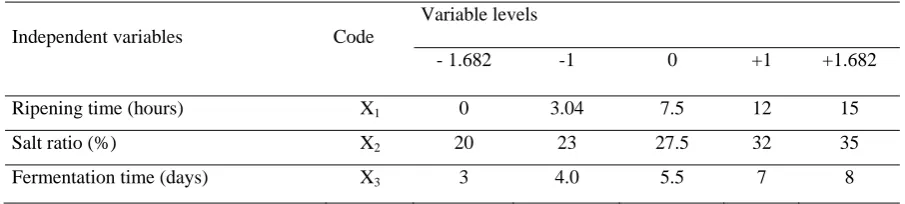
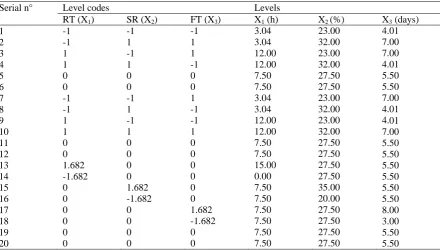
A Central Composite Rotatable Design (CCRD) experiment was set up for K=3 independent variables including ripening time (X1), salt ratio (X2) and fermentation time (X3) as shown in Table 1. The ranges of ripening time
(0-15h), salt ratio (20-35%) and fermentation time (3-8 days) were obtained based on information from the local Lanhouin processors. The responses (Y) were total viable count (TVC), histamine and NaCL contents. Twenty sample combinations were generated by the software (Statgraphics plus version 3.0) as shown in the design matrix in Table 2. The data generated from the experiments were analyzed using stepwise regression analysis
Table 1 Independent variable values of fermentation process and corresponding limits
Independent variables Code
Variable levels
- 1.682 -1 0 +1 +1.682
Ripening time (hours) X1 0 3.04 7.5 12 15
Salt ratio (%) X2 20 23 27.5 32 35
Table 2. Design matrix and variable combinations in experimental runs
Serial n° Level codes Levels
RT (X1) SR (X2) FT (X3) X1 (h) X2 (%) X3 (days)
1 2 3 4 5 6 7 8 9 10 11 12 13 14 15 16 17 18 19 20 -1 -1 1 1 0 0 -1 -1 1 1 0 0 1.682 -1.682 0 0 0 0 0 0 -1 1 -1 1 0 0 -1 1 -1 1 0 0 0 0 1.682 -1.682 0 0 0 0 -1 1 1 -1 0 0 1 -1 -1 1 0 0 0 0 0 0 1.682 -1.682 0 0 3.04 3.04 12.00 12.00 7.50 7.50 3.04 3.04 12.00 12.00 7.50 7.50 15.00 0.00 7.50 7.50 7.50 7.50 7.50 7.50 23.00 32.00 23.00 32.00 27.50 27.50 23.00 32.00 23.00 32.00 27.50 27.50 27.50 27.50 35.00 20.00 27.50 27.50 27.50 27.50 4.01 7.00 7.00 4.01 5.50 5.50 7.00 4.01 4.01 7.00 5.50 5.50 5.50 5.50 5.50 5.50 8.00 3.00 5.50 5.50 RT-ripening time; SR- salt ratio; FT- fermentation time
2.1.2 Samples treatment
Lanhouin samples were prepared for laboratory analysis using the traditional method as determined from a field study. Equal amounts (2 kg) of fish were scaled, gutted, washed and ripened (left covered in a bowl) for 0, 3, 7.5, 12 and 15 h (Table 1). The ripened fish was then treated with salt at a ratio of 20, 23, 27.5, 32 and 35 % by weight of fish and allowed to ferment at room temperature (28-30°C) for 3, 4, 5.5, 7 and 8 days (Table 1). The average weight of the individual fresh fish pieces was 250.00 ± 6.50g.
2.2 Analytical methods 2.2.1 Microbiological analysis
Ten (10) grams of each sample (steaks cut from the head, middle and tail region of the fish) were weighed into a sterile stomacher bag with 90 ml of sterile diluents containing 0.1% peptone (Oxoid L 37, Basingstoke, Hampshire, England), 0.8 % NaCl with pH adjusted to 7.2. The mixture was then macerated for 2 minutes in a stomacher (Lab Blender, Model 400). One (1) ml of the homogenate was serially diluted in aseptic conditions and the total viable cells were enumerated using Plate Count Agar (Oxoid CM 463, Basingstoke, Hampshire, England). The plates were incubated at 30°C for 72 hours
2.2.2 Chemical analyses
Sodium chloride (NaCl) and histamine contents of the samples were determined using (AOAC, 1995) methods: 937.09 and 977.13 respectively.
2.2.3 Statistical analysis
All the statistical analysis and graphical presentations were done using Statgraphics (Graphics Software Systems, STCC, Inc., Rockville, USA). The significant probability was set at p < 0.05.
3. Results and discussion
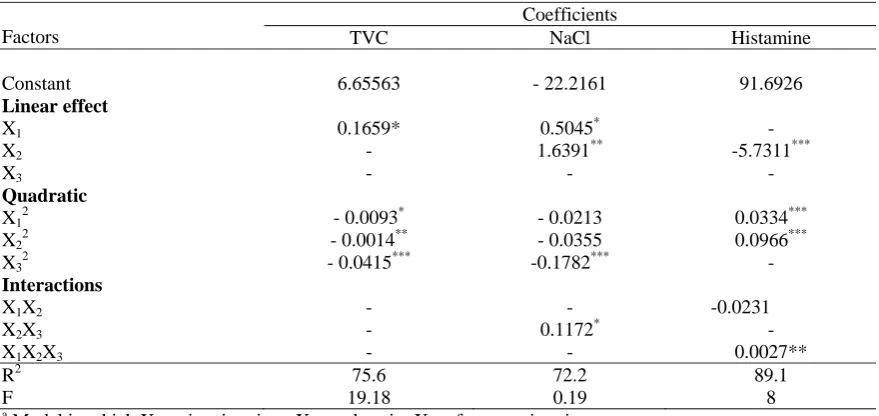
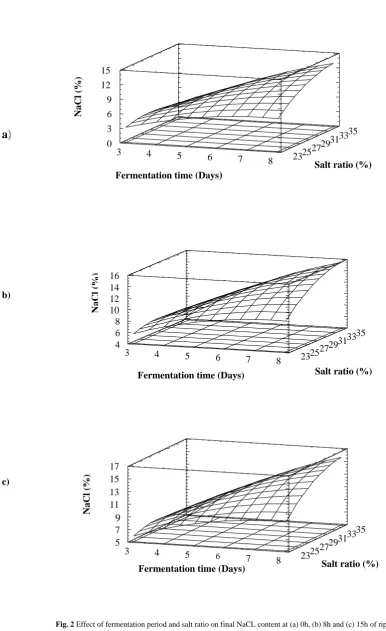
were obtained by varying two variables within the experimental range and keeping the other one constant at the central point. The response surfaces are shown in Figures 1, 2 and 3. The data obtained for TVC, histamine and NaCl contents were used to generate regression models. The estimated regression coefficients for each of the dependent variables are shown in Table 3. The analysis of variance for the model for the three response variables indicated that the model was statistically acceptable at the 5% level, possessing no lack-of-fit (F). Therefore, the model could be used to predict the three response variables at different fermentation conditions. Significant (p<0.05) interaction was observed between salt ratio and fermentation time for NaCl content of the samples and between ripening time, salt ratio and fermentation time for histamine. Indeed, significant influence of the quadratic effect of three independent variables was noted on the total viable count of the fermenting fish samples. The TVC load is an important criterion for the general quality assessment of fish and fish products. High level of TVC is an indication of mishandling and this could lead to the production biogenic amines such as histamine. Histamine is formed in foods by enzymatic decarboxylation of free histidine and various studies have established that decarboxylation results largely from the action of bacteria (Ababouch, 1990; Colette, 2001). Salt is mostly used as conservative agent and appropriate salt content in fish products have been reported to lower the enzymatic deterioration as well as microbial and chemical activities in the product (Horner, 1997; Kingsley-Ekow, 1999); this is said toincrease the shelf life of the product.
Table 3. Reduced model coefficientsa for the dependent variables (TVC, NaCl and Histamine)
Factors
Coefficients
TVC NaCl Histamine
Constant Linear effect X1 X2 X3 Quadratic
X12
X22
X32
Interactions
X1X2
X2X3
X1X2X3
6.65563
0.1659* - -
- 0.0093* - 0.0014** - 0.0415***
- - - - 22.2161 0.5045* 1.6391** - - 0.0213 - 0.0355 -0.1782*** - 0.1172* - 91.6926 - -5.7311*** - 0.0334*** 0.0966*** - -0.0231 - 0.0027** R2 F 75.6 19.18 72.2 0.19 89.1 8
a Model in which X
1 = ripening time; X2 = salt ratio; X3 = fermentation time
- : Variables not included in the model; * Significant at p < 0.05
3.1 Effect of process variables on total viable cells count of fermenting fish samples
The best regression model obtained for total viable cells (TVC) count during the fermentation of cassava fish for Lanhouin production was:
Y = 6.65563 + 0.165911X1 - 0.00932644X12 - 0.00149717X22 - 0.0415606X32 with an adjusted R2 = 75.6 % and
MSE =0.14.
a)
aaa
b)
Fermentation time (Days) Salt ratio (%)
TV
C (Logcfu/
g
sampl
e)
3 4 5
6 7 8 2325 27 29
313335 2.1
3.1 4.1 5.1 6.1
Fermentation time (Days) Salt ratio (%)
TVC (Logc
fu/g sample)
3 4 5
6 7 8 23252729
313335 2.5
c)
Fig. 1 Effect of fermentation period and salt ratio on TVC at (a) 0 h, (b) 8h and (c) 15 h of ripening
3.2 Effect of process variables on NaCl content of fermenting fish samples
The model obtained for final sodium chloride (NaCl) content when cassava fish was processed into Lanhouin was: Y= -22.2161 + 0.50458X1 + 1.63911X2 – 0.0213859X12 – 0.0355826X22 – 0.178205X32 + 0.117226X2X3 ; adjusted
R2 = 72.2 % and MSE = 1.8.
For final NaCl content, the regression coefficients showed that both ripening time and salt ratio had significant linear effects (p ≤ 0.05). The quadratic effect of fermentation time was highly significant (p ≤ 0.001) (Table 3). Significant interaction (p ≤ 0.01) was also observed between the salt ratio and fermentation time. The salt ratio (1.63) (Table 3) was the most important linear variable influencing NaCl content of the samples. The positive value implied that NaCl content of the samples increased with increasing salt ratio. Ripening time was the second most important linear variable (Table 3). The model could explain about 72% of the variations in NaCl content of samples. The model was considered adequate with satisfactory R2 value (> 72 %) (Table 3). The analyses of the response plots (Fig. 2 a–c) showed that the longer the ripening time and the fermentation time, the higher the NaCl content in the samples. A
similar observation was noted with all the salt ratios used to treat the fermenting fish samples. A salt content of fermenting fish samples above 7% is desirable for creating an unfavourable environment for microbial activity and hence increases the shelf life of the product (Horner, 1997; Gram, 2003). The study revealed that the conditions required to achieve the optimum salt content that would assure good shelf life of the samples during and after processing were ripening time of 8 h, salt concentration of 25-30 % by weigh of fish and fermentation time of 4-5 days.
Fermentation time (Days)
Salt ratio (%)
TVC (Logc
fu
/g sample)
3 4 5
6 7 8 2325
27 29 3133 35
a)
b)
c)
Fig. 2 Effect of fermentation period and salt ratio onfinalNaCL content at (a) 0h, (b) 8h and (c) 15h of ripening Fermentation time (Days
)
Salt ratio (%)
NaCl
(
%
)
3 4 5 6
7 8 2325
27293133 35 0
3 6 9 12 15
Fermentation time (Days) Salt ratio (%)
Na
Cl
(%
)
3 4 5 6
7 8 2325
27293133 35 4
6 8 10 12 14 16
Fermentation time (Days) Salt ratio (%)
Na
Cl (%
)
3 4 5
6 7 8 232527
293133 35 5
7
9
3.3 Effect of process variables on histamine content of fermenting fish samples
The regression model obtained for histamine content when the cassava fish was used for the fermentation was: Y= 91.6926 - 5.73119X2 + 0.0334442X12 + 0.0966919X22 - 0.0231231X1X2 +0.00272053X1X2X3 with an adjusted R2
of 89.10 % and MSE = 0.94.
Significant interaction (p ≤ 0.01) was observed between the ripening time, the salt ratio and the fermentation time. Salt ratio was the most important linear factor affecting histamine content of the samples (Table 3). The model could explain 89.0 % of the variations in histamine content, indication that about 11 % of the variation was due to other factors not included in the model, and was considered adequate with satisfactory R2 value (89.0%).
The response plots (Fig.3 a–c) showed that an increase in ripening time resulted in an increase in histamine content. The plots also described a curvi-linear relationship between salt concentration and histamine content indicating a reduction in histamine content of the samples within a defined range of salt concentration. Decrease of histamine content of fish products have been reported to be a result of lower enzymatic and microbial deterioration activities in the presence of salt. Sodium chloride used as antimicrobial agent could allow therefore reduction of microbial activity (Maijala et al., 1995). From the study, the optimal conditions required to achieve the lowest histamine content were identified as ripening time of 8 h, salt concentration of 25-30 % by weigh of fish and fermentation time of 3-4 days.
a)
b)
Fermentation time (Days)
Salt ratio (%)
H
is
tamine (
m
g
/ 10
0 g
sa
m
p
le)
3 4 5
6 7 8 23252729
313335 4.4
6.4 8.4 10.4 12.4
Fermentation time (Days)
Salt ratio (%)
H
istamine (
mg
/ 10
0 g
sa
m
p
le
)
3 4 5
6 7 8 232527
293133 35 5.5
c)
Fig. 3 Effect of fermentation period and salt ratio on histamine content at (a) 0h, (b) 8h and (c) 15h of ripening
3.4 Verification of the model
The criteria used to optimize the fermentation conditions for the test Lanhouin were total viable cells ≤ 5 Log (cfu/g), salt content ≥ 7% and histamine content ≤ 15 mg/100 g. From the three- dimensional plots,Fig. 1 (a-c), Fig. 2 (a-c) and Fig.3 (a-c) a number of combinations of fermentation time, salt ratiosand repining time meet the criteria but from the importance of repining in the process and based on histamine levels obtained in the fermenting fish samples, repining time of 8h, salt ratio of 25% by weight of fish and fermentation time of 4 days could be recommended as the optimal processing conditions. The suitability of the model equation for predicting the optimum response values was tested using the recommended optimal conditions. The predicted values using Y equation for the three response variables are shown in Table 4. The results revealed that the experimental and predicted values showed a good agreement. The parity plots are also shown in Figure 4. In the parity plots, the points are scattered favourably around the diagonal i.e. zero error line indicating that the experimental data was adequate for prediction.
Table 4 Experimental and predicted values for three response variables at optimum fermentation conditionsa
Response variables Histamine (mg/100g) TVC (Log cfu/g) Salt content (%)
Experimental 9.1 5.8 7.6
Predicted 8.5 5.5 8.0
a Results are mean of two determinations
Fermentation time (Days) Salt ratio (%)
Hist
a
m
in
e
(m
g/
1
00
g
samp
le
)
3 4 5 6
7 8 2325
272931 33 35 8.8
Fig.4 Parity plot of predicted Vrs experimental data for histamine, TVC and NaCL
Conclusion
The Central Composite Rotatable Design (CCRD) and Response Surface Methodology (RSM) can effectively be used to estimate the optimum processing conditions of ripening time, salt ratio and fermentation time, and their interactions for fish fermentation for Lanhouin production. The results showed that the ripening time, salt ratios and fermentation time significantly influenced (p ≤ 0.05) most of the quality indices of the fermented fish. The optimum fermentation conditions based on desirable histamine levels in the samples were established as ripening time of 8 h, salt ratio of 25% and fermentation time of 4 days. Experimental values obtained using the optimum conditions were compared with those predicted from the models and good agreement was found.
References
[1] Ababouch, L. (1990). Histamine in fishery products: a review. Proceedings of the FAO expert consultation on fish technology in Africa. Abidjan, Côte d’Ivoire, 25–28 April 1988. FAO-Fisheries Report, 1990, n° 4000, Supplement, pp44–50.
Plot of Histamine
5 7 9 11 13 15 17
predicted
5 7 9 11 13 15 17
obs
er
ve
d
Plot of TVC
3,1 3,6 4,1 4,6 5,1 5,6 6,1
predicted
3,1 3,6 4,1 4,6 5,1 5,6 6,1
ob
se
rve
d
Plot of NaCl
predicted
ob
se
rv
ed
5.1 7.1 9.1 11.1 13.1 15.1 5.1
[2] Abbey, L. D., Hodari-Okae, M. and Osei-Yaw A. (1994).Studies on traditional processing and quality of fermented fish (momone). Ghana/Netherlands Artisanal Fish Processing and Applied Research Project Report. Food Research Institute, Accra, Ghana, p48.
[3] Anihouvi, V.B., Hounhouigan, J.H., Ayernor, S.G. (2005). La production et la commercialisation du Lanhouin, un condiment à base de poisson fermenté du Golfe du Bénin. Cahiers Agricultures, 14 (3) : 323-330.
[4] Anihouvi, V.B., Ayernor, S.G., Hounhouigan, J.H., Sakyi-Dawson, E. (2006).Quality characteristics of Lanhouin, a traditionally processed fermented fish in the Republic of Benin, AJFAND, issue10, 6(1):1-15.
[5] AOAC (1995). Official Methods of Analysis, 16th revised edition, vol. 2. Association of Official Analytical Chemists.
[6] Collette, R. L. (2001). Industry practice of HACCP to prevent histamine in tuna and other seafoods. Histamine and toxigenic amines in foods. IFT Annual meeting, New Orleans, Louisiana.
[7] Eitenmiller, R.R. (2001). Chemical aspects of histamine formation in foods. Histamine and toxigenic amines in foods. IFT Annual meeting, New Orleans, Louisiana. http://ift.confex.com/ift/2001/techprogram/session_754.htm
[8] Essuman, K. M. (1992). Fermented fish in Africa: a study on processing, marketing and consumption. FAO Fisheries Technical Paper No. 329. Rome: FAO.
[9] Food and Drug Administration (2002). FDA’s evaluation of the seafood HACCP program for fiscal years 2000/2001. Washington, D.C.: Department of Health and Human Services, Public Health Service, Food and Drug Administration, Center for Food Safety and Applied Nutrition, Office of Seafood.
[10] Gram, L. (2003). Fermented fish products microbiology and technology. Retrieved February 13, 2003, from
http://www.dfu.min.dk/micro/lg.htm
[11] Horner, W. F. A. (1997). Preservation of fish by curing (drying, salting and smoking). In: Fish Processing Technology. 2nd ed. Hall, G. M. (Ed.). London: Blackie Academic & Professional (Chapman & Hall). pp32–72.
[12] Kim, S.H., Price, R.J., Morrissey, M.T., Field, K.G., Wei, C.I. and An, H. (2002). Occurrence of histamine-forming bacteria in albacore and histamine accumulation in muscle at ambient temperature. J. Food Sci. 67(4): 1515-1521
[13] Kim, S.H., Price, R.J., Morrissey, M.T., Field, K.G., Wei, C.I. and An, H. (2002). Occurrence of histamine-forming bacteria in albacore and histamine accumulation in muscle at ambient temperature. J. Food Sci. 67(4): 1515-1521
[14] Kingley-Ekow, G.S. (1999). A study of the effects of handling, processing and storage on the histamine content in salted, fermented Tilapia. M. Phill thesis, p133.
[15] Maijala, R., Eerola, S., Lievonen, S., Hill, P. and Hirvi, T. (1995). Formation of biogenic amines during ripening of dry sausages as affected by starter culture and thawing time of raw materials. J. Food Sci. 60(6): 1187-1190.