International Journal of Pharmaceutical Research & Allied Sciences, 2017, 6(1):202-212
Research Article
ISSN : 2277-3657
CODEN(USA) : IJPRPM
Evaluation of the Inhibitory Effect of Functional Fermented Milk Containing
Different Probiotic Cultures on Salivary Mutans Streptococci Count in
Experimental rats: A Randomized Control Animal Study
Sumer M. Alaki
1*, Heba M- El-khodary
1,2, Najlaa M. Alamoudi
1, Osama I. El-Batawy
3,
Reema M. Alhusain
41 Department of Pediatric Dentistry, Faculty of Dentistry, King Abdulaziz University, Jeddah, Saudi Arabia
2 Department of Pediatric Dentistry, Faculty of Dental Medicine (Girl’s Branch), Al Azhar University, Cairo, Egypt
3 Food Science Department,Faculty of Agriculture, Ain Shams University, Shoubra Khaima, 11241, Cairo, Egypt
4 B.D.S, Faculty of Oral & Dental Department, Al-Qatif Central Hospital, Eastern region, Saudi Arabia
*Corresponding authors:Sumer Madani Alaki
Email: [email protected]
________________________________________________________________________________________
ABSTRACT
Background: Probiotics are regarded as a part of the normal human microbiota. Previous studies have suggested that lactobacilli-derived probiotics in dairy products may reduce dental caries. Thus, the search for an effective caries preventing probiotic microorganisms appears to be a promising research avenue.
Objectives: The present study was carried out to investigate the inhibitory effect of feeding functional fermented milks containing five different probiotic strains on salivary mutans streptococci in the oral flora of rats.
Materials and Methodology: Mutans streptococci were used in this study for infection the albino rats were isolated from Saudi child saliva, identified using Biolog system. The infected rats (n=42) were randomly divided according to the type of diet given into 7 groups (n=6). Group T1 received laboratory standard rat ration blended with milk without any probiotic strain. Groups T2, T3, T4, T5 and T6 received laboratory standard rat ration blended with functional fermented milk containing different probiotic strains Lb acidophilus NCTC12980R, Lb plantarum ATCC 14917, Lb. reuteri NCIMB1195, Lb rhamnosus ATCC7469 and Bifi. bifidium NCTC1300R respectively. While, rats received laboratory standard rat ration blended without milk were control group (Group C). Rats were housed up to five weeks where saliva samples were collected from rats' oral cavities at the end of each week to evaluate the inhibitory effect of different probiotics by counting the Mutans streptococci count.
Result: Mutans streptococci count decreased significantly in group T3, T4, T5, and T6 with varying degrees where group T4 showed the statistically significant lowest S. mutans mean count followed by T5 (P-value<0.001). Group C and T1 showed the highest significant mean Mutans streptococci count.
Conclusion and Recommendations: Functional fermented milks containing different Probiotic strains showed an inhibitory effect against Mutans streptococci count with varying degrees. Fermented milk containing Lb. reuteri NCIMB1195 could be one of the best dietary regimens for dental caries prevention.
Keywords: Probiotic, mutans streptococci, lactobacilli, bifidobacteria, rats
Dental caries is the one of most common universal oral disease which affects the majority of individuals in all age groups during their lifetime. It is regarded as an infectious disease in which changes in the oral environment lead to a pathological shift in the oral biofilm, which then results in localized destruction of the hard tooth tissues [1]. The principle causative agent is group of streptococcal species of which Mutans streptococci are the most important agent of dental caries. Though the surgical approach has been predominating for the past decades, nowadays, management of dental caries moved toward an antibiotic/antimicrobial model of diseases prevention. There has been a global development in using of commercially available dairy products as complementary foods and/or medicines, that may exert their prevention and therapeutic effect of dental caries [2].
The concept of probiotics evolved at the turn of 20-century. Probiotics have crop up as one of the positive effect on general health and managing several medical conditions. The word “probiotic” is Latin preposition “pro” for and Greek adjective “biotic” bios, life. It was first used by Lilly and Stillwell in 1955 [3]. Today, two principal descriptions are used according to (WHO/FAO., 2002) "Probiotics are defined as living microorganisms, which, when administered in adequate amounts, confer a health benefit on host”. International Life Science Institute (ILSI) Europe suggests another description where probiotic is described as “alive microbial food ingredient that, when ingested in sufficient quantities, exerts health benefits on the consumer” [4]. The Lactobacillus strains are regarded as a component of the ecological community of typical human flora. The role of probiotics and their mechanism of action have been extensively studied regarding their effect on abdominal health and function [5-9]. Many studies have concluded beneficial effects of probiotics in improvement of oral health without negatively affecting the normal oral microbiota: reduction and inhibition in the number of mutans streptococci (MS), dental plaque and treatment of gingival inflammation [10-12]. Growing numbers of products containing probiotic bacteria is commercially available nowadays. Probiotic are provided in fermented food such as yoghurt drink, cheese, kefir, and can be inoculated into milk or dietary supplements. Since probiotics have been added to various foods because of their beneficial effects for human health, it is important to understand their effects in the oral environment. Furthermore, they need to be assessed individually for its favorable effect on oral health as positive or negative effect [13]. The most commonly used probiotic bacteria belongs to the genera lactobacilli and bifidobacteria, the genera that are also associated with dental caries [14]. Research in this area is ongoing but some controversies regarding the potent probiotic strains against SM, the proper delivery vehicle and the survival rate of these probiotic strains in the oral cavity are present [12, 15-21], thus the objective of this study is to investigate the inhibitory effect of functional fermented milks containing five different probiotic strains on the counts of salivary mutans streptococci aiming to provide enough information for future recommendation to be used in market to reduce dental caries in children.
MATERIAL AND METHODS
Microorganisms and culture condition:
Mutans streptococci used in this study for infection of albino rats were isolated from Saudi child saliva attending the outpatient’s clinic, Dental department, Al-Qatif Central Hospital. Informed written consent was obtained from the patient prior to sampling. Criteria of inclusion were as follows: Healthy children aged 5-12 years old, free of any systemic diseases with no history of antibiotic treatment for the past two months, having active caries lesions. All saliva samples were transported to the laboratory of Department of Food Science and Technology, Faculty of Agriculture, Ain Shams University.
Mutans streptococci were identified using Biolog system[22]. The isolated mutans streptococci was grown in Trypticase Soy broth supplement with 0.5% yeast extract (TSBY) incubated at 37°C in anaerobic incubator with 5% CO2. Cells were harvested during the exponential growth phase by centrifugation at 1000 RPM, washed twice with Phosphate buffer saline (PBS), re-suspended in the same buffer and subjected to hand shaking to disperse bacterial aggregates according to Nikawa et al. (2004) [10].
hydrochloride at 37ºC for 24h. Stock cultures of probiotic strains were made by mixing a pure culture that had been grown over night with equal amount of solution and stored at -20ºC until experimentally used.
Functional fermented milk preparation:
The samples of fermented milk were prepared in Food Science Department, Faculty of Agriculture, Ain Shams University. The bio-fermented milk was manufactured according to Farahat & El-Batawy (2013) [23] as follows: reconstituting 14% skim milk powder in water. The mix was heated to 85°C for 10 minutes, and then rapidly cooled to 37°C. The mother culture of probiotic strains (Lb. reuteri NCIMB1195, Lb rhamnosus ATCC7469, Lb acidophilus NCTC12980R, Lb plantarum ATCC 14917, and Bifi. bifidium NCTC1300R) were added at a rate of 3% (w/v). The inoculated mix was filled into 100 ml glass containers and incubated at 37°C. Incubation was terminated till pH 4.5[23]. At this point, the fermented milk was stored in a refrigerator (4±1°C) for 1 day, to be ready for feeding the rats.
Animal Study:
Total of forty-nine albino rats weaned at age of 19 days, were subjected to the same atmospheric condition at room temperature, time of feeding, handling, noise level and food and water were provided equally. All procedures were done at the Animals' house, (The food Technology Research Institute in Agriculture Research Centre, Cairo, Egypt.). The animals were placed under supervision of well-trained technician. The handling of the animals was carried out to a high standard regarding their cleanliness, cage washing, and ventilation and feeding. Oral swabs were taken from the rats' tongue, palatal, lingual and labial surfaces of teeth and streaked on mitis salivarius agar plus bacitracin for screening the indigenous mutans streptococci [24].
The rats at the age of 30- days were infected on three consecutive days with isolated mutans streptococci, by using a dropper containing suspension of the bacterial strain[24]. In addition, their drinking water contained 5% sucrose plus mutans streptococci to confirm the bacterial infection. At the age of 33 days, rats were randomly divided according to the type of diet, into seven groups (n=6). Group T1 received laboratory standard rat ration blended with milk without any probiotic strain. Groups T2, T3, T4, T5 and T6 received laboratory standard rat ration blended with functional fermented milk containing probiotic strains Lb acidophilus NCTC12980R, Lb plantarum ATCC 14917, Lb. reuteri NCIMB1195, Lb rhamnosus ATCC7469 and Bifi. bifidium NCTC1300R respectively. While, rats received laboratory standard rat ration blended without milk were control group (Group C). Randomization was done using SPSS software version 20.0 (Armonk, NY; IBMCorp.) for each cage (1-7) separately with a uniform random variable generation. Allocation concealment was assured by handling sequentially numbered opaque sealed envelopes to attending candidate. At time of intervention, the candidate opened each envelops and allocated the cage to written intervention inside that envelope. All rats were fed two meals per day with 5 ml of different fermented milks in addition to 5% sucrose solution for 5 weeks’ duration according to the diet regimen specified for each group.
Saliva samples and microbiological analysis:
Saliva samples were collected weekly from the tongue, palatal, lingual and labial teeth's surfaces of each mouse using the using sterilize cotton swab. The tip inserted in a test tube with 0.95 ml of sterile physiological solution. Each flask containing the saliva sample was vortex for 1 minute to obtain a uniform suspension. Samples were diluted in a decimal series (10 -5 to 10 -6) in 0.05 M phosphate buffer. One ml of each dilution was inoculated in Mitis Salivarius agar (selective media for Mutans Streptococci). The plates were incubated at 37ºC for 48 h. The counts of Mutans Streptococcus were performed by using the counting technique in each quadrant separately then summation of the number of colonies in the 4 quadrants. The results were expressed as log10 (CFU/ml). The number of colonies per milliliter (CFU/ml) was determined by the following equation:
CFU/ml =Number of colonies × dilution factor of sample
The microbiologist and the statistician were blinded to the treatment each group sample had received. Prior to carrying the microbial counting procedure, 3 microbiologists blindly and independently read 30 specimens. All the readings were compared statistically using Kappa test to evaluate the degree of agreement between the microbiologists.
Statistical Analysis:
Data were presented as mean and standard deviation (SD) values. A logarithmic transformation (log10 transformation) of each CFU count was performed to normalize the data before statistical evaluation because of the high range of bacterial counts. One-way Analysis of Variance (ANOVA) was used for comparisons between the seven groups. Tukey’s post-hoc test was used for pair-wise comparison between the groups. Paired t-test was used to
compare between bacterial counts before and after application. The significance level was set at P ≤ 0.01. Statistical
analysis was performed with IBM® SPSS® Statistics Version 20 for Windows.
RESULTS
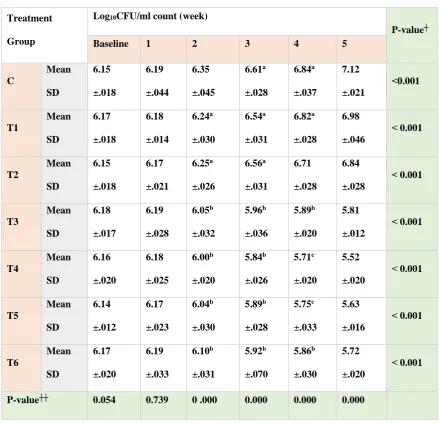
The study included 42 rats that were randomly divided according to the type of diet given into 7 groups (n=6). Rats housed up to five weeks where saliva samples were collected from rats' oral cavities at the end of each week to evaluate the inhibitory effect of the different probiotic strains and their survival rate. The mean and SD values of salivary mutans streptococci (log10CFU/ ml) in study rats at baseline were 6.15±.018 (C), 6.17±.018 (T1), 6.15±.018(T2), 6.18±.017(T3), 6.16±020(T4), 6.16 ±.012(T5) and 6.14±.020 (T6), with no statistical significant difference between the seven groups (p =0.054) [Table 5.1, Fig 5.1]. By the end of the first week: no statistical significant difference was found between the seven groups (p-value =0.739) [Table 5.1, Fig 5.1]. By the end of
second week; there was a statistical significant difference between group C and others groups (p ≤0.001). However,
no significant difference between group T1&T2 (p=1.00) and between T3, T4, T5 &T6 (p≤1.00) [Table 5.1, Fig
5.1]. There was a statistical significant difference between the seven groups by the end of the third week. (p ≤
0.001).
Group (T4) showed the statistically lowest mutans streptococci mean count 5.84 ± .026 (log10 CFU/ml) followed by group (T5) 5.89 ±.028, (T6) group 5.92±.070 then (T3) 5.96±.036. By the end of the fourth week; the salivary mutans streptococcus mean count decrease in group T3, T4, T5&T6 while in group C, T1&T2 salivary mutans mean count increased. Group T4 & T5 showed the statistically lowest mutans mean count (5.71±.020, 5.75 ±.033) respectively, followed by group T6 (5.86 ± .030) then T3 (5.89 ± .020). Group C&T1 showed the statistically highest mutans mean count (6.84±.037, 6.82±.028). There was a statistical significant difference between the seven
groups (p≤0.001) [Table 5.1, Fig 5.1].
Salivary Mutans Streptococcus mean count by the end of fifth week decreased significantly in group T3, T4, T5 & T6 and increased significantly on group C, T1 & T2. Group T4 showed the statistically lowest mutans streptococci mean count 5.52 ± .020 (log10 CFU/ml) followed by T5 (5.63 ±.016) (log10 CFU/ml) and T6 (5.72 ± .020) then T3
(5.81 ± .012) (p≤ 0.001). Group C showed the statistically highest mutans streptococci mean count 7.12 ±0.021
Table (1): Mean and SD of salivary mutans streptococci count in study groups received different probiotic strains during the experimental period
Treatment
Group
Log10CFU/ml count (week)
P-value┼
Baseline 1 2 3 4 5
C Mean SD 6.15 ±.018 6.19 ±.044 6.35 ±.045 6.61a ±.028 6.84a ±.037 7.12 ±.021 ˂0.001 T1 Mean SD 6.17 ±.018 6.18 ±.014 6.24a ±.030 6.54a ±.031 6.82a ±.028 6.98 ±.046
˂ 0.001
T2 Mean SD 6.15 ±.018 6.17 ±.021 6.25a ±.026 6.56a ±.031 6.71 ±.028 6.84 ±.028
˂ 0.001
T3 Mean SD 6.18 ±.017 6.19 ±.028 6.05b ±.032 5.96b ±.036 5.89b ±.020 5.81 ±.012
˂ 0.001
T4 Mean SD 6.16 ±.020 6.18 ±.025 6.00b ±.020 5.84b ±.026 5.71c ±.020 5.52 ±.020
˂ 0.001
T5 Mean SD 6.14 ±.012 6.17 ±.023 6.04b ±.030 5.89b ±.028 5.75c ±.033 5.63 ±.016
˂ 0.001
T6 Mean SD 6.17 ±.020 6.19 ±.033 6.10b ±.031 5.92b ±.070 5.86b ±.030 5.72 ±.020
˂ 0.001
P-value┼┼ 0.054 0.739 0 .000 0.000 0.000 0.000
┼Significant level is set at ≤ 0.01 between the groups using F test
┼┼Significant level is set at ≤ 0.01 within the group using F test (pairwise comparisons)
Group means sharing different letter between the groups are significantly different (post hoc test)
C: Rats received laboratory standard rat ration blended without milk, T1: Rats received laboratory standard rat ration blended with milk without any probiotic strain, T2, T3, T4, T5 and T6: Rats received laboratory standard rat ration blended with functional fermented milk containing probiotic strains Lb acidophilus, Lb plantarum, Lb.
Figure (1): Mean value of salivary mutans streptococci count in study groups received different probiotic strains during the experimental period.
Percent change in bacterial count between groups:
The results showed that there was a statistically significant increase in mean change of mutans streptococci count in group C, T1 and T2 during follow up with the highest mean percent increase in group C (-15.7±0.44). There was statistically significant decrease was noted in Group T3, T4, T5 and T6. The statistically significant lowest mean percent was in T4 (10.3±0.14) [Table 2 and Fig 2].
Table (2): Mean, SD values, and percent change of salivary mutans streptococci count in study groups received different probiotic strains before and after treatment
C T1 T2 T3 T4 T5 T6
P-value┼ Mean SD Mean SD Mean SD Mean SD Mean SD Mean SD Mean SD Pre-Treatment 6.15 ±.018 6.17 ±.018 6.15 ±.018 6.18 ±.017 6.16 ±.020 6.14 ±.012 6.17 ±.020 .054 Post Treatment 7.12 ±.021 6.98 ±.046 6.84 ±.028 5.81 ±.012 5.52 ±.020 5.63 ±.016 5.72 ±.020 ˂.001 % change -15.7 ±.48 -13.1 ±.63 -11.2 ±.71 5.98 ±.40 10.3 ±.14 8.60 ±.41 7.29 ±.52 ˂.001
P-value┼┼ 0.00 0.00 0.00 0.00 0.00 0.00 0.00
┼Significant level is set at ≤ 0.01 between the groups using F test
┼┼Significant level is set at ≤ 0.01 within the group using t- test
A positive sign indicates a decrease in CFU while a negative sign indicates an increase in CFU 5 5.5 6 6.5 7 7.5
B A S E L I N E 1 W E E K 2 W E E K 3 W E E K 4 W E E K 5 W E E K
ME AN C OUN T LOG 10 C FU/ ML
C: Rats received laboratory standard rat ration blended without milk, T1: Rats received laboratory standard rat ration blended with milk without any probiotic strain. T2, T3, T4, T5 and T6: Rats received laboratory standard rat ration blended with functional fermented milk containing probiotic strains Lb acidophilus, Lb plantarum, Lb.
reuteri, Lb rhamnosus and Bifi. bifidium respectively.
Figure (2): Mean of salivary mutans streptococci count in study groups received different probiotic strains before and after treatment
DISCUSSION
Probiotics have been supplemented to several foods because of their valuable effects on human health. They are mostly taken as a part of fermented foods with specially added active live cultures; such as in milk, yogurt or as dietary food. The inhibitory effect of five different probiotic bacterial strains against salivary mutans streptococci (log10 CFU/ml) was investigated among the different experimental groups. There is a significant increase in mean log10 salivary mutans streptococci mean count in rat ration containing Lb acidophilus NCTC12980R [T2] as shown in [Table1]. This increase might be due to the presence of interaction between Lb acidophilus NCTC12980R and salivary mutans streptococcus. The results came in agreement with Hasslöf et al. (2010) who tested Lactobacillus acidophilus La5 against mutans streptococci and found that low concentrations of L. acidophilus La5 (103 CFU/ml) did not affect MS growth [17].
The results disagree with Tahmourespour and Kermanshahi (2011) who reported that the presence of Lactobacilli acidophilus DSM 20079 resulted in a significant reduction in adherence streptococcal strains [25]. This study was conducted in an in-vitro environment, and our study more oriented toward biofilm studies and the ecological niche of the oral cavity is complicated. Bacteria in a biofilm express different genes and response differently to antimicrobial substances. The result also disagrees with Singh et al. (2011) where they found that the ice cream containing Bifidobacterium lactis Bb-12, ATCC27536 and Lactobacillus acidophilus La-5 reduced salivary mutans streptococci level[26]. This disagreement may be due to a combination of two probiotics together with the significant difference between groups at baseline scores of salivary mutans streptococci and lactobacilli in saliva. Besides, some of the subjects were prescribed antibiotics during Stage II and failed to report it to the investigator during the study. Though the reduction of mutans streptococci levels in consumption of probiotic ice-cream were observed, some children, especially with high scores of mutans at baseline, did not exhibit any change .
6.15 6.17 6.15 6.18 6.16 6.14 6.17
7.12
6.98
6.84
5.81
5.52 5.63
5.72
5 5.5 6 6.5 7 7.5
C T1 T2 T3 T4 T5 T6
M
ean
co
un
t l
og
10
CFU
/ml
The results of present study showed a significant decrease in mean log10 salivary mutans streptococci count in rat ration containing Lb plantarum ATCC 14917 [T3] as shown in [Table 1, Fig 1]. The results are in agreement with Simark‐Mattsson et al. (2007), Yang et al. (2008), Hasslöf et al. (2010), Söderling et al. (2011) and Hasslöf (2013) [17, 27-30]. The present study showed a significant reduction in mean log10 salivary mutans streptococcus count in Group [T4] consuming Lb. reuteri NCIMB1195 as a part of their diet which may be attributed to the antimicrobial effect of Lb. reuteri on mutans streptococcus [Table 1, Fig 1].This is in agreement with some in vivo studies (Caglar et al., 2006, Caglar et al., 2007, Çaglar et al., 2008a, Stensson et al., 2013) who concluded that ingestion of Lactobacillus reuteri ATCC 55730 delivered by prepared straws, lozenges, chewing gum, via medical device containing lozenges or drops reduced the level of salivary mutans streptococci significantly [15, 31-33]. On the other hand, the results disagreed with Söderling et al. (2011) who showed the weakness of Lactobacillus reuteri PTA 5289 when compared to Lactobacillus reuteri SD2112 in inhibition of the biofilm formation of the strains of mutans streptococci [29]. This might be due to the antimicrobial activity against S. mutans which was pH-dependent. The results also disagree with Cildir et al. (2012), where they concluded that the novel drop containing L. reuteri could not decrease the salivary mutans streptococci and lactobacilli levels in children aged 4-12 years with cleft lip/palate. It must be figured out that the effect of probiotics and their actions on the oral microflora of patients with cleft palate might be complicated [34]. Possible explanation is the complex condition in the oral cavity, with hundreds of species competing for nutrients, food intake lowering the pH, and saliva always flushing and altering the conditions for bacterial growth. It is possible that the biofilm in children is less mature and consequently more easily modified. The different intervals might explain these conflicting findings between the administration of probiotics and the oral microbiota analyses.
Investigating the inhibitory effect of Lb rhamnosus ATCC7469 [T5], the results showed a significant reduction in mean log10 salivary mutans streptococci count [Table 1 Fig 1]. This result agreed with in the vitro study of Söderling et al. (2011) concluded that Lactobacillus rhamnosus GG interfered with mutans streptococci biofilm formation in vitro[29]. Inhibitory effect of Lb rhamnosus against mutans streptococci reported in this study is also supported by several in vivo studies, Diab et al., 2007, Simark-Mattsson et al. (2009) and Glavina et al. (2012) [35-37].
The results of this study proved a significant decrease in mean log 10 salivary mutans streptococci count in rat ration containing Bifi. bifidium NCTC1300R [T6] [Table 1, Fig 1]. This goes in agreement with Caglar et al., 2005a, Caglar et al., 2008b, Cildir et al., 2009, Singh et al., 2011 and Plonka et al., 2012 where Bifidobacteria strains significantly inhibited mutans streptococci [11, 16, 26, 38, 39].
In the present study, there was no statistically significant difference in the mutans mean count between the groups at the beginning of the study, which was considered an important factor regarding standardization of the experiment. The inhibitory effect of different probiotic strains against salivary mutans streptococci counts among the control groups (C, T1) and experimental groups (T2, T3, T4, T5 &T6) before and after the intervention are shown in [Table 1, Fig 1]. All groups had a detectable level of salivary mutans streptococci at baseline with no statistical significant difference (p=0.054). After one week interventions, no significant different (p=0.73) was reported. An absolute decline in salivary mutans streptococci counts was evident after intake the probiotics bacteria by the end of the second week resulting in a statistically significant difference between group [C] and others groups since the (p
˂0.001). However, group [T1 & T2] showed no statistically significant difference with [T3, T4, T5 & T6] (p ≤1.00).
By the end of the experimental period, the results showed that there was a statistical significant decrease in mean change in salivary mutans streptococcus count in group [T4] during the follow-up period which showed the statistically significant lowest mutans mean count, followed by group [T5] then group [T6] & [T3]. On the other hand, there was a statistical significant increase on mean salivary mutans streptococci count on group [T2], [T1] and [C] (Negative control) which showed the statistical significant highest mutans mean count.
efficient than a single probiotic. The interest in oral probiotics has been growing during the last decades. It is important to recognize that the proposed health benefits of each probiotic bacterial strain must be studied individually. The current study compared between 5 different probiotic strains showing their behavior against mutan streptococci over time in vivo. The results showed that Probiotic strains have an inhibitory effect against MS count with varying degrees. The Lb. reuteri NCIMB1195 showed the most potent effect against MS followed by Lb rhamnosus ATCC7469 while the Lb acidophilus NCTC12980R showed no effect on growth of MS overtime.
CONCLUSIONS:
Within the limitation of the present study, it could be reported that, the reduction of S. mutans count in rats' saliva is associated with the application of bio-fermented milk with different probiotic bacteria. Different Probiotic strains showed an inhibitory effect on MS count with varying degree. Milk containing Lb. reuteri NCIMB1195 has the most potent effect against mutans streptococcus. More researches are needed to detect the effect of other Probiotic bacterial strains against salivary mutans streptococci, and to decide the best and appropriate vehicle for probiotics administration into the oral cavity. Further studies on the combination effect of different probiotics applied simultaneously to test the possible additive, cumulative, or competitive modes of action in the oral environment are still needed.
ACKNOWLEDGEMENT
This project was funded by the Deanship of Scientific Research (DSR) at King Abdulaziz University, Jeddah, under grant no (245 /254 /1437). The authors, therefore, acknowledge with thanks DSR for technical and financial support.
REFERENCES:
1. Petersen, P.E., et al., The global burden of oral diseases and risks to oral health. Bulletin of the World Health Organization, 2005. 83(9): p. 661-669.
2. de Castro Ishida, V.F., et al., A new type of Brazilian propolis: Prenylated benzophenones in propolis
from Amazon and effects against cariogenic bacteria. Food Chemistry, 2011. 125(3): p. 966-972.
3. Lilly, D.M. and R.H. Stillwell, Probiotics: growth-promoting factors produced by microorganisms.
Science, 1965. 147(3659): p. 747-748.
4. FAO\WHO. (2002). Guidelines for the evaluation of probiotics in food. Health and Agriculture Organization of the United Nations and World Health Organization Working Group Report.,
http://www.fao.org/es/ESN/food/foodandfood_probio_en.stm
5. Reid, G., Probiotic agents to protect the urogenital tract against infection. The American Journal of Clinical Nutrition, 2001. 73(2): p. 437s-443s.
6. Prantera, C., et al., Ineffectiveness of probiotics in preventing recurrence after curative resection for
Crohn's disease: a randomised controlled trial with Lactobacillus GG. Gut, 2002. 51(3): p. 405-409.
7. Furrie, E., Probiotics and allergy. Proceedings of the Nutrition Society, 2005. 64(04): p. 465-469.
8. Sudha, M.R., et al., Probiotics as complementary therapy for hypercholesterolemia. Biology and Medicine, 2009. 1(4): p. 1-13.
9. Allen, S.J., et al., Probiotics for treating acute infectious diarrhoea. Cochrane Database of Systematic Reviews, 2010. 11(11): p. 23-30.
10. Nikawa, H., et al., Lactobacillus reuteri in bovine milk fermented decreases the oral carriage of
11. Çaglar, E., et al., Effect of yogurt with Bifidobacterium DN-173 010 on salivary mutans streptococci
and lactobacilli in young adults. Acta Odontologica Scandinavica, 2005a. 63(6): p. 317-320.
12. Haukioja, A., V. Loimarant, and J. Tenovuo, Effect of lactobacilli and bifidobacterium on
streptococcal adherence. International Association for Dental research &Congress, Dublin, 2006a. 4(12): p. 13-16.
13. de Vrese, M. and J. Schrezenmeir, Probiotics, prebiotics, and synbiotics, in Food biotechnology. 2008, Springer. p. 1-66.
14. Saxelin, M., et al., Probiotic and other functional microbes: from markets to mechanisms. Current opinion in biotechnology, 2005. 16(2): p. 204-211.
15. Çaglar, E., et al., A probiotic lozenge administered medical device and its effect on salivary mutans
streptococci and lactobacilli. International Journal of Paediatric Dentistry, 2008a. 18(1): p. 35-39.
16. Cildir, S.K., et al., Reduction of salivary mutans streptococci in orthodontic patients during daily
consumption of yoghurt containing probiotic bacteria. The European Journal of Orthodontics, 2009. 31(4): p.
407-411.
17. Hasslöf, P., et al., Growth inhibition of oral mutans streptococci and candida by commercial probiotic
lactobacilli-an in vitro study. Bio Med Central of Oral health, 2010. 10(1): p. 18.
18. Keller, M.K., et al., Effect of chewing gums containing the probiotic bacterium Lactobacillus reuteri
on oral malodour. Acta Odontologica Scandinavica, 2012b. 70(3): p. 246-250.
19. Twetman, S., Are we ready for caries prevention through bacteriotherapy? Brazilian Oral Research, 2012. 26(SPE1): p. 64-70.
20. Cagetti, M.G., et al., The use of probiotic strains in caries prevention: a systematic review. Nutrients, 2013. 5(7): p. 2530-2550.
21. Campus, G., et al., Effect of a daily dose of Lactobacillus brevis CD2 lozenges in high caries risk
schoolchildren. Clinical Oral Investigations, 2014. 18(2): p. 555-561.
22. Biolg, I.M., instruction manual., in (http://wiki.bio.dtu.dk). 2007. p. 20-74.
23. Farahat, A.M. and O. El-Batawy, Proteolytic Activity and Some Properties of Stirred Fruit Yoghurt
Made Using Some Fruits Containing Proteolytic Enzymes. World Journal of Dairy & Food Sciences, 2013. 8(1): p.
38-44.
24. Duarte, S., et al., The influence of a novel propolis on mutans streptococci biofilms and caries
development in rats. Archives of Oral Biology, 2006. 51(1): p. 15-22.
25. Tahmourespour, A. and R.K. Kermanshahi, The effect of a probiotic strain (Lactobacillus acidophilus)
on the plaque formation of oral Streptococci. Bosnian journal of basic medical sciences/Udruzenje basicnih
mediciniskih znanosti= Association of Basic Medical Sciences, 2011. 11(1): p. 37-40.
26. Singh, R., S.G. Damle, and A. Chawla, Salivary mutans streptococci and lactobacilli modulations in young children on consumption of probiotic ice-cream containing Bifidobacterium lactis Bb12 and Lactobacillus
acidophilus La5. Acta Odontologica Scandinavica, 2011. 69(6): p. 389-394.
27. Simark‐Mattsson, C., et al., Lactobacillus‐mediated interference of mutans streptococci in caries‐free
vs. caries‐active subjects. European Journal of Oral Sciences, 2007. 115(4): p. 308-314.
28. Yang, Y., et al., [Probiotic characteristics of Lactobacilus plantarum HO-69 applied in oral cavity].
29. Söderling, E.M., A.M. Marttinen, and A.L. Haukioja, Probiotic lactobacilli interfere with
Streptococcus mutans biofilm formation in vitro. Current Microbiology, 2011. 62(2): p. 618-622.
30. Hasslöf, P., Probiotic Lactobacilli in the context of dental caries as a biofilm-mediated disease. Bio Medi Central Oral health . 2013. 2(18): p. 117-124.
31. Stensson, M., et al., Oral administration of Lactobacillus reuteri during the first year of life reduces
caries prevalence in the primary dentition at 9 years of age. Journal of Caries Research
2013. 48(2): p. 111-117.
32. Caglar, E., et al., Salivary mutans streptococci and lactobacilli levels after ingestion of the probiotic
bacterium Lactobacillus reuteri ATCC 55730 by straws or tablets. Acta Odontologica Scandinavica, 2006. 64(5): p.
314-318.
33. Caglar, E., et al., Effect of chewing gums containing xylitol or probiotic bacteria on salivary mutans
streptococci and lactobacilli. Clinical Oral Investigations, 2007. 11(4): p. 425-429.
34. Cildir, S.K., et al., A novel delivery system of probiotic drop and its effect on dental caries risk factors
in cleft lip/palate children. The Cleft Palate-Craniofacial Journal, 2012. 49(3): p. 369-372.
35. Simark-Mattsson, C., et al., Final pH affects the interference capacity of naturally occurring oral
Lactobacillus strains against mutans streptococci. Archives of Oral Biology, 2009. 54(6): p. 602-607.
36. Glavina, D., et al., Effect of LGG yoghurt on Streptococcus mutans and Lactobacillus spp. salivary
counts in children. Collegium Antropologicum, 2012. 36(1): p. 129-132.
37. Diab, M., et al., Effect of five commercial mouthrinses on the microhardness and color stability of two
resin composite restorative materials. Austalian Journal Basic and Appliedl Science, 2007. 1(4): p. 667-74.
38. Caglar, E., et al., Short-term effect of ice-cream containing Bifidobacterium lactis Bb-12 on the
number of salivary mutans streptococci and lactobacilli. Acta Odontologica Scandinavica, 2008b. 66(3): p.
154-158.
39. Plonka, K., et al., Mutans streptococci and lactobacilli colonization in predentate children from the