Mining Frequent Closed Patterns using
Sample-growth in Resource Effectiveness Data
Lihua Zhang1,2, Miao Wang2,3,*, Zhengjun Zhai1, Guoqing Wang1,2,3
1School of Computer Science and Engineering, Northwestern Polytechnical University, Xi’an, China, 710072 2Science and Technology on Avionics Integration Laboratory, Shanghai, China, 200233
3China National Aeronautical Radio Electronics Research Institute, Shanghai, China, 200233
Email: {zhang_lihua, wang_miao,wang_guoqing}@careri.com
*Corresponding author
Abstract—As the occurrence of failure of electronic
resources is sudden, real-time record analysis on the effectiveness of all resources in the system can discover abnormal resources earlier and start using backup resources or restructure resources in time, thus managing abnormal situations and finally realizing health management of the system. This paper proposed an algorithm: MFPattern, for mining frequent closed resource patterns in resource effectiveness matrix. In order to improve the efficiency, MFPattern algorithm uses sample-growth method and effective pruning strategies to guarantee mining all frequent closed patterns without candidate maintenance. Different from the traditional frequent closed pattern, MFPattern algorithm can mine resource combination patterns with all resources very effectively during work, those with simultaneous failure of resources and combination patterns in which some resources are very effective while some others have failure. The experimental result shows that our algorithm is more effective than existing algorithms.
Index Terms—frequent pattern, closed, resource
I. INTRODUCTION
Since resources are the physical support of system, the effectiveness of resources will directly influence the effectiveness of the system. Due to the influence of environmental factors and performance degradation of materials, electronic resources in the system will inevitably experience the process of capability loss. The influence of external stress in the process of system operation might cause acceleration of the degradation process of electronic resources and even damage and failure in extreme situations. Due to the aggravation of degradation, if not found in time, resource fault might finally cause system failure. Therefore, research on resource effectiveness is the footstone of prognostics and health management [1] of the system. As the occurrence of failure of electronic resources is sudden, real-time record analysis on the effectiveness of all resources in the system can discover abnormal resources earlier and start using backup resources or restructure resources in time, thus managing abnormal situations and finally realizing health management of the system.
Due to the great number of resources in system and the huge size of effectiveness value matrix of resources sampled in a period of time, how to mine the required resource pattern from these data efficiently is vital for health management of the system. The widely used data mining technology can mine various required knowledge from a lot of complex data. Frequent pattern mining [2-10] is an important branch of data mining technology. It can mine patterns meeting some rules and occurring frequently from huge data. However, this method has a disadvantage, i.e. existence of excessive redundancy modes. Literatures [11-14] reduce redundant patterns for mining frequent closed pattern. The important feature of frequent closed pattern algorithm is reserving and detecting strategies with candidate item. However, when there are a great number of item-sets in data set, it will produce a lot of candidate item-sets and thus cause the breakdown of internal memory. Therefore, BIDE[15] algorithm proposed by Han et al. uses backward checking method to avoid frequent item reservation, thus it can improve the mining efficiency. However, when the data set is sparse, the method of backward checking has a low pruning efficiency, thus increasing the complexity of the algorithm. Then WIBE[16] algorithm proposed by Wang et al. judges frequent closed pattern based on item-set weight information detection. Specifically, all items in the current candidate item-set have the same weight, this pattern is the subset of a frequent closed gene pattern that has been output and can be pruned. However, if the data set is large or sparse, this algorithm needs to store a lot of weight information in the internal memory, which will influence its efficiency and cause the breakdown of internal memory. Pan et al. [17,18] proposed a sample enumeration method of exploring enumeration space through recursive establishment and transposition of project database. Due to the lack of effective pruning strategy, the mining efficiency of this algorithm will be influenced when the number of samples is great.
(2) excessive sampling sites will influence the real-time property of the system, thus causing the failure to ensure normal operation of the system and finally influencing the health of the whole system. Based on the analysis above, this paper proposes an algorithm: MFPattern, for mining frequent closed resource pattern in resource effectiveness matrix using sample-growth method. In order to improve the mining efficiency, this algorithm uses effective pruning strategies to ensure the mining of all frequent closed patterns without candidate maintenance. MFPattern algorithm can mine the following three patterns: (1) resource combination pattern with very effective resources during system operation; (2) resource combination pattern with simultaneous failure of resources during system operation; (3) resource combination pattern in which some other resources will inevitably have failure during efficient operation of some resources.
II. PROBLEM DESCRIPTION
Resource effectiveness matrix is defined as a two-dimensional real matrixD= ×R S, where row collection R represents the resource names set and column collection S refers to a set of different sampling sites. Element Dij of
matrix D is a real-valued number which refers to the effective value (e.g. BIT value) of resource i under sampling site j. |R| is the number of resources in data set D and |S| is the number of sampling sites in data set D. For the convenience of mining, the original effective value in resource effectiveness matrix is generally discretized into 1, -1 and 0, where 1 represents resource health, 0 represents sub-health and -1 represents resource failure, as shown in table 1.
The relationship between two resources R1 and R2 can
be defined as follows: (1) if R1 and R2 are both very
effective (the value is 1), they have effective positive correlation, expressed as R1R2. The support is
1 2 1 2 | | ( ) | | R R sup R R
S
= , where |R R1 2| is the number of
sampling sites when R1 and R2 are both very effective; (2)
if R1 and R2 both have failure (the value is -1), they have
failure positive correlation, expressed as -R1-R2. The
support is 1 2
1 2
| |
( )
| |
R R
sup R R
S − −
− − = , where | - -R R1 2|is
the number of sampling sites when R1 and R2 are both
failure; (3) if R1 is very effective while R2 has failure, they
have effective negative correlation, expressed as R1-R2; if
R2 is very effective while R1 has failure, they also have
effective negative correlation, expressed as -R1-R2; when
R1 and R2 have effective negative correlation, the support
is 1 2 1 2
1 2
| | | |
( )
| | | |
R R R R
sup R R
S S
− −
− = + , where |R R1- 2| is
the number of sampling sites when R1 is very effective
and R2 is failure, and | -R R1 2|is the number of sampling
sites when R1 is failure and R2 is very effective.
Among three relationships above, the first one mines resource combination patterns in which resources are all very effective, i.e. there is a high efficiency when these resources work together; the second one mines resource combination patterns in which resources have failure together; in such patterns, potential reasons of failure can be found and decisions can be made for the use of backup resources; the third one mines resource patterns when some resources are very effective while some other resources have failure, in which potential unstable resources can be found and replaced earlier.
The mining purpose of MFPattern algorithm is to mine all frequent closed resource patterns in resource effectiveness data set, i.e. mine resource patterns without superset and with the same support which satisfies the threshold of support. To improve the mining efficiency of the algorithm, MFPattern algorithm mines frequent closed patterns using sample-growth without candidate maintenance. The mining process of this algorithm will be introduced in the next section.
III. THE MFPATTERN ALGORITHM
Most traditional methods for frequent closed pattern mining are based on row extension. There are two reasons as follows: (1) with row extension, apriori principle can be used to prune the current extended resource that not satisfying the support threshold in real time; (2) according to the definition of frequent closed pattern: if there is no superset with the same support as the current extended frequent pattern, the current extended frequent pattern is frequent closed pattern; it is more convenient to make closed judgment through mining with row extension; if there is no candidate item-set with the same support in all candidate item-item-sets of the current extended frequent pattern, the current frequent pattern must be frequent closed pattern.
However, there are some disadvantages of using row extension as follows: (1) resources might have three relations simultaneously. If the method of row extension is used for mining, the number of resource patterns produced will present 3n increase in extreme situations,
thus row extension increases the complexity of mining; (2) if there are many resources and a few sampling sites, the use of row extension will increase the number of iterations of the algorithm, thus influencing the time efficiency and space efficiency of the algorithm; (3) as resource sampling is dynamic, with the use of row extension, the support of resources will change when the column of original data increases, thus making the design of incremental frequent closed pattern mining algorithm
DISCRETE RESOURCE EFFECTIVENESS MATRIX
relatively complex. Therefore, MFPattern algorithm uses the method of sample-growth for mining.
Before introducing how MFPattern algorithm mines frequent closed resource patterns without candidate maintenance in detail, we will first analyze mining strategies of existing frequent closed pattern mining algorithms briefly. Generally speaking, there are three strategies for mining frequent closed patterns: (1) it mines all frequent patterns firstly, and then outputs frequent closed patterns meeting the condition according to the definition of frequent closed pattern. This mining method is simple and visual, but has a low efficiency; (2) it mines frequent closed patterns with the method of real-time monitoring, i.e. store frequent closed patterns produced currently in the internal memory and compare each new pattern produced with frequent closed patterns stored in memory. If any frequent closed pattern in memory has the same support with the current extended pattern and is also the superset of the current extended pattern, then it stops the current pattern extension; if it is a new frequent closed pattern, update frequent closed patterns stored in the internal memory till finishing the mining of all frequent closed patterns. Such method can make pruning judgment for the current extended pattern in real time. However, as it is required to store all frequent closed patterns produced in the internal memory, it wastes the storage space. Meanwhile, each new frequent pattern produced is compared with frequent closed patterns in the memory, thus it reduces the mining efficiency; (3) it makes pruning judgment for the current extended frequent pattern with the method of backward checking. If the current candidate pattern is the subset of a frequent closed pattern that has been mined, the current extended pattern must have a prior candidate resource (which is candidate resource that has been extended) satisfying the definition of frequent closed pattern for pruning judgment. This method can avoid storing frequent closed patterns in the internal memory for pruning. However, if original data are sparse, the success rate of pruning will decrease and this backward checking method is time-consuming.
As resources in the system are effective in most cases, health management will be conducted in the case of failure. Therefore, the resource effectiveness matrix used in this paper is dense. MFPattern will mine frequent closed resource patterns with the method of sample-growth and backward checking. The mining process of this algorithm can be divided into two steps: first, construct a sample weighted graph; then, mine all frequent closed resource patterns with the method of sample-growth.
A. Construct Undirected Sample Relational Weighted Graph
The method of mining patterns with sample weighted graph was first used in the mining of bicluster in MicroCluster algorithm [19]. Then, Wang et al. [20,21] used sample weighted graph to mine bicluster and fault-tolerant bicluster. MFPattern algorithm proposed in this paper will use undirected sample relational weighted graph (sample weighted graph for short, the same below) to mine frequent closed resource patterns.
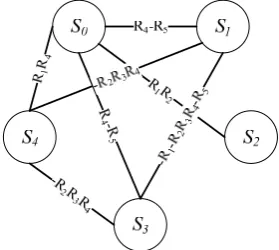
Definition 1. Sample weighted graph can be expressed asG={ , , }E V W . Each vertex in vertex set V in the weighted graph represents a sampling site; if an edge exists between a pair of vertices, it means that there are resources with effectiveness relationship under two sampling sites represented by this pair of vertices. The collection of edge is expressed with E; the weight on each edge is resource collection with effectiveness relationship under two sampling sites connected with this edge. The weight set is expressed with W.
Fig.1 shows the sample weighted graph corresponding to table 1. Weight on each edge is denoted as the set of effective resources under two sampling sites connected with this edge. The effective relationship among resources is obtained through the third relationship among resources defined in section two of this paper.
Figure 1. Undirected sample relational weighted graph corresponding to table 1
B. Mine Frequent Closed Resource Pattern
This section will introduce how MFPattern algorithm mines frequent closed resource patterns in the sample weighted graph. For the convenience of designing effective pruning strategies, MFPattern algorithm adopts the depth-first principle. It is assumed that frequent closed resource patterns are mined from the sample weighted graph in Fig.1. Firstly, MFPattern algorithm extends the edge connected with S0 node, i.e. S0->S0S1
->S0S1S2; then, it extends S1 after the extension of S0
branch. The support of resource pattern under sample S0S1S2S3S4 is 1; that under samples S0S1S2S3, S0S1S2S4,
S0S2S3S4 and S1S2S3S4 is 0.8; that under samples S0S1S2,
S0S1S3, ..., and S2S3S4 is 0.6. It can be seen from the
extension method above that the method based on sample-growth has a different process from the mining of frequent closed patterns with resource extension.
support of resource pattern increases (because the number of samples increases). Therefore, when frequent closed resource patterns are mined based on resource extension, extension can terminate as long as the support of resource does not meet the threshold value. However, when patterns are mined based on sample-growth, it is necessary to continue the extension of sample set so long as the weight under the sample set extended is not null or not more than the minimum number of resources defined by users.
Definition 2.P is the current extended resource pattern. If all samples in Si and P have a link in the sample
weighted graph and the number of intersections (expressed as Si.Resources) of weights of all join edges
satisfies the number defined by users, Si is the candidate
sample of P.
Definition 3.P is the current extended resource pattern. If Si and Sj are candidate samples of P, but Si has been
extended by P and Sj has not been extended by P yet. For
Sj, Si is prior candidate sample of P.
It can be known from the descriptions of the definition above that, a candidate sample becomes prior candidate sample if it has been extended. According to the principle of mining frequent closed patterns with backward checking, if the resource under the current extended sample set is the subset of resources under a prior candidate sample or candidate sample, the resource pattern under the current extended sample must not be frequent closed resource pattern. For example, assuming that the order of sample extension is from S0 to S4 based
on the name and the current extended sample set is S0S1,
S3 and S4 are its candidate samples and S2 is its prior
candidate sample (i.e. mining of S0S1S2 branch has been
completed). If the current sample to be extended is S3, for
S0S1S3, S2 is its prior candidate sample. It means that
S0S1S2S3 must have been extended before S0S1S3 is
extended. If the resource pattern under S0S1S3 is a subset
of that under S0S1S2, the resource pattern that can be
obtained by extension of S0S1S3 can definitely be obtained
by extension of S0S1S2 as well as S0S1S2S3 (because the
resource pattern under S0S1S2S3 is the same as that under
S0S1S3 at this time); as the support of S0S1S2S3 is higher
than that of S0S1S3, S0S1S3 can be pruned according to the
definition of frequent closed pattern.
Lemma 1. Assume that P is the current extended
resource pattern, M is the candidate sample set of P and N is the prior candidate sample set of P, if a prior candidate sample Nj(Nj∈N) making PMi. Resource a subset of
PNj.Resource exists for candidate sample Mi(Mi∈M),
PMi. Resource should be pruned.
Proof. Proof by contradiction. Assuming that the
resource set of the current candidate sample Mi is not a
subset of resource collection of a prior candidate sample Nj before it, Mi can be pruned. It can be known from the
assumption that resources not belonging to PNj.Resource
exists in PMi.Resource. As frequent closed pattern
mining uses sample depth-first extension method and Nj
is extended earlier than Mi, there might be another sample
Sm making PMiSm.Resource is not equal to
PMiNjSm.Resource. Therefore, Mi cannot be pruned,
which is contradictory with the assumption. Thus, the original evidence is true.
Candidate samples meeting theorem 1 should be directly pruned and those not meeting pruning conditions should continue extension. However, whether the current extended pattern is output, should be judged according to the following output strategy (which actually meets the definition of frequent closed pattern):
Output strategy. Assuming that P is the current
frequent closed pattern to be extended, M is candidate sample set of P and N is prior candidate sample set of P, if there is no candidate sample Mi making P.Resource a
subset of PMi.Resourcefor all candidate samples
Mi(Mi∈M) of P, P.Resource can be output.
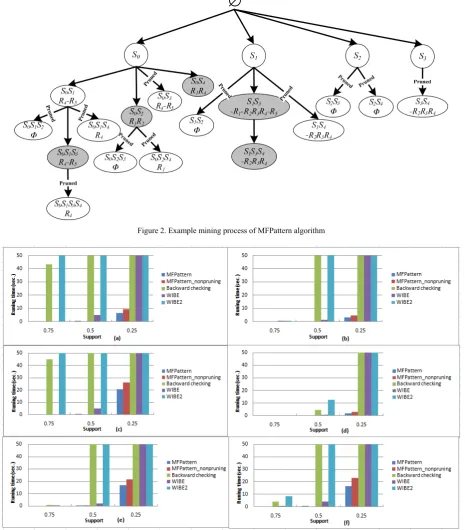
Based on the analysis above, MFPattern algorithm can directly mine frequent closed resource pattern with the method of sample-growth without storing candidate frequent pattern in memory. Fig.2 illustrates the mining process of MFPattern algorithm. Example data is shown in table 1 and the threshold of support is 0.4 and the minimum number of resources in pattern is 2.
Algorithm 1: MFPattern algorithm
Input: threshold of support: rmin; resource effectiveness
data: D
Output: all frequent closed resource patterns satisfying the threshold value
Initial value: sample weighted graph: G =Null; current pattern to be extended Q =Null,Si=Null,Sj=Null
Algorithm description: MFPattern(rmin, D, Q, Si, Sj)
(1) If G is null, scan data set D and make its weighted graph. Si is the first sample in the weighted graph;
(2) For each sample Sj connected with sample Si,
(3) If all resources linked lists in Sj satisfy pruning
conditions, (4) Continue; (5) Else
(6) For resource linked lists not satisfying pruning conditions, Q.Sample= Q.Sample∪Sj;Q. Resource=
Q.Resource∩SiSj.Resource;
(7) MFPattern(rmin, D, Q, Si, Sj->next);
(8) end if (9) end for
(10) if Q satisfies output conditions, then (11) Output Q;
(12) end if; (13) Si = Si->next;
(14) return
IV. EXPERIMENTAL RESULT AND ANALYSIS
algorithm, we generate six data sets randomly. Each data
set contains 35 sampling sites and 800 resources. Table 2 describes the proportion of 1, 0 and -1 in each row in each data set.
∅
Pru ned
Pru ned P
run ed
Prun ed
P ru
ned
Pru ned
Figure 2. Example mining process of MFPattern algorithm
Figure 4. Comparison of operating time of five algorithms under different data sets with 500 resources and 20 sampling sites: (a) D1; (b) D2; (c) D3; (d) D4; (e) D5; (f) D6
In this section, MFPattern algorithm will be compared with MFPattern algorithm without pruning (denoted as MFPattern_nonpruning), Backward Checking algorithm, WIBE algorithm and WIBE2 algorithm. MFPattern_nonpruning algorithm uses the same mining method as MFPattern algorithm, i.e. mine frequent closed patterns with the method of sample-growth. Different from MFPattern algorithm, MFPattern nonpruning algorithm does not use pruning strategies described in Lemma 1, but mines with the method of full extension. Backward Checking algorithm uses backward checking method described in literature [15] and mines frequent closed patterns without storing frequent item-sets. WIBE algorithm uses pruning strategies described in literature [16] and can mine frequent closed patterns without candidate maintenance. WIBE2 algorithm uses the same pruning strategies as WIBE algorithm to mine frequent closed patterns. Different from WIBE algorithm, WIBE2 algorithm uses co-expression support for mining.
The mining efficiency of five algorithms above will be compared. To fully compare the extendibility of algorithms, we produce multiple groups of data sets with different numbers of resources and sampling sites in allusion to six data sets in Table 2. Resources and sampling sites are selected according to the order of resources and sampling sites in data sets. Figs 3(a)-3(f) provide the comparison of operating time of five algorithms above under different data sets with 200 resources and 20 sampling sites. It can be seen from these figures that MFPattern and MFPattern_nonpruning algorithms can complete the mining process within 1 second and have more mining efficiency than other algorithms when the support is 0.75 and 0.5 under each data set. As Backward Checking algorithm judges frequent closed patterns with the method of backward checking, when the data set is dense (the proportion of 0 is low), it is necessary to frequently use backward checking strategy. Thus, the mining efficiency is low. Therefore, even when the support is 0.75, Backward Checking algorithm cannot complete the mining process in limited memory space under dense D1 and D3 data sets.
When the support is 0.5, Backward Checking algorithm can only complete the mining process under data set D4
with the lowest density of data. When the support is 0.25, only MFPattern and MFPattern_nonpruning algorithms can complete the mining process and other three algorithms cannot complete mining in limited memory space. As more frequent closed patterns can be produced when the support is low, pruning strategies used in
DISTRIBUTION OF NUMERICAL VALUE PROPORTION IN SIX DATA SETS
MFPattern algorithm can reduce the mining space of the algorithm. Thus, it has a higher mining efficiency than MFPattern_nonpruning algorithm. It is thus clear that the mining of frequent closed patterns with sample-growth is highly efficient and meanwhile pruning strategies used in MFPattern algorithm can improve the mining efficiency of the algorithm.
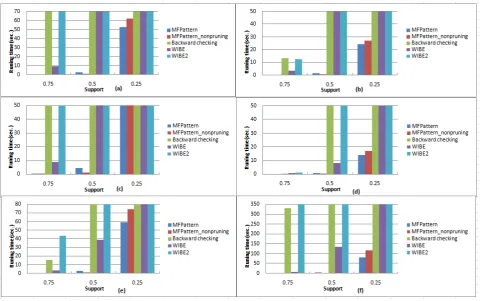
To further verify the extendibility of algorithms, Figs.4(a)-4(f) provide the comparison of operating time of five algorithms above under different data sets with 500 resources and 20 sampling sites. It can be seen that, similar to descriptions in Fig.3, MFPattern and MFPattern_nonpruning algorithms have more efficiency than other algorithms under different supports in each data set. When the support is 0.25, pruning strategies used in MFPattern algorithm have more obvious advantages than other supports. Figs.5(a)-5(f) provide the
comparison of operating time of MFPattern algorithm and other three algorithms under different data sets with 500 resources and 35 sampling sites. It can be seen that MFPattern algorithm has the fastest mining process under most data sets and supports. However, compared to the operating time in Fig.3 and Fig.4, the operating time of MFPattern algorithm increases with the increase of the number of sampling sites. When the support is 0.55, as shown in Fig.5(c) and Fig.5(3), MFPattern algorithm has a lower mining efficiency than WIBE algorithm. As both data sets are dense, MFPattern algorithm needs frequent pruning judgment, thus influencing the mining efficiency. When the support is 0.4, Backward Checking and WIBE2 algorithms cannot complete the mining process under all data sets in limited memory space. MFPattern algorithm can complete the mining process under sparse data sets D2 and D4.
Figure 5. Comparison of operating time of five algorithms under different data sets with 800 resources and 35 sampling sites: (a) D1; (b) D2; (c) D3; (d) D4; (e) D5; (f) D6
V. CONCLUSION
This paper proposed an algorithm mining frequent closed resource patterns from data effectiveness matrix with the method of sample-growth: MFPattern, which uses effective pruning strategies to guarantee the mining of all frequent closed patterns without maintaining candidate item-sets. Different from the traditional frequent closed pattern, MFPattern algorithm can mine resource combination patterns with all resources effectively during work, those with simultaneous failure of resources and combination patterns in which some resources are very effective while some other resources
have failure. The experimental result shows that this algorithm is more efficient than existing mining methods of frequent closed pattern. However, mining on discrete data will cause the loss of original data information. Our next research direction is to mine frequent closed patterns related to resource health from real resource effectiveness data.
ACKNOWLEDGMENT
REFERENCES
[1] Michael Pecht,et al.. A prognostics and health management roadmap for information and electronics-rich systems. Microelectronics Reliability, 2010:317–323.
[2] J. Han, J. Pei, B. Mortazavi-Asl, Q. Chen, U. Dayal, and M.-C. Hsu, FreeSpan: Frequent Pattern-Projected Sequential Pattern Mining, Proc. 2000 ACM SIGKDD Int’l Conf. Knowledge Discovery in Databases (KDD ’00), pp. 355-359, Aug. 2000.
[3] Pei Jian, Han Jiawei. Mining Sequential Patterns by Pattern-growth: The PrefixSpan Approach. IEEE Transactions on Knowledge and Data Engineering, 2004, 6(10): 1-17.
[4] Nohuddin P N E, Coenen F, Christley R, et al. Finding “interesting” trends in social networks using frequent pattern mining and self organizing maps. Knowledge-Based Systems, 2012, 29: 104-113.
[5] Mishra S, Mishra D, Satapathy S K. Fuzzy Frequent Pattern Mining from Gene Expression Data using Dynamic Multi-Swarm Particle Swarm Optimization. Procedia Technology, 2012, 4: 797-801.
[6] Pyun G, Yun U. A Frequent Pattern Mining Technique for Ranking Webpages Based on Topics. Multimedia and Ubiquitous Engineering. Springer Netherlands, 2013: 121-128.
[7] Glatz E, Mavromatidis S, Ager B, et al. Visualizing big network traffic data using frequent pattern mining and hypergraphs. Computing, 2013: 1-12.
[8] Yun U, Lee G, Kim S J. Analyzing Efficient Algorithms of Frequent Pattern Mining. IT Convergence and Security 2012. Springer Netherlands, 2013: 937-945.
[9] Xufei Zheng, Yanhui Zhou, Yonghui Fang. The Dual Negative Selection Algorithm Based on Pattern Recognition Receptor Theory and Its Application in Two-class Data Classification. Journal of computers, Vol 8, No 8, 2013, p:1951-1959.
[10]Haichao Luo, Xiaomin Li, Shujing Zheng, Mei Li, Lili Song. Study on Synthesis Evaluation of Intensive Land Use and Growth Pattern Transformation of Towns. Journal of computers, Vol 7, No 8, 2012, p:1959-1966.
[11]Pasquier N, Bastide Y, Taouil R, Lakhal L. Discovering frequent closed itemsets for association rules. In: Beeri C, et al, eds. Proc.of the 7th Int’l. Conf. on Database Theory. Jerusalem: Springer-Verlag, 1999. 398~416.
[12]Pei J, Han J, Mao R. CLOSET: An efficient algorithm for mining frequent closed itemsets. In: Gunopulos D, et al, eds. Proc. of the 2000 ACM SIGMOD Int’l. Workshop on Data Mining and Knowledge Discovery. Dallas: ACM Press, 2000. 21-30.
[13]Meng Han, Zhihai Wang, Jidong Yuan. Closed Sequential Pattern Mining in High Dimensional Sequences. Journal of Software, Vol 8, No 6, 2013, p:1368-1373.
[14]Qunhui Wu, Shilong Ma, Hao Wang. Extracting Feature Sequences in Software Vulnerabilities Based on Closed Sequential Pattern Mining. Journal of Software, Vol 8, No 8, 2013, p:1809-1817.
[15]Wang, J, Han, J. BIDE: Efficient Mining of Frequent Closed Sequences, Data Engineering, 2004. Proceedings. p: 79 – 90.
[16]Miao Wang, Xuequn Shang, Jingni Diao, Zhanhuai Li. WIBE: Mining Frequent Closed Patterns Without Candidate Maintenance in Microarray Dataset. DMIN 2010: 200-205.
[17]Cong, G., Tan, K., Tung, A. et al.: Mining Frequent Closed Patterns in Microarray Data. ICDM’04. IEEE Press, 2004, 363–366.
[18]Pan, F., Cong, G., Tung, K., Yang, J., Zaki, M.. Carpenter: Finding closed patterns in long biological datasets. In: Proc. ACM SIGKDD Intl. Conf. Knowledge Discovery and Data Mining (KDD), 2003, pp. 637–642.
[19]Lizhuang Zhao, Mohammed J. Zaki, MicroCluster: An Efficient Deterministic Biclustering Algorithm for Microarray Data, in IEEE Intelligent Systems, special issue on Data Mining for Bioinformatics, 2005, Vol. 20, No. 6, pp: 40-49.
[20]Miao Wang, Xuequn Shang, Miao Miao, Zhanhuai Li, Wenbin Liu. FTCluster: Efficient Mining Fault-Tolerant Biclusters in Microarray Dataset. Proceedings of ICDM 2011 workshop on Biological Data Mining and its Applications in Healthcare, p 1075-1082.
[21]Miao Wang, Xuequn Shang, Shaohua Zhang, Zhanhuai Li. FDCluster: Mining frequent closed discriminative bicluster without candidate maintenance in multiple microarray datasets. ICDM 2010 workshop on Biological Data Mining and its Applications in Healthcare, p 779-786.
Lihua Zhang is a doctoral student at the School of Computer Science and Engineering at the Northwestern Polytechnical University, Xi'an China. She completed her master degree from northwestern polytechnical university in 2008. Her current research interests are PHM, avionics, data mining and safety. Since 2013, she has been studying at science and technology on avionics integration laboratory.
Miao Wang is an engineer at Science and Technology on Avionics Integration Laboratory. He completed his doctor degree and master degree from Northwestern Polytechnical University in 2013 and 2008, respectively. He is a member of China Computer Federation. His research interests mainly include data mining, PHM, avionics and safety.
Zhengjun Zhai is a professor at the
Guoqing Wang is a professor and a
supervisor of Ph.D. student in Northwestern Polytechnical University. He was born in 1956 and received his M.S. and Ph.D. degrees in Computer Science and Technology from the Northwestern Polytechnical University in 1984 and 1991 respectively. He is the