ISSN (e): 2250-3021, ISSN (p): 2278-8719
Vol. 06, Issue 11 (Nov. 2016), ||V1|| PP 14-19
Online Examination System using Embedded Device
Karishma SudarshanKalike
1, Mrs. M.R.Vargantwar
21(P.G. Student, Department of Electronics and Telecommunication Engineering, Marathwada Institute of
Technology, Aurangabad, India)
2(Associate Professor, Department of Electronics and Telecommunication Engineering, Marathwada Institute of
Technology, Aurangabad, India)
Abstract: Education of any kind is necessary for man to develop socially and intellectually. Today need of examis in universities, schools, colleges and even companies for recruitment purposes.The general paper-pen tests/exams are now slowly replaced by the online internet based exam system. Online examinations, sometimes referred as e-examinations, are the examinations conducted through the internet or in an intranet (if within the Organization) for a remote candidate/candidates. The previous online examination system is based on Browser/ Server (B/S) structure or Client/Server (C/S) structure as they require individual computer for every student within a batch. As the number of students are increasing morecomputers are needed, this will increase the cost. To avoid this a keypad based embedded device has been designed. This embedded device can be used to conduct online examination with only one desktop computer. The main objective of this system is to provide automated system that not only saves lot of time but also gives accurate and fast result with a higher security.
Keyword:Raspberry Pi, 7 Inches Touch screen LCD Screen, Master Computer, Wi-Fi Dongle,and PHP.
I.
INTRODUCTION
Online examination is a great opportunity for exponential growth. Today all online examination system isbased on the browser/server structure or Client/Server Structure. The Client/server structure is mainly based on Local Area Network (LAN) environment of application development but browser/server is not limited by region because it uses internet communication [1].Many organizations and the universities use the online examination worldwide successfully & issues result immediately. Allthe online examination system required computer for every student within a batch. But small schools, institutes and companies maynot able to afford computers, an embedded device using Raspberry Pi 2 model B with 7 inches LCD screen and Wi-Fi has been designedwhich is small in size and low cost. In this only one master computer control all slave units. In this Questions can have multiple options, multiple answers or can be text answers including images, mathematical equations anddiagrams.
Online examination system is more and more popular in many colleges and training organization that students have an exam via internet. The examination system may be divided into two kinds, one is stand-alone edition and the other is online edition, Stand-alone examination system needs to be installed on the computer which is used in examination, while the item bank will also be installed with the computer, the type of examination system has been gradually eliminated because of high maintenance cost and lowperformance. The online edition system can also be divided into C/S (Client/Server) online examination system and B/S (Browser/server) online examination system. In C/S online examination system, there is a database server, used to store user’s information, item bank information, examination results, etc. In C/S online examination systems have high maintenance cost because they request every computer install their client system. The benefits of B/S system is to support more users than C/S system at the same time and has lower maintenance cost because only web servers requiresmaintenance [2]. An online examination system means more powerful than the others if it provides more question types. Most online examination system, often only supportsfixed kinds of question types, but also hard coded into a program. If users want to add some new kind of question types would require developers to re-modify the program, and then re-release and re-develop new applications. The user define question type module allows users to add, delete and modify question types [3].
examination system includes the architectural components as Browser-Server architecture, client-server architecture, auto question generator system, security, and randomization. Random number generators (RNG) i.e. rng’s used for applications of cryptography that mostly produces a sequence of zeros and one bits, that may be together combined into the sub-sequences or blocks of random values. The two basic classes in this are deterministic and non-deterministic [4].
In existing online examination systems used various authentication techniques to provide security. Authentication attempts to verify that the user is who he/she claims to be. In an online examination scenario, authentication aims to verify the identity of online student and plays a key role in security. The mainstream authentication is based on user’s knowledge, objects and physical or behavioral features. Knowledge based authentication required personal knowledge to authenticate individual access to the online environment.A user id and password scheme is a commonly used, challenge question or security question are another example of knowledge based authentication. In a similar way object are used to identify the person. The users are identifying by presenting or applying physical objects i.e. electronic chip cards, magnetic cards, and digital keys. But in this authentication process object may be transferred to a third party, and it is dangers or not secure. [5].
II.
SYSTEM MODELING
All the examination system is based on Browser/Server structure and client/server structure and it required computer system for every student within a batch. The scope of online examination system is increases. Main objective to implement this project is to design and develop a low cost reliable and efficient technique for online examination system. This technique uses only one master computer and others are slave units i.e. embedded device. The Block Diagram of proposed system is as shown in Figure 1.
Figure1. Block Diagram of System
In this proposed system one master computer is used and number of slave units are available.Master unit consists of a master computer which is connected to intranet for sending and receiving of the questions and answers. It is used for sending the data (Question Paper) to slave unit and also receiving the final data from the slave. The master computer stores all the data and question paper in database. The slave unit consists of Raspberry pi 2 model B, 7 inches touch screen Liquid Crystal Display (LCD), High Definition Multimedia Interface (HDMI) connector, Wi-Fi Dongle. Raspberry pi 2 model B is used as a core controller. The raspberry
Master
Computer
Wi-Fi
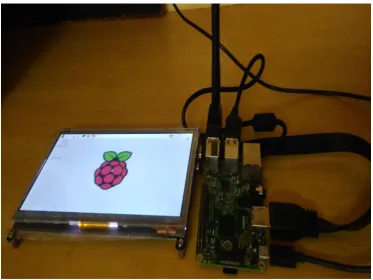
pi is run on Linux kernel it has a quad core processor with 1GB RAM. The 7 inches touch screen LCD is used as a display. The 7 inches LCD screen is connected to raspberry pi using HDMI cable and USB cable. The Raspberry Pi HDMI port is connected to HDMI port of Raspberry Pi using HDMI cable for displaying purpose and USB port of raspberry pi is connected to micro USB port of LCD screen. Wi-Fi Dongle is connected to USB port of Raspberry Pi. Wi-Fi is used to establish wireless connection between master unit and slave unit. The range of Wi-Fi is 50 to 100 meter. Operating frequency of Wi-Fi is 2.4GHz. Though the Wi-Fi data can be send from master unit to slave unit and back to master unit also. Master unit is handling the entire slave unit, slave unit not access anything whenever master unit send a start command to slave unit. After completing examination the slave unit is send data to master unit. Master unit analysis with a standard form and result send back to slave unit and also store in the database.
III.
RESULTS
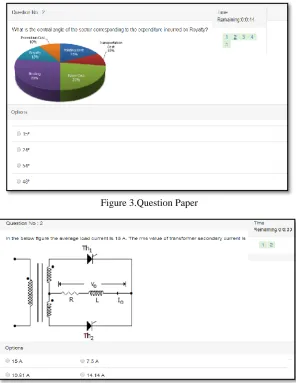
Examination will start on every slave device only after receiving command from master. Then each candidate has to enter his/herusername and password on master computer. After completion of registration procedure candidate’s examination time starts& each question will be displayed sequentially as per the set for each slave.
Figure 2. Handheld Device (Slave Unit)
Figure 3.Question Paper
Figure 4. Question including circuit Diagram
Figure 5. Admin window
Figure 6. Add/Update Test
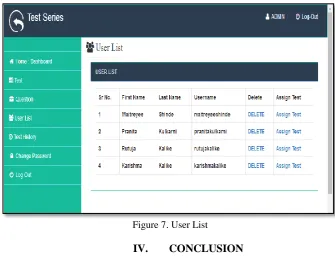
Figure 6 is an add/update test window. Using this administrator add and update the different test with the time and marks. Figure 7 is a user list window; in the user list the entire user’s detailed information is available.
Figure 7. User List
IV.
CONCLUSION
Online examination system provides more effective and efficient examination environment with low cost and small size device. Each slave unit communicates with master computer and after the examination finished the results can be displayed on slave unit and can be stored in master computer,because of this device cost is reduced. The size of the device is smaller than the computer/laptop and power consumption of device is less because only one master computer is used where as other slave unit requires less power than computer. This system is very useful in schools, institutes, and companies for examination purpose.
V.
ACKNOWLEDGEMENT
MarathwadaInstitute of Technology, Aurangabad for their constant support. Finally I would like to thank all the authors whose papers provided me a helping hand.
REFERENCES
[1] S.G.Pardeshi, K.S.Jadhav, “Key pad Based Online Examination System”,International Journal Of
Computational Engineering Research,Volume 3, Issue 11, 2013.
[2] Xingbao Li, Yunming Wu, “Design and Development of the Online Examination and Evaluation System
Based on B/S Structure" School of Information And Communication Normal University, China, 2007.
[3] Shan Wei-feng, Huang Meng, Li Jun, “An Online Examination System supporting User Define Question
Type, International Conference on Education Technology Computer, 2010.
[4] DeepankarVishwasKotwal, ShubhamRajendraBhadke, Aishwarya Sanjay Gunjal, Puspendu Biswas,
“Online Examination System” , International Research Journal of Engineering and Technology
(IRJET), Volume: 03 Issue: 01 , Jan-
[5] AbrarUllah, Hannan Xiao, Mariana Lilley, “Profile Based Student Authentication in Online
Examination”, International Conference on Information Society, 2012.
[6] V.Selvi, R.Sankar, R.umarani, “The Design and Implementation of On-Line Examination Using Firewall
security”,IOSR Journal of Computer Engineering, ISSN: 2278-8727, Volume 16, Issue 6, Ver. V (Nov –
Dec. 2014).
[7] Yang Chenying, “Design of Online Examination System Based on B/S on Fire Poster Tuitio”
International Conference on Information Management, Innovation Management and Industrial Engineering, 2012.
[8] Sanjay Kumar Singh, Arvind Kumar Tiwari, “Design and Implementation of Secure Computer Based
Examination System Based On B/S Structure” ,International Journal of Applied Engineering Research
ISSN 0973-4562 Volume 11, Number 1 (2016)
[9] MadhuBabuAnumolu, N.Bharadwaj, “An online Examination System Using Wireless Security
Application”, International Journal of Engineering Trends and technology, Volume 4, Issue 9, Sep 2013.
[10] Mohammad A Sarrayrih, Mohammed Ilyas, “Challenges of Online Exam, Performances and problems
for Online University Exam” ,IJCSI International Journal of Computer Science Issues, Vol. 10, Issue 1, No 1, January 2013.
[11] Liu Wei,Zhou Cong, Ye Zhiwei, “Fingerprint Based Identity Authentication for Online Examination
System, second International Workshop on Education Technology and Computer Science, 2010.
[12] T. Ramu, Dr.T. Arivoli, “A framework Of Secure Biometric Based Online Exam Authentication: An Alternative To Traditional Exam”, International Journal Of Scientific & Engineering Research, Volume 4, Issue 11, November-2013.
[13] Monica Farrow and Peter J. B. King, “Experiences With Online Programming Examinations” IEEE
Transactions On Education, Vol. 51, No. 2, May 2008.
[14] Barry Hayes and John V. Ringwood, “Student Authentication for Oral Assessment” IEEE Transactions