© 2017 AJAST All rights reserved. www.ajast.net
Design and Implementation of Soft-i-Robot for face Detection and Obstacle
Avoidance using Neural Networks and Genetic Algorithm
N.Rathan
1and A.Venkatesh
21Assistant Professor, Department of Electronics and Communication Engineering, Hindusthan Institute of Technology, Coimbatore, India. 2Assistant Professor, Department of Electronics and Communication Engineering, Hindusthan Institute of Technology, Coimbatore, India.
Article Received: 21 February 2017 Article Accepted: 11 March 2017 Article Published: 13 March 2017
1.INTRODUCTION
Robots are mechanical bodies that perform physical actions on their environment; they are characterized by flexibility, as a given robot can execute a variety of tasks or execute a given task in a variety of ways. Robots are “intelligent” or self-adapting, so they can react to changes in the environment and take corrective actions in order to perform their tasks successfully. Robots that have these attributes are usually used in manufacturing engineering. However, robots are also used in unstructured environments such as remote maintenance, security purposes or in areas hazardous to human health. Hence the robot has to be controlled through tele-operation. One of the difficulties associated with tele-operation is that the human operator is remote from the robot; therefore the feedback data may be insufficient for correct control decisions [1]. Hence, a tele-robot is described as “a form of tele-operation in which a human operator acts as a supervisor, intermittently communicating to a computer information about goals, constraints, plans, contingencies, assumptions, suggestions and orders relative to a limited task, getting back information about accomplishments, difficulties, concerns, and as requested, raw sensory data – while the subordinate robot executes the task based on information received from the human operator plus its own artificial sensing and intelligence”.
Soft computing is a consortium of methodologies, which work synergistically and provides in one form or another flexible information processing capabilities for handling real life ambiguous situations. Its aim is to exploit the tolerance for imprecision, uncertainty, approximate reasoning and partial truth in order to achieve tractability, robustness and low cost solution. In other words, it provides the foundation for the conception and design of high MIQ (Machine IQ) systems, and therefore forms the basis of future generation computing
systems. These techniques, incorporated with the
Soft-i-Robot improve the intelligent information processing capabilities using the Internet.
1.1 Objectives
1) To develop an intelligent security model known as the Soft-i-Robot that departs from the existing developments in the field of interfacing and functionality.
2) To achieve high performance in terms of both recognition accuracy and computing time using Neural Networks for face recognition of the intruder.
3) To obtain a collision-free path for the Soft-i-Robot with derivative free Genetic Algorithm.
4) To remotely control the mobile robot effectively with improved performance rate and information processing capabilities using Internet.
1.2 Organization of the paper
The paper has been organized in such a way that each section deals with the major concepts involved in the research work. Section 2 deals with the modeling of the Soft-i-Robot where in the electronic and mechanical specification along with the configuration of the robot is discussed. Section 3 elaborates on the hardware environment which includes a brief description of the sensors and their interfaces with the microcontroller. The intelligence embedded in the modules of the Soft-i-Robot along with the multimedia sensors and their functions is discussed in section 4. Section 5 covers the test and simulation results of the intelligent security system.
2. SOFT-I-ROBOT CONFIGURATION
Soft-i-Robot is 200 mm x 315 mm in area, 185 mm tall and 3.5 kg weight. The model is powered with 12 V-DC by a rechargeable battery with the help of which the model runs continuously for over a period of 5 hours’ time. It contains 12 A B S T R A C T
The Internet-based security Soft-i-Robot is modeled using Soft computing paradigms for problem solving and decision-making in complex and ill-structured situations. Soft-i-Robot monitors the workspace with multimedia devices and sensor using an Internet application program. The model has sensory subsystems such as Intruder detection which, detects intruder, captures image and sends to server, and an Obstacle Avoidance Unit to detect the objects in the path of the mobile robot. These multiple features with hybrid Soft computing techniques depart the developed Soft-i-Robot from the existing developments, proving that the streaming technology-based approach greatly improves the sensibility of robot tele-operation. The relatively powerful online robots available today provoke the simple question, in terms of two competing goals: recognition accuracy and computing time. Improved recognition accuracy and reduced computing time for face recognition of the intruder is obtained using Morphological Shared Weight Neural Network. To obtain a collision-free optimized path, Soft-i-Robot uses derivative free Genetic Algorithm. With rapid expansion of Robotics and Soft computing paradigms, robotic technology touches upon self-understanding of humans, socio-economic, legal and ethical issues leading to improved performance rate and information processing capabilities.
© 2017 AJAST All rights reserved. www.ajast.net V stepper motors and a steering motor with wheels for
mobility [14]. Attached to the head assembly is a small board level camera that acts as a single eye. The stepper motor fixed on the head allows the camera to rapidly pan and tilt over a wide range of viewing angles. The robot control board mounted on the steel body is connected to the desktop computer (server) using RS232C. The robot has the following subsystems.
a. Intruder detection - detects an intruder, captures image and sends to server. Robot recognizes the face using Morphological Shared Weight Neural Network.
b. Obstacle detection and avoidance - detects objects in the path of the robot and optimizes the path using Genetic Algorithm.
The modelled Soft-i-Robot’s top view is shown in Figure 1 and the front view is shown in Figure 2, which reveals the electronic components fixed on the body of the robot. The general electronic and mechanical specifications of the Soft-i-Robot’s controller board are explained as follows:
1) On board CPU – 8-bit high performance, RISC processor (PIC16F877).
2) On board Storage – 8 x 14 words of FLASH, 368 x 8 bytes of RAM, 256 x 8 bytes of EEPROM.
3) Interface modules
Wireless color camera transmitting both audio and video signals
434 MHz and 315 MHz wireless RF module
Three Stepper motors and drive circuits
Ultrasonic sensor module
RS232 interface module
Wireless Operation Range – 200 meters (approx.)
Power Supply – 12 V-DC
Fig.1. Top View of Soft-i-Robot
Configuration: 3-wheel, front wheel drive, rear wheel steer
Dimensions: 200 mm X 315 mm in area, 185 mm tall, 3.5 kg weight
Wheel size: 5" diameter
Drive Motor: 12 V-DC stepper motor with current 1.6 A
Fig.2. Front View of Soft-i-Robot
3. HARDWARE ENVIRONMENT
This section provides a brief overview about the system and general description of the microcontroller, sensors, motors and power supply. The client monitors and controls the Soft-i-Robot in a remote workspace through internet. The peer to peer link is established between client and server PC [1]. The command given by the client is received by the server, which communicates with the robot through a wireless link. The Radio Frequency receiver receives the control signals and the signals are fed to the PIC16F877 microcontroller.
3.1 Block diagram description
The block diagram of the control board is shown in Figure 3. The control board is mounted on the body of the robot. It consists of a microcontroller (µc) which acts as the brain of the robot. The microcontroller is interfaced with the sensors such as temperature, humidity and flame. The ultrasonic transmitter and receiver module measures the distance of the obstacle from the robot and transmits to the server.
Fig.3. Block diagram of the control board
© 2017 AJAST All rights reserved. www.ajast.net The robot’s movements is achieved with two stepper motors,
which include forward, reverse, left and right turns. The third stepper motor is used for camera rotation. The power to drive the robot and its sensory subsystems is achieved with the aid of a 12 V battery pack. Soft-i-Robot receives and transmits signals from and to the client and server through the internet, proving that the streaming technology-based approach greatly improves the sensibility of robot tele-operation [2].
The parameters such as temperature, humidity, distance and flame intensity are monitored continuously by the sensors and fed to the microcontroller. The microcontroller is programmed to transmit the information through 315 MHz Radio Frequency (RF) module to the personal computer (client) through a serial interface as shown in Figure 4. The personal computer in turn sends control signals to control the movement of the robot and camera position through the 434 MHz RF module.
4. DESIGN METHODOLOGY
The Micro robot device and its controller board connected to the server through a wireless link receive commands from the client and execute them. The ultrasonic pair senses any obstacles in the path of robot and accordingly plan the path of the mobile robot. The multimedia devices, detects and captures the image in the workspace. Robot movement is controlled to capture a close-up image of the intruder and sent to the server. Client receives the image through the Internet and checks for danger. If the image represents a danger, then the client sends a signal to the robot to set an alarm and a warning message is generated. The flame sensor detects fire and extinguishes within the shortest possible time. Temperature and humidity sensors sense the environment condition for the robot and if it exceeds its normal operating conditions, then appropriate control action has to be taken.
4.1 Face recognition system
When an intruder is detected, the image of the intruder is captured by the camera fixed on the Soft-i-Robot and transmitted over the wireless link to the client. The recognition is performed on the client and results are displayed on the client as well as transmitted to the server [2]. If the person is considered dangerous warning messages are generated. The functional diagram of the face recognition system is shown in Figure 5.
Fig.5. Functional Diagram of the Face recognition system
4.2 Face recognition using MSNN
Face recognition using MSNN [3] is a persistent representation of morphological theories. Hit-Miss Transform is used to extract the hit-miss distance between an eroded image and its corresponding dilated image. The
feature is then trained and compared with those of other images to determine which face is the closest match.
Face Database: The image from the WS-808AS multimedia camera is found to be good in quality and not too small. Since training and analyzing too many images is a waste of time, 10 sets of available 40 images, each belonging to a different individual is chosen. In each of these sets, there are 10 face images as shown in Table 1a. Each of them varies in orientation and expression.
Table 1a. Face Database
Structure Training Set Test Set
Face Image 40 face images (10 subjects x 4)
40 face images (10 subjects x 4)
Size of each image
720 x 576 = 414720 pixels
720 x 576 = 414720 pixels
Resized Image
30 x 30 = 900
pixels 30 x 30 = 900 pixels
The original images are 720 by 576 pixels in dimension, which means each has a total pixel size of 414720. This size is not efficient for normal training, especially when large training sets are available. To avoid increased computation and long training times, it is necessary to resize the face images. The images are therefore resized to 30×30 pixels immediately after they have passed through the hit and miss kernels, before entering the classification stage.
4.3 Obstacle detection and path planning module
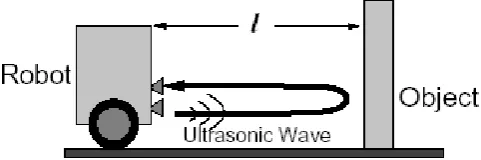
For mobile robots, functions, which recognize environments, are required to find unpredictable obstacles and paths through which the robot can pass [7]. As for range sensors, which can measure a distance to objects, ultrasonic sensor (Figure 7) is more commonly used with mobile robots because it is small, inexpensive and easy to calculate distances.
Fig.6. Principle of operation of ultrasonic sensor
Ultrasonic waves are discharged from a transmitter given comparatively long burst waves in order to vibrate its piezoelectric vibrator fully. A range value is calculated by using the amplified echo and a threshold level.
© 2017 AJAST All rights reserved. www.ajast.net Variable-length chromosomes have been employed. Their
elements represent nodes included in a path between a designated pair of source and destination nodes.
The crossover exchanges partial chromosomes and the mutation introduces new partial chromosomes. Lack of positional dependency in respect of crossing sites helps maintain diversity of the population. In addition, a simple repair function has been proposed to deal with all the infeasible chromosomes.
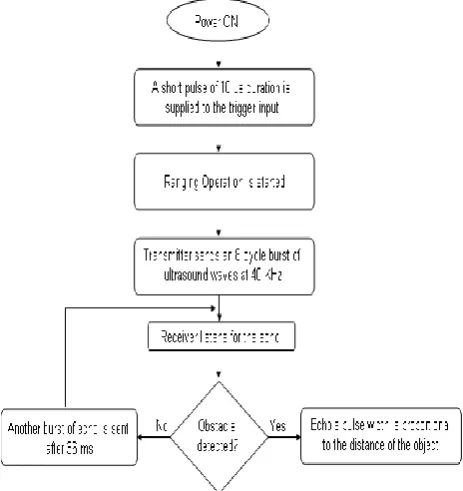
Fig.7. Flow chart for distance measurement
Genetic algorithm (GA) parameterization
Fitness Function: The fitness function interprets the chromosome in terms of physical representation and evaluates its fitness based on traits of being desired in the solution. The fitness function in the Shortest Path (SP) routing problem is obvious because the SP computation amounts to finding the minimal cost path. Therefore, the fitness function to optimize the path is defined as follows:
1
0
2 1 2
1 ) ( )
(
1
i
l
i
i i i i i
y y x x f
Where fi - fitness value of the ith chromosome, li - length of the ith chromosome, xi and yi – coordinates of the ith in the workspace of the robot.
The fitness function has a higher value when the fitness characteristic of the chromosome is better than others. In addition, the fitness function introduces a criterion for selection of chromosomes.
Selection: The selection (reproduction) operator is intended to improve the average quality of the population by giving the high-quality chromosomes a better chance to get copied into
the next generation. It is defined as the ratio of the probability of selection of the best chromosome in the population to that of an average chromosome. Hence, a high selection pressure results in the population’s reaching equilibrium very quickly, but it inevitably sacrifices genetic diversity.
Crossover: Crossover examines the current solutions in order to find better ones. Physically, crossover in the Shortest Path problem plays the role of exchanging each partial route of two chosen chromosomes in such a manner that the offspring produced by the crossover represents only one route [7]. The crossover between two dominant parents chosen by the selection gives higher probability of producing offspring having dominant traits.
Fig.8. Crossover Procedure
As shown in Figure 10, a set of pairs of nodes which are commonly included in the two (chosen) chromosomes but without positional consistency is formed first [i.e., (3,2) and (5,4)]. Such pairs are also called “potential crossing sites.” Each partial route is exchanged and assembled and thus, two new routes are produced eventually.
Mutation: The population undergoes mutation by an actual change or flipping of one of the genes of the candidate chromosomes, thereby keeping away from local optima [7]. Physically, it generates an alternative partial-route from the mutation node to the destination node in the proposed GA. Figure 11 shows the procedure of the mutation operation. In order to perform a mutation, a gene (i.e., node) is randomly selected first from the chosen chromosome (“mutation point”). One of the nodes, connected directly to the mutation point, is chosen randomly as the first node of the alternative partial-route.
Fig.9. Mutation Procedure
© 2017 AJAST All rights reserved. www.ajast.net 5. EXPERIMENTAL RESULTS AND ANALYSIS
Simulation model and Results presents the effectiveness of the product. In this section, the hardware test results and the simulation results for various modules implemented namely, Face recognition and Speech recognition are explained to quantify the benefits of soft computing approaches in the Soft-i-Robot.
5.1 Hardware test results
The Soft-i-Robot’s controller board has different monitoring and controlling features such as stepper motor control, temperature and humidity monitoring and control, flame detection and ultrasonic sensor for distance measurement. This section illustrates the implementation of the features along with the test results conducted on the robot.
Face recognition unit
The image of the robot’s environment is captured by the WS-808AS multimedia camera and transmitted to the receiver which displays the image in the Personal Computer (PC) with the aid of the TV tuner card interfaced in the Peripheral Component Interface (PCI) slot. The image sensed by the camera is viewed with the InterVideo WinDVR program installed in the PC whose parameters are configured as,
Aspect Ratio – 4 : 3 Screen Size – 640 x 480
Image sensor configuration– PAL
The InterVideo WinDVR supports different recording modes such as GOOD, BETTER, BEST, and CUSTOMIZED. The images captured are recorded using BEST mode with the following parametric configuration.
Size – 720 x 576
Frame Rate – 25.00 frames/s Bit Rate – 6400 kBps Frequency – 1.2 GHz
The stills of the image is captured using the capture option in the panel and these images are saved to the hard disk of the PC. Figure 12 shows a sequence of real time images captured by the WS-808AS camera. The face area of the person in the screen is cropped and fed as input to the Morphological Shared Weight Neural Network for recognition and detection.
Fig.10. Frames of stills captured by WS-808AS camera
Obstacle detection unit
The ranger works by transmitting a pulse of sound outside the range of human hearing at a frequency of 40 kHz. This pulse
travels at the speed of sound (approximately 0.9 ft/ms) away from the ranger in a cone shape beam pattern shown in Figure 13 and the sound reflects back to the ranger from any object in the path of this sonic wave. The ranger pauses for a brief interval after the sound is transmitted and then awaits the reflected sound in the form of an echo.
Fig.11. Beam Pattern of the Ultrasonic wave
The controller driving the ranger then requests a signal; the ranger creates the sound pulse, and waits for the return echo. If received, the ranger reports this echo to the controller and the controller computes the distance to the object based on the elapsed time using the formula,
Distance = (Elapsed Time / 58) cm Distance = (Elapsed Time / 148) inches
There are a couple of requirements for the input trigger and output pulse generated by the ranger. The input line is held low and then brought high for a minimum of 10 µs to initiate the sonic pulse. The pulse is generated on the falling edge of this input trigger as shown in Figure 14. The ranger's receive circuitry is held in a short blanking interval of 100 µs to avoid noise from the initial trigger and then enabled to listen for the echo.
The duration between the falling edge of the trigger input and falling edge of the echo line determines the distance to the first object from which the echo is received. The parameters and their configuration is tabulated in Table 2.
Table 1b. Time computation
Experiment
Actual Distance
(m)
Optimized Distance
(m)
Computati onal Time
(s)
1 2.2361 2.021 2.81
2 3.1623 2.929 3.21
3 5 4.271 5.7
4 5.0990 4.4142 1.6
© 2017 AJAST All rights reserved. www.ajast.net Fig.12. SRF04 Timing Diagram
Table 2. Specifications of the Ultrasonic Ranging Sensor
Parameters Values
Maximum Range 3 m
Minimum Range 3 cm
Sensitivity Detect a 3 cm diameter stick at a distance greater than 2 m
Input Trigger 10 µs TTL level pulse
Echo Pulse Positive TTL level signal
5.2 Simulation of facer recognition system
The aim of this work is to investigate the feasibility and effectiveness of an MSNN-based real time face recognition system. The MSNN is special because it has an extra network stage that depends on structuring elements to extract features. Feature extraction is performed over the entire image as well as its sub-image in separate networks. The evaluation tests were conducted in the areas given in Table3.
Table 3. Areas of Evaluation
Evaluation Areas Variable Parameters
Size and Shape Structuring Element
1×1 to 31×31, “Disk” and “Diamond”
Learning Rate 0.05 to 0.4
Number of Hidden Neurons 5 to 40
Sigmoid Functions
(hidden layer-output layer) tan-log, log-log
5.3 Analysis of genetic algorithm for path planning In this section, simulation and experimental results are obtained by applying the proposed path planning method to
navigate a mobile robot. Obstacles, and start and goal positions are marked as rectangles and circles respectively. The experimental results indicate successful application of global path planning.
The size of population is in the range [20,100]. Since the population size increases exponentially with the complexity of the problem, after conducting several tests the size is fixed to 100.
The work space is divided in such a way that the total number of nodes or genes is 100. Each node is represented as (x,y) coordinates. Random initialisation is used to initialise population in order to choose the node points effectively. Random initialisation chooses genes from the topological information in a random manner.
5.4 Graphical user interface
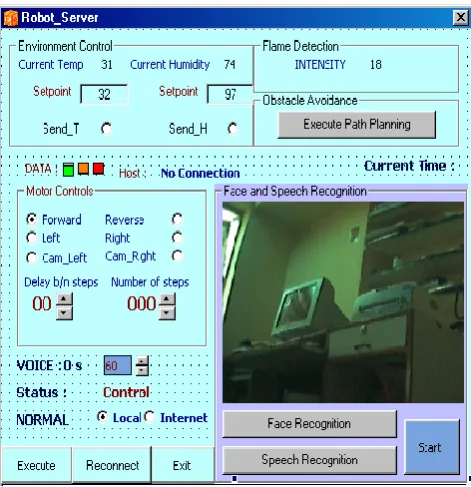
The Graphical User Interface is designed with Visual Basic 6.0. The parameters such as image of the intruder, recorded speech signal, temperature, humidity and status of fire sensor are all transmitted to the client.
When the execute button on the front panel in the client is selected, all the parameters mentioned above are transmitted to the server whose IP address is specified by the user. In the test program, the computer opens a socket and listens on a particular port for the client. Once the client program is executed, it also opens a socket and establishes a connection with the desktop computer since it has its IP address.
Now any data sent by the server is accepted by the client. This is verified since all the data sent by the user on the computer is made visible on the server. Screenshots of the server and client are shown in Figures 21 and 22 respectively. The client computer also has the same front panel except the IP address of the server is to be mentioned on the client front panel.
© 2017 AJAST All rights reserved. www.ajast.net Fig.14. Front Panel of Client
6. CONCLUSION
Intelligent robots play an important part in Internet security services. This issue is addressed by proposing an Internet based intelligent robot security system, namely Soft-i-Robot, which uses hybrid soft computing techniques with various subsystems. The Internet application program on the watch guard (client) displays the status of the sensory subsystems and also provides provision for controlling the Soft-i-Robot. The convolution Neural Network used for face recognition improved the performance of the robot in terms of recognition accuracy and computing time. The objective in terms of reduced time and recognition accuracy was achieved using Morphological Shared Weight Neural Network since MSNN can approach the robustness needed for face recognition.
The Genetic Algorithm used for path planning establishes a collision avoidance optimal path. The crossover and the mutation operations work on variable-length chromosomes. Consequently, the algorithm can search the solution space in a very effective manner. In essence, it maintains the diversity of population thereby avoiding local traps. The results prove that the Shortest Path algorithm searches the solution space effectively thereby optimizing the path of the Soft-i-Robot.
Mobility and tele-operation using the soft computing paradigms, in which the watch guards can remotely control the mobile Soft-i-Robot to track and identify the potential intruder over the Internet is much more attractive than the traditional immovable security system.
REFERENCES
[1] M. A. Al-Mouhamed, Onur Toker, Abdulkhalik Al-Harthy, “A 3-D Vision-based Man-Machine Interface for
Hand-Controlled Tele-Robot,” IEEE Transactions on
Industrial Electronics, vol. 52, pp. 306-319, February 2005.
[2] J. N. K. Liu, Bo Feng, “iBotGaurd: An Internet-Based Intelligent Robot Security System Using Invariant Face Recognition against Intruder,” IEEE Transactions on
Systems, Man and Cybernetics – Part C Applications and Reviews, vol. 35, pp. 97-105, February 2005.
[3] Y. Won, “Morphological Shared-Weight Networks with Applications to Automatic Target Recognition,” IEEE Transactions on Neural Networks, vol. 8, pp. 1195-1203, September 1997.
[4] Nikola Kasabov, Robert Kozma, “Hybrid Intelligent Adaptive Systems: A frame work and a Case Study on Speech Recognition,” International Journal of Intelligent Systems, vol. 13, pp. 455-466, December 1998.
[5] Y. Linde, A. Buzo, R. Gray, “An algorithm for vector quantizer design”, IEEE Transactions on Communications, vol. 28, pp.84-95, January 1980.
[6] R. S. Ramakrishna, Chang Wook Ahn, “ A Genetic Algorithm for shortest path (SP) routing problem and the sizing of populations,” IEEE Transactions on Evolutionary