University of Pennsylvania
ScholarlyCommons
Publicly Accessible Penn Dissertations
1-1-2015
Development of Bond-Order Potentials for
Body-Centered-Cubic Transition Metals and Their
Application in atomistic Studies of Plastic
Properties Mediated by Dislocations
Yi-Shen Lin
University of Pennsylvania, [email protected]
Follow this and additional works at:http://repository.upenn.edu/edissertations
Part of theCondensed Matter Physics Commons,Mechanical Engineering Commons, and the
Mechanics of Materials Commons
This paper is posted at ScholarlyCommons.http://repository.upenn.edu/edissertations/1849
For more information, please [email protected].
Recommended Citation
Lin, Yi-Shen, "Development of Bond-Order Potentials for Body-Centered-Cubic Transition Metals and Their Application in atomistic Studies of Plastic Properties Mediated by Dislocations" (2015).Publicly Accessible Penn Dissertations. 1849.
Development of Bond-Order Potentials for Body-Centered-Cubic
Transition Metals and Their Application in atomistic Studies of Plastic
Properties Mediated by Dislocations
Abstract
ABSTRACT
DEVELOPMENT OF BOND-ORDER POTENTIALS FOR BODY-CENTERED-CUBIC TRANSITION METALS AND THEIR APPLICATION IN ATOMISTIC STUDIES OF PLASTIC PROPERTIES
MEDIATED BY DISLOCATIONS
Yi-Shen Lin
Professor Vaclav Vitek
Bond-order potentials (BOPs), based on the tight binding (TB) approach for the evaluation of bonding, are an real-space method. They are eminently suitable for atomistic simulations of extended defects in transition metals in which the bonding is mixed nearly free electron and covalent. The latter requires a rigorous quantum mechanical treatment performed within the TB. In this Thesis, new BOPs were developed for non-magnetic BCC transition metals, V, Nb, Ta, Cr, Mo and W, as well as for the ferromagnetic Fe. In these BOPs, bond integrals used in the bond part of the cohesive energy were directly extracted from DFT calculations employing a projection formalism and a physically more transparent functional form was established for the repulsive part of the cohesive energy. In the ferromagnetic Fe, the magnetism was introduced through the Stoner’s model of the itinerant magnetism. In the bond part of the cohesive energy only d bonds are included explicitly but the screening of these bonds by the surrounding s electrons needs to be taken into account. This is particularly important when studying atomic arrangements in which the deviation from the ideal BCC lattice is very localized and inhomogeneous. The developed BOPs show an excellent transferability to various atomic environments which was tested by calculating energies of alternative crystal structures, vacancy formation energies, transformation paths, phonon spectra and -surfaces, all of which allow for direct comparisons with experiments and/or DFT based calculations. Moreover, we show that with slight variation of the number of d electrons used in BOPs, they are suitable for the atomistic studies involving self-interstitial atoms. This is essential if the BOPs are to be used in studies of the radiation damage. Employing these BOPs, the core structures and glide of ½<111> screw dislocations, which govern the plastic deformation in BCC metals, were investigated using a variety of applied stress tensors. These simulations reveal a breakdown of the Schmid law that has two aspects. First is the so-called twinning-antitwinning asymmetry of the critical resolved shear stress, which has been known for a long time and occurs even when the applied stress is the pure shear stress parallel to the Burgers vector. The second relates to core transformations induced by the shear stress components perpendicular to the Burgers vector. Our simulations suggest that the latter may explain the anomalous slip found in a number of BCC transition metals, which has been known for a long time but its full understanding is still elusive. Most importantly, the calculations employing BOPs suggest significantly different anomalous slip for group 5 (V, Nb and Ta) and group 6 (Mo and W) metals, which is observed but has never been explained based on the standard continuum theory of dislocations. Finally, a very simple formalism was proposed for the development of BOPs for binary homogeneous substitutional alloys that leads to a good agreement with DFT calculations of basic structural and mechanical properties. Studies of ½[111] screw dislocations in Ta-W alloy confirm the applicability of this formalism to investigation of the effect of substitutional alloying on the dislocation glide.
Degree Type
Dissertation
Degree Name
Doctor of Philosophy (PhD)
Graduate Group
Materials Science & Engineering
First Advisor
Vaclav Vitek
Keywords
Alloy, Anomalous slip, BCC metal, Bond-order potential, Dislocation, Transition metal
Subject Categories
Condensed Matter Physics | Mechanical Engineering | Mechanics of Materials
DEVELOPMENT OF BOND-ORDER POTENTIALS FOR
BODY-CENTERED-CUBIC TRANSITION METALS AND THEIR APPLICATION IN ATOMISTIC
STUDIES OF PLASTIC PROPERTIES MEDIATED BY DISLOCATIONS
Yi-Shen Lin
A DISSERTATION
in
Materials Science and Engineering
Presented to the Faculties of the University of Pennsylvania
in Partial Fulfillment of the Requirements for the Degree of Doctor of Philosophy
2015
Supervisor of Dissertation
___________________________________
Vaclav Vitek, Professor of Materials Science and Engineering
Graduate Group Chairperson
___________________________________
Shu Yang, Professor of Materials Science and Engineering
Dissertation Committee
David J. Srolovitz, Professor of Materials Science and Engineering
John L. Bassani, Professor of Mechanical Engineering and Applied Mechanics
DEVELOPMENT OF BOND-ORDER POTENTIALS FOR
BODY-CENTERED-CUBIC TRANSITION METALS AND THEIR APPLICATION IN ATOMISTIC
STUDIES OF PLASTIC PROPERTIES MEDIATED BY DISLOCATIONS
COPYRIGHT
2015
iii
ACKNOWLEDGEMENTS
First and foremost, I would like to express my deepest gratitude to my advisor,
Professor Vaclav Vitek. As my role model, he has been showing his great insight on
various science topics (usually with a good sense of humor) that naturally motivates me
to think differently when tackling various problems. Without his continuous support and
caring encouragement, I would not be able to overcome various challenges throughout
my PhD years. I also appreciate many opportunities he provided for me to present our
research work at various conferences that helped me to improve tremendously my
communication skills of interacting with other researchers. I am thankful for his patient
guidance and valuable advice on this Thesis.
I am very grateful to our collaborator Dr. Matous Mrovec for his kind help in the very
early and vital phase of developing the new BOPs. Specifically, the detailed investigation
on the importance of screening of the bond integrals could never be fully realized without
his involvement. I would also like to thank Dr. Roman Gröger for helping me to solve a
variety of issues particularly when simulating the response of dislocations to various
applied stresses. Many thanks are due to Dr. Miroslav Čák who taught me a number of
programming skills and introduced me to using the OXON code that is the major package
employed in this Thesis.
I would like to take this opportunity to thank Professor David Pettifor who started the
idea of BOPs back in late eighties. Special thanks are due to him for the discussions
iv
appreciate discussions with Dr. Duc Nguyen-Manh and his sharing of his results of DFT
calculations with us that helped to justify many aspects of our development of BOPs.
My special thanks are due to Pat Overend, Irene Clements and Vicky Lee whose
tremendous and instant help on everything in LRSM makes this laboratory such a warm
and friendly place.
Finally, I would like to thank very much all my family. I am particularly grateful to
my parents who have always been the most supportive. I would like to thank my sister,
bother-in-law and my lovely newborn niece who brought me laughter during the hard
time of finishing up writing this Thesis. Last, but certainly not least, many thanks to all
v
ABSTRACT
DEVELOPMENT OF BOND-ORDER POTENTIALS FOR
BODY-CENTERED-CUBIC TRANSITION METALS AND THEIR APPLICATION IN ATOMISTIC
STUDIES OF PLASTIC PROPERTIES MEDIATED BY DISLOCATIONS
Yi-Shen Lin
Professor Vaclav Vitek
Bond-order potentials (BOPs), based on the tight binding (TB) approach for the
evaluation of bonding, are an O( )N real-space method. They are eminently suitable for atomistic simulations of extended defects in transition metals in which the bonding is
mixed nearly free electron and covalent. The latter requires a rigorous quantum
mechanical treatment performed within the TB. In this Thesis, new BOPs were developed
for non-magnetic BCC transition metals, V, Nb, Ta, Cr, Mo and W, as well as for the
ferromagnetic Fe. In these BOPs, bond integrals used in the bond part of the cohesive
energy were directly extracted from DFT calculations employing a projection formalism
and a physically more transparent functional form was established for the repulsive part
of the cohesive energy. In the ferromagnetic Fe, the magnetism was introduced through
the Stoner’s model of the itinerant magnetism. In the bond part of the cohesive energy
only d bonds are included explicitly but the screening of these bonds by the surrounding s
vi
atomic arrangements in which the deviation from the ideal BCC lattice is very localized
and inhomogeneous. The developed BOPs show an excellent transferability to various
atomic environments which was tested by calculating energies of alternative crystal
structures, vacancy formation energies, transformation paths, phonon spectra and γ
-surfaces, all of which allow for direct comparisons with experiments and/or DFT based
calculations. Moreover, we show that with slight variation of the number of d electrons
used in BOPs, they are suitable for the atomistic studies involving self-interstitial atoms.
This is essential if the BOPs are to be used in studies of the radiation damage. Employing
these BOPs, the core structures and glide of ½<111> screw dislocations, which govern
the plastic deformation in BCC metals, were investigated using a variety of applied stress
tensors. These simulations reveal a breakdown of the Schmid law that has two aspects.
First is the so-called twinning-antitwinning asymmetry of the critical resolved shear
stress, which has been known for a long time and occurs even when the applied stress is
the pure shear stress parallel to the Burgers vector. The second relates to core
transformations induced by the shear stress components perpendicular to the Burgers
vector. Our simulations suggest that the latter may explain the anomalous slip found in a
number of BCC transition metals, which has been known for a long time but its full
understanding is still elusive. Most importantly, the calculations employing BOPs suggest
significantly different anomalous slip for group 5 (V, Nb and Ta) and group 6 (Mo and W)
metals, which is observed but has never been explained based on the standard continuum
theory of dislocations. Finally, a very simple formalism was proposed for the
development of BOPs for binary homogeneous substitutional alloys that leads to a good
vii
of ½[111] screw dislocations in Ta-W alloy confirm the applicability of this formalism to
viii
Contents
1 Introduction ... 1
2 Theory of Bond-Order Potentials ... 7
2.1 Tight-binding Bond Model... 7
2.2 Bond-order Potentials ... 17
2.2.1 Local Density of States and Green’s Function of the Schrödinger Equation ... 18
2.2.2 Moment expansion of the Density of States and the Recursion Method ... 21
2.2.3 Physical Meaning of Bond Order ... 27
3 Development of Bond-order Potentials for Non-magnetic Transition Metals ... 30
3.1 Attractive Part of the Cohesive Energy: Ecov... 33
3.1.1 Unscreened Bond Integrals used in BOPunscr ... 41
3.1.2 Screened Bond Integrals used in BOPscr... 44
3.2 Repulsive Part of the Cohesive Energy: Erep ... 53
4 Testing of Transferability of BOPs for Non-magnetic Transition Metals ... 64
4.1 Alternative Structures ... 65
4.2 Vacancy formation energy ... 67
4.3 Transformation Paths ... 68
4.4 Phonons ... 77
ix
5 BOP for Ferromagnetic Iron: Development and Testing ... 92
5.1 Formalism of BOP for Ferromagnetic Iron ... 93
5.2 Development of BOPunsrc and BOPscr ... 95
5.3 Testing of Transferability of BOPs for Iron ... 102
6 Core Structure of the ½[111] Screw Dislocation and its Glide under the Effect of Applied Stresses ... 114
6.1 Structure of the Core of the ½[111] Screw Dislocation ... 116
6.2 Stress Application and Related Dislocation Glide of the ½[111] Screw Dislocation... 125
6.3 Anomalous Slip ... 153
7 Self-interstitial Atoms ... 164
7.1 Formation Energies of SIAs ... 165
7.2 BOPs Modified for Modelling involving SIAs ... 171
8 Bond-order Potentials for Binary Substitutional Alloys of BCC Transition Metals ... 174
8.1 Development of BOPs for Binary Substitutional Alloys ... 175
8.2 Equilibrium Properties of Ta-W Alloy System ... 177
8.3 Cores of ½<111> Screw Dislocations and the Glide of Dislocations in Ta-W .... 182
x
10 Appendices ... 196
10.1 Dislocation Core Transformations and Glide Under Applied Stress for BOPunscr ... 196
10.2 The CRSS-χ Dependence Calculated Using BOPunscr ... 204
10.3 Experimental Observations of Anomalous Slip ... 208
10.3.1 Anomalous Slip in V ... 208
10.3.2 Anomalous Slip in Nb ... 210
10.3.3 Anomalous Slip in Ta ... 213
10.3.4 Anomalous Slip in Mo ... 216
10.3.5 Anomalous Slip in W ... 218
xi
List of Tables
Table 3-1. Parameters used in GSP function (eq. (3.2)) for BOPunscr when R is in Å. Unit
of βτ
( )
R0 is eV; R0 and Rc are in Å; na and nc are dimensionless. ... 43 Table 3-2. R1BI and BIcut
R in units of the lattice parameters used in BOPunscr for the studied
non-magnetic metals. ... 43
Table 3-3. Parameters entering equations (3.3), (3.4) and (3.5) for screened bond integrals
of the group 5 metals. Units of βτ
( )
R0 and O Rτ( )
0 are eV; R0, Rc, R1BI and RcutBI are inÅ. ... 51
Table 3-4. Parameters entering equations (3.3), (3.4) and (3.5) for screened bond integrals
of the group 6 metals. Units of βτ
( )
R0 and O Rτ( )
0 are eV; R0, Rc, R1BI and RcutBI are inÅ. ... 52
Table 3-5. Experimental values of cohesive energies, Ecoh (in eV), elastic moduli (in 1011
Pa), and lattice parameters, a (in Å) for group 5 and 6 transition bcc metals. Values of
Ecoh are taken from [81] and elastic moduli from [82] (see also [13]). ... 57
Table 3-6. Parameters used in the environment dependent repulsion (Eenv) in BOP
unscr
given by eq. (3.7), (3.8) and (3.9) when Rij is in units of the lattice parameter a. Rs = 0.52
(in units of a) for all metals studied; µ, g and ν are dimensionless. ... 58
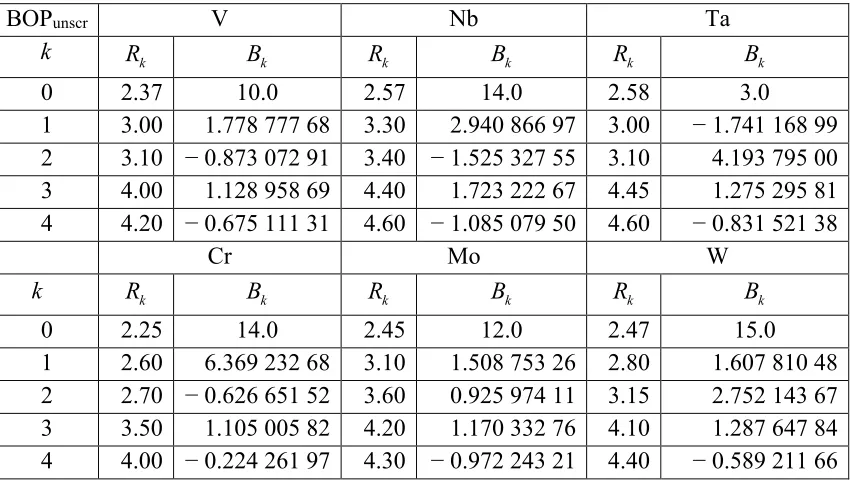
Table 3-7. Parameters used in the pair potential Φ in BOPunscr given in eq. (3.10). Rk is in
the unit of Å and Bk in eV Å-3, when Rij is in the unit of Å. In all cases, R0 is chosen to be
xii
Table 3-8. Parameters used in the environment dependent repulsion (Eenv) in BOP
scr
given by eq. (3.7), (3.8) and (3.9) when Rij is in units of the lattice parameter a. Rs = 0.52
(in units of a) for all metals considered; µ, g and ν are dimensionless. ... 60
Table 3-9. Parameters used in the pair potential Φ in BOPscr given in eq. (3.10). Rk is in Å
and Bk in eV Å-3, when Rij is in the units of Å. In all cases, R0 is taken as 0.9 of the first
nearest neighbor spacing in the equilibrium bcc lattice. ... 60
Table 4-1. Energies (meV/atom) of alternative lattice structures measured relative to the
energy of the equilibrium bcc lattice, calculated using DFT, BOPunscr, and BOPscr. All the
structures were relaxed with respect to corresponding lattice parameters. ... 66
Table 4-2. Vacancy formation energies (eV) calculated using BOPunscr, BOPscr, DFT [88]
and measured experimentally [87]. ... 68
Table 4-3. Ratios of the total energy of faults involved in the non-degenerate core to that
in the degenerate core of the ½[111] screw dislocation, for both BOPunscr and BOPscr
using unrelaxed and relaxed γ surface. ... 91
Table 5-1. The parameters of unscreened bond integrals (eq. (3.2)) used in BOPunscr for
bcc Fe. The parameters are taken from [35], with only BI cut
R changed to a larger value in
order to avoid any unphysical bumps in the tail function. The unit of βτ
( )
R0 is eV; R0,c
R , R1BI and RcutBI are in Å; na and nc are dimensionless. ... 96
Table 5-2. Parameters entering equations (3.3), (3.4) and (3.5) for screened bond integrals
used in BOPscr for bcc Fe. Units of βτ
( )
R0 and O Rτ( )
0 are eV; R0, Rc, R1BI and RcutBI inxiii
Table 5-3. Experimental values [81, 112] to which the BOPs for Fe are fitted. Cohesive
energy (Ecoh) is in eV, elastic moduli in 1011 Pa, and lattice parameter (a) in Å. ... 100
Table 5-4. Parameters used in the environment dependent repulsion (Eenv), given by equations (3.7), (3.8) and (3.9) in Chapter 3, for BOPunscr and BOPscr for bcc Fe. Rij is in units of the lattice parameter a. Rs = 0.52 (in units of a). µ, g and ν are dimensionless. ... 100
Table 5-5. Parameters used in the pair potential Φ, given by eq. (3.10) in Chapter 3, for BOPunscr and BOPscr for bcc Fe. Rk is in Å and Bk in eV Å-3, when Rij is in Å. In all cases, R0 is chosen to be 0.9 of the first nearest neighbor spacing of the equilibrium bcc lattice. ... 101
Table 5-6. Equilibrium energies (meV/atom) of bcc, fcc and hcp structures in different magnetic states relative to that of FM bcc structure. All the structures were relaxed with respect to the corresponding lattice parameter. ... 103
Table 5-7. Vacancy formation energies (eV) in Fe calculated using BOPunscr, BOPscr, DFT and measured experimentally. ... 108
Table 5-8. Ratios of the energy of planar faults involved in the non-degenerate core to that in the degenerate core of the screw dislocation that determine, following the criterion of Duesbery and Vitek [105], which of the core structures is favored energetically. ... 113
Table 6-1. The glide planes of the ½[111] screw dislocation using BOPunscr for Mo. ... 134
Table 6-2. The glide planes of the ½[111] screw dislocation using BOPscr for Mo. ... 135
Table 6-3. The glide planes of the ½[111] screw dislocation using BOPscr for V. ... 144
Table 6-4. The glide planes of the ½[111] screw dislocation using BOPscr for Nb. ... 144
xiv
Table 6-6. The glide planes of the ½[111] screw dislocation using BOPscr for Cr. ... 145
Table 6-7. The glide planes of the ½[111] screw dislocation using BOPscr for Mo. ... 146
Table 6-8. The glide planes of the ½[111] screw dislocation using BOPscr for W. ... 146
Table 6-9. The glide planes of the ½[111] screw dislocation using BOPscr for Fe. ... 147
Table 6-10. The <111>{101} slip systems with corresponding Schmid factors for the loading axes [5 8 9] , [8 20 27] and [5 9 17]. ... 156
Table 6-11. The <111>{101} slip systems with corresponding Schmid factors for the loading axes [0 1 2] and [2 3 8]. ... 157
Table 6-12. The <111>{101} slip systems with corresponding Schmid factors for the loading axes [1 3 10], [1 6 34] and [0 1 14]. ... 158
Table 7-1. The minimum interatomic separations, 0 min R , in the units of the first nearest neighbor spacing in the ideal bcc lattice, found in unrelaxed configurations of SIAs. .. 168
Table 7-2. Formation energies of SIAs (eV) calculated using BOPscr for all the metals studied. Both atomic and volume relaxation were carried out. ... 169
Table 7-3. The minimum interatomic separations, Rmin, in the units of the first nearest neighbor spacing in the ideal bcc lattice, found in relaxed configurations of SIAs using BOPscr. Only atomic relaxation was carried out. No volume relaxation was conducted. ... 170
xv
Table 7-5. Comparison of formation energies of SIAs in W obtained using BOPscr
modified with Nd = 3.7, BOPscr developed in this Thesis (Nd = 4.2) and using a DFT
method [88]. ... 173
Table 8-1. Glide planes found using BOPscr for Ta-5at%W alloy. ... 185
Table 8-2. Glide planes found using BOPscr for Ta-10at%W alloy. ... 185
Table 8-3. Glide planes found using BOPscr for Ta-15at%W alloy. ... 186
Table 8-4. Glide planes found using BOPscr for Ta-20at%W alloy. ... 186
Table 10-1. The glide planes found using BOPunscr for V... 200
Table 10-2. The glide planes found using BOPunscr for Nb... 201
Table 10-3. The glide planes found using BOPunscr for Ta. ... 201
Table 10-4. The glide planes found using BOPunscr for Cr. ... 202
Table 10-5. The glide planes found using BOPunscr for Mo. ... 202
Table 10-6. The glide planes found using BOPunscr for W. ... 203
xvi
List of Figures
Figure 3-1. Comparison of DOS calculated using k-space TB method and previously
developed BOPs limited to nine moments of LDOS [61]. ... 31
Figure 3-2. Band structures for bcc, fcc and sc bulk phase of Mo calculated using DFT,
optimized spd and optimized d-only TB models. ... 35
Figure 3-3. The dependence of bond integrals (ddσ, ddπ and ddδ) on the interatomic
distance (R) in bcc Mo determined using the orthogonal sd basis (OTB-sd) and
orthogonal d-only basis (OTB-d), respectively. ... 39
Figure 3-4. The distance dependence of bond integrals used for BOPunscr, obtained using
OTB-d basis, for all six nonmagnetic bcc transition metals studied... 42
Figure 3-5. The dd-type bond between the atoms i and j is screened by the s orbital
associated with the neighboring atom k. ... 45
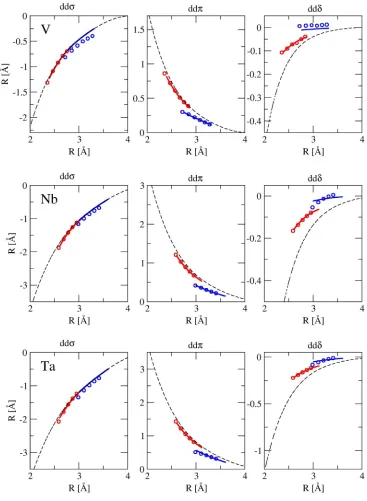
Figure 3-6. Bond integrals used in BOPscr for group 5 metals. Dots: OTB-sd data; solid
lines: screened bond integrals; dashed lines: simplified GSP function (eq. (3.4)). OTB-sd
data and the screened bond integrals obtained from the vicinity of the first nearest
neighbors is in red and from the vicinity of the second nearest neighbors in blue. ... 49
Figure 3-7. Bond integrals used in BOPscr for group 6 metals. Denotation of lines and
dots is the same as in Figure 3-6. ... 50
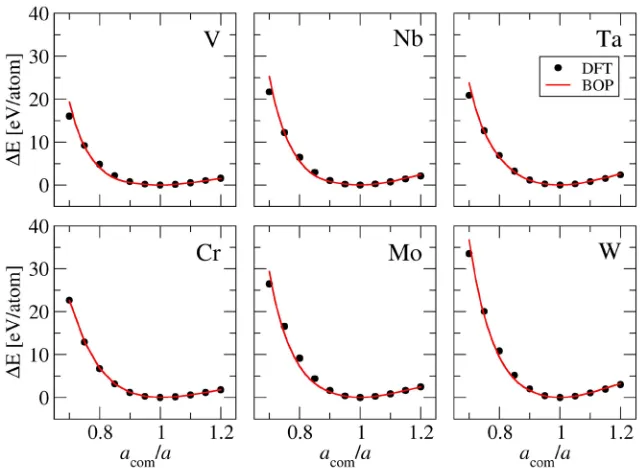
Figure 3-8. Dependence of the energy difference ∆E between the hydrostatically
compressed bcc lattice and the equilibrium bcc lattice for BOPunscr on acom/a, where acom
xvii
Figure 3-9. Dependence of the energy difference ∆E between the hydrostatically
compressed bcc lattice and the equilibrium bcc lattice for BOPscr on acom/a, where acom is
the lattice parameter of the compressed bcc lattice. ... 58
Figure 3-10. The dependence of the pair potential Φ in BOPunscr for groups 5 and 6
metals. The first, second and third neighbor spacing in the equilibrium bcc lattice are
marked by vertical lines denoted as 1st, 2nd and 3rd, respectively. ... 61
Figure 3-11. The dependence of the pair potential Φ in BOPscr for group 5 and 6 metals.
The first, second and third neighbor spacing in the equilibrium bcc lattice are marked by
vertical lines denoted as 1st, 2nd and 3rd, respectively. ... 62
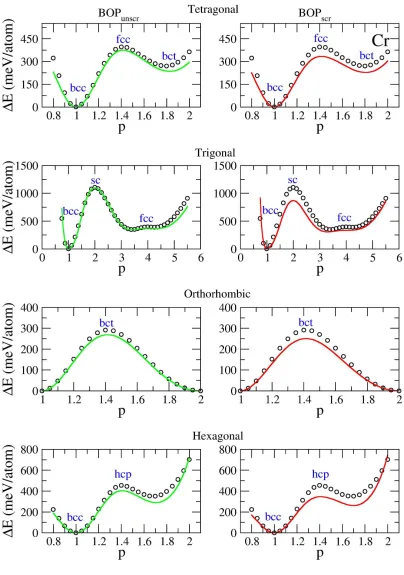
Figure 4-1. Deformation paths for V calculated using different methods. Green line:
BOPunscr. Red line: BOPscr. Black circles: DFT. ... 71
Figure 4-2. Deformation paths for Nb calculated using different methods. Green line:
BOPunscr. Red line: BOPscr. Black circles: DFT. ... 72
Figure 4-3. Deformation paths for Ta calculated using different methods. Green line:
BOPunscr. Red line: BOPscr. Black circles: DFT. ... 73
Figure 4-4. Deformation paths for Cr calculated using different methods. Green line:
BOPunscr. Red line: BOPscr. Black circles: DFT. ... 74
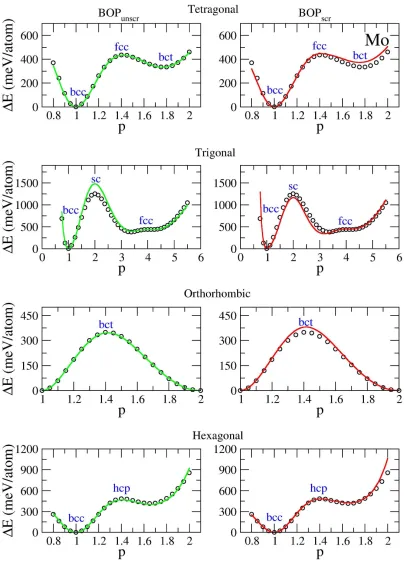
Figure 4-5. Deformation paths for Mo calculated using different methods. Green line:
BOPunscr. Red line: BOPscr. Black circles: DFT. ... 75
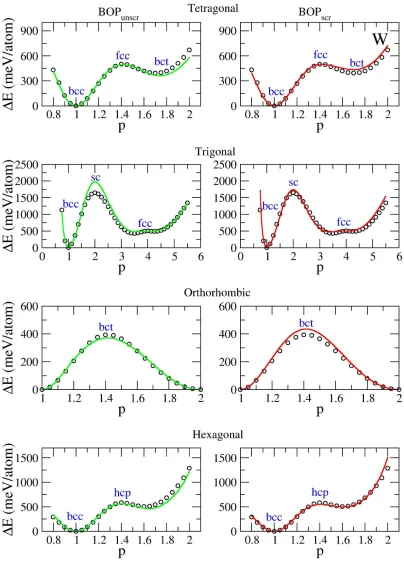
Figure 4-6. Deformation paths for W calculated using different methods. Green line:
BOPunscr. Red line: BOPscr. Black circles: DFT. ... 76
Figure 4-7. Phonon dispersion curves for V. Lines: BOPunscr (above) and BOPscr (below).
xviii
Figure 4-8. Phonon dispersion curves for Nb. Lines: BOPunscr (above) and BOPscr
(below). Dots: experimental data from [92]. ... 80
Figure 4-9. Phonon dispersion curves for Ta. Lines: BOPunscr (above) and BOPscr (below).
Dots: experimental data from [93]. ... 81
Figure 4-10. Phonon dispersion curves for Cr. Lines: BOPunscr (above) and BOPscr
(below). Dots: experimental data from [94]. ... 82
Figure 4-11. Phonon dispersion curves for Mo. Lines: BOPunscr (above) and BOPscr
(below). Dots: experimental data from [95]. ... 83
Figure 4-12. Phonon dispersion curves for W. Lines: BOPunscr (above) and BOPscr
(below). Dots: experimental data from [96]. ... 84
Figure 4-13. [111] cross-sections of γ-surfaces for the (101) planes in the group 5 metals
calculated by BOPs and DFT. Lines: Blue = BOPunscr and red = BOPsrc ; solid lines
correspond to unrelaxed and dashed lines to relaxed configurations. Open Circles: Results
of DFT calculations [100] in which relaxation was not carried out. ... 88
Figure 4-14. [111] cross-sections of γ-surfaces for the (101) planes in the group 6 metals
calculated by BOPs and DFT. Lines: Blue = BOPunscr and red = BOPsrc ; solid lines
correspond to unrelaxed and dashed lines to relaxed configurations. Open Circles: Results
of DFT calculations [100] in which relaxation was not carried out. In the case of Mo
relaxation was carried out in DFT calculations and these results are depicted as filled
circles. ... 89
Figure 5-1. The R-dependence of unscreened bond integrals used in BOPunscr for Fe. .... 96
Figure 5-2. Screened bond integrals used in BOPscr for bcc Fe. Dots: OTB-sd data. Solid
xix
The red and blue color correspond to R from the regions of the first and second nearest
neighbors, respectively. ... 98
Figure 5-3. Dependence of the energy difference between the hydrostatically compressed
bcc lattice of Fe and its equilibrium bcc lattice, ∆E, on acom/a, where acom is the lattice
parameter of the compressed bcc lattice. Lines: BOPs. Dots: DFT. ... 100
Figure 5-4. The R-dependence of the pair potential Φ used in BOPunscr and BOPscr for Fe.
The first, second and third neighbor spacings in the equilibrium bcc lattice are marked as
vertical lines denoted as 1st, 2nd and 3rd, respectively. ... 101
Figure 5-5. Comparison of energies of different magnetic states in bcc lattice relative to
that of the equilibrium FM bcc lattice, plotted as dependences on the volume per atom.
The DFT results are taken from [113]. ... 104
Figure 5-6. The volume dependences of the total cohesive energy relative to that of FM
bcc (upper panels) and the individual contributions to the total energy (lower panels) in
bcc, fcc and hcp lattices calculated using BOPscr for Fe. The energy contributions in the
case of the FM bcc and the NM bcc are also plotted in the panels for fcc and hcp as
dashed lines for easy comparison. ... 107
Figure 5-7. Deformation paths for Fe calculated using different methods. Green lines:
BOPunscr; red lines: BOPscr; black circles: DFT. ... 110
Figure 5-8. Phonon dispersion curves for Fe. Lines: BOPunscr (above) and BOPscr (below).
Dots: experimental data from [115]. The black color corresponds to the longitudinal
mode L, red to the transversal modes T and T1, and green to the transversal mode T2 for
xx
Figure 5-9. [111] cross-sections of γ-surfaces for the (101) plane in the bcc
ferromagnetic Fe calculated by BOPs and DFT. Lines: Blue = BOPunscr and red = BOPsrc;
solid lines correspond to unrelaxed and dashed lines to relaxed configurations. Filled and
open circles represent results of DFT calculations [100] with and without the relaxation
perpendicular to the (101) plane, respectively. ... 113
Figure 6-1. Schematic of the block of atoms used for studying dislocation core structure
and its changes induced by external stresses. ... 117
Figure 6-2. (a) Map of screw displacements of the core of the ½[111] screw dislocation in
Nb modeled using BOPscr. (b) Coordinate system used and the rosette of planes of the
[111] zone. ... 119
Figure 6-3. Edge components of the core displacements of the ½[111] screw dislocation
in V calculated using BOPunscr and BOPscr. ... 121
Figure 6-4. Edge components of the core displacements of the ½[111] screw dislocation
in Nb calculated using BOPunscr and BOPscr. ... 121
Figure 6-5. Edge components of the core displacements of the ½[111] screw dislocation
in Ta calculated using BOPunscr and BOPscr. ... 122
Figure 6-6. Edge components of the core displacements of the ½[111] screw dislocation
in Cr calculated using BOPunscr and BOPscr. ... 122
Figure 6-7. Edge components of the core displacements of the ½[111] screw dislocation
in Mo calculated using BOPunscr and BOPscr. ... 123
Figure 6-8. Edge components of the core displacements of the ½[111] screw dislocation
xxi
Figure 6-9. Edge components of the core displacements of the ½[111] screw dislocation
in Fe calculated using BOPunscr and BOPscr. ... 124
Figure 6-10. Definition of the angle χ between the MRSSP and the (101) plane. The
{112} planes sheared in the twining and antitwining sense, respectively, are shown. The
arrows on the planes point in the direction in which the ½[111] screw dislocation is
considered to be moving. ... 127
Figure 6-11. Position of tensile/compressive loading axes within the standard triangle that
are employed in this Thesis and were studied in earlier calculations [72]. The values of χ
correspond to the loading by tension; the sign of χ changes for compression. ... 129
Figure 6-12. The core transformations taking place under the effect of the tensile loading
along the axis [2 3 8] (χ = 0°) calculated using BOPscr for Mo. (a) and (c) correspond to
fully relaxed atomic configurations at the stress levels ‘slightly lower than the CRSS’ and
‘at the CRSS’, respectively. (b) illustrates the core during the relaxation, but not fully
relaxed, with the stress level at the CRSS... 130
Figure 6-13. Comparison of the core transformations during the relaxation at the stress
level corresponding to the CRSS between BOPunscr (above) and BOPscr (below) for Mo.
... 132
Figure 6-14. The dependence of the CRSS on χ calculated for Mo using BOPunscr (above)
and BOPscr (below), respectively. ... 137
Figure 6-15. The dependence of the CRSS on χ calculated for Ta using BOPunscr (above)
and BOPscr (below), respectively. ... 138
Figure 6-16. Core transformations found during the relaxation at the stress level equal to
xxii
Figure 6-17. Core transformations found during the relaxation at the stress level equal to
the CRSS calculated using BOPscr for group 6 metals. ... 141
Figure 6-18. Core transformations found during the relaxation at the stress level equal to
the CRSS calculated using BOPscr for Fe. ... 142
Figure 6-19. The dependence of the CRSS on χ calculated using BOPscr for V. ... 149
Figure 6-20. The dependence of the CRSS on χ calculated using BOPscr for Nb. ... 150
Figure 6-21. The dependence of the CRSS on χ calculated using BOPscr for Ta. ... 150
Figure 6-22. The dependence of the CRSS on χ calculated using BOPscr for Cr. ... 151
Figure 6-23. The dependence of the CRSS on χ calculated using BOPscr for Mo. ... 151
Figure 6-24. The dependence of the CRSS on χ calculated using BOPscr for W. ... 152
Figure 6-25. The dependence of the CRSS on χ calculated using BOPscr for Fe. ... 152
Figure 7-1. Configurations of SIAs proposed by Johnson [154]. The atoms positioned at
the sites of the ideal bcc lattice sites are white and inserted interstitial atoms are green. In
dumbbell configurations, two atoms (green) are located symmetrically along the <111>,
<110> and <100> directions, respectively, about the ideal bcc lattice site at the center of
the cube. The atom at the center of the cube is eliminated. The separation between the
two atoms forming a dumbbell is in each case 0.75 of the lattice spacing. In the <111>
crowdion configuration an extra atom is inserted at the midpoint between the two first
nearest neighbor atoms of the ideal bcc lattice. In the octahedral configuration, an
additional atom is inserted at the midpoint between two second nearest neighbor atoms of
the ideal bcc lattice and in the tetrahedral configuration an extra atom is inserted at the
xxiii
Figure 8-1. Left: the dependence of the equilibrium lattice constant on the mole fraction
of Ta calculated using BOPsrc for Ta-W alloy compared with the prediction of the
Vegard’s law. Right: The percentage deviation of the results obtained by BOPscr from the
Vegard’s law. ... 179
Figure 8-2. The dependence of the equilibrium lattice parameter on the mole fraction of
Ta for Ta-W alloy studied in [159]. ... 179
Figure 8-3. The dependence of elastic moduli (C11, C12, C44 and bulk modulus) on the
mole fraction of Ta calculated using BOPsrc for Ta-W alloy. ... 181
Figure 8-4. The dependence of the bulk modulus on the mole fraction of Ta for Ta-W
alloy studied in [159]. ... 181
Figure 8-5. The dependence of the CRSS on χ calculated using BOPscr for Ta-5at%W.
... 187
Figure 8-6. The dependence of the CRSS on χ calculated using BOPscr for Ta-10at%W.
... 187
Figure 8-7. The dependence of the CRSS on χ calculated using BOPscr for Ta-15at%W.
... 188
Figure 8-8. The dependence of the CRSS on χ calculated using BOPscr for Ta-20at%W.
... 188
Figure 10-1. Core transformations found during the relaxation at the stress level equal to
the CRSS calculated using BOPunscr for group 5 metals. ... 197
Figure 10-2. Core transformations found during the relaxation at the stress level equal to
xxiv
Figure 10-3. Core transformations found during the relaxation at the stress level equal to
the CRSS calculated using BOPunscr for Fe. ... 199
Figure 10-4. The dependence of the CRSS on χ calculated using BOPunscr for V. ... 204
Figure 10-5. The dependence of the CRSS on χ calculated using BOPunscr for Nb. ... 205
Figure 10-6. The dependence of the CRSS on χ calculated using BOPunscr for Ta... 205
Figure 10-7. The dependence of the CRSS on χ calculated using BOPunscr for Cr. ... 206
Figure 10-8. The dependence of the CRSS on χ calculated using BOPunscr for Mo. ... 206
Figure 10-9. The dependence of the CRSS on χ calculated using BOPunscr for W. ... 207
Figure 10-10. The dependence of the CRSS on χ calculated using BOPunscr for Fe. ... 207
1
1
Introduction
The body-centered-cubic (BCC) transition metals (including iron) and their alloys
are very important materials used in a broad variety of technological applications. The
refractory BCC metals (Nb, Ta, Mo and W) have melting temperatures well above 2000
°C, and they are significantly more creep resistant than other metals and thus can be
employed at very high temperatures. For example [1]: Nb and its alloys have been used
in aerospace industry, e. g. in nozzle flaps of jet engines, Ta has been utilized broadly in
electrolytic capacitors, Mo and its alloys in lighting industry and W and its alloys in
lighting, as heating elements, filaments for incandescent lamps and X-ray tubes. Recently,
W became an important component of the wall of plasma containment chamber in the
developing fusion reactors, such as the international experimental fusion reactor (ITER)
[2]. Naturally, the most utilized between all transition metals is iron (Fe) and its alloys. In
the BCC form it is the major component of ferritic stainless steels.
The mechanical properties of BCC metals are very different from those of FCC
and HCP metals, whether noble (e.g. Cu, Ag, Au), refractory (e.g. Ti, Zr, Hf) or nearly
free electrons-like (e. g. Al). This was first noted by G. I. Taylor and co-workers in the
twenties of the last century [3] and studied extensively in the last fifty years (for reviews
see [4-8]). The most important aspects of the deformation of BCC metals are: (1) At low
temperatures the yield and flow stress increase rapidly with decreasing temperature even
in pure single crystals. (2) Both the yield and flow stress display a strong dependence on
the strain rate and type of loading. (3) The Schmid law does not apply and dislocation
2
the dislocation glide are the same (e.g. differences in tension and compression). (4) The
remarkable phenomenon is the so-called anomalous slip in which the most dominant
operating slip system is a slip system with a much lower Schmid factor than not only that
of the primary slip system but several other available slip systems. The anomalous slip is
found in high-purity single crystals at low temperature and most commonly observed in
group 5 metals, namely V, Nb and Ta. (5) Interstitial and substitutional impurities affect
strongly the flow and yield stress at low temperatures. Many of these features of the
plastic behavior are found not only in transition metals but also in alkali metals, in
particular potassium that remains BCC even at liquid helium temperature [9, 10]. In these
metals the nearly free s electrons mediate the bonding while in transition metals the
bonding has a mixed nearly free electron and covalent character arising from the d
electrons. This suggests that some aspects of the plastic deformation relate principally to
the BCC structure. Nevertheless, the details of bonding that distinguish individual metals
are responsible for significant differences in the mechanical properties of different BCC
metals. The prime example is the anomalous slip that is most distinct in the group 5
transition metals, limited in group 6 and never observed in alkali metals and iron.
The principal goal of this Thesis is computer modeling of the structure and glide
of ½<111> screw dislocations in transition BCC metals that control the plastic
deformation in any metal with the BCC structure (see e.g. Ref. [5]). The first step in this
study is development of reliable interatomic potentials describing interactions between
atoms. This is the cornerstone and precursor of any atomistic modeling. When simulating
extended defects such as dislocations, two important requirements for potentials, besides
3
number of atoms, often many thousands, and depending on the problem even up to a
million. (b) No use of periodic boundary conditions so that there is no interference
between the extended defects studied and their replicas in the repeat cells arising when
periodic boundary conditions are applied. This is particularly important when studying
the movement of a dislocation under the effect of applied stresses. Calculations based on
the density functional theory (DFT) [11, 12] are at present most rigorous and applicable
to any bonding environment and therefore suitable for any material. However, the
iterative self-consistent solving of the Kohn-Sham equation is very time-consuming, and
the computational time scales with the cube of the number of atoms in the system, N (it is
so-called O( )N3 method). Hence, feasible size of the atomic block is usually not more
than few hundred atoms. Moreover, in all commonly used DFT methods the periodic
boundary conditions are necessary.
The other extreme corresponding to a very approximate description of atomic
interactions is central-force empirical potentials such as pair potentials, many-body
potentials of Finnis-Sinclair (FS) type [13, 14] and the embedded-atom method (EAM)
[15-18]. While often successful in modeling materials with nearly pure metallic bonding
(nearly free electrons-like), in materials where directional covalent bonding is involved
the applicability of such potentials is questionable. This is particularly the case in
transition metals the stability of which is determined by the level of filling of the d band
[19, 20] and thus the bonding is governed by d electrons leading to the angular
non-central bonds. The covalent character of bonding is accounted for in tight-binding (TB)
methods that are less rigorous than DFT calculations since in this case the Schrödinger
4
[21-24]. However, the diagonalization of the Hamiltonian is usually done in the k-space
and in this case the periodic boundary conditions need to be again imposed.
Based on the tight-binding method in the formulation of moments of the density
of states [25] Pettifor proposed new type of potentials called bond-order potentials (BOPs)
that include the covalent bonds arising from d electrons and can be used purely in the real
space [26]. These potentials were being developed in the last two decades and applied to
a broad variety of problems involving crystal lattice defects (for reviews see [27-31]).
When using these potentials the computational time scales linearly with the system size
so they represent so called O( )N method.
In the first part of this Thesis, we develop a new version of BOPs that includes
two recent advances. First, Urban et at. [32] developed a new projection scheme to
extract from DFT-based data the bond integrals that are the basic parameters that
determine the bond part of BOPs and we employ this method. Secondly, we develop a
new functional form of the empirical environment dependent repulsion [33] using the
suggestion of Aoki and Kurokawa [34] based on their study of repulsion in FCC solid
argon in which no attraction other than Van der Waals exist. Both these developments are
presented in detail in this Thesis. An analogous upgrading has also been done for the
BOP for ferromagnetic Fe the original version of which was proposed by Mrovec et al.
[35]. The transferability of the developed BOPs is tested by comparing the experimental
data and/or results of DFT calculations with the results obtained using these potentials.
This involves energies of lattice structures other than BCC, energy variation when
deforming the lattice homogeneously along several transformation paths [36], vacancy
5
a new approach for construction of BOPs for substitutional alloys of two bcc transition
metals the development of which can further continue towards study of multi-component
complex alloys, so called entropic alloys.
The second part of this Thesis deals with the computer simulation of the structure
and glide of ½<111> screw dislocations in the transition metals studied. The applied
stresses, the impact of which we investigate, include the pure shear stress parallel to the
Burgers vector with various orientation of the maximum resolved shear stress plane
(MRSSP) and uniaxial tension/compression loadings along several different loading axes
within the standard stereographic triangle. In this study we principally concentrate on the
variation of the following properties on differently applied stresses: Glide planes, the
critical resolved shear stress (CRSS) in the direction of the Burgers vector that drives the
dislocation motion and related core transformations. In this context our goal is to
investigate how these aspects of dislocation behavior vary from material to material. An
important result of this study is the possible explanation of the above mentioned
anomalous slip that is based on understanding transformations of dislocation cores under
the effect of shear stresses perpendicular to the Burgers vector.
This Thesis is organized as follows. The tight binding formalism on which the
bond order potentials are based is overviewed in Chapter 2, followed by the introduction
to the theory of BOPs. In Chapter 3 we explain and summarize the new advancements in
both attractive and repulsive parts of BOPs for non-magnetic bcc transition metals. This
includes group 5 metals (V, Nb and Ta) and group 6 metals (Cr, Mo and W). In Chapter 4
the thorough testing of the transferability of the developed BOPs for non-magnetic metals
6
testing of its transferability is summarized in Chapter 5. Here we explain the magnetic
contribution introduced into the BOP through the Stoner’s model of the itinerant
magnetism [37]. In Chapter 6, we focus on the study of the core structure of the ½[111]
screw dislocation and the response of this dislocation to various applied stresses as
mentioned above. Chapter 7 summarizes the investigation of some basic properties of
self-interstitial atoms that are essential for, e.g., the studies of the radiation damage. The
formalism and the development of the BOPs for substitutional homogeneous alloys are
explained in Chapter 8. Here we present some testing of this approach for Ta-W binary
system together with a limited study of the ½[111] screw dislocation in this alloy.
Chapter 9 summarizes conclusions of the Thesis together with suggestions for future
7
2
Theory of Bond-Order Potentials
In this Chapter we review the theory of bond-order potentials (BOPs) [26, 38] that
enable large-scale real-space atomistic calculations. We start with the tight-binding bond
model (TBBM) [22] that the BOPs are based on. Here we explain the evaluation of the
energy and interatomic forces in the studied system, as well as the crucial local charge
neutrality condition (LCN) imposed in TBBM for metals. Secondly, we introduce
approximations to the TBBM employed in the development of BOPs that lead to BOPs
being an O( )N rather the O( )N3 method, where N is the number of particles in the
studied system. The details of calculating the bond order in practice and the physical
meaning of the bond order are also discussed in this part.
2.1
Tight-binding Bond Model
Within the tight-binding (TB) scheme [22, 39], the total energy of the studied
system of atoms (ions and electrons) consists of two parts:
( )
rep band tot band
E =E +E (2.1)
The first term Eband is the band energy of electrons, which produces attraction between
the atoms, and the second term Erep band( ) is the repulsive contribution that accounts for the
Coulomb interaction between ion cores and the double counting correction (for both the
electron-electron Coulomb interaction and the exchange-correlation energy). However,
this part of the energy is within the TB determined empirically by fitting quantities such
8
moduli and, possibly, other quantities known either experimentally or from DFT
calculations. This methodology is called the tight-binding band model. Later in this
Section we introduce the so-called tight-binding bond model (TBBM) [22], where the
attractive bonding contribution governing the cohesion of atoms is extracted from the
band energy and can be interpreted as a sum of environment dependent interactions
between the pairs of atoms of the system. The decomposition of the total energy in
TBBM provides a clear physical insight to the bonding of materials.
Assuming the Born-Oppenheimer approximation, the band energy is in any TB
calculation obtained by solving the one-electron Shrödinger equation for the wave
function n
(
)
ˆ ˆ ˆ n
H n = T V n+ =e n . (2.2)
The Hamiltonian ˆH includes the kinetic energy ˆT and the potential energy ˆV that
contains electron-ion interactions as well as all types of electron-electron interactions. At
this point eq. (2.2) and the Kohn-Sham equation of the DFT theory [11] look the same.
However, instead of adjusting the potential to be self-consistent with the electronic
charge density as in DFT schemes, in the TB band model the potential ˆV is fixed, as in
the usual Shrödinger equation. If we label the eigenstates in the order of energy
eigenvalues from the lowest to the highest, n is the eigenstate with n-th energy
eigenvalue en. The basis set formed by the eigenstates is orthonormal and complete. In
TB schemes the eigenstates are usually further expanded into a basis spanned by
9 ,
n i i
n C iα α
α
=
∑
.Orbitals iα are usually considered to be localized at the atom site i. In the
orthogonalized TB, employed in the development of bond-order potentials, the basis
orbitals iα are assumed to be orthonormal, namely i jα β =δ δij αβ, and thus
n i
Cα = i nα . The possible non-orthogonality of the basis set is either negligible [22, 40],
or with a proper transformation (e.g. the Löwdin’s symmetrical orthogonalization [41])
non-orthogonal TB models can be turned into orthogonal ones. The orbitals are not
necessarily real, but to simplify the following discussion we assume from now on that the
orbitals are real (see [28, 39]for a more comprehensive derivation without this
simplification).
Let us define the Hamiltonian matrix elements in the basis of orbitals iα as
( )
( )
ˆ ˆ
i j i j
Hα β, = i H jα β =
∫
φα r Hφβ r rd ,where ( )φiα r is the orbital of the type α at the atom i that is a function of the position vector r. The Hamiltonian matrix elements with i j= are called on-site elements. The on-site elements with the same orbitals, namely Hi iα α, , are diagonal elements and are denoted εiα hereafter. We will discuss later how the diagonal elements are determined in the TB calculations. The on-site elements with two different atomic-like orbitals, namely
( )
i i
Hα β, α β≠ , are neglected, which is a good approximation owing to the assumed
10
Hamiltonian is taken as a sum of effective fixed potentials localized at each atom site, so
that ˆ ˆk
(
k)
k
V =
∑
V r r− . The hopping integrals can then be decomposed as( , )
ˆ ˆ ˆi ˆj ˆk
k i j
i H jα β i T jα β i V jα β i V jα β i V jα β
≠
= + + +
∑
.The first three terms depend only on positions of atoms i and j, and are therefore called
two-center integrals. The last term is the summation of so-called three-center integrals
since the integrals have atomic-like orbitals centered on two different atoms i and j, with
the effective potential centered at a third atom k, different from atoms i and j. Owing to
the localization of both the atomic orbitals and the potential ˆV , the three-center integrals
are small compared to the two-center integrals and henceforth neglected. Therefore, in
this approximation the hopping integrals (Hi jα β, ) are only functions of the positions of atoms i and j.
Let us define the position vectors of atoms i and j as Ri and Rj, respectively. Slater and Koster [42] have shown how to express any two-center hopping integrals
between atoms i and j in terms of direction cosines of the vector Rij ≡R Ri− j and a small number of independent special hopping integrals, called bond integrals. For
example, with two atoms each having p orbitals with arbitrary orientations (px, py, and pz
on each atom), one may consider nine different hopping integrals. However, they can be
expressed in terms of only two independent bond integrals: ppσ (two p orbitals oriented
in the straight line connecting the two atoms) and ppπ(two p orbitals oriented parallel to
each other and both perpendicular to the straight line connecting the two atoms) [38]. In
11
use the basis composed of only d-type orbitals. In this case, three types of bond integrals
are needed, namely ddσ, ddπ, and ddδ [33]. A comprehensive summary of the relative
orientation between orbitals at two atomic sites for all types of bond integrals in a full spd
TB model can be found in [39] (see Figure 7.1 in Section 7.3.1 in [39]). In real TB
calculation, the bond integrals are usually not obtained by actually evaluating the
integrals
∫
φiα( )
r Hˆφjβ( )
r rd using genuine orbital functions in the r-space. Rather, theyare represented by functions of separation (Rij) of the pair of atoms i and j with
parameters fitted to either experiments or DFT calculation. This is why the scheme is
sometime referred to as the empirical tight-binding.
Using the expansion of n into orbitals iα and the orthogonality of the atomic
orbital basis set, eq. (2.2) can then be written as a set of linear homogeneous equations
,
n n i j j n i j
Hα βCβ e Cα
β ,
=
∑
. (2.3)With the Hamiltonian matrix elements known, the energy eigenvalues en and the
expansion coefficients n i
Cα are obtained by solving eq. (2.3) via the standard
diagonalization of the Hamiltonian matrix. The band energy is 2
f n n n< e
∑
, where nf isthe eigenstate with the energy equal to the Fermi energy and the factor 2 accounts for the
spin degeneracy. The band energy can be expressed in terms of the expansion coefficients
and the Hamiltonian matrix elements:
, ,
, ,
ˆ ˆ
2 2 2
2
f f f
f band
n
n n n n n n i j
n n
i i j j n n i j
E e n H n n i i H j j n
C H C
α β
α α β β
α β
α α β β
< < <
12 Defining the density matrix elements ρi jα β, as
f n n i j j i
n n
C C
α β β α
ρ , <
=
∑
, (2.4)we obtain a very simple form for the band energy
, ,
2 band
j i i j i j
E β αHα β
α β
ρ , ,
=
∑∑
. (2.5)In the tight-binding bond model (TBBM) [22] the cohesive energy (or binding
energy) is evaluated instead of the total energy, Etot. The cohesive energy (Ecoh) is the
total energy of the studied system minus the energy of the system composed of the same
number of free atoms (Eatom). Marking the diagonal Hamiltonian elements of free atoms
as 0
iα
ε and the diagonal Hamiltonian elements when the solid has been formed as εiα, the
change of these diagonal elements upon formation of the solid is 0
iα iα iα
ε ε ε
∆ = − . The
energy of free atoms can then be written as
0
, , ,
atom atom atom atom
i i i i i i
i i i
E Nα α Nα α Nα α
α α α
ε ε ε
=
∑
=∑
+∑
∆ ,where atom i
Nα is the occupancy of the atomic-like orbital iα in the free atom.
Using eq. (2.1), the cohesive energy of the system is
( )
, ,
rep band
coh tot atom band atom atom i i i i
i i
E E E E E Nα α Nα α
α α
ε ε
= − = + −
∑
−∑
∆ (2.6)In the TBBM, the repulsive energy (Erep) incorporates both Erep band( ) and the last term in
eq. (2.6) so that
( ) , rep band rep atom i i i
E E Nα α
α
ε
13
In the real development of TBBM or BOP models, Erep is approximated as a repulsive
potential, in general not a pair potential, that has a physically justified functional form the
parameters of which are fitted to reproduce empirical or DFT based data. This will be
discussed in more detail later.
Combining equations (2.5), (2.6) and (2.7), the cohesive energy is
, , ,
2
coh atom rep
j i i j i i
i j i
E β αHα β Nα α E
α β α
ρ , , ε
=
∑∑
−∑
+ , (2.8)where the first term is the band energy. The on-site Hamiltonian elements with different
orbitals (namely Hi iα β, with α β≠ ) can be neglected owing to the orthogonality of the atomic orbitals centered on the same atom, and we can then split the band energy into
two contributions, namely that from i j≠ terms and from i j= terms, respectively:
( )
, , ,
2 2
band
j i i j i i i
i j i i
E β αHα β α α α
α β α
ρ , , ρ , ε
≠
=
∑ ∑
+∑
. (2.9)Combining equations (2.8) and (2.9), we obtain
( )
(
)
, , ,
2 2
coh atom rep
j i i j i i i i
i j i i
E β αHα β α α Nα α E
α β α
ρ , , ρ , ε
≠
=
∑ ∑
+∑
− + . (2.10)The physical meaning of the first termis that it represents the total covalent bond energy
(Ecov) arising from the bonds between atoms i and j, with each bond contributing 2 j iβ αHi jα β
α β
ρ , ,
,
∑
. The second term is called the promotion energy (Eprom) that accountsfor the energy arising from the change in occupancy of the atomic-like orbital iα when
free atoms are brought together to form the solid.
In atomistic modeling, the crucial quantities needed for minimizing the total
14
forces. To derive the expression for the force within the TBBM, we first define the
position vector of an atom k as
(
( )x, ( )y, ( )z)
k = r r rk k kr . Using the expression for the cohesive
energy in eq. (2.8), the σ-component of the force acting on the atom k is
( )
( ) ( ) ( ) ( )
, , ,
2
coh atom rep
k j i i j i i
i j i
k k k k
F E H N E
r r r r
σ β α α β α α σ σ σ σ α β α ρ , , ε ∂ ∂ ∂ ∂ = = − +
∂ ∂
∑∑
∂∑
∂ . (2.11)Using the Hellmann-Feynman theorem [43]1 the first term in eq. (2.11)
( ) ( )
, , , ,
2 j i i j 2 j i i j
i j i j
k k
H H
rσ β α α β β α rσ α β
α β α β ρ , , ρ , , ∂ = ∂ ∂
∑∑
∑∑
∂ .Separating the on-site and off-site contributions while neglecting Hi iα β, with α β≠ , it is
( ) ( )
( ) ( )
, , , , ,
2 j i i j 2 j i i j 2 i i i
i j i j i i
k k k
H H
rσ β α α β β α rσ α β α α rσ α
α β α β α ρ , , ρ , , ρ , ε ≠ ∂ = ∂ + ∂
∂
∑∑
∑ ∑
∂∑
∂ . (2.12)Since the number of electrons associated with a free atom i and an orbital α, atom i
Nα , is fixed the second term in eq. (2.11)
( ) ( )
, ,
atom atom
i i i i
i i
k k
N N
rσ α α α rσ α
α α ε ε ∂ ∂ =
∂
∑
∑
∂ . (2.13)Combining equations (2.11), (2.12) and (2.13), we obtain
( )
( )
( )
(
)
( ) ( ), , ,
2 2 atom rep
k j i i j i i i i
i j i k i k k
F H N E
r r r
σ β α σ α β α α α σ α σ α β α ρ , , ρ , ε ≠ ∂ ∂ ∂ = + − + ∂ ∂ ∂
∑ ∑
∑
(2.14)When studying a metallic system using TBBM the total charge associated with any atom
is assumed to remain unchanged, in other words the condition of the local charge
1 The assumption of the validity of the Hellmann-Feynman theorem is an approximation that is strictly
15
neutrality (LCN) is imposed. This approximation, which represents an ersatz for charge
self-consistency, is reasonable for metals where any charge variation is rapidly screened.
This condition implies that for any atom i,
(
2 atom)
0i iα α Niα α
ρ , − =
∑
. (2.15)In the TBBM (and also BOP) calculations, the LCN is attained by first choosing an initial
approximation for the diagonal elements εiα, for example those of the isolated atoms, εi0α. If the LCN condition is not satisfied then new diagonal elements, εiα, are obtained by
changing the 0
iα
ε on each atom i by an amount ∆i such that εiα =εi0α+ ∆i. Equations (2.3)
are solved again with the new Hamiltonian containing adjusted diagonal elements, and
i iα α
ρ , is re-constructed through n i
Cα. This procedure is continued iteratively until the LCN
condition is attained.
With the shifted εiα, the second term in eq. (2.14) becomes
(
)
( )(
)
( )(
)
( )(
)
( ) 0 , , 0 , 2 2 2 2 atom atomi i i i i i i i
i k i k
atom atom
i i i i i i i i
i k i k
N N r r N N r r α α α σ α α α α σ α α α α α σ α α α α σ α α ρ ε ρ ρ ε ρ , , , , ∂ ∂ − + − ∆ ∂ ∂ ∂ ∂ = − + − ∆ ∂ ∂
∑
∑
∑
∑ ∑
. (2.16)The first term is zero since ( ) 0 0
i k
rσ εα ∂
=
∂ . The second term is also zero when the LCN
condition (2.15) is satisfied and thus the promotion energy does not contribute to forces
on atoms when the LCN condition (2.15) is satisfied. Hence, following eq. (2.14)
( )
( )
( ) ( )
, ,
2 rep
k j i i j
i j i k k
F H E
r r σ β α σ α β σ α β ρ , , ≠ ∂ ∂ = + ∂ ∂
16
The contribution to the force arising from the attractive interactions between the
atoms contains only the derivatives of the hopping integrals Hi jα β, for different atoms i and j owing to the use of the Hellmann-Feynmann theorem [43]. Since the promotion
energy does not contribute to interatomic forces, its gradient with respect to the atomic
positions is zero. Consequently, it can be regarded as a constant when varying the atomic
positions and because the energy is always determined only up to a constant the
promotion energy can be set to zero. The cohesive energy can then be written as
( )
, ,
2
coh rep
j i i j i j i
E β αHα β E
α β
ρ , ,
≠
=
∑ ∑
+ , (2.18)where α and β represent all the orbitals used in the calculation and the summation
extends over all the atoms i and j. At this point we re-emphasize that both equations (2.17)
and (2.18) apply provided the condition of the local charge neutrality, given by eq. (2.15),
is satisfied.
So far we have not discussed in detail how to determine the repulsive energy (Erep).
Provided the hopping integrals (or in the Slater-Koster formalism the bond integrals) are
known, the attractive part of the energy is determined rigorously through the quantum
mechanical calculation described above. In contrast, Erep, which is equally important in
atomistic simulations, is within the TB represented by a physically justified but not
rigorously derived empirical function with parameters fitted to reproduce experiments
and/or results of DFT calculation. In earlier TB studies [22] and sometimes even now
[32], it was assumed that Erep can be represented by a repulsive pair potential. However,
in this approximation the model cannot reproduce even some basic material properties.