Attribute based Encryption on Secret Verification
in Cloud
Mr. S. Vigneshwaran Mr. R. Nirmalan. R
PG Scholar Assistant Professor
Sri Vidya College of Engineering & Technology, Virudhunagar
Sri Vidya College of Engineering & Technology, Virudhunagar
Abstract
Cloud computing is an emerging computing technology that enables users to distantly store their data into a cloud so as to enjoy scalable services when required. Privacy and Security are thus important issues in cloud computing. The secured structure was proposed to upgrade centralized approach to decentralized access control. In the proposed scheme, the cloud verifies the authenticity of the user without knowing the user’s identity before storing data. Attribute based access control has provided in which only valid users who have matching attributes are able to decrypt the stored information in cloud. The two protocols namely attribute based encryption and attribute based signature are applied to achieve authenticated access control without disclosing the identity of the user to the cloud. This scheme prevents illegal attacks and supports design, alteration, and reading data stored in cloud. This scheme also addresses user revocation. The added feature is the access policy of record can be hided from the cloud. Moreover, authentication and access control scheme is decentralized.
Keywords: Access control, authentication, attribute based encryption, attribute based signature, paillier cryptosystem ________________________________________________________________________________________________________
I.
I
NTRODUCTIONCloud computing is shared resource, information, and software are provided to computers and other devices. Cloud computing is a large-scale distributed computing that makes use of existing technologies such as service-orientation, virtualization, and grid computing. It offers a different way to manage IT resources. A webmail is a simple example of cloud computing. The webmail provider maintains the server space and provides access; the webmail user just plugs a web address into a browser and submits user information to access an account. Cloud computing is the long dreamed vision of computing utility, where cloud customers can remotely store their data into the cloud so as to enjoy the on-demand high-quality applications and services from a shared pool of configurable computing resources. Centralized cloud has more and more sensitive information such as e-mails, company finance data, personal health records, government documents and etc.Though Cloud Computing is in a period of strong growth, but still it has some issues of security and somewhat it is undeveloped. Government Technology Research Alliance (GTRA) research showed that the most common concern about implementing Cloud Computing technology with security.
The real value of cloud computing is that it makes your library related software and data available transparently and everywhere. We are all aware, country like India faced problems like digital device and off course very low internet capacity. So, benefit of new technology can be reached to limited area of educational area.
The cloud verifies the authenticity of the user without knowing the user’s identity before storing data. The scheme prevents replay attacks. User revocation are Addressed. Authentication and access control schemes is decentralized and robust.Providing more security for data stored in cloud. Hides the attributes and access policy of a user in the cloud.
Consider the following situation: a law student, Alice, wants to post a series of reports about some malpractices by authorities of university Z to all the professors of University Z, Research chairs of universities and students belonging to Law department in all universities in the province. Also she wants to remain anonymous while publishing all evidence of malpractice. She uses cloud to store the information. Access control is important in such case, so that only authorized users can access the information. It is also important to confirm that the information comes from a reliable source. The problems of access control, authentication, and confident surety should be solved simultaneously.
II.
R
ELATED WORKAll the approaches take a centralized approach and allow only one Key Distribution Centre (KDC), which is a single point of failure. [7] scheme depicts to avoid storing multiple encrypted copies of same data. The main novelty of this model is addition of KDCs. It provides user revocation but does not support authentication. [4] depicts the system to allow a party to sign a message with fine-grained control over identifying information and also resists to collusion attack. [8] realized the data sharing protocol by combining and exploiting two of the latest attribute based cryptographic techniques: Attribute based Encryption and Attribute based Signature but contains security overhead and no data confidentiality. [9] illustrates decentralized approach in which multiple KDCs are used to issue the attributes and keys to user. Although Yang et al. [9] represents a decentralized approach, their technique does not verify users, who want to remain unidentified while accessing the cloud. Recently [10] proposed the decentralized access control and achieving anonymous authentication, but it contains data security overhead and does not hide the attributes and access policy from cloud.
III.
P
ROPOSED SYSTEMThe main objective of this project is to develop the secure framework of cloud for storing the user data with privacy preserving and business continuity needs more security. Many of the protocols and algorithm are created and implemented, but still there are some loopholes in preventing user and organizational data. To provide anonymous authentication for user in cloud without knowing the identity of the user, attribute based signature is used. To hide the attributes and access policy of each record stored in the cloud.
The previous work on access control in cloud are centralized in nature [2][4][6]. Some scheme [3] uses a symmetric key approach and does not support authentication. In centralized approach where a single key distribution centre (KDC) distributes secret keys and attributes to all users. Therefore it emphasize that clouds should take a decentralized approach while distributing secret keys and attributes to users. It is also really natural for clouds to have many KDCs in different locations in the world. The existing work consists of following drawbacks:
A single KDC is do not support for large number of users in a cloud environment.
Does not prevent replay attacks
Data Security is very low in existing system. Generally, it is most common that the security is important factor in all the system.
Cloud knows the attributes and access policy of each record. In the proposed system, the following advantages are implemented. Key assessment is done in a decentralized way.
It provides user revocation and thus prevents replay attacks.
Uses asymmetric key approach (paillier cryptosystem) for providing more security for data stored in cloud.
Hides the attributes and access policy of a user in the cloud.
IV.
A
RCHITECTUREThe architecture is typically used for a higher level, less detailed description aimed more at understanding the overall concepts and less at understanding the details of implementation.
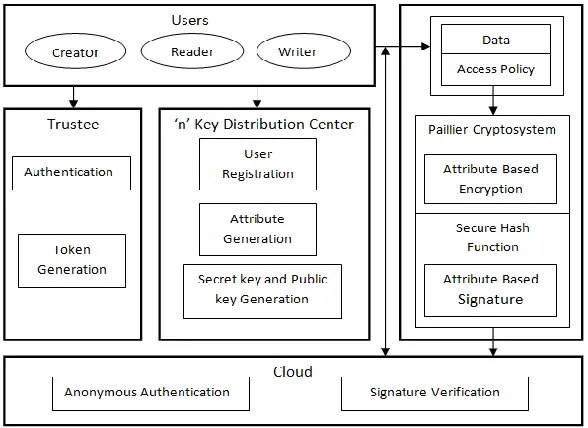
User who have attain to access the cloud storage have to register their details to the respective number of KDC. When user want to upload the file to the cloud database have to submit their identity to the trustee which responsible for issuing the token to the user. After user receiving the token from the trustee, then login into the KDC with their credentials for requesting it to give attributes and keys for file storage. User submits the token given by trustee to KDC. The token verification algorithm verifies the signature contained in token using the signature verification key. If the token is valid, then KDC will provide the two public and three secret key for encryption and decryption by executing paillier key generation algorithm and also signing key for signing the message using secure hash function algorithm. The keys size will be larger than the existing system, which enables the strong security. After users received the keys, the files are encrypted with the public keys and set their Access policies (privileges).The creator of the data then creates an access policy X which is in form of monotone Boolean function. The message is then encrypted under the access policy is called as Attribute based Encryption. Then signs the message and calculate the message signature by using secure hash function which is called as Attribute based Signature.
Finally, user will send the cipher text along with access policy to the cloud. If reader wants to read the file, their attributes must be matched with the cipher text access policy. Using the access policy of data the users can download their files by the help of KDC's to issue the private keys for the particular users. If the user having matching attribute as cipher text access policy, then cloud sends the cipher text to the requested user and allow them to read/write as only with respect to access policy of data.
V.
M
ODULES METHODOLOGYCreation of KDC: A.
KDC is an active database which is responsible to distribute secret keys and attributes to all users. To create a different number of KDC's , by creating with different KDC Name, KDC ID and KDC password, then save it in a database. KDC then assign the appropriate attributes to the user.
User Registration: B.
After KDC given a attributes to a user, the user will enroll the personal details such as Username, user id, Password and other information to KDC. The KDC will be verifying the user details and store it in a database if valid.
Trustee and User Accessibility: C.
Trustee can be someone like federal Government who manages social insurance number etc. User can login with their credentials and request the token from trustee for the file upload. Trustee is initialized with (Tsig, Tver) Tsig is the private key with which a message is signed and Tver is the public key used for verification. Trustee will create token which contains user id, key and user signature which is signed using signing key Tsig(SHA1 algorithm).Then the trustee will issue a token to the particular user and then trustee can view the logs. User may be Creator, Writer or Reader.
File Storage: D.
User submits the token given by trustee to KDC. The token verification algorithm verifies the signature contained in token using the signature verification key Tver. If it is valid then KDC will provide the public and secret key for encryption/decryption and keys for signing/verifying to the user. After users received the keys, the files are encrypted with the two public keys which is issued by KDC using paillier key generation algorithm and set their Access policies (privileges).The user then encrypt the data under access policy X using Attribute Based Encryption. The user can construct a Claim Policy to enable the cloud to authenticate the user using ABS. Then Sign the message using Attribute based Signature which is used to enable the cloud for verifying access claim of the user. Finally, ciphertext is sent to the cloud through SSH channel.
File Retrieval: E.
VI.
P
ROPOSED PRIVACY PRESERVING DATA STORAGE IN CLOUDAttribute based Encryption: A.
In ABE, a user’s private key will be associated with an arbitrary number of attributes articulated as strings. On the other hand, when a party encrypts a message in our system, they specify an associated access framework over attributes. A user will only to be capable to decrypt a ciphertext if that user’s attributes pass through the ciphertext’s access structure
Instead of using Advanced Encryption Standard algorithm (AES), new technique called paillier cryptosystem is used which proceeds as follows:
Key Generation:
1)
It executes the following steps:
1) Choose two large prime numbers p and q randomly and independently of each other such that lcm(p1,q1)
a. gcd(pq,(p-1)(q-1))=1. This property is assured if both primes are of equivalent length, i.e., p, q 1|| for security parameter .
2) Compute npq andlcm(p1,q1). 3) Select random integer g
4) Ensure n divides the order of g by checking the existence of the following modular multiplicative inverse:
, mod )) mod (
(L g n2 1 n
where function Lis defined as
n u u
L( ) 1. Note that the notation b a
does not denote the modular multiplication of atimes
the modular multiplicative inverse of b but rather the quotient of adivided by b, i.e., the largest integer value
0to satisfy the relation ab.Thus The public (encryption) key is (n,g). The private (decryption) key is(n,,). If using p, q of samelength, a simpler variant of the above key generation steps would be to setgn1, (n),and
(n)1modn, where) 1 )( 1 ( )
(n p q
.
Encryption by Sender:
2)
Let m be a note to be encrypted where m Zn 1) Select random r Zn* where 2) Compute cipher text c as:
2
mod
.
r
n
g
c
m nDecryption by Receiver:
3)
It follows the following steps:
1) Let c be the cipher text to decrypt, where c Z*n2
2) Compute the plaintext message as mL(cmodn2).
modnThe advantage of using the paillier cryptosystem is to ensure the strong security over encryption and decryption of data. The application of paillier cryptosystem is used in electronic voting, electronic cash and thus gives the system as privacy preserving application. So it is difficult for attacker to hack the data in cloud.
Attribute based Signature: B.
To ensure anonymous user authentication Attribute Based Signatures were introduced by Maji et al. [4].In ABS, users have a declare predicate associated with a message. The declare predicate helps to identify the user as an authorized one, without illuminating its identity. Other users or the cloud can confirm the user and the validity of the message stored.
System Initialization:
1)
chosen at random. (TSig,TVer) mean TSig is the private key with which a message is signed and TVer is the public key used for verification.
User Registration:
2)
For a user with identity Uu the KDC draws at random Kbase G. Let K0 = K 1/a0
base. The following token γ is output
γ = (u, Kbase, K0, ρ)
where ρ is signature on u||Kbase using the signing key TSig.
KDC Setup:
3)
Choose a, b Z∗ q randomly and stores all the user relevant details.
Attribute Generation:
4)
The token verification algorithm verifies the signature contained in γ using the signature verification key TVer. This algorithm extracts Kbase from γ and computes Kx = K1/(a+bx)base , x J[i, u].
Sign:
5)
The secure Hash Function (SHA1) is used to sign the message. SHA1 algorithm is most commonly used algorithm in distributed system. It ensures the message integrity and performs faster computation than others.
User Revocation: C.
It should be ensured that users must not have the facility to access data, even if they possess the same set of attributes. For this basis, the owners should change the stored data and send updated information to other users. The set of attributes lu possessed by
the revoked user Uu is noted and all users change their stored data that have attributes. In [5], revocation involved changing the
public and secret keys of the smallest set of attributes which are required to decrypt the data. This system does not consider this approach because here different data are encrypted by the same set of attributes, so such a smallest set of attributes is different for different users. Therefore, this does not relate to our model. Once the attributes Iu are recognized, all data that possess the
attributes are composed. For each such data record, the following steps are then carried out: 1) A new value of s, snew Zq is selected.
2) The first entry of vector vnew is altered to new snew.
3) λx = Rxvnew is calculated, for each row x corresponding to leaf attributes in Iu.
4) C1,x is recalculated for x.
5) New value of C1,x is firmly transmitted to the cloud.
6) New C0 = Me(g, g) snew
is calculated and stored in the cloud
7) New value of C1,x is not stored with the data, but is transmitted to users, who desire to decrypt the data. Here that the
new value of C1,x is not stored in the cloud but transmitted to the non-revoked users who have attribute related to x. This
prevents a revoked user to decrypt the new value of C0 and get back the message.
Hiding Access Policy from Cloud: D.
In proposed scheme, the added feature is to hide the attributes and access policy of each record of user from cloud. This can be achieved by database management technique. It means only owner of the file can able read the access policy of their own record, others cannot able read anything about it.
Performance E.
Schemes Fine grained access control
Centralized/ Decentralized
Write/ Read access
Type of access control
Anonymous Authentication
User Revocation
1 Yes Centralized 1-W-M-R Symmetric Key No Authentication No
2 Yes Centralized 1-W-M-R ABE No Authentication No
4 Yes Decentralized 1-W-M-R SHA Sign Verification Yes
5 Yes Decentralized
M-W-M-R
Paillear CryptoSystem
Scalability, ,Asymetric Key
Approach Yes
VII.
C
ONCLUSIONThe proposed scheme decentralized access control technique with secret verification, which provides user revocation and prevents repeat attacks. The cloud does not know the identity of the user who stores information, but only check the user’s credentials. Key allotment is done in a decentralized way. The attributes and access policy of each record is hided from the cloud, which will be explored more in mere future.
R
EFERENCES[1] Sahai and B. Waters, “Fuzzy identity-based encryption,” in EUROCRYPT, ser. Lecture Notes in Computer Science, vol. 3494. Springer, pp. 457– 473, 2005.
[2] V. Goyal, O. Pandey, A. Sahai, and B. Waters, “Attribute-based encryption for fine-grained access control of encrypted data,” in ACM Conference on Computer and Communications Security, pp. 89–98, 2006.
[3] Bethencourt, A. Sahai, and B. Waters, “Ciphertext-policy attribute-based encryption,” in IEEE Symposium on Security and Privacy. , pp. 321–334, 2007.
[4] H. K. Maji, M. Prabhakaran, and M. Rosulek, “Attribute-based signatures: Achieving attribute-privacy and collusion-resistance,” IACR Cryptology ePrint Archive, 2008.
[5] S. Yu, C. Wang, K. Ren, and W. Lou, “Attribute based data sharing with attribute revocation,” in ACM ASIACCS, pp. 261–270, 2010.
[6] Matthew Green, Susan Hohenberger and Brent Waters, “Outsourcing the Decryption of ABE Ciphertexts,” in USENIX Security Symposium, 2011. [7] S. Ruj, A. Nayak, and I. Stojmenovic, “DACC: Distributed access control in clouds,” in IEEE TrustCom, 2011
[8] F. Zhao, T. Nishide, and K. Sakurai, “Realizing fine-grained and flexible access control to outsourced data with attribute-based cryptosystems,” in ISPEC, ser. Lecture Notes in Computer Science, vol. 6672. Springer , pp. 83–97, 2011.
[9] Kan Yang, Xiaohua Jia and Kui Ren, “ DAC-MACS: Effective Data Access Control for Multi-Authority Cloud Storage Systems”, IACR Cryptology ePrint Archive, 419, 2012.