Author for correspondence:
Department of Chemical Engineering, Adhiparasakthi Engineering College, Melmaruvathur (T.N.) India.
Volume-5 Issue-2
International Journal of Intellectual Advancements
and Research in Engineering Computations
Study on the effect of sintering temperature on synthesize of LTA -
Zeolite
Velmurugan. S, Santhosh Kumar. S, Ganesh. B
ABSTRACT
The aim of this paper is to provide a review on the effect of temperature on synthesizing zeolites Lind Type- A. The zeolites are the adsorbent which can be effective in synthesized rather than naturally obtained because the synthesized one having more pore volumes and can retain the more ions which has to be separated. The objectives are to synthesize Lind Type-A (LTA) zeolite by aluminosilicate gel method at 100⁰C (drying time-24hr) and sinter the synthesized Lind Type-A (LTA) zeolite between 200⁰C, 300°C, 400°C,500°C, 600⁰C. The characteristics of synthesized LTA analysed by FTIR, XRD, SEM, and BET surface area.
INTRODUCTION
Zeolites are crystalline, micro porous, hydrated aluminosilicates that are built from an infinitely extending three dimensional network of [SiO4]
4-and [AlO4]5-tetrahedra linked to each other by the
sharing of oxygen atoms. Aluminosilicates zeolites synthesis involves mixing together Si and Al species, metals cations, organic molecules and water, which are then treated hydrothermally and the mixture then is then converted into a micro porous crystalline aluminosilicate.
Synthetic zeolites are used commercially more often than natural zeolites due to the purity of crystalline products and the uniformity of particle sizes. The sources for early synthesized zeolites were standard chemical reagents. The main advantages of synthetic zeolites in comparison to naturally-occurring zeolites are pore sizes and that they have greater thermal stability. Synthetic zeolites help to improve the ion exchange properties of the zeolites. Zeolites are mainly used in chemical, biochemical and physicochemical processes. They can be used for purification of gaseous as well as liquid mixtures and solutions by sorption, for storing of molecules, for sieving and filtering, for ion exchange purposes and also for
catalysis under non-oxidizing and oxidizing environment. [1]
Zeolite A has the double 4-ring (D4R) as a common SBU unit in its framework structure. The composition of the zeolite A is Na12 [AlO2)12
(SiO2)12] 27 H2O. The primary unit of zeolite is
made up of simple arrangement of polyhedral, each polyhedron being a three-dimensional array of (Si, Al) O4tetrahedra in a different geometric form. The
Si/Al ratio in zeolite A is 1:1. [1-3]
These zeolite-A can be synthesised by many techniques such as Hydrothermal crystallisation method, sol-gel process method and aluminosilicate gel method. The most following method for synthesis is hydrothermal method but inhere we are incorporated the aluminosilicate gel method as the prime one and to analyse its characteristic response as an adsorbent by XRD, FTIR, SEM and BET surface method.
In this aluminosilicate gel method, different types of alumina and silica sources can be used as precursors. This method can be used for synthesizing zeolites in laboratory. Zeolites can be synthesized at ambient temperature. This is the simplest method of synthesizing zeolite-A. In the waste water there are some ions which causing the living environment very difficult to sustain. The
Copyrights © International Journal of Intellectual Advancements and Research in Engineering Computations, ferric ions and fluoride ions are the major one
because ferric ion may be act as metal in some circumstances and the fluoride ions are formed as salts which will gets contaminate the drinking water. Hence this zeolite-A will be use for separating these ions by adsorption.
MATERIALS AND METHODS
LTA Zeolite was synthesized by aluminosilicate gel method. In this method, a required source of materials was used as shown in the Table 3.1.
Table 1.1: Source of materials Sl. No. Source of material 1 Deionized water 2 Sodium hydroxide 3 Aluminium nitrate 4 Sodium metasilicate
Experimental procedure
The experimental procedure involves three main steps; Preparation of precursors, Crystallization or Heating process, Product recovery and Sintering.
Preparation of precursors
A sodium hydroxide solution of 0.9N in 80 mL was prepared using deionized water. The solution was equally divided into two polypropylene bottles (used for air tight and also to avoid contamination).8.258 g of Aluminium nitrate was added to the first half of the solution until clear solution was obtained and then capped tightly (this solution was labeled as precursor-1). 15.48 g of sodium metasilicate was added to another half of the solution until clear solution was obtained and then capped tightly (this solution was labeled as precursor-2) all the precursor solutions were
homogenized using the homogenizer at 8000 rpm. Precursor-2 was poured quickly into precursor-1, so a thick creamy gel was formed and capped tightly and mixed well until it was homogenized. [4-6]
Product recovery
The product in the Whatman filter paper-1 was removed. The product was dried using electric oven at 80-110oC for 4hrs. The product was stored in a plastic cover.
Sintering process
Copyrights © International Journal of Intellectual Advancements and Research in Engineering Computations,
Flow chart for synthesis of LTA zeolite
Synthesized Zeolite LTA
RESULTS AND DISCUSSIONS
One of the objectives of our project was to study the effect of parameters on LTA formation and its crystallinty. The effect of different parameters was discussed in this section through characterization of FTIR, XRD, SEM, and BET surface area.
Parameters studied
During the synthesis of Lind Type A zeolite, the following parameters were studied. They are: 1. Effect of homegenation of the precursors
2. Effect of sintering temperature on the surface area
Comparison of synthesized LTA zeolite with
reference LTA
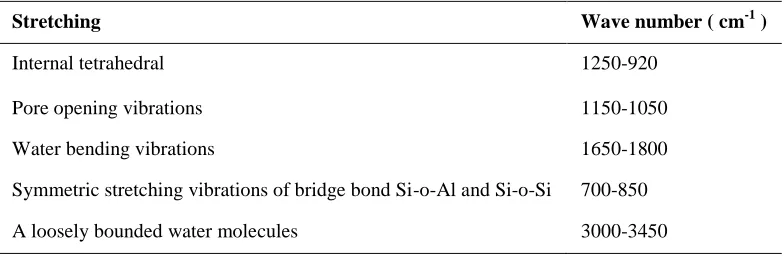
Copyrights © International Journal of Intellectual Advancements and Research in Engineering Computations, Table 1.1: Vibrations at different wave number
Stretching Wave number ( cm-1 )
Internal tetrahedral 1250-920
Pore opening vibrations 1150-1050
Water bending vibrations 1650-1800
Symmetric stretching vibrations of bridge bond Si-o-Al and Si-o-Si 700-850
A loosely bounded water molecules 3000-3450
Figure 1.1: Reference LTA (unsintered)
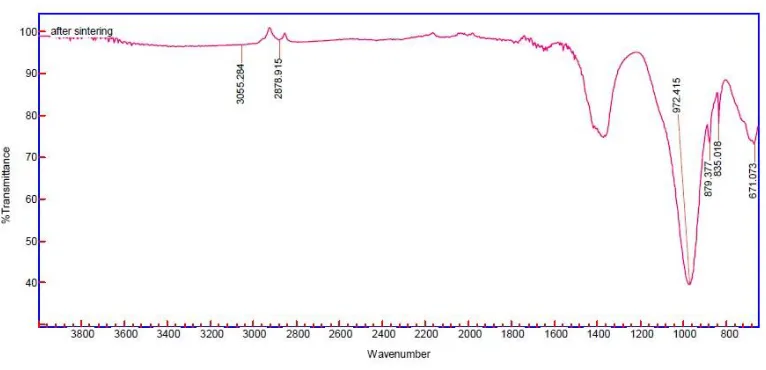
Copyrights © International Journal of Intellectual Advancements and Research in Engineering Computations, Figure 1.3: The synthesized homogenised LTA at 100oC for 4hrs. before sintering.
Effect of sintering temperature on the
Crystallinity of LTA Zeolite
1. Sintering temperature: 200-600oC 2. Sintering time: 2hrs.
By maintaining the above sintering time constant, the effect of sintering temperature was studied by using FTIR results. Aluminium nitrate and sodium metasilicate were used as alumina sources.
The Fig 1.4 shows that the effects of 200°C sintering temperature. The peaks in the range between 1650-1800 cm-1 and 3000-3450 cm-1 were missed, that indicates a water bending vibrations and a loosely bounded water molecules were absent
in that particular LTA which was obtained when sintering was done.
The Fig 1.5 shows that the effects of 400°C sintering temperature on the zeolite where The peaks in the range between 1650-1800 cm-1 was missed, that indicates a water bending vibrations was absent. [10-12]
The Fig 1.6 shows that the effect of 500°C sintering temperature. The peaks in the range between 1650-1800 cm-1was missed, that indicates a water bending vibrations was absent.
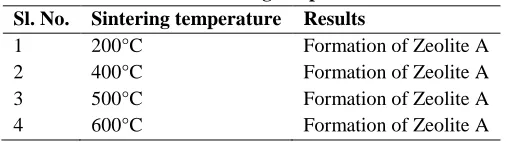
After the sintering of zeolite, the LTA zeolite was converted into Zeolite A because of the formation of Na2O molecule.
Table 1.2: Effect of sintering temperature on LTA formation Sl. No. Sintering temperature Results
1 200°C Formation of Zeolite A
2 400°C Formation of Zeolite A
3 500°C Formation of Zeolite A
4 600°C Formation of Zeolite A
Copyrights © International Journal of Intellectual Advancements and Research in Engineering Computations, Figure 1.4: Effect of 200 oC sintering temperature for 2 hrs
Figure 1.5: Effect of 400oC sintering temperature for 2hrs.
Copyrights © International Journal of Intellectual Advancements and Research in Engineering Computations, Figure 1.7: Combined FTIR Graph of LTA zeolite.
Effect
of
sintering
temperature
on
Crystallinity of LTA by XRD
1. Sintering temperature: 300-6000C 2. Alumina source: Aluminium nitrate 3. Sintering time: 2hrs.
By maintaining the sintering time and the source of alumina and silica constant, the effect of sintering temperature 3000C, 4000C, 5000C, 6000C was studied on the end crystalline products with aluminium nitrate as alumina source and sodium metasilicate as silicate source.
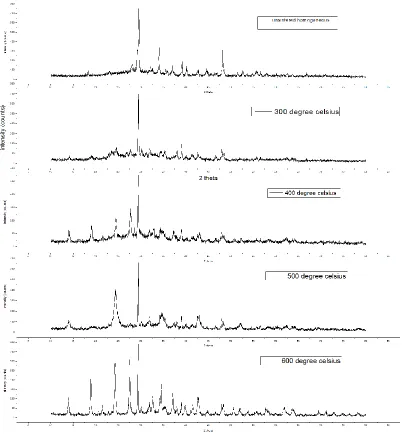
The Fig 1.7 shows that the effect of sintering temperature of 3000C, 4000C, 5000C, 6000C. The peak intensity of the samples increases with
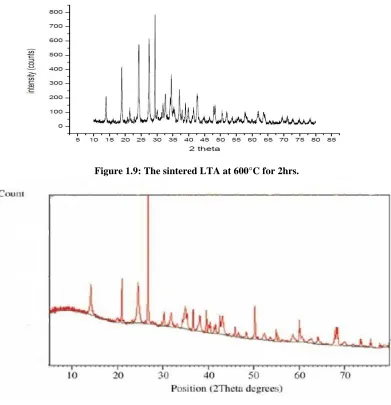
increasing the sintering temperature from 3000C, 5000C, 6000C. It conforms that crystallinity increases with the increasing sintering temperature as shown in the Fig 1.8. The results obtained at 300°C of the sintering temperature indicates that there was no crystallinity formation at that sintering temperature. For 400°C and 500°C sintering temperature, there was slightly increase in crystallinity of material. At 600°C of sintering time, there were some prominent peaks arise indicates that high crystalline nature of material. The observations made out from the Fig 1.8 which were tabulated in the Table 1.4. The XRD result of LTA sintered at 600°C resembled some of the XRD peaks of zeolite A. [14-15]
Table 1.3: Effect of sintering temperature on crystallinity of LTA Sl no Sintering temperature (°C) Results
1 NIL Amorphous in nature
2 300 Amorphous in nature
3 400 Slightly increase in crystallinity 4 500 Slightly increase in crystallinity
Copyrights © International Journal of Intellectual Advancements and Research in Engineering Computations, Figure 1.8: XRD results of different sintering temperature; unsintered, 300°C, 400°C,
500°C, 600°C
From the above merged graph, we can see that the peaks at 48.53° stats diminishing and is nearly negligible at the last graph and peaks at 13.99°,19.03°, 24.45°, 27.67°, 31.89°, 32.89°, 34.39°, 37.21°, 38.99° starts forming at 400°C sintered LTA and the peak becomes more intense for the XRD graph of 600°C sintered LTA.
The comparison of synthesized LTA zeolite
with reference LTA through XRD
The powder diffraction pattern explores the different features to characterize the crystalline
Copyrights © International Journal of Intellectual Advancements and Research in Engineering Computations, Figure 1.9: The sintered LTA at 600°C for 2hrs.
Figure 1.10: Reference XRD for LTA zeolite (unsintered)
Figure 1.11: Reference XRD pattern of sintered Zeolite A
Position [°2Theta]
0 0 0 0 0
4 00
1 600
3 600
Copyrights © International Journal of Intellectual Advancements and Research in Engineering Computations,
Effect of sintering temperature on SEM
results
Results obtained by XRD were confirmed with those of SEM results. This technique was used to determine the morphology of the material. The effect of sintering temperature was also studied through SEM results. The surface analysis in SEM is carried out different magnifications to determine the morphology of LTA zeolite.
The surface analysis of unsintered homogenous sample was studied at different scale of 30µm, 50µm and 100µm. The Fig 1.12, 1.13 and 1.14 show that the SEM results of unsintered homogeneous sample at different magnifications of
30µm, 50µm and 100µm respectively. The particles were found to be amorphous in nature and the particles which are found to be in irregular shape.
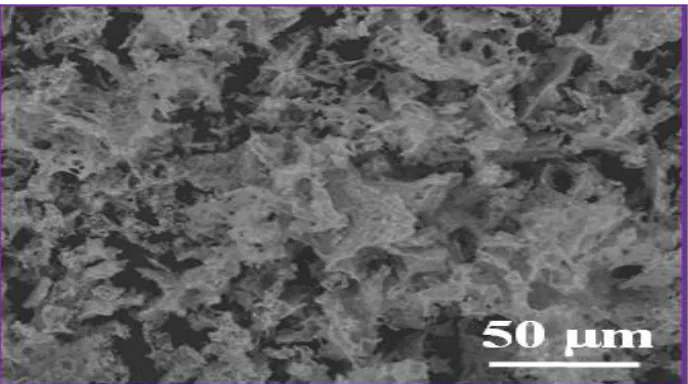
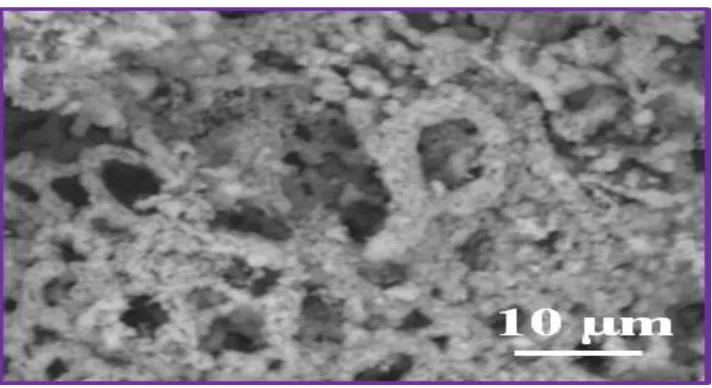
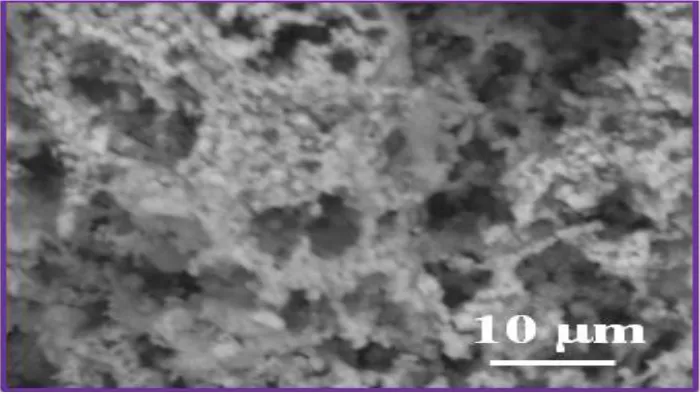
The surface analysis of 600°C sintered homogeneous sample was studied at the scale of 20µm, 10µm, 10µm and 5µm. The Fig 1.15, 1.16, 1.17, and 1.18 shows that the SEM results of 600°C sintered homogeneous sample at different magnifications of 20µm, 10µm and 5µm respectively. It was found that for 600°C sintered homogeneous sample, the surface morphology of the samples by SEM indicates that the shape of the zeolite is irregular. [11-14]
Figure 1.12: SEM micrograph of unsintered homogeneous LTA at 30µm scale
Copyrights © International Journal of Intellectual Advancements and Research in Engineering Computations, Figure 1.14: SEM micrograph of unsintered homogeneous LTA at 100µm scale
Figure 1.15: SEM micrograph of 600°C sintered homogeneous at 20µm scale
Copyrights © International Journal of Intellectual Advancements and Research in Engineering Computations, Figure 1.17: SEM micrograph of 600°C sintered homogeneous at 10µm scale
Figure 1.18: SEM micrograph of 600°C sintered homogeneous at 5µm scale
Table 1.4: Surface area, pore volume and pore size of unsintered and sintered zeolite BET Surface area, m2/g Pore Volume, cm3/g Pore Size, Ᾰ
Unhomoginized 29.686 - -
Homoginized 33.882 0.2596 306.569
300° C 10.091 0.0635 301.006
500° C 3.1309 0.0246 338.684
Copyrights © International Journal of Intellectual Advancements and Research in Engineering Computations,
BET surface area
The specific surface area of unsintered homogenized Lind Type-A zeolite was determined by using BET surface area analyzer. The results show that, BET surface area: 33.882m²/g Langmuir surface area: 50.6833m²/g of the optimized synthesis time of 24h.As we can see in the above table that as the sintering temperature increases, the pore size and pore volume decrease. The least pore size is found in 600°C sintered LTA zeolite.
CONCLUSION
The Lind Type-A Zeolite synthesis by aluminosilicate gel method was successfully done. With the set of experiments carried out and from the characterization as well as from parameters study, it can be concluded that the LTA Zeolite was
successfully synthesized at 100°C crystallization temperatures, synthesis time, by using aluminium nitrate as alumina source and sodium metasilicate as a silica source. The synthesized LTA was characterized by using FTIR, XRD, SEM, and BET surface area. The results confirms optimum sintering temperature as 600oC by FTIR results and XRD and shows crystallinity at the same. The particle size analysis by SEM indicates arrangement of particles as irregular and appears to be partially spherical. The BET surface area analyzer results indicate BET Surface Area as 33.882m²/g and Langmuir Surface Area as 50.6833m²/g for the optimized unsintered homogeneous sample and BET Surface Area as 4.7682 m²/g and Langmuir Surface Area as 7.3570m²/g.
REFERENCES
[1]. Breck, D. W., 1974. Zeolite Molecular Sieves: Structure, Chemistry and Use. London: John Wiley and Sons, 4. [2]. Bekkum, V. H., Flanigen, E.M., Jacobs, P.A., Jansen, J.C., Introduction to Zeolite Science and Practice, 2,
1991, nd. Revised Edn. Elsevier, Amsterdam.
[3]. Haag, W. O., Lago, R. M., Weisz, P. B., The active site of acidic aluminosilicate catalysts, Nature, 309, 1984, 589-591.
[4]. Ghulam Murtaza., Ion-exchange Studies of Zeolite For Selective Removal of Transition Metal Ions From Mix Solutions 2011.
[5]. Ersin Polat, Mehmet Karaca, Halil Demir, and A. Naci Onus., Journal of Fruit and Ornamental Plant Research. 12, 2004.
[6]. Robert Virta, mineral commodity specialist for the U.S. Geological Survey, 2008. Geotimes mineral resource.
[7]. SitihidaBinti Ibrahim, 2007. Synthesis and characterization of zeolites from sodium aluminosilicate solution. [8]. Mathaveesathupunya, Erdogangulari, Alexander Jamieson, and Sujitra Wongkasemjit. Microporous and
Mesoporous Materials 69, 2004, 157–164.
[9]. Alexander Klug, X-Ray Diffraction Procedures, London 1974.
[10]. Danilatos, G, D. Foundations of environmental scanning electron microscopy. Advances in Electronics and Electron Physics. 71, 1988, 109-250.
[11]. X. Zhang et al. Materials Research Bulletin 52, 2014, 98 96–102. [12]. Monticelli et al., 1999 and Chatterjee et al., 2003.
[13]. Nah et al., 2006 and Ursini et al., 2006.
[14]. S. Aguado et al. Microporous and Mesoporous Materials 120, 2009, 170–176. [15]. S. Alfaro et al. Materials Letters 61, 2007, 4655–4658.
[16]. M. Jafari et al. Powder Technology 237, 2013, 442–449.
[17]. Szostak, R., 1989. Molecular Sieves: Principles of Synthesis and Identification, Van Nostrand Reinhold, New York.