Volume-6 Issue-2
International Journal of Intellectual Advancements
and Research in Engineering Computations
Raspberry PI GUI kernel remote authentication multitasking & embedded
web control
#1B.Guga Priya,*2Mr. B. PRABHAKARAN
# PG Scholars, * professor
Department of Electrical and Electronics Engineering Nandha Engineering College (Autonomous), Erode.
1E-Mail: [email protected]
2E-Mail: [email protected]
ABSTRACT- The system provide secured data transfer by remote method & each user can split the task an
access and run the task by using OS which include IOT enable remote. The main features of the system
includesRaspberry Pi Kernal Tasking & Control Network Remote Authentication Web Control By Master &
Remote System. The software output is done with ARDUINO, ESP CORER 1.8 using embedded C. schematic
is prepared using PROTEUS. Also the Software and hardware portion is done.
KEYWORDS—IOT,RASSPBERRY PI3, ARM 7, ATMEGA, VIDEO CORE IV,BCM 548 ,ESP8266- II,BUCK BOOST CONVERTER, HDMI TO VGA CONVERTER, RELAY DRIVER,GUI POWER AMPLIFIER , OPTO COUPLER, ETHERNET, LCD, PROTEUS, PYTHON IDE,ARDUNIO IDE, WIRE SHARK.
I. INTRODUCTION
The Internet of things (IoT) is the network of physical
devices, vehicles, and other items embedded with
electronics, software, sensors, actuators, and network
connectivity which enable these objects to collect and
exchange data. Each thing is uniquely identifiable
through its embedded computing system but is able to
interoperate within the existing Internet infrastructure.
Experts estimate that the IoT will consist of about 30
billion objects by 2020. The IoT allows objects to be
sensed or controlled remotely across existing network
infrastructure, creating opportunities for more direct
integration of the physical world into computer-based
systems, and resulting in improved efficiency, accuracy
and economic benefit in addition to reduced human
intervention. When IoT is augmented with sensors and
actuators, the technology becomes an instance of the
more general class of cyber-physical systems, which
also encompasses technologies such as smart grids,
virtual power plants, smart homes, intelligent
transportation and smart cities.
KERNAL MULTITASKING & CONTROL
Kernal is an operating system, is allowing a user to
perform more than one computer task (such as the
operation of an application program) at a time. The
operating system is able to keep track of where you are
in these tasks and go from one to the other without
losing information.
NETWORK REMOTE AUTHENTICATION
Network Level Authentication is a technology used in
Remote Desktop Services (RDP Server) or Remote
Desktop Connection (RDP Client) that requires the
connecting user to authenticate themselves before a
session is established with the server.
WEB CONTROL BY MASTER & REMOTE
SYSTEM
It means control of a machine or apparatus from a
distance by means of radio or infrared signals
transmitted from a device.
II EXISTING SYSTEM
The main objective of the system,
To implement a pure kernel system in an Empty
manner for creates an efficient platform for device
driver.To make and configure they image data and
beagle bone setup in terminal window.Unless the
hardware being controlled is really misbehaving.User
memory is swappable, unlike kernel memory. An
infrequently used device with a huge driver won't
occupy RAM that other programs could be using, except
when it is actually in use. A well-designed driver
program can still allow concurrent access to a device.
A.Drawbacks
One user can access the data
More drivers are required to execute the
multitasking.
Limited Number of users can access the Wi-Fi
B.Algorithm for Empty Kernel
In Linux operating system will able to execute the
instructions in the terminal window. Here various
parameter and command sets will run in the terminal
window. Creating a directory setup updating the
essential packages. Then install Yocto project simulator
tool is prospective manner from the company website.
Formation of an image in the minimal execution method.
Device driver bridge module will be created by run
qemux module. More executed parameter run on the
executed terminal window.
1) STEP 1 - go to terminal and connect to internet
2) STEP 2 - sudo apt-get update
3) STEP 3 - sudo apt-get install build-essential
4) STEP 4 - Git clone -b dylan
git://git.yoctoproject.org/pokyt
5) STEP 5 - cd poky ( getting into the folder of
yocto)
6) STEP 6 - source oe-init-build-env
build-tamil-arm-simulation (creating a build directory in the
name of yours)
7) STEP 7 - cd build-tamil-arm-simulation (getting
into that directory)
8) STEP 8 - cd conf (getting into conf directory)
9) STEP 9 - geditlocal.conf ( editing the file )
10)STEP 10 - change the line following
11)STEP 11 MACHINE ??= "qemux86" to
MACHINE ?= "qemuarm"
12)STEP 12 - save and quit gedit
13)STEP 13 - cd.. (comming out of the conf
directory)
14)STEP 14 - bitbake -k core-image-minimal
(compiling ---- it will take more time to
15)STEP 15- runqemuqemuarm (running the
simulation)
III PROPOSED SYSTEM
The main objective of the system,
Real time kernel based multitasking is
performed in proposed system.
Internet of things are used to control the
parameter operations from any where.
Remote authentication is used for the
multiprocessor operation.
BLOCK DIAGRAM
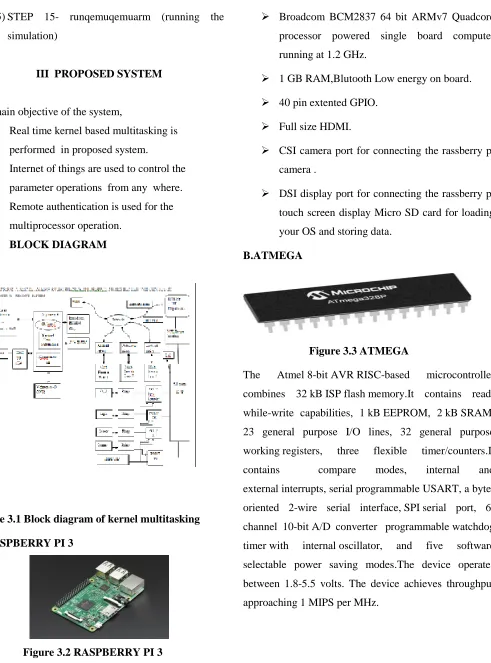
Figure 3.1 Block diagram of kernel multitasking
A.RASPBERRY PI 3
Figure 3.2 RASPBERRY PI 3
Broadcom BCM2837 64 bit ARMv7 Quadcore
processor powered single board computer
running at 1.2 GHz.
1 GB RAM,Blutooth Low energy on board.
40 pin extented GPIO.
Full size HDMI.
CSI camera port for connecting the rassberry pi
camera .
DSI display port for connecting the rassberry pi
touch screen display Micro SD card for loading
your OS and storing data.
B.ATMEGA
Figure 3.3 ATMEGA
The Atmel 8-bit AVR RISC-based microcontroller
combines 32 kB ISP flash memory.It contains
read-while-write capabilities, 1 kB EEPROM, 2 kB SRAM,
23 general purpose I/O lines, 32 general purpose
working registers, three flexible timer/counters.It
contains compare modes, internal and
external interrupts, serial programmable USART, a
byte-oriented 2-wire serial interface, SPI serial port,
6-channel 10-bit A/D converter programmable watchdog
timer with internal oscillator, and five software
selectable power saving modes.The device operates
between 1.8-5.5 volts. The device achieves throughput
C. ESP 8266
Figure 3.4 ESP8266
The ESP8266 is a low-cost Wi-Fi microchip
withfull TCP/IP stack and microcontroller
capability
Standards FCC/CE/TELEC/SRRC
Protocols 802.11 b/g/n/e/i
Frequency Range 2.4G ~ 2.5G (2400M ~
2483.5M)
Tx Power
802.11 b: +20 dBm
802.11 g: +17 dBm
Rx Sensitivity
802.11 b: -91 dbm (11 Mbps)
802.11 g: -75 dbm (54 Mbps)
D. ARDUINO UNO R3
Arduino is an open source computer hardware and
software company, project, and user community that
designs and manufactures single-board
microcontrollers and microcontroller kits for building
digital devices and interactive objects that can sense and
control objects in the physical world. The project's
products are distributed as open-source
hardware and software, which are licensed under
the GNU Lesser General Public License (LGPL) or
the GNU General Public License(GPL), permitting the
manufacture of Arduino boards and software distribution
by anyone. Arduino boards are available commercially
in preassembled form, or as do-it-yourself kits. Arduino
board designs use a variety of microprocessors and
controllers. The boards are equipped with sets of digital
and analog input/output (I/O) pins that may be interfaced
to various expansion boards (shields) and other circuits.
The boards feature serial communications interfaces,
including Universal Serial Bus (USB) on some models,
which are also used for loading programs from personal
computers. The microcontrollers are typically
programmed using a dialect of features from the
programming languages C and C++. In addition to using
traditional compiler tool chains, the Arduino project
provides an integrated development environment (IDE)
based on the Processing language project.
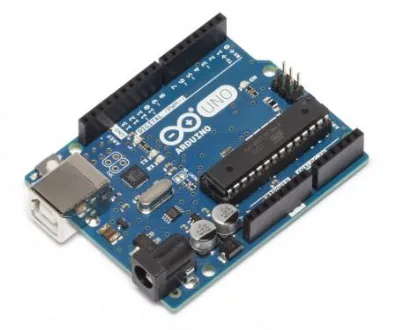
Arduino Uno R3 is a microcontroller board based on the
ATmega328P. It has 14 digital input/output pins (of
which 6 can be used as PWM outputs), 6 analog inputs,
a 16 MHz quartz crystal, a USB connection, a power
jack, an ICSP header and a reset button. It contains
everything needed to support the microcontroller; simply
connect it to a computer with a USB cable or power it
with a AC-to-DC adapter or battery to get started.. You
can tinker with your UNO without worring too much
about doing something wrong, worst case scenario you
can replace the chip for a few dollars and start over
again. "Uno" means one in Italian and was chosen to
mark the release of Arduino Software (IDE) 1.0. The
Uno board and version 1.0 of Arduino Software (IDE)
were the reference versions of Arduino, now evolved to
newer releases. The Uno board is the first in a series of
USB Arduino boards, and the reference model for the
Arduino platform; for an extensive list of current, past or
outdated boards see the Arduino index of boards.
E. LIQUID CRYSTAL DISPLAY
LCD (Liquid Crystal Display) screen is an electronic
display module and find a wide range of applications. A
16x2 LCD display is very basic module and is very
commonly used in various devices and circuits. These
modules are preferred over seven segments and other
multi segment LEDs. The reasons being: LCDs are
economical; easily programmable; have no limitation of
displaying special & even custom characters (unlike in
seven segments), animations and so on. A 16x2
LCD means it can display 16 characters per line and
there are 2 such lines. In this LCD each character is
displayed in 5x7 pixel matrix. This LCD has two
registers, namely, Command and Data. The command
register stores the command instructions given to the
LCD. A command is an instruction given to LCD to do a
predefined task like initializing it, clearing its screen,
setting the cursor position, controlling display etc. The
data register stores the data to be displayed on the LCD.
The data is the ASCII value of the character to be
displayed on the LCD. Click to learn more about internal
structure of a LCD.
Figure 3.6 16x2 Lcd Display
IV TESTING
A.PROTEUS CIRCUIT FOR MULTITASKING
ANALYSIS
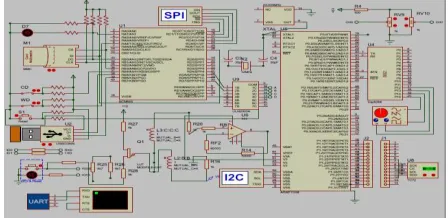
Figure 4.1 Multitasking analysis
B. PROTEUS CIRCUIT FOR RELAY
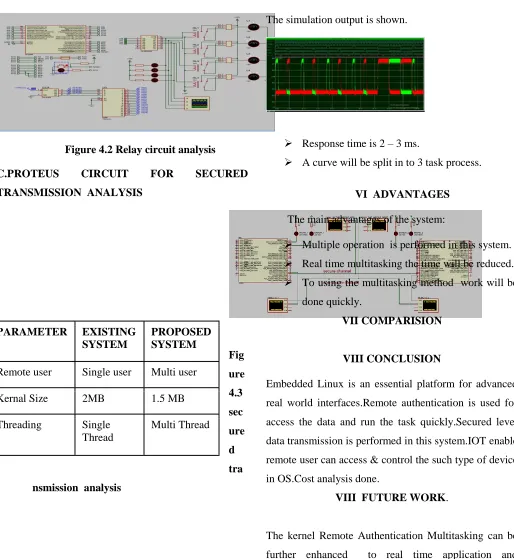
Figure 4.2 Relay circuit analysis
C.PROTEUS CIRCUIT FOR SECURED
TRANSMISSION ANALYSIS
Fig
ure
4.3
sec
ure
d
tra
nsmission analysis
V RESULT AND ANALYSIS
The simulation output is shown.
Response time is 2 – 3 ms.
A curve will be split in to 3 task process.
VI ADVANTAGES
The main advantages of the system:
Multiple operation is performed in this system. Real time multitasking the time will be reduced. To using the multitasking method work will be
done quickly.
VII COMPARISION
VIII CONCLUSION
Embedded Linux is an essential platform for advanced
real world interfaces.Remote authentication is used for
access the data and run the task quickly.Secured level
data transmission is performed in this system.IOT enable
remote user can access & control the such type of device
in OS.Cost analysis done.
VIII FUTURE WORK.
The kernel Remote Authentication Multitasking can be
further enhanced to real time application and
implementation of software , hardware portion. PARAMETER EXISTING
SYSTEM
PROPOSED SYSTEM
Remote user Single user Multi user
Kernal Size 2MB 1.5 MB
Threading Single Thread
REFERENCES
1. K.Tamilselvan, M.E., (ph.d ), “Real Time
Kernel Based Hot Spot Communication Using
Raspberry Pi” IJSRD Vol. 3, Issue 02, 2015 .
2. John Shawe Taylor, Theodoros
Evgeniou,Charles A. Micchelli’, “Learning Multiple Tasks with Kernel Methods”, Journal of Machine
Learning Research 6 (2005) 615–637 Submitted
2/05; Published 4/05.
3. Jean-Philippe, VertElsa Bernard,Yunlong
Jiao’,“Kernel multitask regression for toxicogenetics”,
Aug 1,2017.
4. By Jie Liu , Edward A. Lee “Timed
Multitasking for Real-Time Embedded Software” IEEE
Control Systems Magazine , February
2003,10535888/03/2003.
5. Ralph Moore ,Mr. Moore, “How to Use
Real-Time Multitasking Kernels in Embedded Systems”
Micro Digital Associates,October 7, 2001.
6. AndiKleen “On submitting kernel patches”
article 2010.
7. Andrew Morton kernel.org development and the
embedded
worldhttp://userweb.kernel.org/~akpm/rants/elc-08.odp.
8. Jonathan Corbet, “Linux Kernel Development”
A White Paper By The Linux Foundation December
2010.
9. RajendraPrasad.M, S. Ramasubba Reddy,
V.Sridhar. “Framework To Port Linux Kernel On power
pc Based Embedded System Used OrtelecomApplication
– Ipbts” International Journal of Software Engineering &
Applications (IJSEA), Vol.2, No.4, October 2011.
10. Tamilselvan.K, G.Sivasangari and
S.Menakambal “Multitasking Operating System for ARM Processors” with LED Display Vol. 3 issue.1
No.13, March 2014, 65-70.
11. http://www.ijisr.issr-journals.org.