(10.24874/jsscm.2019.13.02.05)
VISCOSITY VARIATION EFFECT ON THE MAGNETIC FLUID
LUBRICATION OF A SHORT BEARING
Jimit R. Patel 1*, Gunamani Deheri 2
1 Department of Mathematical Sciences, P. D. Patel Institute of Applied Sciences,
CHARUSAT, Changa, Anand, Gujarat, India e-mail: [email protected]
2 Department of Mathematics, Sardar Patel University, Vallabh Vidyanagar, Anand, Gujarat,
India
e-mail: [email protected]
*corresponding author
Abstract
The performance of a magnetic fluid based short bearing is examined with the effect of viscosity variation. The pressure temperature relation of Tipei (1962) concerning viscosity variation is adopted here. The Neuringer-Rosensweig’s model has been considered for the magnetic fluid flow. The related modified Reynolds type equation is solved for the calculation of pressure distribution leading to the computation of load bearing capacity. The graphical representations indicate that the positive effect of viscosity variation gets aided considerably by the ferrofluid lubrication.
Keywords: iscosity Vavriation, short bearing, magnetic fluid, load carrying capacity
1. Introduction
The use of slider bearing has been proved to be very useful from the industry point of view for many decades. This has been documented in the literature (Agrawal (1986), Lin (2001), Deheri et al. (2005), Ahmad and Singh (2007), Oladeinde and Akpobi (2010), Deheri and Patel (2011), Patel and Deheri (2013, 2015)). The basic phenomenon associated with hydrodynamic slider bearing is the formation of a converging wedge of the lubricant. The hydrodynamic slider may be constructed to provide this converging wedge in a number of ways such as plane, convex, concave and stepped ones.
Most of the investigations (Agrawal (1986), Shah and Bhat (2003), Ahmad and Singh (2007), Deheri and Patel (2011), Patel and Deheri (2013, 2015, 2016), Patel et al. (2017), Patel and Deheri (2018)) deal with constant viscosity. But, it fails to comply with reality. In some discussions, of course, viscosity variation has been talked about.
By now, it is known that viscosity of nanofluids is subjected to thorough investigations for system dealing with heat transfer applications. It is well known that pumping power pressure drop in laminar flow and convective heat transfer always depend on the viscosity of fluids. It is established that viscosity increases pumping power. The analysis of viscosity variation turns out to be crucial for deciding the thermo-fluidic behavior of heat transfer fluid. It has been observed that nano fluid’s viscosity depends mainly on the effects of particles shape, particle size volume fraction and temperature. Very little (Sinha et al. (1981), Siddangouda et al. (2013), Naduvinamani and Kadadi (2013), Patel et al. (2018)) is known for the effect of viscosity variation under the presence of a ferrofluid. So, it was thought appropriate to launch an investigation into the effect of viscosity variation on a ferrofluid based short bearing.
2. Analysis
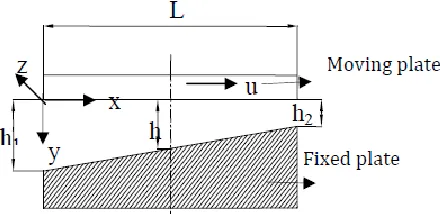
The geometrical configuration of the short bearing system is displayed in Figure 1, which is given below. In x-direction, the slider bearing surfaces move with uniform velocity 𝑢. 𝐿 and 𝐵
are respectively length and breadth of the bearing in 𝑧 direction where 𝐵 ≪ 𝐿. Since 𝜕𝑝 𝜕𝑧≫
𝜕𝑝 𝜕𝑥, without loss of generality 𝜕𝑝
𝜕𝑥 can be neglected (Basu et al. (2005)).
Fig. 1. Configuration of bearing
The magnetic field remains oblique to the starter as in Agrawal (1986). In view of the deliberations there in Prajapati (1995) and Patel and Deheri (2013), the magnitude of the magnetic field is taken as
2 2 1 1 1 1
sin sin
2 2 2 2
z z z z
M kB
B B B B
(1)
where constant 𝑘 is suitably chosen from dimensionless point of view (Patel and Deheri (2013)).
In 1964, Neuringer and Rosensweig proposed a simple flow model to investigate the steady flow of magnetic fluids wherein there is the presence of a slowly changing external magnetic fluid. The following equations constitute the model:
2
0
q q p q M H
0
q
(3)
0
H
(4)
M
H (5)
H M
0 (6)
where 𝜌, 𝑞̅, 𝐻̅, 𝜇̅ , 𝑝, 𝜂 and 𝜇0 denote the fluid density, the fluid velocity in the film region, external magnetic field, magnetic susceptibility of the magnetic field, the film pressure, the fluid viscosity and the permeability of the free space, respectively.
In the light of equations (3) to (6), equation (2) turns to
0 2 22
q q p
M q
Under the usual considerations of hydro-magnetic lubrication, the modified equations for the pressure distribution (Bhat 2003;Prajapati 1995; Deheri et al. 2005) is derived to be
2 2 0 2 3 6 2
d u dh
p M dx dz h
(7)
where 𝜇0 represents the magnetic susceptibility, 𝜇̅ denotes the free space permeability and 𝜇 being the lubricant viscosity.
It appears that viscosity of the lubricant may change across the film and may be different near the bearing surfaces due to the reactions of additives and surfactant with the bearing surfaces. It has been found in Rao and Prasad (2004) that the coefficient of friction decreases with a high viscous layer. As per the discussions of Tipei (1962), it has been verified experimentally that the highest temperature occurs in the zones in the least film thickness region. Here we discuss the thermal effect in view of the viscosity-temperature relation given by,
1 2 q h h
(8)
when the viscosity μ1 at h = h2 is known, where q, the thermal factor, usually lies between 0 and 1 according to the nature of the lubrication (Sinha et al. (1981), Siddangouda et al. (2013), Naduvinamani and Kadadi (2013), Patel et al. (2018)).
The concerned Reynolds physical boundary conditions associated with the system are
0; ,
2 B p z
and
0; 0.
dp
z
dz (9)
22 3 2
0 1 2 2 3 2 4 q um B
p M A z
h L
(10)
Introduction of the non-dimensional quantities
3 *
3
* 2 0
1 2 2
2
2 2 2
, , , h K , , ,
h h z h x L B
m Z P p X L B
h B uB u L h h
21 1 x , 1 1 x , 1 1
A m h h m A m X
L L
transforms the above equation (10) to
*
2 3
1 1 1 1 3 1
sin sin
2 2 2 2 2 4
q m
P Z Z Z Z Z A
L
(11)
Further, the load bearing capacity in non-dimensional form is calculated from
1 1 3 2 2 4 1 0 2 , hW w p x z dxdz uB
(12)which assumes the form
1 * 3 0 1 0.98254 2 q L m
W A dX
B B
(13)3. Results and Discussion
Equation (11) determines the non-dimensional pressure distribution while expression (13) decides the effect of dimensionless load carrying capacity in the short bearing. From equation
(13), one can notice that the load carrying capacity enhances by 0.98254 μ∗L̅
B
̅ due to the magnetic fluid lubrication as compared to conventional fluid based bearing system. Eventually, as found, this is much more than the case of constant viscosity (Agrawal (1986), Lin (2001), Ahmad and Singh (2007), Oladeinde and Akpobi (2010), Deheri and Patel (2011), Patel and Deheri (2015))
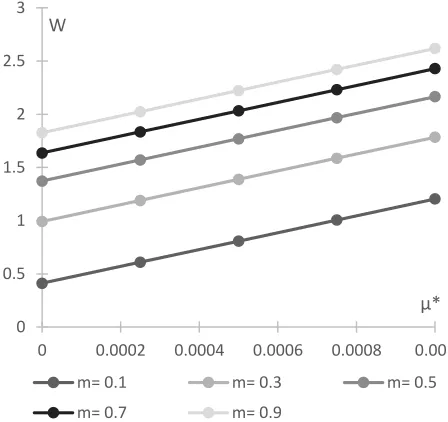
Fig. 2. Variation of 𝑊 with respect to 𝜇∗ and 𝑞 .
Fig. 3. Variation of 𝑊 with respect to 𝜇∗ and 𝑚 .
1 1.2 1.4 1.6 1.8 2 2.2 2.4 2.6 2.8
0 0.0002 0.0004 0.0006 0.0008 0.001
W
μ*
q = 0.1 q = 0.3 q = 0.5
q = 0.7 q = 0.9
0 0.5 1 1.5 2 2.5 3
0 0.0002 0.0004 0.0006 0.0008 0.001
W
μ*
m= 0.1 m= 0.3 m= 0.5
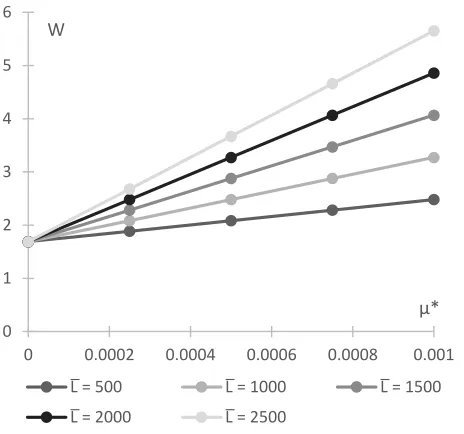
Fig. 4. Variation of 𝑊 with respect to 𝜇∗ and 𝐿̅ .
Fig. 5. Variation of 𝑊 with respect to 𝑞 and 𝐵̅ .
The variation of load carrying capacity with respect to 𝜇∗ is exhibited in Figs. 2-5. It is found that the load bearing capacity enhances due to magnetization which jells well with the theoretical consideration based on the linearity of 𝑊 with respect to 𝜇∗. Probably, this is due to the fact that the magnetization increases the viscosity of the fluid. It is interesting to note that the behavior of
𝑚 and 𝐵̅ are approximately opposite in nature.
0 1 2 3 4 5 6
0 0.0002 0.0004 0.0006 0.0008 0.001
W
μ*
L̅ = 500 L̅ = 1000 L̅ = 1500
L̅ = 2000 L̅ = 2500
0 0.5 1 1.5 2 2.5 3
0 0.0002 0.0004 0.0006 0.0008 0.001
W
μ*
B̅ = 10 B̅ = 20 B̅ = 30
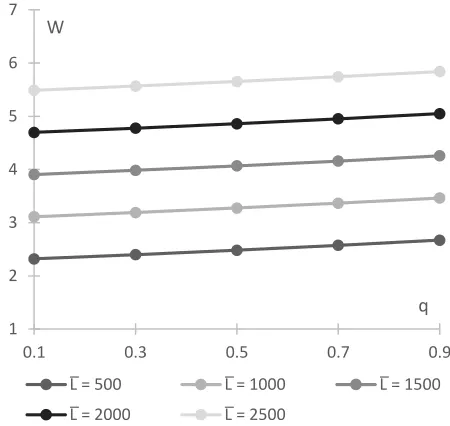
Fig. 6. Variation of 𝑊 with respect to 𝑞 and 𝑚.
Fig. 7. Variation of 𝑊 with respect to 𝑞 and 𝐿̅ .
1 1.2 1.4 1.6 1.8 2 2.2 2.4 2.6 2.8 3
0.1 0.3 0.5 0.7 0.9
W
q
m= 0.1 m= 0.3 m= 0.5
m= 0.7 m= 0.9
1 2 3 4 5 6 7
0.1 0.3 0.5 0.7 0.9
W
q
L̅ = 500 L̅ = 1000 L̅ = 1500
Fig. 8. Variation of 𝑊 with respect to 𝑞 and 𝐵̅ .
The impact of 𝑞 reflected in Figs. 6-8 shows that the increasing viscosity variation parameter causes enhanced load bearing capacity.
Fig. 9. Variation of 𝑊 with respect to 𝑚 and 𝐿̅ .
0 0.5 1 1.5 2 2.5 3
0.1 0.3 0.5 0.7 0.9
W
q
B̅ = 10 B̅ = 20 B̅ = 30
B̅ = 40 B̅ = 50
1 2 3 4 5 6 7
0.1 0.3 0.5 0.7 0.9
W
m
L̅ = 500 L̅ = 1000 L̅ = 1500
Fig. 10. Variation of 𝑊 with respect to 𝑚 and 𝐵̅ .
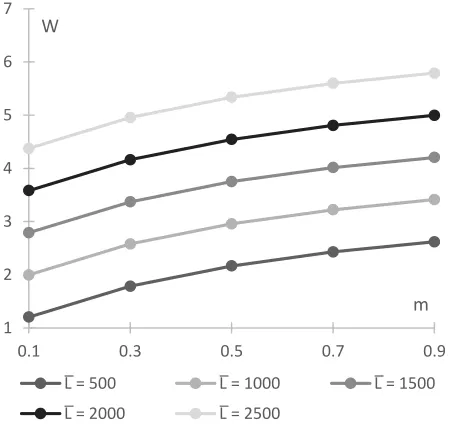
Fig. 9 and 10 display the effect of aspect ratio 𝑚 with respect to 𝐿̅ and 𝐵̅ . The behavior of 𝐿̅ and
𝐵̅ is same with 𝑚, barring the higher values of 𝐵̅.
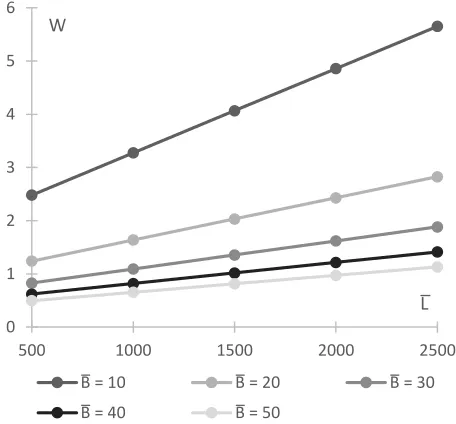
The variation of load carrying capacity with respect to 𝐿̅ and 𝐵̅ can be seen in Fig. 11. It is manifest that load carrying capacity increases with respect to 𝐿̅ while it lowers with respect to 𝐵̅.
Fig. 11. Variation of 𝑊 with respect to 𝐿̅ and 𝐵̅ .
The graphical pictures demonstrate clearly that under any circumstances the magnetic fluid lubrication helps in a good way to the positive effect of viscosity variation and vice a versa.
0 0.5 1 1.5 2 2.5 3
0.1 0.3 0.5 0.7 0.9
W
m
B̅ = 10 B̅ = 20 B̅ = 30
B̅ = 40 B̅ = 50
0 1 2 3 4 5 6
500 1000 1500 2000 2500
W
L̅
B̅ = 10 B̅ = 20 B̅ = 30
4. Conclusions
This study suggests that the ferrofluid lubrication improves the performance of bearing system and it remains responsible for an increased bearing’s life span. The viscosity variation may provide some measures to boost the performance of the short bearing further. Unlike the traditional lubrication the effect of ferrofluid lubrication allows the bearing system to sustain a good amount of load even in the absence of flow. The variation effect arising out of the magnetic strength and viscosity parameter remains more favorable for the improvement of the bearing performance, so far as Neuringer and Rosensweig’s model is concerned. Notably, this type of bearing system tends to support some load for almost all range of viscosity. If parameters are picked up suitably, then this type of bearing system may be helpful to the industry.
Acknowledgements
The authors acknowledge with regards the reviewers’ and editors’ comments and suggestions.
References
Agrawal VK (1986). Magnetic Fluid based porous inclined slider bearing, Wear, 107(2), 133-139.
Ahmad N, Singh JP (2007). Magnetic Fluid lubrication of porous-pivoted slider bearing with slip velocity, J. of Eng. Trib., 221, 609-613.
Basu SK, Sengupta SN, Ahuja BB (2005). Fundamentals of Tribology, Prentice-Hall of India Private Limited, New Delhi.
Bhat MV (2003). Lubrication with a Magnetic fluid, Team Spirit (India) Pvt. Ltd.
Deheri GM, Andharia PI, Patel RM (2005). Transversely rough slider bearings with squeeze film formed by a magnetic fluid, Int. J. of Applied Mechanics and Engineering, 10(1), 53-76. Deheri GM, Patel JR (2011). Magnetic fluid based squeeze film in a rough porous parallel plate
slider bearing, Annals-J. of Egg., 9(3), 443-463.
Lin JR (2001). Optimal design of one –dimensional porous slider bearing using the brinkman model, Tri. Int., 34(1), 57-64.
Naduvinamani NB, Kadadi AK (2013). Effect of Viscosity Variation on the Micropolar Fluid Squeeze Film Lubrication of a Short Journal Bearing, Advances in Tribology, 2013, Article ID 743987, 1-7.
Oladeinde MH, Akpobi JA (2010). A study of load capacity of finite slider bearings with slip surfaces and Stokesian couple stress fluids, Int. J. of Eng. Rea. Afri., 1(2), 57-66.
Patel JR, Deheri GM (2013). A comparison of porous structures on the performance of a magnetic fluid based rough short bearing, Trib. in Ind., 35(3), 177-189.
Patel JR, Deheri GM (2015). A comparison of different porous structures on the performance of a magnetic fluid based double porous layered rough slider bearing, Int. J. of Mate. Lifetime, 1(1), 29-39.
Patel JR, Deheri GM (2016). Performance of a Ferrofluid Based Rough Parallel Plate Slider Bearing: A Comparison of Three Magnetic Fluid Flow Models, Advances in Tribology, 2016, Article ID 8197160.
Patel JR, Deheri GM (2018). A comparison of Magnetic fluid flow models on the behavior of a ferrofluid squeeze film in curved rough porous circular plates considering slip velocity, Iranian Journal of science and Technology, Transactions A: Science, 42(4), 2053-2061. Patel JR, Deheri GM, Patel PA (2018). Ferrofluid lubrication of Journal bearing with thermal
Patel NS, Vakharia DP, Deheri GM, Patel HC (2017). Experimental performance analysis of ferrofluid based hydrodynamic journal bearing with different combination of materials, Wear, 376-377, 1877-1884.
Prajapati BL (1995). On Certain Theoretical Studies in Hydrodynamic and Electromagneto hydrodynamic Lubrication. Ph. D. Thesis, S.P. University, Vallabh Vidya- Nagar, Gujarat, India.
Rao RR, Prasad KR (2004). Effects of Velocity-slip and viscosity variation on Journal bearings, ANZIAM J, 46, 143-155.
Shah RC, Bhat MV (2003). Magnetic Fluid based porous inclined slider bearing with velocity slip, Int. Jour. of App. Mech. and Eng., 18(2), 331-336.
Siddangouda A, Biradar TV, Naduvinamani NB (2013). Combined effects of surface roughness and viscosity variation due to additives on long journal bearing, Tribology - Materials, Surfaces & Interfaces, 7(1), 21-35.
Sinha Prawal, Singh Chandan, Prasad KR (1981). Effect of viscosity variation due to lubricant additives in journal bearings, Wear, 66, 175 – 188.