~ 459 ~ WWJMRD 2017; 3(12): 459-465
www.wwjmrd.com International Journal Peer Reviewed Journal Refereed Journal Indexed Journal UGC Approved Journal Impact Factor MJIF: 4.25 e-ISSN: 2454-6615
Priti
M. Tech (CSE)
Department of Computer Science and Engineering GZS Campus College of Engineering & Technology, Bathinda, India
Jyoti Rani
Associate Professor Department of Computer Science and Engineering GZS Campus College of Engineering & Technology, Bathinda, India
Correspondence:
Priti
M. Tech (CSE)
Department of Computer Science and Engineering GZS Campus College of Engineering & Technology, Bathinda, India
Performance Enhancement of Multicast Routing
Protocols ODMRP-MPR and MAODV with Genetic
Technique for Mobile Ad-hoc Network
Priti,
Jyoti Rani
Abstract
MANET is mobile ad-hoc network works in the area of wireless. While performing the communication, because of lack of various types of infrastructural elements routers and switching components etc will be having various security and successful communication issues. Various protocols in the category of reactive and proactive lies in the area of multicast and unicast exist. Their performance in terms of energy and throughput can be checked and compared. So that better category such as throughput and energy efficiency of protocol can be selected. ODMRP-MRP protocol will be selected which will be efficient in terms of performance perspective. In current research two protocols falls in the category of MAODV and ODMRP. ODMRP shows the better performance. It has shown the throughput enhancement of 61%, and the energy efficiency of 37%. That means ODMRP is better in both the perspectives. Based on ODMRP the improvement by using genetic based technique ACO (Ant Colony Optimization) is done. The results of throughput and remaining energy have shown the improvement of 49.53% and 63.035% respectively.
Keywords: MAODV, ODMRP, MANET, ACO
1 Introduction
With the development of network technologies and new applications, multicast has become a significant networking service. In mobile ad-hoc networks, multicast communication also holds an important position. Such applications as disaster discovery, search and rescue, and automated battlefields are typical examples of where ad-hoc networks are deployed. A mobile ad-hoc network is a group of wireless mobile nodes which self-organize into a network in order to communicate. Such networks can operate without fixed infrastructure or configuration. Because the nodes are dynamically linked in freeways, the most prominent feature of ad-hoc networks is frequently changing and undetermined topology of the network besides their nature of broadcast. What’s more, the limited energy, low bandwidth and unreliable communication are vital factors affecting the performance. So routing protocols for wired network with little modification and adaptation don’t suit ad-hoc networks. There are many new concepts and novel ideas emerged for the new requirement. Due to their inherent broadcast capability, wireless ad-hoc networks are well suited for multicast. Multicast routing is always built on top of unicast routing infrastructure in wireline network, but in wireless ad-hoc networks it’s not the case. Many multicast routing protocols independent of unicast are even more efficient.
1.1 Manet Protocols
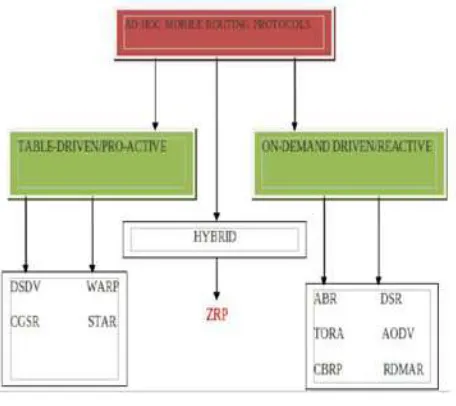
Mobile ad hoc network is a one class of wireless network consists of wireless mobile nodes which can communicate without any fixed base station. MANET is a multi-hop wireless network. Due to its fundamental characteristic like infrastructure-less, dynamic topology, self-manageable etc., we cannot uses those routing protocols in MANE which are used in the traditional wired networks. Ad hoc routing protocols are classified a follows shown in Figure 1.
~ 460 ~
1.1.1 Proactive Routing Protocol (ProRout)
As we all know ProRout is the more power full routing technique that was used in conventional Network (Ethernet). After some time this technique was successfully implemented for wireless ad hoc networks (MANET). In this technique each device maintains the information about their neighbor’s node in the table. Due to this, it is also called the table driven routing protocol. The information inside the table is updated on the periodic basis. In this technique each node exchanges the topology information with its neighbors. These periodic information exchanges consume lot of network resources like network band width, battery life of communicating devices. The proactive routing gives better performance in the case of stable (zero mobility) network as compared to mobile network. Most widely used table driven routing protocols are: DSDV, WRP, OLSR and STAR
1.1.2 Reactive Routing Protocol(ReRout)
Another approach that is used for route the packet form the source to destination is a ReRout also called on demand routing protocol. As its name on demand, it preserves and establishments the path when node actually sends the data instead of regularly maintain and update the information table about the all neighbor nodes. The major advantage of reactive routing over proactive routing is that it saves the network bandwidth and battery life of nodes. The disadvantage of this technique is that it is slower than table than proactive routing technique. Most widely used table driven routing protocols are: DSR, AODV, TORA, CBRP, RDMAR and ABR.
Fig.1:Protocols
1.1.3 Hybrid Routing Protocol (HyRout):
HyRout accede the advantage of both table driven and on demand driven routing protocols. The most powerful advantage of table driven routing is high speed and on demand driven is less overhead. HyRout inbuilt these features. HybRout protocols may exhibit table driven or on demand driven routing depending on the circumstance, hence allow flexibility based on the wireless network. Most widely used table driven routing protocols are: ZRP and ZHLS.
1.1.4 ACO (Ant Colony Optimization)
In the natural world, ants of some species (initially) wander randomly, and upon finding food return to their colony while laying down pheromone trails. If other ants find such a path, they are likely not to keep travelling at random, but instead to follow the trail, returning and reinforcing it if they eventually find. Over time, however, the pheromone trail starts to evaporate, thus reducing its attractive strength. The more time it takes for an ant to travel down the path and back again, the more time the pheromones have to evaporate. A short path, by comparison, gets marched over more frequently, and thus the pheromone density becomes higher on shorter paths than longer ones. Pheromone evaporation also has the advantage of avoiding the convergence to a locally optimal solution. If there were no evaporation at all, the paths chosen by the first ants would tend to be excessively attractive to the following ones. In that case, the exploration of the solution space would be constrained. The influence of pheromone evaporation in real ant systems is unclear, but it is very important in artificial systems. The overall result is that when one ant finds a good (i.e., short) path from the colony to a food source, other ants are more likely to follow that path, and positive feedback eventually leads to all the ants following a single path. The idea of the ant colony algorithm is to mimic this behavior with "simulated ants" walking around the graph representing the problem to solve.
Network Configuration
Network Size 800*500
Number of Nodes 50
Protocol TCP
Application CBR
Packet Size 512kb
Queue Length 50
Intermediate delay 1 sec.
Table 1
Above are the basic network configuration used while setting up the network. So that the network having successful communication amongst different nodes. These network configurations are used for setting up the network in NS2.
Performance Parameter
While setting the network for two protocols two performance parameters are being evaluated. These parameters are like.
a. Throughput.
b. Energy Dissipation
I. Throughput: it is the amount of packets sent
successfully per unit interval of time. Throughput= (Sent packets-Received packets)/(Total communication time)
II. Energy Dissipation: it is the amount of energy that
has been used while success full communication. And what the amount of energy left as residual energy at each node.
Research Algorithm
~ 461 ~
Step2 set the communication under fixed setting under both MAODV and ODMRP.
Step3 Identify the network simulation performance parameters under both the network settings.
Step4 compare the performance parameters for network under both the protocols.
Step5 Identify which protocol is better in terms of throughput and remaining energy.
Flowchart
Results and Discussions 7.1 Nam File for MAODV
Fig.2
This Figure 2 shows various nodes distributed randomly.
Source node identifies the intermediate node to arrive at the destination. While identifying the path from source to the destination various route requests are being sent. And multiple route replies will be received. Such that better path will be identified. This path will be minimum hop path.
7.2 Nam files for ODMRP-MPR
Fig.3
This figure 3 shows various nodes distributed randomly and identify the path from source to the destination. It is again based on identifying the path from source to the destination.
7.3 Throughput Comparison of MAODV and ODMRP
Graph 1
This graph 1 shows the throughput comparison of both MAODV and ODMRP. Clearly it is shown that the throughput of ODMRP shows better performance compared to MAODV.
7.4 Energy Comparison of MAODV and ODMRP
~ 462 ~ This graph of energy shows that the energy for ODMRP shows better performance compare to the MAODV. In case of ODMRP the energy diminish less compare to the MAODV.
7.5 Energy Comparison of ACO and ODMRP
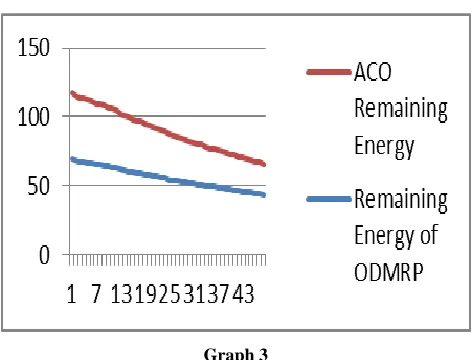
Graph 3
This graph of energy shows that the energy for ACO shows better performance compare to the ODMRP. In case of ACO the energy diminish less compare to the ODMRP.
7.6 Throughput Comparison of ACO and ODMRP
Graph 4
This graph shows the throughput comparison of both ACO and ODMRP. Clearly it is shown that the throughput of ACO shows better performance compared to MAODV.
7.7 Percentage improvement of Throughput
Throughput of MAODV 5200 Throughput of ODMRP 13366
Percentage improvement is 61%. That means throughput of ODMRP has shown the improvement of about 61% compare to MAODV.
7.8 Percentage Improvement of Energy Remaining
Table 3
Remaining Energy of MAODV 1664.1197 Remaining Energy of ODMRP 2672.1197
Percentage improvement is 37.72%. That means remaining Energy of ODMRP has shown the improvement of about 37% compare to MAODV.
7.9 Percentage improvement of Throughput
Table 4
Throughput of ACO 19988.36 Throughput of ODMRP 13366
Percentage improvement is 49.35 %. That means throughput of ACO has shown the improvement of about 49.35 % compare to ODMRP.
7.10 Percentage Improvement of Energy Remaining
Remaining Energy of ACO 1638.983 Remaining Energy of ODMRP 2672.1197
Table 5
Percentage improvement is 63.035%. That means remaining Energy of ACO has shown the improvement of about 63.035% compare to ODMRP.
Conclusion and Future Work
MANET is mobile ad-hoc network. Where various mobile nodes communicate to each other. They transfer the data amongst each other. For sending the data there requires to identify the path from source to destination. Different protocols behaves in different way for identifying the path. MAODV and ODMRP are two another improved techniques for identifying the path from source to the destination. For route each source node sends the route request and against route request multiple route replies will be received. Out of multiple route reply best or optimized route will be identified. In comparison of MAODV and ODMRP, ODMRP has shown marked improvement in two contexts like throughput and remaining energy. Throughput of ODMRP has shown the improvement of 61%. And remaining energy has shown the improvement of 37%. That means ODMRP behaves better compared to the MAODV. Based on ODMRP the improvement by using genetic based technique ACO (Ant Colony Optimization) is done. The results of throughput and remaining energy has shown the improvement of 49.53% and 63.035% resp.
References
1. Yao Zhao, Leiming Xu, Meilin Shi,” On-Demand
Multicast Routing Protocol with ultipoint Relay (ODMRP-MPR) in Mobile Ad-Hoc Network”,issue 4,vo. 4,234-40,2016
2. XingweiWanga, Dapeng Qub, Min Q1 Huangc, Keqin
Lid, Sajal K. Dase, Jinhong Zhangc, Ruiyun Yu,” Multiple many-to-many multicast routing scheme in green multi-granularity transport networks”,vol 4,issue 2 231-30,2015.
3. Hua Wang , Xiangxu Meng, Min Zhang, Yanlong Li,”
Tabu search algorithm for RP selection in PIM-SM multicast routing”, Computer Communications 33 35– 42,2010
4. Ying-Dar Lina,Nai-Bin Hsua, Ren-Hung Hwangb,”
~ 463 ~ 5. Jzau-Sheng Lin a,Mingshou Liu a, Nen-Fu Huang b,”
The shortest path computation in MOSPF protocol using an annealed Hopeld neural network with a new cooling schedule”, Information Sciences 129 17-30 ,2010.
6. Alex Hinds, Michael Ngulube, Shaoying Zhu, and
Hussain Al-Aqrabi,” A Review of Routing Protocols
for Mobile Ad-Hoc NETworks (MANET)”, Vol. 3, No.
1, February 2013.
7. R. Manoharan and E. Ilavarasan,” impact of mobility on the performance of multicast routing protocols in Manet”,vo. 2 no. 2 2010.
8. Maamar Sedrati , Azeddine Bilami and Mohamed
Benmohamed,” M-AODV: AODV variant to Improve Quality of Service in MANETs”, Vol. 8, Issue 1, January 2011.
9. Tanu Preet Singh Neha Vikrant Das,” MULTICAST
ROUTING PROTOCOLS IN MANETS”, Volume 2, Issue 1, January 2012.
10. Christian Esposito, Aniello Castiglione, Francesco Palmieri,” Layered multicast for reliable event notification over large-scale networks”,vo. 4,issue 4 1-18 2016.
11. Jerzy Dom_ zał a, Zbigniew Dulin ski b, Mirosław Kantor a, Jacek Rza˛sa a, Rafał Stankiewicz a, Krzysztof Wajda a, Robert Wójcik,” A survey on methods to provide multipath transmission in wired packet networks”, 77 (2015) 18–41.
12. Necla Bandirmali a,Ismail Erturk,” WSNSec: A
scalable data link layer security protocol for WSNs”,vol 3 issue 7 10 (2012) 37–45,2012.