Advances in Low Temperature Processing
Darshana C. Admane#1, Dr. Sneha V. Karadbhajne#2 1
Laxminarayan Institute of Technology, RTMNU, Nagpur 2Laxminarayan Institute of Technology, RTMNU, Nagpur Abstract --- Food is preserved by various methods such
as high temperature processing (heating, blanching), low temperature processing (freezing) or by using chemicals. This paper reviews about novel technologies applied to low temperature freezing process like pulsed electric field treatment, high pressure processing, ultra sound freezing, ultra rapid freezing and pressure shift freezing. Low temperature freezing changes water (present in food) into ice in the number of crystals. Due to applied pressure, electric current and voltage small ice crystals are formed which are uniformly distributed to whole food. Hence, foods shelf life increases. Colour, texture, structure, taste, appearance and quality attributes are better preserved in freezing. Low temperature processing offers several advantages such as preservation of color, flavor, texture, appearance and volatile retention, modification of sensory qualities and inhibition of bacterial growth. Novel technologies applied to thawing like high voltage electric field thawing, radio frequency thawing and ultra sound assisted thawing have also explained. Thawing is process of conversion of frozen ice into liquid i.e. frozen ice crystals into water. Heat is supplied to frozen food which converts frozen food into unfrozen. Hence, these novel technologies have become beneficial in terms of preserving food and quality attributes & sensory characteristics.
Keywords — Pulsed electric field treatment, high pressure processing, ultra sound freezing, ultra rapid freezing, pressure shift freezing, high voltage electric fieldthawing, radio frequency thawing and ultra sound assisted thawing.
I. INTRODUCTION
Spoilage occurs due to chemical, biological, physical and enzymatic activities in the food that cause rancidity/poisoning. Due to which, food industries commenced use of preservatives such as salt, sugar, vinegar, benzoates, nitrites, sulphites and sorbates which is the easiest, simplest and commonly used methods for food preservation [Z.I.M. Sharif et al., 2017]. Another techniques for preservation [Z.I.M. Sharif et al., 2017] such as heating, drying, pickling, smoking, freezing, edible coating or high pressure processing [Navin k. Rastogi, 2013] have also been
practiced to preserve food. These preservation techniques increases foods shelf life, maintain its nutritive value, stabilizes quality and preserve taste, colour & flavour [Z.I.M. Sharif et al., 2017].
Freezing is the widely used and common technique of preservation which not only maintains its nutritive value but also retains its sensory attributes [Xinfeng Cheng et al., 2015, Xiao-fei wu et Al., 2016]. Previously freezing was practiced in meat, fish, fruits and vegetables, and other animal industry [S. Oranusi et al., 2014]. In the recent times, low temperature process or freezing has become the main technique of preservation to maintain the characteristics of frozen foods in industry [Lina Cheng et al., 2015]. Since freezing is not a perfect technique of preservation as deterioration may occur due to development of random ice crystals. Large size of crystals leads to loss in protein content, lipid oxidation, and loss of moisture, texture, colour and tenderness [Arpassorn Sirijariyawat et al., 2012].
Micro organisms during freezing are not killed. Their activity gets diminish. [Z.I.M. Sharif et al., 2017]. Freezing preserves the food by inhibiting the growth of microorganism or by halting their enzymatic activity [Paul Dawson et al., 2018]. In freezing, pathogens needs water to grow that turns into ice crystals which inhibits their activity so they don’t get multiply [S. Oranusi et al., 2014].
Freezing makes the food of better quality by maximizing its shelf life. Some methods like air freezing, cryogenic freezing, immersion freezing and their advanced collaboration are widely used in the frozen food or freezing industry to obtain superlative
freezing rate for products [Bing Li et al., 2002].
Freezing offers some significant advantages like preservation of color, flavor, texture, appearance, volatile retention, modification of sensory qualities, inhibition of bacterial growth specially in sensitive plant tissues such as leaves (which are complicated to protect against freezing injuries) [Katarzyna Dymek et al., 2015]. Freezing also destroy some quality like colour, texture, water holding capacity, effects on crystal growth formation (intracellular or extracellular) [ Paul Dawson et al., 2018].
Different freezing methods have different freezing rate. Conventional methods such as air blast freezing, immersion freezing and contact freezing have slow freezing rate and produce large ice crystals whereas novel technology like high pressure freezing [Lebail et al., 2002], ultra sound freezing [Peizhi Zhang et al., 2018], ultra rapid freezing [Alan Trounson et al., 1987] produces small and uniformly distributed ice crystals [Peizhi Zhang et al., 2018].
Food freezers are used in freezing process; it is depend on air-blast system technology where cold air of fluid of temperature -40 degree Celsius to -20 degree Celsius was used. It is used to lower the food temperature until the temperature of internal part of food is reduced to -18 degree Celsius. Cold air fluid flows with velocity ranges from 1m/s to 6m/s depending upon foods size, shape and kind of product [Alessandro Bigliaa et al., 2016].
Some physical, chemical and biochemical processes take place during freezing process, food storage and thawing which is the topic of concern to manufacturers, producers and consumers [Quang et al., 2018]. Therefore novel technologies in freezing and thawing has been studied as the long-term preservation
of the food which maintains natural attributes and quality thereby forming a globally technique in frozen food industry [Xiao-Fei Wu et al., 2016]
II. Novel Technology To Freezing Treatment
A. Pulsed Electric Feild Treatement
Pulsed electric field treatment generates high-voltage intense electric pulse in food which is placed between two conductive electrodes for a short interval of time. The high voltage electric pulse develops mass transfer which affects the permeability of cell membranes. Due to tissue permeability the accessibility of internal materials increases. [Xiao-Fei Wu et al., 2016].
Pulsed electric field treatment is widely applied in the food industry to improve the extraction efficacy of valuable compounds. It is used to accelerate drying and to inactivate microorganisms by providing high voltage electric pulses. Pulsed electric field treatment improves the extraction efficiency of compounds from fruits and vegetables [Xiao-Fei Wu et al., 2016].
High intensity field strength in pulsed electric field treatment is used to inactivate the microorganisms in food whereas low field intensity field strength is used for the improvement of extraction yield [Federico Gomez Galindo et al., 2008]. High voltage (pulsed electric field treatment) can cause damages to cell, membranes and tissues. High voltage can also induce some stress in cell membranes and produce electrophoretic movement in food cells [Federico Gomez Galindo et al., 2008]. The freezing rate increases and freezing time decreases with the permeability of cell [Xiao-Fei Wu et al., 2016].
Katarzyna Dymek et al., 2015 investigate the spinach leaves under pulsed electric field and vacuum impregnation with cryopectants (trehalose, mannitol, sucrose & glucose). The effect of pulsed electric field (PEF) on freezing temperature of leaves and propagation of ice was studied. However, leaves subjected to pulse electric field have high freezing temperature than other leaves while ice propagation in leaves was not influenced by pulse electric field treatment.
Pulsed electric field treated Potato tissues were studied by the Federico Gomez Galindo et al., 2008. These potato tissues were subjected to 30-500v/cm field strength. Some metabolic responses, changes in electrical resistance and impedance responses were also measured.
Shima Shayanfar, 2013 studied frozen potato strips that was treated to PEF treatment and assisted by CaCl2 and trehalose treatment to prevent softening after defrosting.
B. High Pressure Freezing
High pressure freezing (HP) is an advance technology in food processing from 10 years [Lebail et
al., 2002]. Frozen foods are of high grade quality, high nutritive values and sensory factors. To maintain foods quality freezing, pre-freezing preparations and post-freezing storage treatment should be carefully done [R.M. Georg et al., 1993].
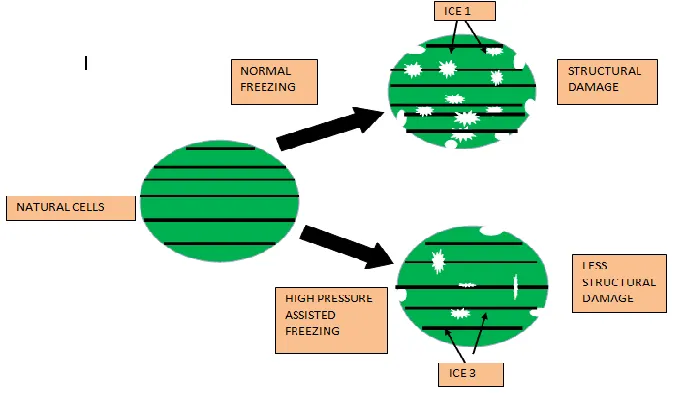
The aim of high pressure is to change the hydrophobic and electrostatic reactions in structures of protein [Roumalt Cherrat et al., 2015]. When food is placed under high pressure, temperature of water present in food gets reduced [below 0 degree Celsius]. Food undergoes uniform & equal distribution of pressure irrespective of size and geometry. It is effective at all temperatures, with no or less structure damage with no use of chemicals (fig 2,3) [Navin K. Rastogi, 2013]. It is low cost process with less process time which gives high retention of colour, texture, appearance, flavour and high nutritive value [Navin K. Rastogi, 2013]. When pressure is released, low temperature develops small sized ice crystals which are distributed throughout the food sample uniformly [Lina Cheng et al., 2015]. When water is freezed at high pressure large number of heavy random ices is formed [Michiko Fuchigami et al., 1998] results in histological damage to tissues and excessive softening occurs.
Fig 2: Schematic representation of high pressure processing
When products are subjected to pressure from 100 M pa to 1000 M pa [Roumalt Cherrat et al., 2015] water goes through different formations of ice (type 1 to type 6) at different pressure and different temperatures. Crystallization of ice occurs with low temperature. Ice density, volume and stability also vary with the type of ice. During freezing, volume of water and ice density changes with the formation of ice. Ice
no of ice crystals formed e.g. type ice 3 has smaller size than type 1 ice. At atmospheric pressure type ice 4 becomes unstable and gets converted to type ice 1 after
some time. When the temperature and pressure are under control ice type 1 and ice type 5 are obtained (fig 3) [Xiao-Fei Wu et al., 2015].
Fig 3: Phase diagram of high pressure freezing [Xiao-Fei Wu et al., 2015]
High pressure freezing not only inhibit the growth of microorganism but also extends foods shelf life for prolonged period of time with complete retention of nutritive values and its organoleptic characteristics [Roumalt Cherrat et al., 2015].
For cryoimmobilisation of native food sample like animal tissues, plant tissues and microorganisms, it is only possible by high pressure freezing which preserves ultra structure [Daniel Studer et al., 1992].
Romuald Cherret et al., 2015 studied the effect of high-pressure treatment in which sea bass fillets are treated with 500 MPa for 5 min after refrigeration storage of 0, 7 and 14 days to study the physical characteristics of sea bass fillets. Quality of the sea bass fillets were improved by the high-pressure treatment that preserves the microstructure of sea bass with increases in its shelf life. Romuald Cherret et al., 2015 also reported sea bass fillets under different pressure. At 200 MPa exudation decreases with water holding capacity which increases the net weight yield after storage. At pressure above 300 MPa fillet gets hard with improved quality for consumers who rejects soft fish. Roumalt Cherrat et al., 2015 also studied on high pressure processing for microbial decontamination and concluded that complete microbial inactivation is not possible.
Muchiko Fuchigami et al., 1997 observed the effect of high-pressure-freezing on kinu-tofu (soybean
curd) and its quality. Kinu tofu was frozen at 100 MPa ( ice 1), 200 MPa (liquid phase), 340 MPa (ice 3), 400, 500, 600 MPa (ice 5) or 700 MPa (ice 6) at -20 degree C for 90 minutes. Muchiko Fuchigami et al., 1997 concluded that textural and structure properties of tofu frozen at 200 M Pa, 340 MPa and 400 MPa were better preserved than other samples of tofu. When the pressure was reduced to atmospheric pressure, tofu was stored under 2 days at -30 degree C and thawed at 20 degree C. Comparison was made between kinu frozen tofu and stored tofu. Rupture stress and strain of frozen tofu at 0.1 MPa and 100 MPa increases. The formation of ice crystals was also studied. Ice crystals in frozen tofu at 200 MPa and 400 MPa was smaller than frozen tofu at 100 MPa or 700 MPa was determined.
Cabbage under high pressure with low temperature of -20 degree C was studied by Michiko Fuchigami et al., 1998. He investigates the difference in texture, pectin production, damages and structure of Chinese cabbage. Cabbage was freeze at 100 MPa (ice 1 formed) and at 700 MPa (ice 6). However, texture of samples frozen at 200 MPa (liquid), 340 MPa (ice 3), 400 MPa was compared. He conclude that pectin production and damages in middle part of frozen cabbages at 200 and 340 MPa were less than midribs frozen at 100 and 700 MPa. Texture and structure was preserved at -30 degree C at atmospheric pressure.
structure in samples using live cells for the preparation of specimen for electron microscopy.
Daniel Studer et al., 1992 observed nodules of soybean under high-pressure freezing which was chemically treated with buffered glutaraldehyde in contrast to chemical fixation and pre-fixation. This results in the preservation of ultra structure of soybean nodules close to the native state.
C. Ultra Rapid Freezing
In ultra rapid freezing, foods are frozen below -25 degree Celsius and are stored under -18 degree C.
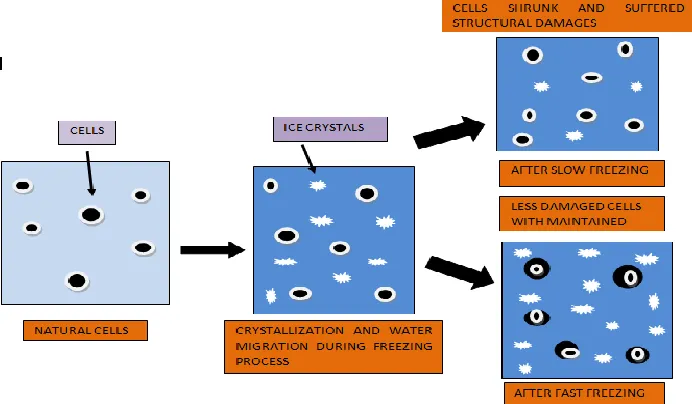
Foods are rapidly frozen at high freezing rates of 10 cm/h where uniform distributions of smaller ice crystals were produced. Hence preserves flavour, colour and texture of food. Due to production of numerous small ice crystals, cellular structure and cell integrity was better preserved with fewer damages (fig 4). For this reason, used of ultra rapidly freezing technology has been increased rapidly by the food industries [Xiao-Wei Wu et al., 2016]. Ultra rapid freezing methods offers several advantages like rapid freezing of sample, production of large amount of nuclei, development of uniformly distributed ice crystals. These advantages maintain the quality of frozen food products [Xiao-Fei Wu et al., 2016].
Fig 4: Schematic representation of ultra rapid freezing
Effects of Air blast freezing and cryogenic freezing was studied by Sirintra Boonsumrej et al., 2007 on tiger shrimp. Tiger shrimp was thawed by
microwave and refrigeration and changes in
thiobarbituric acid [TBA], %freezing loss [%FL], %thawing loss [%TL] and cutting force [CF], salt-soluble protein [SSP] of tiger shrimp was studied.
Ultra rapid freezing method was used to preserved human multi pronuclear (PN) zygotes. After processing and thawing of zygotes high cleavage rate of 88.7 % and survival rate of 85.5 % was obtained by See-Pill Park et al. 2000.
In Cryopreservation of embryos, 2 cell embryos were frozen by ultra rapid freezing technique under different conditions to measure their survival and viability. Alan Trounson et al., 1987 concluded that surviving embryos are better preserved with little damages to intracellular cells and membranes.
D. Ultra Sound Freezing
Ultra sound freezing process is an advanced and promising technology in food industry [Xinfeng Cheng et al., 2016]. It consists of sound waves that are obtained from molecular movements of atoms that oscillate in medium [Monica Gallo et al., 2018]. The waves generated by ultrasound are of high frequency nearby 20 KHz which are not perceived by human ear [Monica Gallo et al., 2018]. This applied ultra sound range is divided into two forms of waves that is low intensity and high intensity waves. This wave controls the crystallization process [Bing Li et al., 2002]. Low intensity fluctuates between 5-10 MHz and high intensity ranges between 20-100KHz. [Monica Gallo, 2018] [Xinfeng Cheng et al., 2015].
structure of food [Bing Li et. al, 2002]. Technique of ultra sound preserves and maintains the food microstructure due to the formation of nuclei of controlled size and its uniform distribution during freezing [Peizhi Zhan et al., 2018]. Power ultrasound has various benefits like it reduce some adverse effects during freezing, improves heat and mass transfer process and reduces freezing time [Peizhi Zhang et al., 2018].
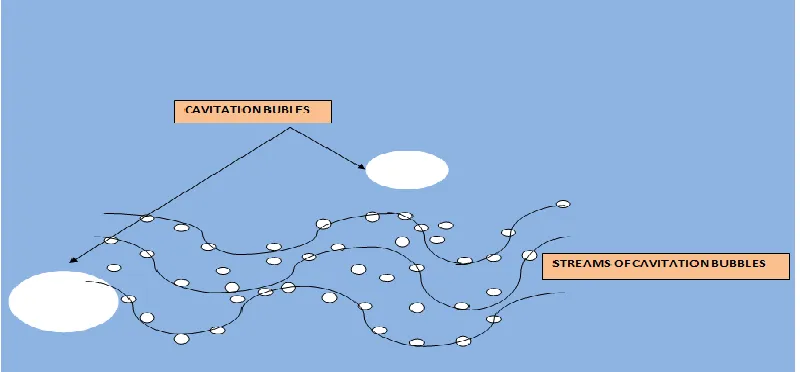
During ultra sound freezing, acoustic
cavitations occurs which consist large number of small
liquid bubbles. High pressure is generated due to collapsing activity of cavitations’ bubble (fig 5). High pressure enhanced the nucleation process by raising the equilibrium freezing temperature. Cavitations bubble acts as nuclei in the growth of crystal. Nuclei are broken down into fragments or smaller crystals [Bing Li et al., 2002]. Ultra sound cavitation strengthens the nucleation process, crystal growth and transportation process of ice crystals along solid liquid boundaries [N. S. Deora et Al., 2013; Xiao-Fei Wu et al., 2016].
Fig 5: Schematic representation of ultrasound cavitations process
Nucleation process is composed of two pathways that are primary nucleation and secondary nucleation [Yang Taoa et al., 2015]. Both the nucleation process of ice is raised by power ultra sound as it increases the nucleation temperature. The cavitation bubbles are only responsible for the formation of nuclei [A. Mortazavi et al., 2008]. Primary nucleation is the formation of crystals in a solution without existence of ice crystals in solution whereas secondary nucleation is the formation of crystals in the solution with crystals [Yang Taoa, 2015].
Ultra sound freezing produce some physical and chemical changes in the medium and these changes improves the efficiency of food freezing operations [Xinfeng Cheng et al., 2015]. Ultra sound makes freezing process more active by increasing the heat transfer rate, mass transfer rate and uniform distribution of ice crystal [Yang Taoa et al., 2015]. The Freezing time and degree of freezing can be determined by using ultrasound freezing process [Xiao-fei Wu et al., 2016].
Xinfeng Cheng et al, 2015 discuss the recent development techniques related to the low temperature ultrasound process, ultrasound freezing & thawing, freeze concentration and freeze drying. Xinfeng Cheng et al., 2015 also discussed the quality of frozen product. Applications of low intensity ultrasound freezing
process have also discussed to increase the efficiency of freezing process.
Peizhi Zhang et al., 2018 reviewed on ultrasound technique to accelerate the freezing process in solid food, liquid food, fruits and vegetables. Ultrasound technique preserves microstructure and improves the freezing rate by increasing the heat transfer and mass transfer efficiency.
Potato samples were freezed by immersion with the power ultra sound. Effects of freezing rate on potato samples were studied by Bing Li et al., 2002. Agitation was produced by Ultrasonic cavitations which improves the rate of heat transfer in potato samples. Ultrasonic power, exposure time and the freezing phase are determined. Bing Li et al., 2002 reported that freezing rate was high when 15.85 W of ultrasound power was applied for two minutes and phase change was significantly increased by 0.05.
E. Pressure Shift Freezing
Water is at liquid state when pressure of 210 MPa was applied at -22 degree C. Uniform, crystals and nuclei are formed when high pressure is applied. Water is maintained to temperature above its freezing point at same pressure. Suddenly pressure is released results in super cooling and this process is known as
pressure shift freeing (PSF). PSF gives instantaneous and uniform distribution of crystals in sample which produces large number of small crystals which preserves the structure of food components [V. Tironi et al., 2007, Dominique Chevalier et al., 2000]. Super cooling in the food is only achieved by Pressure shift freezing (PSF) [D. Chevalier et al., 2000].
During ultrasound freezing, salt bonds are broken down with hydrophobic interactions, while hydrogen bonds become stronger than before due to
pressure applied. Covalent bonds are insensitive to pressure.
Some adverse effects on proteins are observed due to high pressure such as dissociation of oligomeric structures, unfolding, denaturation and aggregation [V. Tironi et al., 2007].
Pressure shift freezing (PSF) offers advantages like higher crystallization rates (than conventional freezing) [H. Koch et al., 1996], smaller thawing time and drip loss and demolition of microorganism present in the sample [V. Tironi et al., 2007]. Some adverse effects due to high pressure like change in color, texture and conformational changes in protein are also seen [V. Tironi et al., 2007].
Effects of shift freezing and pressure-assisted thawing were observed on sea bass muscle. Pressure of 200 MPa was applied to sea bass muscle that results in denaturation of protein, insolubilization of the myosin and alterations of the sarcoplasmic proteins [V. Tironi et al., 2007].
Dominique Chevalier et al., 2000 explained the effect of pressure shift freezing on turbot. Pressure of 140 MPa at -14 degree C was applied to turbot to study the properties in terms of biochemical and physical changes. Properties like protein stability, texture, TBA number, free fatty acid content and color were determined. Extraction of salt soluble proteins was observed after pressure shift freezing. Toughness was also compared between frozen and non frozen samples. Conclusion was made that toughness was better increased in pressure-shift freezing (PSF) than other methods except air blast freezing.
Byeongsoo Kim et al., 2014 studied the effects of gelatin, its concentration, freezing temperatures and methods to investigate the structural and physical properties of gelatin matrices. Pressure of 0.1, 50 and 100 MPa was applied at -40 degree C.
So, the results were made that pressure-shift freezing (PSF) produces small ice crystals at low freezing temperatures at -50 degree C.
Comparison was made between high pressure freezing and high pressure assisted freezing by P.P. Fernandez et al., 2006 to study the effects of microstructure of Gelatin gel samples. Pressure, temperatures and ice distribution was varied to characterize the process. As soon as the pressure is released sample gets super cooled all over which proves pressure-shift freezing is superior than high pressure assisted freezing.
Again a comparison was made by D. Chevalier et al., 2000 between pressure shift freezing with air-blast freezing of Norway lobster and pressurized samples at 200MPa to study the effect on the quality, texture, structure water and salt soluble protein extractabilities. Results showed that PSF produces small ice crystal than air blast freezing. PSF also preserves microstructure better than other conventional methods. Pressurized lobster with PSF has higher toughness with less soluble protein extractability.
After thawing effects of drip loss, texture, color, drying behavior, rehydration properties and cell damages on potato cubes was studied by H. Koch et al., 1996. Temperature changes during pressure shift freezing was also studied and compared with conventional freezing. Potato tubes under high pressure freezing shows better crystallization rates, uniform formation of small ice crystals than conventional
freezing. Cell structure, color, re-constitutional
properties and quality texture was also better preserved by high pressure shift freezing.
III. Novel Technologies In Thawing Process
A. HVEF Thawing
Thawing is the process of conversion of frozen food to unfrozen. During low temperature freezing process heat is supplied to frozen food to melt the ice formed [Michaela Archer et al., 2008].
Thawing time is the time taken by ice crystals in frozen food to get back to water completely. During thawing, foods undergo physical and chemical damages due to action of micro-organisms which remains on the surface of food [Chang-Wei Hsieh et. al, 2010]. This makes thawing as a concern topic for many researchers.
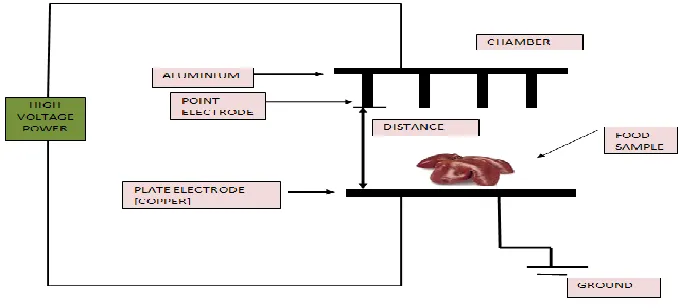
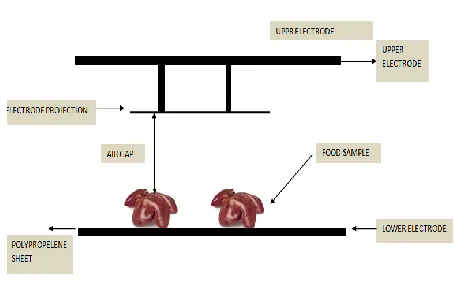
[Changjiang Ding et al., 2018]. AC or DC high voltages are used in HVEF freezing process with multipoint and plate electrode systems. High power voltages are used to accelerate the thawing process in frozen food [Changjiang Ding et. al, 2018]. During HVEF thawing process, high voltage produces corona winds. This winds causes turbulence and
vortices which accelerate the heat and mass transfer process hence, thawing rate increases [Xiao-fei wu et. al, 2016].
Xiao-Fei Wu et al., 2016 observed that thawing rate depends on voltage, distance between needles placed and electrode spacing of 6 cm (fig 6). As the voltage increases, the thawing time decreases.
High-voltage electric field thawing has several advantages like less thawing time is required, quality is maintained, restricted microbial growth and low energy consumption when compared to other thawing methods [Changjiang Ding et al., 2018].
Some disadvantages such as meat discoloration, decreasing in weight of foodstuff, oxidation of lipids due to high thawing time are observed in thawing [Changjiang Ding et al., 2018].
Changjiang Ding et al., 2018 considered the frozen tofu as a research sample to investigate the
influence of different voltages and electrode
configuration. When the inner part of tofu’s temperature was kept at -2 degree C to 0 degree C then thawing loss was observed. Thawing time, temperature at the centre and thawing rate was also measured. HVEF treatment in frozen tofu improves the thawing rate and reduces the thawing time.
Effects of high voltage electrostatic field (HVEF) thawing process on chicken thigh meat was studied by Chang-Wei Hsieh et al., 2010. Chicken thigh meat was treated under high voltage electric field and was compared to frozen food stored under refrigerator. Comparison was made between them to study the effects of HVEF on chicken thigh meat. Results were obtained that HVEF thawing shortens the thawing time at -3 degree C as there were no changes observed in biochemical properties.
Different voltages of alternating current (AC) were treated on frozen tofu and characteristics of the high-voltage thawing were studied by Shilongdeng et al., 2017. The thawing time, thawing loss, specific energy consumption was also measured. Conclusion was marked that thawing rate increases with voltage in frozen tofu.
Alireza Mousakhani- Ganjeh et al., 2015 studied the changes like colour, TBA values of fish tuna. Fish was thawed under high voltage electrostatic field (HVEF). Three different voltages with electrode gaps of 3, 4.5, and 6 cm at 20 degree C were subjected to tuna fish. Sample was compared with the control samples. Conclusion came to that HVEF thawing improves the thawing rate and total volatile nitrogen binding of fish tuna. But quality of texture, colour, and protein solubility decreases due to HVEF thawing. Increase in voltage in HVEF decreases the protein solubility, hardness, cohesiveness, chewiness and gumminess.
B. Radio Frequency Thawing
Freezing and thawing are two food processes and are opposite to each other. Freezing is main unit operation in preservation. Before consumption of food, food must be thawed (example: frozen food). Minimum thawing time is required to obtain less damage to food and its quality [Rahmi Uyar et al., 2015]. To prevent such damages radio frequency thawing has been taken into consideration. Thawing time in radiofrequency depends on some factors like uniformity of sample blocks and dielectric point [Ammar Altemim et al., 2009]. But loss in moisture, changes in the structure of proteins, growth of microorganisms and changes in texture of sample can be affected by radiofrequency thawing process [Rahmi Uyar et al., 2015].
During thawing process by radio frequency, system produce heat in sample by ionic displacement and dipole rotation. Heat is generated in food of Frequency ranges from 1- 300 MHz which converts electrical energy to electromagnetic radiation (fig 7)
[Xiao-Fei Wu et al., 2016].
Fig 7: Schematic representation of radio frequency freezing
Comparison was made between radio
frequency thawing and air thawing on the properties of water holding capacity in the lean meat beef. RF
resulted in decrease of drip loss by P < 0.05 when compared to air thawing. Micronutrient losses were also observed in frozen samples by K.W. Farag et al., 2009.
Rahmi Uyar et al., 2015 studied the radio frequency thawing of lean beef. Radiofrequency thawing minimize the thawing time with least damage to structure of food. A computational model was prepared by Rahmi Uyar et al., 2015 with free running oscillator RF system. Potential Distribution was also determined in the lean beef. Comparison was made between RF thawing and conventional air thawing.
Radio frequency process was applied by S.
Wanga et al., 2010 on Chickpea (Cicer arietinum),
green pea (Pisum sativum), and lentil (Lens culinaris) with 27 MHz and 6 KW RF unit to investigate the quality attributes.
Cathcart et al., 1947 described the advantages of radiofrequency thawing process. Quality is maintained, less discoloration and negligible loss of flavor in frozen eggs, fruits and vegetables was observed when they were thawed at 14-17 MHz.
C. Ultra sound assisted thawing
Thawing is practiced before cooking or consumption. Freezing maintains the quality of food whereas food are more affected by thawing as it
requires more time [Xin-feng Cheng et al.,2014].
Moreover proper thawing should be done to minimize the losses
Ultrasound assisted thawing requires less thawing time compared to immersion thawing. Ultrasound thawing at 900 W powers shows best thawing on retention of ascorbic acid, chlorophyll, hardness. Ultrasound also minimizes the drip loss activity. Xin-feng Cheng et al., 2014 studied the effects
of freezing and thawing methods on the
physicochemical indices and nutritive value of edamame. Thawing times was reduced [P < 0.05]
compared to water immersion thawing. Poor
Fig 8: Schematic representation of ultra sound assisted freezing
IV. TABLE NO 1
TYPES OF FOOD SAMPLE TREATED WITH LOW TEMPERATURE FREEZING AND THAWING. SR
NO
NOVEL
TECHNOLOGIES
FOOD WORK DONE REFERENCES
1) Pulsed electric field
treatment
Spinach leaves Ice propagation were studied Katarzyna Dymek et al.,
2015
Potato tissues Prevent softening after defrosting
Quality of sensitive tissues were
preserved
Federico Gómez Galindo et al., 2008
Frozen potato strips Prevents softening Shima Shyanfar et al.,
2013
2) High pressure freezing Sea bass filletes Quality of sea bass fillet is improved
Preserves the microstructure
Romuald Cherret et al., 2005
Kinu tofu Texture and structure of tofu frozen
at 200 Mpa, 340 Mpa and 400 Mpa were better preserved
Muchiko Fuchigami et al., 1997
Cabbage Pectin production and damages were
studied
Texture and structure was preserved
at -30 degree c
Michiko Fuchigami et al., 1998
Live cells Ultra structure was preserved Mc Donald et al., 2009
Nodules of soyabean
Ultra structure was preserve close to
the native state
Daniel Studer et al., 1992
3) Ultra rapid freezing Tiger shrimp Effects of TBA, SSP, % freezing
loss, %TL, CF was studied
Sirintra Boonsumrej et al., 2007
Human zygotes Cleavage and survival rate was
determined
See-Pill Park et al. 2000.
Embryos Embryos were preserved Alan Trounson et al., 1987
4) Ultra sound freezing Frozen foods. Quality was improved Xinfeng Cheng et al., 2015
food, fruits and vegetables
Increase in freezing rate
Potato samples Increase in freezing rate Bing Li et al., 2002
In ice cream Sensory characteristics such as
flavor, texture, color and mouth feel were studied.
A. Mortazavi et al., 2008
5) Pressure-shift freezing Sea bass muscle Denaturation of protein V. Tironi et al., 2007
Turbot Biochemical and physical changes
were studied
Dominique Chevalier et al., 2000
Gelatin matrices Produces small sized ice crystals at
low freezing temperatures of -50 degree c
Byeongsoo Kim et al., 2014
Gelatin gel samples Comparison was made between high
pressure freezing and high pressure assisted freezing
P.P. Fernandez et al., 2006
Lobster Studied the effects on the quality,
texture, water’s structure of sample
and its salt soluble protein
extractabilities
D. Chevalier et al.,2000
Potato tubes Temperature changes were studied
Better crystallization rates,
formation of small ice crystals
H. Koch et al., 1996
6) HVEF thawing Frozen tofu Thawing loss was observed
Increase in thawing rate
Reduction in thawing time
Chang-Wei Hsieh et al., 2010
Chicken thigh meat Shortens the thawing time at -3
degree C
Chang-Wei Hsieh et al., 2010
Frozen tofu Thawing rate was increased with
voltages
Shilongdeng et al., 2017
Fish tuna Improves the thawing rate and total
volatile nitrogen
Alireza mousakhani- Ganjeh e. al., 2015
7) Radio frequency thawing Lea beef Minimize the thawing time with
least damage to structure
Rahmi Uyar et al., 2015
Chickpea Investigate the quality attributes S. Wanga et al., 2010
Beef meat Better quality was observed. Tesfaye F. Bedane et al.,
2017
8) Ultra sound assisted
thawing
edamame Physicochemical indices and
nutritive value was studied
Xin-feng Cheng et al., 2014
V. CONCLUSION
This paper has been successfully reviewed on novel technologies applied to freezing process and thawing process which are used in food industry. Due to low temperature process some effects are observed in the food that reduces foods quality such as change in colour, loose microstructure, decrease in nutritive value etc. Hence these negative effects are reduced by novel technologies reviewed in this paper. Pulsed electric field freezing, high pressure freezing, ultra rapid freezing, ultra sound freezing and pressure shift
REFERENCES
[1] K.W. Farag, E. Duggan, D.J. Morgan, D.A. Cronin, J.G. Lyng, ―A comparison of conventional and radio frequency defrosting of lean beef meats: Effects on water binding characteristics‖, Meat Science 83 , 278–284, May 2009. [2] Ammar Altemimi, Salah Naji Aziz, Asaad R. S. Al-HiIphy,
Naoufal Lakhssassi, Dennis G. Watson and Salam A. Ibrahim, ―Critical review of radio-frequency (RF) heating applications in food processing‖, Food Quality and Safety, XX, 1–11, March 2019.
[3] S. Wanga, G. Tiwari , S. Jiao , J.A. Johnson , J. Tang, ―Developing postharvest disinfestations treatments for legumes using radio frequency energy‖, biosystems eng ineering 105, 341– 349, Sept. 2010.
[4] Byeongsoo Kim, Hyung Bae Gil, Sang-Gi Min, Si-Kyung Lee1, and Mi-Jung Choi, ―Effects of Pressure-shift Freezing on the Structural and Physical Properties of Gelatin Hydrogel Matrices‖, Korean J. Food Sci. An. Vol. 34, No. 1, pp. 33~39, Jan 2014.
[5] H. Koch, I. Seyderhelm, P. Wille, M. T. Kalichevsky and D. Knorr, ―Pressure-shift freezing and its influence on texture, colour, microstructure and rehydration behaviour of potato cubes‖, Nr. 2, S. 125- 131 0 VCH Verlagsgesellschaft mbH, D-69451 Weinheim, Jan 1996.
[6] Dominique Chevalier, Amaral Sequeira-Munoz, Alain Le Bail*, Benjamin K. Simpson and Mohamed Ghoul, ―Effect of Pressure Shift Freezing, Air-blast Freezing and Storage on Some Biochemical and Physical Properties of Turbot (Scophthalmus maximus)‖, Lebensm.-Wiss. u.-Technol., 33, 570-577, Oct. 2000.
[7] Mousakhani-Ganjeh, A., Hamdami, N., and Soltanizadeh, N., ―Impact of high voltage electric field thawing on the quality of frozen tuna fish (Thunnusalbacares)‖, J. Food Eng. 156:39–44.
[8] Shayanfar, S., Chauhan, O., Toepfl, S., and Heinz, V., ―Pulsed electric field treatment prior to freezing carrot discs significantly maintains their initial quality parameters after thawing‖, Int. J. Food Sci. Technol. 49(4):1224–1230,2014 [9] Xiao-Fei Wu, Min Zhang, Benu Adhikari & Jincai Sun, ―Recent developments in novel freezing and thawing technologies applied to foods‖, Critical reviews in food science and nutrition 2017, VOL. 57, NO. 17, 3620– 3631,2016
[10] Federico Gómez Galindo & Lars Wadsö & António Vicente & Petr Dejmek, ―Exploring Metabolic Responses of Potato Tissue Induced by Electric Pulses‖, Food Biophysics, 3:352–360, June 2008.
[11] Shima Shayanfar,1,2* OP Chauhan,3 Stefan Toepfl1 & Volker Heinz, ―Pulsed electric field treatment prior to freezing carrot discs significantly maintains their initial quality parameters after thawing‖, International Journal of Food Science and Technology, 49, 1224–1230, oct. 2014. [12] Arpassorn Sirijariyawat and Sanguansri Charoenrein,
―Freezing characteristics and texture variation after freezing and thawing of four fruit types‖, Songklanakarin J. Sci. Technol. 34 (5), 517-523, Oct. 2012.
[13] ShilongDeng,ZhiweiGao,JingXu,GuoqingWang,YuBai,and ChangjiangDing, ―The Thawing Characteristic of Frozen Tofu under High-Voltage Alternating Electric Field‖, Hindawi Journal of Food Quality Volume 2017, Article ID 3914074, 6 pages, june 2017.
[14] Alireza Mousakhani-Ganjeh, Nasser Hamdami, Nafiseh Soltanizadeh, ―Effect of high voltage electrostatic field thawing on the lipid oxidation of frozen tuna fish (Thunnus albacares)‖, Innovative Food Science and Emerging Technologies, S1466-8564(16)30104-7, Feb. 2015.
[15] Chang-Wei Hsieh,Cheng-Hung Lai,Wai-Jane Ho,Su-Chen Huang, And Wen-Ching Ko, ―Effect of Thawing and Cold Storage on Frozen Chicken Thigh Meat Quality by High- Voltage Electrostatic Field‖, JOURNAL OF FOOD SCIENCE, Vol. 75, Nr. 4, 2010.
[16] Changjiang Ding , Jiabao Ni, Zhiqing Song, Zhiwei Gao, Shilong Deng, Jing Xu, Guoqing Wang, and Yu Bai, ―High-Voltage Electric Field-Assisted Thawing of Frozen Tofu: Effect of Process Parameters and Electrode Configuration‖, Hindawi Journal of Food Quality Volume 2018, Article ID 5191075, 8 pages July 2018.
[17] Daniel Studer, Hauke Hennecke and Martin Miiller, ―High-pressure freezing of soybean nodules leads to an improved preservation of ultrastructure‖, Planta 188:155-163, April 1992.
[18] Navin K. Rastogi, Recent Developments in High Pressure Processing of Foods, Springer New York Heidelberg Dordrecht London, 2013
[19] Romuald Chéret1-2, Nicolas Chapleau1, Christine Delbarre-Ladrat2, Véronique Verrez-Bagnis2, Marie de Lamballerie1, ―Effects of high pressure on texture and microstructure of sea bass (Dicentrarchus labrax L.) fillets‖, Journal of Food Science ,70(8) : E477-E483, Oct. 2005 [20] K.L. Mcdonald, ―A review of high –pressure freezing
preparation techniques for correlative light and electron microscopy of the same cells and tissues, JournalofMicroscopy,Vol.235,Pt32009,pp.273–281, jan. 2009.
[21] Michiko Fuchigami, Noriko Kato And Ai Teramoto, ―High-Pressure-Freezing Effects on Textural Quality of Chinese Cabbage‖, Journal Of Food Science—Volume 63, No. 1, 1998.
[22] Michiko Fuchigami And Ai Teramoto, ―Structural and Textural Changes in Kinu-Tofu Due to HighPressure-Freezing‖, Journal Of Food Science—Volume 6 2 , N o . 4 , 1 9 9 7.
[23] A. LeBail a,*, D. Chevalier a, D.M. Mussa a, M. Ghoul, ―High pressure freezing and thawing of foods: a review‖, International Journal of Refrigeration 25, 504–513, March 2002.
[24] Z.I.M. Sharif1, F.A. Mustapha1, J. Jai1*, N. Mohd.Yusof 1, N.A.M. Zaki, ―Review on methods for preservation and natural preservatives for extending the food‖, Chemical Engineering Research Bulletin, 2017 paper 19, 145-153 [25] S. Oranusi*, T.U. Obioha and B.T. Adekeye, ―Investigation
on the microbial profile of frozen foods: Fish and Meat‖ Int.J.Adv.Res.Biol.Sci., 1(2):71-78, Jan. 2014.
[26] R.M. George, ―Freezing processes used in the food industry‖, Trends in Food Science & Technology, Vol. 4, May 1993.
[27] Paul Dawson ,Wesam A l- Jeddawi, and Nanne Remington, ―Effect of Freezing on the Shelf Life of Salmon‖, International Journal of Food Science Volume 2018, Article ID 1686121, 12 pages , Feb. 2018
[28] Lina Chenga, Da-Wen Sunab, Zhiwei Zhua & Zi Zhanga, ―Emerging Techniques for Assisting and Accelerating Food Freezing Processes─A Review of Recent Research Progresses‖, Critical Reviews in Food Science and Nutrition, June 2015.
[29] Alessandro Biglia, Lorenzo Comba, Enrico Fabriziob, Paolo Gaya, Davide Ricauda Aimonino, ―Case studies in food freezing at very low temperature‖, 71st Conference of the Italian Thermal Machines Engineering Association, ATI, 14-16 September 2016, Turin, Italy, paper 101, 305 – 31 [30] V.Tironi,A.Lebail, And M. De Lamballerie, ―Effects of
[31] P.P. Ferna´ndez, L. Otero, B. Guignon, P.D. Sanz, ―High-pressure shift freezing versus high-―High-pressure assisted freezing: Effects on the microstructure of a food model‖, Food Hydrocolloids 20, 510–522, April 2005
[32] Katarzyna Dymek, Petr Dejmek , Federico Gomez Galindo, Michael Wisniewski, ―Influence of vacuum impregnation and pulsed electric field on the freezing temperature and ice propagation rates of spinach leaves‖, LWT - Food Science and Technology 64, 497-502, May 2015.
[33] Michaela Archer Mark Edmonds Martin George, ―Thawing seafood‖, Research & Development Department , SR598, Feb. 2018.
[34] Alan Trounson, Anita Peura, Carol Kirby, ―Ultrarapid freezing: a new low-cost and effective method of embryo cryopreservation‖, The American Fertility Society, Vol. 48, No.5, N ovember 1987.
[35] See Pill Park, Eun Young Kim, Jong Hoon Oh, Hwa Kyung Nam, Keum Sil Lee, Sae Young Park, Eun Mi Park, San Hyun Yoon, Kil Saeng Chung, Jin Ho Lim, ― ultra rapid freezing of human multipronuclear zygotes using electron microscope grids‖, human reproduction, vol. 15 no. 8 pp 1787-1790, May 2000.
[36] Sirintra Boonsumrej, Saiwarun Chaiwanichsiri, Sumate Tantratian , Toru Suzuki, Rikuo Takai ―Effects of freezing and thawing on the quality changes of tiger shrimp (Penaeus monodon) frozen by air- blast and cryogenic freezing Journal of Food Engineering 80, 292–299, June 2007.
[37] Monica Gall, Lydia Ferrar and Daniele Naviglio, ―Application of Ultrasound in Food Science and Technology: A Perspective‖, Foods 7, 164, Oct. 2018. [38] Xinfeng Cheng, Min Zhang, Baoguo Xu, Benu Adhikari,
Jincai Sun, ―The principles of ultrasound and its application in freezing related processes of food materials: A review‖, Food Sci. Biotechnol. 23(4): 1095-1102 Sept. 2015.
[39] Yang Taoa & Da-Wen Suna, ―Enhancement of Food Processes by Ultrasound: A Review‖, CriticalReviewsinFoodScienceandNutrition,55:570–594, Oct 2015.
[40] Quang Tuan PHAM, ―Advances In Food Freezing/Thawing/Freeze Concentration Modelling and Techniques‖, japan Journal of Food Engineering, Vol. 9, No. 1, pp. 21 - 32, Mar. 2008.
[41] Tesfaye F. Bedane, Long Chen, Francesco Marra, Shaojin Wang, ―Experimental study of radio frequency (RF) thawing of foods with movement on conveyor belt‖, Journal of Food Engineering 201, 17-25, Jan. 2017.
[42] N. S. Deora, N. N. Misra , A. Deswal , H. N. Mishra, P. J. Cullen, B. K. Tiwari, ―Ultrasound for Improved Crystallisation in Food Processing‖ Food Eng Rev 5,36–44, Jan 2013.
[43] Bing Li, Da-Wen Sun, ―Effect of power ultrasound on freezing rate during immersion freezing of potatoes‖, Journal of Food Engineering 55, 277–282, March 2002. [44] Peizhi Zhang, Zhiwei Zhu & Da-Wen Sun, ―Using Power
Ultrasound to Accelerate Food Freezing Processes: Effects on Freezing Efficiency and Food Microstructure‖, Critical Reviews in Food Science and Nutrition, ISSN: 1040-8398, 1549-7852, May 2018.
[45] A. Mortazavi and F. Tabatabaie, ―Study of Ice Cream Freezing Process after Treatment with Ultrasound‖, World Applied Sciences Journal 4 (2): 188-190, 2008 ISSN 1818-4952, 2008.