Author:
Kganetso Sekome
iPerceptions on and quality of clinical
practice guidelines for stroke management
in a rural health district
Perceptions on and quality of clinical
practice guidelines for stroke management
in a rural health district
Evidence suggests a low
uptake of clinical practice
guidelines amongst health
care practitioners
12
12
i Department of Physiotherapy, University the Witwatersand, Johannesburg
S
troke is a catastrophic illness, with around 360 South Africans suffering a stroke per day, of which 110 die and 90 are left with a life changing disability, thus causing strokes to be the leading natural cause of disability and the fourth most common cause of death. Due to the absence of a cure for stroke, rehabilitation aims to restore function in an individual who has suffered a stroke. People living in rural areas are more vulnerable to developing stroke than their urban counterparts due to disparities in health care services and availability of health care providers. South Africa still lacks dedicated stroke units that concentrate services and care expertise for stroke survivors, and this is more acute in rural areas.The use of clinical evidence-based practice assists with the provision of a uniform level of care across all levels. Existing evidence suggests a low uptake of clinical practice guidelines amongst health care practitioners because of lack of knowledge and/or the quality of the actual guidelines.
The aim of this study was to understand the perceptions of rural therapists of clinical practice guidelines for stroke management and to assess the quality of stroke clinical practice guidelines using the international Centre for Allied Health Evidence (iCAHE) guideline quality checklist.
Recommendations include the review and revision of the clinical practice stroke guidelines provided to rural therapists; taking into account the human and material resources in rural areas; and the development of a clear strategy and plan of action to disseminate and promote implementation of the guidelines.
fourth major cause of disease burden and disability worldwide, following heart disease, HIV and AIDS, and unipolar depression.1,2
Studies show that the prevalence of stroke is even higher in rural settlements than urban areas owing to differences in the profiles of rural and urban dwellers.1,3 Approaches to the management
of acute stroke in rural areas are considered suboptimal, thus creating inequities between patients in urban settings and their rural counterparts.1,3
A multi-disciplinary team approach is needed for stroke management due to the varied symptoms that survivors present with, including slurred speech, numbness, blurred vision, weakness or paralysis, severe headache, and confusion. The efforts of rehabilitation prac-titioners, guided by clinical practice guidelines (CPGs), are critical in assisting stroke survivors to achieve or maintain optimum physical function.4,5
Rehabilitation practitioners involved in the management of stroke include physiotherapists, occupational therapists, speech therapists and audiologists. However, it has been reported that therapists working in rural areas often lack access to continuous professional development (CPD) activities that assist in keeping them up to date with new knowledge on specific topics, including stroke.6 To
fill this gap, CPGs contextualised for rural therapists are required so that therapists are able to provide the best up-to-date clinical interventions for stroke patients.
CPGs are scientifically developed statements to assist health practitioners with health decision-making, thereby reducing dispari-ties in patient care.7,8 CPGs assist with evidence-based information
for the management of specific medical conditions, including stroke. Research studies have explored different issues pertaining to guideline utilisation by healthcare practitioners.8 For example, the
mode of information transfer is essential in the implementation of CPGs.9 A guideline that is too long is less likely to be read or used,
especially in rural public health facilities where extra demands are made on the time of therapists due to staff shortages.1,3
Furthermore, the mode of CPG dissemination varies from country to country, the most common method being by postal mail.9,10 The way
practitioners receive CPGs impacts on the level of implementation and use, as some practitioners have reported being unaware that CPGs exist.11 This shows that merely disseminating CPGs will not
result in optimal uptake. Other factors reported to impact on guideline uptake include: lack of time to read the guidelines; complex patient presentation including co-morbidities; not being supported by peers or colleagues; lack of focus on multi-disciplinary interventions; and preference for using personal clinical experience.8,12
The publication and implementation of CPGs does not always guarantee good-quality guidelines. Therapists who perceive clinical guidelines as being of poor quality will have negative attitudes about them, which results in the guidelines not being used.13,14 Rating the
quality of a clinical guideline helps to identify gaps that need to be filled before a guideline can be accepted for use.15
This chapter reports on a study conducted to ascertain the knowledge, attitudes and practices towards CPGs in the treatment of
quality of existing stroke CPGs using the international Centre for Allied Health Evidence (iCAHE) guideline assessment tool.
Therapist perceptions of CPGs in stroke
management
Sixteen rehabilitation therapists (seven physiotherapists, five occupational therapists, and four speech therapists and audiologists) employed in three district hospitals in rural Mpumalanga were interviewed. The therapists were selected based on their involvement in stroke rehabilitation.
Knowledge of stroke CPGs
Twelve of the 16 participants had never been exposed to the CPGs. The remaining four participants had either been exposed to the guidelines at university, through their supervisor, or at provincial level, e.g. through the provincial physiotherapy forum. Some therapists reported being aware of the existence of the guidelines but never having actually perused them, as evidenced in the following quotes.
I haven’t really gone through them [the guidelines]…. I heard about them…. I think it’s that thing that they are here and if you need to look at them then you are more than welcome to. [Participant 4]
Is it not like a procedure on what to do? For example, this disorder – what are the procedures, the assessment tools, the instruments and stuff? [Participant 16]
I think they [the guidelines] are somewhere in the file but I have never seen them. [Participant 14]
Attitudes towards stroke CPGs
The results indicate that the therapists had a positive attitude towards the CPGs. Participants suggested that the guidelines could improve the rehabilitation process, assist in comprehensive patient management, and provide increased learning and updated information. This is reflected in their comments on the value of guidelines.
I think guidelines do give kind of a goal in a way, so I think treatment of the patients will be more focused. [Participant 9]
If there’s a clinical guideline for stroke that says ‘do this and this, and first try this’, at least you know that when you are running out of ideas you have clinical guidelines to refer to. [Participant 15]
Obviously the guidelines would change the way I do patient care because I can at least have a reference point where I can always go back and check. [Participant 8]
Although most of the therapists had not been exposed to stroke CPGs, they had an understanding that having access to the guidelines and utilising them would improve their patient care.
Stroke management
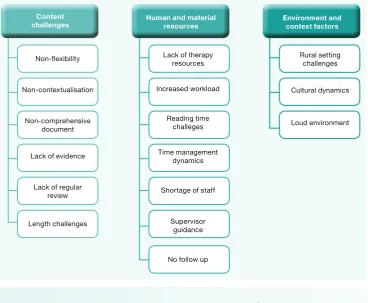
Rural setting challenges Cultural dynamics Loud environment Non-flexibility
Non-contextualisation Non-comprehensive
document Lack of evidence
Lack of regular review Length challenges
Lack of therapy resources Increased workload
Reading time challeges Time management
dynamics Shortage of staff
Supervisor guidance No follow up
Environment and context factors Human and material
resources Content
challenges
is going to help me then I’m sure I can develop more, and one of these days I can be confident enough. [Participant 15]
Practices related to stroke CPGs
Two main themes emerged: in terms of patient care, therapists stressed the importance of educating families to conduct home-care programmes, and in terms of barriers to the utilisation of guidelines, they stressed the importance of taking a holistic approach to patients.
We don’t have as many resources as we would like, and keeping family members heavily involved I think is very important. [Participant 9]
The patient might be presenting with maybe RVD [retroviral disease], or other conditions that might affect the patient’s function, so they didn’t add those kind of things. With them a stroke patient is still presenting with hemiplegia and it’s just a straightforward thing, but there are some other clinical things they haven’t added. [Participant 11]
Newly qualified therapists (community service therapists) had very little experience in managing stroke patients; their reliance was mainly on undergraduate university training.
Yeah, I think it’s the combination of my clinical background, the information from my colleagues, as well as the person who is accompanying the patient. [Participant 7]
They reported that having access to a CPG would improve their rehabilitation process with stroke patients. This highlights an unmet need to provide training in public health facilities where community service therapists are employed as they felt that using a stroke CPG would make them feel more confident in managing stroke patients.
A review by Spiers and Harris came to similar conclusions, namely that more support should be provided to allied health professionals working in rural and remote communities in order to improve the health outcomes of rural patients.16
Compared with other studies which found that physiotherapists regard guideline utilisation as time consuming, therapists in this study reported that using a CPG would save them time during patient rehabilitation.10 This difference in opinion could be because
many therapists in this study had not utilised guidelines before and therefore did not have a sense of the time required to read and implement them.
The barriers experienced by the therapists in implementing stroke CPGs are given in Figure 1.
Strategies to improve the implementation of stroke CPGs
Therapists suggested various strategies to improve the dissemination and implementation of stroke CPGs. These suggestions included staff training, and changing the design and content of the current clinical guidelines disseminated in rural district hospitals. According to the therapists, these initiatives are currently not in place and would play a major role in improving the implementation of CPGs in their local context. This is consistent with reports from other studies, which state that the mode of clinical guideline dissemination ultimately affects guideline utilisation.9,10
Therapists reported that they preferred electronic communication, especially email, as a way to receive information on clinical guidelines, despite reported problems with internet connectivity in rural areas. This preference highlights the need to strengthen internet connectivity in public health facilities to make service delivery more efficient.
Currently there is neither training nor an implementation strategy on how best to use clinical guidelines. The therapists in this study suggested that training should measure effectiveness of the strategy and assess practitioner knowledge and understanding. This is in keeping with recommendations from authors who proposed an active strategy for guideline implementation that included interactive education and discussion sessions, feedback, and reminders to physiotherapists.10 Research findings have reported on a
correlation between workplace-based initiatives and corresponding improvement in the uptake of CPGs.
Maybe they can in-service us on these guidelines, then we are aware of these guidelines that are developed. [Participant 5]
The therapists suggested that stroke CPGs should be designed differently to make them more user-friendly. Recommendations included improving the design and layout; developing shorter, more succinct guidelines; the addition of graphics; and giving the guideline development date.
Assessing the quality of stroke CPGs
All 16 therapists were asked to rate the quality of the stroke guidelines available at their hospitals using the iCAHE tool developed by Grimmer-Somers et al.,15 which consists of 14 yes/no questions. The
total score was the sum of ‘yes’ responses. Therapists who had never seen the guidelines were given time to peruse them before rating. Percentage scores were calculated using the iCAHE quality ratings obtained from each therapist, per profession. The percentages were categorised as follows: 0–24% (poor quality); 25–49% (fair quality); 50–74% (good quality); and 75–100% (excellent quality).13
Speech therapists and audiologists (STAs) scored their stroke guideline at 35.7%, physiotherapists (PTs) scored their guideline at 20.4%, and occupational therapists (OTs) gave their guideline a rating of 18.6%.
Overall, the scoring was low for each professional stroke guideline used in Bushbuckridge local municipality. All three categories of allied rehabilitation practitioners submitted an iCAHE score below 50%, representing poor to fair quality. The stroke CPG provided to physiotherapists and occupational therapists scored poor quality, while the guidelines for speech therapists and audiologists was scored as fair quality. The low scoring by all therapists could be related to the low uptake of these stroke guidelines. Even though speech therapists and audiologists scored their guidelines slightly higher than the physiotherapists and occupational therapists, their overall uptake was still very low due to the negative perception of the CPGs. It is possible that this perception may also have been influenced by their rural context. The differences in stroke CPG quality scoring among the three professions could be an indication of lack of collaboration among the developers of the guidelines. As stroke is a condition requiring a multidisciplinary approach,4
CPGs intended for stroke management should be developed as a multidisciplinary initiative with input from all the stakeholders.
guidelines by the therapists also provides insight into why therapists who have been exposed to the guidelines do not use them.
Two further findings from this study are the need to develop multidisciplinary stroke CPGs, and the importance of considering the context (in this case rural) when designing and implementing clinical guidelines.
The following recommendations are pertinent for stroke CPG developers.
➢ Review and revise the clinical practice stroke guidelines
provided to rural therapists, taking into account the human and material resources in rural areas. These guidelines should then be scored using the iCAHE quality checklist, and piloted before dissemination and implementation.
➢ Develop a clear strategy and plan of action to disseminate
and promote implementation of the guidelines which includes running workshops with the intended users. Make guidelines easily accessible to therapists living in rural areas. The use of mobile technology should be incorporated into the guideline dissemination plan.
➢ Guideline developers must also consider developing guidelines
that are not too long to read as this discourages therapists from reading them.
The heads of therapy departments and rehabilitation directors should create the space and time for therapists to read and engage with the CPGs on a regular basis. Audits of CPGs should take place quarterly or bi-annually. Heads of department should discuss CPGs during national rehabilitation forums so that they can share ideas with other provincial therapy departments.
Acknowledgements
Stroke management
References
1 Joubert J, Prentice LF, Moulin T, Liaw ST, Joubert LB, Preux PM. Stroke in rural areas and small communities. Stroke. 2008;39(6):1920–8. doi.org/10.1161/ STROKEAHA.107.501643.
2 Connor M. Prevalence of stroke survivors in rural South Africa: Results from the Southern Africa Stroke Prevention Initiative (SASPI) Agincourt field site. Stroke. 2004;35(3):627–32. 3 Leira EC, Hess DC, Torner JC, Adams HP. Rural-urban
differences in acute stroke management practices: a modifiable disparity. Arch Neurol. 2008;65(7):887–91. doi. org/10.1001/archneur.65.7.887.
4 Maleka M, Stewart AS, Hale L. The experience of living with stroke in low urban and rural socioeconomic areas of South Africa. S Afr J Physiother. 2012;68(3):25–9.
5 Van Peppen RPS. Towards evidence-based physiotherapy for patients with stroke [thesis]. Utrecht: University of Utrecht; 2008.
6 Sein N, Tumbo J. Determinants of effective medical intern training at a training hospital in North West Province, South Africa. Afr J Health Prof Educ. 2012;4(1):10–4. doi:10.7196/AJHPE.100.
7 Thomas L, Cullum N, McColl E, Rousseau N, Soutter J, Steen N. Guidelines in professions allied to medicine. Cochrane Database Syst Rev. 2000;2:349.
doi.org/10.1002/14651858.CD000349.
8 Francke AL, Smit MC, de Veer AJE, Mistiaen P. Factors influencing the implementation of clinical guidelines for health care professionals: a systematic meta-review. BMC Med Inform Decis Mak. 2008;8(38):107–12. doi. org/10.1186/1472–6947–8–38
9 Bouter LM, Oostendorp RAB. Implementation of clinical guidelines on physical therapy for patients with low back pain: Randomized trial comparing patient outcomes after a standard and active implementation strategy. Bone Joint Decade. 2005;85(6):544–55.
10 Bekkering GE, Hendriks HJM, van Tulder MW, Knol DL, Hoeijenbos M, Oostendorp RB. Effect on the process of care of an active strategy to implement clinical guidelines on physiotherapy for low back pain: a cluster randomised controlled trial. Qual Saf Health Care. 2005;14(2):107–12. doi.org/10.1136/qshc.2003.009357
11 Agrawal V, Ghosh AK, Barnes MA, McCullough PA. Awareness and knowledge of clinical practice guidelines for CKD among internal medicine residents: A national online survey. Am J Kidney Dis. 2008;52(6):1061–9. doi. org/10.1053/j.ajkd.2008.06.022
12 Bennett S, Tooth L, Mckenna K, et al. Feature article
perceptions of evidence-based practice: A survey of Australian occupational therapists. Aust Occup Ther J. 2003; 50(2):13– 22. doi.org/10.1046/j.1440–1630.2003.00341.x 13 Wiseman R, Cohen K, Gray A, et al. Agree to disagree:
Critical appraisal and the publication of practice guidelines. S Afr Med J. 2014;104(5):345–6.
14 Muckart DJJ. Evidence-based medicine – Are we boiling the frog? Publication bias. S Afr Med J. 2013; 103(7):447–8.
URL: http://doi.org/10.7196/SAMJ.6805.
15 Grimmer-Somers K, Dizon JM, Milanese S, et al. Efficient clinical evaluation of guideline quality: development and testing of a new tool. BMC Med Res Methodol. 2014;14(1):14–63. doi.org/10.1186/1471–2288–14–63
16 Spiers MC, Harris M. Challenges to student transition in allied health undergraduate education in the Australian rural and remote context: a synthesis of barriers and enablers. Rural Remote Health. 2015;15:3069. Available: