On Concurrently Secure Computation in the Multiple
Ideal Query Model
∗Vipul Goyal† Abhishek Jain‡
Abstract
The multiple ideal query (MIQ) model was introduced by Goyal, Jain and Ostrovsky [Crypto’10] as a relaxed notion of security which allows one to construct concurrently secure protocols in the plain model. The main question relevant to the MIQ model is how many queries must we allow to the ideal world adversary? The importance of the above question stems from the fact that if the answer is positive, then it would enable meaningful security guarantees in many application scenarios, as well as, lead to resolution of long standing open questions such as fully concurrent password based key exchange in the plain model.
In this work, we continue the study of the MIQ model and prove severe lower bounds on the number of ideal queries per session. Following are our main results:
1. There exists a two-party functionality that cannot be securely realized in the MIQ model with only a constant number of ideal queries per session.
2. There exists a two-party functionality that cannot be securely realized in the MIQ model by any constant round protocol, withany polynomial number of ideal queries per session.
Both of these results are unconditional and even rule out protocols proven secure using a non-black-box simulator. We in fact prove a more general theorem which allows for trade-off between round complexity and the number of ideal queries per session. We obtain our negative results in the following two steps:
1. We first prove our results with respect to black-box simulation, i.e., we only rule out simulators that make black-box use of the adversary.
2. Next, we give a technique to “compile” our negative results w.r.t. black-box simulation into full impossibility results (ruling out non-black-box simulation as well) in the MIQ model. Interestingly, our compiler uses ideas from the work on obfuscation using tamper-proof hardware [GIS+10, GO96], even though our setting does not involve any hardware
tokens.
∗
This is the full version of the Eurocrypt’13 paper.
†
Microsoft Research, India. Email: [email protected] ‡
1
Introduction
The notion of secure computation is central to cryptography. Introduced in the seminal works of [Yao86, GMW87], secure multi-party computation allows a group of (mutually) distrustful parties
P1, . . . , Pn, with private inputsx1, . . . , xn, to jointly compute any functionalityf in such a manner
that the honest parties obtain correct outputs and no group of malicious parties learn anything beyond their inputs and prescribed outputs.
The classical results for secure computation are only in the stand-alone setting where security holds only if a single protocol session is executed in isolation. Unfortunately, as it has become increasingly evident over the last two decades, stand-alone security does not suffice in real-world scenarios where several protocol sessions may be executedconcurrently – a typical example being protocols executed over modern networked environments such as the Internet.
Background: Concurrently Secure Computation. Towards that end, the last decade has a seen a significant effort by the cryptographic community towards obtaining protocols that are concurrently composable, i.e., protocols that remain secure even when executed concurrently over an insecure network. For example, we could require security under concurrent self-composition (which is the focus of this work): a protocol should remain secure even when there are multiple copies executing concurrently. The framework of universal composability (UC) [Can01] was intro-duced to capture the setting ofconcurrent general composition, where a protocol may be executed concurrently not only with several copies of itself but also with other arbitrary protocols.
General positive results for UC secure computation are known based on various trusted setup assumptions, such as a common random string [Can01, CF01, CLOS02, BCNP04, CPS07, Kat07, LPV09]. Whether a given set of players is actually willing to trust an external entity, however, is debatable. Indeed, a driving goal in cryptographic research is to eliminate the need to trust other entities. As such, positive results for concurrently-secure computation in theplain model (which is the main focus of this work) are highly desirable, both from a theoretical and practical viewpoint.
Negative Results for Concurrent Composition. Unfortunately, in the plain model, by and large, most of the results have been negative. UC secure protocols for most functionalities of interest were ruled out in [CF01, CKL03, PR08, KL11]. These impossibility results were extended to the setting of general composition by Lindell [Lin03] who proved that security under concurrent general composition implies UC security. Later, Lindell [Lin04] established broad negative results even for the setting of concurrent self-composition by showing equivalence of concurrent self-composition and general composition for functionalities where each party can “communicate” to the other via its output. Following the work of Barak et al. [BPS06] and Goyal [Goy12], recently Agrawal et al. [AGJ+12] and Garg et al. [GKOV12] ruled out essentially all non-trivial two-party functionalities for concurrent self-composition, even in the setting where the inputs of honest parties are fixed in advance for all the protocol sessions.
The Search for Relaxed Security Notions. While the above discussion paints a rather bleak picture of state of the art on concurrent security, fortunately, there is a brighter side. Indeed, several prior works have studied relaxations of the standard definition of secure computation that bypass the above negative results, yet provide strong and meaningful security guarantees in the concurrent setting. A well studied notion is that of security w.r.t. super-polynomial simulation [Pas03, PS04, BS05, LPV09, CLP10, GGJS12, LP12] which intuitively guarantees that a real-world adversary does not learn any more information than what can be computed in super-polynomial time in the ideal world. Another notion is that of input-indistinguishable computation [MPR06, GGJS12] which intuitively guarantees that an adversary cannot decide which input (out of possibly many inputs leading to the same output) is used by the honest party in the protocol.
Recently, Goyal, Jain and Ostrovsky [GJO10] introduced the multiple ideal query (MIQ) model for concurrent self-composition where the ideal world adversary is allowed to make more than one output query per session to the ideal functionality. The exact number of queries allowed is a priori fixed by a parameterλ. In our view, the main advantage of this notion over the previously discussed notions is that it provides an (arguably) intuitive, easy to understand, security guarantee. In particular, in this model, one can precisely measure the amount of “extra” information that the adversary can potentially learn. The security guarantee is provided with standard polynomial time simulation (and adversary) and follows the ideal/real world security formalization. Furthermore, for functionalities such as password-based key exchange, the MIQ definition in fact implies the previous standard definition [GL01] when λ=O(1).
The MIQ model has also proven relevant in the related setting of resettability. Goyal and Sahai [GS09] introduced the notion of resettable secure computation and construct such protocols in the model where the ideal adversary can “reset” the trusted party at any point. This gives the ideal adversary the power to query the trusted party multiple times (per session in the real world). This allows them to get a general positive result for all PPT computable functionalities in the plain model in the resettable ideal world setting.
The multiple ideal query model has also proven relevant as technical tool. In particular, the recent positive results of Goyal [Goy12] can be seen as obtained using the following two step paradigm. First, very roughly, Goyal constructs a protocol secure in the multiple ideal query model. Then, the additional queries made to the ideal trusted party are eliminated by constructing an “output predictor”.
We believe the study of the MIQ model is well motivated: both because the guarantee provided in the concurrent setting is interesting and non-trivial on its own, as well as the connection it has to constructing secure protocols in other related settings.
In this work, we continue the study of the MIQ model.
Our Question: How many Queries? The main question relevant to the MIQ model is how many queries must we allow to the ideal world adversary? Note that if we allow a large number of queries, then the security guarantee may quickly degrade and become meaningless; in particular, the adversary may be able to learn the input of the honest party in the worse case. On the other hand, if the number of allowed queries is very small, say 1+per session, then the security guarantee is very close to that of the standard definition.
Q(α) as the output. This is a natural functionality with applications to list intersection, mutual authentication, metering on the web, etc (see [NP06] for more details on these).
Now, note that if we only allow, say, 2 queries to a malicious P2 in the ideal world (per real world session), then as long asQ is a high-degree polynomial, the security guarantee forP1 is still quite meaningful. Instead of a single point, now a malicious adversary may learn the output on two points of its choice (from an exponential domain of points). The adversary still does not learn any information about what the polynomial evaluates to on rest of the (exponential) domain. On the other hand, if we allow too many queries (exceeding the degree of the polynomial), then the ideal world adversary may be able to learn the entire polynomial Q thus rendering the security guarantee meaningless.
The only known positive results in the MIQ model are due to [GJO10, GGJ13]. Goyal et. al. [GJO10] provide a construction where the average number of queries in the ideal world per real world session is a constant (with the constant depending upon the adversary). This was further improved in a recent result [GGJ13] which provides a construction where the average number of ideal queries in any session are (1 + poly(1 n)).
If the guarantee on the number of queries per session is only in expectation, this means that in some sessions, the ideal adversary may still be able to make a large number of queries (while keeping the number of queries low in other sessions). Considering the oblivious polynomial evaluation example above, this means that the security in some sessions may be completely compromised. Furthermore, consider the problem of concurrent password based key exchange [KOY01, GL03, CHK+05, BCL+05, GJO10]. An interesting question that has remained open so far is designing a concurrent password based key exchange in the plain model where different pair of parties share different (but correlated) passwords. Indeed, this is the most natural setting for password based key exchange (PAKE) and all currently known construction either do not provide concurrent security or are not in the plain model. We note that a positive result in the MIQ model where the number of queries per sessions is a strict constant would directly imply a positive result for this problem.1 This raises the following natural question:
“Do there exist concurrent secure protocols in the MIQ model where the number of ideal queries per session is a strict constant?”
As discussed, the importance of the above question stems from the fact that if the answer is positive, then it would enable meaningful security guarantees in many application scenarios (e.g., oblivious polynomial evaluation), as well as, lead to resolution of long standing open questions such as concurrent password based key exchange in the plain model.
1.1 Our Results
In this work, we continue the study of the MIQ model and prove severe unconditional lower bounds on the number of ideal queries per session. Following are our main results:
1. There exists a two-party functionality that cannot be securely realized in the MIQ model with only a constant number of ideal queries per session.
1
2. There exists a two-party functionality that cannot be securely realized in the MIQ model by any constant round protocol, withany polynomial number of ideal queries per session.
Both of these results are unconditional and even rule out protocols proven secure using a non-black-box simulator. We in fact prove a more general theorem that provides a trade-off between the round-complexity and the number of ideal queries per session.
Let ceil1(x) =dxe. For y ≥ 2, let ceily(x) be recursively defined as ceily(x) = dx·ceily−1(x)e. Our main result is stated as follows:
Theorem 1 (Informal) There exists a two-party functionality f such that for any d=d(k) and n = n(k) that satisfy nd = poly(k), no n-round protocol Π securely realizes f in the MIQ model with at most λ=ceild(1 +n1) number of queries per session.
Application to concurrent precise zero-knowledge. While our main results concern with the MIQ model, interestingly, they also find applications in the setting ofprecise simulation[MP06]. Recall that in the setting of precise simulation, we wish to ensure that the resource utilization of the simulator is “close” to the resource utilization of the adversary in the real world interaction. The resource being studied is typically the running time, however, previous works have also considered a more general setting where the resource in question can be, e.g., memory. One can consider a general setting, where instead of focusing only on a particular resource (such as time), we consider many resources at the same time, such as memory, cache, power, etc. A general question we may ask is whether it is possible to perform simulation that achieves precision for each of these resources simultaneously.
To be more concrete, say we have a concurrent adversary interacting with the prover in many sessions and making use of k different resources (each resource may be utilized by the adversary at any arbitrary point). A natural question is: can one obtain a zero-knowledge simulator such that its utilization ofeach resource is only within a constant factor of the adversary? Our negative results directly imply a negative answer for this question as well where the number of resources is equal to the number of sessions. In other words, viewing the ideal functionality query in session
i as a utilization of the i-th resource, we directly have that the simulator will end up going over a constant factor for at least one of the resources. Similarly, our results also imply a severe lower bound for constant round protocols: there exists a resource whose utilization will, in fact, not be within any polynomial factor of the adversary’s utilization.
Independent of our work, Pass [Pas12] has been able to obtain a positive result in the stand-alonesetting for the above problem. In particular, [Pas12] gives a construction where the simulator is able to be precise in multiple resources simultaneously in the standalone setting.
1.2 Our Techniques
In this section, we give an overview of our techniques. We obtain our negative results in the following two steps:
1. We first prove our results with respect toblack-box simulation, i.e., we only rule out simulators that make black-box use of the adversary.
Interestingly, our compiler uses ideas from the work on obfuscation using tamper-proof hard-ware [GIS+10, GO96], even though our setting does not involve any hardware tokens. We believe these techniques may find applications elsewhere.
Below, we discuss each of these steps separately.
Impossibility for Black-box Simulation. Recall that in order to prove security of a two-party computation protocol, we need to demonstrate that for every real world adversaryA that controls one of the parties, there exists an ideal world adversary (or simulatorS) who can simulate the view ofA. Typically, the simulatorS works by extracting the inputaused byA and then querying the ideal functionality with ato receive the correct output; this output is then used to complete the simulation of A’s view.2 Now, further recall that the only advantage that a black-box simulator has over the real adversary is the ability torewind. In other words, a black-box simulator extracts the input ofAby rewinding. However, in the concurrent setting, extracting the input of Ain each session is a non-trivial task. In particular, given an adversarial scheduling, it may happen that in order to extract the input of A in a given session s, the simulator S rewinds past the beginning of another session s0 (that is interleaved inside the protocol messages of session s). When this happens,Amay change its input in session s0. Thus, the simulatorS would be forced to query the ideal functionality more than once for the sessions0. Indeed, as shown in [Lin04], this intuition can be formalized to obtain a black-box impossibility result for concurrent self-composition w.r.t. the standard definition of secure computation, where only one query per session is allowed.
We now briefly explain how the above intuition can be further extended to achieve a black-box impossibility result even when the simulator is allowed to make multiple queries to the ideal functionality. For concreteness, let us consider the (simplified) case where the simulator is allowed a fixedconstant C number of queries per session. Note that in order to obtain the desired negative result, we need to construct a concurrent adversaryAthat can force any black-box simulatorS to make more than C queries for at least one session. We now briefly discuss how to construct such an adversary. Let n be the round complexity of the protocol, where n is any polynomial in the security parameter.
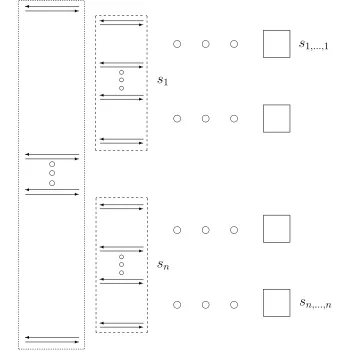
Consider the following static adversarial scheduling of messages. Consider an “outer” session (say) s. We will call it a session at level 0. Now, between every round of messages in the outer session, place a new complete protocol session. We will call thesensessions to be at level 1. Next, we again place a new complete protocol session between every round of messages in each session at level 1. Note that this createsn2 sessions at level 2. Repeat this process recursively until we reach level C, where there are exactly nC sessions. Thus, in total, we have m= nCn+1−1−1 sessions, which is polynomial in the security parameter.
Now, as discussed earlier, a black-box simulator Smust perform at least one rewinding in order to extract the input ofAin the “outer” sessions. Suppose thatS rewinds theith round of session
s. Then, this immediately implies that the ith session at level 1 is executed at least twice, which in turn means that S will be forced to query the ideal functionality twice for that session. Now, note that S will need to extract A’s input in each of these two executions in order to complete them successfully. Thus, assuming that (even if) S rewinds different rounds in each of these two executions, we have that there exist two sessions at level 2 that are each executed three times.
2
Continuing this argument inductively, we can show that for every leveli, there exists at least one session that is executed i+ 1 times. As a result, we obtain that there exists a session s∗ at level
C that is executed C+ 1 times. If the adversary chooses a different input in each of the C + 1 executions, we have thatS must query the ideal functionalityC+ 1 times for sessions∗. Thus, we conclude that the black-box simulatorS, who is only allowedC queries, must fail.3
From Black-Box to Non-Black-Box. We now discuss a compilation technique to transform our negative results for black-box simulation into full impossibility results that rule out non-black-box simulation as well.
Recall that the main advantage that a non-black-box simulator has over a black-box simulator is that the former can make use of the adversary’s code. Then, our high-level approach is to “nullify” this advantage by making use of secure program obfuscation. We note, however, that general program obfuscation is known to be impossible [BGI+01]. Towards this end, our key idea is to use positive results on program obfuscation using stateless tamper-proof hardware tokens by Goyal et. al. [GIS+10]. In the obfuscation with hardware model, one can take the given program and convert it into an obfuscated program using an obfuscation keyk. The obfuscated program, for execution, would require oracle access to a hardware token having the obfuscation keyk. We denote the functionality of the token (required to run the obfuscated program) by ftoken (parameterized
by the keyk).
Very roughly, our idea is to implement the “token functionality” ftoken of [GIS+10] using
two-party computation. An important point is that ftoken is “robust” to any polynomial number of
queries; thus, it is particularly suited to the MIQ model. In more detail, we obtain our negative result in the following three steps described at a very high level (see Section 4 for details and further intuition):
Toy Experiment: Let Π be any protocol for the ftoken functionality and letAbe any concurrent
adversary for Π that rules out black-box simulators that make at mostλqueries per session. We first consider a toy experiment involving three parties, namely, Alice, Bob and David. In this experiment, Alice and Bob interact in multiple ideal world executions of the token functionality ftoken. At the same time, Bob and David are involved in concurrent real-world
executions of Π where Bob and David follow the same scheduling of messages as defined by adversaryA. Furthermore, the adversary Bob is allowed to reset David at any point during their interaction.
David, who has a secret inputsecretis instructed to revealsecretto Bob if all the executions of Π are completed “successfully”. The goal of Bob is to successfully complete its interaction with David and learn the value secret. Then, the main idea in this experiment is that, by relying on our black-box impossibility result, we show that no adversarial Bob can succeed in learning secret, except with negligible probability.
Ideal World: In the second step, we eliminate David from the above experiment by obfuscating his next-message function in theftoken-hybrid model and give it as an auxiliary input to Bob
(while the corresponding obfuscation “key” is given to Alice). This results in a scenario where Alice and Bob are the only parties, who interact in multiple ideal world executions of ftoken.
From the security of obfuscation, we can argue that this experiment can be reduced to the toy experiment; as such, no adversarial Bob can learnsecret, except with negligible probability.
3
Real World Experiment: We finally consider the real world experiment, which is the same as previous step, except that all the ideal world invocations offtoken are now replaced with
real-world executions of protocol Π. It is not difficult to see that in this experiment, an adversary Bob can simply play a “man-in-the-middle” between Alice and David (since Bob has David’s obfuscated code); as a result, Bob can learnsecretwith probability 1.
From above, it follows that the adversary Bob in the real world experiment is apptconcurrent
adversary for Π whose view cannot be simulated by any simulator that makes at most λqueries per session, thus yielding us the desired result. We refer the reader to the technical sections for more details.
2
Preliminaries
2.1 Our Model
In this section, we present our security model. Throughout this paper, we denote the security parameter byk.
Concurrently Secure Computation in the MIQ model. We define our security model by extending the standard real/ideal paradigm for secure computation. Roughly speaking, we consider a relaxed notion of concurrently secure computation where the ideal world adversary is allowed to make an a priori fixed number (denoted as λ=λ(k), where kis the security parameter) of output queries to the ideal functionality for each session. Note that in contrast, the standard definition for concurrently secure computation only allows for one output query per session to the ideal adversary. We now give more details.
In this work, we consider a malicious, static adversary. The scheduling of the messages across the concurrent executions is controlled by the adversary. We do not require fairness and hence in the ideal model, we allow a corrupt party to receive its output in a session and then optionally block the output from being delivered to the honest party, in that session. We consider a static adversary that chooses whom to corrupt before execution of the protocol. Finally, we considercomputational security only and therefore restrict our attention to adversaries running in probabilistic polynomial time. We denote computational indistinguishability by≡.c
We now proceed to describe the ideal and real world experiments and then give our security definition.
Ideal model. We first define the ideal world experiment, where there is a trusted party for
computing the desired two-party functionality f. Let there be two parties P1 and P2 that are involved in multiple sessions, say m=m(k). An adversary may corrupt either of the two parties. As in the standard ideal world experiment for concurrently secure computation, the parties send their inputs to the trusted party and receive the output of f evaluated on their inputs. The main difference from the standard ideal world experiment is that the adversary is allowed to make
λ output queries (with possibly different inputs of its choice) in each session. The ideal world execution (parameterized by λ) proceeds as follows.
assume that the adversary corruptsP2 (when the adversary controlsP1, the roles are simply reversed). The adversary receives the input vector~y of the corrupted party.
II. Session initiation: The adversary initiates a new session by sending a start-session message to the trusted party. The trusted party then sends (start-session, i) toP1, whereiis the index of the session.
III. Honest parties send inputs to trusted party: Upon receiving (start-session, i) from the trusted party, honest party P1 sends (i, xi) to the trusted party, where xi denotesP1’s input for session i.
IV. Adversary sends input to trusted party and receives output: Whenever the adversary wishes, it may send a message (i, `, yi,`0 ) to the trusted party for any yi,`0 of its choice. Upon sending this pair, it receives back (i, `, f(xi, y0i,`)) where xi is the input value that P1 previ-ously sent to the trusted party for sessioni. The only limitation is that for anyi, the trusted party accepts at mostλtuples indexed by ifrom the adversary.
Adversary instructs trusted party to answer honest party: When the adversary sends a message of the type (output, i, `) to the trusted party, the trusted party sends (i, f(xi, yi,`0 ))
toP1, wherexi and y0i,` denote the respective inputs sent by P1 and adversary for sessioni.
VIII. Outputs: The honest party P1 always outputs the values f(xi, y0i,`) that it obtained from
the trusted party. The adversary may output an arbitrary (probabilistic polynomial-time computable) function of its auxiliary inputz, input vector~y and the outputs obtained from the trusted party.
Theideal execution of a functionf with security parameter sec, input vectors~x,~yand auxiliary input z toS, denotedidealf,S(k, ~x, ~y, z), is defined as the output pair of the honest party and S from the above ideal execution.
Definition 1 (λ-Ideal Query Simulator) Let S be a non-uniform probabilistic (expected) ppt machine representing the ideal-model adversary. We say that S is a λ-ideal query simulator if it makes at most λoutput queries per session in the above ideal experiment.
Real model. We now consider the real model in which a real two-party protocol is executed (and there exists no trusted third party). Letf be as above and let Π be a two-party protocol for computing f. Let A denote a non-uniform probabilistic polynomial-time adversary that controls either P1 orP2. The parties run concurrent executions of the protocol Π, where the honest party follows the instructions of Π in all executions. The honest party initiates a new sessioniwith input
xi whenever it receives astart-session message from A. The scheduling of all messages throughout
the executions is controlled by the adversary. That is, the execution proceeds as follows: the adversary sends a message of the form (i,msg) to the honest party. The honest party then adds
The real concurrent execution of Π with security parameter k, input vectors~x,~y and auxiliary input ztoA, denoted realΠ,A(k, ~x, ~y, z), is defined as the output pair of the honest party andA, resulting from the above real-world process.
Security Definition. Having defined the ideal and real models, we now give our security
defini-tion.
Definition 2 (λ-Secure Concurrent Computation in the MIQ Model) A protocolΠis said to λ-securely realize a functionality f under concurrent self composition in the MIQ model if for every real model non-uniformppt adversary A, there exists a non-uniform (expected)ppt λ-ideal query simulator S such that for all polynomials m = m(k), every pair of input vectors ~x ∈ Xm, ~
y∈Ym, every z∈ {0,1}∗s,
{idealf,S(k, ~x, ~y, z)}k∈ N
c
≡ {realΠ,A(k, ~x, ~y, z)}k∈ N
2.2 Obfuscation with Tamper-Proof Hardware Tokens
In this work, we use ideas from the area of obfuscation using tamper-proof hardware tokens. In particular, we use the positive result of Goyal et al. [GIS+10] on secure program obfuscation using stateless tamper-proof hardware tokens. Below, we give an abstract overview of the scheme of [GIS+10] that we will use in our negative results. We remark that the discussion below hides most of the internal details of the scheme of [GIS+10]. We refer the reader to [GIS+10] for the details of the scheme.
Obfuscation in Token Hybrid Model. In order to obfuscate a circuitC, the sender executes the following steps:
• Sample a token instanceT ←SampleT. The token instance has some secret values hardwired inside it. We will denote the secret values as a key K (that is drawn from some distribution K). In other words, sampling of the token instance just involves to sampling the keyK from the distributionK.
• Compute the obfuscated programO(C)←Obfuscate(C, K)
To computeC(x) on any inputx, the obfuscated programO(C) makestC queries of various types
to the token T, where each q is drawn from some distribution Q. Here, tC, denoted as the query
parameter of the obfuscation scheme, is an integer that depends on the size of the circuitC that is obfuscated.
Obfuscating Stateful Programs. The above description is only relevant to obfuscating stateless circuits C. We note that it is also possible to obfuscate the programs of stateful (or reactive) machines M in the above scheme by using standard techniques. The basic idea is that obfuscated code O(M) is computed in such a manner that its output on any given input x consists of both
M(x) and an authenticated encryption of its resultant state after the computation ofM(x). We now recall the following security lemma from [GIS+10] (informally stated):
exists an ideal world simulator having only black-box access to the circuit C, such that, the output distribution of the simulator is computationally indistinguishable from that of the adversary.
The Token Functionality. A key idea that is used in our negative results is to implement the working of the hardware token T via a two-party secure computation protocol. To this end, we abstract the working of the token T as the following two-party functionality ftoken, that we will
refer to as the “token functionality”.
Denote by ftoken the token functionality with the keyK hardwired inside the description of its
circuit. The input and output interface of the functionalityftoken is described as follows:
Inputs: PartyP1 gets a token keyK ← K as input, whileP2 gets a query q← Q as input.
Outputs: P1 gets no output, whileP2 gets ftoken(K;q).
Note thatftokenis a deterministic functionality. We now state a lemma regarding the
unpredictabil-ity of outputs of ftoken. We note that this lemma is implicit in [GIS+10].
Lemma 2 (Unpredictability of Output of ftoken [GIS+10]) There exists a distributionQ(with super-logarithmic min-entropy) from which a query q can be sampled with the following properties. Any adversary A, given oracle access to the functionality ftoken(K;·) (where K is sampled at ran-dom from K) with the restriction that it is allowed to queryftoken(K;·) on any string exceptq, can output ftoken(K;q) with only negligible probability.
Proof Sketch. Observe queries of Type 1 in the obfuscation scheme of [GIS+10]. For a large enough randomly chosen inputx, the resulting query q has at least super-logarithmic min-entropy. Note that the output offtoken(K;q) consists of a message-authentication code (MAC) on a message
that has full information about q. Hence, the lemma follows from the unforgeability of the MAC scheme. We refer the reader to [GIS+10] for details.
3
Impossibility of Concurrently Secure Computation in the MIQ
Model with Black-Box Simulation
In this section, we prove impossibility results for concurrently secure computation in the MIQ model with respect to black-box simulation.
Let ceil1(x) =dxe. For y ≥ 2, let ceily(x) be recursively defined as ceily(x) = dx·ceily−1(x)e. Our general result, stated below, shows a trade-off between the query parameterλand the round-complexitynof the protocol:
Theorem 2 There exists a functionality f such that for any d=d(k) and n= n(k) that satisfy nd = poly(k), no n-round protocol Π λ = ceild(1 + n1)-securely realizes f in the MIQ model with
respect to black-box simulation.
Note thatceild(1+n1)≥d+1. Thus, we obtain the following general corollary when substituting
dwithλ:
Corollary 1 There exists a functionality f such that for any λ=λ(k) and n=n(k) that satisfy nλ = poly(k), non-round protocolΠλ-securely realizesf in the MIQ model with respect to black-box
By plugging in n = poly(k) and λ = O(1) above, we get the following as a sub-corollary, ruling out general positive results in the MIQ model when a (black-box) simulator is allowed only a constant number of ideal queries per session:
Corollary 2 There exists a functionalityf that cannot be O(1)-securely realized in the MIQ model with respect to black-box simulation.
Finally, by plugging inn=O(1) andd= log(k) in Theorem 2, we obtain the following corollary ruling out constant-round protocols in the MIQ model:
Corollary 3 There exists a functionality f that cannot be securely realized in the MIQ model by anyO(1)-round protocol w.r.t. black-box simulation, even if a (black-box) simulator is allowed any (fixed) poly(k) ideal queries per session.
We now proceed to the proof of Theorem 2. In fact, we will prove something stronger, as stated below. We first give the following definition:
Definition 3 (λ-special black-box adversary) Let λ=λ(k)andΠ = (P1, P2) be a protocol for
functionality f. Apptconcurrent adversary Afor Π that corrupts partyP2 is said to be λ-special adversary if the following holds:
• A outputs acceptwith probability1 in the real-world execution with P1.
• Except with negligible probability, noλ-ideal query black-box simulator can send a query to A such that it outputs accept.
It is easy to see that Theorem 2 is implied by the following theorem:
Theorem 3 For every d = d(k) and n = n(k)-round protocol Π for the ftoken functionality, if nd= poly(k), then there exists a λ-special adversaryfor Π, where λ=ceild(1 +n1).
We prove the above theorem for the ftoken functionality.
3.1 Proof of Theorem 3
Our proof builds on ideas from Lindell’s black-box lower bound for the round complexity of bounded-concurrent self-composition [Lin04]. In what follows, we will follow the notation and terminology used in [Lin04]. Some of the text below is taken from [Lin04].
We will prove the theorem assuming one-way functions. Note that this suffices since secure coin-tossing (even in the stand-alone setting) implies one-way functions. Therefore, if one-way functions do not exist, then it is easy to see that coin-tossing already suffices to prove Theorem 3. Now, assuming one-way functions, we will prove Theorem 3 for the token functionality ftoken,
as defined in Section 2.2. Our proof will be according to the following outline:
I. First, given any d = d(k) and an n-round protocol Π (s.t. nd = poly(k)) for ftoken, we will
construct a real-model adversary A who corrupts party P2 and interacts with honest P1 in
II. Next, we assume for contradiction that with non-negligible probability, there exists a λ(=
ceild(1 +n1))-ideal query black-box simulator S that manages to send a query toAsuch that
A outputsaccept. We will argue some special properties aboutS; most notably that there must exist a session at leveli < dwhere S does not rewind A.
III. Using the above observation, (following standard techniques from [CKL03, Lin04]) we finally construct a new adversaryA0 who interacts with an honestP
2and learns its private input with non-negligible probability. Since this is impossible in the ideal world (from the stand-alone security of Π), we reach a contradiction.
We now proceed to give details. Let us assume for contradiction that there exists an n-round protocol Π thatλ(=ceild(1+n1))-securely realizesftokenunder concurrent self-composition. Without
loss of generality, we assume that the first message in Π is sent by partyP2.
In the first part of the proof, we will describe a ppt concurrent adversary A and a specific static message schedule form= ndn+1−−11 concurrent executions of Π. Before proceeding further, we first describe how the inputs of the parties P1 and P2 are chosen for the m sessions. Recall the description of the token functionality ftoken from Section 2.2. Let Q denote a distribution on the
token queries with super-logarithmic min-entropy (see Lemma 2). Then, in each session i∈ [m], the inputs of P1 and P2 are Ki and qi respectively, where each token key Ki is drawn at random
from K, and each qi is drawn at random from Q.
Part I. Adversary A. Adversary Ais provided as auxiliary input a random string z∈ {0,1}k,
as well as token keys K1, . . . , Km as defined above. A schedules the protocol messages of the m
sessions of Π in the following manner.
Adversarial schedule. Let s denote the first protocol execution initiated by A. We will call it the session at level 0 (i.e., the “outer level”). Now, between every two consecutive rounds of messages in session s, place a new complete protocol session. Let these n nested sessions be denoted as
s1, . . . , sn. We will call them as sessions at level 1. Now, for every session si at level 1, we again
place a new complete protocol session between every round of messages insi. Note that this creates
n2 sessions denoted assi,1, . . . , si,n at level 2. Repeat this process recursively until we reach level
d (i.e., the “inner-most level”), where there are exactly nd sessions s1,...,1, . . . , sn,...,n. Thus, in
total, we have exactly ndn+1−1−1 = poly(k) sessions. Figure 1 gives a pictorial representation of the adversarial schedule.
A’s strategy. Let Π1, . . . ,Πm denote the m protocol executions, where Πi denotes the ith session
started by A. (That is, Π1, . . . ,Πm is the ordered list of protocol sessions, based on when each
session starts.) We now describe the strategy ofA in each of them protocol sessions.
Areplaces its inputq1 in the first session Π1 withq01, whereq10 is sampled from the distribution Q using auxiliary input z as the randomness. A starts the execution of Π1 using q01 as its input and behaves honestly (running the code of honestP2). Later, when any session Πi (i∈ {2, . . . , m})
starts (as per the schedule), A collects the partial transcript Ti of the protocol messages (across
all sessions) generated so far and applies a pseudo-random function (PRF) F with a random key
k to the transcript.4 It then replaces its input qi in session Πi with q0i, where qi0 is sampled from
4
d d d
c c c
c c c
f f f
f f f
f f f
f f f
-s
1,...,1s
n,...,ns
1s
ns
distributionQusing Fk(Ti) as the randomness. Abehaves honestly (by running the code ofP2) in Πi using qi0 as its input.
In any session i∈ [m], if the output σi received by A is such that σi 6=ftoken(Ki, qi0) (i.e., the
output is incorrect5) then A sends ⊥, outputs all the output values received from the protocol sessions completed so far, and aborts. On the other hand, ifAreceives correct answers in all the m
sessions, then it outputs accept, along with all its inputs and output values from all the sessions. This completes the description of adversary A. It is easy to see that since Abehaves honestly in each protocol session, it outputsacceptwith probability 1 in a real-world execution with honest
P1.
Part II. Properties of Simulator S. Now, assume for contradiction that with non-negligible probability, there exists a λ-ideal query black-box simulator S that sends a query to A such that A outputs accept. Recall from the construction of the adversary A that it outputs accept only when it receives correct outputs in all of them sessions. In other words,Aoutputsacceptonly if S successfully completes an entire execution ofmsessions withA. We will now claim some specific properties about the working of S.
Towards that end, first recall that a black-box simulator only has oracle access to the real world adversary. This oracle represents the next-message function of A that gets as input the history of the interaction in the form of a query α, and outputs the next message that A would in an interaction where it sees this history. If A would abort after receiving a prefix of the messages in an oracle query, then the oracle’s response to the query is ⊥.
We now argue a specific property of all the oracle queries where A does not abort.
Claim 1 For everyi∈[m], letΦi denote the set of all oracle queries sent byS toAwhich includes
a full transcript of sessionΠi and whereAdoes not abort. LetTi denote the transcript prefix before
the start of sessionΠi. Then, except with negligible probability, at most λunique prefixes Ti appear
in the queries α∈Φi.
Proof. The proof of this claim follows from Lemma 2 and the collision-resistance property of pseudo-random functions. To begin, we first note that except with negligible probability, S does not make two queries α and α0 containing Ti and Ti0 such that Ti 6=Ti0 but Fk(Ti) =Fk(Ti0). This
is easy to see since otherwise we can construct a machine M that distinguishes a pseudo-random function from a random function. Thus, for the remainder of the proof, we make the assumption that such queries αand α0 are never made by S.
The claim now follows easily from Lemma 2. Note thatS is allowed to query the ideal function-ality at mostλtimes for sessioni. Now, suppose for contradiction that with non-negligible proba-bility, there existλ+1 different transcript prefixesTi,1, . . . , Ti,λ+1that appear in the queriesα∈Φi.
Then, using S and A, we can construct an adversary B for the token functionality who makes at mostλqueries to ftoken(Ki,·), but outputsλ+ 1 valuesftoken(Ki, qi,01), . . . , ftoken(Ki, q0i,λ+1), where
each qi,j0 is sampled from the distribution Q using randomness Fk(Ti,j). Since with non-negligible
probability, eachFk(Ti,j) is unique, it follows that with non-negligble probability, eachqi,j0 is unique
as well. Thus, B is a valid adversary forftoken(Ki,·), yielding us a contradiction to Lemma 2.
Next, we claim thatSmust extractA’s input in each execution of Πithat has a unique prefixTi,
and whereA does not abort. (Note that there may be multiple executions of Πi due to rewinding
by S in sessions “enclosing” Πi.)
5
Claim 2 For everyi∈[m], in every execution ofΠi that has a unique prefix Ti and whereA does
not abort, except with negligible probability, S must query the ideal functionalityftoken onA’s input qi0 in that execution of Πi.
Proof. Recall from the construction of A that it checks whether its output σi at the end of an
execution of Πi with prefix Ti is the correct value ftoken(Ki, qi0), where qi0 is A’s input in that
execution sampled from Q using randomness Fk(Ti). (Note that A can checks the correctness of
output since it receives the token keyKi as auxiliary input.) Then, it follows easily from Lemma 2
thatS must query the ideal functionalityftokenonqi0 since otherwise, we can construct an adversary
B that has oracle access to ftoken(Ki,·) and with non-negligble probability, correctly predicts the
value ftoken(Ki, q0i) without ever querying ftoken(Ki,·) on input q0i. The details follow in a similar
manner to the proof of previous claim and are omitted.
Thus, it follows from the previous claim that S extracts A’s input in each protocol session where A does not abort. This brings us to our final and most important claim about S. Let Ψs
denote the subset of all the queries from S toA that contain any message in session s. We claim the following:
Claim 3 There exists a session s∗ at level ` < d such that:
• There does not exist a pair of queries α, α0 ∈Ψj that contain the same transcript prefix Ts∗,
but contain two different round r messages msgr, msg0r in session s∗ for some r∈[n]. • S queries the ideal functionality ftoken on A’s input in s∗ (as defined by the prefix Ts∗).
Proof. (Sketch) Note that the above lemma essentially states that there exists an execution of session s∗ at levelj < dwhere S extractsA’s input without rewinding A. Then, let us assume for contradiction that S extracts A’s input in each session i∈[m] by rewinding A. Further suppose thatS succeeds in extracting A’s input in each session by rewinding only once per session.6
Now, let us view the schedule as an n-ary tree where the root at level 0 denotes the outer session and the nd nodes at level ddenote the innermost sessions. Then, first note that since the outer session is rewound at least once, it follows that thensessions at level 1 are executed in total
n+ 1 times. In other words, there exists a session (say) si at level 1 that is executed at least
ceil1(1 + n1) times, each time with a different prefix (this is because the last message of the prefix must be different in order for the rewinding in session s to be successful). Now, it follows from Claim 2 that S will need to extract A’s input in each of these executions in order to complete them successfully. Then, focusing on the sub-tree with root si, we have that the nchild nodes of
si are executed in total (n+ 1)ceil1(1 + n1) times. In other words, there exists a child node of si
at level 2 that is executed at leastceil2(1 +1n) times, each time with a different prefix. Continuing this argument inductively, it follows that at every level j, there exists at least one session that is executed ceilj(1 + n1) times. As a result, we obtain that there exist at least one session at leveld
that is executed ceild(1 + n1) times, every time with a different prefix. However, this contradicts
Claim 1.
Part III. AdversaryA’ for breaking stand-alone security ofP2. We will now construct an adversary A’ that interacts with an honestP2 in an execution of Π and obtains P2’s input query
q∈ Q with non-negligible probability to contradict the stand-alone security offtoken.
6
Recall that it follows from Claim 3 that there exists a session s∗ at level j < d such that in every execution of s∗, S extracts A’s input without rewinding. Since A honestly plays the role of party P2 in each session (see description of A), it follows that S must be able to extract the input of an honestP2 as well. Then, adversaryA’ works as follows. It simply runs the black-box simulator S and emulates the role ofP2 in each session s6=s∗ by using random queries q ∈ Qas inputs for P2. Further, A samples keys Ks ← K for each session s6= s∗ and uses them to answer
the ideal functionality queries of S. Finally, A0 forwards the messages of S in (the first execution of) sessions∗ to the external honest partyP2, and returnsP2’s responses toS. S runs and at some point, queries the ideal functionality on the input of P2 in (the forwarded execution of) session
s∗. A receives this query from S and thus obtains the input of the external party P2, which is a contradiction.
Full details of the construction ofA0 follow in the same manner as in [Lin04], and are therefore omitted.
4
Full Impossibility of Concurrently Secure Computation in the
MIQ Model
Recall that the impossibility results presented in Section 3.1 are only relevant to black-box simula-tion. In this section, we present full impossibility results for concurrently secure computation in the multiple ideal query model, i.e., we now rule out non-black-box simulation as well. Interestingly, we rely on the black-box impossibility results from Section 3.1 in order to obtain our full impossibility results.
More concretely, we present a technique to “compile” our impossibility results w.r.t. black-box simulation into full impossibility results, thus ruling out non-black-box simulation as well. We now state our main theorem of this section:
Theorem 4 Let λ=λ(k) and Π be any protocol for the ftoken functionality. If there exists a ppt λ-special black-box adversaryAfor Π, then there exists a pptconcurrent adversaryB forΠ whose view cannot be simulated by any (potentially non-black-box) ppt λ-ideal query simulator.
Recall that we proved our impossibility results in Section 3.1 by constructing aλ-special black-box adversary A for any n-round protocol for ftoken with λ = ceild(1 + 1n), where d is such that
nd= poly(k). Thus, by combining Theorem 3 with the above theorem, we immediately obtain the following corollaries:
Corollary 4 For any d =d(k) and n = n(k) that satisfy nd = poly(k), there exists no n-round
protocol Π thatλ-securely realizes ftoken in the MIQ model forλ=ceild(1 + 1n).
Corollary 5 For any λ= λ(k) and n =n(k) that satisfy nλ = poly(k), there exists no n-round protocol Π thatλ-securely realizes ftoken in the MIQ model.
Corollary 6 The functionality ftoken cannot be O(1)-securely realized in the MIQ model.
Corollary 7 The functionalityftoken cannot be λ-securely realized in the MIQ model by any O(1) -round protocol for any λ= poly(k).
4.1 Proof of Theorem 4
Let λ=λ(k) and Π be any protocol for the ftoken functionality. Then, given any λ-special
black-box adversary A for Π, we now show how to construct a λ-special adversary B for Π. We use ideas from obfuscation using stateless tamper-proof hardware tokens [GIS+10] in order to show this transformation.
We start by giving the outline of the proof:
I. We first consider a toy experiment involving three parties, namely, Alice, Bob and David, where Alice and David are honest parties, and Bob is the adversary. (This will be the case throughout our proof.) In this experiment, Alice and Bob interact in multiple ideal world executions of the functionality ftoken. At the same time, Bob and David are involved in concurrent real-world
executions of Π where Bob and David follow the same scheduling of messages as defined by adversaryA. Furthermore, the adversary Bob is allowed to reset David at any point during their interaction.
David, who has a secret inputsecretis instructed to revealsecretto Bob if all the executions of Π are completed “successfully”. (We define this precisely later.) The goal of Bob is to successfully complete its interaction with David and learn the value secret. Then, by relying on our black-box impossibility result, we will show that no adversarial Bob can succeed in learning secret, except with negligible probability.
II. In the second step, we will use ideas from [GIS+10] to obfuscate David’s program in theftoken
-hybrid model and give it as an auxiliary input to Bob. This results in a scenario where Alice and Bob are the only parties, who interact in multiple ideal world executions of ftoken. We
will show that in this ideal world experiment, no adversarial Bob cannot learnsecret, except with negligible probability.
III. We finally consider thereal world experiment, which is the same as step II, except that all the ideal world invocations of ftoken are now replaced with real-world executions of protocol Π.
We will show that in the real experiment, an adversarial Bob can learnsecretwith probability 1.
Our adversary B is simply the adversary Bob in step III. Note that from steps II and III, it immediately follows that B is a ppt concurrent adversary for Π whose view cannot be simulated
by any λ-ideal query simulator, thus yielding us the proof of Theorem 4.
We now proceed to describe each of the above three steps in details. We first setup some notation that is common to the three steps.
Notation. Let m be the number of sessions that adversary A schedules for protocol Π. Let
K1, . . . , Km denote a set of token keys, where each Ki is drawn at random from the
distribu-tion K. Let q1, . . . , qm be a set of query strings for the token functionality, where eachqi is drawn
at random from the distribution D(as defined in Lemma 2). Finally, letsecretbe a random string in{0,1}k.
values are chosen in the manner as described above. We describe the interaction between Alice and Bob, and Bob and David, separately.
Interaction between Alice and Bob. Alice and Bob are interacting in m ideal world executions of the functionalityftoken, where Alice plays the role ofP1 using input vector (K1, . . . , Km) and Bob
plays the role of P2 using any inputs of its choice. In each of thesem ideal world executions, the adversary Bob is allowed to query the token functionalityλtimes using any inputs of its choice.
Interaction between Bob and David. At the same time, Bob and David are interacting in m real-world concurrent executions of protocol Π, where Bob plays the the role of P1 with any inputs of its choice and David plays the role ofP2 by simply running the code of the λ-special adversaryA.7 Bob and David are instructed to assume the identities of Alice and Bob, respectively, in these sessions. The messages of them sessions follow the same schedule as defined by the adversary A. Furthermore, the adversary Bob is allowed to reset David at any point during their interaction. That is, at any point during their interaction, Bob can choose to “rewind” David to an earlier state and create new threads of execution.
In each session i ∈ [m], David verifies whether his output yi = ftoken(Ki, qi) (where qi is the
input of David in that session, chosen in the same manner asAwould); if this is not the case, then David aborts the interaction with Bob and outputs⊥(i.e., David does not continue any remaining sessions with Bob). Ifall of the m sessions are completed successfully, then David sendssecretto Bob (as the only additional message outside of them concurrent executions of Π).
We now claim the following lemma:
Lemma 3 Bob outputs secretin Experiment I with negligible probability.
The proof of the above lemma follows in a straightforward way from the observation that if Bob outputssecretwith non-negligible probability, then there exists aλ-ideal query black-box simulator for the λ-special adversary A, which contradicts our assumption on A. This simulator is simply the description of the party Bob.
Experiment II: Ideal World. We now eliminate the party David from the above toy experiment by using techniques from [GIS+10]. Note that eliminating David results only in interactions between Alice and Bob, which is indeed our desired setting of concurrent self-composition. Very roughly, in order to eliminate David, we would like to obfuscate David’s next message function and give it as auxiliary input to Bob. However, recall that general program obfuscation is impossible in the plain model [BGI+01]. Our key idea then is to use positive results on secure program obfuscation using tamper-proof hardware tokens, and adapt them to our setting. In particular, we will use the positive results of Goyal et al. [GIS+10] on secure program obfuscation using a stateless hardware token that implements the ftoken functionality. We now give more details. Some of the notation
used below is as defined in Section 2.2
Eliminating David. Consider the next message functionNMFof party David as described in Exper-iment I. Sample a keyK ← K. Compute the obfuscation ofNMFin theftoken-hybrid model, where ftokenhas the keyKhardwired. The resulting program, denoted asO(NMF)←Obfuscate(K,NMF),
is given as auxiliary input to Bob. The key K, on the other hand, is given as an additional input to Alice.
7In particular, ifAchooses to ignore the inputsq
1, . . . , qmand choose fresh inputs “on-the-fly”, then David follows
Ideal World Experiment. Experiment II, or in other words, the ideal world experiment is defined in the same manner as Experiment I, except that we eliminate the party David in the manner as described above. Note that in order to evaluate the program O(NMF) on any input, Bob would need to answer the queriesq ofO(NMF) to the token functionalityftoken(K,·). In particular, recall
from Section 2.2 that the obfuscated code O(C) for a program C makes tC queries to the token
functionality, wheretC (referred to as the query parameter) depends on the size of the circuit C.
Then, in the ideal world experiment, we have Alice and Bob engage intNMF·m·nadditional ideal
executions of ftoken, where tNMF is the query parameter for the obfuscation scheme of [GIS+10]
as determined by the circuit description of NMF, m is the number of sessions that adversary A schedules, and n is the round complexity of protocol Π. In each of these tNMF·m·n executions,
Alice uses the keyK as input, while Bob is allowed to use any inputs of its choice. Further, in each of thesetNMF·m·nideal executions, Bob is allowed to query the token functionalityλtimes using
any inputs of its choice.
Thus, overall the ideal world experiment between Alice and Bob consists of the following:
• m“main” ideal executions offtoken, where in each sessioni∈[m], Alice uses keyKi as input,
while Bob is allowed to use any inputs of its choice.
• tNMF·m·n “auxiliary” ideal executions offtoken, where in each session, Alice uses keyK as
input, while Bob is allowed to use any inputs of its choice.
Further, as explained above, ineach of them+tNMF·m·nideal executions offtoken, Bob is allowed
to query the ideal functionality λtimes using any inputs of its choice.8 We now claim the following:
Lemma 4 Bob outputs secretin Experiment II with negligible probability.
Proof.The proof of the above lemma comes from the following simple observation. It follows from the security of the obfuscation scheme of Goyal et al. (see Lemma 1) that giving the obfuscated code O(NMF) and thetNMF·m·nideal executions offtokenas described above (or rather any polynomial
number of ideal executions of ftoken with key K) to the adversary Bob is the same as giving Bob
oracle access to the next-message function of party David. Thus, the view of Bob is computationally indistinguishable in Experiments I and II. Then, the above lemma follows immediately from Lemma 3.
Experiment III: Real World. We now describe the final experiment, which is the real world experiment between Alice and Bob. This experiment is essentially the same as Experiment II, except that each ideal world execution of ftoken is now replaced with a real world execution of
protocol Π between Alice and Bob. In more detail, the interaction between Alice and Bob consists of the following:
• m“main” executions of protocol Π, where the messages of them executions are scheduled in the same manner as defined by the adversaryA. In eachi∈[m] main session, Alice uses the keysKi as her input.
• tNMF·m·n“auxiliary” executions of protocol Π that are scheduled by Bob in the manner,
as described below. In each of these auxiliary sessions, Alice uses key K as her input.
8
In more detail, the real world experiment is described by the following programs:
Alice’s program: Alice is given input the keysK1, . . . , Kn for them “main” sessions, and keyK
for thetNMF·m·n“auxiliary” sessions.
Alice behaves honestly according to the protocol Π and responds honestly to all protocol invo-cations made by Bob by using the code ofP1.
Bob’s program: Bob is given as auxiliary input the obfuscated programO(NMF), where NMFis the next-message function of David (as described above). Let secretbe the secret value hardwired inO(NMF).
For i= 1, . . . , m·n, do:
1. Upon receiving the ith message from Alice in mmain sessions, say ai, suspend (temporarily)
the ongoing session. Run the codeO(NMF) on input ai.9 Whenever O(NMF) makes a query
q, start a new auxiliary session of Π with Alice, and run the code ofP2 honestly using input
q. Since O(NMF) makes tNMF different queries, in total, tNMF auxiliary sessions of Π are
executed sequentially by Bob.
2. If i < m·n, then on receiving the output di from O(NMF) outputs, resume the suspended
“main” session and send di to Alice as the response to ai. Otherwise, output the value
di =secret.
Lemma 5 Bob outputs the value secretin Experiment III with probability 1.
The proof of the above lemma follows immediately from the description of Bob.
Completing the Proof of Theorem 4. The adversary B is simply the adversary Bob in Ex-periment III as described above. The proof of Theorem 4 then follows immediately from Lemma 4 and 5.
References
[AGJ+12] Shweta Agrawal, Vipul Goyal, Abhishek Jain, Manoj Prabhakaran, and Amit Sahai. New impossibility results on concurrently secure computation and a non-interactive completeness theorem for secure computation. In CRYPTO, 2012.
[BCL+05] Boaz Barak, Ran Canetti, Yehuda Lindell, Rafael Pass, and Tal Rabin. Secure compu-tation without authentication. In CRYPTO, pages 361–377, 2005.
[BCNP04] Boaz Barak, Ran Canetti, Jesper Buus Nielsen, and Rafael Pass. Universally compos-able protocols with relaxed set-up assumptions. In FOCS, pages 186–195, 2004.
9
[BGI+01] Boaz Barak, Oded Goldreich, Russell Impagliazzo, Steven Rudich, Amit Sahai, Salil P. Vadhan, and Ke Yang. On the (im)possibility of obfuscating programs. In CRYPTO, pages 1–18, 2001.
[BPS06] Boaz Barak, Manoj Prabhakaran, and Amit Sahai. Concurrent non-malleable zero knowledge. In FOCS, pages 345–354, 2006.
[BS05] Boaz Barak and Amit Sahai. How to play almost any mental game over the net -concurrent composition via super-polynomial simulation. In FOCS, pages 543–552, 2005.
[Can01] R. Canetti. Universally composable security: A new paradigm for cryptographic pro-tocols. In FOCS, pages 136–147, 2001.
[CF01] Ran Canetti and Marc Fischlin. Universally composable commitments. In CRYPTO, pages 19–40, 2001.
[CHK+05] Ran Canetti, Shai Halevi, Jonathan Katz, Yehuda Lindell, and Philip D. MacKenzie. Universally composable password-based key exchange. In EUROCRYPT, pages 404– 421, 2005.
[CKL03] Ran Canetti, Eyal Kushilevitz, and Yehuda Lindell. On the limitations of universally composable two-party computation without set-up assumptions. In EUROCRYPT, pages 68–86, 2003.
[CLOS02] Ran Canetti, Yehuda Lindell, Rafail Ostrovsky, and Amit Sahai. Universally compos-able two-party and multi-party secure computation. In STOC, pages 494–503, 2002.
[CLP10] Ran Canetti, Huijia Lin, and Rafael Pass. Adaptive hardness and composable security in the plain model from standard assumptions. In FOCS, pages 541–550, 2010.
[CPS07] Ran Canetti, Rafael Pass, and Abhi Shelat. Cryptography from sunspots: How to use an imperfect reference string. In FOCS, pages 249–259, 2007.
[DNS98] Cynthia Dwork, Moni Naor, and Amit Sahai. Concurrent zero-knowledge. In STOC, pages 409–418, 1998.
[GGJ13] Vipul Goyal, Divya Gupta, and Abhishek Jain. What information is leaked under concurrent composition? In CRYPTO, 2013.
[GGJS12] Sanjam Garg, Vipul Goyal, Abhishek Jain, and Amit Sahai. Concurrently secure com-putation in constant rounds. InEUROCRYPT, 2012.
[GIS+10] Vipul Goyal, Yuval Ishai, Amit Sahai, Ramarathnam Venkatesan, and Akshay Wadia. Founding cryptography on tamper-proof hardware tokens. In TCC, pages 308–326, 2010.
[GKOV12] Sanjam Garg, Abishek Kumarasubramanian, Rafail Ostrovsky, and Ivan Visconti. Im-possibility results for static input secure computation. In CRYPTO, 2012.
[GL01] Oded Goldreich and Yehuda Lindell. Session-key generation using human passwords only. In CRYPTO, pages 408–432, 2001.
[GL03] Rosario Gennaro and Yehuda Lindell. A framework for password-based authenticated key exchange. In EUROCRYPT, pages 524–543, 2003.
[GMW87] O. Goldreich, S. Micali, and A. Wigderson. How to play ANY mental game. InSTOC, pages 218–229, 1987.
[GO96] Oded Goldreich and Rafail Ostrovsky. Software protection and simulation on oblivious rams. J. ACM, 43(3):431–473, 1996.
[Goy12] Vipul Goyal. Positive results for concurrently secure computation in the plain model. In FOCS, 2012.
[GS09] Vipul Goyal and Amit Sahai. Resettably secure computation. InEUROCRYPT, 2009.
[Kat07] J. Katz. Universally composable multi-party computation using tamper-proof hard-ware. In Advances in Cryptology — Eurocrypt 2007, volume 4515 of Lecture Notes in Computer Science, pages 115–128. Springer, 2007.
[KL11] Dafna Kidron and Yehuda Lindell. Impossibility results for universal composability in public-key models and with fixed inputs. J. Cryptology, 24(3):517–544, 2011.
[KOY01] Jonathan Katz, Rafail Ostrovsky, and Moti Yung. Efficient password-authenticated key exchange using human-memorable passwords. In EUROCRYPT, pages 475–494, 2001.
[KP01] Joe Kilian and Erez Petrank. Concurrent and resettable zero-knowledge in poly-logarithm rounds. In STOC, pages 560–569, 2001. Preliminary full version published as cryptology ePrint report 2000/013.
[Lin03] Yehuda Lindell. General composition and universal composability in secure multi-party computation. In FOCS, pages 394–403, 2003.
[Lin04] Yehuda Lindell. Lower bounds for concurrent self composition. InTCC, pages 203–222, 2004.
[Lin08] Yehuda Lindell. Lower bounds and impossibility results for concurrent self composition. J. Cryptology, 21(2):200–249, 2008.
[LP12] Huijia Lin and Rafael Pass. Black-box constructions of composable protocols without set-up. InCRYPTO, pages 461–478, 2012.
[LPV09] Huijia Lin, Rafael Pass, and Muthuramakrishnan Venkitasubramaniam. A unified framework for concurrent security: universal composability from stand-alone non-malleability. In STOC, pages 179–188. ACM, 2009.
[MPR06] Silvio Micali, Rafael Pass, and Alon Rosen. Input-indistinguishable computation. In FOCS, pages 367–378, 2006.
[NP99] Moni Naor and Benny Pinkas. Oblivious transfer and polynomial evaluation. InSTOC, pages 245–254, 1999.
[NP06] Moni Naor and Benny Pinkas. Oblivious polynomial evaluation. SIAM J. Comput., 35(5):1254–1281, 2006.
[Pas03] Rafael Pass. Simulation in quasi-polynomial time, and its application to protocol com-position. InEUROCRYPT, pages 160–176, 2003.
[Pas12] Rafael Pass. Personal communication. 2012.
[PR08] Manoj Prabhakaran and Mike Rosulek. Cryptographic complexity of multi-party com-putation problems: Classifications and separations. InCRYPTO, pages 262–279, 2008.
[PRS02] Manoj Prabhakaran, Alon Rosen, and Amit Sahai. Concurrent zero knowledge with logarithmic round-complexity. In FOCS, pages 366–375, 2002.
[PS04] Manoj Prabhakaran and Amit Sahai. New notions of security: achieving universal composability without trusted setup. InSTOC, pages 242–251, 2004.
[RK99] Ransom Richardson and Joe Kilian. On the concurrent composition of zero-knowledge proofs. InEUROCRYPT, pages 415–431, 1999.