183 | P a g e
SMART SIGNALING TRAFFIC CONTROL SYSTEM
Pawar Shitalkumar S.
1, Vibhute Pritish M.
21
Department of E&TC, SRES COE,Kopargaon,423 603,University of Pune (India)
2
Department of E&TC, SRES COE,Kopargaon,423 603,University of Pune (India)
ABSTRACT
The aim of the Intelligence traffic management system is built up a traffic management system by dealing with
the fuel supply of vehicles. Due to the ever-increasing traffic demand, modern societies with well-planned road
management systems, and sufficient infrastructures for transportation still face the problem of traffic
congestion. This results in loss of travel time, and huge societal and economic costs. Constructing new roads
could be one of the solutions for handling the traffic congestion problem, but it is often less feasible due to
political and environmental concerns. An alternative would be to make more efficient use of the existing
infrastructure. Our proposed work will manage the existing traffic system to follow an automatic real-time
situation regarding situation based system. We analyzed various traffic roads and the road having highest
traffic will get the signal the stop signal. These vehicles will get automatically stopped by disconnecting the fuel
supply to the vehicle. It is real time operating management which is too difficult but we able to do
microcontroller based traffic control system. Traffic control problem is a big problem in our country at present
and we hope this real-time technique will to solve the problem and it also saves fuel.
Keywords
:
CCD, ATCS, TX/RF receiver.
I. INTRODUCTION
Traffic congestion is a severe problem in many modern cities around the world. Traffic congestion has been
causing many critical problems and challenges in the major and most populated cities. To travel to different
places within the city is becoming more difficult for the travelers in traffic. Due to these congestion problems,
people lose time, miss opportunities, and get frustrated. Traffic congestion directly impacts the companies. Due
to traffic congestions there is a loss in productivity from workers, trade opportunities are lost, delivery gets
delayed, and thereby the costs goes on increasing. To solve these congestion problems, we have to build new
facilities and infrastructure but at the same time make it smart. The only disadvantage of making new roads on
facilities is that it makes the surroundings more congested. So for that reason we need to change the system
rather than making new infrastructure
There is also necessity of reducing the consumption of fuel in our nation. Vehicle is the biggest factor
which utilizes the fuel. Due to abundant use of vehicles there is a huge requirement of fuel. Therefore India
needs to make large amount of investments abroad for the fuel supply. It indirectly affects on the cost of fuel in
our country. Now it becomes our personal responsibility to take a respective step towards fuel conservation.
184 | P a g e
The system we are designing „Fuel Conservation for Vehicles at Traffic Signal‟ is the automatic control
system implemented for automatic control over congestion of vehicles at traffic signals. At the traffic signal
when the vehicle is in steady state fuel supply automatically gets disconnected i.e. when red signal glows. The
vehicles get started when there is the indication of green signal.
II. RELATED WORKS
Many countries are working to manage their existing transportation systems to improve mobility, safety and
traffic flows in order to reduce the demand of vehicle use. By enhancing public transport, route guidance
systems, traffic signal improvements, and incident management, congestion can be improved greatly from the
statistical analysis of US department of transportation in 2007[2], it has been found that half of the congestion
caused is due to the recurring congestion. Due to recurring congestion, the roads have been used repeatedly when
they were not supposed to be used twice. These congestion problems are recurring congestion problems are
caused due to poor guidance of travellers. The other half of the congestions are due to the non-recurring
congestions which are due to traffic incidents, work zones, weather on special events. Non-recurring events
dramatically reduce available capacity and reliability of the entire transportation system. The researches done on
these goals would be started by stating about the simulation model created by Schaefer, Upcburch and Asbur
(1998) which evaluated the freeway lane control signing. The simulation showed that lane control had some
influence that lane control had some influence on congestion. Chen and Yang (2000) have created an algorithm
[1] to find a minimum total time path to simulate the operations of traffic light control in a city. After them,
many researchers worked on these problems and ultimately Wen and Yang (2006) developed a dynamic and
automatic traffic light control system for solving the road congestion problem.
In May2013, Optimization of Fuel Cost and Emission Using V2V communication [3] sponsored by IEEE
Intelligent Transportation Systems Society. This paper focuses on using traffic light signals to communicate with
approaching vehicles. The communication can be traffic-light-signal-to-vehicle (TLS2V) and vehicle-to-vehicle
(V2V). Based on the information sent, the vehicle receiving the message adapts its speed to a recommended
speed (SR), which helps the vehicle reduce fuel consumption and emissions.
Area Traffic Control System (ATCS) [4] is an indigenous solution for Indian Road Traffic, which optimizes
traffic signal, covering a set of roads for an area in a city. It is an intelligent traffic signal control system that use
data from vehicle detectors and optimize traffic signal settings in an area to reduce vehicle delays and stops.
But these systems are not cost effective solutions for traffic monitoring and are not useful in reducing the
consumption of fuel. Till now the step towards conservation of fuel is considered while manufacturing of
vehicle.
Now days, fuel consumption is the serious issue which deals with vehicles in India. In order to control excess
fuel consumption we came with an invention of an idea of saving the fuel at traffic control system, The
Intelligence Traffic Control System.
At traffic signal during the dedicated time, vehicles are not in motion and this is the event at which we can
save the fuel. Here fuel can be saved by disconnecting the fuel supply to vehicle. This can be done manually but
sometime it does not happen. That‟s why we came with the solution that would automatically cut off the fuel
185 | P a g e
Most of the traffic control system now a day in developing countries are works based on fixed time concept, the
time for Green/Red signals are previously set on the basis of expected traffic densities. Such systems are not
dynamic and yields poor results in many situations. Comparatively newer trend is the use of close circuit Charge
Coupled Device (CCD) cameras at traffic junctions and in high density areas for surveillance. But compared to
the huge amount of money spend by the govt. for just the surveillance system is inefficient.
Various conditions are taken under consideration while implementing this idea. Before automatically
disconnecting the supply, the speed of the vehicle should be within specified lowest range and if necessary then
only the supply should get disconnected that is in case if there is very less time remaining for the green signal to
glow.
III. EXPERIMENTAL WORK
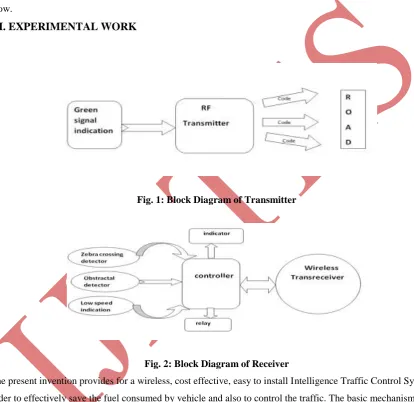
Fig. 1: Block Diagram of Transmitter
Fig. 2: Block Diagram of Receiver
The present invention provides for a wireless, cost effective, easy to install Intelligence Traffic Control System in
order to effectively save the fuel consumed by vehicle and also to control the traffic. The basic mechanism of this
system is based on wireless network and controller. We have assigned different codes to traffic signal. Each
traffic signal contains a reference code which is transmitted in all direction with the help of RF transmitter. When
green signal is ON, a particular code which we have assign to it only transmits for a short duration.
The RF receiver which is installed in the vehicle will receive the code and compare it with vehicle code. For
eight different directions we have assign 000 to 111 codes which as follows:
000 for North, 001 for North East, 010 for East, 011 for South East, 100 for South, 101 for South West, 110 for
186 | P a g e
Fig. 3: Codes According to Roads Fig. 4: Codes Assigned to Poles
Compass is fitted in the vehicle to detect the direction along which the vehicles are to be positioned. Once the
direction has been finalized the signal is given to the controller. The controller compares the code which is
generated from compass with reference code. The direction can be identified with help of digital compass. When
the two codes exactly match, then only the vehicles are allowed to move without any interruption.
If the code is mismatch it means the red signal is now ON. In this case, first it checks the condition for zebra
crossing. A standard range is prescribed say 100 meters, based on the traffic conditions of the respective signal.
As the vehicle enters into the zone, system firstly checks the condition for zebra crossing. If the vehicles are on
the zebra crossing then it disconnects the supply of fuel of vehicle from fuel tank by using relay contact.
If this condition is not satisfied then it will go for next condition that is obstacle detection. If the detector
founds the obstacle with the minimum spacing between two vehicles then it can disconnects the supply of fuel.
As the vehicles are entered into the specific range the system gives an indication, to slow the speed of vehicle.
The time duration of signal is also displayed on it.
Compass is fitted in the vehicle to detect the direction along which the vehicles are to be positioned. Once the
direction has been finalized the signal is given to the controller. The controller compares the code which is
generated from compass with reference code. The direction can be identified with help of digital compass. When
the two codes exactly match, then only the vehicles are allowed to move without any interruption.
If the code is mismatch it means the red signal is now ON. In this case, first it checks the condition for zebra
crossing. A standard range is prescribed say 100 meters, based on the traffic conditions of the respective signal.
As the vehicle enters into the zone, system firstly checks the condition for zebra crossing. If the vehicles are on
the zebra crossing then it disconnects the supply of fuel of vehicle from fuel tank by using relay contact.
If this condition is not satisfied then it will go for next condition that is obstacle detection. If the detector
founds the obstacle with the minimum spacing between two vehicles then it can disconnects the supply of fuel.
As the vehicles are entered into the specific range the system gives an indication, to slow the speed of vehicle.
The time duration of signal is also displayed on it.
IV. CONCLUSION
Most of the traffic control system now a day in developing countries are works based on fixed time concept, the
time for Green/Red signals are previously set on the basis of expected traffic densities. Such systems are not
dynamic and yields poor results in many situations. Comparatively newer trend is the use cameras at traffic
junctions and in high density areas for surveillance. But compared to the huge amount of money spend by the
187 | P a g e
Smart signing traffic control system provides a best solution for controlling the traffic, saving the fuel and
avoids violence against traffic rules. The fuel consumed by single vehicle for 60 seconds doesn‟t make much
difference in consumption of fuel, but if we consider number of vehicles present at traffic signal, it will definitely
make large difference. Through our project, we can save huge amount of fuel.
At the zebra crossing near traffic signal, the vehicles are turned off automatically, Due to this eventually the
government rules are being followed and this ultimately reduces the pollution. Pollution is also one of the factors
which we have considered. Carbon Dioxide and methane leaking through the vehicles reduces by 27% to 30%.
REFERENCES
[1] Jubair Mohammed Bilal, Don Jacob”, Intelligent Traffic Control System,” (ICSPC 2007), PP 496-499.
[2] Haimeng Zhao, Xifeng Zheng, Weiya Liu,” Intelligent Traffic Control System Based on DSP and Nios II”,
2009 International Asia Conference on Informatics in Control, Automation and Robotics,PP90-94.
[3] Wu Hejun, Miao Changyun,” Design of intelligent traffic light control system based on traffic flow”,2010
International Conference on Computer and Communication Technologies in Agriculture
Engineering. PP 368-371.
[4] Liang-Tay Lin, Hung-Jen Huang, Jim-Min Lin, Fongray Frank Young, “A New Intelligent Traffic Control
System For Taiwan”, ITST2009, PP 138-
142.
[5] Chen Zhaomeng, “Intelligent Traffic Control Central System of Beijing-SCOOT”, MACE 2010, PP 5067 –
5069.
[6] V.K. Sehgal, Nitin, D.S. Chauhan, R. Sharma,” Smart Wireless Temperature Data Logger Using IEEE 802.15.4/ZigBee Protocol”, IEEE Region 10 Conference TENCON