INTERNATIONAL RESEARCH JOURNAL OF PHARMACY
www.irjponline.com
ISSN 2230
–
8407
Research Article
A STUDY ON PHYTOCHEMICAL ANALYSIS OF PHYLLANTHUS TENELLUS ROXB.
Ananthagiri Komuraiah *, Ajmeera Ragan
Department of Botany, Kakatiya University, Warangal, Telangana state, India
*Corresponding Author Email: [email protected]
Article Received on: 02/06/17 Approved for publication: 28/06/17
DOI: 10.7897/2230-8407.086104
ABSTRACT
Phyllanthus tenellus is a dominant plant in herbaceous family to appear frequently in various humid environments in Warangal region in Telangana. This plant is used to treat different disease like urolithiasis, inflammatory bowel disease, diabetes and hepatitis B. The present study developed phylogenetic relationship with secondary metabolites and other related compounds of 2 other species of Phyllanthus belongs to family Euphorbiaceae. This investigation was to establish the phylogenetic relationship with secondary metabolites and other related compounds of Phyllanthus tenellus of Euphorbiaceae family. Among them, Phyllanthus tenellus shows unique relationship with secondary metabolites, protein related compound.
Keywords: Phytochemical analysis, Phyllanthus amarus, Phyllanthus emblica, Phyllanthus tenellus
INTRODUCTION
The Indian medicinal plants of the native flora are frenzied with little or no knowledge of their pharmacological properties. These plants are generally used for medical purposes other than those of home-grown and local communities. Furthermore, it is estimated that there is nearly 25,000 plant species are used for the production of worldwide medicines, including those synthesized from natural products and those are commercialized herbal medicines1. The toxicity of medicinal plants and the
resultant medicines from them may seem to be a little importance compared to that of conventional treatments. However, this is not the case for public health; the toxicity of medicinal plants is a serious problem2. The unfavorable effects
of plant medicines, of individual products or synergistic action i.e. interaction with other drugs, are currently unknown3.
Research on the plant medicines and derived drugs is still at an early stage, and the control of their commercialization by official agencies is not well maintained in free fairs, stores or public markets for natural products. Now a days, there are approximately 120 clinical products are used in allopathic medicine that are originated from plants used by indigenous groups. These plant drugs are extensively commercialized in various countries like France, Italy, United Kingdom, Asian countries and in the USA4.
Phyllanthus family is one of the largest and commonest plant families belong to Euphorbiaceae. Phyllanthus are used traditionally to treat different diseases like diabetes, hepatitis B and urolithiasis inflammatory bowel disease. One of the species of Phyllanthus is a “stone breaker” (quebra-pedra) is Phyllanthus tenellus Roxb. which is inhabitant to a common weed in humid environments and Brazilian tropical and sub-tropical regions5. This species is found in cultivated areas,
sidewalk edges land strips and garden seed beds. Various literature reported by scientists Phyllanthus tenellus Roxb. possesses immune modulatory, analgesic and anti-hepatitis
activity6-9. Regarding the chemical composition, different
authors examined different aerial parts of Phyllanthus tenellus Roxb10-11. Hence the present investigation was to establish the phylogenetic relationship with secondary metabolites and other related compounds of Phyllanthus tenellus of Euphorbiaceae family with 2 other Phyllanthus species i.e. Phyllanthus amarus
and Phyllanthus emblica of the same family
MATERIAL AND METHODS Plant materials
Three species of Phyllanthus plant materials were used (Table 1) of the family Euphorbiaceae were collected different areas of Telangana, India. Samples were deposited in Herbarium of Botany Department, Kakatiya University. The whole plants were oven dried at 60°C for one week, and powdered and stored in airtight containers. 10 g of each of the powdered plant materials were extracted in a soxhlet extractor containing 40 ml of 80% methanol. The resulting extracts were evaporated under reduced pressure. The plant specimens were collected with flower and fruit for the purpose of determination of their identity. The specimens were identified with the help of volume II of Flora of the Presidency of Madras12 and the current global
taxonomic literature and e-floras on Euphorbiaceae. A brief description of each and every taxon studied is provided using the standard, universally accepted terminology for comparison and assessment of their morphological relationships. It is intended to provide a contrast to the chemical relationships currently revealed.
Amino Acids
of the amino acids. The chromatographic separation was carried out on Whatman No.1 chromatographic paper (28 x 23 cm). A fraction (0.01ml) of the extract was used for separation. The solvent system used in the first direction was BAW (n-butanol: Acetic acid: Water; 4:1:1 v/v). In the second direction, the paper was placed perpendicular to the first in the solvent containing phenol and water (4:1).
The paper was rolled into a vertical cylinder and the chromatogram was run in a chromatographic chamber (cylindrical glass jar). The paper after development was dried and sprayed with 0.2% ninhydrin in acetone. It was allowed to air dry. Then it was kept in hot air oven for 10 minutes, maintained at 60oC, comparing the R
F values with authentic samples (Loba-chemei Indoaustranal Co, Bombay), the amino acids were identified. The RF (mobility relative to front) values (0.01-0.99), which did not tally with those of the standards, were designated as A-W.
The RF values were calculated as:
RF=
The distance travelled by compound The distance travelled by solvent
Phenolic Acids
The phenolic acids are ubiquitous in almost all the plant groups. Therefore, an attempt has been made to survey the phenolic acids and secondary metabolites, both known and unknown, present in the 3 taxa of South Indian Euphorbiaceae (Table 2). The shade dried plant material of various species of Phyllanthus
are first made free from dust and then boiled in 2N HCl for about 20 minutes on water both. It was then filtered and cooled. The filtrate was then extracted with diethyl ether. This was repeated twice or thrice. The extract was then concentrated and it was used for two dimensional ascending paper chromatography. Whatman No. 1 chromatographic paper of 20 x 20 cm dimensions was used. A vertical line leaving a margin of 3 cm from the left and a horizontal line, 3 cm above the lower margin of the paper, were drawn. With a micropipette, the concentrated ether extract was applied on the point of interaction of these two lines. After it is dried up, the same was repeated. The solvent system used in the first direction was 1% HCl propanol: ammonia: water (10:1:4 v/v) were used in the second direction. The procedure regarding the in-rolling of the filter paper and its lowering into the chromatographic chamber containing the solvent system was the same adopted for the amino acids. The solvent system was allowed to run for about 2 hr in the second direction.Every time the chromatographic paper was removed from the chamber, the solvent front was marked before it was allowed to dry while hanging to a rope with plastic clips. Then, the paper was sprayed with ninhydrin (prepared in acetone) for the development of spots. The chromatographic paper was again allowed to dry in the air. A number of spots of different colours developed on the chromatographic paper. With a pencil, the spots were ringed and their central points were
noted to calculate the Rf values in both the directions. The spots were identified by comparing the position, colour and Rf values of these spots with those of the authentic samples of phenolic acids run earlier under identical conditions. Apart from the spots identified, a number of other spots with different colours and hRf values (100 x Rf) which did not tally with those of authentic samples were also noted. These were treated as ‘unknown’ phenolic acids and designated as A-Z, AA-AZ and BB-BR with their hRf values.
Secondary Metabolites
Eight secondary metabolites, namely alkaloids, ellagic acid, iridoids, lignans, methylene-dioxy compounds, steroids, tannins and terpenoids were tested for their presence using the standard phytochemical tests13-17. The following chemical tests were
employed to identify the secondary metabolites (Table 2).
RESULTS AND DISCUSSION Amino acids
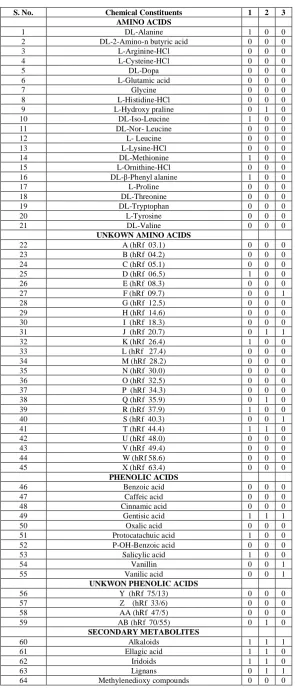
21 amino acids are detected in the 3 species of Phyllanthus investigated (Table.2). Besides, there are 24 non-protein amino acids present in them. The commonly found amino acid is L-Proline. It is present in all 3 species of Phyllanthus (P.amarus, P.emblica, P.tenellus). D.L Alanine was observed in P.amarus, P.tenellus. DL.Isoleucine and DL-Methionine are common in
P.amarus, L-Hydroxy Proline is present in P.emblica whereas DL-Dopa, Glycine, L-Histidine HCl L-Lysine HCl. Were found in P.tenellus. Were observed that maximum amino acids are found in P.tenellus among the Phyllanthus species are taken. T(hRf 44.4) occurs in P.amarus, P.emblica, P.tenellus whereas F(hRf 9.7) is found in P.tenellus J(hRf 20.7) is observed in
P.emblica, P.tenellus. The non-protein amino acids C(hRf 5.1), K(hRf 26.4), R(hRf 37.9) are found in P.amarus and the non-protein amino acids S(hRf 40.3) present P.tenellus and Q(hRf 35.9) observed in P.emblica given in table 2.
Phenolic acids
There are 10 Known and 4 unknown phenolic acids detected in the 3 species of Phyllanthus. Of the known phenolic acids Gentisic acid present in all species of Phyllanthus. Protocatechuic acid is present P.amarus and P.tenellus. Vanillic acid are present in P.tenellus. Salicylic acid is present in
P.amarus.The unknown phenolic acid AB(hRf 70/55) is present in P.tenellus only other secondary metabolites. 3 species of
Phyllanthus were tested for 8 secondary metabolites alkaloids are present in all species. While ellagic acid iridoids and steroids are found in both the species of P.amarus and P.emblica. Lignins, Tannins are characteristics of two species of P.amarus
and P.tenellus. Tri, tetraphenols are found in P.emblica
methylenedioxy compound is absent in all species of
Phyllanthus.
Table 1: The species of Euphorbiaceae examined for phytochemical study
S. No. Name of the Taxa Source
1 Phyllanthus amarus Schum. & Thonn. A.Komuraiah1812,Hanamkonda,TS
2 Phyllanthus emblica L. V.S.Raju & A. Ragan 1815, Hanamkonda, TS
3 Phyllanthus tenellus Roxb. A. Komuraiah 1828, Hanamkonda, TS
Table 2: Distribution of chemical constituents in Phyllanthus
S. No. Chemical Constituents 1 2 3 AMINO ACIDS
1 DL-Alanine 1 0 0 2 DL-2-Amino-n butyric acid 0 0 0 3 L-Arginine-HCl 0 0 0 4 L-Cysteine-HCl 0 0 0 5 DL-Dopa 0 0 0 6 L-Glutamic acid 0 0 0 7 Glycine 0 0 0 8 L-Histidine-HCl 0 0 0 9 L-Hydroxy praline 0 1 0 10 DL-Iso-Leucine 1 0 0 11 DL-Nor- Leucine 0 0 0 12 L- Leucine 0 0 0 13 L-Lysine-HCl 0 0 0 14 DL-Methionine 1 0 0 15 L-Ornithine-HCl 0 0 0 16 DL-β-Phenyl alanine 1 0 0 17 L-Proline 0 0 0 18 DL-Threonine 0 0 0 19 DL-Tryptophan 0 0 0 20 L-Tyrosine 0 0 0 21 DL-Valine 0 0 0
UNKOWN AMINO ACIDS
22 A (hRf 03.1) 0 0 0 23 B (hRf 04.2) 0 0 0 24 C (hRf 05.1) 0 0 0 25 D (hRf 06.5) 1 0 0 26 E (hRf 08.3) 0 0 0 27 F (hRf 09.7) 0 0 1 28 G (hRf 12.5) 0 0 0 29 H (hRf 14.6) 0 0 0 30 I (hRf 18.3) 0 0 0 31 J (hRf 20.7) 0 1 1 32 K (hRf 26.4) 1 0 0 33 L (hRf 27.4) 0 0 0 34 M (hRf 28.2) 0 0 0 35 N (hRf 30.0) 0 0 0 36 O (hRf 32.5) 0 0 0 37 P (hRf 34.3) 0 0 0 38 Q (hRf 35.9) 0 1 0 39 R (hRf 37.9) 1 0 0 40 S (hRf 40.3) 0 0 1 41 T (hRf 44.4) 1 1 0 42 U (hRf 48.0) 0 0 0 43 V (hRf 49.4) 0 0 0 44 W (hRf 58.6) 0 0 0 45 X (hRf 63.4) 0 0 0
PHENOLIC ACIDS
46 Benzoic acid 0 0 0 47 Caffeic acid 0 0 0 48 Cinnamic acid 0 0 0 49 Gentisic acid 1 1 1 50 Oxalic acid 0 0 0 51 Protocatachuic acid 1 0 0 52 P-OH-Benzoic acid 0 0 0 53 Salicylic acid 1 0 0 54 Vanillin 0 0 1 55 Vanilic acid 0 0 1
UNKWON PHENOLIC ACIDS
56 Y (hRf 75/13) 0 0 0 57 Z (hRf 33/6) 0 0 0 58 AA (hRf 47/5) 0 0 0 59 AB (hRf 70/55) 0 1 0
SECONDARY METABOLITES
65 Tannins 0 1 1 66 Steroids 1 1 0 67 Triterpenoids 0 1 0
Table 3: Phyllanthus plant secondary metabolites and chemical test
S.No. Secondary metabolites Chemical Test
1. Alkaloids Alkaloids test 2. Ellagic acid Ellagic acid test 3. Iridoids Trim-Hill test 4. Lignans Badouni test 5. Methylene-dioxy compounds Labat test 6. Steroids Salkowski reaction 7. Tannins Tannin test 8. Triterpenoids Libermann-Burchard test
Table 4: Paired, Group Affinity and Isolation Values of genera of Phyllanthus
Taxa Taxa IV
1 2 3 GA IVi IVn
1 100 50 36 186 40 8.95
2 100 45 195 23.07 4.47
3 100 181 50 13.43
1.Phyllanthus amarus; 2. Phyllanthus emblica; 3. Phyllanthus tenellus
GA = Group Affinity; IV = isolation Values; Ivi = Individual isolation value, Ivn = The percentage of unique characters with in a taxon with respect to the grand total of all different characters in all taxa
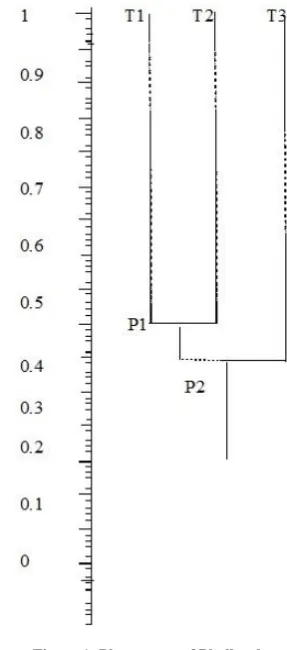
Figure 1: Phenogram of Phyllanthus
T1. Phyllanthusamarus; T2. Phyllanthusemblica ; T3. Phyllanthustenellus.
Phytochemical diversity
The micromolecules found in the plants are innumerable in the present study, only the amino acids, phenolic acids and select secondary metabolites were chosen of these, as is expected, the greater number of species studies, the higher is the number or diversity of the compounds detected, therefore, the discussion is a comparison within the group (Genus Phyllanthus) as regards to
unique character are high (Ivi) (40) and (Ivn) 8.95, Ivi (23.07) and Ivn (4.47) as such because of unique in nature
Phenetic relationship
The numerical assessment of the micromolecules in Phyllanthus
are examined through the construction of dendrograms for the species of Phyllanthus the pointers are justified phenons between 50% and 45.5%, therefore, P.amarus T1 and P.emblica
T2 join at 0.5 to form a group P1 (Figure 1) are allied pair than each other to P. tenellus (T3) with which they join at 0.40. The geographic evidence and economic value also reflect this point.The profile of three medicinal plants used in this study is shown in (Table 1). Tests were conducted in the presence of phytochemicals in all of these methanolic extracts (Table 2). Lignans, tannins and phenols were detected in all the 3 tested plants. These results are in parallel to the earlier studies conducted on terpenes, alkaloids, lignans, flavonoids and tannins in Phyllanthus species18-21. The difference in the
findings might be due to the nature of the solvent used for extraction, which determines the presence or absence of a metabolite in the extract.
CONCLUSION
The present study of phylogenetic relationship based on secondary metabolites and other related compounds of 3 species of Phyllanthus. Among them, Phyllanthus tenellus shows the unique relationship with secondary metabolites, protein related compound and their antimicrobial activities.
ACKNOWLEDGMENT
Dr. A. Komuraiah, acknowledges the financial assistance from the University Grants Commission (UGC), New Delhi as the Minor research grant
REFERENCES
1. Reston JC, Lima OEC. As pequenas empresas e a biodiversidade. Rev. SEBRAE. dez.2001/Jan.2002;1:66-9. 2. Veiga Jr, Valdir F, Pinto Angelo C, Maciel, Maciel, Maria
Aparecida M. .Plantas medicinais: cura segura?. Quím. Nova [online]. 2005;28(3):519-28. http://dx.doi.org/ 10.1590/S0100-40422005000300026.
3. Oga S. Fundamentos de Toxicologia. 2nd ed. São Paulo: 2003. Atheneu; p. 696.
4. Lapa AJ, Souccar C, Lima-Landman MTR, Godinho RO, De Lima TCM. Farmacologia e toxicologia de produtos naturais. In: Simões CMO, Schenkel EP, Gosmann G, Mello JCP, Mentz LA, Petrovick PR. Farmacognosia: da planta ao medicamento. 3ª ed. Porto Alegre: Ed. da Universidade UFRGS; 2001. p. 183.
5. Silva MJ, Sales MF O. genero Phyllanthus L. (Phyllantheae
- Euphorbiaceae Juss.) no bioma Caatinga do estado de Pernambuco – Brasil. Rodriguesia. 2004;55(84):101-26. 6. Ignacio SRN, Ferreira JLP, Almeida MB, Kubelka CF.
Nitric oxide production by murine peritoneal macrophages
in vitro and in vivo treated with Phyllanthus tenellus
extracts. Journal of Ethnopharmacol. 2001;74 (2): 181-7. 7. Santos AR. Analgesic effects of callus culture extracts from
selected species of Phyllanthus in mice. J.Pharm. Pharmacol. 1994. 46(9): 755-759.
8. Shead A, Vickery K, Pajkos A, Medhurst R, Freiman J, Dixon R, Cossart Y. Effects of Phyllanthus amarus plant extracts on duck Hepatitis B virus in vitro and in vivo. Antiviral. Research. 1992.18:127-38.
9. Venkateswaran PS, Millman I, Blumberg BS Effects of an extract from Phyllanthus niruri on hepatitis B and woodchuck hepatitis viruses: in vitro and in vivo studies. Proc Natl Acad Sci USA. 1987;84(1):274-8.
10.Vickery ML, Vickery B. Secondary Plant Metabolism. Hong Kong: The Macmillan Press Ltd; 1981.
11.Santiago LJM, Louro RP,Oliveira DE. Compartmentation of phenolic compounds and phenylalanine ammonia-lyase in leaves of Phyllanthus tenellus Roxb. and their Induction by Copper Sulphate. Annals of Botany. 2000;86(5):1023-32. 12.Gamble JS 1925. Euphorbiaceae Flora of the Presidency of
Madras. Vol 2. Adlards & Son, Limited, London.
13.Gibbs RD 1974. Chemotaxonomy of Flowering Plants. I-IV.McGill Queen’s University Press: Montreal
14.Harbone JB. Phytochemical Methods: A Guide to Modern Technique of Plant Analysis. 3rd Edition. London: Chapman
and Hall 1988.
15.Nageshwar G. Chemotaxonomy of Some Caesalpiniaceae. Ph.D. thesis. Osmania University, Hyderabad 1986. 16.Ragan A. Chemotaxonomic Study of some South Indian
Cyperaceae. Ph.D. thesis. Kakatiya University, Warangal1993.
17.Samata A.Chemosystematics of the Genus Crotalaria (Papilionaceae). Ph.D. thesis. Kakatiya University. Warangal 2006.
18.Komuraiah A, Bolla K, Rao KN, Ragan A, Raju VS & Singara Charya MA. Antibacterial studies and phytochemical constituents of South Indian Phyllanthus species. African Journal of Biotechnology. 2009.19: 4991–4995.
19.Vongvanich N, Kittakoop P, Kramyu J, Tanticharoen M, Btaranonth Y Phyllanthusols A and B, Cytotoxic Norbisabolane Glycosides from Phyllanthus acidus Skeels. J. Org.Chem 2000. 65:5420-5423.
20.Houghton RA, Hackler JL & Lawrence KT the U.S. carbon budget: contributions from land-use change, Science, , 1999. 285: 574–578.
21.Lin MH, Nguyen H, Bour B, Abmayr SM, Dybala C, Storti, RV Drosophila myocyte-specific enhancer-binding factor 2 (D-MEF2) is a regulator of D. Tropomyosin I gene expression and muscle development. A. Dros. Res. Conf 1995. 36: 80A.
Cite this article as:
Ananthagiri Komuraiah and Ajmeera Ragan. A study on phytochemical analysis of Phyllanthus tenellus Roxb. Int. Res. J. Pharm. 2017;8(6):95-99 http://dx.doi.org/10.7897/2230-8407.086104
Source of support: Nil, Conflict of interest: None Declared