438 | P a g e
BIOLOGICAL COMPUTING: A NEW PARADIGM IN
COMPUTING
Mini Singh Ahuja
1, Samriti Sharma
21
Assistant Professor,
2Student
Department of Computer Science, Regional Campus Gurdaspur, Punjab, (India)
ABSTRACT
Advancement in computer science has played a vital role in addressing and solving problems in molecular biology,
including the decoding of the human body. In this paper we are reviewing new computational techniques which are
used to process, analyze, visualize and solve many complex biological problems which seems to be unapproachable
until a few years ago.
I. INTRODUCTION
Biological computing is about computers composed of different biological parts which are used to store and
manipulate data to process in the human body. Biological computing is one of the new fields in research which deals
with both computer science and Biology. The biological computers are mostly used for medical applications. The
biological computer is made up of RNA (Ribonucleic Acid), DNA (Deoxyribonucleic Acid), and proteins. The
biological computer can also perform simple mathematical calculations. A new computing paradigm enables the
researcher to build an array or a system of biosensors that has the ability to detect or target specific types of cells
that could be found in the patient's body. These computing can also be used to carry out or perform target-specific
medicinal operations that can provide medical procedures or remedies according to the doctor's instructions.
Computational biology depends upon functional genomics, analysis of protein structures, and biomolecular
computation. These days researchers are trying to solve many complex biological problems which were
unapproachable earlier. With this they are taking a closer look at the possibility of developing alternative models of
computation. Biological computing nowadays is used for developing geometric techniques and paradigms for
representing, storing, searching, analyzing, and visualizing different biological structures. In essence, biological
computing is about supporting the potential of the DNA for the benefit of human being just by manipulating the
439 | P a g e
II. DNA
DNA, or deoxyribonucleic acid, is the hereditary material in humans and other organisms. Nearly every cell in a
person’s body has the same DNA. The structure of DNA was first identified by Watson and Crick (1953). The
earliest discovery of DNA was by Swiss physician Fritz Miescher in cell nuclei as early as 1868. The information in
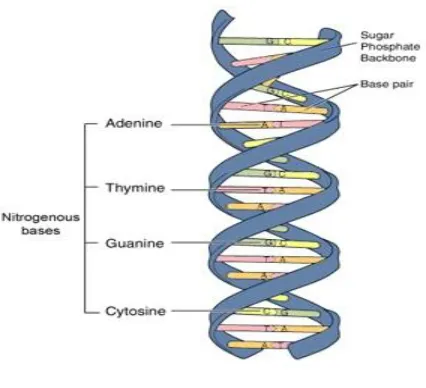
DNA is stored as a code made up of four chemical bases: adenine (A), guanine (G), cytosine (C), and thymine (T).
Human DNA consists of about 3 billion bases, and more than 99 percent of those bases are the same in all people.
The order, or sequence, of these bases determines the information available for building and maintaining an
organism, similar to the way in which letters of the alphabet appear in a certain order to form words and sentences.
These DNA bases pair with each other.
A is always opposite T;
T is always opposite A;
G is always opposite C;
C is always opposite G.
Fig 1: The Structure of the DNA
DNA does not usually exist as a single molecule, but instead as a tightly-associated pair of molecules. These two
long strands entwine like vines, in the shape of a double helix. DNA has an important property that it can replicate,
or make copies of itself.
The nucleotide contains both the segment of the backbone of the molecule and a base, which interacts with the other
DNA strand in the helix. A base linked with a sugar is called a nucleoside and a base linked with a sugar is called a
440 | P a g e
III. CURRENT COMPUTERS Vs BIOLOGICAL COMPUTETRS
Current computers use registers to flip the binary between 1 and 0. But microorganisms use the same ―Registers
and flip-flop occurs but at the DNA level. Adenine (A), guanine (G), cytosine (C), and thymine (T) can be the
registers that are involved in protein synthesis. Any change to this structure or inhibition of the normal protein
synthesis by changes in environment results in a completely new product; worse in some cases if no product is
created. This is the whole idea behind using DNA in biological computing. DNA is intelligent and has the ability to
adapt to changing conditions far surpasses anything and everything one could imagine.DNA also has the ability to
repair itself; provide backup; create new patterns; select the best for its survival . Most complex computers exhibit
the above in one way or the other. As a DNA has to survive in nature, only the fittest survive and hence the ability to
adapt to changing environment. However the same environment (extreme heat, chemicals, Ultra Violet rays, etc.)
can sometimes causes changes to DNA that may make them loose some of their magic and in carries to successfully
replicate thereby passing some cases can be catastrophic. The main component of a biological computer is DNA
DNA Computers are small, fast and highly efficient computers which have dense data storage capacity. They can
perform massively parallel computation and are highly energy efficient systems.
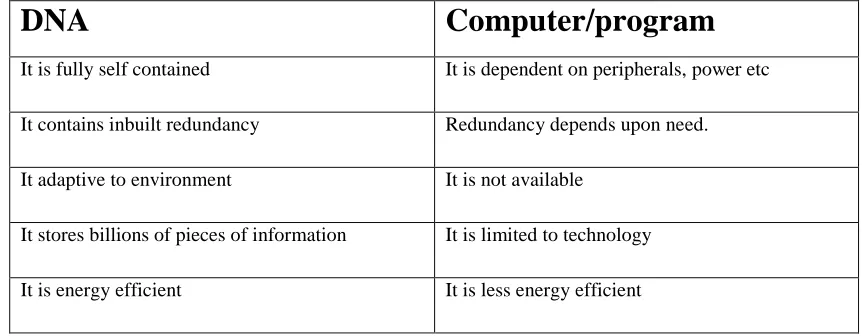
Table 1: DNA Vs Computer
IV. MECHANISM INVOLVED
Biological computers are made inside a patient’s body. The information of the patient’s body is called a blueprint
along which lies the biological computer. Once the computer’s genetic blueprint has been provided, the human body
will start to build it on its own using the body’s natural biological processes and the cells found in the body.
Through Boolean logic equations, we can easily use the biological computer to identify all types of cellular activities
and determine whether a particular activity is harmful or not. The cellular activities that the biological computer
could detect can even include those of mutated genes and all other activities of the genes found in cells. As with
DNA
Computer/program
It is fully self contained It is dependent on peripherals, power etc
It contains inbuilt redundancy Redundancy depends upon need.
It adaptive to environment It is not available
It stores billions of pieces of information It is limited to technology
441 | P a g e
conventional computers, the biological computer also works with an output and an input signal. The main inputs ofthe biological computer are the body’s proteins, RNA, and other specific chemicals that are found in the human
cytoplasm. The output on the other hand could be detected using laboratory equipment.
V. ADVANTAGES OF BIOLOGICAL COMPUTERS
Parallel Computing- Biological computers are massively parallel.
Incredibly light weight- With only 1 LB of DNA we can have more computing power than all the
computers ever made.
Low power- The only power needed is to keep DNA from denaturing.
Solves Complex Problems quickly- A DNA computer can solve hardest of problems in a matter of weeks.
VI. LIMITATIONS
Sometimes there occur errors as the molecular operations are not perfect.
The increase or decrease of efficiency is calculated by examining the number molecules contributed.
The problem of encoding in molecules is difficult.
DNA computing involves a relatively large amount of error
.
With the increase in the size of problem, probability of receiving incorrect answer becomes greater than
probability of receiving correct answer
.
VII. APPLICATIONS
The biological computer is a device which is used in various medical applications where intercellular
evaluation and treatment are needed or required.
It is especially useful in monitoring intercellular activity including mutation of genes.
Through it, a doctor can focus on or find and treat only damaged or diseased cells.
With biological computer selective cell treatment is made possible.
It involve many possible applications like Pattern recognition, Cryptography, Evaluating gene sequence
and many more.
It is used in different Medical Application such as developing disease treatments such as cancer.
VIII. FUTURE OF BIOLOGICAL COMPUTING
While we live in the age of computers, biological computing is slowly gaining importance but without much show.
Biological computing has played a vital role in modern medicine and will continue to do so, but to see a computer
being entirely regarded by microorganisms/DNA is far away. We are not even close enough to say that the next
442 | P a g e
professionals who are wedded to silicon chips it is time to look at the future and prepare for the next big thing incomputers.
The future for biological computing is bright. Already some of the medical/industrial products like Vaccines,
Insulin (for diabetes treatment) are benefiting from this research. Most of the design/patterns coming out of various
software companies have already been in existence in nature (DNA) and all we need to do to effectively use the
DNA is to reverse engineer, understand the inner workings and make it fit to work to our requirements. The
popularity of Nano technology offer more avenues to use DNA. Under laboratory conditions, DNA self-assembly
has been demonstrated successfully, simple patterns that are visible through microscopy has been used successfully
for simple computations such as counting, XOR, and addition.
IX. CONCLUSION
Biological computing is a field which aims to extract the power of computing from the combined action of large
numbers of biological molecules. In biological computers the CPU is replaced by biological molecules. Biological
computer is a parallel machine where each processor consists of a single biological molecule. One part of the system
can be made up of biological components and the other one by using the current or new hardware that may become
available which gives us the combined benefit of both systems.
Biological organisms regularly convert data about the macroscopic world gathered by senses in to a form that
influences biology at molecular level. It is an idea to look to real biological systems for solutions to particular
problems. A computational micro architecture based on membrane justifies the name biological computing as
opposed to molecular computing.
REFERENCES
[1] http://www.faadooengineers.com/attachm ent.php
[2] http://www.omicsonline.org/biological-computers-their- echanism
[3] http://www.technologyreview.com/computin g/12087