ENERGY EFFICIENT ROUTING TECHNIQUE IN
WIRELESS SENSOR NETWORK
Kavita More
1, Anil A. Bharate
21
PG Scholar,
2Assistant Professor,
Dept of CSE,
BLDEA’s Dr. P. G. Halakatti College of Engineering and Technology Vijapur (India)
ABSTRACT
Energy conservation in Wireless Sensor Network(WSN) has always been the most crucial issue, for the sensor
nodes are all powered by limited capacity battery sources which are difficult, if not impossible, to replace or
recharge due to the inherent nature and types of applications WSN is used for. Therefore, energy efficient
design of WSN has drawn considerable attention from many researchers resulting in quite a good number of
approaches for saving the precious and limited energy of the sensor nodes. In this paper, a comprehensive list
of these EER protocols have been studied having classified them into proper categories. The relative advantages
and disadvantages of the protocols are also discussed while the protocols are evaluated based on certain
performance metrics at the end of the paper.
Keywords: Wireless Sensor Network, Energy Conservation Routing, EER
I. INTRODUCTİON
A Wireless Sensor Network (WSN) consists of a collection of some sensing stuffs usually called sensors which
observes an event or gathers some physical data from its area of interest, processes the observed or gathered data
by a tiny processor embedded in it and sends processed data via a short range radio transmitter to a central data
collector usually called sink either directly or through intermediate sensor nodes. All these activities in a sensor
node are carried out by limited energy battery sources which drain out in course of time as these activities are
carried out. Therefore, energy conservation has always been a vital factor and a major challenge in the design of
WSN. Although WSN is a class of ad hoc network, routing techniques for WSN widely differ from that of the
traditional ad hoc networks mainly for its energy constrained nature. WSN routing approaches are compelled to
find out routes that ultimately result in prolonged network life time, rather than focusing on routes with shortest
distance, minimum delay or maximum bandwidth. Therefore, considerable research has been conducted on
routing data in WSN where the main focus has been on reducing energy consumption giving rise to a new class
of routing called Energy Efficient Routing (EER). And hence the dominant EER protocols for WSN are
explored with proper classification. And a comparative study of the EER protocols is also carried out.
II.RELATED WORK
S. Kaur, D. Prashar[7] and R.Rani,“Improvement in energy efficiency of Wireless Sensor Network”, have
proposed Improvement in energy efficiency of Wireless Sensor Network. In this scheme WSN the energy
efficiency is the greatest topic for the research purpose. Clustering in the wireless sensor network is very
important to increase the lifetime of the network. There are several numbers of protocol which is based on it
A Hybrid Relative Distance[8] H. Gao, H. Li and Y. Cheng proposed “A Hybrid Relative Distance Based
Cluster Scheme for Energy Efficiency in Wireless Sensor Networks e Based Cluster Scheme for Energy
Efficiency in Wireless Sensor Networks. In this scheme energy efficiency is of great importance for wireless
sensor network. A popular way for saving the energy of the node is construct the cluster of the networks for data
collecting and transmitting. This paper studies the distributed cluster algorithm to improve the energy efficiency
Doohan, N.V [9] Mishra, D.K. Sanjiv Tokekar, “Shortest Path Routing Protocol (SPRP) for Highly Data
Centric Wireless Sensor Networks”. stuided on Data Centric protocols .where In data-centric routing , base
station (BS) sends queries to certain area and waits for the data values from sensors located in that selected area.
[10] C. Intanagonwiwat, R. Govindan, and D. Estrin, "Directed diuffusion a scalable and robust communication
paradigm for sensor networks," C. Intanagonwiwat et. al. proposed a popular data aggregation paradigm for
WSNs, called directed diffusion. Directed diffusion is a data-centric (DC) and application-aware paradigm in
the sense that all data generated by sensor nodes is named by attribute-value pairs. The main idea of the DC
paradigm is to combine the data coming from diffusion sources (in-network aggregation) by eliminating
redundancy, minimizing the number of transmissions; thus saving network energy and prolonging its lifetime
III. ENERGY EFFICIENT ROUTING TECHNIQUE IN WSN
The main goal of any Energy Efficient Routing (EER) protocol for WSN is to maximize network lifetime by
minimizing energy consumption in end-to-end transmission.The EER protocols for WSN are categorized in this
paper as follows:
• Data Relaying Protocols
• Data Centric Protocols
• Hierarchical or Clustering-based Protocols
• Location-based or Geographical Protocols
3.1Data Relaying Protocols
Data relaying protocols are very simple in nature and easy to implement as they don't require any routing table
nor do they require maintaining topology information about the network. Gossiping ,Flossiping, and LGossiping
are some popular protocols of this family.
3.1.1 Gossiping
A Gossiping [3] was proposed as an improvement over the straight forward flooding mechanism with a view to
overcoming the implosion problem with flooding. Implosion is a phenomenon where a node broadcasts a packet
to all of its neighbors which in turn continue with broadcasting the packet creating multiple copies of the same
packet in the network. On the other hand, Gossiping doesn't broadcast a packet to all the neighbors, rather only
to a single one chosen randomly which in turn forward the packet randomly to one of its neighbors including the
one from which it received the packet. This process continues until the ultimate destination is reached.
Gossiping reduces energy consumption over flooding to a great extent, but it heavily suffers from long
propagation delay.
3.1.2 Flossiping
Y. Zhang and L. Cheng proposed Flossiping [4] which is a balance between flooding and Gossiping. When a
node has a packet to send, it decides a threshold value and then forwards the packet in Gossiping mode by
saving the threshold in the packet header. Receiving the packet, a neighbor node generates a random number
3.1.3 LGossiping
LGossiping [5] proposed by S. Kheiri et. al. requires the nodes to have their location information available
through GPS. Actually, it improves over Gossiping
by choosing a known neighbor that is closer to the source based on GPS location information. Thus, it reduces
the long latency problem of Gossiping, but introduces some extra cost for GPS device per node.
3.2 Data Centric Protocols
In data centric routing [9], all nodes have equal and same functions. Global identification to each sensor node is
very difficult to assign in wireless sensor networks because the deployment of sensor network is very dynamic
and dense. In data-centric routing base station (BS) sends queries to certain area and waits for the data values
from sensors located in that selected area. To specify the properties of data,an attribute-based naming scheme is
used to provide facilities in data-centric characteristics of sensor queries.
3.2.1 Spin
Sensor Protocols for Information via Negotiation)Adaptive Protocols for Information Dissemination in Wireless
Sensor Networks (SPIN) overcame the limitations of Implosion, Overlapping, and Resource Blindness of the
traditional data flooding protocols by negotiating meta-data among the nodes before transmitting real data.
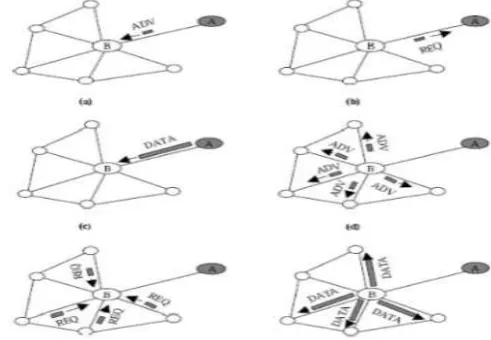
Whenever a node has some new data to share, it sends an ADV message to its neighbors who then place a
request to get the new data if they haven't already availed it via a REQ message in response to the ADV
message. Eventually, the originator of the ADV message sends the real data to all REQ message issuers via
DATA message to complete the whole process. Figure 1, shows the phases of SPIN. While SPIN achieves a
reduction in energy consumption by a factor of 3.5 less than that of flooding, it can't guarantee the delivery of
data in case the potential neighbors are far away from the ADV message generator (i.e. source node) and the
nodes in between the source and destination are not interested in the new data.
Figure 1. SPIN protocol. (a) Node A starts by advertising its data to node B. (b) Node B responds by sending a
request to node A. (c) After receiving the requested data. (d) node B then sends out advertisements to its
neighbours, (ef) who in turn send requests back to B.
3.2.2 Modified Spin (Mspin)
MSPIN transmits information only to sink node instead of the whole network thereby making the response to
the sink faster than SPIN. Here, total number of packet transmissions is less than SPIN. Therefore a significant
3.2.3 Directed Diffusion
In [10], C. Intanagonwiwat et. al. proposed a popular data aggregationparadigm for WSNs, called directed
diffusion. Directed diffusion is a data-centric (DC) and application-aware paradigm in the sense that all data
generated by sensor nodes is named by attribute-value pairs.The main idea of the DC paradigm is to combine
the data coming from different sources e(in-network aggregation) by eliminating redundancy, minimizing the
number of transmissions; thus saving network energy and prolonging its lifetime. Unlike traditional end-to-end
routing, DC routing¯ nodes routes from multiple sources to a single destination that allows in-network
consolidation of redundant data. In directed diffusion, sensors measure events and create gradients of
information in their respective neighborhoods. The base station requests data by broadcasting interests. Interest
describes a task required to be done by the network. Interest diffuses through the network hop-by-hop, and is
broad-cast by each node to its neighbors. As the interest is propagated throughout the network, gradients are
setup to draw data satisfying the query towards the requesting node, i.e., a BS may query for data by
disseminating interests and intermediate nodes propagate these interests. Each sensor that receives the interest
setup a gradient toward the sensor nodes from which it receives the interest.
This process continues until gradients are setup from the sources back to the BS. More generally, a gradient
specifies an attribute value and a direction. The strength of the gradient may be different towards different
neighbors resulting in different amounts of information. At this stage, loops are not checked, but are removed at
a later stage. Figure 2 shows an example of the working of directed diffusion ((a) sending interests, (b) building
gradients, and (c) data dissemination). When interests ¯t gradients, paths of information are formed from
multiple paths and then the best paths are reinforced so as to prevent further according to a local rule. In order to
reduce communication costs, data is aggregated on the way. The goal is to ¯and a good aggregation tree which
gets the data from source nodes to the BS. The BS periodically refreshes and re-sends the interest when it starts
to receive data from the source(s). This is necessary because interests are not reliably transmitted throughout the
network.
Directed diffusion differs from SPIN in two aspects. First, directed diffusion issues on demand data queries as
the BS send queries to the sensor nodes by some tasks. In SPIN, however, sensors advertise the availability of
data allowing interested nodes to query that data. Second, all communication in directed diffusion is
neighbor-to-neighbor with each node having the capability of performing data aggregation and caching. Unlike SPIN,
there is no need to maintain global network topology in directed diffusion. However, directed diffusion may not
be applied to applications (e.g.,environmental monitoring) that require continuous data delivery to the BS. This
is because the query-driven on demand data model may not help in this regard. Moreover, matching data to
queries might require some extra overhead at the sensor nodes.
3.3 Hierarchical or Clustering-based Protocols
S.Kaur et al [7] have proposed Improvement in energy efficiency of Wireless Sensor Network. In this scheme
WSN the energy efficiency is the greatest topic for the research purpose. Clustering in the wireless sensor
is based on it but here the LEACH protocol is used for clustering .In LEACH each node has to equal probability
of select as the cluster head .In each round the cluster head is change because every node has equal probability
for selecting as a cluster head .In this paper the focus is on the approach how could the number of cluster head
are limited in the network if there are limited number of cluster head in the network than the lifetime of the
network is increased and decrease the energy dissipation per node. H.Gao et al [8] have proposed A Hybrid
Relative Distance Based Cluster Scheme for Energy Efficiency in Wireless Sensor Networks. In this scheme
energy efficiency is of great importance for wireless sensor network.
A popular way for saving the energy of the node is construct the cluster of the networks for data collecting and
transmitting. This paper studies the distributed cluster algorithm to improve the energy efficiency .We observe
that the cluster head has to lie within the range of transmission of the base station and the distance between the
cluster head and sink node for energy consumption. Author have proposed the HRDCS scheme which is based
on the distance between CH and BS and the energy consumption at the time of cluster head selection. Guo et al
have proposed the Analysis and Optimization of Energy Efficient Cluster Forming for Wireless Sensor
Networks. In this scheme Wireless Sensor Network should operate without protection for the long time before
the replacement of battery; therefore characteristics such as self-organization and energy efficiency are of at
most importance to the WSN. In the WSN we have meet with all these requirement by dividing the WSN
network into clusters, where each the cluster managed by a cluster head. In this paper we provide the analysis of
energy consumption in a clustered network and gain of energy with different number of nodes in the network.
This analysis is generally proposed for minimize the energy consumption at the time of cluster head selection by
the less cluster head selection. This provides the lifetime of the network isprolonged and easy to maintain the
network.
3.4 Location-based or Geographical Protocols
Location based or geographical protocols rely on the location information of the sensor nodes to find out the
most energy efficient path between a source node and the sink or the cluster head. Location information is
usually made available to the nodes by the use of GPS devices as it gives very accurate location information but
imposes an extra cost per node. Sometimes, some localization algorithms are also used to find out the position
of a node which is very cost effective. But this approach suffers from inaccuracy or approximation in estimating
the position of a node. Some of the popular and representative geographical routing protocols for WSN
includeGAF , GEAR and which are discussed below.
3.4.1 Gaf ( Geographic Adaptive Fidelity)
Geographic Adaptive Fidelity (GAF) proposed by Y. Xu et. al. forms a virtual grid where each node is
associated with a point on the virtual grid by exploiting its GPS-indicated position information. GAF tries to
reduce energy consumption by switching some nodes to their sleeping states provided that some equivalent
nodes are kept active.
3.4.2 Gear (Geographical and Energy Aware Routing)
(GEAR) complements the Directed Diffusion (DO) protocol by restricting the dissemination of interest
messages to only a certain region rather than to the whole network as is the case with DD. This is possible in
GEAR since it enables each node to possess the location information and remaining energy level of itself and its
IV. CONCLUSION AND FUTURE WORK
WSN, by nature, is extremely energy constrained there by forcing the routing protocol designers to go for
energy efficient design. Here a comprehensive list of the EER protocols for WSN has been studied. Through
this, it is obvious that still there are plenty of issues the EER protocols are left with to address such as QoS,
bandwidth utilization, exact but cost effective localization etc. Therefore, it is expected that researchers will of
course go for these open areas of research to put things into shape so that the yet-to-be standardized EER
protocols could be standardized.
REFERENCES
[1] P. Minet, "Energy efficient routing", in Ad Hoc and Sensor Wireless Networks: Architectures: Algorithms
and Protocols, Bentham Science,2009.
[2] K. Akkaya and M. Younis, "A survey on routing protocols for wireless sensor networks", Ad Hoc
Networks, vol. 3, issue: 3, pp. 325-349,2005.
[3] S. M. Hedetniemi, S. T. Hedetniemi, and A L. Liestman, "A survey of gossiping and broadcasting in
communication networks", Networks,18(4).
[4] M. Y. Zhang and L. Cheng, "Flossiping: A new routing protocol for wireless sensor networks", in
Proceedings of the 2004 IEEE. International Conference on Networking, Sensing & Control, Taipei, Taiwan,
Mar. 21- 23, 2004.
[5] S. Kheiri, MB. Ghaznavi Goushchi,M. Rafiee and B. Seyfe, "An improved gossiping data distribution
technique with emphasis on Reliability and Resource Constraints", in IEEE 2009 International conference on
communications and mobile computing, vol. 2, pp. 247-252,2009.
[6] W. Heinzelman, 1. Kulik, and H. Balakrishnan, "Adaptive protocols for information dissemination in
wireless sensor networks", in Proceedings of the 5th Annual ACM/IEEE International Conference on Mobile
Computing and Networking (MobiCom_99), Seattle, WA, Aug. 1999.
[7] S. Kaur, D. Prashar and R.Rani,“Improvement in energy efficiency of Wireless Sensor Network”, in
International Journal of Computer & Technology, vol. 2 no.2 , 2012
[8] H. Gao, H. Li and Y. Cheng “A Hybrid Relative Distance Based Cluster Scheme for Energy Efficiency in
Wireless Sensor Networks”, in IEEE Globecom, 2010
[9] Doohan, N.V. ; Mishra, D.K. ; SanjivTokekar, “Shortest Path Routing Protocol (SPRP) for Highly Data
Centric Wireless Sensor Networks”, IEEE conference on Internet (AH-ICI), 2011, Second Asian
Himalayas, pp.1-4.
[10] C. Intanagonwiwat, R. Govindan, and D. Estrin, "Directed diffusion: a scalable and robust communication