Original Research Article
Health education as a tool to quit tobacco use among non-teaching staff
in a medical college of North Karnataka: an interventional study
Yogesh Kumar Shashikanth
1, Ankita Priydarshini
2*
INTRODUCTION
Tobacco consumption is increasing in developing countries, which will bear the brunt of the tobacco epidemic in the twenty first century. If current smoking patterns continue, seven out of the world’s 10 million annual deaths from tobacco in 2025 will occur in developing countries.1 India, the largest grower of tobacco in the world, amassed 1.7 million disability adjusted life years (DALYs) in 1990 due to diseases and injury attributable to tobacco use in a population where 65% of the men & 38% of women consume tobacco in
any form. India’s anti-tobacco legislation, first passed at the national level in 1975, was largely limited to health warnings & proved to be insufficient.2 India has one of the world’s highest prevalence of tobacco use. The major drawback that exists in its prevalence is the lack of awareness about hazardous effects of tobacco use and also the lack of intervention through tobacco cessation clinics and interactive sessions that could motivate them to give up its practice and lead a healthy life style. District Tobacco Control Units were set up in 18 districts in 9 states in 2007-2008 under the National Tobacco Control Program initiated by the Government of India in
ABSTRACT
Background: Non-teaching staff working in medical institutes forms a formidable workforce and an important sector with respect to public health point of view. Nothing much is known about their tobacco habits and quit patterns.
Methods: An interventional study was conducted for the period of two months among 258 non-teaching staff in a medical college in north Karnataka. A self-administered questionnaire followed by intervention in the form of health education about the harms of tobacco was given to the participants. Further, follow-up was conducted after a week and at the end of one month using the same questionnaire to study the quit rate among the tobacco users. Appropriate statistical tests were used to analyze the results.
Results: Among 258 consented participants, 98 (38%) were using tobacco in any form. Smoking forms of tobacco use was seen in 17 (17.35%), smokeless forms in 61 (62.24%) and dual smoking and smokeless forms in 20 (20.41%) participants. Among tobacco users, only 30 (32.60%) actually attended the intervention. First follow-up was attended by 26 (86.67%) but none of them had quit tobacco. Second follow-up was again attended by same 26 participants. Among them, 3 (11.54%) participants had quit tobacco.
Conclusions: Tobacco consumption among the study participants was high. Compliance for health education to quit tobacco was poor among study participants. Similarly, tobacco quit rate among those who attended the intervention and the two follow up sessions was very poor.
Keywords: Tobacco, Health education
1
Department of Community Medicine, 2Department of Psychiatry, J.N.Medical College, KAHER University, Belagavi, Karnataka, India
Received: 04 February 2019
Revised: 01 April 2019
Accepted: 02 April 2019
*Correspondence:
Dr. Ankita Priydarshini,
E-mail: [email protected]
Copyright: © the author(s), publisher and licensee Medip Academy. This is an open-access article distributed under the terms of the Creative Commons Attribution Non-Commercial License, which permits unrestricted non-commercial use, distribution, and reproduction in any medium, provided the original work is properly cited.
2002.3 Its expansion to various states and districts is yet to be accomplished thus barring the community from taking advantage out of it. Many studies have been conducted in medical and dental students and their staff members with respect to tobacco use and tobacco cessation activities in India.4-8 Non-teaching staff working in medical institute forms a formidable workforce and an important sector with respect to public health point of view. Medical students, patients, teaching staff, relatives of the patients and even general public will have some interactions with this sector on a day to day basis. Their tobacco habits may have profound implications on the different set of populations, especially medical students. There are hardly any studies conducted among non-teaching staff of medical colleges regarding their tobacco consumption pattern and cessation aspects. In this regard, this study was planned with the objectives of knowing the prevalence of tobacco consumption, effect of health education on cessation and the compliance for discontinuation.
METHODS
This is an interventional study, which was conducted among 360 non-teaching staff of J.N. Medical College, KLE University, Belgaum, in north Karnataka during 1st August 2014 to 31st October 2014. The list of all the non-teaching staff was obtained from the college office with due permission from the Dean. The non-teaching staff included office Superintendent, clerical staff in the office, clerical staff in the individual departments, cashiers, peons and drivers. Out of 360 participants, 258 gave informed consent to participate in the study. Among those who consented for the participation, 158 are regular employees and 100 employees working on daily wages basis. Information was collected on socio-demographic background like age, sex, economic status, occupation, dietary history and the details of tobacco use in the lines of Global Adult Tobacco Survey. Following this, the investigator gave intervention in the form of health education through flip charts and lecture to the study participants found to be using any form of tobacco depending upon their availability. Including all the participants (n=258) for intervention in a single sitting was not a feasible option in our study as it involved participation of staff from different departments. Hence, the intervention sessions were divided according to the availability of study participants. This was followed by interactive sessions to help them understand the hazards of tobacco use. This helped to clear the misconceptions about tobacco use among those participants who are using any form of tobacco. Further, follow-up was conducted for all the participants using tobacco after a week using the same questionnaire to know the quit rate. Similar follow up study was conducted after end of one month after the health education to study the continuation of quit rate among the tobacco users. Appropriate statistical tests were used to analyze the results.
Clearance was obtained from Institutional Ethical Review Committee of J.N. Medical College to conduct the proposed study.
RESULTS
Socio-demographic profile
Socio-demographic characters of study participants showed that, maximum number of participants were in the range of 31-40 years (41.1%), followed by 41-50 years (34.5%), less than 30 years (12.4%) and 51-60 (12.0%). Majority of them were males (75.6%), Kannada speaking (96.9%) and belonged to Hindu religion (99.6%). Most of them had studied up to secondary school (29.0%) followed by higher secondary (27.5%) and primary school (16.7%). Few (4.3%) were illiterates. When it comes to income, 39.9% of participants had income of 2000-5000 rupees followed by those with 5000-10,000 rupees (29.8%) and less than 2000 rupees (15.5%).
Table 1: Socio-demographic profile of study participants (n=258).
Socio-demographic
variable Number
Percentage (%)
Age (in years)
<30 32 12.4
31-40 106 41.1
41-50 89 34.5
51-60 31 12.0
Sex
Male 195 75.6
Female 63 24.4
Mother tongue
Kannada 250 96.9
Marathi 8 3.1
Education
Primary 43 16.7
Secondary 75 29.0
Higher secondary 71 27.5
Senior college 27 10.5
Graduate 31 12.0
Illiterate 11 4.3
Religion
Hindu 257 99.6
Muslim 1 0.4
Income (in Rupees per month)
<2000 40 15.5
2000-5000 103 39.9
5000-10,000 77 29.8
10,000-15,000 35 13.6
Tobacco consumption pattern
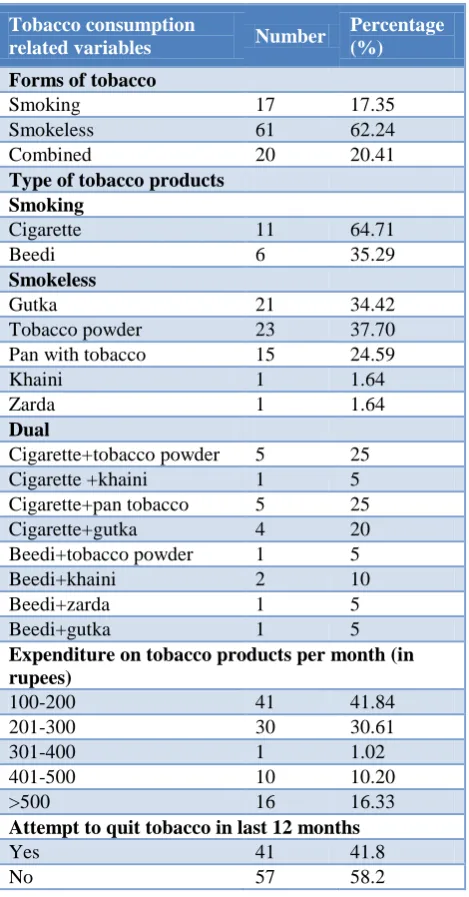
The prevalence of tobacco consumption in participants was 38%. Among tobacco users, majorities were using smokeless form (62.24%) of tobacco followed by dual forms (20.41%) and smoking forms (17.35%). Among smokeless tobacco users, tobacco powder (37.70%), gutka (34.42%) and pan with tobacco (24.59%) were most commonly used products. Those using dual forms of tobacco were using cigarettes and tobacco powder (25%), cigarette and pan with tobacco (25%), cigarette with gutka (20%) and beedi with khaini (10%). Cigarette (64.71%) was the favorite among only smokers. About 72% of tobacco users were spending between 100 to 300 rupees per month on tobacco products and 41.8% had made attempt to quit in the last 12 months.
Table 2: Tobacco consumption pattern of study participants (n=98).
Tobacco consumption
related variables Number
Percentage (%)
Forms of tobacco
Smoking 17 17.35
Smokeless 61 62.24
Combined 20 20.41
Type of tobacco products Smoking
Cigarette 11 64.71
Beedi 6 35.29
Smokeless
Gutka 21 34.42
Tobacco powder 23 37.70
Pan with tobacco 15 24.59
Khaini 1 1.64
Zarda 1 1.64
Dual
Cigarette+tobacco powder 5 25
Cigarette +khaini 1 5
Cigarette+pan tobacco 5 25
Cigarette+gutka 4 20
Beedi+tobacco powder 1 5
Beedi+khaini 2 10
Beedi+zarda 1 5
Beedi+gutka 1 5
Expenditure on tobacco products per month (in rupees)
100-200 41 41.84
201-300 30 30.61
301-400 1 1.02
401-500 10 10.20
>500 16 16.33
Attempt to quit tobacco in last 12 months
Yes 41 41.8
No 57 58.2
Figure 1: Distribution of tobacco users in study participants (n=258).
Compliance for health education intervention, follow-up visits and quit rate
All tobacco users (n=98) were eligible for the initial health education intervention. Six of them left the job during this period and hence 92 were invited for the intervention. Among 92 participants only 30 (32.60%) actually attended the intervention program. For the one week and one month follow-up visits, the compliance was 86.67%. None of the participants who attended the first follow-up visit had quit tobacco whereas 3 (11.54%) participants had quit during the second follow-up visit.
Table 3: Compliance of study participants for health education intervention (n=92*).
Health education
intervention Number
Percentage (%)
Attended 30 32.60
Not attended 62 67.40
* Out of 98 study participants 6 of them quit the job after initial survey and before health education intervention.
Table 4: Compliance for follow-up and quit rate among those who attended the health education
intervention (n=30).
Follow up Attended (%) Quit rate (%)
After 1 week 26 (86.87) Nil
After 1 month 26 (86.67) 3 (11.54)
DISCUSSION
illiterates and were Hindu by religion with income of above10,000 Rupees per month. A survey of socio-demographic characteristics of tobacco use was done in Bombay among 99,598 individuals also showed maximum tobacco users belonging to illiterate category.10
In our study 38% of the participants were tobacco users, among those, 62.24% were smokeless tobacco users, 17.35% were smokers and 20.40% were using both smoking and smokeless forms. This indicated the rise of smokeless tobacco use was higher among tobacco users. Among those who smoked, majority preferred cigarettes (64.71%) followed by beedi (35.29%).The combination of smoking and smokeless forms included cigarette with tobacco powder (25%) followed by tobacco powder with paan (25%). Combination with beedi is preferred by 25% of tobacco users and among them, the preferred combination was beedi with khaini (10%). A survey conducted in India also showed that the tobacco use among men was reported to be 69.3% with 23.6% using smoking forms.11 Another interventional study conducted in India showed that the smokeless tobacco users were more than the smoking forms and combined forms.9 Expenditure pattern related to tobacco use showed that majority of study participants (41.84%) spent 100-200 rupees per month. A study was conducted in Australia to find what price of tobacco can lead to people quitting the habit thereby setting higher taxes on tobacco products.12 This indicates the need of strict government policies and levying of high taxes in the sale and purchase of tobacco products, which, unfortunately is not being done in developing countries like India. The study also showed that 57 (58.2%) did not try to quit tobacco in the last 12 months whereas 41 (41.8%) tried to quit tobacco without seeking any professional help but failed to do so. This shows the lack of motivation among the participants due to lack of intervention activities, lecture sessions and dearth of knowledge about the hazards of tobacco use.
The Global Health Professional Students Survey (GHPSS) was conducted among the third-year medical and dental students in selected Member States of the South- East Asia region observed no significant change in the proportion of medical students ever having-received cessation training in Bangladesh, India, and Nepal between 2005 and 2006 and 2009 and 2011. However, in Myanmar (43.7% in 2006 to 28.8% in 2009), cessation training declined significantly whereas, it increased in Sri Lanka (16.2% in 2006 to 18.6% in 2011). The study depicted that there had not been significant decline in the tobacco use and second hand smoke exposure among the students. Also the study showed the existing gaps in training needs for tobacco cessation assistance skills for medical and dental students.6 Similar efforts are required in this sector also to help the participants to overcome the habit of tobacco use. In our study, the intervention program was organized for 98 tobacco users but only 92 took part as 6 out of 98 participants left the institute during the course of the study. Among 92 participants, 30 attended the intervention with a poor compliance rate of
32.60%. The first follow-up (after 1 week) was attended by 26 participants out of 30 with compliance rate of 86.67% which was considerably good but none among those gave up tobacco with quit rate of zero percent. In the second follow up (after 1 month) 26 participants (86.67%) out of 30 agreed for the interview. This time 3 participants had quit tobacco with quit rate of 11.54%, which is unsatisfactory. An interventional cohort- study conducted among 104 employees working in a chemical industry in rural Maharashtra, India for duration of one year showed 48% employees consumed tobacco. The tobacco quit rates increased with each follow-up intervention session and reached 40% at the end of one year. The study also showed the effect of interventions in the form of improvement in knowledge regarding harms of tobacco.9 This study was carried out for a year, which gave more time for the intervention activities and consistent follow-ups. Also it involved family support and peer-pressure to give up tobacco habit, which accounted for the success of this study. Similar efforts are required in this non-teaching staff of medical college sector to achieve good quit rate.
CONCLUSION
Tobacco consumption among the study participants was high. Tobacco consumption habit was seen more among those with higher income. Compliance for tobacco intervention in the form of health education was poor among study participants. Compliance for follow up was relatively good among those who attended the intervention. Tobacco quit rate among those who attended the intervention and the follow study was very poor.
ACKNOWLEDGEMENTS
All the non-teaching staff of J.N. Medical College, KAHER, who participated in the study. The College Administration, who provided necessary permission to carry out the study.
Funding: ICMR-STS Reference number 2014-00683 Conflict of interest: None declared
Ethical approval: The study was approved by the Institutional Ethics Committee
REFERENCES
1. Mackay J, Crofton J. Tobacco and the developing world. Br Med Bull. 1996;52(1):206-21
2. Shimkhada R, Peabody JW. Tobacco control in
India. Bull World Health Organ. 2003;81(1):48- 52.
3. Murthy P, Saddichha S. Tobacco cessation services
in India: Recent developments and the need for expansion. Indian J Cancer. 2010;47(1):69-74.
4. Khandelwal V, Khandelwal S. Tobacco Addiction
5. Surani NS, Pednekar MS, Sinha DN, Singh G, Warren CW, Asma S, et al. Tobacco use and cessation counseling in India-data from the Global Health Professions Students Survey, 2005-09. Indian J Cancer. 2012;49(4):425-30.
6. Sinha DN, Rinchen S, Palipudi KM, Naing Shein NN, de Silva P, Khadka BB, et al. Tobacco use, exposure to second-hand smoke, and cessation training among the third-year medical and dental students in selected Member States of South-East Asia region: a trend analysis on data from the Global Health Professions Student Survey, 2005-2011. Indian J Cancer. 2012;49(4):379-86.
7. Chatterjee T, Haldar D, Mallik S, Sarkar GN, Das S, Lahiri SK. A study on habits of tobacco use among medical and non-medical students of Kolkata. Lung India. 2011;28(1):5-10.
8. Mehrotra R, Chaudhary AK, Pandya S, Mehrotra
KA, Singh M. Tobacco use by Indian medical
students and the need for comprehensive
intervention strategies. Asian Pac J Cancer Prev. 2010;11(2):349-52.
9. Mishra GA, Majmudar PV, Gupta SD, Rane PS,
Uplap PA, Shastri SS. Workplace tobacco cessation program in India: A success story. Indian J Occup Environ Med. 2009;13(3):146-53.
10. Gupta PC. Survey of socio-demographic
characteristics of tobacco use among 99,598 individuals in Bombay, India using handheld computers. Tob control. 1996;5(2):114-20.
11. Tobacco Questions for Surveys. Available at:
www.who.int/tobacco/surveillance/en_tfi_tqs.pdf. Accessed on 28 January 2014.
12. Scollo M, Hayes L. Wakefield M. What price
quitting? The price of cigarette at which smokers say they would seriously consider trying to quit. BMC Public Health. 2013;13:650.