© 2015 IJSRSET | Volume 1 | Issue 6 | Print ISSN : 2395-1990 | Online ISSN : 2394-4099 Themed Section: Science and Technology
Developments of HPLC Method for Determination of Methyl
Dopa
Hussein Hassan Kharnoob
College Pharmacy, Tikrit University, Tikrit, Iraq
ABSTRACT
This research contains the development of accurate and quick method for determination methyldopa drug using high performance liquid chromatographic technique, injected 20 μl of the drug solution with concentration 20 μg/ml using a column type C18 , mobile phase consists of Acetonitrile: 0.02M KH2PO4 (70 : 30) at flow rate of 1.6 m1/min using UV detector at 275nm, pH5.65 ,with retention time 2.89min at linear range 10 – 50μg/ml with good accuracy and precision . The recovery value is to 99.2%and detection limit of 0.05 μg/ ml. The method is applied successfully to determine methyl dopa in its pharmaceutical formulations.
Keywords: Chromatography, Methy Dopa, Acetonitrile, Drug
صخهًنا
ازه ًٍضج ثحبنا
شيذمحن ةعيشسو ةميلد ةميشط شيىطج ابود ميثًنا
ٍمح ىج را ءادلاا يناع مئاسنا ايفاشغىجايوشك ةيُمج واذخحسأب 20
ٍي شحينوشكياي
ضيكشحب سامعنا لىهحي 20
واذخحسأب مي / واشغوشكياي
عىَ ٍي دىًع C18 :ميشحَىحيسا ٍي ٌىكحي نشححي سىطو KH2PO4 )3 :70( يسلاىي 0.02 عشس لذعًبو
ٌايشج ة 1.6قىفةعشلاافاشكيو ةميلد / مي صاجححا ٍيصو ،5.56 ةيضياحنا ةناذنا ذُع شحييىَاَ275يجىًنالىطنا ذُع ةيجسفُبنا 2.89
ضيكاشحنا ةيطخ يذي ٌاكو ةميلد 10
-50
تارو مي / واشغوشكياي ةلد ظبضو را ٍيذيج ثغهب % ..99ةيعاجشحسلااةًيل فشكناذحو
0.05 واشغوشكياي /
مي كيبطجو ةميشطنا حاجُب يف ابود ميثًناشيذمحن ةيَلاذيصنااهجاشضححسي. ثباثنا سىطنا , نشححًنا سىطنا, ايفاشغىجىيوشك :هيحاححفلاا تاًهكنا
I.
INTRODUCTION
Scientific names of methyldopa
L-alpha-methyl-3,4-dihydroxyphenyl alanine
L-2-amino-2-methyl-3-(3,4-dihydr oxy phenyl)propionic acid
2-amino-3-(3,4-dihydroxyphenyl)-2-methylpropanoic acid composition formula Its
Molecular formula: C10H13NO4, 1½ H2O, MW: 238.2 g/mol, uv max : 281nm
A white or yellowish white, crystalline powder or colourless or almost colourless crystals, slightly soluble in water, very slightly soluble in alcohol, practically insoluble in ether. It is freely soluble in dilute mineral acids, practically insoluble in chloroform and ether. M.p. about 310°C(1). It is used as antihypertensive and it exists as Tablets. It has the following commercial names
Aldomet, Aldoril, Dopamet, Dopegyt, Aldosam, Aldopren , Amender, Cardin, Dopegyt, Hipten, Hydopa, Isomet, Medimet-250 , Medomet, Medopren, Meldopa, MetalphaNova- Medopa, Nudopa, Nu-Medppa, Presinol, Prodop, Pulsoton , Selm, Sembrina, Tenzone(2).
II.
METHODS AND MATERIAL
Methods of estimating Methyl dopa :
Chromatographic methods(3 -9) Spectroscopic
methods (11) Experimental Works Apparatus
HO
HO COOH
1-Apparatus of High Performance Liquid chromatography of type schematize UV / VIS – HPLC Series 200 JAPAN mode and supplied with Column of Type L1 – macherey – NOGEL ( MN ) – (25CM X 4.6 mm . 5MM ) Porous silica Particles 5 to 10 Micro min diameter, Japan.
2-Shimadzu UV-160, UV-Visible computerized
double-beam spectroph-otometer , Japan. 3- The pH measurements are carried out using Philips
PW 9421 pH meter
Reagent and Chemicals
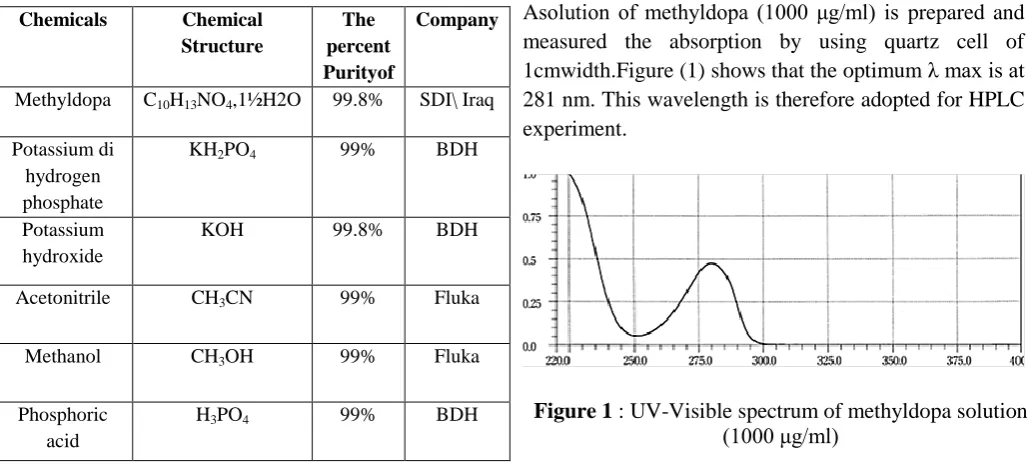
Chemical material and analytical reagents of high purity were used and as in the Table (1)
Table 1 : Reagent and ChemicalsTable (1)
Company The
percent Purityof Chemical
Structure Chemicals
SDI\ Iraq 99.8%
C10H13NO4,1½H2O
Methyldopa
BDH 99%
KH2PO4
Potassium di hydrogen phosphate
BDH 99.8%
KOH Potassium
hydroxide
Fluka 99%
CH3CN
Acetonitrile
Fluka 99%
CH3OH
Methanol
BDH 99%
H3PO4
Phosphoric acid
Preparation of the Solutions
1-Solution of the stock methyldopa (1000 μg/ml).
This solution is prepared by dissolving 0.1000 g of methyldopa powder in distilled water and the volume is completed to 100 ml with distilled water in volumetric flask.
2-Solution of methyldopa (100 μg/ml)
This solution is prepared by diluting10 ml of the above stock methyl dopasolutionto100 ml in a volumetric flask with distilled water.
3-Solution of methyldopa (20 μg/ml)
This solution is prepared by diluting 5 ml of the above stock methyldopa solution to 25 ml in a volumetric flask with distilled water.
III.
RESULTS AND DISCUSSION
1- Selection of column
The best separation column is selected for the chlorpromazine hydrochloride drug of type (porous silica particles 5 to 10 micron) C18 at 250 mm length and 4.6 mm diameter due to its high separation efficiency according to the previous research (10).
2-Selection of wavelength (λ max)
Asolution of methyldopa (1000 μg/ml) is prepared and measured the absorption by using quartz cell of 1cmwidth.Figure (1) shows that the optimum λ max is at 281 nm. This wavelength is therefore adopted for HPLC experiment.
Figure 1 : UV-Visible spectrum of methyldopa solution (1000 μg/ml)
3- Selection of mobile phase
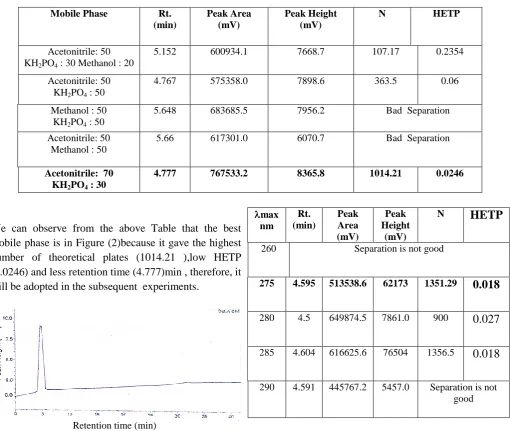
When injection 20 µl of methyldopa solution (20 μg/ml) using various mobile phases at wave length 281nm and flow rate 1ml/min, The results are shown in Table (2) Figure (2).
We can observe from the above Table that the best mobile phase is in Figure (2)because it gave the highest number of theoretical plates (1014.21 ),low HETP (0.0246) and less retention time (4.777)min , therefore, it will be adopted in the subsequent experiments.
Figure 2 : Chromatogram injection 20 µl of methyldopa solution (20 μg/m l) by mobile phase with ratio of Acetonitrile 70 : KH2PO4 30
4- Effect of wavelength
After choosing the (Acetonitrile: KH2PO4 with ratio 70: 30, 20) µl of methyldopa solution (20 μg/ml). Signal (peak area) was recorded at different wave lengths (280, 260 , 290 , 285 , 275 ) nm . The results are shown in Table (3) and Figure (3).
Table (3) Selection of wavelength
HETP
NPeak Height
(mV) Peak
Area (mV) Rt.
(min)
max nm
Separation is not good 260
0.018
1351.2962173 513538.6
4.595 275
0.027
900 7861.0
649874.5 4.5
280
0.018
1356.5 76504
616625.6 4.604
285
Separation is not good 5457.0
445767.2 4.591
290
From the above Table it was found to be 275nm is the best wave length which is showing in Figure (3)because it gave the highest number of theoretical plates (1351.29), low HETP (0.018) and less retention time (4.595)min , therefore , it will be adopted in the subsequent experiments.
Figure 3: Chromatogram injection 20 µl of methyldopa solution (20 μg/m l) at 275nm
HETP N
Peak Height (mV) Peak Area
(mV) Rt.
(min) Mobile Phase
0.2354 107.17
7668.7 600934.1
5.152 Acetonitrile: 50
KH2PO4 : 30 Methanol : 20
0.06 363.5
7898.6 575358.0
4.767 Acetonitrile: 50
KH2PO4 : 50
Bad Separation 7956.2
683685.5 5.648
Methanol : 50 KH2PO4 : 50
Bad Separation 6070.7
617301.0 5.66
Acetonitrile: 50 Methanol : 50
0.0246 1014.21
8365.8 767533.2
4.777 Acetonitrile: 70
KH2PO4 : 30
Retention time (min)
5- Effect of pH
The mobile phases (Acetonitrile : KH2PO4 with ratio 70 : 30) at various pH ( 5.65 , 6.66 , 7.8 ,4.6 , 5 ) are prepared by using the solutions of phosphoric acid( 0.1
M) and potassium hydroxide ( 0.1 M). The response (peak area) is measured for each mobile phase at various pH, and the results are shown in Table (4) and Figure (4).
Table 4 : Effect of pH
From the above Table it was found that the mobile phase of Acetonitrile and buffer solution with ratios (70:30) at pH function 5.65 is choosed due to appearance of a sharp peak is in Figure (4) because it gave the highest number of theoretical plates (1353.61), low HETP (0.0184) and less retention time (4.599) min , therefore , it will be adopted in the subsequent experiments.
Figure 4 : Effect of pH=5.65 of mobile phase (Acetonitrile 70 : KH2PO4 30 ) on the chromatogram
6-Effect of flow rate
When injection 20 µl of methyldopa solution (20 μg/ml) at flow rate for mobile phase Acetonitrile 70 : KH2PO4 30 between (0.8 – 1.8) ml/min. The results are shown in Table (5) and Figure (5).
Table 5 : Effect of flow rate
HETP N
Peak Height
(mV) Peak
Area (mV) Rt.
(min) Flow
Rate ml/min
0.0291 838.93
3791.6 379318.0
5.793 0.8
0.0184 1353.6
3615.7 290368.9
4.599 1
0.026 936.84
4140.5 310253.5
3.826 1.2
0.0230 1086.36
3790.1 222845.6
3.296 1.4
0.0168 1484.8
3816.3 196650.3
2.890 1.6
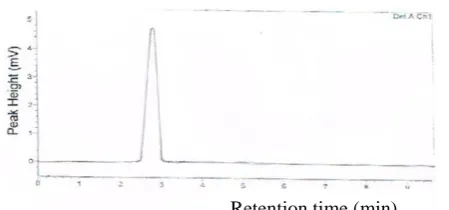
We can see from the above Table that the best flow rate is in Figure (5)because it gave the highest number of theoretical plates (1484.8 ), low HETP (0.0168) and less retention time (2.890)min, therefore ,it will be adopted in the subsequent experiments.
HETP N
Peak Height (mV) Peak Area
(mV) Rt.
(min) pH
Separation is not good 3451.9
262329.4 4.591
4.6
Separation is not good 3838.2
313392.8 4.591
5
0.0184 1353.61
3615.7 290368.9
4.599 5.65
0.0471 530.61
3852.3 278351.5
4.607 6.66
0.0610 409.83
4065.7 324764.2
4.555 7.8
Figure 5: Chromatogram injection 20 µl of methyl dopa solution (20 μg/ml) at flow rate (1.6ml /min) .
Calibration curve-7
After obtaining the optimum conditions 20 µl of different concentrations methyldopa solution a (10 , 20 ,
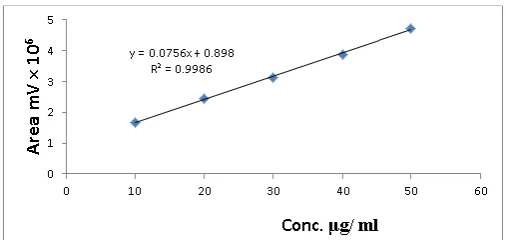
30, 40, 50 ) μg/ml which prepared from the solution of 1000 μg/ml was injected in column of type C18 at wave length 275nm , mobile phase Acetonitrile 70 : KH2PO4 30 , pH function 5.56 and flow rate 1.6 ml/ min .The results are shown in Table (6) and Figures (6 ) .
Table (6) Calibration curve
Figure 6: Calibration curve for the determination of methyl
We can see from the above results calibration curve was linear over the concentration range of 10 – 50 µg/ml for methyldopa. The method was accurate, specific and rapid.
8 - Detection limit Detection limit was calculated by measuring the peak area of five injections for the lowest concentration ( 10 µg/ ml) in the calibration curve and within the limit of the Beer law at the same conditions (optimum conditions), the detection limit was 3.610- 4µg/ ml, and results are recorded in Table (7).
Table (7) Detection limit
D.L µg/ ml S
X
Concentrationµg/ ml
3.610- 4 0.02
1656.77 10
Applications 9
The proposed method has been applied on the preparation pharmacist Aldosam (Samarra/ Iraq ) in tablets . Each tablet contains 250 mg methyldopa , has been weight of 10 tablets each tablet alone and crushed well and then calculated the required weight to prepare a solution with concentration of 1000 μg/ml , dissolved in amount of distilled water and complete the volume to the mark in volumetric flask of 100ml. It was prepared and then the solution of 20 μg/ml was prepared and 20μl of this solution is injected in HPLC instruments. The results are shown in Table (8) and (9) and Figures (7) and (8).
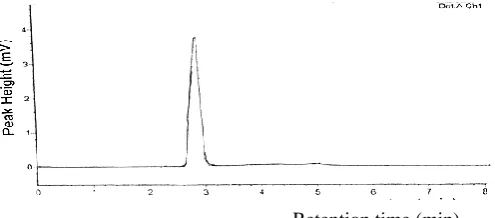
Figure 7: Chromatograms of injection 20 µl of 20 μg/ml of standard methyl dopa
HETP N
Recovery% Conc. measured
μg/ml Rt. (min)
Conc. Present μg/ml
0.0167 1492.0
100.8 10.08
2.897 10
0.0167 1495.1
103.5 20.7
2.900 20
0.0168 1484.8
99.98 29.64
2.890 30
0.0169 1476.6
99.45 39.78
2.882 40
0.0167 1490.9
102.0 51.00
2.896 50
Figure 8: Chromatograms of injection 20 µl of 20 μg/ml
of preparation pharmacist Aldosam
Table (8) Results for the determination of methyldopa in standard and pharmaceutical preparation
HETP N
*Peak Height (mV) *Peak Area
(mV) Rt.(min)
Conc. μg/ml Sample
0.0167 1493.11
45878.5 245604.9
2.900 20
Standard
0.0167 1490.90
43977.2 243760.7
2.896 20
Aldosam Tablets
Average of three determinations*
Table (9) Precision and accuracy of the determination of methyldopa in its Aldosam formulation
*Rec.% SCM RE%*
SCM *Rec.%
CC *RE%
CC RSD%*
Conc. Of Aldosam μg/ml
99.2 - 0.8
103.5 3.5
0.0503 Measured
SCM Measured 0f
calibration curve Present
19.84 20.7
20
Average of three determinations*
From the above Tables we can see that the application of the proposed method on the preparation pharmacist Aldosam gives good results, the value of RSD 0.0503% and high recovery 99.2%
Comparison with other methods 10
The proposed method was compared with other methods and the results are shown in Table (10).
Table (10) Comparison with other methods
Present Method Literature(19)
method Analytical
Parameter
Acetonitrile : KH2PO4: 70:30
Acetonitrile: distilled water:
triethylamine (45:45 :10)
Mobile phase
C18
C18 Column
1.6 1.5
Flow rate ml/min
2.89 6.499
Retention time ( min)
275 245
λ max (nm)
5.56 3.0
pH
99.2 102.9
Recovery (%)
0.0503 0.0493
RSD (%)
0.998 0.998
Coefficient of correlation
RP-HPLC RP-HPLC
Type of HPLC
3.610- 4 0.029
D.L μg/ ml
Tablet Tablet
Pharmaceutical preparation
The results of the above Table indicate that the method used in the present work is sensitive and economical because it needed low quantity of mobile phase and low retention time.
IV.
CONCLUSION
A rapid and easy chromatographic method was developed to separate and determined methyldopa drug by using the reversed phase. This method gives an efficiency in good separation by using mobile phase Acetonitrile 70: KH2PO4 30 ) in column of type C18at pH 5.56 , wavelength 275nm and flow rate 1.6 ml/ min and detection limit attained to 3.610- 4μg/ml .The method is applied successfully on determine methyldopa in its pharmaceutical appliances.
V.
REFERENCES
[1] The Merck Index , 12th Copyright by Merck Co. ,
Inc. Whiteho , 2000, CD Rom
[2] Clarke' , "Analysis of Drugs and Poisons ", 3nd ,
p1252 – 1253, 2006.
[3] M. A. Ali, M. S. Ali and A. M. K. M. Yar,
International Journal of Chemical &
Environmental Engineering, 4 (3) , 159, 2013.
[4] S. Ting ," J Assoc Off Anal Chem.,66(6), 1436 -
1442 , 1983.
[5] M. Dolezalova and M. Tkacykova , J Pharm
Biomed Anal. , 19(3-4) , 555 – 567, 1999.
[6] G.M. Kochak and W.D. Mason , Journal of
Pharmaceutical Sciences , 69 (8), 897 – 900, 1980.
[7] G. Bahrami, A. Kiani and S. Mirzaeei , Journal of
Chromatography B , 832(2), 197 – 201, 2006.
[8] A. Majidano, N. A. Sodho, G. N. Rajper, M. A.
Alamgir and M. Y. Khuhawar, Sindh Univ. Res. Jour. (Sci. Ser.) , 46 (1) , 77 - 82 , 2014.
[9] M. V.L. Sahithi, V. Perumal, K. Sekhar, and P.
Vijay Babu, journal of Advanced pharmacy Education & Researh, 3 (4), 464 – 470 , 2013.
[10] G.Aymard,M.Legrand,N.Trichereau and B.
Diquet., J. of Chromatography B: Biomedical Sciences and Applications,744 (2) , 227-240 ,2000.
[11] A . A . AL-Daamy and F. AL-Moswi,Kerbala
Journal of Pharmaceutical Sciences , 6 , 70 – 77 , 2013.
[12] E. A. Gadkariem, K. E. E. Ibrahim,N. A. A.
Kamil,M. E. M. Haga, and H. A. El-Obeid, Saudi Pharm J, 17 , ( 4 ) , 289 – 293 , 2009.
[13] P. R. S. Ribeiro; L. Pezza and H. R. Pezza, Eclet .
Quim , 30( 3 ) , 23 - 28 , 2005.
[14] R. O. Matos, C. F. Silva and R. R. Silva , Latin
American Journal of Pharmacy , 31 ( 2 ), 190 –1 94, 2002 .
[15] M. A. Gotardo, L. S. Lima, R. Sequinel, J. L.
Rufino, L. Pezza, and H. R. Pezza Ecl. Quim., Sao Paulo, 33(3), 7-12 , 2008.
[16] M. A.A. Daamy and R. F. AL- Moswi, Asian
Journal of Chemistry , 14(2) , 867 – 873, 2002.
[17] M. A. Gotardo, L. S. Lima, R. Sequined, J. L.
Rufino, L. Pezza and H. R. Pezza,"Ecl. Quim., Sao Paulo, 33(3): 7-12, 2008.
[18] Brynn Hibbert, D., New York , USA , 2007, p 254
[19] I. T. Haoon, University of Tikrit, College of