Original Research Article
Psychological distress among adult urban population of Puducherry
Murugan N.
1, Amit Kumar Mishra
1*, Ramesh Chand Chauhan
2, Velavan A.
1INTRODUCTION
World Health Organization (WHO) definition of health includes mental wellbeing as a component along with physical and social wellbeing.1 Mental disorders are estimated to account for 14% of all disability adjusted life years (DALY‟s) lost to disease throughout the globe and these also contribute more to the burden of disease than either cardiovascular disease or cancer worldwide.2,3
According to estimates, 12% of the burden of total diseases are due to mental disorders worldwide and this is expected to increase to 15% by 2020.4 In India, approximately 6% of the population have some mental disorder at any point of time.5 According to a study in Mumbai slum, 28% of patients aged >18 years suffered
from psychiatric problems.6 Mental disorders, in general, which are responsible for increasing costs of medical care and loss of productivity every year, don‟t get the same attention, like physical illnesses. Presently, the identification of Common Mental Disorders (CMD) among the people in community or attending primary health centers is extremely inadequate.7 Also, the identification of CMD among the people in a community is more difficult than the people attending the health centers. The WHO has called for the integration of mental health into primary health care (PHC) as a step towards closing gap in treatment.8
Psychological distress is a general term used to describe unpleasant feelings or emotions that impact your level of functioning. Serious psychological distress is a precursor
ABSTRACT
Background: A large proportion of population in the community with psychological distress goes unnoticed. This study was done to assess the psychological distress among adult population of an urban area of Puducherry.
Methods: The study was conducted among 569 individuals of age 18 years and above. Systematic random sampling method was used to select the households in the study area and from each household one adult was randomly selected. The General Health Questionnaire-12 (GHQ-12) was used to assess the psychological distress among the study participants.
Results: Majority of the participants had low psychological distress (60.5%) followed by typical (19.3%), more than typical (10%), evidence of psychological distress (6.2%) & severe distress (4%). One-fifth (20.2%) of the participants had psychological distress which needs attention. The mental health status of the participants was significantly associated with the age, sex, marital status, religion and education (p<0.05).
Conclusions: The psychological distress is a major public health problem in the study population. Focused interventions to improve the mental health of population are required to decrease the mental distress in the community.
Keywords: Psychological, Distress, Mental health, GHQ-12, Community
1
Department of Community Medicine, Pondicherry Institute of Medical Sciences, Kalapet, Pondicherry, India
2
Department of Community and Family Medicine, AIIMS, Bhopal, Madhya Pradesh, India
Received: 25 June 2018
Revised: 12 July 2018
Accepted: 13 July 2018
*Correspondence:
Dr. Amit Kumar Mishra, E-mail: [email protected]
Copyright: © the author(s), publisher and licensee Medip Academy. This is an open-access article distributed under the terms of the Creative Commons Attribution Non-Commercial License, which permits unrestricted non-commercial use, distribution, and reproduction in any medium, provided the original work is properly cited.
to serious mental illness like depression and anxiety disorders. A large proportion of population in the community with psychological distress goes unnoticed and primary health care providers could have a key role to play in the detection of risk of mental disorders in community. This study was done to assess the psychological distress among adult population of an urban area of Puducherry, India.
METHODS
This community based cross-sectional study was conducted in the urban field practice area of Department of Community Medicine of a Tertiary Heath Care Institute at Puducherry. The study area comprises of a population of about twelve thousand.
Sample size and sampling
The sample size for the study was calculated as 525 by assuming the prevalence of psychological distress as 28%6 and relative precision of 14% with 95% confidence interval to find the prevalence of psychological distress in the study population. A house to house survey was conducted and list of all the households in the study area were prepared. Using systematic random sampling method, 600 households were selected and from each household one adult was randomly selected. Pregnant women and disabled were excluded from the study. After providing participant information sheet (in local language) and explaining about the study purpose and procedures, informed written consent was obtained from all the subjects.
Data collection and quality assurance
This study was done during the month of February 2013 as part of imparting hands on training in community based research to MBBS final year (Part I) students under the guidance and supervision of interns, postgraduate students and faculty from Department of Community Medicine. All the students were given training in research methodology and data collection including taking informed consent, administering questionnaire, interview techniques, and proper physical measurements. Random checks for 10% of the completed proformas were done by the faculty.
Measurements
General Health Questionnaire - 12 (GHQ - 12) was used as the tool for assessment of psychological distress. The GHQ-12 is a well–known and commonly used measuring tool for psychological wellbeing with high validity and is not influenced by gender, age or educational level. Either the bimodal method or a Likert scoring system is used for the scoring of GHQ-12. For the assessment of psychological distress, we used a five categories Likert Scoring System with a score range of 0–36. The interpretation of the five categories Likert score is described in the Table 1.9
Table 1: Likert scoring system for GHQ–12.9
Score Psychological distress
1–10 Low psychological distress
11–12 Typical
13–15 More than typical
16–20 Evidence of psychological distress
>20 Severe distress
Statistical analysis
Data were entered in Microsoft excel spread sheet 2010 (Microsoft Corporation) and data cleaning was done. Statistical Package for Social Sciences (SPSS) for a windows version 19.0 (Armonk, NY: IBM Corp.) was used for the analyses. Chi-square test was applied to assess the association between categorical data and p value of <0.05 was considered as statistically significant.
RESULTS
Sociodemographic characteristics
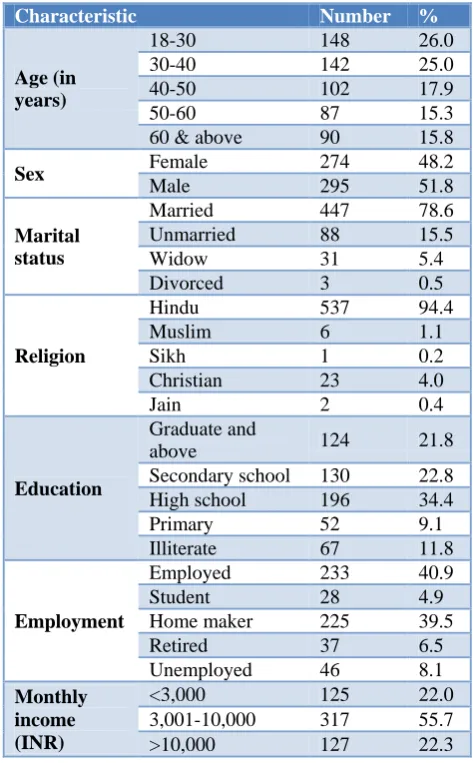
Table 2: Socio-demographic characteristic of study participants (n=569).
Characteristic Number %
Age (in years)
18-30 148 26.0 30-40 142 25.0 40-50 102 17.9
50-60 87 15.3
60 & above 90 15.8
Sex Female 274 48.2
Male 295 51.8
Marital status
Married 447 78.6 Unmarried 88 15.5
Widow 31 5.4
Divorced 3 0.5
Religion
Hindu 537 94.4
Muslim 6 1.1
Sikh 1 0.2
Christian 23 4.0
Jain 2 0.4
Education
Graduate and
above 124 21.8 Secondary school 130 22.8 High school 196 34.4 Primary 52 9.1 Illiterate 67 11.8
Employment
Employed 233 40.9 Student 28 4.9 Home maker 225 39.5 Retired 37 6.5 Unemployed 46 8.1
Monthly income (INR)
Among the 600 households selected for the study, participants from 569 households were participated & interviewed, participant response rate was 95%. Maximum numbers of participants (26%) were aged 18 to 30 years, followed by 30 to 40 years (25%). Majority of the participants were males (51.8%), married (78.6%),
belonged to Hindu religion (94.4%). About 12% respondents were illiterate, 8.1% were unemployed and 22% had monthly income below 3000 INR. The details of the socio-demographic characteristics of the study population are described in Table 2.
Table 3: Distribution of study participants based on the psychological distress.
Psychological distress Score Number Percentage (%)
Low psychological distress 1–10 344 60.5
Typical 11–12 110 19.3
More than typical 13–15 57 10.0
Evidence of psychological distress 16–20 35 6.2
Severe distress >20 23 4.0
Total 569 100
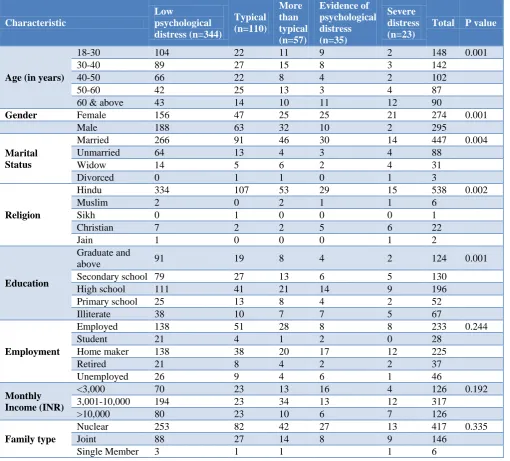
Table 4: Association between socio-demographic characteristics and psychological distress (n=569).
Characteristic
Low
psychological distress (n=344)
Typical (n=110)
More than typical (n=57)
Evidence of psychological distress (n=35)
Severe distress (n=23)
Total P value
Age (in years)
18-30 104 22 11 9 2 148 0.001
30-40 89 27 15 8 3 142
40-50 66 22 8 4 2 102
50-60 42 25 13 3 4 87
60 & above 43 14 10 11 12 90
Gender Female 156 47 25 25 21 274 0.001
Male 188 63 32 10 2 295
Marital Status
Married 266 91 46 30 14 447 0.004
Unmarried 64 13 4 3 4 88
Widow 14 5 6 2 4 31
Divorced 0 1 1 0 1 3
Religion
Hindu 334 107 53 29 15 538 0.002
Muslim 2 0 2 1 1 6
Sikh 0 1 0 0 0 1
Christian 7 2 2 5 6 22
Jain 1 0 0 0 1 2
Education
Graduate and
above 91 19 8 4 2 124 0.001
Secondary school 79 27 13 6 5 130
High school 111 41 21 14 9 196
Primary school 25 13 8 4 2 52
Illiterate 38 10 7 7 5 67
Employment
Employed 138 51 28 8 8 233 0.244
Student 21 4 1 2 0 28
Home maker 138 38 20 17 12 225
Retired 21 8 4 2 2 37
Unemployed 26 9 4 6 1 46
Monthly Income (INR)
<3,000 70 23 13 16 4 126 0.192
3,001-10,000 194 23 34 13 12 317
>10,000 80 23 10 6 7 126
Family type
Nuclear 253 82 42 27 13 417 0.335
Joint 88 27 14 8 9 146
Single Member 3 1 1 1 6
Psychological distress
The different levels of psychological distress i.e. low, typical, more than typical psychological distress was observed among 60.5%, 19.3% and 10.0% participants respectively. Thirty five (6.2%) and 23 (4.0%) participants had evidence of psychological distress and severe distress respectively (Table 3).
In our study majority of respondents (60.5%) had low psychological distress, 19.3% respondents had typical psychological distress and 20.2% respondents had more severe form of psychological distress ranging from more than typical to severe distress.
Table 4 shows the association between different socio-demographic characteristics and psychological distress. The factors like age, sex, marital status, religion and education were significantly associated with the psychological distress (p<0.05).
DISCUSSION
In the present study, 19.3% of participants had typical psychological distress whereas 10%, 6.2% and 4% of the participants had more than typical distress, evidence of psychological distress and severe distress respectively. In a study conducted among 152 medical students in Ahmedabad to assess their mental health status, the prevalence of distress (described as “case-ness”) among the medical students was found to be 23.7% where a cutoff of 3 was used to describe the cases.10 In the present study the psychological distress above the typical (more than typical, evidence of psychological distress, severe distress) was observed in 20.2% participants. The high prevalence among medical students as compared to the present study may be due to the specific professional participants or due to different method of assessment of the GHQ-12.
Devis et al conducted a study in New Zealand among patients attending primary health care. They used Bi-modal method for assessing the scores of GHQ-12 with a cut-off of 2/3 for „caseness‟ - means having some form of psychological distress. In that study, 33% of participants had some form of psychological distress, the proportion was higher than our study because the present study was conducted in a community and the above mentioned study in a tertiary center, patients suffering from different disease and attending a tertiary health center might be experiencing some form of psychological distress.
In s study conducted by Doherty DT et al in Ireland among adults using Bimodal method of assessment for GHQ-12 score and taking cut off of 4 (Score more than or equal to 4 was defined as “case”) the proportion of „cases‟ in the study was 12.3%.11
Our study has shown slightly higher prevalence (20.2%).
In another study to assess the psychological health among Malaysian College Students aged between 18 to 32 years, using GHQ-12 questionnaire with a cut off score of 6, 47.1% of students obtained scores 6 and higher (psychological distress).12 Whereas, in present study with 5 categories Likert scale assessment of scores ranges from 0 to 36, 20.2% of participants had higher level of psychological distress. Similarly, in a study among Spanish population for the Reliability, external validity and factor structure of 12-Item General Health Questionnaire (GHQ-12). In that study, there was a significant difference in the mean scores of men (7.34±5.05) and women (9.30±5.45).13
A number of different scales can be used for the scores of GHQ -12. In present study we used the 5 categories Likert scale system for the assessment of scores, but in some of the studies bimodal method was used. But the interpretation of psychological distress is almost same irrespective of the method of scoring system. We have attempted to compare the results of different studies to find out the difference in prevalence of psychological distress among different study participants.
CONCLUSION
One fifth (20.2%) of the study participants reported that they experienced significant psychological distress. The level of psychological distress among the study participants was significantly associated with their age, gender, marital status and education level. Detailed studies to find out the causes of the psychological distress among the study participant and community level intervention to increase the awareness regarding the ill effect of psychological distress are recommend.
ACKNOWLEDGEMENTS
The authors would like to thank all the participants of the study. The authors acknowledge assistance of the final year (Part I) MBBS students in data collection, compilation; interns, teaching/nonteaching staff of Department of Community Medicine for their continuous support in completing the study. The authors also thank & acknowledge the logistic support provided by the management of the institute throughout the study period.
Funding: No funding sources Conflict of interest: None declared
Ethical approval: The study was approved by the Institutional Ethics Committee
REFERENCES
no. 2, p. 100) and entered into force on 7 April 1948. 1946: 100.
2. Prince M, Patel V, Saxena S, Maj M, Maselko J, Phillips MR, et al. No health without mental health. Lancet. 2007;370(9590):859–77.
3. Mathers CD, Loncar D, Murray C, Lopez A, Murray C, Lopez A, et al. Projections of Global Mortality and Burden of Disease from 2002 to 2030. PLoS Med. 2006;3(11):442.
4. 4. Doku VCK, Wusu-Takyi A, Awakame J. Implementing the Mental Health Act in Ghana: any challenges ahead? Ghana Med J. 2012;46(4):241– 50.
5. WHO | Integrating mental health into primary care: a global perspective. WHO, 2013.
6. Weiss MG, Isaac M, Parkar SR, Chowdhury AN, Raguram R. Global, national, and local approaches to mental health: examples from India. Trop Med Int Health. 2001;6(1):4–23.
7. Simon GE, Goldberg D, Tiemens BG, Ustun TB. Outcomes of recognized and unrecognized depression in an international primary care study. Gen Hosp Psychiatry. 2016;21(2):97–105.
8. Patel V, Maj M, Flisher AJ, De Silva MJ, Koschorke M, Prince M, et al. Reducing the treatment gap for mental disorders: a WPA survey. World Psychiatry. 2010;9(3):169–76.
9. Goldberg DP, Gater R, Sartorius N, Ustun TB, Piccinelli M, Gureje O, et al. The validity of two
versions of the GHQ in the WHO study of mental illness in general health care. Psychol Med. 1997;27(1):191–7.
10. Dalal AP, Bala VD. Socio-demographic, General Health Status and Mental Health Profile of First Year Medical Students of NHL MMC, Ahmedabad-2011 Admission Batch. NHL J Med Sci. 2013;2(2):69-74.
11. Doherty DT, Moran R, Kartalova-O ‟doherty Y. Psychological distress, mental health problems and use of health services in Ireland. Available at: http://www.hrb.ie/uploads/tx_hrbpublications/HRB_ Research_Series_5.pdf. Accessed on September 26, 2017.
12. Zulkefly SN, Baharudin R. Using the 12-item General Health Questionnaire (GHQ-12) to Assess the Psychological Health of Malaysian College Students. Glob J Health Sci. 2010;2(1):73.
13. Sánchez-López M del P, Dresch V. The 12-Item General Health Questionnaire (GHQ-12): reliability, external validity and factor structure in the Spanish population. Psicothema. 2008;20(4):839–43.