Infogain Publication (Infogainpublication.com) ISSN : 2454-1311
www.ijaems.com Page | 1557
A Study in Image Watermarking Schemes using
Neural Networks
N. Mohananthini
1, G. Yamuna
21
Assistant Professor, Department of Electrical and Electronics Engineering, Muthayammal Engineering College, Rasipuram, Tamilnadu, India
2Department of Electrical Engineering, Annamalai University, Tamilnadu, India
Abstract—The digital watermarking technique, an effective way to protect image, has become the research focus on neural network. The purpose of this paper is to provide a brief study on broad theories and discuss the different types of neural networks for image watermarking. Most of the research interest image watermarking based on neural network in discrete wavelet transform or discrete cosine transform. Generally image watermarking based on neural network to solve the problem on to reduce the error, improve the rate of the learning, achieves goods imperceptibility and robustness. It will be useful for researches to implement effective image watermarking by using neural network.
Keywords— Image Watermarking, Discrete Wavelet Transform, Discrete Cosine Transform, Neural Network.
I. INTRODUCTION
Watermarks are identification marks produced during the paper making process and the watermarks first appeared in Italy during the 13th century. Andrew Tirkel and Charles Osborne are first coined the term of digital watermark in 1992. Image watermarking is an important specific area for the advancement of image processing technology. A variety of watermarking schemes have been reported in recent years which can be broadly classified in two categories: spatial transform and frequency transform technique [1].
An artificial neural network commonly referred to us neural networks is an information processing systems which are implemented to model the human brain. Artificial neural networks perform certain computations (pattern matching and classification, optimization function, approximation, vector quantization and clustering) many times faster than the traditional system [2]. In 1988, DARPA studied a neural network is a system composed of many simple processing elements operating in parallel whose function is determined by network structure, connection strengths, and the processing performed at computing elements or nodes.
Meva et al. [3] discussed some of the possible ways to incorporate neural network approach in covert communication. When you want to hide the data from
intruders, you can use different methods for covert communication. The most useful methods are steganography and digital watermarking. Actually with steganalysis, can be finding the loop holes in their algorithm and digital watermarking, can be making their algorithm more robust and fast with the help of the neural approach. The performance of their methods can be further improved with the use neural network approach adoption. Bibi Isac et al. [4] have given a review of a few of the proposed image and video watermarking techniques using neural networks. Digital watermarks have been recently proposed for authentication of both video and still images. This study paper is discussed in the following sections, first we will introduce the related theories of digital watermarking; then we will discuss the related theories of neural networks; at last the image watermarking using neural networks are explained; Finally, conclude this study are discussed.
II. DIGITAL WATERMARKING
Watermarking is the process of embedding information into a multimedia object such as, text, image, audio and video. The watermarking information can be detected or extracted later to make an assertion about the multimedia object. The digital watermarks can be divided into visible and invisible watermark. The visible watermark the information is visible to a viewer in video or documents only on careful inspection. For example, the logo displayed at one corner of different television. The invisible watermark is completely imperceptible.
2.1. General Framework
The watermark can be embedded a visual watermark or Pseudo Random Number (PRN) sequence [5]. The embedding and extraction process is given below
2.1.1. Embedding Process
Infogain Publication (Infogainpublication.com) ISSN : 2454-1311
Fig. 1: Block Diagram of Embedding Process 2.1.2. Extraction Process
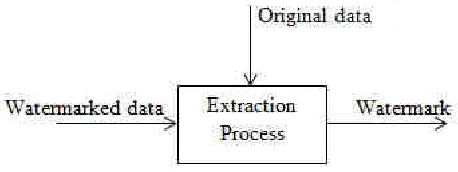
The inputs are original data and watermarked data and the output is watermark. The watermark is extracted from the original data and the watermarked data in the extraction process. The block diagram of extraction process is shown in Fig 2.
Fig. 2: Block Diagram of Extraction Process 2.2.Different Techniques of Digital Watermarking
Watermarks can be embedded either in the spatial or the transform domain watermarking techniques [6] as discussed below,
2.2.1. Spatial Domain Watermarking Technique
The spatial-domain techniques directly modify the intensity values of some selected pixels in an image to hide the watermark image. Liu Jun et al. [7] presented an improved watermarking detected algorithm for colour image based on a block probability in spatial domain. Each bit of the binary encoded watermark is embedded by modifying the intensities of a nonoverlapping block of 8*8 of the blue component of the host image. Experimental results show that their algorithm is robust against various kinds of attacks such as Affine, Rotating, Cropping, Scaling, JPEG compression and Mean filtering. The spatial domain methods are discussed below
2.2.1.1. Least Significant Bits (LSB)
The least significant bit (LSB) is the bit position in a binary integer giving the units value, that is, determining whether the number is even or odd. The least significant bit is sometimes referred to as the right-most bit, due to the convention in positional notation of writing less significant digit further to the right. Least significant bits are frequently employed in pseudorandom number generators, hash functions and checksums.
Deepshikha Chopra et al. [8] presented the general overview of image watermarking and different security issues. Various attacks are also performed on watermarked images and their impact on quality of images is also
studied. Image Watermarking using Least Significant Bit (LSB) algorithm has been used for embedding the message/logo into the image. Chan and Cheng [9] proposed to embed data by simple LSB substitution with an optimal pixel adjustment process.
2.2.2. Spread Spectrum Modulation
Spread spectrum technique is based on spreading the message energy over a bandwidth much larger than the minimum bandwidth required. If find a way of encoding the data into a large signal bandwidth, then to get error free transmission under conditions where the noise is much more powerful than the signal are using. This very simple idea is the secret behind spread spectrum techniques. For example; 3 kHz voices signal to send through a channel with a noise level 100 times as powerful as the signal. Manipulating the preceding equation, find that require a bandwidth of 208 kHz, which is about 70 times greater than the voice signal. Readers with knowledge of radio will note here that this idea of spreading is a central part of FM radio and the reason why it produces good sound quality compared to the simpler AM scheme. These techniques are used for a variety of reasons, including the establishment of secure communications, increasing resistance to natural interference, noise and jamming, to prevent detection, and to limit power flux density. Spread-spectrum telecommunications is a signal structuring technique that employs direct sequence, frequency hopping, or a hybrid of these, which can be used for multiple access and/or multiple functions.
Spread Spectrum (SS) modulation principle has been widely used in digital watermarking due to its distinguishing characteristics viz. excellent security and robustness in performance. Das et al. [10] analysed the usage of M-ary modulation principle in SS watermarking scheme. Their method is found that, the robustness performance of wavelet transform is better over spatial domain as wavelet transform models the host data towards Gaussian independent & identically distributed nature. Maity et al. [11] proposed fast walsh transform based Spread Spectrum (SS) image watermarking scheme that serves the dual purposes of authentication in data transmission as well as quality of services assessment for digital media through dynamic estimation of the wireless channel condition. Spread spectrum methodology is used as their method has proven to be efficient, robust and cryptographically secured.
2.2.3. Frequency Domain Watermarking Technique
Infogain Publication (Infogainpublication.com) ISSN : 2454-1311
www.ijaems.com Page | 1559
the much improved performance of the frequency domain in terms of imperceptibility and robustness as compared to the spatial domain domain [12]. Gunjal et al. [13] provided complete overview of Digital Image Watermarking techniques in Spatial as well as transform domain. The Transform domain watermarking techniques are recommended to achieve robustness. The watermarking scheme based on the frequency domains can be further classified into the Discrete Fourier Transform (DFT), Discrete Cosine Transform (DCT) and Discrete Wavelet Transform (DWT) domain methods.
2.2.3.1. Discrete Fourier Transform
The discrete Fourier transform (DFT) converts a finite list of equally spaced samples of a function into the list of coefficients of a finite combination of complex sinusoids, ordered by their frequencies, that has those same sample values.
A novel design of a DFT-based digital watermarking system for images is proposed in [14]. The original images is split into the blocks and proceed DFT transform after that by using Arnold scrambling change water mark and produce pseudo-random sequence, result an image with watermark is produce. The watermark detection is achieved with image segmentation process, DFT transform process and relativity process. A watermarking algorithm based on image segmentation, is also use for improve the security of the watermark with DFT algorithm. Awanish Kr Kaushik [15] evaluated the degradation of an image due to the implementation of a watermark in the frequency domain of the image. As a result, their watermarking method, which minimizes the impact of the watermark implementation on the overall quality of an image, is developed. The watermark is embedded in magnitudes of the Fourier transform.
2.2.3.2. Discrete Cosine Transform
A discrete cosine transform (DCT) expresses a finite sequence of data points in terms of a sum of cosine functions oscillating at different frequencies. DCT coefficients are real-valued. DCT domain watermarking can be classified into Global DCT watermarking and Block based DCT watermarking. The block based DCT, the image is first partitioned into a number of blocks and DCT transform is applied on each block before watermark embedding.
Wen-Nung Lie et al. [16] proposed two simple DCT-domain-based schemes to embed single or multiple watermarks into an image for copyright protection and data monitoring and tracking. The watermark data are essentially embedded in the middle band of the DCT domain to make a trade-off between visual degradation and robustness. A set of systematic experiments, including Gaussian smoothing, JPEG compression and image cropping are performed to prove the robustness of their
algorithms. Hernandez et al. [17] analysed a spread-spectrum-like discrete cosine transform domain watermarking technique for copyright protection of still digital images. The DCT is applied in blocks of 8 × 8 pixels as in the JPEG algorithm. As a result of their work, analytical expressions for performance measures such as the probability of error in watermark decoding, probabilities of false alarm and detection in watermark are derived and contrasted with experimental results.
2.2.3.3. Discrete Wavelet Transform
The transformation product is set of coefficients organized in the way that enables not only spectrum analyses of the signal, but also spectral behaviour of the signal in time. This is achieved by decomposing signal, breaking it into two components, each caring information about source signal. Filters from the filter bank used for decomposition pairs are low pass and high pass filter. The filtering is succeeded by down sampling. Low pass filtered signal contains information about slow changing component of the signal, looking very similar to the original signal, only two times shorter in term of number of samples. High pass filtered signal contains information about fast changing component of the signal. Filters from the filter bank are called "wavelets".
Ramana Reddy et al. [18] emphasized on the digital watermarking provides a comprehensive evaluation algorithm that embeds and extracts the watermark information effectively. Embedding the watermark at high level decomposition (II Level Decomposition) improves both the quality of watermarked image and the robustness of watermark. The extraction is done without using original image hence it is a blind watermarking scheme. The experimental results show that their scheme is highly robust against several of image processing operations such as, filtering, cropping, compression, Gaussian noise and salt and pepper noise. Yamuna and Sivakumar [19] proposed a novel watermarking scheme for copyright protection in digital images. The watermarking is performed in wavelet domain using bi-orthogonal wavelet transform. As their proposed approach is non-blind, it requires original image for extracting the watermark. The watermark image is a binary image. The watermark image is embedded in the HH sub-band of the wavelet transformed original image. A Good quality of watermarked image is assured through their proposed scheme from the higher PSNR values which is evident from experimental result.
2.3. Requirements of Watermarking 2.3.1. Data Payload
Infogain Publication (Infogainpublication.com) ISSN : 2454-1311
unit of time or within a Work. For a photograph, the data payload would refer to the number of bits encoded within the image. A watermark that encodes N bits is referred to as an N-bit watermark. Such a system can be used to embed any one of 2N different messages. Different applications may require very different data payloads.
2.3.2. Imperceptibility
The main requirement for watermarking technique is the perceptual transparency. In the most applications of watermarking algorithm, the watermark is to be embedded in original data, such that this does not affect the quality of the original data. A digital watermark is called imperceptible if the original cover signal and the marked signal are perceptually indistinguishable.
2.3.3. Robustness
Robustness of watermarking algorithm depends upon the capability of the hidden data to survive host signal manipulations. Robustness refers to the ability to detect the watermark after common signal processing operations. Not all watermarking applications require robustness to all possible signal processing operations. Rather, a watermark need only survive the common signal processing operations likely to occur between the time of embedding and the time of detection.
2.3.4. Security
A watermark should be secret and must be undetectable by unauthorized parties. The security of watermarking technique can be interpreted in the same way as the security of encryption technique. Watermarks should survive deliberate attempts to remove them. Ideally, a watermark should remain readable up to the point where the content becomes modified enough to be of low value.
2.3.5. Effectiveness
When input to a detector results in a positive detection. With this definition of watermarked works, the effectiveness of a watermarking system is the probability that the output of the embedded will be watermarked. In other words, the effectiveness is the probability of detection immediately after embedding.
2.4. Applications of Watermarking 2.4.1. Copyright Protection
Copyright protection objective is to embed information about the source and thus typically the copyright owner of the data in order to prevent other parties for claiming the copyright on the data. The application requires a very high level of robustness and the watermarks are used to resolve rightful ownership.
2.4.2. Copy Protection
Copy protection mechanism disallows unauthorized copying of the media. Copy protection is very difficult to achieve in open systems, it is feasible to achieve closed or proprietary systems.
2.4.3. Fingerprinting
An impression on a surface is formed by the ridges on a fingertip, especially such an impression made in ink and used for identification. The recovery of fingerprints from a crime scene is an important method of forensic science. Fingerprints are easily deposited on suitable surfaces (such as glass or metal or polished stone).
2.4.4. Authentication
With the advance of computer tools available for digital signal processing, modifying a digital document is becoming easier while detecting that the content is modified becomes harder. The authorized source knows the valid key for encryption, an adversary who tries to change the message cannot create a corresponding valid signature for the modified message.
2.4.5. Data Hiding
Data hiding is a method of hiding the existence of a message and this allows communication using often enciphered messages without attracting the attention of a third party.
2.4.6. Broadcast Monitoring
Broadcast monitoring is the process of receiving and reviewing media that is transmitted on a broadcast channel to determine if a particular media item has or has not been broadcasted. Broadcast monitoring may be performed to ensure an advertisement has been inserted on a broadcast television system as defined in an advertising agreement or broadcast monitoring may be used to ensure some media is not broadcast (e.g. licensed content).
III. ARTIFICIAL NEURAL NETWORKS
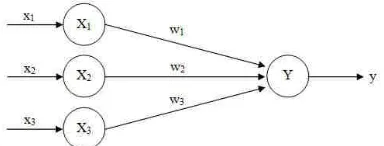
Artificial Neural Networks are a large number of highly interconnected processing elements called neurons. Each neuron is connected to other neurons by a connected link, each with an associated weight which contains information being used by the neural net to solve a particular problem. ANNs is characterized by their ability to learn, recall and generalize form similar to that of a human brain. Each neuron has an internal state of its own, called its activation or activity level of neuron, which is a function of the inputs the neuron receives. A neuron sends its activation of a one signal which can be transmitted to several other neurons.
Fig. 3: Architecture of a simple Artificial Neural Network
From Fig 3 the net input has to be calculated as follows
Infogain Publication (Infogainpublication.com) ISSN : 2454-1311
www.ijaems.com Page | 1561
where, x1, x2, x3 are the activations of the input neurons X1,
X2 and X3. The weights on the connection from X1, X2 and
X3 to neuron y are w1, w2 and w3 respectively. The output
y of the output neuron Y is given by some function of its net input.
y=f (yin)
The function to be applied over the net input is called activation function.
Review of image watermarking by using artificial neural network is presented below.
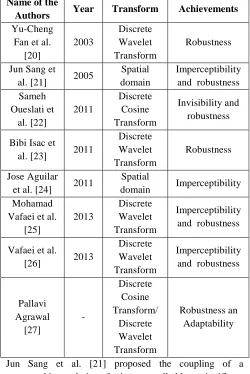
Table 1 shows the different frequency domain methods and various years on Artificial Neural Network for image watermarking. An artificial neural network based scheme for fragile watermarking has been developed in [20]. They used the artificial neural network model to analyse the degree of changes and any tampered image what kind of alteration has occurred.
Table 1: Different frequency domain methods on Artificial Neural Network for image watermarking
Name of the
Authors Year Transform Achievements
Yu-Cheng Fan et al.
[20]
2003
Discrete Wavelet Transform
Robustness Jun Sang et
al. [21] 2005
Spatial domain
Imperceptibility and robustness Sameh
Oueslati et al. [22]
2011
Discrete Cosine Transform
Invisibility and robustness Bibi Isac et
al. [23] 2011
Discrete Wavelet Transform
Robustness Jose Aguilar
et al. [24] 2011
Spatial
domain Imperceptibility Mohamad
Vafaei et al. [25]
2013
Discrete Wavelet Transform
Imperceptibility and robustness Vafaei et al.
[26] 2013
Discrete Wavelet Transform
Imperceptibility and robustness
Pallavi Agrawal
[27]
-
Discrete Cosine Transform/
Discrete Wavelet Transform
Robustness an Adaptability
Jun Sang et al. [21] proposed the coupling of a watermarking technique for images, called least significant bit, in the multiple classes random neural network. Their method obtained very good performances in terms of Imperceptibility and robustness. A new method to obtain the invisibility and the robustness in DCT domain watermarking has been described in [22]. HVS
characteristics are taken into consideration so as to make the watermark invisible during the process of watermark embedding and artificial neural network is applied and for enhancing the performance of conventional watermarking techniques. Bibi Isac et al. [23] described a method to embed watermark in region of non-interest (RONI) and also a method for adaptive calculation of strength factor using neural network. The embedding and extraction processes are carried out in the transform domain by using Discrete Wavelet Transform (DWT). Their algorithm robustness is tested against noise addition attacks and geometric distortion attacks. A lossless digital image watermarking algorithm based on neural network is proposed in [24]. Their proposed algorithm does not degrade the visual quality of the cover image.
A novel watermarking method based on wavelet coefficient quantization using artificial neural networks is proposed in [25]. In their proposed method, better compromises are achieved applying neural networks to adjust the watermark strength. The Experimental results demonstrate simultaneous good imperceptibility and high robustness of their method against several types of attacks, such as Gaussian and salt and pepper noise addition, median filtering, and JPEG compression. A blind digital watermarking algorithm based on feed-forward neural networks was presented in [26]. The host image was decomposed into wavelet domain and watermark bits embedded in the appropriately selected sub-band coefficients. It is shown that the neural networks can satisfactorily maximize the watermark strength using proper trainings; in addition to being adaptive based on the knowledge of the block features. The simulation results illustrate that their proposed method has good imperceptibility and high robustness. The different categories of Artificial Neural Networks are illustrated in Fig 4.
Fig. 4: The categories of Artificial Neural Networks
Infogain Publication (Infogainpublication.com) ISSN : 2454-1311
into the middle frequency coefficients of the cover image’s blocked DCT/DWT based transform domain. In order to make the watermark stronger and less susceptible to different types of attacks, it is essential to find the maximum amount of interested watermark before the watermark becomes visible. Here neural networks are used to implement an automated system of creating maximum strength watermarks. The experimental results show that their method can survive of common image processing operations and has good adaptability for automated watermark embedding.
3.1.Layers of Neural Network
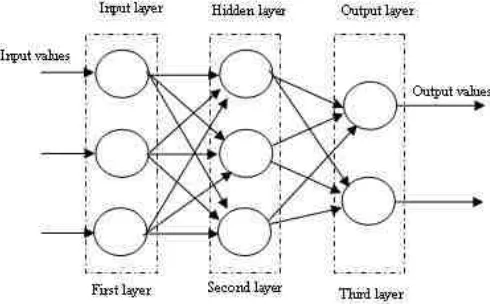
The neural network is formed by the interconnection of several layers such as, input, hidden and output layers [28]. The input is processed and relayed from one layer to the other, until the final result has been computed. The general structure of layered architecture is shown in Fig 5.
Fig. 5: General Structure of a Layered Architecture
3.1.1. Input Layer
The input layer is that which receives the input variables. This layer has no function, but simply passes the values to the processing layer.
3.1.2. Hidden Layer
The hidden layer is any layer that is formed between the input and output layers. This hidden layer is internal to the network and they are not connected directly to the external environment. It should be noted that there may be zero to several hidden layers in an artificial neural network. More the number of the hidden layer more is the complexity of the network.
3.1.3. Output Layer
The output layer generates the output of the network.
3.2. Types of Neural Network
The two major types of neural networks are feed forward and recurrent neural networks [29] as discussed below.
3.2.1. Feed Forward Neural Network
The Feed Forward Neural network (FFNN) is the first and simplest type of artificial neural network. It consists of a number of layers, which are arranged into a layered configuration as shown in Fig 6. In this network, the information moves only in forward direction, from the input layer, through the hidden layer and to the output
layer. There are no loops or cycles in the feed forward neural network, that is it never goes backwards. Feed forward neural networks represent a well-established computational model, which can be used for solving complex tasks requiring large data sets [30]. Their method provided a survey of some existing techniques that optimize architecture of BP-networks.
Fig. 6: The Architecture of Feed Forward Neural Network
3.2.2. Recurrent Neural Network
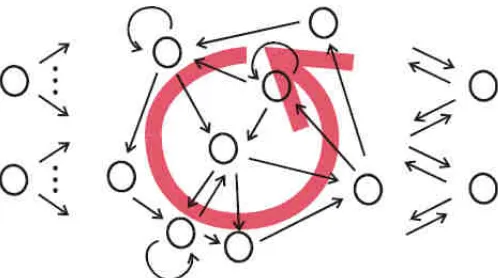
A recurrent neural network (RNN) is a class of artificial neural network where connections between units form a directed cycle. This creates an internal state of the network which allows it to exhibit dynamic temporal behaviour. Unlike feed forward neural networks, RNNs can use their internal memory to process arbitrary sequences of inputs. In the Recurrent Neural Network the output can be directed back to the nodes in a preceding layer. The architecture of recurrent neural network is shown in Fig 7. Ilya Sutskever et al. [31] demonstrated the power of RNNs trained with the new Hessian-Free optimizer (HF) by applying them to character-level language modelling tasks. Their standard RNN architecture is effective.
Fig. 7: Architecture of Recurrent Neural Network
3.3. Training Process in Neural Network
The learning or training process of an artificial neural network can be generally classified into supervised and unsupervised learning as follows,
3.3.1. Supervised Learning
Infogain Publication (Infogainpublication.com) ISSN : 2454-1311
www.ijaems.com Page | 1563
is shown in Fig 8. During the training process the actual output is compared with the desired output. If their exits a difference between the two output then an error signal is generated by the network. This error signal is used for adjustment of weights until the actual output matches the desired output. Sathya et al. [32] presented a comparative account of unsupervised and supervised learning models and their pattern classification evaluations as applied to the higher education. Their method found that, though the error back-propagation learning algorithm as provided by supervised learning model is very efficient for a number of non-linear real-time problems, KSOM of unsupervised learning model, offers efficient solution and classification.
Fig. 8: Block diagram of supervised learning network
3.3.2. Unsupervised Learning
In unsupervised learning when a new input pattern is applied, the neural network gives an output response indicating the class to which the input pattern belongs. The block diagram of unsupervised learning is shown in Fig 9. Here there is no feedback from the environment to inform whether the outputs are correct. In this case the network relations for the input data over the output undergoes change its parameters. This process is also called self-organizing. Roland Memisevic et al. [33] described a probabilistic model for learning rich, distributed representations of image transformations. Experimental results demonstrated that their method is applicability to a variety of tasks.
Fig. 9: Block diagram of supervised learning network
IV. IMAGE WATERMARKING USING NEURAL
NETWORKS
A review of different types of watermarking techniques has been proposed for embedding and extracting a watermark in a digital image using neural networks.
4.1. Back Propagation Neural Network (BPN)
The back propagation algorithm is one of the must important developments in neural networks. The back
propagation neural network (BPNN) is a very popular modal and most frequently used learning techniques in neural networks.
A BPNN is a multilayer and feed-forward neural network, order to obtain minimum mean squared error between expected outputs and actual outputs, BP neural network can fix the network weights by using mean squared error and gradient descent methods. A typical BP network architecture is shown in Fig 10, which consists of an input layer, hidden layer, and output layer. Each layer has one or more neurons and each neuron is fully connected to its adjacent layers. Two neurons of each adjacent layer are directly connected to one another, which is called a link. Each link has a weighted value, representing the relational degree between two neurons. The numbers of input nodes and output neurons of neural network can be easily determined according to the practical problem. Table 2 shows the different frequency domain methods and various years on Back Propagation Neural Network for image watermarking.
Fig. 10: Architecture of a Back Propagation Neural Network
There has been many works in the literature related to image watermarking by using back propagation neural network and some of them are discussed below.
Infogain Publication (Infogainpublication.com) ISSN : 2454-1311
mean value of the corresponding coefficients in other three sub blocks. The learning and adaptive capabilities of the BPN, the false recovery of the watermark can be greatly reduced by the trained BPN. Experimental results show that their proposed method has good imperceptibility and high robustness to common image processing operators. Zhenfei Wang et al. [37] proposed a novel digital watermarking technique based on neural networks in wavelet domain. Watermark bits are added to the significant coefficients of wavelet selected by considering the human visual system (HVS) characteristics, because of the learning and adaptive capabilities of neural networks, the trained neural networks can exactly recover the watermark from the watermarked image. Extensive experiments show that their technique possesses significant robustness to be against the various attacks. Cheng-Ri Piao et al. [38] proposed a new watermarking scheme in which a logo watermark is embedded into the discrete wavelet transform (DWT) domain of the color image using Back-Propagation Neural networks (BPN). In order to strengthen the imperceptibility and robustness, the original image is transformed from RGB color space to brightness and chroma space (YCrCb). BPN will learn the characteristics of the color image, and then watermark is embedded and extracted by using the trained neural network.
An effective blind digital watermarking algorithm based on neural networks in the wavelet domain is presented in [39]. The significant coefficients of wavelet are selected according to the human visual system (HVS) characteristics. The neural networks to learn the characteristics of the embedded watermark related to them, because of the learning and adaptive capabilities of neural networks, the trained neural networks almost exactly recover the watermark from the watermarked image. Their proposed digital watermarking technique can be robust against many different types of attacks. A new digital watermarking algorithm based on BPN neural network is proposed in [40]. Watermark bits are added to the selected coefficients blocks, because of the learning and adaptive capabilities of neural networks, the trained neural networks can recover the watermark from the watermarked images. The experimental results show that their watermarking algorithm has a good preferment. A novel blind watermarking technique based on back propagation neural networks is proposed in [41]. The watermarking technique hides a scrambled watermark into an image, and takes HVS characteristics into consideration during the watermark embedding process, then uses a back propagation neural network to learn the characteristics of the embedded watermark related to the watermarked image. Extensive experiments show that their proposed watermarking algorithm has a good imperceptibility and
high robustness to various common image processing attacks. Ashish Bansal et al. [42] described the algorithm to use a Back propagation Neural Network with an additional advantage of hiding the trained network weights within the original cover image. The watermarked image has a good robustness and the imperceptibility of the cover image is also highly preserved. For the extraction, only cover image is required and no external weights files need to be supplied with the watermarked image.
Qianhui Yi et al. [43] proposed a improved Back-Propagation neural network for color image. The watermark is embedded into the discrete wavelet domain of the original image and extracted by training BPN, which can learn the characteristic of the image. Experimental results show that their proposed method has good imperceptibility and high robustness to common image processing such as JPEG compression, noise adding, chopping, and rotation. A novel watermarking technique based on image features and neural network is proposed in [44]. The watermark is the fusion of a binary copyright symbol and image feature label which is gotten by analyzing the image fractal dimension. Then the watermark is pre-treated by Arnold transform in order to increase the security, and embedded into the multiwavelet transform domain. Experimental results demonstrate that their proposed algorithm can achieve good perceptual invisibility and security, and it is also robust against various common image processing attacks. A color image oblivious watermarking scheme based on neural network and discrete wavelet transform (DWT) is proposed
Table 2: Different frequency domain methods on Back-Propagation Neural Network for image watermarking Name of the
Authors Year Transform Achievements
Davis et al.
[34] 2001
Discrete Wavelet Transform
Robustness Zhang et al.
[35] 2002
Multiwavelet Transform
Imperceptibility and robustness Jun Zhang et
al. [36] 2002
Multiwavelet Transform
Imperceptibility and robustness Zhenfei Wang
et al. [37] 2006
Discrete Wavelet Transform
Robustness Cheng-Ri
Piao et al. [38]
2006
Discrete Wavelet Transform
Imperceptibility and robustness WANG
Zhenfei et al. [39]
2006
Discrete Wavelet Transform
Robustness Xue-Quan Xu
et al. [40] 2007
Discrete
Infogain Publication (Infogainpublication.com) ISSN : 2454-1311
www.ijaems.com Page | 1565
Transform Song Huang
et al. [41] 2008
Discrete Wavelet Transform Imperceptibility and robustness Ashish Bansal
et al. [42] 2008 ---
Imperceptibility and robustness Qianhui Yi et
al. [43] 2009
Discrete Wavelet Transform Imperceptibility and robustness Song HUANG et al. [43]
2009 Arnold Transform
Invisibility, security and robustness Qun-ting
Yang et al. [45] 2010 Discrete Wavelet Transform Robustness Yonghong
Chen et al. [46] 2010 Discrete Wavelet Transform Robustness Fenglian Liu
et al. [47] 2010
Dual-Tree Wavelet Transform
Robustness Olanrewaju et
al. [48] 2011
Fourier
Transform Fidelity Mohananthini
et al. [49] 2012
Discrete Wavelet Transform Imperceptibility Nallagarla Ramamurthy et al. [50]
2012 Discrete Wavelet Transform Imperceptibility and robustness Nallagarla Ramamurthy et al. [51]
2012 Discrete Wavelet Transform Imperceptibility and robustness Mya Thidar
Kyaw et al. [52] 2013 Discrete Cosine Transform Robustness
Saini [53] 2014
Discrete Wavelet Transform
Robustness in [45]. Three identical watermarks and some different expanded bit streams are adaptively embedded into the low frequency sub-bands generated from three channels for a color image. Extensive experiments illustrate that their new scheme possesses good robustness against different attacks including noise addition, shearing, scaling, luminance and distortion.
A novel blind watermarking scheme based on the back-propagation neural networks (BPNN) for image is presented in [46]. The convolutional codes encoding is used to refine the watermark for increasing robustness of the scheme. BPNN is developed to memorize the relationships between the wavelet selected samples and a processed chaotic sequence. With wavelet domain of original image being divided into watermarking blocks,
then several different BPNN models of selected watermarking blocks are trained simultaneously to form certain relationships, which are employed for embedding the coded watermark bit stream. Experimental results demonstrate the high robustness of their proposed scheme against common signal processing.
Fenglian Liu et al. [47] proposed a novel digital watermarking technique based on BP neural networks in wavelet domain. The original image is decomposed by DTCWT, and then the watermark bits are added to the selected coefficients blocks, because of the learning and adaptive capabilities of neural networks, the trained neural networks can recover the watermark from the watermarked images. Experimental results show that their proposed scheme has good performance against several attacks. Olanrewaju et al. [48] suggested an efficient and distortion free digital watermarking algorithm using complex neural network and fast Fourier transform. The performance of their proposed technique has been evaluated image fidelity. A digital image watermarking technique based on Back-Propagation neural networks (BPNN) is proposed in [49]. Using improved BPNN, the watermark can be embed into Discrete Wavelet Transform(DWT), which can reduce the error and improve the rate of the learning, the trained neural networks can recover the watermark from the watermarked images. Their proposed method has good imperceptibility on the watermarked image and superior in terms of Peak Signal to Noise Ratio (PSNR).
Infogain Publication (Infogainpublication.com) ISSN : 2454-1311
Discrete Cosine Transform (DCT). The performance analysis such as robustness of their secret information against various attacks will be presented. Their proposed system can be applied for copyright protection for authorized user using handwritten online signature. Saini [53] proposed a hybrid watermark embedding and extracting technique. SVD and DWT methods are used for watermark embedding because DWT method is more flexible and provides a wide range of functionalities for still image processing. Their result shows that after a numerous image attacks like paper and salts, mean, median, shear, noise, crop and rotation the watermark is identifiable.
4.2. Radial Basis Function Neural Network (RBF)
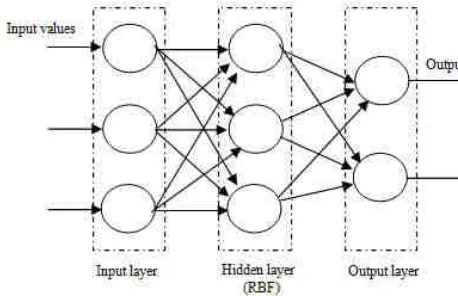
The Radial Basis Function is a classification and functional approximation neural network. RBF is a multi-layered feed forward networks. The radial basis function network has universal approximation capability and has been successfully applied to many signal and image processing problems. The RBF network used the most common nonlinearities such as sigmoidal and Gaussian function. This is resembles a BPN network, but the activation function used a Gaussian function.
The Radial basis function Network architecture is shown in Fig 11, consists of a set of inputs, a hidden layer for the processing elements and an output layer. The output layer is a linear combination of the Gaussian functions computed by means of the RBF notes or hidden layer nodes. The Gaussian function in the hidden layer produces a significant nonzero response to the input stimulus it has received only when the input of it falls with in a small localized region of the input space. Table 3 shows the different frequency domain methods and various years on Radial basis function Network for image watermarking.
Fig. 11: Architecture of a Radial Basis Function Network
Review of image watermarking by using radial basis function network is presented below.
A meaningful digital image watermarking algorithm based on RBF (radial basis function neural network) neural network is proposed in [54]. RBF neural network is used to simulate human visual speciality to determine the
watermark embedding intensity endured by DCT coefficients and the watermarking is a meaningful two value image. The experiments of results show that their algorithm has good robustness against all kinds of attacks. Cheng-Ri Piao et al. [55] proposed a new blind watermarking scheme in which a watermark is embedded into the discrete wavelet transform (DWT) domain. Radial basis function neural networks (RBF) will be implemented while embedding and extracting watermark and human visual system (HVS) model is used to determine the watermark insertion strength. Experimental results show that their proposed method has good imperceptibility and high robustness to common image processing attacks.
Table 3: Different frequency domain methods on Radial Basis Function Neural Network for image watermarking
Name of the Authors
Yea r
Transfor m
Achievement s
Quan Liu et al. [54] 200 5
Discrete Cosine Transfor
m
Robustness
Cheng-Ri Piao et al. [55]
200 6
Discrete Wavelet Transfor
m
Imperceptibili ty and robustness
Hitesh et al. [56] 200 7
Discrete Cosine Transfor
m
Robustness
Rakhi Motwani et al. [57]
200
9 -
Embedding capacity and
robustness Yanhong Zhang et
al. [58]
200 9
Discrete Wavelet Transfor
m
Invisible and robust
Nallagarla.Ramamur thy et al. [59]
201 2
Discrete Wavelet Transfor
m
Robustness
Infogain Publication (Infogainpublication.com) ISSN : 2454-1311
www.ijaems.com Page | 1567
characterize different geometries. Their algorithm achieves minimal perceptual distortion and accomplishes high watermark embedding capacity. Experimental results prove that their algorithm is robust against a variety of attacks as well.
Yanhong Zhang et al. [58] proposed a new blind watermarking scheme based on discrete wavelet transform (DWT) domain. The method uses the HVS model, and radial basis function neural networks (RBF). RBF will be implemented while embedding and extracting watermark. The human visual system (HVS) model is used to determine the watermark insertion strength. The neural networks almost exactly recover the watermarking signals from the watermarked images after training and learning. The experimental results show that their watermark is invisible (the PSNR is higher than 41) and is robust in the case of against some normal attacks such as JPEG compression, additive noise and filtering. A blind transform domain based algorithm using Radial Basis Function Neural Network is introduced in [59]. Their proposed algorithm is robust to cropping, salt & pepper noise and rotation attacks.
4.3. Hopfield Neural Network
John J. Hopfield has developed a number of Neural Networks based on fixed weights and adaptive activations. The Networks proposed by Hopfield are known as Hopfield networks and the network has found many useful applications in associative memory and various optimization problems. The architecture of Hopfield network with four nodes is shown in Fig 12 consists of a set of neuron forming a multiple loop feedback system. The number of feedback loops is equal to the number of neurons. Hopfield networks normally have units that take on values of +1 or -1. Table 4 shows the different frequency domain methods and various years on Hopfield neural network for image watermarking.
Fig. 12: Architecture of a Hopfield Network
Review of image watermarking by using Hopfield network is presented below.
Fan Zhang et al. [60] presented a blind watermarking algorithm using Hopfield neural network, and analyze watermarking capacity based on neural network. In their watermarking algorithm, watermarking capacity is decided by attraction basin of associative memory. A blind digital watermarking algorithm based on Hopfield neural network is proposed in [61]. The host image and original watermark are stored by Hopfield neural network. The noise visibility function (NVF) is used for adaptive watermark embedding. In watermark extraction, the host image and the original watermark are retrieved by neural network. The experimental results show that their watermarking algorithm has a good preferment.
Table 4: Different frequency domain methods on Hopfield Neural Network for image watermarking
Name of the Authors
Year Transform Achievements
Fan Zhang
et al. [60] 2004 - Capacity Xinhong
Zhang et al. [61]
2005 - Imperceptibility Katiyar et
al. [62] 2011 - Image quality He Xu et al.
[63] 2011
Discrete Cosine Transform
Invisible and robust
Katiyar et al. [62] proposed a digital watermarking technique with the Hopfield Neural network for the authentication and copyright protection of audio, video and still images. Different from the traditional methods, the watermark is embedded in the synapses of Hopfield Neural Network rather than the cover image. Hence the quality of the watermarked image is almost same as the original cover image. In addition, the quality of the extracted watermark image does not degrade after most attacks, because the watermark is stored in the synapses. An adaptive image watermarking algorithm based on neural network is proposed in [63]. The watermarking signal is embedded in higher frequency, which is in the lower frequency of original image by DWT joined with DCT. The ability of attracting is improved by pre treatment and re-treatment of image scrambling and Hopfield network. Experimental results show that their embedded digital watermarking is invisible and robust enough against common image processing such as JPEG compression, noises, filter and shearing.
Infogain Publication (Infogainpublication.com) ISSN : 2454-1311
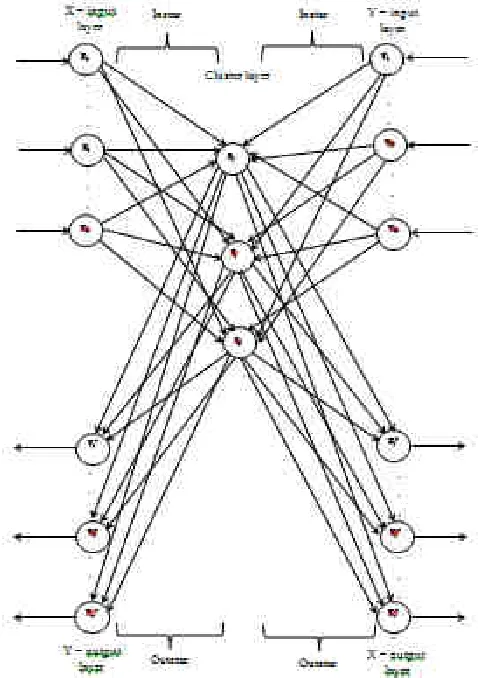
Counter propagation networks applications are data compression, function approximation and pattern association. The Full Counter Propagation Network and Forward only Counter Propagation network are the types of counter propagation networks. The Full Counter Propagation Network is the extension of Forward only Counter Propagation network with is a supervised learning network with the capacity of bidirectional mapping. The architecture of Full Counter Propagation Network is shown in Fig 13, constructed from an instar-outstar model such as input layer, instar, and hidden (competitive) layer and outstar. An instar responds maximally to the input vectors from a particular cluster, and then all the instars are grouped into a layer called the competitive (hidden) layer. Every instar responds maximally to a group of input vectors in a different region of space. The input layer of instars classifies any input vector because, for a given input, the winning instar with the strongest response identifies the region of space in which the input vector lies. Hence, need the competitive layer to single out the winning instar by setting its output to a nonzero value and also suppressing the other outputs to zero. That is, it is a winner-take-all or a Maxnet-type network. An outstar model is found to have all the nodes in the output layer and a single node in the competitive layer. The outstar looks like the fan-out node. Table 5 shows the different frequency domain methods and various years on Full Counter Propagation Neural Network for image watermarking.
Fig. 13: Architecture of a of Full Counter Propagation Network
Review of image watermarking by using Full Counter Propagation Neural Network is presented below.
A specific designed full counter- propagation neural network for digital image watermarking has been presented in [64]. The watermark is embedded in the synapses of FCNN instead of the cover image. The result shows that their proposed FCNN could resist various attacks. Chuan-Yu Chang et al. [65] proposed a novel method called Full Counter-propagation Neural Network (FCNN) for digital image watermarking, in which the watermark is embedded and extracted through specific FCNN. The experimental results show that their proposed method is able to achieve robustness, imperceptibility and authenticity in watermarking.
Infogain Publication (Infogainpublication.com) ISSN : 2454-1311
www.ijaems.com Page | 1569
desired watermark image. The specialty of their technique is its lesser complexity and easy apprehension.
Table 5: Different frequency domain methods on Full Counter Propagation Neural Network for image
watermarking Name of the
Authors Year Transform Achievements
Chuan-Yu Chang et al.
[64]
2005 - Robustness Chuan-Yu
Chang et al. [65]
2005 -
Robustness, imperceptibility and authenticity A.R. Naghsh
Nilchi et al. [66]
2008
Discrete Cosine Transform
Robustness Summrina
Kanwal Wajid et al.
[67]
2009 - Lesser complexity Ashish
Bansal et al. [68]
2010
Discrete Cosine Transform
Complexity, capacity and
PSNR Amarjeet
Kaur et al. [69]
2013
Discrete Cosine Transform
Robustness Amarjeet
Kaur et al. [70]
2013 - Imperceptibility Ashish Bansal et al. [68] proposed a novel approach using Full Counter propagation Neural Network for Watermarking. Chun –Yu-Chang et al. [64] proposed a wonderful technique of embedding the watermarks into synapses of FCNN rather than cover image. This helped to increase robustness and reduce imperceptibility problems to a great extent. However, with their modification, FCNN can be practically employed to obtain a successful watermarking scheme with better time complexity, higher capacity and higher PSNR. Amarjeet Kaur et al. [69] proposed Hopfield model and full counter propagation neural network (FCNN) techniques to overcome the remedies such as peak signal to noise ratio (PSNR) and to maintain the quality of the image. Their result shows that Hopfield model can resist various attack better than FCNN. Amarjeet Kaur et al. [70] proposed Hopfield model and full counter propagation neural network (FCNN) techniques for two images as a cover image and one image in the form of text as watermark image to overcome the remedies such as peak signal to noise ratio (PSNR) of watermarked image and to check the quality of the image normal correlation is also calculated by using six parameters.
4.5.Synergetic Neural Network
Synergetic neural network (SNN) associates synergetic with artificial neural network, it can carefully deal with the behaviour of network in the mathematical theory, and have the advantage of fast learning, short pattern recalling time. Synergetic neural network (SNN) developed by Haken [71] describes the pattern recognition process in the human brain which tries to achieve the learned model with fast learning and no false state. Table 6 shows the different frequency domain methods and various years on Synergetic Neural Network for image watermarking.
Table.6: Different frequency domain methods on Synergetic Neural Network for image watermarking Name of the
Authors Year Transform Achievements
Chen Yongqiang et
al. [72]
2009
Discrete Wavelet Transform
Imperceptibility and robust Chen
Yongqiang et al. [73]
2009
Discrete Cosine Transform
Imperceptibility and robustness Chen
Yongqiang et al. [74]
2009
Discrete Wavelet Transform
Security, imperceptibility
and robustness Review of image watermarking by using Synergetic Neural Network is presented below.
A novel optimal color image watermarking scheme in DWT domain is proposed in [72]. In the procedure of watermark embedding, the watermark is embedded into host color image through selecting and modifying the wavelet coefficients using Genetic Algorithm (GA) to improve the imperceptibility of watermarked image. In order to identify the owner of extracted watermark, Synergetic Neural Network (SNN) is used in the watermarking identification to overcome the limitation of correlation analysis or the human sense organ after some attacks. The results of their scheme realization and robust experiments show that this novel scheme has preferable performance.
Infogain Publication (Infogainpublication.com) ISSN : 2454-1311
recognition, is used in watermark identification to identify the extracted watermark and has the ability to recognize the original watermark quickly and accurately after attacks. In [74] their scheme they used the two-dimensional chaotic stream encryption, GA and SNN to meet these watermarking properties. In their scheme realization and robust experiments, the results prove the feasibility and validity of their proposed scheme.
V. CONCLUSION
This paper has studied a several important issues and recent developments of neural networks for image watermarking. A few papers are found using spatial domain, while many papers are carried out in frequency domain by using the different types of neural networks such as, Artificial Neural Network (ANN), Back propagation Neural Network (BPNN), Radial Basis Function Neural Network (RBF), Hopfield Neural Network, Full Counter Propagation Network (FCPN), Synergetic Neural Network (SNN). In this study, the BPNN is found to be better for the image watermarking process. There are many other research topics have been studied the most important aspects of neural networks in solving image watermarking problems.
In future work, a new algorithm can be designed to embed and extract the watermark using BPNN. The error will be minimized to a minimum value using the back propagation neural network which has to be trainedfor performing the testing phase. In the testing process, the trained neural network is to check whether the testing data will predict the maximum watermarking strength.
REFERENCES
[1] Cox I J, Miller M L, Bloom J A. Digital Watermarking, Morgan Kaufmann Publishers, San Francisco, 2002.
[2] S.N. Sivanandam and S.N. Deepa, “Principles of soft computing”, John Wiley & Sons, 2007.
[3] Divyakant T. Meva and Amit D. Kothari, “Adoption of Neural Network Approach In Steganography and Digital Watermarking for Covert Communication and Copyright Protection”, International Journal of Information Technology and Knowledge Management, 2011, Volume 4, No. 2, pp. 527-529.
[4] Bibi Isac and V. Santhi, “A Study on Digital Image and Video Watermarking Schemes using Neural Networks”, International Journal of Computer Applications, Vol. 12– No.9, pp. 1-6, 2011.
[5] Elias Kougianos, Saraju P. Mohanty and Rabi N. Mahapatra, “Hardware Assisted Watermarking for Multimedia”, Computers & Electrical Engineering Volume 35, Issue 2, pp. 339–358.
[6] Saba Riaz, M. Younus Javed, and M. Almas Anjum, “Invisible Watermarking Schemes in Spatial and Frequency Domains”, International Conference on Emerging Technologies, 2008.
[7] Liu Jun, Liu LiZhi, “An Improved Watermarking Detect Algorithm for Color Image in Spatial Domain”, IEEE, International Seminar on Future BioMedical Information Engineering, 2008.
[8] Deepshikha Chopra, Preeti Gupta, Gaur Sanjay B.C., Anil Gupta, “Lsb Based Digital Image Watermarking For Gray Scale Image”, IOSR Journal of Computer Engineering (IOSRJCE), Volume 6, Issue 1, PP 36-41. [9] C.K. Chan, L.M. Cheng,” Hiding data in images by
simple LSB substitution”, pattern recognition vol.37, Issue 3,pp. 469-474, 2004.
[10]T. S. Das, V. H. Mankar and S. K. Sarkar, “Spread Spectrum based M-ary Modulated Robust Image Watermarking”, International Journal of Computer Science and Network Security, VOL.7 No.10, October 2007. pp. 154 – 160.
[11]Santi P. Maity, Malay K. Kundu, Seba Maity, “Dual Purpose FWT Domain Spread Spectrum Image Watermarking in Real-Time”, Computers & Electrical Engineering, pp. 415–433, 2008.
[12]Dharm Singh, Naveen Choudhary and Madhuri Agrawal, “Spatial and Frequency Domain for Grey level Digital Images “, International Journal of Computer Applications on Communication Security, No.4. Mar.2012. pp. 16-20.
[13]Baisa L. Gunjal and R.R. Manthalkar, “An overview of transform domain robust digital image watermarking algorithms”, Journal of Emerging Trends in Computing and Information Sciences, Volume 2, No. 1, pp. 37-42, 2011.
[14]Awanish Kr Kaushik, A Novel Approach for Digital Watermarking of an Image Using DFT, International Journal of Electronics and Computer Science Engineering, pp. 35 – 41.
[15]Ante Poljicak, Lidija Mandic and Darko Agic, Discrete Fourier transform–based watermarking method with an optimal implementation radius, Journal of Electronic Imaging, Vol. 20, No. 3, pp. 1 – 8.
[16]Wen-Nung Lie, Guo-Shiang Lin, Chih-Liang Wu, and Ta-Chun Wang, “Robust Image Watermarking On the DCT Domain”, IEEE International Symposium on Circuits and Systems, May 28-31, 2000.
Infogain Publication (Infogainpublication.com) ISSN : 2454-1311
www.ijaems.com Page | 1571
[18]Ramana Reddy, P., Muruga. V. N. K. Prasad., & Sreenivasa Rao, D. (2009). Robust Digital Watermarking of Images using Wavelets, International Journal of Computer and Electrical Engineering, 2 (2), 111 – 116.
[19]Yamuna and D. Sivakumar, “A novel digital image watermarking scheme using biorthogonal wavelets”, ICTACT Journal on Image and Video Processing, vol. 01, Issue. 04, 2011.
[20]Laurene V. Fausett, “Fundamentals of Neural Networks: Architectures, Algorithms, and Applications”, Pearson, 1994.
[21]Jose Aguilar and Juan Anderson, “A Neural Watermark Approach”, Electronic Notes in Theoretical Computer Science, Vol. 281 (2011) 35–50. [22]Yu-Cheng Fan, Wei-Lung Mao and Hen-Wai Tsao,
“An Artificial Neural Network – based Scheme for Fragile Watermarking”, In proceeding of: IEEE International Conference on Consumer Electronics, (ICCE) 2003.
[23]Jun Sang and Mohannad S. Alam, “A neural network based lossless digital image watermarking in the spatial domain”, Springer, pp 772-776, 2005.
[24]Sameh Oueslati, Adnene Cherif and Sameh Oueslati, “Adaptative Image Watermarking Scheme based on Neural Network”, International Journal of Engineering Science and Technology (IJEST), Vol. 3 No. 1 Jan 2011.
[25]Bibi Isac, V. Santhi and Arunkumar Thangavelu, “Region of Non-Interest based Digital Image Watermarking using Neural Networks”, ICTACT Journal on Image and Video Processing, Vol. 02, Issue. 02, 2011.
[26]Mohamad Vafaei, and Homayoun Mahdavi-Nasab, “A Novel Digital Watermarking Scheme Using Neural Networks with Tamper Detection Capability”, Journal of Basic and Applied Scientific Research, 3(4), pp. 577-587, 2013.
[27]M. Vafaei, H. Mahdavi-Nasab and H. Pourghassem, “A New Robust Blind Watermarking Method Based on Neural Networks in Wavelet Transform Domain”, World Applied Sciences Journal 22 (11): 1572-1580, 2013.
[28]S.N.Sivanandam & S.N.Deepa, Principles of soft computing”, John Wiley & Sons, 2007
[29]J. Schmidhuber, “A local learning algorithm for dynamic feed forward and recurrent networks. Connection Science, 1(4): pp. 403–412, 1989. [30]Z. Reitermanova, Feedforward Neural Networks –
Architecture Optimization and Knowledge Extraction, Proceedings of Contributed Papers WDS’08, 2008, pp. 159-164.
[31]Ilya Sutskever, James Martens, Geoffrey Hinton, Generating Text with Recurrent Neural Networks, Proceedings of the twenty eighth International Conference on Machine Learning, 2011.
[32]Sathya and Annamma Abraham , “Comparison of Supervised and Unsupervised Learning Algorithms for Pattern Classification”, International Journal of Advanced Research in Artificial Intelligence, Vol. 2, No. 2, pp. 34 – 38, 2013.
[33]Roland Memisevic and Geoffrey Hinton,
Unsupervised Learning of Image Transformations, IEEE Conference on Computer Vision and Pattern Recognition, 2007. CVPR '07, pp. 1 -8.
[34]Kenneth J. Davis, and Kayvan Najarian, “Maximizing Strength of Digital Watermarks Using Neural Networks”, Proceedings of International Joint Conference on Neural Networks, Vol. 4, pp. 2893 – 2898, 2001.
[35]Zhang, J., Wang, N.C., Xiong, F: “A Novel Watermarking for Images Using Neural Networks”, International Conference on Machine Learning and Cybernetics, 3(2002) 1405-1408.
[36]Jun Zhang, Nengchao Wang and Feng Xiong, “Hiding a Logo Watermark into the Multiwavelet Domain Using Neural Networks”, Proceedings of the 14th IEEE International Conference on Tools with Artificial Intelligence, 2002.
[37]Zhenfei Wang, Nengchao Wang and Baochang Shi, “A Novel Blind Watermarking Scheme Based on Neural Network in Wavelet Domain”, Proceedings of the 6th World Congress on Intelligent Control and Automation, June 21 - 23, 2006.
[38]Cheng-Ri Piao, Sehyeong Cho and Seung-Soo Han, “Color Image Watermarking Algorithm Using BPN Neural Networks”, Springer-Verlag Berlin Heidelberg, pp. 234–242, 2006.
[39]WANG Zhenfei, ZHAI Guangqun and WANG Nengchao, “Digital Watermarking Algorithm Based on Wavelet Transform and Neural Network”, Wuhan University Journal of Natural Sciences, Vol. 11, No. 6, 2006, pp. 1667-1670.
[40]Xue-Quan Xu, Xian-Bin Wen, Yue-Qing Li, and Jin-Juan Quan, “A New Watermarking Approach Based on Neural Network in Wavelet Domain’ Springer-Verlag Berlin Heidelberg, pp. 1–6, 2007.
[41]Song Huang, Wei Zhang, Wei Feng and Huaqian Yang “Blind Watermarking Scheme Based on Neural Network”, Proceedings of the 7th World Congress on Intelligent Control and Automation, Chongqing, China, June 25 - 27, 2008.
Infogain Publication (Infogainpublication.com) ISSN : 2454-1311
Theoretical and Applied Information Technology, Vol. 4, No. 8, pp. 663 – 670, 2008.
[43]Qianhui Yi and Ke Wang, “An Improved Watermarking Method Based on Neural Network for Color Image,” Proceedings of the IEEE International Conference on Mechatronics and Automation, Changchun, China, August 9 – 12, 2009.
[44]Song HUANG and Wei ZHANG, “Digital Watermarking Based on Neural Network and Image Features”, Second International Conference on Information and Computing Science, IEEE Computer Society, 2009.
[45]Qun-ting Yang, Tie-gang Gao, Li Fan, “A Novel Robust Watermarking Scheme Based on Neural Network” International Conference on Intelligent Computing and Integrated Systems (ICISS), 22-24 Oct. 2010, pp. 71 - 75.
[46]Yonghong Chen and Jiancong Chen, “A Novel Blind Watermarking Scheme Based on Neural Networks for Image”, IEEE International Conference on Information Theory and Information Security (ICITIS), 17-19 Dec. 2010 pp. 548 - 552 .
[47]Fenglian Liu and Lili Liu, “A New Watermarking Approach Based on BP Network in Wavelet Domain”, 3rd International Congress on Image and Signal Processing (CISP2010), 2010.
[48]R. F. Olanrewaju, O. O. Khalifa, Aisha- Abdulla, A. A. Aburas and A, M . Zeki, “Distortion-free embedding in the optic disk of retina fundus images using complex-valued neural network”, Word Applied Science Journal, 13(6), pp. 1295-1301, 2011.
[49]Mohananthini. N and Yamuna. G, “Watermarking for Images using Wavelet domain in Back-Propagation Neural Network”, IEEE – International Conference on Advances in Engineering, Science and Management (ICAESM ’12) – March 2012, pp 100 – 105.
[50]Nallagarla Ramamurthy and S. Varadarajan, “ Robust Digital Image Watermarking Using Quantization and Back Propagation Neural Network”, Contemporary Engineering Sciences, Vol. 5, 2012, no. 3, 137 – 147. [51]Nallagarla Ramamurthy and S. Varadarajan, “The
Robust Digital Image Watermarking Scheme with Back Propagation Neural Network in DWT Domain”, International Conference on Modelling Optimization and Computing, Vol. 38, 2012, pp. 3769–3778, 2012. [52]Mya Thidar Kyaw and Kyi Soe, “Neural Network
Approach to Bio-watermarking for Image Authentication in DCT Domain”, International Journal of Computer & Communication Engineering Research (IJCCER), Vol. 1 - Issue 4, pp. 124 – 129,2013. [53]Saini. H, “Efficient hybrid watermarking approach by
using SVD, DWT, and Back Propagation Neural
Network”, IEEE International Advance Computing Conference (IACC), pp. 985 – 990, 2014.
[54]Quan Liu and Xuemei Jiang, “Design and Realization of a Meaningful Digital Watermarking Algorithm Based on RBF Neural Network”, International Conference on Neural Networks and Brain, Vol. 1, 2005, pp. 214-218.
[55]Cheng-Ri Piao, Seunghwa Beack, Dong-Min Woo and Seung-Soo Han, “A Blind Watermarking Algorithm Based on HVS and RBF Neural Network for Digital Image”, In proceeding of: Second International Conference on Advances in Natural Computation, 2006.
[56]Agarwal, Hitesh and Panda, Sapan Kumar and Behera, Jayachandra, “Improved digital watermarking schemes using DCT and neural techniques”, BTech thesis, 2007.
[57]Rakhi Motwani, Mukesh Motwani, and Frederick Harris, Jr. “Using Radial Basis Function Networks For Watermark Determination In 3D Models”, Annual IEEE India Conference (INDICON), 2009, pp. 1 – 4. [58]Yanhong Zhang, “Blind Watermark Algorithm Based
on HVS and RBF Neural Network in DWT Domain”, Wseas Transactions on Computers, Issue 1, Volume 8, pp. 174 – 183. January 2009.
[59]Nallagarla.Ramamurthy and S.Varadarajan, “Effect of Various Attacks on Watermarked Images”, International Journal of Computer Science and Information Technologies, Vol. 3 (2), 2012, pp. 3582-3587.
[60]Fan Zhang and Hongbin Zhang, “Image watermarking capacity analysis based on Hopfield neural network”, Chinese Optics Letters 2004, Vol. 02 – Issue. 11, pp.634-634.
[61]Xinhong Zhang and Fan Zhang, “A Blind Watermarking Algorithm Based on Neural Network”, In proceeding of: International Conference on Neural Networks and Brain, Vol. 2, 2005.
[62]Katiyar, V. K. Kumar and Vinod, “Digital Watermarking with Hopfield Neural Networks” International Transactions in Mathematical Sciences & Computer, Vol. 4 Issue 1, 2011.
[63]He Xu, Chang Shujuan, “An Adaptive Image Watermarking Algorithm Based on Neural Network”, Fourth International Conference on Intelligent Computation Technology and Automation, 2011, Vol. 2, pp. 408 – 411.
[64]Chuan-Yu Chang and Sheng-Jyun Su, “A Neural-Network-Based Robust Watermarking Scheme”, IEEE International Conference on Systems, Man and Cybernetics, Vol. 3, 2005, pp. 2482 – 2487.