University of South Carolina
Scholar Commons
Theses and Dissertations
2017
Detracking High School Physical Science Classes
through Teacher Efficacy: An Action Research
Study
Vincent Scott Taylor
University of South Carolina
Follow this and additional works at:https://scholarcommons.sc.edu/etd Part of theCurriculum and Instruction Commons
This Open Access Dissertation is brought to you by Scholar Commons. It has been accepted for inclusion in Theses and Dissertations by an authorized administrator of Scholar Commons. For more information, please [email protected].
Recommended Citation
DETRACKING HIGH SCHOOL PHYSICAL SCIENCE CLASSES THROUGH TEACHER EFFICACY: AN ACTION RESEARCH STUDY
by
Vincent Scott Taylor
Bachelor of Science The Citadel, 2000
Master of Education Converse College, 2004
Submitted in Partial Fulfillment of the Requirements
For the Degree of Doctor of Education in
Curriculum and Instruction
College of Education
University of South Carolina
2017
Accepted by:
Susan Schramm-Pate, Major Professor
Richard Lussier, Committee Member
Russell Conrath, Committee Member
Kenneth Vogler, Committee Member
© Copyright by Vincent Scott Taylor, 2017
DEDICATION
I dedicate this dissertation to my devoted family and their abundance of
love for me through this process. To my beloved wife, Jennifer. Without her
immensesacrifices, overwhelming patience, and persistence, this journey would
never have come to fruition. To my son Aaron, who was a consistent source of
encouragement, I hope this process instills within you a strong work ethic with an
appreciation of the value of education. To my parents, I am thankful for the
ABSTRACT
This study uses the action research method to determine whether students
enrolled in a basic science course (Physical Science College Prep) can be
successful learning more advanced material (Physical Science Advanced) by
increasing teacher efficacy. Currently, there are three levels of Physical Science
courses taught at the study school, a high school in South Carolina, USA. The
most basic course, Physical Science College Prep, is comprised of 76% minority
students, and 56% who receive a free or reduced-cost lunch. In the spring
semester of 2017, a group of students (n = 14) completed two units of study: Unit
One - Experimental Design and Unit Two - Classification of Matter. The students
experienced a variety of teaching methods and techniques, including
problem-based learning, lectures, classroom discussions, and laboratory experiments.
The results showed that the students were able to maintain a B-grade average.
In fact, the overall average grades actually increased from 87.08 in Unit One to
87.67 in Unit Two. The results of this study accompany a recommendation for
district and school administrators to de-track the Physical Science course.
Instead of offering the more basic College Prep course, all students can be
successful in the Advanced and Honors-level courses.
TABLE OF CONTENTS
Dedication ... iii
Abstract ... iv
List of Tables ...vii
List of Figures ... ix
Chapter 1: Introduction to the Action Research ... 1
Introduction ... 1
Methodology ... 14
Glossary ... 20
Chapter 2: Research ... 24
Introduction ... 24
Theoretical Base ... 29
Chapter 3: Action Research Design ... 65
Introduction ... 65
Purpose Statement ... 69
Problem Statement ... 69
Hypothesis ... 70
Research Design ... 70
Introduction ... 82
Timeline... 82
Findings of the Study ... 83
Interpretations of the Results of the Study ... 101
Correlational Studies ... 103
Conclusion ... 115
Race ... 117
Chapter 5: Summary & Discussion ... 119
Introduction ... 119
Summary of the Study ... 121
Discussion of the Major Points of the Study ... 123
Action Plan: Implications of the Study ... 124
Suggestions for Future Research ... 129
Conclusions ... 130
LIST OF TABLES
Table 1.1: Difference in Curriculum for a Unit ... 18
Table 1.2: Unit Tests ... 19
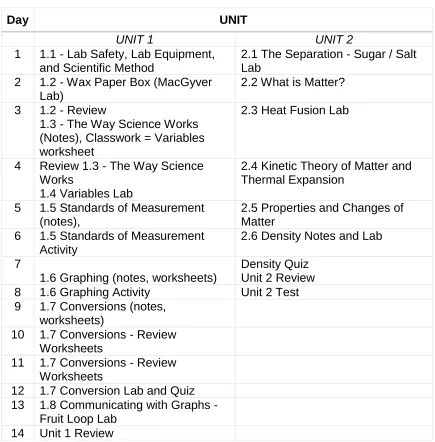
Table 3.1: Detailed Outline ... 79
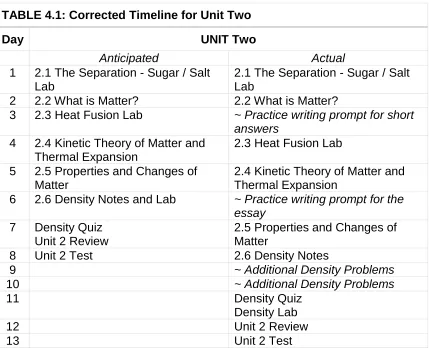
Table 4.1: Corrected Timeline for Unit Two ... 83
Table 4.2: Teachers’ Sense of Efficacy Scale ... 84
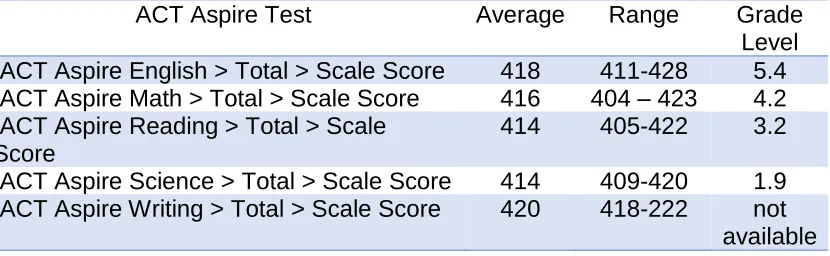
Table 4.3: Act Aspire Score and Corresponding Grade Level ... 86
Table 4.4: Readiness Benchmark ... 86
Table 4.5: Act Aspire Descriptive Statistics for Students in Physical Science ... 88
Table 4.6: Correlations between Student Lunch Status and ACT Aspire Scores 88 Table 4.7: Correlation between Student Sex and ACT Aspire Scores ... 89
Table 4.8: Correlation between Math Course and ACT Aspire Scores ... 89
Table 4.9: Correlation between English Course and ACT Aspire Scores ... 90
Table 4.10: Math Quizzes and Minor Grades Averages for Unit One ... 91
Table 4.11: Major Grade for Unit One (TEST) ... 92
Table 4.12: Final Averages and Corresponding GPA for Unit One ... 92
Table 4.13: Correlations between Student Lunch Status and Outcomes from Unit One ... 94
Table 4.14: Correlations between Sex and other Outcomes from Unit One ... 94
Table 4.16: Major Grade and Subsequent parts for Unit Two (TEST) ... 96
Table 4.17: Final Average and Corresponding GPA for Unit Two ... 97
Table 4.18: Correlations between Student Lunch Status and Outcomes from Unit Two ... 98
Table 4.19: Correlations between Sex and Other Outcomes from Unit One ... 99
Table 4.20: Correlations between Extra Help Unit Two and Student Outcomes ... 100
Table 4.21: Student Scores in Response to Academic Rigor ... 101
Table 4.22: Major Grade for Both Unit One and Unit One (TESTS)... 102
Table 4.23: Final Averages and Corresponding G.P.A ... 103
Table 4.24: Correlation between Students’ Unit One Overall Average and other Student Outcomes ... 103
Table 4.25: Correlation between Mathematics Course Enrollment and other Student Outcomes ... 104
Table 4.26: Correlation between English Course Enrollment and other Student Outcomes ... 106
Table 4.28: Student Responses Compared across Time Using Chi-square ... 108
Table 4.29: Correlations between Item 8 Questions (Unit One and Unit Two) and Student Outcomes ... 112
Table 4.30: Correlations between Students’ Unit Two Overall Average and Other Student Outcomes ... 113
Table 4.31: Categories of Teacher Efficacy ... 115
Table 4.32: Correlations between ACT Aspire English, Reading, Math Scores and Physical Science Outcomes ... 116
Table 4.33: Correlations between Race and Other Significant Factors ... 117
LIST OF FIGURES
Figure 1.1: Teacher Sense Efficacy Scale (long form) ... 17
Figure 3.1: Survey before the introduction of Unit One ... 80
Figure 3.2: Survey at the end of Unit One ... 80
Figure 3.3: Survey at the end of Unit Two ... 81
CHAPTER 1: INTODUCTION TO THE ACTION RESEARCH
Introduction
Topic
Student achievement in tracked ninth-grade science classes has
long-term academic and social ramifications. Tracking is “the practice of grouping students into separate classes based on achievement” (Loveless, 2009) and
many observers argue that tracking “polarizes the student body into pro-school
and anti-school factions”, while “students tend to form friendship with others in
the same track” (Gamoran, 1992). In many schools, tracking students in math
and English begins in middle school, and the idea is reinforced in high schools
when “across the country, mathematics classes are usually grouped by
topic…meaning that a student’s placement largely depends on the course taken
their previous year” (Loveless, 2009). However, at this research site, tracking in
science classes starts in ninth grade (which is the first year of high school). The
justification given for tracking is that it helps prepare students for future career
and/or educational paths.
At the research site, students enrolled in Physical Science Honors or
Physical Science Advanced are within a “track” to take college-level courses their
junior or senior year. These college-level include both advanced placement
classes necessary for high school graduation. The administration at the district
level recognizes some of the detrimental effects of tracking and starting in the fall
of 2016, this researcher’s district embarked on a new initiative working with Equal
Opportunity Schools to “find students missing from the most rigorous classes and
change their life trajectories” (Equal Opportunity Schools, n.d).
As the only school in the state of South Carolina chosen to undertake this
ambitious project, Equal Opportunity Schools will work with this researcher’s
school to remove barriers and create opportunities for more students to take the
college level courses. Equal Opportunity Schools will work with the
administration and teachers to help identify juniors and seniors who are “stuck
literally just across the hall from advanced high school classes they are ready to
succeed in” (Equal Opportunity Schools, n.d). Waiting the students are juniors or
seniors in high school does not necessarily have an adverse effect on college
acceptance. Tanya Abrams (2013) of the New York Times interviewed Jeff Rickey, Dean of Admission at St. Lawrence University, who said, “We will
consider grades in the academic courses over the arc of the years, but also each
year separately. That allows us to see performance over time and determine any
trends.” He also went on to say, “the student should take the most challenging
course that is best for him or her.”
Students should not have to wait until they are juniors or seniors to feel
the effects of the “tragedy of twenty-feet” (Equal Opportunity Schools, n.d) when
there are higher-level courses with greater opportunities just across the hall. To
arbitrary, designed to serve the needs of their schools’ master schedules rather
than the needs of the students” (Yonezawa & Jones, 2002). As freshmen in high
school, students tracked into lower achieving science classes are literally just
across the hall from higher achieving science classes.
A precedent has already been set at the research site for detracking or
possibly reducing the number of tracks. In 2009, the school and district saw fit to
remove the lowest level of social studies classes, only offering two levels of
social studies—honors and advanced. Following suit from the South Carolina
State Department, the grading scale does not recognize a difference in the grade
point average (G.P.A) between a student who makes an 87 in a College Prep
course or an 87 in an Advanced level course. The uniform grading scale
throughout the state of South Carolina only distinguishes GPA for honors and
advance placement courses. Starting in the 2017-2018 school year, the
research site will remove the lowest-performing math class (Foundations of
Math), and all students not enrolled in Geometry or Algebra II Honors classes will
enroll in Algebra I. Approximately 35% of the students enrolled in Algebra I will
complete the course over two semesters, while the remaining 65% will follow the
traditional block schedule of one semester. Students completing Algebra I in the
ninth grade will have a better opportunity to enroll in higher-level math and
science courses further on in high school.
Protheroe (2008) defines efficacy as the “teachers’ confidence in their
ability to promote students’ learning.” Several factors lead to a high teacher
school culture. Teacher efficacy is broken down into two parts: teachers own
feeling of confidence in teaching abilities and the general influence that teachers
have over students in the classroom. Both are important but have proved to be
independent of each other (Protheroe, 2008). Tschannen-Moran, Hoy, and Hoy
(1998) developed a scale (Figure 1.1) to measure teacher efficacy in three
categories: efficacy in student engagement, efficacy in instructional strategies,
and efficacy in classroom management
Currently, the research site offers three levels of physical science classes
that are tracked: Physical Science Honors, Physical Science Advanced, and
Physical Science College Prep. Within the last two years, in an effort to promote
college and career readiness, the South Carolina State Department of Education
changed the name of the Physical Science College Prep class to Physical
Science Advanced, and Physical Science Tech Prep to Physical Science College
Prep. In this researcher’s district, no recommendation process exists for
students entering the ninth-grade; however, middle-school science teachers
regularly use the current math course, the recommended ninth-grade English
course, student behavior, student interest, parent interest, and teacher intuition to
recommend a course.
The state of South Carolina does not allow middle schools to group
science students according to academic ability. In turn, teachers insist it is
difficult to challenge the intellect of all students in the classroom. Academically,
as freshmen, some students might not be ready to commit to the honors or
school freshman science students, enrolling in an upper-level class does not
seem to fit their academic abilities or future career path. Tracking students at an
early age implies more uncertainty with regard to the students’ true capabilities
(Elk, Steeg, & Webbink, 2011) and does not take into account student growth
and maturity over time. At this researcher’s school, academic rigor and
academic maturity are two key components used for tracking science classes.
Academic rigor has a substantial role in developing an honors or
advanced level class. Physical science classes are taught for a semester
(approximately ninety days), and all physical science classes are generally
designed to hold the chemistry units in the first nine weeks and the physics
portion in the second nine weeks. Several differences exist between the honors,
advanced, and college prep levels, including time commitments, curricula, and
unit tests.
At the research site, a physical science honors student should spend
anywhere between 45—60 minutes per night completing homework, to
understand the concepts in preparation for class the next day, and to master the
material in preparation for upcoming tests. In comparison, an advanced student
should spend between 30—45 minutes per night and college prep students
between 20—30 minutes per night. In order for an honors student to fully grasp
the concepts, he or she must connect ideas from one section to another within a
unit, relate the section to previous material, apply the elements from the lab back
to the material in a unit, and work to comprehend the material (not just memorize
and advanced levels, students have greater responsibility to review material
outside of the classroom.
Not only are there different requirements outside of the classroom, but the
structure of the class is more demanding as well. In the scope and sequence of
the classes, the honors level completes one more unit of study on the topic of
thermal energy. In comparison to Physical Science Advanced and Physical
Science College Prep, each unit of a Physical Science Honors course involves a
deeper understanding of material, greater topical coverage, and increased
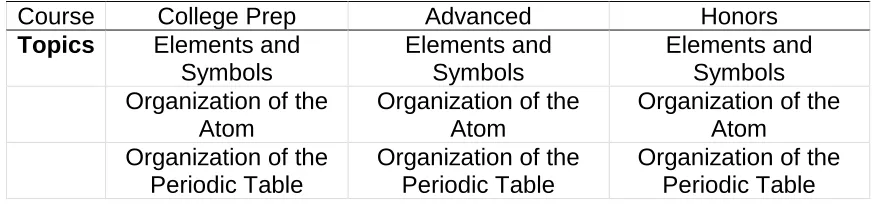
understanding of how the material is applicable to the real world. Table 1.2
demonstrates an example of the curriculum differences in Unit Three (Atomic
Structure) between Physical Science College Prep, Physical Science Advanced,
and Physical Science Honors. While developing this understanding of the atom
in Unit Three, the Advanced and College Prep classes complete all the topics in
fifteen days, while the Honors class completes it in just twelve.
The last major difference is the unit testing (Table 1.3). Students in all
three levels typically have one class period (90 minutes) to complete a test. The
multiple-choice questions on the tests for each level are generally the same and
the students at all three levels receive a formula sheet as a reference for the
math portion of tests. Besides some minor point value differences, the primary
distinction is in the “thought questions". The thought questions are extremely
difficult and designed to focus on taking the knowledge learned within the unit
and applying it to new situations outside of class.
Frick is on a diving board 50 m above the surface. In a frictionless world, what would his velocity be when he hits the water?
The students are given the formulas PE = mgh (Potential Energy = mass x
gravity x height), KE = ½mv2 (Kinetic Energy = ½ x mass x velocity2), and gravity
is 9.8 m/sec2. The student would have to know in a frictionless world that the KE
would equal the PE and therefore, mgh = ½mv2. Algebraically, they would then
infer that the masses would cancel out, gravity is a constant, which is given, and
now they can solve for the velocity. In addition, correct understanding of the
order of operations is critical for completing this problem properly. All of these
steps are completed using high-functioning algebraic concepts. In stark contrast,
each Physical Science College Prep test consists of only 50 multiple-choice
questions, but does include math problems that are multiple choice. At this
researcher’s school, academic rigor is one difficult aspect of the honors course
and, subsequently, the advanced level class, but academic maturity moves
beyond the academic knowledge the student has, to the actual process skills and
habits of the individual.
Some of the students who are academically gifted do not have the academic
competency or resources to act on that ability. Students at the research site
need to acquire the following educational skills in order to use these talents
efficiently:
maintaining proper study habits
making connections to previous information
For most students, advantageous study habits are not part of their
educational repertoire. Teachers develop these study habits in school and then
reinforcement should occur at home. Likewise, for most students, the ability to
draw connections to previous information is a skill learned through constant
repetition of information from both the teacher, and the parents or guardians
outside of school. In the classroom, perceived parental support is a good
predictor of student skill development, GPA, and self-efficacy (Cutrona et al.,
1994).
In Physical Science Honors, students must have a firm grasp,
understanding, and working knowledge of algebraic concepts. Currently, the
school has six different level math classes: Algebra I Advanced Part I, Algebra I
Advanced Part II, Algebra I Advanced, Geometry College Prep, Geometry
Honors, and Algebra II Honors. Those students who have completed Algebra I in
middle school have an understanding of how the “properties and relations of
numbers and symbols enables students to solve problems that would be difficult
without the methods of algebra” (XYZ High School Curriculum Guide, 2017).
Students who have not completed Algebra I are encouraged not to take Physical
Science Honors.
Problem Statement
A conundrum facing this researcher’s school is the tracking of ninth-grade
students in physical science classes. While tracking is well-intentioned, if it
commitment to providing the “highest quality education for all children by
providing a highly qualified staff, a challenging curriculum, first class facilities,
and a safe and nurturing environment” (XYZ County, n.d). The problem of
practice in this researcher’s school is that the Physical Science College Prep
course does not disseminate the necessary academic curriculum necessary for
higher education. How can the students enrolled in this course achieve the
outcomes required for enrolling in higher education?
Statement of Purpose
The purpose of this study is to determine if students enrolled in Physical
Science College Prep could possibly experience academic success with the
Physical Science Advanced methods and curriculum. Teacher efficacy and
student expectations could promote an academic trend towards detracking
physical science, and then enrolling in advanced placements or dual enrollment
courses in high school. The research literature and the raft of interventions
proposed in this dissertation (concerning the nature of teacher efficacy and
student expectations) work to alleviate the problem of practice, and facilitate
greater student achievement for the College Prep students.
Research
An abundance of research exists demonstrating the adverse effects of
tracking, the inherent policies of tracking, and political pressure in detracking.
Loveless (2009) eloquently summarized these three concerns. He wrote that
should, “relinquish their role as agents in reproducing inequities in the larger
society.” Further, the National Association for Gifted Children endorsed tracking
for high achievers, but those in opposition to tracking demand equity for all
students in the curriculum. However, some studies also infer that the effects of
tracking are difficult to ascertain, due to many factors not accounted for in the
literature. These include a commonly accepted definition of tracking, the fact that
some teachers take into consideration items other than test scores, and parental
requests. While some critics of detracking argue that existing studies did not
randomly assign students into groups, other factors, such as motivation and
engagement in subject matter, present greater challenges to research. Chapter 2
will provide a more substantial review of research into tracking.
Rationale
Many factors could explain why a student struggles in middle school, such
as academic maturity, parental involvement (too little or too much), social issues,
extracurricular activities, and health problems. However, if students who would
otherwise have been enrolled in Physical Science College Prep have a teacher
who is effective at setting “higher standards for themselves and their students”
(Ross, McKeiver, & Hogaboam-Gray, 1997), they could be successful with the
Physical Science Advanced curriculum. This could increase their chances of
enrolling in advanced placements and dual enrollment courses in high school.
Grouping or tracking students is highly controversial. Evidence from one
associated with the increasing gaps between high and low achievers over time”
(Gamoran, 2009) and “certain groups of students are consistently
disadvantaged” (Bernhardt, 2014). However, it is also reasonable to suggest that,
"grouping students using methods that convey academic expectations" (Harris,
Leithwood, & Strauss, n.d) could be feasible as well. In order for grouping to
work properly, “there needs to be a clear understanding among all teachers
within a department about what skills, prior knowledge, and academic
dispositions students need to have in order to be successful in 9th and 10th grade”
(Bernhardt, 2014). Gamoran (2009) suggested that it was a challenge to
“distinguish the effects of track assignments from the effects of pre-existing
differences among students assigned to different tracks.” At this researcher’s
school, each level of science is intended to create conditions in which “teachers
can efficiently target instruction to students’ needs” (Gamoran, 2009) and to
prepare the students for future academic pursuits. However, data collected from
the Equal Opportunity Schools initiative exposes a flaw in this intent. Of the
student population, 30% of White and Asian students enrolled in advanced
placement and dual enrollment courses are in the medium- to high-income
bracket; only 8% of the white and Asian students in the low-income bracket enroll
in such courses. In contrast, African-Americans are at 8% and 4%, respectively.
Physical Science Honors is a course designed for students who are
pursuing a career in the sciences and are interested in a four-year college
degree. The course is also a very strong foundation and a pre-requisite for
well in those honors-level classes may enroll in advanced placement courses in
their junior and senior years in high school. Physical Science Advanced is a
course designed for those students who are interested in a two- or four-year
college degree, but are not necessarily interested in pursuing a career in the
sciences. Physical Science Advanced acts as the foundation for the Chemistry
Advanced, Physics Advanced, and Biology Advanced courses. Physical Science
College Prep is a course designed for those interested in a two-year school,
trade school, or going directly into the workforce. This course is a foundation for
Chemistry College Prep, Physics College Prep, and Biology College Prep.
At the research site, the school does not confine students to one track,
and the students and parents have the ability to move between tracks during
course registration. If a student successfully completes Physical Science College
Prep with an A grade, then that student can receive a recommendation for
Biology Advanced. Likewise, if a student successfully completes Physical
Science Advanced with a solid A grade, then that student can receive a
recommendation for Biology Honors and therefore be on track to take an
advanced placement or dual enrollment course in high school. In addition, if a
parent wishes to override the teacher’s recommendation and place the student in
a higher-level class, the school will accommodate that request. However, the
current district policy states that if a parent override occurs, the student must
complete the class at that level. Despite how difficult the material is to the
student or how low the student’s grade is, changing to a lower-level course is not
The principal and guidance counselors at this researcher’s school arrange
the teacher schedule according to teacher preference, teacher qualifications, and
coaching schedule. The district administration arranged the school year into two
semesters with four 90-minute blocks each semester and teachers allotted one
block each semester for planning purposes. In season, coaches are in need of
fourth-block planning due to coaching responsibilities occurring immediately after
school at different locations throughout the district. At the end of each school
year, the teachers complete a preference form stating which level of classes they
would like to teach the following school year, but they do not choose the number
of classes of each level. In addition, according to the State Department of South
Carolina, a teacher must have a gifted and talented endorsement in order to
teach the honors level.
Conceptual Framework
In a typical school year, the guidance department fills about six sections of
honors, eighteen sections of advanced, and eighteen sections of college prep. In
general, the principal assigns each teacher at least two college prep class. A
teacher will either teach two Physical Science Honors and four sections of
Physical Science College Prep, or four sections of Physical Science Advanced
and two Physical Science College Prep classes.
In 2016, approximately 850 students attended the study school. Of the
student population, Physical Science Honors accounted for 17%, Physical
level consisted of only 19% ethnic minority students while the Physical Science
College Prep consisted of 73% ethnic minority students. In addition, concerning
the poverty index, 12% of the Physical Science Honors students were on free
and reduced lunch while Physical Science College Prep had 59% on free and
reduced lunch. Some people (the author included) are concerned that tracking in
physical science at the study school does a disservice to minority and
poverty-stricken students, and that the school has not offered academic equity to all of its
students. The school has conveyed “messages that can have deleterious effects
on student performance and outcomes” (Atwater, 2000). If this is so, then
corrective action should occur to allow all students the same opportunity for
educational success.
Students enrolled in Physical Science College Prep could potentially have
success in the Physical Science Advanced curriculum and, therefore possibly
allowing the administration to eliminate some tracking. Students who complete
the advanced or honors level courses will gain the academic skills and
experience necessary to enroll in advanced placements or a dual enrollment
course.
Methodology
Research Question
What would be the short-term effect on classwork, laboratory work, and
of an organized program of teacher efficacy and student expectations for
students in the Physical Science College Preparatory program?
Research Objectives
Research Objective 1: Create a classroom environment conducive to student learning through high teacher efficacy.
Research Objective 2: Based on empirical studies of tracking and the
results of this study, formulate an action plan in accordance with the
district science coordinator to eliminate Physical Science College Prep, or
eradicate tracking altogether, in physical science courses at the study
school.
Sources of Data
The first source of data was a survey given to teachers and students
throughout the entire high school under study. The results from the Equal
Opportunity Survey collected in October of 2016 provided percentages of each
population in advanced placements and dual enrollment courses. In addition, the
researcher obtained all assignments of the students enrolled in his second
semester, first block class during the 2016-2017 school to include laboratory
experiments, quizzes, daily work, and a unit test for analysis. Unit One consisted
of four laboratory experiments, two quizzes, three daily work assignments, and
one unit test. Unit 2 consisted of three laboratory experiments, two quizzes,
was from student surveys and the results of the Teachers’ Sense of Efficacy
Scale (long form).
Ensuring the academic welfare of every student in an educational setting
is absolute, and deserves the administration’s utmost attention. Principals' and
teachers' duties require the limiting of physical distractions both in and out of the
classroom, as well as limiting possible academic distractions. Tracking students
could interfere with the academic pursuits of some students, possibly limiting
their future educational attainments. Chapter Two of this action research study
will scrutinize tracking-related studies; Chapter Three will introduce the research
design; Chapter Four will address the results of the study; and Chapter Five
outlines the action research plan.
Weaknesses of the Study
The single class does limit and present several weaknesses within the
study. The total number of participants is fifteen, which is a fraction of the total
student population at the research site. The study does not take into account
second, third, or fourth block classes; other teachers and their sense of efficacy;
and first and second semester classes.
Directions: This questionnaire is designed to help us gain a better
understanding of the kinds of things that create difficulties for teachers in their
school activities. Please indicate your opinion, between a 1 and 9, about each of
How much can you do?
1 = nothing
3 = very little
5 = some influence
7 = quite a bit
9 = a great deal
1. How much can you do to get through to the most difficult students?
2. How much can you do to help your students think critically?
3. How much can you do to control disruptive behavior in the classroom?
4. How much can you do to motivate students who show low interest in
schoolwork?
5. To what extent can you make your expectations clear about student behavior?
6. How much can you do to get students to believe they can do well in
schoolwork?
7. How well can you respond to difficult questions from your students?
8. How well can you establish routines to keep activities running smoothly?
9. How much can you do to help your student’s value learning?
10. How much can you gauge student comprehension of what you have taught?
11. To what extent can you craft good questions for your students?
12. How much can you do to foster student creativity?
14. How much can you do to improve the understanding of a student who is
failing?
15. How much can you do to calm a student who is disruptive or noisy?
16. How well can you establish a classroom management system with each
group of students?
17. How much can you do to adjust your lessons to the proper level for individual
students?
18. How much can you use a variety of assessment strategies?
19. How well can you keep a few problem students form ruining an entire lesson?
20. To what extent can you provide an alternative explanation or example when
students are confused?
21. How well can you respond to defiant students?
22. How much can you assist families in helping their children do well in school?
23. How well can you implement alternative strategies in your classroom?
24. How well can you provide appropriate challenges for very capable students?
Figure 1.1: Teacher Sense of Efficacy Scale (long form)
TABLE 1.1: Differences in curriculum for Unit 3: Discovering the Atom
Course College Prep Advanced Honors
Topics Elements and
Symbols
Elements and Symbols
Elements and Symbols Organization of the
Atom
Organization of the Atom
Organization of the Atom Organization of the
Periodic Table
Organization of the Periodic Table
Atomic Mass Electronic Configuration
Electronic Configuration
Isotopes Atomic Mass Atomic Mass
Isotopes Isotopes
Ionization Energy Moles
TABLE 1.2: Unit Tests
Course College Prep Advanced Honors
Test format 50 multiple choice (2 points each)
20 multiple choice (3 points each)
20 multiple choice (1 point each)
5 Math (5 points each)
6 math (5 points each)
1 short answer (5 points)
2 short answers (5 points each)
2 thought questions (6 points each)
5 thought questions (6 points each)
1 Essay (10 points)
GLOSSARY
ADVANCED - a specific level assigned to a high school credit class intended for
students who would like to enter a two- or four-year college degree.
ADVANCED PLACEMENT - a college-level course offered in high school where
the teacher must be certified through the national Advanced Placement
Program. Students are required to score at least three (out of five) on the
final nationalized exam to receive a college credit.
ALIGN - when the material in a classroom or assessment is coordinated with
current standards.
ALGEBRAIC CONCEPTS - skills gained within an algebra class that are not
unique to mathematics, but are applicable to other
subject areas as well.
ASSESSMENT - a measure of progress of a student that can take many forms,
such as a quiz, a chapter test, or a final exam.
COLLEGE PREP - a type of high school credit class intended for students who
intend to enter a two-year college degree.
CORRELATION - a relationship, either positive or negative, between two
different assessments used to predict future performance
DETRACKING – a process within a school or district where the administration
and College Prep. Students in each class are grouped
heterogeneously.
DUAL ENROLLMENT - a college-level class in which the high school works with
a local college or university, and a college professor
teaches the class at the high school for college credit.
EDUCATION DEPARTMENT - An entity appointed by the state government
responsible for overseeing all education decisions
within that state
END-OF-COURSE TESTING – state-level mandated testing administered at the
end of specific courses, as determined by the
Department of Education
ESOL – English for speakers of other languages. The school provides students
who are not native English speakers with extra resources (typically a
class throughout the year) to help with learning English.
FREE OR REDUCED LUNCH – one manner in which the government evaluates
a school to determine the socio-economic status.
When more than 75% of the students receive
free or reduced lunch then the government
labels the school I as a Title 1 school and then
the school will receive additional specific federal
funding.
FRESHMAN CAMPUS – a part of the high school, but specifically referring to the
GRADING SCALE – a uniform manner across the state of South Carolina to
assign a grade a corresponding grade point average number
between 0.000 and 5.875. Students who would make a
hundred in an Advanced Placement course would have a
5.875. Students who would make a 100 in an honors course
would have a 5.375.
HIGH SCHOOL - Ninth through to twelfth-grade students, faculty and staff.
HONORS - a specific level assigned to a high school credit class intended for
students who intend to enter a four-year college degree.
INDICATOR - when the result of an assessment is used to describe or predict
performance on another assessment, or a student’s level of
ability.
INDIVIDUALIZED EDUCATION PLAN (IEP) – Designed for students who need
special education services, such as time extensions for assignments, tests
read out to them, and/or course notes printed for them.
INTERNAL VALIDITY - the accuracy of a causal relationship.
MIDDLE SCHOOL - Students, faculty, and staff in fifth to eighth grades.
PREDICTIVE RELIABILITY - how well the results of one study apply to another
study.
RECOMMENDATION PROCESS – the process by which students are enrolled
in a certain level of class for the following
RELIABILITY - the quality of a measurement, as determined by the consistency
or repeatability of the measures.
STANDARD - guidelines from the Department of Education that are designed for
a subject area or a specific class.
TEST-RETEST - when the same test is administered to students on multiple
occasions to measure the consistency of the results.
TYPE 1 ERROR - the incorrect rejection of a true null hypothesis, otherwise
known as a false positive.
504 – A plan that is similar to an IEP, but is for students with a physical or mental
CHAPTER 2: RESEARCH
Introduction
Problem of Practice
High schools across America have to face a number of academic, social,
and financial dilemmas, including inadequate numbers of buses, illegal drugs,
passing rates, overcrowded classrooms, and truancy. One particular issue the
study school must confront is the way tracking in physical science courses
provides disproportionate amounts of educational materials and methods of
teaching for students that are low-achievers, minorities, and of low
socioeconomic status.
Rationale
This study school is a place where “All students can learn and are a part
of a community of learners - students, faculty and parents - who share the
responsibility of education excellence” (Shared Values/Belief Statements, n.d.).
Part of the responsibilities of the faculty, administrators, and teachers is to
ensure the academic success of each child. The intention of having three
different levels of physical science courses is to offer unique curriculum and
teaching methods matched to students’ abilities, and provide the appropriate
whether students customarily placed in Physical Science College Prep could be
successful in the Physical Science Advanced course, through teacher efficacy.
Causes of the problem of practice
Research on tracking continually grapples with the following question: Is
tracking in physical science course doing a disservice to minorities, females, or
the poverty-stricken? At the study school, the Physical Science College Prep
course has an enrollment consisting of 73% minorities and 59% on free and
reduced lunch—a drastic difference from the Physical Science Honors course.
Teachers recommend each student to a course level based on their academic
performance, behavior, and standardized tests from middle school. However,
many factors could have led to low scores or misbehavior, including academic
immaturity or lack of academic support at home.
In middle school, the guidance and administration group students in the
science classes with varying abilities in both math and English. In contrast, in
high school, the courses such as Algebra I and English I group student according
to ability and prerequisites. This grouping allows some students to obtain the
academic skills needed for Physical Science Honors. At the research site,
Physical Science Honors is a rigorous course that demands a tremendous
amount of time. Not only is the curriculum difficult, but less reinforcement of
material occurs, and the expectation is for students to have greater responsibility
for reviewing the material. One other point that separates the Honors level from
College Prep is the testing. The typical Honors test moves beyond
students must demonstrate an actual understanding of the material. One-third of
such tests requires students apply their knowledge to an unfamiliar, real-world
situation.
Salvittie and Hwang (2015) confirm the use of multiple-choice tests with
The Center for Excellence in Science Education at Penn State University. They
listed a number of positives that could arise from multiple-choice tests, including
ease of distribution to large groups and ease of marking. Ease of marking allows
the teacher to grade the assessment very rapidly and in some cases, with the
use of computers, almost instantaneously. However, the multiple-choice format
often leads students to memorize material instead of understanding it and in a
question with a standard four answers, have a twenty-five percent chance to
guess the correct answer. On the other hand, free-response-type test formats
offer other advantages, including the ability to give partial credit, evidence of
thought processes, and more thought-provoking answers. Lin and Singh (2013)
found that multiple-choice testing could reasonably reflect free-response testing if
the multiple-choice answers were weighted. Free-response questions are useful
and can reflect student understanding when the individuals grading the test hold
fast to a rubric.
Research Question
What would be the short-term effects on classwork, laboratory work, and test
scores on in-house, teacher-prepared assessments of student achievement of an
the Physical Science College Preparatory program?
Importance of a Literature Review
The literature review is an essential element of this dissertation. It
provides the reader and researcher with a background of the subject before the
research is undertaken. However, the review “goes beyond the search for
information and includes the identification and articulation of relationships
between the literature and your field of research” (Boote and Beile, 2005). The
discernment of these relationships provides an insight to previous studies, the
uniqueness of the study, and a demonstration of a knowledge of the topic.
Previous studies related to this dissertation offer a solid foundation for
action research. For example, Jeannie Oakes is a nationally known
teacher-researcher in the field of tracking who specializes in understanding how tracking
affects minority students. Armed with knowledge of the tracking and the data
collected from this dissertation, this researcher can meet the needs of a specific
classroom, school, or district.
This literature review will give readers the opportunity to not only see
other research that is similar to this dissertation but also how the dissertation is
different. Joan A. Spade, in 1997, completed a study in tracking in mathematics
and science courses, but not necessarily using the math course or skills to track
students into physical science level courses. The literature sets a framework that
demonstrates the characteristics that are exclusive to the particular time and
One of the greatest opportunities for this teacher-researcher to gain
credibility from the reader is through the literature review. The strength of this
credibility increases when the teacher-researcher can demonstrate vast
knowledge of the field of research and can establish the preparedness to
complete the research but also to convey the results in an appropriate manner.
Understanding the politics of tracking, as demonstrated by Jeff Clause in 1999,
allows the reader to consider carefully the research from all angles. If the reader
can have the confidence in the teacher-researcher and the methods used, then it
will carry over to have confidence in the results as well.
Methodology
To investigate the research questions, this researcher used a
mixed-method design. This study used the Equal Opportunity Schools survey, which
the district distributed to parents, students, and teachers in the fall of 2016. The
teacher portion of the survey included questions on demographics, the teacher's
role at the school, what the school could do to help students transition to
upper-level classes, and the school environment. The student portion of the survey
included questions on self-efficacy, academic preferences, future academic
goals, and views on how well the school promotes an academic environment. In
addition, the researcher collected from daily assignments, quizzes, laboratory
experiments, and unit tests during Units 1 and 2.
Descriptive statistics are “commonly used when trying to describe the
169). A single score for each student was obtained from the mean and standard
deviation of the class grades. Data points from Unit One were compared to
those of Unit Two using a scatter plot. Correlation analysis investigated the
relationships between student scores and demographic data, course enrollment,
and question number eight from the student survey. Question number eight
states: On a scale of 1-5, do you believe your teacher knew you could be
successful in this class? (1 being not motivated at all and 5 being very
motivated)
The results from the Equal Opportunity Survey will compare the
demographic data (poverty and ethnicity) of enrollment in the advanced
placement dual enrollment courses. Once the data is collected and analyzed, the
researcher will meet with the study school’s guidance counselors and principals
to establish a course of action to allow all students, who have the ability and
desire, to enroll in upper-level classes. In order to eliminate or even modify the
current tracking procedures from the middle school and high school science
teachers for physical science, a meeting would occur with the district science
coordinator and the director of curriculum and instruction.
Theoretical Base
Tracking is a prominent and often-accepted practice in the public school
system throughout the United States. Often placed into groups based on criteria
of presumed ability or expectations, school systems implement tracking to reduce
the academic differences initially associated with those groups. The political and
social implications of tracking pose a deep-seated controversy (Welner & Burris,
2006) in the schools, as parents often believe that other struggling students will
impede the learning of their child. Little evidence supports the benefits of
tracking, and its continued use segregates minorities and the working-class poor
into the lower-level courses. Some have suggested that tracking offers students
a challenging curriculum and gives them critical thinking skills, but the result is
that struggling students often receive mediocre lessons. Those benefiting from
tracking are often upper-level students, while the lower-level students have
reduced self-esteem and develop negative self-efficacy (Schramm-Pate &
Vogler, 1985).
Historical Context
The district administration, district science coordinator, and the school
department head use the South Carolina state standards to develop the
curriculum in physical science classes. However, the state education personnel
did consider the concepts of tracking when they wrote the physical science
standards. These standards are a set of basic skills, understandings, and
principles that all students should attain before they leave a physical science
class in the ninth grade. In order to create classes of different ability levels,
schools use supplemental material, and draw on chemistry/physics standards
intended for juniors and seniors in high school for the upper-level classes. Thus,
head design the upper-level classes to go beyond the requirements of the
standards for that level and, in some instances, address them more in-depth.
Physical Science Standards in the State of South Carolina
A curriculum specialist at the South Carolina Department of Education
wrote the physical science standards for students at the College Prep level.
Standard 1.5 states that students should be able to “Organize and interpret the
data from a controlled scientific investigation by using mathematics (including
formulas and dimensional analysis), graphs, models, and/or technology”
(“Science,” 2015). The standards go into further detail to state that students
should be able to use a formula to solve for one variable if given the values of the
other variables, and should be proficient at calculating density, velocity, voltage,
acceleration, and work. Another objective is to be able to determine
mathematically the number of neutron, protons, and/or electrons in an isotope of
any element when given its mass number and atomic number. Students should
be able to complete simple graphs comparing solubility in saturated and
unsaturated solutions, and phase-change graphs of time vs temperature. Finally,
students should be able to complete the following tasks concerning graphs:
● Construct distance/time graphs from data showing the distance traveled
over time for selected types of motion (rest, constant velocity,
acceleration).
● Compare the shape of these three types of graphs, and recognize the type
● Discuss the significance of the shapes of the graphs in terms of the motion
of the objects (“Science,” 2015).
As with every school in the state, the study school uses the state
standards to align the curriculum in the classroom, including physical science,
with state expectations. The current standards indicate that students in physical
science courses should be able to employ several algebraic concepts, including
“Construct distance/time graphs from data showing the distance traveled over
time for selected types of motion (rest, constant velocity, acceleration)” and
“Compare the shape of these three types of graphs and recognize the type of
motion from the shape of the graph” (“Science,” 2015). These physical science
standards are similar to the Algebra I standards 1.SPID.7, which state: “Create a
linear function to graphically model data from a real-world problem and interpret
the meaning of the slope and intercept(s) in the context of the given problem”,
and A1.NQ.1, which states: “use units of measurement to guide the solution of
multi-step tasks. Choose and interpret appropriate labels, units, and scales when
constructing graphs and other data displays” (South Carolina, 2015). Other
Algebra I standards that would serve as good foundations include A1.AREI.1:
“understand and justify that the steps taken when solving simple equations in one
variable create new equations that have the same solution as the original”, and
A1.ACE.2: “Create equations in two or more variables to represent relationships
The effects of tracking on minorities and women
With the education of our children in mind, educators should stand by the
fact that “all citizens are to be treated equally before the law and within the
realms of the public so that all have an equal chance to advance themselves”
(Jeffries & Schramm-Pate, 2008, p. 17). Understanding the relationship between
race and education is arduous, due to the numerous factors involved in the
learning process of a child. This study will look at the effect of teacher efficacy
on student expectations and then use “education as a force for social justice”
(Jeffries & Schramm-Pate, 2008, p. 61) to eliminate or modify tracking.
In order to conduct a serious discussion of academic success within every
race, all factors should be considered, including the perception of school, the
stability of the home, and, most importantly, the culture within the race
itself. Rosario Dawson, a prominent Afro-Cuban actor/songwriter, was
interviewed for an MTV special and said, “I remember being in school and when
you were really smart, people were like 'Why you trying to be white?'
Unfortunately, there are a lot of demographics where education is looked down
upon. Our culture doesn’t support education” (personal communication, October
20, 2008). Sears reaffirms this notion in an interview with Grant, one of three
Americans in an accelerated class. In reference to how other
African-Americans saw him, Grant went on to say, “They would always say that you were
being uppity because you were in that class. They’d say you were trying to act
like an Oreo. They’d shy away from you and then the only people you have to
culture and the perception of education is paramount for academic success in the
classroom.
To understand the effect leveling of classes has on minorities and women,
some “emphasize the need to take group membership into account in order to
level the playing field” (Jeffries & Schramm-Pate, 2008, p. 17). In the classroom,
this would mean that the race/gender composition of each class would directly
reflect the race/gender composition of the school and the surrounding area. Yet,
this is a direct contradiction of the idea that “our model of liberation does not
become the model of oppression for others” (Smith, 2013, p. 89). These others,
the ones that are higher achieving, could not receive the proper education that
intellectually challenges them. The battle between these two thought processes
is again before the United States Supreme Court in Fisher v. University of Texas
at Austin.
This term, the U.S. Supreme Court is reconsidering whether it is
constitutional for the University of Texas at Austin to use race in its
undergraduate admissions decisions, to the detriment of some students
and the benefit of others. In Fisher v. University of Texas at Austin, Abigail Fisher argues that the school’s policy of giving racial preferences to
preferred minorities is discriminatory and violates the Equal Protection
Clause of the Fourteenth Amendment (von Spakovsky & Slattery, 2015).
The purpose of educators (principals, teachers, etc.) is to provide the
proper materials in a classroom, a safe learning environment, and appropriate
student he or she is teaching, and no matter the race of the child sitting at the
desk, should remember that “people can transform their existential realities
through personal initiative and collective action” (Jeffries & Schramm-Pate, 2008,
p. 17).
Tracking or leveling of students
The purpose of tracking is “intended to create conditions in which teachers
can efficiently target instruction to students’ needs” (Gamoran, 2009). Whether
mixed homogeneously or heterogeneously, classrooms in a school are “charged
with providing all students with a common framework of cognitive and social skills
essential for full participation in the civic and economic activities of adult society”
(Gamoran, 2009). Academic responsibilities, including providing all students with
present individual academic needs and preparing them for future academia, are
ideas entrusted to the school. Consequently, this “ongoing tension between
commonality and differentiation is at the heart of the tracking debate” (Gamoran,
2009).
Gamoran summarized many of the latest findings of tracking and
inequality. One conclusion was “tracking per se does not generate inequality, but
rather inequality has emerged because of the way in which tracking has been
implemented” (Gamoran, 2009). He also concluded that where tracking was
prevalent, the lower-achieving students increased in achievement, just not at the
same rate as the higher-level students. Despite that thought, “the harmful effects
(Gamoran, 2009). These incentives for success could include high-stakes
testing targeted at different achievement levels, and the option to change to a
higher achievement level.
Gamoran (2009) also states that the “methodological challenge has been
to distinguish the effects of track assignment from the effects of preexisting
differences among students assigned to each group;” however, “due to
unreliability and measure error, not all preexisting conditions may have been
captured by the controls, and the potential for selectivity bias remains.” Gamoran
is stating that it was difficult to tell whether the tracking caused the effects or
whether the conditions were already present before the students entered a track.
Tracking or leveling of students in science classes
In 1976, Ian Westbury and Marshall Arlin completed a study on “The
leveling effect of teacher pacing on science content mastery.” This study
investigated the difference in group-paced or teacher-paced science instruction.
In this study, the investigators assigned sixty-eight students to one of two groups
concerning mastery of learning: self-paced or teacher-paced. The teacher-paced
group experienced traditional-style teaching, in which the teacher set the pace for
the entire class, which acted as the control group. The control group was 37
sophomores taking biology, while the 31 students in the self-paced group were
eleventh-graders taking chemistry. The two groups were of similar composition
in race, sex, and socioeconomic status; however, a random assignment of
Both groups in this study were required to review seven chapters adapted
from Merrill’s Xenograde systems. The researcher used this artificial science in
order to account for the differences in previous knowledge already obtained in
previous science classes. The self-paced class learned the content, and when
they felt they were ready, they took the assessments. The teacher-paced
instruction taught equivalent content through lectures, and the teacher decided
when the students took the assessment. The learning rate was “defined as the
number of new concepts of discrete units of information mastered (answered
correctly) per hour” (Arlin & Westbury, 1976). The researcher recorded the
amount of time spent in each chapter for self-paced students while the
teacher-paced class was the control and recorded the amount of time as well. The
researcher then calculated the learning rate score as the total number of items
answered correctly divided by the total time required taken to complete the seven
chapters (Arlin & Westbury, 1976).
The results indicated that, “teacher-paced students learn at a much slower
rate than self-paced students.” With a homogeneous mixture in the class, the
“teacher appears to set a pace that is better adapted to the needs of lower-ability
student” (Arlin & Westbury, 1976). The odd-even reliability (corrected by the
Spearmen-Brown formula) was .91, indicating an acceptable degree of reliability
for the learning rate. The teacher-based group final grade mean was 19.2 and
was considerably lower than the self-paced groups mean of 25 (t = 3.24, p < .01). The chi-square value of 14.8 was “significantly beyond the .01 level” indicating a
1976). Concerning the upper-level students, two significant findings were made:
1) the “learning rate of the upper third averaged almost 18 units per hour more
than the learning rate of the lower third” and; 2) teacher-pacing limited “the
achievement of abler students” (Arlin & Westbury, 1976).
Tracking adversely affects minorities but not women
Oakes (1990) completed a study of 6000 teachers of science and math
randomly selected from 1,200 public and private schools. She collected data
from a questionnaire on descriptions of their programs, including levels,
curriculum, instruction, training, and teacher experience. Also included in the
survey were student demographics, including the race, gender, and ability level
of students in each class.
Oakes reported differences in what teachers taught, and how teachers
taught the material. In secondary schools, high-performing classes focused on
further study in science, inquiry skills, laboratory techniques, and systematic
approaches to solving problems. Lower-performing classes focused on science
and math in daily life and in terms of vocational relevance. The thoughts
reported from the teachers suggest that, “Students judged to have low ability may
get less because they are thought to need less” (Oakes, 1990). This was the
case across the study, as “teachers at the same track levels in very different
types of schools appear to place similar emphasis on various curriculum
objectives. Especially among low-track levels” (Oakes, 1990).
fragmented, focused on recitation, used worksheets to break information into
minute bits of information, and required more rote memory and less critical
thinking. However, in higher track levels, teachers focused on learning activities,
students were on task for a greater percentage of the class time, students spent
more time on homework, teachers taught higher-ordered cognitive tasks and
used open-ended questions, and students had more control over their work. In
secondary schools, the results indicated little to no difference in instructional
activities or the amount of time spent on lectures, discussions, small groups, or
hands-on tasks. “Moreover, teachers in low-ability classes (where
disproportionate percentages of minority students in mixed schools are found)
place less emphasis on nearly the entire range of curricular goals” (Oakes,
1990).
The results of this study produced an interesting finding concerning
women. The results indicated that “both women and minorities have been shown
to be more likely to persist in mathematics and science if they see these subjects
as interesting, connected to everyday life, and relevant to their future careers”
(Oakes, 1990). Despite some evidence to support the advantages of
detracking-leveled classes, there is little evidence about future academic success or failure.
The evidence from Oakes’ study suggested a possible disproportionate effect on
the African-American population, but the evidence was “unable to examine
distributional differences related to gender”, because “such distinct enrollment
patterns did not appear” (Oakes, 1990).
not collect any data on student achievement. Oakes (1990) noted how
“important are differences rooted in the social-class backgrounds of the
students,” but she did not take into account student motivation, parental
involvement, single family homes, or even whether the students received free or
reduced lunch (an indicator of low socioeconomic status). Researchers must
also consider the learning experiences of students, “because minority students
tend to reach high school with lower test scores and less advantaged
socio-economic circumstances” (Gamoran, 2009).
One major issue that Oakes did not give much attention to was discipline.
In lower tracks, a tremendous amount of time was devoted to the management of
students’ behavior in the classroom, while in the higher track, teachers required
less behavior management. Behavior has a huge impact on instruction, including
how much time the instructor spends on teaching material and the success of
certain laboratory experiments in science classes.
Tracking: A return to Jim Crow
The Jim Crow era and its subsequent laws in education was regrettable,
and proved dismal for improving the education of every American. As ruled by
the courts, “separate” was not “equal” and all educational institutions need to
ensure the elimination of mindsets such as, “Whites are superior to blacks in all
important ways, including the intelligence, morality, and civilized behavior”
(Jeffries & Schramm-Pate, 2008, p. 79) from their curricula and procedures. The
of crushing limitations with little or no opportunity to learn. Clearly, black children
were provided with an educational experience that was separate, still unequal
and inferior” (Ansalone, 2006, p. 146). If current tracking models perpetuate this
same disastrous arrangement, then each school district should revisit their
models to ensure all children actually do have an equal opportunity to receive an
education. Fifty years after the Brown vs. Board of Education decision, Anselone
wrote, “the nation is experiencing one of the most insidious tactics employed to
maintain segregation in schooling by the ubiquitous nature of tracking or the
practice of sorting students into different levels or tracks based on their perceived
academic ability” (Anselone, 2006, p. 148). If tracking involves “educational
processes which creates a restricted learning environment for children in lower
tracks” (Anselone, 2006, p. 149), then educators must “work to alleviate unjust
situations for other people” (Jeffries & Schramm-Pate, 2008, p. 91). According to
Schramm-Pate and Jeffries (2008), our education system must not and cannot
relegate African-Americans (or any student) “to the status of second-class
citizens,” especially below the Mason-Dixon Line, where it is often acceptable for
the “South to be less tolerant” (Sears, 1991, p. 10).
Achievement gap and tracking
Chambers (2009) discussed the discrepancy in achievements between
black and white students. The study focused on the improper application of
achievement gap with American education, and analyzed