The Study Circle.
Participatory Action Research,
With and For the Unemployed.
“There is a whole ocean of error and a few islands of truth, and neither chart nor compass to go by. We build up the map by accumulating shipwrecks… (Connell 1983: 252).”
Mark Brophy
Submitted in fulfilment of the requirements for the Doctorate of Philosophy in Education and Training
by Thesis at Victoria University.
Table of contents
Table of contents Table of appendices Declaration of authorship Acknowledgments Guide to acronyms List of tables Abstract
Page Number
Introduction to Part one – methodology/literature review 1
Chapter one Introduction 3
1.1 Introduction
1.2 The thematic concern – research purpose 1.3 Research aims
1.4 Significance of research 1.5 Unemployment
1.6 Government initiatives 1.7 Chapter summary
Chapter two Methodology 40
2.1 Introduction
2.2 Research paradigms
2.3 Relationship between paradigms 2.4 Critical theory
2.5 Critical theory/postmodern tensio ns 2.6 Participatory action research
2.7 Emancipatory action research 2.8 Reflective analysis
2.9 Empowerment 2.10 Agency
Chapter three Study circles – the milieu 93
3.1 Introduction
3.2 Examples of alternative educational programs for unemployed 3.3 Models of adult education
3.4 Study circles - introduction 3.5 What is a study circle?
3.6 Study Circle experiences - internationally and in Australia 3.7 Key principles of establishing a study circle
3.8 Chapter summary
Chapter four Method 147
4.1 Introduction
4.2 Planning the study circle
4.2.1 Developing the discussion guide 4.2.2 Recruiting members
4.2.3 Sample size
4.3 Planning the data collection 4.3.1 Correspondence
4.3.2 Session transcripts 4.3.3 Interviews
Introduction to Part two – the study circle season 189
Chapter five Description of season 214
5.1 Introduction
5.2 Study circle member profiles 5.3 Attendance
5.4 Overview
5.4.1 Session one 5.4.2 Session two 5.4.3 Session three 5.4.4 Session four 5.4.5 Session five 5.4.6 Session six 5.4.7 Session seven 5.4.8 Session eight
5.5 Emergent issues in relation to study circle process 5.6 Chapter summary
Chapter six Reflecting upon the themes 266
6.1 Introduction
6.2 Redefining “unemployed” and “work”
6.3 Psychological and physiological effects of unemployment 6.4 Education/Training
6.5 Working with bureaucracies
6.5.1 Government organisation 6.5.2 Non-government organisations 6.5.3 Employers
6.6 Individual alternatives in response to unemployment 6.6.1 LETS
6.6.2 WWOOF
6.6.3 Job modularisation 6.6.4 Voluntary work
6.6.5 Living on a low income
6.7 Structural alternatives in response to unemployment 6.7.1 Free market
6.7.2 Public sector job section
6.8 Chapter summary
Chapter seven Reflecting upon the members’ individual experience 322
7.1 Introduction 7.2 Interviews
7.3 Chronological reflection
7.4 Post study circle member check
7.5 Empowerment from members’ perspective 7.6 Chapter summary
Chapter eight Conclusion 352
Table of Appendices
1 External Support for Research
2 Study Circle Discussion Guide: Unemployment 2.1 Discussion Guide Handouts
- The Basics of Study Circle Leadership - Overview of a Typical Study Circle - Tips for Effective Discussion Leadership - Dealing with Typical Challenges
- Key Terms 3 Discussion Guide Exemplars
3.1 The Busy Citizen’s Discussion Guide: Violence in our Communities (SCRC) (1994)
3.2 The Busy Citizen’s Discussion Guide: Education in our Communities (SCRC) (1995)
4 Minutes from Aboriginal Reconciliation Study Circle – 31 July 1997 5 Participant Recruitment
5.1 Flyer 5.2 Flyer
5.3 Media Releases/Facsimiles
5.4 Local Print Media Articles
6 Correspondence - Study Circle Coordinator to Members 6.1 30 March 1998 – Pre Season
6.2 01 April 1998 – Pre Season 6.3 03 April 1998 – After first session 6.4 13 April 1998 – After second session 6.5 20 April 1998 – After third session 6.6 27 April 1998 – After fourth session 6.7 4 May 1998 – After fifth session 6.8 11 May 1998 – After sixth session 6.9 18 May 1998 – After seventh session 6.10 25 May 1998 – After eighth session
6.11 14 April 1999 – with Thesis Draft (Number 11) enclosed 6.12 07 May 1999 – Confirming meeting on 28 May 1999
7 Victoria University of Technology Consent Form for Subjects Involved in Research
10 Interview Schedules
10.1 Pre Season Interview Schedule 10.2 Mid Season Interview Schedule 10.3 Post Season Interview Schedule 11 Pre Season Interview Transcripts
11.1 Paul 11.2 Francis 11.3 Pam 11.4 George 11.5 Barbara 12 Member’s Guide 13 Issues Poster 14 Objectives Poster 15 Groundrules Poster
16 Study Circle Session Transcripts 16.1 Session One
16.2 Session Two 16.3 Session Three 16.4 Session Four 16.6 Session Six 16.7 Session Seven 16.8 Session Eight 17 Post Study Circle Meeting
17.1 Post study circle meeting with Francis, George & Barbara (28/5/99) 17.2 Post study circle notes compiled by Pam (3/6/99)
17.3 Post study circle notes compiled by Paul (24/6/99) 18 Mid Season Interview Transcripts
18.1 Paul 18.2 Francis 18.4 Pam 18.5 George 18.6 Barbara
19 End Season Interview Transcripts 19.1 Paul
20 Publicity Flyer Fifth National Conference on Unemployment 21 Other Correspondence, Resources etc, introduced into sessions
21.1 Herald-Sun Articles distributed by George at fifth session, discussed in fifth and sixth sessions
21.2 Handouts distributed by Pam in sixth session
Declaration of authorship
This thesis contains no material which has been submitted for examination in
any other course or accepted for the award of any other Degree or Diploma in
any University. To the best of my knowledge and belief, it contains no material
previously published or written by another person, except where due reference
is made in the text.
__________________________________
Dedication – Helen Sertori, my elder sister who died of cancer in 1996. A
teacher who inspired me to learn.
Supervisors – Ass. Prof. Maureen Ryan and
Ass. Prof. Tony Kruger - VUT
Acknowledgments
Alice Brophy
Nada Banjanin
Dr Kevin Brophy
Darija Bosnjak
Leo and Moira Brophy
Mary Brennan
Janine Dixon-Brophy
Caroline Brown
Pauline Brophy
Brenda Cherednichenko
Shandra Cohen
Nadia Foster
Dr Alister Crombie
Jan Gay
Veli Fikret
Leslie Hyde
Elaine Timmermans
Sue Madden
Greg Hackett
Tracey Oliver
Fiona Hyde
Margaret Penrith
Meryl Hyde
Grace Pulis
Wendy Marlowe
Amanda Smith
Gavin Murray
Linda Scott
Fiona McDonald
Jim Sillitoe
David Shires
Maree Wheelens
Alan Tonkin
Prof John Wilson
Guide to acronyms
w AAACE Australian Association of Adult and Community Education
w AAP Australian Associated Press
w AARE Australian Association for Research in Education
w ABC Australian Broadcasting Corporation
w ABS Australian Bureau of Statistics
w ACFE Adult Council for Further Education
w ACOSS Australian Council of Social Services
w ACT Australian Capital Territory
w ACTU Australian Council of Trade Unions
wAEU Australian Education Union
w AGPS Australian Government Printing Service
w ALP Australian Labor Party
w AMPU A More Perfect Union
w ANTA Australian National Training Authority
w ANU Australian National University
w ATSIC Aboriginal and Torres Strait Islander Commission
w ATY Australian Training for Youth
w ANTA Australian National Training Authority
w ANU Australian National University
w ANZ Australian and New Zealand (Bank)
w ATY Accredited Training for Youth
w BAC Bricklayers and Allied Craftsmen
w BEAT Bridging Education and Training
w B.Ed Bachelor of Education
w BIPR Bureau of Immigration and Population Research
w CBT Competency Based Training
wCDROM Computer Disk Read Only Memory
w CESAC Commonwealth Employment Service Advisory Committee
w CEDEFOP European Centre for the Development of Vocational Training (Translated from German)
w CEO Committee on Employment Opportunities
w CEP Community Employment Program
w CES Commonwealth Employment Service
w CESAC Commonwealth Employment Service Australian Committee
w CIS Community Information Services
w COS Certificate of Occupational Studies
wCPS Committee for Postgraduate Studies
w CSU Curriculum Services Unit
w CYSS Community Youth Support Scheme
w DEET Department of Employment, Education and Training1
w DEETYA Department of Employment, Education, Training and Youth Affairs2
1 Departmental name change to Department of Employment, Education, Training and Youth Affairs
(DEETYA) in 1996. 2
wDETYA Department of Employment, Training and Youth Affairs
w DEWRSB Department of Employment, Workplace Relations and Small Business
w DPA Domestic Policy Association
w DSS Department of Social Security
w EAP Employment Access Program
w EEO Equal Employment Opportunity
w EMB Evaluation and Monitoring Branch
w EO Equal Opportunity
w EPAC Economic Planning Advisory Council
w EPP Employment Preparation Program
w EPUY Education Program for Unemployed Youth
w ERIC Educational Resources Information Centre
w ESP Employment Support Program
w FEU Further Education Unit
w FFE Foundation For Employment
w FRAGS Faculty Research and Graduate Studies Committee
w GDP Gross Domestic Product
w IFLA International Federation of Library Associations
w IPA Institute of Public Affairs
w ITB Industry Training Board
w IU International Union
w LATA Labour Adjustment Training Arrangements
w LBOTE Language Background Other Than English
w LEAP Landcare and Environment Action Program
w LETS Local Exchange Trading Scheme
w LMP Labour Market Program
w LNP Liberal and National Parties
w LTU Long Term Unemployed
w MAAT Modern Australian Apprenticeship and Training
w MEd Masters in Education
w MP Member of Parliament
w NBEET National Board of Employment, Education and Training
w NCA National Crime Authority
w NEATS National Employment and Training System
w NEIS New Enterprise Incentive Scheme
w NESB Non-English Speaking Background
w NIF National Issues Forum
w NILS National Institute of Labour Studies
w NWO New Work Opportunities
w OECD Organisation for Economic Cooperative Development
wPEP Participation and Equity Program
w PEP Participatory Equity Program
w RCEC Regional and Community Employment Councils
w REDS Regional Employment Development Scheme
w SEETRC Senate Employment, Education and Training References Committee
w SES Special Employment Strategy
w SID Skills in Demand
w SIP Special Intervention Program
w SJRF Social Justice Research Foundation
w SPRC Social Policy Research Centre (University of NSW, Sydney)
w SYETP Special Youth Employment Training Program
w TAFE Technical and Further Education
w TAP Training for Aboriginal Program
w TEP Training for Employment Program
w TESOL Teachers of English to Speakers of Other Languages
w UK United Kingdom
wUNSW University of New South Wales
w USA United States of America
w VCOSS Victorian Council of Social Services
w VET Vocational Education and Training
w VUT Victoria University of Technology (or Victoria University)
w WMIT Western Melbourne Institute of TAFE 3
w WWOOF Willing Workers On Organic Farms
3
List of tables
Table one Thesis structure
Table two Paradigms
Table three Methodology –data analysis
Table four Empowerment levels
Table five Gidden’s concepts of agency/action
Table six Terminology
Table seven Data collection process, correspondence
Table eight Data collections process, session transcripts
Table nine Data collection process, interviews
Table ten Member check process
Table eleven Structure of Part two
Table twelve Study circle season attendance
Table thirteen List of objectives
Table fourteen List of issues
Table fifteen List of ground rules
Table sixteen Season development
Table seventeen Mid interviews
Abstract
Although considered unorthodox in comparison to more traditional research methodologies, participatory action research and the critical theory that supports such an approach has been an accepted research practice for over four decades. The fundamental aim of this methodology is to empower and emancipate marginalised groups through a collaborative and participatory research process, ensuring the research participants’ “stories” are represented honestly.
Critical theory requires a researcher to initially focus on a thematic concern of social significance. In this study the concern is unemployment. This study then integrates the subjective “voice” of unemployed people in the research process. It is an attempt to conduct research with and for the unemployed participants involved in the study, not on them. From a critical theory methodology perspective, it attempts to challenge the notion of “blame” and the label of “deviant” the unemployed are coerced to accept for their own situation. The study therefore does not pathologise the unemployed, but seeks to address issues in relation to unemployment from the research participants’ perspective.
Critical theory and action research requires the researcher to select a milieu, which grounds the process in a meaningful context. An approach to adult learning which has existed in Scandinavian countries and the USA for over one hundred years, but recently introduced into Australia and currently growing in popularity is the study circle. The study circle format is adopted in this study as the milieu to act as the catalyst for an action research process. This milieu has been selected because it reflects and endorses the fundamentals of critical theory and action research. In this way it is participatory, collaborative, empowering, and embraces the breaking down of the researcher and researched divide.
Part one of the thesis, the methodology and literature review, introduces the thematic concern of unemployment and then discusses in detail issues in relation to the critical theory/action research methodology. The milieu, the study circles is elaborated upon as well as the research method. This then is the planning stage of the action research cycle. Where methodological theory begins to be applied in a practical manner.
Introduction to Part one - methodology/literature review
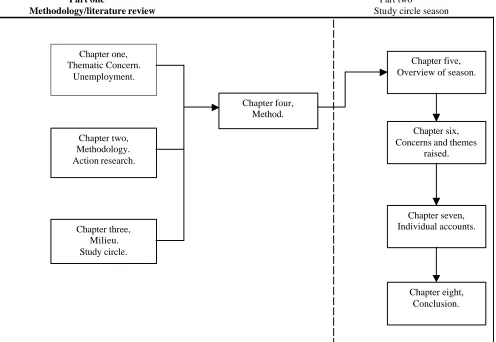
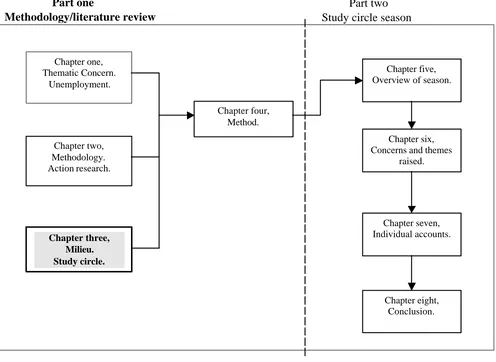
This thesis is presented in two parts as illustrated in the Table below.
Table one: Thesis structure
Part one Part two
Methodology/literature review Study circle season
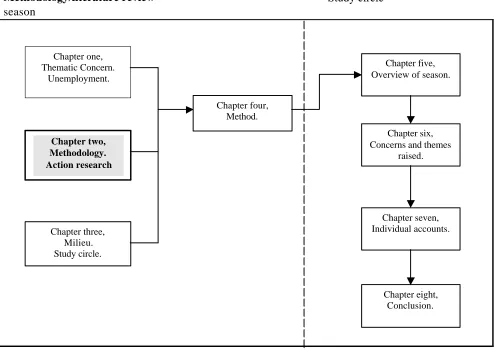
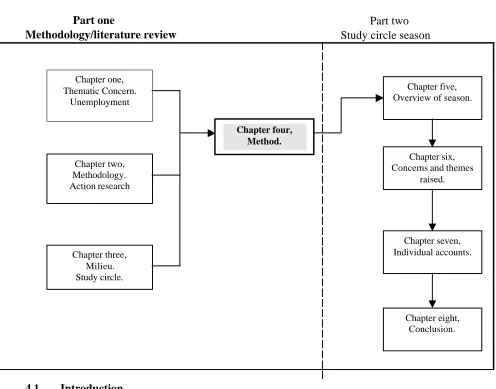
Note: To assist the reader, this Table will be reproduced throughout the thesis and the relevant area of discussion will be portrayed in the shaded box in bold.
Part one initially examines the thematic concern of this research – unemployment. The underlying methodological direction of the study is then discussed drawing upon the relevant literature in relation to the methodology and the research milieu – the study circle. Action research commences with a thematic concern, in this case, unemployment
Chapter one, Thematic Concern.
Unemployment.
Chapter two, Methodology. Action research.
Chapter three, Milieu. Study circle.
Chapter four, Method.
Chapter five, Overview of season.
Chapter six, Concerns and themes
raised.
Chapter seven, Individual accounts.
and then establishes a milieu, in this case, a study circle, to address the thematic concern (Kemmis and McTaggart 1990).
Chapter one - Introduction
Table one: Thesis structure
Part one Part two
Methodology/literature review Study circle season
1.1 Introduction
As illustrated in table one, Part one comprises four chapters. Chapters one, two and three somewhat stand alone and are then linked within Chapter four. Chapter one initially details the manner in which the thesis is structured. Historical research antecedents, which determine the direction of this research, are elaborated upon and then the research aims and significance of the research, from a practical and theoretical perspective are presented. The Chapter then addresses the thematic concern of the research –
Chapter one, Thematic Concern.
Unemployment.
Chapter two, Methodology. Action research.
Chapter three, Milieu. Study circle.
Chapter four, Method.
Chapter five, Overview of season.
Chapter six, Concerns and themes
raised.
Chapter seven, Individual accounts.
“unemployment” - and then clarifies issues in relation to unemployment levels and the definition of unemployment. The Chapter then embarks on an historical critical analysis of the issue of unemployment within the Australian context and specifically the current government’s policy platform. By deconstructing a number of commonly held myths in relation to unemployment and the unemployed, this Chapter attempts to demonstrate that our society’s dominant assumptions go a long way to establishing and reinforcing beliefs that create a sense of disempowerment for the unemployed.
Chapter two then presents details in relation to the larger paradigm and methodological theory from which this research is based. Initially, the relationships between the recognised range of methodological paradigms available are discussed. The Chapter then focuses on these research paradigms and critical theory is discussed in detail addressing the tensions between these research orthodoxies. The notions of empowerment, agency and validity are expanded upon. Finally, participatory action research and emancipatory action research are discussed with reference to issues such as bias, validity and subjectivity. The Chapter also comments on the challenges facing the critical researcher in relation to traditional and conservative academic environments.
Chapter three reviews the relevant literature in relation to critical and empowering educational initiatives. It introduces the milieu and as such provides a detailed exploration of what study circles are, as well as their pedagogical theory and practice, including existing research findings in relation to study circles in Australia and overseas. The Chapter provides theoretical and practical guidance and informs on the conduct of the study circle undertaken in this research.
In effect, Part one of the thesis begins by establishing why the researcher is interested in the issue of unemployment. From this basis, a methodology which attempts to truly assist the unemployed in the areas of social justice and equity is sought. From here a “vehicle” or milieu to enact the methodology is identified (the study circle). Then the details in relation to the method are refined.
Part two of the thesis introduces and reports on the results of these efforts.
1.2 The thematic concern – research purpose
Research, especially action research, does not stand alone. It sits within an historical context of inquiry. The impetus and motives behind this research stem from over eight years’ professional work as a teacher and program coordinator with unemployed learners at TAFE and university levels, as well as from research and studies carried out during this time at under-graduate and post graduate levels. It is therefore relevant to provide some background on the ideas and themes presented in previous research.
1996). The “voices”4 (in the research) of those who were experiencing unemployment
spoke for themselves. For example, when research participants were asked how and why unemployment occurs, and if they perceived that “change” was possible, responses included:
‘You’re not going to change it. There’s always going to be unemployment.
There’s nothing we can do about the unemployment problem.
It’s out there, the government, the system.
You wouldn’t feel like you could change anything’ (Brophy 1996:65).
However, the study also investigated whether from the perspective of the participants, the engagement in empowering activities, and working towards change and action, were worthwhile issues to explore. When participants reflected on these possibilities the responses included:
‘Well if it gives people an idea of how to start off.
You can sort of start thinking about how to fix it.
You can get a better understanding.
It would be really good to learn something like that.
To be involved in starting up some small group or action plan or something.
Somebody might notice you.’ (Brophy 1996:66).
This earlier study also argued that many factors contribute to and compound the problem of the structural inequality of the unemployed (Brophy 1996). The research demonstrated that LMP participants believed that focusing on unemployment issues in a program or
4
course would have a positive effect on themselves and others (Brophy 1996). Research by the Further Education Unit (FEU) in Britain in the late 1980s also revealed that many unemployed individuals wanted the opportunity to understand the socio -political context of unemployment (1990). Furthermore, it was established that if and when group discussion wandered (or was directed by a teacher) “unofficially” – outside of curriculum objectives - into addressing issues of unemployment, it was seen as a positive opportunity to share experiences (Brophy 1996). As action research operates in a cyclic manner, the reflections of the previous research are the rationale for this further cycle of research. The reflections indicated that participants did want to discuss issues in relation to unemployment. Therefore this cycle aimed to enact and respond to this reflection.
1.3 Research aims
In response to the reflections that participants raised in relation to discussing issues on unemployment in the previous research, the intention of this study was to respond to those reflections by employing an action research approach, which enabled this discussion to take effect. A context or milieu was therefore needed to act as a “vehicle” for the research process.
In order to respond to the needs raised by participants in the previous research and to explore the opportunity of empowerment, this research again adopted an action research methodology and applied the Swedish study circle5 as the milieu, for the action research. The research focus concentrated on investigating if, how, and to what extent the Swedish study circle promoted empowerment within a group of unemployed individuals. Specifically the aims were:
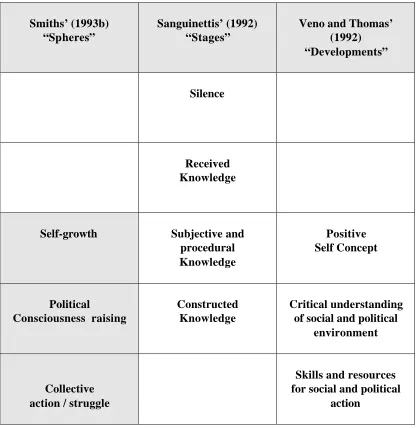
used to depict personal development – “the development of a sense of voice, mind, and self were integrally connected” (Sanguinetti 1992, p. 18).
5
General aim
To determine whether, and investigate how, a Swedish study circle contributes to the empowerment of the unemployed research participants, both at an individual and group level.
Specific aims
a. To explore the potential of a critical-action research methodology to advance understandings in relation to unemployment;
b. To utilise Smith’s (1993b)6 three tiered framework of empowerment as a basis for
organising and analysing data;
c. To gather data by conducting beginning, mid and end interviews with each participant, recording and transcribing meetings, and collecting any documentation produced; and
d. To uncover, analyse, validate, triangulate and document how participants discuss issues in relation to unemployment, how they feel, and what action and/or change occurs during the study circle season.
The above general aim and specific aim ‘a’ can be seen as the overarching or overall aims of the research, while specific aims ‘b’ and ‘c’ are organisational aims. These aims are all planned for and discussed in Part one, while specific aim ‘d’, the analytical aim, is addressed in Part two.
1.4 Significance of research
The need for alternative approaches to researching unemployment
There are several aspects of significance that apply to this research. Firstly, there is emerging evidence which suggests that many issues, including unemployment, should be researched from alternative perspectives. Historically, the negative social, physiological and psychological effects of unemployment have been well documented (Western and
6
Pettit 1999; Kermond 1998; Feather 1992, Winefield 1995 in Creed, Hicks and Machin 1997; Webber and Campbell 1997; Saunders 1996; Baker 1993; Gilbert in Easterbrook 1993; Wilson 1992; Waters and Crook 1990; Western 1989; King in Read and Alder 1988; Bekke, et al in Hogan 1985 - Vol.1). These researchers have demonstrated that many unemployed individuals experience compounding personal and domestic problems and are denied opportunities to contribute to society. For individuals, unemployment can result in any combination of the following: loss of income, boredom, isolation, depression, social stigma, increase in crime and crime victimisation, imprisonment, lack of routine, absence of contrast between work and leisure, suicidal thoughts and suicide, increased stress, mortality, deterioration of family relationships as well as a decline in morale, self-esteem, self-respect, and sense of personal worth.
Research also exists which attempts to quantitatively measure and analyse these negative effects of unemployment on mental health, psychological well-being and behaviour. These works have encompassed a range of theories such as Jahoda’s latent function analysis and Warr’s Vitamin Model (Feather 1992). Other approaches include the analysis of self-concept, as well as the use of stress and coping theory, learned helplessness theory, expectancy-value theory, attribution theory, social cognition and self-efficacy theory, unidirectional or asymmetrical causal structures and criminal embededness (Hagan 1993; Feather 1992; Thornberry and Christenson 1984).
decade of vehement criticism of “empiricism”, good old conventional survey research has plodded along regardless, regularly training new graduate students, regularly turning out its crop of polls and attitude surveys regularly filling its journals” (1983:244).
Furthermore, it has been argued that psychological theories, although concerned with cognitive processes at an individual level, do not thoroughly investigate the nature of the social environment that shapes an individual (Burchell 1992). Veno and Thomas note that:
‘Clinical psychology has traditionally defined the “normal” and then defined actions and behaviours outside this range as “deviant” or “pathological”’(1992:24).
Or, as Seligman and Csikszentmihalyi state:
‘Psychology has since World War 2, become a science largely about healing. It concentrates on repairing damage within a disease model of human function. This almost exclusive attention to pathology neglects the … individual and the … community’ (2000:1).
As Probert, Wiseman and Watts state in relation to this specific study, “Critical theory, emancipatory action research and standpoint theory7 are uncommon approaches used to address unemployment, but these methodological frameworks and techniques are utilised in this research in an attempt to shed new light on the cripplin g problem of unemployment” (Probert, Wiseman and Watts 1998:17).
This research is therefore significant, as it is a response to the emerging need of alternative research approaches to build on existing knowledge in relation to unemployment. However at this stage, it seems appropriate to briefly address some of the reasons why more post positivist research approaches into unemployment are not more common8.
Firstly, there is the argument that “… sociology has a somewhat marginal status in the Australian system” (Waters and Crook 1990:18). It has been suggested that in order to gain credibility a number of sociological and educational researchers embrace psychological frameworks of behaviourism to offset any potential empirical criticisms (Connell et al. 1982; Rose and Rose 1976). The view that “What is important to behaviourism is what can be measured” (Rose and Rose 1976: 126) may motivate the researcher to satisfy an empiricist perspective by attempting to “measure” behaviour. Although this research into behavioural psychology is useful, its abundance is problematic, as all behaviour is interpretive, whereas “ … classic category reductionism, where all aspects of human activity ... are defined as behaviours ... This type of reductionism is at its worst ... [unable to] … see that the contradictions between individuals are themselves a part of and contained within the overall structure of society” (Rose and Rose 1976:126). Furthermore, “The exclusive focus on pathology that has dominated so much of our discipline [psychology] results in a model of the human being lacking positive features” (Seligman and Csikszentmihalyi 2000:1). Jones even goes so far as to state: “We should oppose excessive reliance on “reductionism”, which poses
7
These aspects of the research are discussed in detail in Chapters two and four. 8
grave dangers to democracy and personal autonomy” (1995:257). Lather states, “Positivism is not dead … What is dead, however, is its theoretic dominance and its “one best way” claims over empirical work …” (1991b:9). Alternative sociological research approaches are uncommon, and therefore should be employed to balance the overall knowledge pertaining to important social issues.
Secondly, some alternative research approaches may be considered too dangerous, radical and foolhardy. For example, the traditional and accepted positivist research approaches, often employed by psychologists, essentially aim to explain and predict; they focus on constructing deductive statements that can be applied to other contexts (Sarantakos 1994; Waters and Crook 1990). On the other hand post positivist approaches to research, including critical educational and sociological methodologies that are interested in understanding “people”, and aim to critique social reality, emancipate and empower disadvantaged people and even offer possible solutions (Sarantakos 1994).9 Specifically, critical theory and action research attempt to abandon conventional “scientific”, minimal and preconceived categories as they are seen to somewhat legitimise dominant relations (Kellehear 1993; Gancian 1992), and may maintain the stereotypical assumptions pertaining to certain groups (Fetterman 1989). For example, as Hagan states: “American discussions of unemployment and crime often are empirically and ideologically confounded by issues of race” (1993:486). Critical sociological approaches also focus on internal processes in relation to the social landscape that surrounds them (Waters and Crook 1990). Critical research attempts to explain, critique, and empower (Sarantakos 1994). It “... is interested in the way individuals make sense of their own lives” (Pierce 1995:571). This research is therefore an attempt to study the issue of unemployment from an underutilised methodological perspective.
9
The need for more research into the area of unemployment
In returning to the area of significance of this research, the second aspect is that many sociologists have noted the lack of substantial research in relationship to disadvantaged groups, including the unemployed. This has been seen to perpetuate powerlessness and to limit any attempts to alleviate disadvantages (Saunders 1998; Brown 1996; Munford 1994; Connell 1993; Reinharz 1992; Rodgers and Wilkinson 1991).
‘Australian research on people’s personal or ethical evaluations of their unemployed fellow citizens is rare’ (Eardley and Matheson 1999:11).
Furthermore:
‘… although it is clear that unemployment remains a matter of deep public concern, there is little detailed information available on what people think the Government should be doing to solve the problem’ (Eardley and Matheson 1999:31).
Moreover, this scarcity often results in misinformed views and social division:
‘The Government must show leadership by educating the community about issues of unemployment, rather than allowing uninformed attitudes to develop that place the blame on people who are its victims’ (Boreham and Chamberlin 1996:A4).
The need for research into unemployment to be based upon a collaborative and
democratic methodology
The authority, power and deference that governments used to command have also waned due to globalisation and its decentralisation, open frameworks and active communication (Giddens 1999b). Opinion polls show that many people have lost trust in orthodox political processes and their traditional symbolism, disenchanted by pomp and circumstance, old boy networks, backstage deals and corrupt self interest (Giddens 1999b).
However Giddens states, “Diminished trust in politics and other authority figures is sometimes taken to indicate general social apathy … [however] … it does not – perhaps the opposite” (1999a:80). Furthermore, “… some people see contemporary society as fragmented and disorganised, but in fact the opposite is true. People are getting more involved in groups and associations than they used to” (1999b:77).
For example groups such as Community Aid Abroad, Greenpeace and Amnesty International are powerful single issue groups. In Australia alone there is an abundance of community organisations. The Directory of Self Help and Social Action Groups (1998) lists over seven hundred small and large non government organisations and community groups in Victoria alone from ethnic support groups to environmental groups and social action groups.
The Victorian Community Groups and Services (http:/www.vicnet.net.au/vicnet/com.htm) on the internet, lists pages of groups such as resident associations, urban action groups and consumer rights groups. Several other Community Directories listing other organisations are also available.
The initiatives that such groups employ may seem ineffectual, however small action can be profound. Dodson, in relation to Aboriginal Reconciliation has stated “… small initiatives such as flying the Aboriginal flag from the town hall, could be hugely symbolic and inclusive, giving people a feeling of esteem and pride” (in Westerman 2000:1).
Giddens suggests small single issue groups are therefore “… at the forefront in raising problems and questions that may go ignored in orthodox political circles” (1999b:77). He states that forty per cent of Americans belong to at least one group that meets regularly (1999a), and that special interest groups and activists address many issues that orthodox politics cannot (1999b). As a result he argues that a deepening of democracy is required, where “… we need to democratise above as well as below …” (1999b:75). This he terms as “democratising democracy”. “Democratising democracy means having an effective devolution of power … we should also be prepared to experiment with alternative democratic procedures, especially where these might help bring political decision making close to the everyday concerns of citizens” (1999b:76, 77). This particular research therefore exemplifies this practice by conducting a study with study circles on the issue of unemployment. Giddens also suggests we need to re-establish direct contact with citizens, through “… experiments with democracy” (1999a:75). Moreover, “Political parties will have to get more used to collaborating with single issue groups” (Giddens 1999b:77) and “Governments should be prepared to contribute to such endeavours as well as encourage other forms of bottom-up decision-making and autonomy” (Giddens 1999a:84).
inequalities between neighbourhoods. (The Central Office of Information 2000a). Blair states that his Government must: “… develop ways to put deprived communities in the driver’s seat” (in the Central Office of Information 2000a:2).
A theme that emerges from the SEU publications is that the decision making and problem solving in relation to social issues of social problems needs to be addressed by those directly affected and involved.
“Key Policy Action Team recommendations … seek feedback from everyone with an interest in deprived neighbourhoods” (National Strategy for Neighbourhood Research Execution Summary 2000:3). “Communities themselves ought to be the best advocates of their own interests. And the best solution will be those that include their input and have their support or participation” (The Central Office of Information 2000a:4).
“Without effective self help it is unlikely that any other purposes of community regeneration … will provide long-term solution to long-term problems” (The Central Office of Information – PAT9 2000b:1).
Giddens uses a Swedish example:
‘One model is the approach used in Sweden twenty years ago, when the government drew the public directly into the formulation of energy policy. The government, unions, parties and education agencies set up day-long courses on energy. Anyone who took such a course could make formal recommendations to the government” (Giddens 1999a:76).
Swedish civic educational initiatives also include study circles, which are discussed in detail in Chapter three. There are many advocates, both in Australia and North America, who believe that the option of study circles should be considered further. For example, Peak, after visiting Sweden, remarked:
circle model should or could be imported into our country ... for the growth of the individual and for movement towards a more democratic society’ (1990:165).
The need to conduct research into study circles
The above discussion leads to the third area of significance in relation to this research, the need to explore the study circle approach as an alternative adult educational practice.
Or as Oliver states in relation to the United States context:
‘No promise can or should be made for the introduction of study circles into our advanced, technologically based, communications-orientated society. But it seems an idea worthy of experimentation - worthy if only to prove that the individual citizen has views that should be heard in policy making’ (1987:145).
Furthermore:
‘… if enough organizations in our country adopt the study circle idea as part and parcel of their mission and philosophy, we have both a study circle movement and an adult education movement - steps towards the goal of a learning society’ (Oliver 1995:14).
In Australia, at Federal Government level there has been endorsement for further educational efforts to explore the potentials of study circles. In 1994 the Civics Expert Group published a report entitled “Whereas the people…Civics and Citizenship
Education”. The twenty-first recommendation of this report reads:
‘The Commonwealth should support the preparation of study circle materials by adult and community education providers … and support their dissemination’ (Civics Expert Group 1994:27).
learn of your progress … Learning circles10 are increasingly being considered by all levels
of government in Australia, for a range of educational needs, and your research will prove valuable” (see appendix 2). The significance of this research is supported further when considering that no study circles have been conducted, assessed or researched into the area of unemployment itself. Shires and Crawford recommend in their evaluation of Aboriginal Reconciliation Study Circles in Australia: “Consideration should be given to encouraging greater use of learning circles within universities and TAFEs … as a professional development tool for service sector workers … particularly in … unemployment (1996b:iv)11.
1.5 Unemployment
As mentioned previously, this research represents a further stage of enquiry into the issue of unemployment. This section therefore introduces the issue of unemployment in relation to previous research, and also grounds the critical research direction of the study. As will be discussed in the methodology and method Chapters, this research is based upon critical theory. As such, this review of literature is a critical text analysis as is customary in critical research approaches. Critical researchers view images, representations and information derived from such texts as books, films, media, policy, television, magazines, research, evaluations and so forth, as social creations and constructions, which can either empower or constrain, but nonetheless reflect the interests and values of the creators themselves (Smith 1993b).
A critical text analysis also seeks to deconstruct or rethink questions and expose the rhetorical, discourse, assumed truths and resultant colonising trends in these information sources and their power to position us all to view dominant ideas as unproblematic and
10
Prominent advocates for study circles in Australia have adopted the term “learning circle” rather than study circle. AAACE has endorsed this change as “learning” is seen to have greater appeal than the word “study” which may suggest a traditional type of teaching/learning and/or negative experiences. Both study circles and learning circles within this thesis can therefore be considered synonymous (Gibson 1998).
11
natural (Smith 1993; Fairclough 1989). As Berger and Luckmann state: “… social order is a human product, or, more precisely, an ongoing human production … Social order is not part of the “nature of things”, and it cannot be derived from the “laws of nature”. Social order exists only as a product of human activity” [original emphasis] (1991:69-70).12
This section therefore attempts to demonstrate how the dominant ideology and government policy not only blames the unemployed for their own situation and labels them as “deviant”, but is also predominantly ineffective in alleviating the overall problem of unemployment. Arguably this is the reason why the unemployed themselves are blamed, as governments cannot afford to accept that unemployment is a major problem they are ultimately responsible for.
In essence, it is the reason the researcher, who has worked with unemployed individuals for many years, has decided to conduct the research; it is the thematic concern.
There are two matters that need to be raised and clarified at this point in relation to unemployment an d the following discussion. Firstly, there is an abundance of literature which claims to uncover the causes of Australia’s high unemployment levels, and supplies a range of measures to address the problem (Hellyer 1999; Eardley and Matheson 1999; Saunders 1998; Stilwell 1997; Moore; Liberal/Nationals 1996; ARIS 1995; Carson and Doube 1995; Davidson 1995; Dollery and Webster 1995, p. 7; Bessant 1995a; Blandy 1994; Byrne and Buchanan 1994; Carson and Doube 1994; Hughes 1994; Roth 1994; CEO 1994; Freeland 1994; Jones 1994b; Sloan 1994; Sloan and Wooden 1994; Boeri 1994; Webber and Campbell 1994; Probert 1994; Winefield et al. 1993; Buchanan 1993; O’Connor, Maher and Rapson 1993; Probert 1993a; Probert 1993b; Smith 1993a; Castle 1992; Rodgers and Wilkinson 1991; Jones 1990; West 1987;
12
Hartmann 1985; Handy 1984; Brewer 1980; Windschuttle 1979). This range of views and opinions has been compiled and categorised previously by this researcher (Brophy 1997; Brophy 1996). A summary of these potential unemployment “cures” can also be found in the discussion guide for this study (appendix 2 pp14-17).13
What is relevant within the context of this research is that this long, continual, and exhaustive debate on how to address the problem of high unemployment has resulted in little or no action or effect over a considerable time on unemployment levels.
It is therefore not the intention of this study to further debate these views or suggest other “cures” or panaceas for unemployment. In some respects therefore this research is sympathetic to the ideas discussed by Graham at the Sixth National Conference on Unemployment (1999), where she expressed concern that so much political and academic effort is invested in how to solve and what should be done about unemployment, rather than focusing on the unemployed individuals who are directly affected.
The second matter therefore for the reader to consider is that amongst all the perceived “panaceas”, there is little “voice” representing the unemployed themselves. This study then is an attempt to give “voice” to and reflect upon and empower those affected: to view unemployment from the perspective of the unemployed, in a “bottom up” rather than a “top down” approach. The theoretical foundations for this approach will be discussed in detail in the methodology Chapter.
This Chapter now seeks to explore the reasons why the unemployed have been excluded from the debate on unemployment. This study also does not suggest “answers” nor ever pose more “questions” in relation to unemployment. What is sought here is that perhaps, the unemployed could (or should) be consulted to see if they can raise the “questions” (or
13
answers) themselves. This section firstly addresses the problematic issue of defining unemployment. It then traces and critiques the historical developments of Federal Government initiatives in LMPs from the 1970s to the present. It is argued that the dominant assumptions which pervade the myths of unemployment are indeed disempowering, as they tend to blame the individual for her/his situation, rather than focusing on the social, structural, economic and political contributing factors. That is, unemployment as a form of deviance is socially objectified as knowledge, as a generally valid “truth” about reality (Berger and Luckmann 1991). Effectively, individuals learn this objective “truth” in the course of socialisation and then internalise it as a subjective reality (Berger and Luckmann 1991). This section thus begins to examine how, why and by whom these “objective truths” are formulated, and focuses on the resultant effects of such truths for the unemployed individual labelled “deviant”.
Historically, there have been several technical definitions of unemployment available, which attempt to give a picture of Australia’s unemployment situation. The former Commonwealth Employment Service (CES)14 provided one source of statistics, which
compared the number of unemployed as a percentage of the total labour force (Baker 1993). The Department of Social Security (DSS) defined the unemployed as all people in receipt of unemployment benefits (Baker 1993). The Australian Bureau of Statistics (ABS) conducted surveys and used a specific criterion to define unemployment, ie. if an individual is: fifteen years and over; not employed at all during the week of survey; has actively looked for full and part time work during the last four weeks; and was available for work within the week (Baker 1993). The ABS therefore defines “employed” as any person who gains any paid work at all during a specific week regardless of the number of hours worked (Castle 1992). The Department of Employment, Training and Youth Affairs (DETYA)15 also carries out its own research into unemployment statistics (Baker
14
CES and DSS were merged in late 1998 to become one organisation – Centrelink. 15
1993). Other organisations that measure unemployment levels include banks such as the Reserve, Westpac, and the ANZ which analyse job advertisements in newspapers (Baker 1993). The Federal Parliament, the Senate and the Economic Planning Advisory Council (EPAC) also conduct research which measures unemployment levels in a variety of different ways (Baker 1993).
It is therefore important to emphasise the fact that the term “unemployment” is extremely difficult to measure or define as it is a technical term that is often manipulated in different ways (Jones 1990). No uniform measure of unemployment exists, and therefore it may be postulated that registered and published figures are almost meaningless (Jones 1990). One ABS study concluded that there are up to six very different definitions of youth unemployment alone, and the estimates between these unemployment groups range from very high to very low (Bessant 1995b).
Furthermore, although official unemployment levels in Australia over the past two decades have hovered around the ten per cent mark, many analysts suggest that these published figures grossly underestimate the true levels of unemployment and that a more realistic estimate should be placed at twenty per cent (Kenny 1993; Jones 1990). For example in 1992 the EPAC commissioned the Australian National University (ANU) to look at unemployment and they found that the “real” unemployment rate was close to twenty per cent (Baker 1993). The same report also criticised the ABS data collection methods and criteria (Baker 1993). In May 1999, ABS data showed that fourteen and a half per cent of people aged between fifteen to nineteen years were “at risk”, that is not in full time education and either unemployed, in part time work or not included in statistics (Dusseldorp 1999).
being a wage earner. There are also the “under employed”, “mis-employed”, “marginally attached”, and “semi-employed” (Buchanan 1993; Jones 1990; Sinclair 1987). In 1992, one hundred and forty six thousand people were classified as discouraged job seekers and not included in statistics (Baker 1993). Youth also exhibit abnormally high levels of underemployment and hidden unemployment as compared to other groups (Whitfield 1993). Some analysts have placed youth unemployment alone as high as fifty per cent (Hewson and Disney in Wilson 1992). A comprehensive study conducted by Monash, Melbourne, Flinders and ANU universities in 1998 found that for every young unemployed person counted in official statistics, there was at least one more not counted who was not studying or working (Horin 1998). In the same report it was noted that “… unemployment statistics are a poor indicator and only told half the story” (Horin 1998:14). Moreover, many unemployed women workers are hidden amongst classifications (Bittman 1992). In 1999, the Federal Treasury issued a media release, “Winter Economic Round Up”. It was reported that, “… it is not possible to encapsulate all the aspects of teenage unemployment in a single measure and that alternative measures … which are more appropriate in assessing the extent of the problem … are required” (Murray 1999:1). All these factors lead to the conclusion that “official” rates will always underestimate the actual levels of unemployment.
As Connell noted even back in 1983:
‘Governments and companies lie and suppress information as a matter of course; information, when let out, is often distorted and sometimes invented; dominant groups shape the words we have to talk with, the concepts we have to think with. Our mass media are a sea of manipulative fantasy and half-truths. Such basic facts as unemployment statistics are currently among the chief works of imaginative fiction in the western world’ (vii).
1.6 Government initiatives
Alternatively, many of those unable to secure work were sent to prison under vagrancy laws (Windschuttle 1979).
After World War 2, due to a relatively low unemployment level, these relief work initiatives ceased. The CES was formed and sharp increases in unemployment levels during the 1970s resulted in a host of new ideas and schemes to tackle the ever increasing number of unemployed (Windschuttle 1979).
Many of the introductory major government LMP interventions in the 1970s for the unemployed in Australia, were designed primarily to assist those re-entering the workforce (Jones 1994b; Carson and Doube 1994; Windschuttle 1979). Most programs targeted specific unemployed groups and subsidised employers to employ the jobless (Jones 1994b; Windschuttle 1979). Yet many of these initiatives were considered “… to be of a questionable nature” (Windschuttle 1979:227). The community continued to have the same number of unemployed, and many studies showed that the only major benefit was to employers in the form of cheap labour (Jones 1994b ; Hogan 1985).
The 1980s saw the continued maintenance, and introduction of even more programs to assist the unemployed (Jones 1994b; Hogan 1985). Some programs did create new jobs (Castle 1992). However a rapidly rising unemployment rate forced the policy focus from long-term labour market restructuring to short-term “mopping-up” exercises and relief schemes by the late 1980s (Jones 1994b; Castle 1992; Windschuttle 1979; Brewer 1980). In retrospect, the government’s response to increasing unemployment during the late 1970s and early 1980s was seen to be predominantly reactionary, aimed at diffusing anger and hiding unemployment levels (Carson and Doube 1994; Brewer 1980).
recommendations, the trend of tackling unemployment with predominantly short-term initiatives continued (Jones 1994b; Carson and Doube 1994), and protests from advocates for long term structural change were largely ignored (Jones 1994b, O’Connor, Maher and Rapson 1993).
In 1994 the Labour Government unveiled its White Paper entitled “Working Nation”, which attempted to readdress the problems of the labour market by creating yet more new LMPs. However the target unemployment rates of Working Nation were fundamentally linked to an improved economy (CEO 1994:113). For many analysts, it was predicted that the higher rates of employment growth stated would never be achieved (Greenlees 1995; Longo 1995b; Lydall 1995; Wooden 1994; Sloan 1994; Blandy 1994).
After the federal election in March 1996, the Hawke/Keating Labour Government was replaced with a Liberal/National Coalition Government. The release of the new government’s “Reforming Employment Assistance” policy during August 1996, by Vanstone, the then Minister for the Department of Employment, Education, Training and Youth Affairs (DEETYA), terminated the Working Nation policy. This new policy was the foundation and springboard for a range of labour market reforms in existing structures, the creation of new ones and a change of focus on LMPs that exist today.
Although much policy documentation could be critically examined, it is perhaps fitting to focus on this current “Reforming Government Assistance” (1996) policy momentarily as an example of how a perceived “reality” can be constructed and used to pacify the unemployed. As Henry states:
Graham states, in relation specifically to this policy:
‘It seemed to me that these policies, and the knowledge they embody, assume the form of being neutral, operating to uncover a naturally existing order in relation to unemployment. In fact, such policies are far from neutral …’ (1999:12).
The underlying principles for reform that the Government has based its decisions upon are outlined in Chapter Two, pages five to thirteen of the policy document. This chapter is in three parts, entitled:
• ‘Background to Australia’s labour market assistance policies;
• International Research; and
• Australia’s recent experience’ (Vanstone 1996:5, 6, 8).
In the section “Background to Australia’s labour market assistance policies”, the document states:
‘In 1985 the ... Kirby Inquiry criticised the proliferation of LMPs established during the preceding decade ... but the structure of intervention continued to be focused on programs rather than clients (Jarvie and McKay 1993) and a multitude of complex programs soon reappeared’ (Vanstone 1996:5).
In reality, this “multitude of complex programs” was exactly what the Kirby Report had recommended. In the same reference cited by the policy, Jarvie and McKay recommended that:
‘LMP assistance is just one of a range of assistance available to clients ... in these strategies the focus is on the clients and their needs, not on programs and services ... delivery in DEET ... has become increasingly client focused with structural reforms ... and client targeted operational planning [emphasis added]’ (1993:6).
(Vanstone 1996:15). Yet assistance already was, and had been for three years, “client-focused” according to the reference quoted in the government policy itself. The Ministerial Statement goes on to state:
‘In its August 1995 review of LMPs the CESAC [Commonwealth Employment Service Advisory Committee] echoed some of the criticisms of the Kirby Committee. It called for major changes ... and ... noted that current administrative arrangements were “an impediment to maximising outcomes” and described the complex array of guidelines ... as “baffling” to all but the very experienced (CESAC 1995:xi)’ (Vanstone 1996:5).
The CESAC Review of LMP is a comprehensive sixty page evaluation. This criticism is presented as only a “consideration” in the Executive Summary (CESAC 1995:xi). In the Findings section of this review, it is recommended that: “… some streamlining measures should be introduced ... to simplify procedures” [emphasis added] (p. 35). It did not call for a major change as stated in the Ministerial Statement. It could be argued that the Liberal/National policy is a misinterpretation to the CESAC Review. For example in the CESAC review, under Recommendation Five, it is suggested:
‘CESAC sees that further rationalisation of DEET LMPs is desirable ... For example ... the LEAP [Landcare and Environment Action Program], JobSkills and NWO [New Work Opportunities] programs ... could be synthesised to form a single program’ (p. xiv).
Furthermore, the National Board of Employment, Education and Training (NBEET) reference cited in the policy advises:
‘Recommendation eleven: The Council recommends that the NWO program, the JobSkills program and LEAP should be amalgamated into one employment-based training program incorporating the best features of the three programs’ (NBEET 1996:xiii).
(ATY), Skillshare, Job Clubs and many others (Vanstone 1996). The Liberal/National policy also proposed that:
‘The requirement to meet numerical targets ... has tended to take precedence over the needs of the individual’ (Vanstone 1996:6).
This criticism of the previous Labour Government’s approach to LMPs is perhaps well-founded. However the problem of being “target driven” is not addressed adequately in the policy. Agencies and organisations responsible for assessing, training and assisting clients to gain work receive “Payments [which] will be weighted towards outcomes” (Vanstone 1996:45).
Previously, providers were required to meet numerical targets. That is, the number of LMP participants placed into employment, further education or training. Now, the pressure and resultant problems may well be greater as “targets” now equate with financial viability, which arguably takes precedence over individual client needs.
Under “Principles for Reforms - International Research”, the policy states: ‘According to the OECD [Organisation for Economic Cooperation and Development], programs that are broadly targeted ... often have no significant impact. The OECD concludes, “targeting appears to be a crucial design feature determining the success of training programs”’ (OECD 1996:6 in Vanstone 1996:6).
Careful targeting is indeed considered vital. For some time now, the OECD, has called on member countries to carry out specific targeting:
Arguably, the wide range of targeted LMPs that existed before the Liberal/National parties were confusing to some, but nonetheless it was an attempt to carry out specific and careful targeting. However twelve specifically targeted programs were abolished during 1997 (Vanstone 1996:30). Many of these directly involved trade unions, educational institutions, local government and employers (ie. NWO, LEAP, JobSkills and Skillshare). In the new policy, trade unions and local government are not mentioned, and educational institutions rarely. Under Principle Five, the Liberal/National policy states:
‘... after access to .. government funded employment services [will] be provided through an integrated service delivery agency - a “one stop shop”. This would make the link between receipt of income support and active job search clearer and more explicit’ (Vanstone 1996:13).
It is debatable if a “one stop shop” equates with “careful targeting”. As the OECD has stated, broad initiatives are seldom successful. Furthermore as Graham states, this “… unemployment policy tends to position subjects in ways which do not necessarily capture the complexity of life” (1999:3).
The Liberal/National policy goes on to claim:
‘Wage subsidies generally have good outcomes and are regarded as effective ... The consensus is that they should be of short duration with further access to employer subsidies’ (Vanstone 1996:6).
However there is much historical evidence that suggests these schemes are relatively ineffective. Skill enhancement is marginal, it is rather a form of cheap labour for employers who tend not to retain employees after the subsidised period. It promotes the acceptance of wages lower than minimum legal levels and low wage competition, the casualties are the disadvantaged who are recycled into unemployment (Burgess 1995; Dollery and Webster 1995; Probert 1994; Hawthorne 1994; Winefield et al. 1993).
‘... the OECD acknowledges that substitution and displacement 16should not be
seen as shortcomings ... Self employment assistance schemes are viewed as having good outcomes ...’ (OECD 1995 in Vanstone 1996:6).
However the OECD has also determined that:
‘Many new jobs are likely to be low productivity, low wage jobs ... employment subsidies for the creation of low wage jobs should be avoided’ (OECD 1994:33).
In reality the claimed high success rates of sixty to seventy per cent with wage subsidy schemes are incorrect. In reality the “net” additional employment is more in the region of only fifteen to twenty per cent. The difference between gross and net results is due to labour turnover or substitution, “deadweight”17 and displacement (Carson and Doube
1995; Byrne and Buchanan 1994; Castle 1992). For example, there is clear evidence that employers substitute subsidised labour for unsubsidised labour. (Carson and Doube 1995; Byrne and Buchanan 1994; Castle 1992).
The Liberal/National policy goes on to inform of OECD recommendations: ‘Direct job creation programs have high unit costs and have shown little success (OECD 1996:7)’ (Vanstone 1996:6).
The OECD however, also claims:
‘... effective public employment service is a key element in making active measures more effective ... Ensuring that the public employment service has access to ... the availability of training or job creation
16
Substitution: - The notion that an employer secures financially subsidised labour in place of unsubsidised labour. (Carson and Doube 1995). The implications of this action result in no new positions being created therefore no reduction in overall unemployment levels. This equates to a financial cost to the government with nil return, while providing a financial windfall for employers and therefore increased profits and often a lower income for the workers themselves.
Displacement:- Where a subsidised employee replaces a non subsidised employee (Carson and Doube 1995) Not only resulting in the above substitution effects, but also creating insecurity for existing unsubsidised labour.
17 “Deadweight” – Whereas there is little or no actual productive labour function for the subsidised
programme places can serve as a ‘work test’ for benefit claimant’ [emphasis added] (OECD 1994:37).
However, job creation programs can be successful. British economists and researchers have demonstrated that the programs are effective as there is always some type of worthwhile work people could do (Winefield et al. 1993; Jones 1990). Such schemes however do need to be carefully planned (Carson and Doube 1995; Jones 1990;Windschuttle 1979). Job creation in the areas of environment, health, public transport and education are arguably more socially beneficial than wage subsidy programs in some private industry areas such as commercial advertising or tax minimisation (Stilwell 1994). Estimates place the net employment effect of job creation schemes at forty seven per cent (Carson and Doube 1995). This is nearly four times more effective than a wage subsidy approach.
In the section addressing “Income support arrangements”, the policy states: ‘In looking at this issue OECD ... policies include .... applying benefit sanctions to enforce job search requirements’ (Vanstone 1996:7).
The specific OECD reference that this claim is based on is not cited. This omission seems even more odd when the OECD in 1994, stated that this type of action had a questionable impact and did not equate with increased employment (Boeri 1994). An Australian study into unemployment benefits from 1950 to 1989, came to the conclusion that:
‘Unemployment policies which focus on [reducing] benefits are unlikely to have any effect on unemployment rates’ (Dollery and Webster 1995:7).
Furthermore “Reducing benefits, at best, just forces people into an overcrowded low-wage labour market” (Giddens 1999a). An OECD report cited often in the policy’s “Principles for Reform”, states clearly:
Moreover, in a recent study by Graham into the effects of this policy in rural areas she states in her conclusion:
‘… with such limited regional resources and support for development it would seem that all the regulation and surveillance in the world will not ‘recruit’ unemployed people into jobs that don’t exist’ (1999:14,15)
Under the “Lessons from Australia’s recent experience” section, the policy states:
‘Qualitative evidence obtained in the Working Nation evaluation ... suggests that case management can play a useful ‘deterrence’ role. Rather than face the scrutiny of case management, many jobseekers who could easily find work, or who were already employed, chose to leave the CES register’ (Vanstone 1996:8).
The actual quote from this evaluation is:
‘Case management has been effective in deterring some income support recipients ... For example, when some jobseekers were told that they had been referred to case management ... they stopped claiming unemployment allowances. Case managers believed that case management was effective as a deterrent ...’ [emphasis added] (DEETYA 1996:34).
This is not “evidence” of “many” clients “leaving the CES register in the face of scrutiny”. Rather, it was “believed” that “some stopped claiming allowances” due to case management.
The evaluation concludes by reporting that:
‘Further work is underway to validate these perceptions’ [emphasis added] (DEETYA 1996:36).
‘Policy changes have licensed … abuse, even though most of those who are taken off benefits are victims of administrative errors …’ (1998:59)
Research in Britain in 1996 uncovered that the official estimates of alleged welfare fraud had been doubled by including “… misdemeanours, trivia and mistaken action of … an increasingly complex system” (Pilger 1998:105) Furthermore, “… in one year alone, 1996, 3.5 million of benefits were not claimed because people were unaware they were eligible or because they were too proud” (Pilger 1998:105).
The Government’s approach to tackling unemployment is based on two premises. Firstly, it believes that employers are restricted in their endeavours to employ because of “arthritic” labour market regulations such as the “unfair dismissal law” (Carney 1996:A25). Secondly, unemployment will not be reduced until national savings and rates of economic growth increase as well as low inflation and a balanced budget (Carney 1996; Colebatch 1996b).
‘We won’t get real movement on unemployment until we get small business booming’ (Howard in Colebatch 1996b:A7).
‘You won’t reduce unemployment until you can get a higher rate of growth’ (Howard in Tingle 1996:A2).