R E S E A R C H
Open Access
Design of sampled-data controllers for the
synchronization of complex dynamical
networks under controller attacks
Tae H. Lee
1and Ju H. Park
2**Correspondence:[email protected]
2Nonlinear Dynamics Group,
Department of Electrical Engineering, Yeungnam University, Gyeongsan, Republic of Korea Full list of author information is available at the end of the article
Abstract
This paper addresses the design problem of sampled-data controllers for the synchronization of complex dynamical networks under controller attack. Some discontinuous Lyapunov functionals and zero equation are employed to deal with a sampled-data pattern. Due to the limited access of networks to hackers, cyber-attacks on the controller are considered randomly occurring and are described as an attack function which is nonlinear but assumed to be certain known conditions. The designing conditions for sampled-data controllers against cyber-attack are developed in terms of linear matrix inequality (LMI) by using Lyapunov theory and some novel inequalities. Finally, a numerical example is given to prove the usefulness of the proposed method.
Keywords: Complex network; Synchronization; Sampled-data control; Controller attack
1 Introduction
Nowadays, most of systems, components, plants are connected complicatedly to each other thanks to high level of communication technology, which can be called complex dynamic networks (CDNs). CDNs consist of many nodes with complicated interconnec-tions among them, so each node is affected and affects the others whether they are willing or not; for example, World Wide Web (WWW), social media, metabolic systems, Internet of Things (IoT), transportation networks, power grids, food chain, and so on. By consid-ering the high potential of CDNs, therefore, it is natural that the research on CDNs has become a large research area, and many researchers have discovered the nature of CDNs [1–3]. The synchronization is one of the popular applications of CDNs, which makes all states of each node in a CDN follow the same trajectories, and it has been widely studied [4–20]. To solve the synchronization problem for CDNs, various control schemes, such as feedback control [4–6], adaptive control [7,8], sliding-mode control [9,10], dynamic control [11,12], event-triggered control [13], impulsive control [14,15],H∞control [16],
and pinning control [17–20], have been employed.
In [17], the problem of both exponential synchronization and generalized synchroniza-tion of CDNs with/without time-varying coupling delays was investigated by designing an intermittent periodically adaptive pinning controller, and the results were applied to the
nearest-neighbor network and the Barabasi–Albert network to show the effectiveness. The paper [7] proposed a concept of consecutive synchronization and designed a dis-tributed adaptive controller for consecutive synchronization of CDNs with special topol-ogy structures. Synchronization of CDNs withN-coupled fractional-order chaotic system oscillators and regular/irregular topologies was studied in [6], and their results were ap-plied to various fractional-order chaotic systems, Lorenz, Volta, Duffing, and financial chaotic oscillators. [8] dealt with traffic road network as an application of CDNs, in which an adaptive controller and adjustable coupling strength were designed to reduce the im-pact of uncertainties, and pinning control method was employed as well for the smooth flow of traffic.
Rapidly growing communication technology opened a research field on sampled-data control. Sampled-data control has many benefits such as easy installation and mainte-nance, low operation fee, and so on. Therefore, it is natural to have a meteoric rise of research field on the sampled-data control scheme [21–32]. In [21], an aperiodic sampled-data controller was designed for controlling the two-wheel inverted pendulum in the T-S fuzzy model with disturbances on actuators where the proposed controller satisfies very-strict passivity. In [22],H∞state estimator for genetic regulatory networks with random
delays, uncertainties, and disturbances was designed using sampled-data of the concen-trations of mRNAs and proteins. In [23], an observer-based sampled-data controller was designed for a class of scalar nonlinear affine systems where the discrete-time states were firstly estimated by a nonlinear state observer, and then they were used for designing the sampled-data control. And there are a number of papers on the synchronization of CDNs by a sampled-data controller. The synchronization of CDNs with coupling time-varying delays was achieved via a sampled-data controller in [24], in which sampled-data had a constant time delay, and a discontinuous Lyapunov functional based on the ex-tended Wirtinger inequality was used. In [25], the synchronizability analysis for CDNs with sampled-data coupling signals was conducted by employing multiple-integral Lya-punov functionals, and then a sampling period-dependent criterion was derived in terms of linear matrix inequalities (LMIs). The main feature of the sampled-data controller is that it uses discontinuous signals because the control signals can be updated at sampling instants and are held a constant value for sampling periods. To make the efficient use of this feature, several techniques have been reported, such as input delay approach [26,
27], discontinuous Lyapunov functional based on extended Wirtinger inequality [28], free-matrix-based time-dependent discontinuous Lyapunov approach [30], looped-functional-based approach [29], sampling-instant-to-present-time fragmentation approach [31,32], and so on.
against cyber-attacks is a major concern of scholars [38,39]. In [40],H∞observer-based
periodic event-triggered controller for the control of a class of cyber-physical systems was designed under consideration of DoS attacks where the designed controller maximized the frequency and duration of the DoS attacks. In [41], distributed event-triggeredH∞
filters were designed on sensor networks in the presence of sensor saturations and ran-domly occurring cyber-attacks. In [42], the consensus problem of nonlinear multi-agent systems was studied by using sampled agents’ states and considering cyber-attacks on con-nectivity of the network topology, but it was recoverable. Authors in [43] proposed both event- and self-triggered control schemes for the leader-following consensus problem of multi-agent systems under consideration of DoS attacks, in which both synchronous and asynchronous updated strategies for control protocols were derived. Obviously, cyber-attacks would become a hotter issue for CDNs because CDNs consist of numerous nodes connected through communication networks. Nevertheless, research on CDNs with the consideration of cyber-attacks deserves much interest from scholars, only several works have been reported, which motivates this research.
This paper is about the synchronization of CDNs using sampled-data information un-der controller attacks. The main contribution of the paper is laid on mainly two streams: (i) Development of novel discontinuous Lyapunov functionals and zero inequality. Novel discontinuous Lyapunov functional would help the utilization of sampling characteris-tic. Combining with the novel discontinuous Lyapunov functionals, a zero inequality is needed to deal with a rest term of the time derivative of the novel discontinuous Lyapunov functionals. These may lead to less conservative conditions for designing a sampled-data controller. (ii) Consideration of cyber-attacks on controllers. Recently, the concept of attacks is the hottest issue in control engineering, and many works on cyber-attacks have been done. However, only few works cover controllers under cyber-cyber-attacks, even controllers of CDNs with cyber-attacks are few or nonexistent. Therefore, this paper considers deception attacks on controllers and designs the suitable controller against the attacks.
2 Problem formulation
Consider the following a CDN withNlinearly coupled identical nodes:
˙
xi(t) =Ax(t) +Bf
xi(t)
+
N
j=1
cijxj(t) +ui(t), i= 1, . . . ,N, (1)
wherexi= (xi1,xi2, . . . ,xin)T∈Rnis the state vector of theith node,A∈Rn×n,B∈Rn×n
are known constant matrices,f(t) = (f1(t),f2(t), . . . ,fn(t))T:Rn→Rnis a smooth nonlinear
vector field, andui(t) = (ui1,ui2, . . . ,uin)Tis the control input ofith node.C= (cij)N×Nis the
coupling matrix of the network, where each element of the matrixcijis defined as follows:
if there is a connection from nodeito nodej(i=j), thencij= 1; otherwisecij= 0 (i=j),
and the diagonal elements of matrixCare assumed by
cii= – N
j=1,j=i cij= –
N
j=1,j=i
Assumption 1 The nonlinear functionfi(·) (i= 1, 2, . . . ,n) satisfies the following
condi-tion:
0≤fi(a) –fi(b)
a–b ≤li, fi(0) = 0,
whereliis a positive constant.
Let us consider a target note ass˙(t) =As(t) +Bf(s(t)). Then the aim of this paper is syn-chronizing all nodes of a CDN up to the target node, i.e.,limt→∞s(t) –xi(t)= 0 for i= 1, 2, . . . ,N. To this end, we define error vectors as ei(t) =s(t) –xi(t). Then the error
dynamics is given as follows:
˙
ei(t) =Ae(t) +Bf¯i(t) – N
j=i
cijej(t) –ui(t), i= 1, . . . ,N, (2)
wheref¯i(t) =f(s(t)) –f(xi(t)).
In this paper, the controllers are designed using sampled-data signals as follows:
uFi(t) =Kiei(tk), tk≤t<tk+1, (3)
whereKiis the gain matrices forith node to be determined,tkis the updating instant time
of the Zero-Order-Hold (ZOH) satisfyingtk+1–tk=h,his a positive scalar.
Recently, the controller has become a target of hackers to alter the transmitted informa-tion. So, this paper is concerned with designing a sampled-data controller under cyber-attack. Because of the limited communication capacity of the network resources for hack-ers, the attacks might randomly destroy the control signals, and the maliciously modified signals would not be far away from the original one. To reflect this situation, we introduce Bernoulli random variableγi(t)∈ {0, 1}, satisfyingPr{γi(t) = 1}=γi, wherePr{x}implies
the occurrence probability of the eventx, andγiis a known positive constant less than 1.
Here,γi(t) = 1 means the cyber-attacks are launched to the controlleruFi(t). The specific
controller model under cyber-attack is as follows:
ui(t) =
1 –γi(t)
Kiei(tk) +γi(t)Kigi
ei
t–d(t), (4)
wheregi(t) = (gi1(t),gi2(t), . . . ,gin(t))T:Rn→Rnis the function of controller attacks,d(t)
is time-varying delay satisfying 0≤d(t)≤dandd˙(t)≤μ, anddandμare known positive constants.
Assumption 2 The cyber-attack functiongi(·) is satisfiedgi(0) = 0 and∀i∈ {1, 2, . . . ,n}, a=b
0≤gij(a) –gij(b)
a–b ≤mij,
Remark1 It can be strictly said that the cyber-attacks considered in this paper are ran-domly occurring deception attacks because, when a controller is under cyber-attacks, the real control inputs are replaced with the incorrect ones which adversaries want. And the cyber-attacks would be launched at any time, this introduces randomly occurring sense. Since adversaries try to adjust real control signals and transmit them through commu-nication networks, the considered cyber-attacks signals contain time-delayed informa-tion.
Then the closed-loop error systems with controller (4) can be rewritten in the following vector-matrix form:
˙
e(t) =ANe(t) +BNF
e(t)–CNe(t) –Γ¯(t)Ke(tk)
–Γ(t)Get–d(t), (5)
wheree(t) = [eT1(t),eT2(t), . . . ,eNT(t)]T,F(e(t)) = [f¯1T(e1(t)),f¯2T(e2(t)), . . . ,f¯NT(eN(t))]T,G(e(t)) =
[g1T(e1(t)),g2T(e2(t)), . . . ,gNT(eN(t))]T, K =diag{K1,K2, . . . ,KN}, Γ(t) =diag{γ1(t),γ2(t), . . . ,
γN(t)} ⊗In,Γ¯(t) = (IN –Γ(t))⊗In,AN=IN⊗A,BN =IN⊗B,CN=C⊗In, and⊗stands
for the notation of Kronecker product.
3 Main results
This section proposes a design scheme for the sampled-data controller under cyber-attack synchronizing a CDN. Before proceeding further, the following lemma is given.
Lemma 1 For given three scalars a,b,c where a≤b≤c,a positive definite matrix W ∈
Rn×n,and any matrix S∈R2n×2nand all continuous functionηin[a,c]→Rnthe following inequality holds:
c
a ˙
ηT(s)Wη˙(s)ds≥βT(t)Wβ(t),
subject to
diag{W, 3W} S
diag{W, 3W}
> 0,
where
β(t) =Ω1T(a,b),Ω2T(a,b),Ω1T(b,c),Ω2T(b,c)T,
Ω1(a,b) =η(b) –η(a),
Ω2(a,b) =η(b) +η(a) –
2
b–a
b
a
η(s)ds.
The following notations are used in the paper. The block entry matrices and a vector are
Now, the main result is given by the following theorem.
Theorem 1 For given scalars d, h, μ, α, γi (i= 1, 2, . . . ,N), li (i= 1, 2, . . . ,n), mij (i=
R10nN×nN satisfying the following LMIs:
H=
Proof Consider the following discontinuous Lyapunov functional for the error system (5):
V(t) =V1(t) +V2(t) +V3(t), t∈[tk,tk+1), (11)
The matrixHis not defined as positive definite, so we firstly show the positiveness of
From LMI (6), we can knowV1(t) is positive definite. And next, it is obvious that (i)V3(t) is discontinuous att=tk, i.e.,V3(tk) =limt→tk+V3(t)=limt→tk–V3(t); (ii)V3(t) is positive
duringt∈(tk–1,tk); (iii)V3(tk) = 0. Therefore, we can concludelimt→t–kV(t)≥V(tk).
The infinitesimal operatorLofV(xt) is defined as follows:
LV(xt) = lim
whereΠ4is defined in Theorem1and
ν4(t) =
˙
eT(t), eT(t)T.
If condition (8) holds, then we have
0 = 2ζT(t)Y
where Jensen’s inequality [46] is used to obtain the last equation. Therefore, the following inequality can be derived:
–
Also, according to the error system (5), for a scalarαand a diagonal matrixD, the fol-lowing equation holds:
0 =E2eT(t)D+αe˙T(t)D –e˙(t) + (AN–CN)e(t) +BNF(t)
–Γ¯Ke(tk) –ΓKG
=EζT(t)Sym(b1+αb8)–DbT8 +D(AN–CN)bT1 +DBNbT9 In other words, the designed controller (4) makes the error system asymptotically stable against controller attacks. This completes the proof.
4 Numerical examples
This section considers CDNs (1) consisting of five Chua’s chaotic circuits in which the parameters are given as follows:
For the simulation, we choose the following parameters and initial conditions:d(t) = 0.4 + 0.1sin(t), d = 0.5, h= 0.4, α = 0.1, γij = 0.5 (i = 1, . . . ,N; j= 1, . . . ,n), gij(a) =
tanh(0.04a) (i= 1, . . . ,N; j= 1, . . . ,n), x1(0) = [–0.1 –0.5 –0.7], x2(0) = [–0.1 –0.4 0.3],
x3(0) = [0.6 –1.5 0],x4(0) = [0.1 0.1 0.1],x5(0) = [0 0.5 –0.4], ands(0) = [0.1 0.5 –0.7]. With the above parameters, Theorem1calculates the following control gains:
where
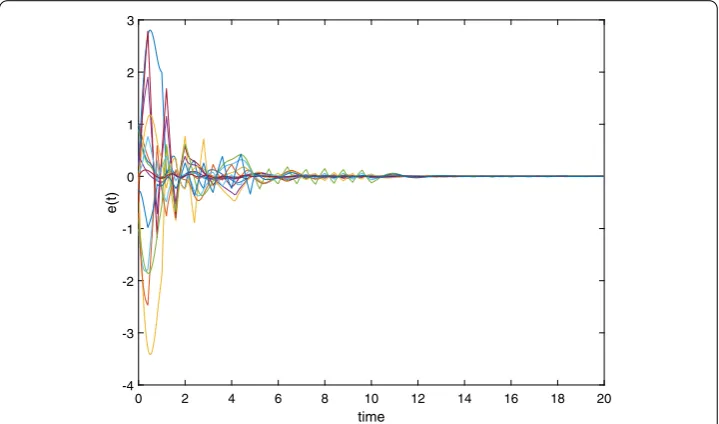
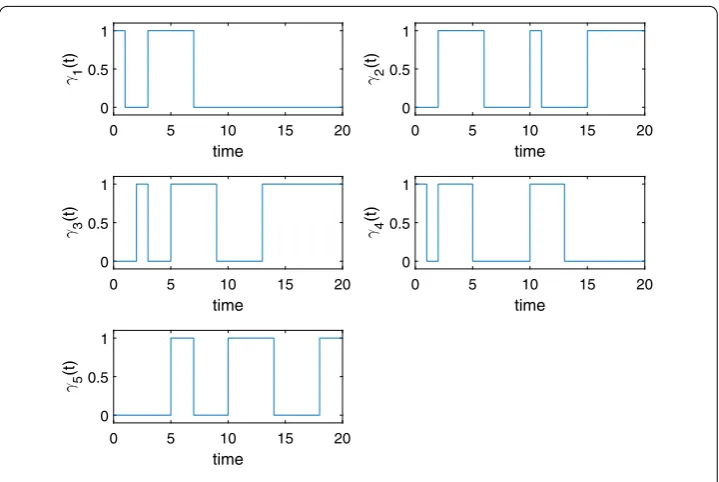
Then the controlled error signals can be obtained in Fig.1which shows the error dy-namics asymptotically converse to zero; in other words, the synchronization is achieved betweens(t) andxi(t) fori= 1, . . . ,N. Figures2and3show the applied control signalsui(t)
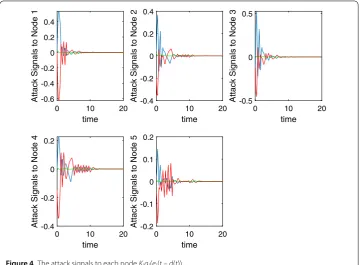
and cyber-attack scenario γi(t), respectively. Figure4 displays the attack signals
trans-mitted to the CDNs instead of the real control signals when cyber-attacks are launched to the controller ofith node, i.e.,γi(t) = 1. The difference between the real control
sig-nals(without cyber-attack)uF
i(t) and the control signals under attackui(t) is depicted in
Fig.5. As seen in Figs.1and5, the controller attacks make big changes from real control
Figure 2The applied control signals for each node under cyber-attacksui(t)
Figure 3The random cyber-attack scenario for each nodeγi(t)
Figure 4The attack signals to each nodeKigi(ei(t–d(t))
Figure 5The difference between control signals with/without cyber-attacks,ui(t) –uF i(t)
5 Conclusions
control information. Using discontinuous Lyapunov functionals and a zero inequality, the designing conditions of the sampled-data controller were derived in terms of LMI. The validity of the proposed method was proven by a numerical example.
Acknowledgements
The authors would like to thank the anonymous reviewers and the editor for their valuable comments and suggestions that helped improve the manuscript.
Funding
This work was supported by the National Research Foundation of Korea (NRF) grant funded by the Korea government (MSIT) (Grant number NRF-2018R1C1B5036886) and also supported by research funds for newly appointed professors of Chonbuk National University in 2017.
Competing interests
The authors declare that they have no competing interests.
Authors’ contributions
All authors contributed equally to the writing of this paper. All authors read and approved the final manuscript.
Author details
1Division of Electronic Engineering, Chonbuk National University, Jeonju, Republic of Korea.2Nonlinear Dynamics Group, Department of Electrical Engineering, Yeungnam University, Gyeongsan, Republic of Korea.
Publisher’s Note
Springer Nature remains neutral with regard to jurisdictional claims in published maps and institutional affiliations.
Received: 4 December 2018 Accepted: 1 May 2019
References
1. Strogatz, S.H.: Exploring complex networks. Nature410, 268–276 (2001)
2. Dorogovtsev, S.N., Mendes, J.F.F.: Evolution of networks. Adv. Phys.51, 1079–1187 (2002) 3. Newman, M.E.J.: The structure and function of complex networks. SIAM Rev.45, 167–256 (2003)
4. Zhang, H., Cao, J., Xiong, L.: Novel synchronization conditions for time-varying delayed Lur’e system with parametric uncertainty. Appl. Math. Comput.350, 224–236 (2019)
5. Wang, X., Gao, K., Chen, G., Xu, Y.: Finite-time synchronization control relationship analysis for two classes of Markovian jump complex networks under feedback control. Adv. Differ. Equ.2018, 382 (2018)
6. Angulo-Guzman, S., Posadas-Castillo, C., Platas-Garza, M.A., Diaz-Romero, D.A., Lopez-Mancilla, D.: Chaotic synchronization of regular and irregular complex networks with fractional order oscillators. Int. J. Control. Autom. Syst.14, 1114–1123 (2016)
7. Kazemy, A., Cao, J.: Consecutive synchronization of a delayed complex dynamical network via distributed adaptive control approach. Int. J. Control. Autom. Syst. (2018).https://doi.org/10.1007/s12555-017-0718-6
8. Wang, D., Che, W.-W., Yu, H., Li, J.-Y.: Adaptive pinning synchronization of complex networks with negative weights and its application in traffic road network. Int. J. Control. Autom. Syst.16, 782–790 (2018)
9. Ma, N., Liu, Z., Chen, L.: Sliding-modeH∞synchronization for complex dynamical network systems with Markovian
jump parameters and time-varying delays. Adv. Differ. Equ.2019, 48 (2019)
10. Ali, M.S., Yogambigai, J., Cao, J.: Synchronization of master-slave Markovian switching complex dynamical networks with time-varying delays in nonlinear function via sliding mode control. Acta Math. Sci.37, 368–384 (2017) 11. Lee, T.H., Park, J.H., Ji, D.H., Kwon, O.M., Lee, S.M.: Guaranteed cost synchronization of a complex dynamical network
via dynamic feedback control. Appl. Math. Comput.218, 6469–6481 (2012)
12. Lee, T.H., Ji, D.H., Park, J.H., Jung, H.Y.: Decentralized guaranteed cost dynamic control for synchronization of a complex dynamical network with randomly switching topology. Appl. Math. Comput.219, 996–1010 (2012) 13. Sivaranjani, K., Rakkiyappan, R., Cao, J., Alsaedi, A.: Synchronization of nonlinear singularly perturbed complex networks with uncertain inner coupling via event triggered control. Appl. Math. Comput.311, 283–299 (2017) 14. Dai, A., Zhou, W., Feng, J., Fang, J., Xu, S.: Exponential synchronization of the coupling delayed switching complex
dynamical networks via impulsive control. Adv. Differ. Equ.2013, 195 (2013)
15. Lu, J., Ho, D.W.C., Cao, J., Kurths, J.: Single impulsive controller for globally exponential synchronization of dynamical networks. Nonlinear Anal., Real World Appl.14, 581–593 (2013)
16. Lee, T.H., Park, J.H., Wu, Z.G., Lee, S.C., Lee, D.H.: RobustH∞decentralized dynamic control for synchronization of a complex dynamical network with randomly occurring uncertainties. Nonlinear Dyn.70, 559–570 (2012)
17. Pan, L., Tang, X., Pan, Y.: Generalized and exponential synchronization for a class of novel complex dynamic networks with hybrid time-varying delay via IPAPC. Int. J. Control. Autom. Syst. (2018).
https://doi.org/10.1007/s12555-017-0771-1
18. Shi, L., Chen, G., Zhong, S.: Outer synchronization of a class of mixed delayed complex networks based on pinning control. Adv. Differ. Equ.2018, 330 (2018)
19. Li, B., Wang, N., Ruan, X., Pan, Q.: Pinning and adaptive synchronization of fractional-order complex dynamical networks with and without time-varying delay. Adv. Differ. Equ.2018, 6 (2018)
21. Liu, R., Wu, J., Wang, D.: Sampled-data fuzzy control of two-wheel inverted pendulums based on passivity theory. Int. J. Control. Autom. Syst. (2018).https://doi.org/10.1007/s12555-018-0063-4
22. Chen, W., Chen, D., Hu, J., Liang, J., Dobaie, A.M.: A sampled-data approach to robustH∞state estimation for genetic
regulatory networks with random delays. Int. J. Control. Autom. Syst.16, 491–504 (2018)
23. Nguyen-Van, T.: An observer based sampled-data control for class of scalar nonlinear systems using continualized discretization method. Int. J. Control. Autom. Syst.16, 709–716 (2018)
24. Lee, T.H., Wu, Z.-G., Park, J.H.: Synchronization of a complex dynamical network with coupling time-varying delays via sampled-data control. Appl. Math. Comput.219, 1354–1366 (2012)
25. Park, J.H., Lee, T.H.: Synchronization of complex dynamical networks with discontinuous coupling signals. Nonlinear Dyn.79, 1353–1362 (2015)
26. Mikheev, Y., Sobolev, V., Fridman, E.: Asymptotic analysis of digital control systems. Autom. Remote Control49, 1175–1180 (1988)
27. Astrom, K., Wittenmark, B.: Adaptive Control. Addison-Wesley, Reading (1989)
28. Liu, K., Fridman, E.: Wirtinger’s inequality and Lyapunov-based sampled-data stabilization. Automatica48, 102–108 (2012)
29. Seuret, A., Briat, C.: Stability analysis of uncertain sampled-data systems with incremental delay using looped-functionals. Automatica55, 274–278 (2015)
30. Lee, T.H., Park, J.H.: Stability analysis of sampled-data systems via free-matrix-based time-dependent discontinuous Lyapunov approach. IEEE Trans. Autom. Control62, 3653–3657 (2017)
31. Lee, T.H., Park, J.H.: Improved criteria for sampled-data synchronization of chaotic Lur’e systems using two new approaches. Nonlinear Anal. Hybrid Syst.24, 132–145 (2017)
32. Lee, T.H., Park, J.H.: New methods of fuzzy sampled-data control for stabilization of chaotic systems. IEEE Trans. Syst. Man Cybern. Syst. (2018).https://doi.org/10.1109/TSMC.2017.2690803
33. Zhang, H., Cheng, P., Shi, L., Chen, J.: Optimal denial-of-service attack scheduling with energy constraint. IEEE Trans. Autom. Control60, 3023–30288 (2015)
34. Wang, Z., Wang, D., Shen, B., Alsaadi, F.E.: Centralized security-guaranteed filtering in multirate-sensor fusion under deception attacks. J. Franklin Inst.355, 406–420 (2018)
35. Teixeira, A., Shames, I., Sandberg, H., Johansson, K.H.: A secure control framework for resource-limited adversaries. Automatica51, 135–148 (2015)
36. Sandberg, H., Amin, S., Johansson, K.H.: Cyberphysical security in networked control systems: an introduction to the issue. IEEE Control Syst. Mag.35, 20–23 (2015)
37. Zhu, M., Martinez, S.: Stackelberg game analysis of correlated attacks in cyber-physical system. In: Paper Presented at the American Control Conference, 29 June–1 July San Francisco, pp. 4063–4068 (2011)
38. Yuan, Y., Zhang, P., Guo, L., Yang, H.J.: Towards quantifying the impact of randomly occurred attacks on a class of networked control systems. J. Franklin Inst.354, 4966–4988 (2017)
39. Ding, D., Han, Q.-L., Xiang, Y., Ge, X., Zhang, X.: A survey on security control and attack detection for industrial cyber-physical systems. Neurocomputing275, 1674–1683 (2018)
40. Sun, Y.-C., Yang, G.-H.: Periodic event-triggered resilient control for cyber-physical systems under Denial-of-Service attacks. J. Franklin Inst. (2018).https://doi.org/10.1016/j.jfranklin.2018.06.009
41. Liu, J., Gu, Y., Cao, J., Fei, S.: Distributed event-triggeredH∞filtering over sensor networks with sensor saturations and cyber-attacks. ISA Trans. (2018).https://doi.org/10.1016/j.isatra.2018.07.018
42. Zhang, W., Wang, Z., Liu, Y., Ding, D., Alsaadi, F.E.: Sampled-data consensus of nonlinear multiagent systems subject to cyber attacks. Int. J. Robust Nonlinear Control28, 53–67 (2018)
43. Xu, W., Ho, D.W.C., Zhong, J., Chen, B.: Event/self-triggered control for leader-following consensus over unreliable network with DoS attacks. IEEE Trans. Neural Netw. Learn. Syst.https://doi.org/10.1109/TNNLS.2018.2890119 44. Seuret, A., Gouaisbaut, F.: Wirtinger-based integral inequality: application to time-delay systems. Automatica49,
2860–2866 (2013)
45. Park, P.G., Ko, J.W., Jeong, C.: Reciprocally convex approach to stability of systems with time-varying delays. Automatica47, 235–238 (2011)