R E S E A R C H
Open Access
Dynamical analysis of an SIRS network model
with direct immunization and infective vector
Rongzhong Yu
1*, Kezan Li
2, Baidi Chen
1and Dingqin Shi
1*Correspondence: [email protected] 1College of Sciences, Jiujiang University, Qianjin East Road, Jiujiang, 332005, China Full list of author information is available at the end of the article
Abstract
With the awareness of risk in infective disease spreading, healthy individuals (the susceptible ones) will take some measures to acquire temporary immunity. This paper addresses an SIRS model with direct immunization and an infective vector in complex networks and performs the dynamical analysis for this model. By theoretical analysis, we obtain the epidemic threshold
λ
cand prove that if infection rateλ
<λ
c, the disease-free equilibrium is globally asymptotically stable; ifλ
>λ
c, there exists a unique endemic equilibrium, and it is globally attractive. These theoretical results are confirmed by numerical simulations.Keywords: epidemic threshold; dynamical analysis; epidemic equilibrium; SIRS model; global attraction
1 Introduction
In recent years, many epidemic models on complex networks, such as SIS (susceptible-infected-susceptible) [–] and SIR (susceptible-infected-removed) [–] and so on, have been widely studied by researchers from different subjects. Classical studies have revealed that there is an epidemic thresholdλcfor an epidemic model on homogeneous networks, below which the disease will die out; otherwise there will exist a persistence. However, Pastor-Satorras and Vespignani further showed a striking result that the epidemic thresh-oldλcwill vanish for a heterogenous network with sufficiently large sizes [, , ].
In fact, apart from the human behavior [, ] and the external environment [], the infection vector (e.g., mosquitoes) may also play an important role in epidemic transmis-sion [, , ]. The infective vector generally acts as a carrier of an infective disease and can transmit it to a human. By considering the disease spreading on a human network caused by an infection vector, Cooke and Busenberg [, ] have addressed some epi-demic compartment models. As we known, some diseases spread not only by contacts between people and infected vectors but also by blood contacts within human. By noting this fact, Shiet al.[] proposed a new SIS model with an infective medium on complex networks, which models the spread of a class of infectious diseases. Then a modified SIS model is proposed in [] by assuming that the human contacts can be considered as a scale-free network, but the infective media may contact a person without any selectivity. The epidemic threshold and the stability of endemic equilibrium are investigated theoret-ically. A more general modified SIS model with an infective medium on complex networks was introduced in [], and the authors investigated the global attraction of endemic equi-librium by the basic reproduction numberR. However, the direct relation between the
epidemic thresholdλcin [] and the basic reproduction numberRin [] has not been revealed.
In the real world, with the awareness of an infectious disease spreading, some healthy in-dividuals will usually take some protective measures (e.g., vaccine inoculation) to acquire temporary immunity. By investigating an SIRS epidemic model [] with direct immuniza-tion on complex networks, the result shows that the direct immunizaimmuniza-tion can increase the epidemic threshold and reduce the prevalence of infectious disease.
In this paper, we propose a new SIRS model with direct immunization and an infective vector on complex networks. We get the epidemic thresholdλc, below which the disease-free equilibrium is globally stable; otherwise, the disease-disease-free equilibrium is unstable and a unique endemic equilibrium exists, and it is also globally attractive. More importantly, according to our method, one can directly determine the relation between the epidemic threshold and the basic reproduction number.
The rest of the paper is organized as follows. In Section , we propose a new SIRS model with direct immunization and an infective vector on complex networks. Section analyzes the dynamics of the model and shows some theoretical results. Some numerical simula-tions are performed to confirm our theoretical predicsimula-tions in Section .
2 The model
Based on the real mechanism of some relevant epidemic networks, our model will be con-structed with the following context:
• Two infection mechanisms: the disease spreads not only by contacts between individuals, but also by contacts between individuals and infective vectors.
• Two removed ways: (i) with awareness of risk infective disease spreading, some health individuals may make some protective measures (vaccination) to acquire temporary immunity; (ii) an infected individual becoming a removed individual after cure may acquire temporary immunity.
In addition, we further suppose that the individuals’ contacts can be treated as hetero-geneous, but the contacts between individuals and vectors can be considered as homo-geneous. This assumption results from the selective contacts in a human network and non-selective contacts between people and vectors [, ].
LetSk(t),Ik(t) andRk(t) be the densities of susceptible, infected and removed nodes with degreekat timetrespectively, and letV(t) be the density of the infective medium at timet. Letρ(t) =p(k)Ik(t) denote the density of infected individuals on the network, andrepresents the probability that a randomly chosen link emanating from a node of degreekleads to infected nodes. In this paper, we consider the situation of uncorrelated networks, thencan be written as=
k
kkp(k)Ik(t) [, ], wherep(k) denotes the degree distribution of the network,k=kp(k) is its average degree.
We assume that the susceptible nodes become the removed nodes with rateαfor ac-quiring temporary immunity. At the same time, each susceptible (health) node is infected with ratesλandγif it is contacted to infected nodes and infective vectors, respectively. Infected nodes are cured with rateβ and removed nodes again become susceptible with rateδfor immunization-lost. Health vectors are infected with rateγif they are contacted to infected individuals and infected vectors recover with rateξ.
the proposed SIRS propagation model can be described by the following differential
equa-Without loss of generality, assume that the infective vector has unit recovery,i.e.,ξ= . In addition, the variablesSk(t),Ik(t),Rk(t) satisfy the normalization conditionSk(t) +Ik(t) +
3 Epidemic threshold and global analysis
3.1 Epidemic threshold
Theorem Letλc=δγγ[β(α(+kδ)––δγkγ)+]βδβ(α(+δδ+)αk)k andβ–αδ+δγγ> ,ifλ>λc,then one and
only one endemic equilibrium solution of system()exists,i.e.,the epidemic propagation may outbreak on complex networks.
Proof By letting the right-hand side of system () be zero, we have
βIk(t) =
Substituting () into (), one obtains
βIk(t) =
Then substituting () into (), we have
Then one has a self-consistency equation as follows: condition under which the epidemic propagation outbreaks. Since∈[, ],F() = and F()∈[, ), then Eq. () must have a non-trivial solution ifddF|=> .
By computing the following expression
dF
we have the epidemic thresholdλctaking the following expression in the case whereβ– δ
Inequality () holds if and only ifλ>λc. Furthermore, we will ascertain the uniqueness of endemic equilibrium in a similar way as paper []. Assume thatI= (I,I, . . . ,In,V) and
Moreover, assume thatη> without loss of generality. We will complete the proof in two cases as follows.
while we have the following inequalities according to the definition ofη:
η·λk
Case : Ifη=VV∗, according to (), then we have
V= ( –V)γρ(I), ()
V∗= –V∗γρ
I∗, ()
whereρ(I) =p(k)Ik andρ(I∗) =p(k)Ik∗. From (), () and the definition ofη, one obtains
( –V)γρ(I) =
–V∗γρ
I∗·η> ( –V)γ
p(k)Ik∗·η> ( –V)γρ(I). ()
A contradiction appears. In conclusion, whenλ>λc, one and only one endemic equilib-rium solution exists for system ().
Lettingτ=δ+δα, the epidemic thresholdλccan be rewritten as
λc=
[β–τ γγ]βk τγ
γ(k–k) +τβk
. ()
Note that the assumption thatβ–τ γγ> , which is a default condition below, ensures that the thresholdλcis larger than zero for a finite size network. One can see that the crit-ical threshold vanishes for a scale-free network with sufficiently large sizes, which agrees with the previous papers [, , ].
The reader should find that the model parameters are general in this model. Ifγ or γvanishes, the proposed model may become an SIRS model with direct immunization via one infection mechanism (contacts between individuals), and the epidemicλc=τβkk which agrees with the one of paper []. In addition, the proposed model may become one SIRS model with an infection vector via two infection mechanisms whenα= . And the epidemic thresholdλc=γγ([βk–γ–γk]β)+kβ k, especially,λc=γγ([–kγ–γk]k)+kifβ= , which is in accordance with the one of paper [].
3.2 Global stability of disease-free equilibrium
Theorem For system(),letλcbe the epidemic threshold defined as().Ifλ<λc,then the
disease-free equilibrium is globally asymptotically stable.Otherwise,there exists a unique endemic equilibrium.
Proof For convenience, system () can be rewritten as follows: ⎧
⎪ ⎪ ⎨ ⎪ ⎪ ⎩
dSk(t)
dt = –[λk+γV(t) +δ+α]Sk(t) –δIk(t) +δ, dIk(t)
dt = [λk+γV(t)]Sk(t) –βIk(t), dV(t)
dt = –V(t) +γ( –V(t))ρ(t).
()
The disease-free equilibrium of Eq. () isSk=δ+δα=τ,Ik= ,V= ,k= , , . . . ,n. More-over, the Jacobian matrix at disease-free equilibrium can be represented as
J=
D F
M
whereD= –(δ+α)En, andEnis annth identity matrix,FandMaren×(n+ ) and (n+ )×(n+ ) matrices taking the following forms, respectively:
F=
It is obvious that all of eigenvalues ofJhave negative part if and only if all of eigenvalues ofMhave negative part. DenoteA=M–μ·Eandν=μ+β, whereEis an (n+ )-order unit matrix, andμis eigenvalue, then
detA=
It follows that all of eigenvalues ofMhave negative real part if and only if all of roots of the characteristic polynomialdetA= have real part of at mostβ. By some elementary trans-formations, one obtains that the issue above holds if and only all of roots of the following cubic polynomial have real part of at mostβ:
g(ν) =ν–aν–aν+a= , ()
It is easy to obtain that
sincek kfor a sufficiently large network. We will investigate the roots to the cubic equation () below:
g(β) =β–βτ λk
k –γγτβ+γγτ
λk–k k
> , ifλ<λc, < , ifλ>λc.
()
Ifλ<λc, thenλτk
k <βsinceλc<τβkk. It implies that the cubic equation () has three rootsν,νandνsatisfying
–∞<ν< <ν<λτ
k
k <ν<β.
Ifλ>λc, then the cubic equation () has three roots satisfying
–∞<ν< <ν<β<ν< +∞.
In a word, there exists a unique positive eigenvalue ofJif and only ifλ>λc, below which the unique epidemic equilibrium exists. Otherwise all real-valued eigenvalues ofJare neg-ative, this implies that the disease-free equilibrium is globally stable according to Lemma
in paper [].
In paper [], the authors follow the concepts of next-generation matrix (NGM) to give a threshold - the basic reproduction numberR, by which the global stability of a modi-fied SIS model is studied. The NGM is a matrix that relates the numbers of newly infected individuals in various categories in consecutive generation, and the basic reproduction number Ris the spectral radius of the NGM (refer to the papers [, ] for details). However, the direct relationship between the epidemic threshold and the basic reproduc-tion number is not clearly revealed. In fact, we can reveal thatλ=λcif and only ifR= by the same way as above.
3.3 Global attraction of endemic equilibrium
In this part, we show a proposition and prove the global attraction of the endemic equi-librium by the same way as the one in [, ]. Inequalities () and () in Proposition are helpful to prove the main result (Theorem ).
Proposition Suppose that α ≥ β and the solution Ik(t) of system () satisfies
lim supt→∞Ik(t)≤Uk,lim inft→∞Ik(t)≥Lk,then
lim sup
t→∞ V(t)≤
γUk +γUk
, lim inf
t→∞ V(t)≥
γLk +γLk
and
lim sup
t→∞
–Rk(t)
≤(α–β)Uk+δ
α+δ , lim inft→∞
–Rk(t)
≥(α–β)Lk+δ α+δ .
Proof Without loss of generality, we only verify the upper limit inequalities. From
Uk+fort>τ. It follows that
fort>τ. Therefore, the following inequality holds since> is arbitrarily small:
lim sup
t→∞ V(t)≤
γUk +γUk
. ()
At the same time, it follows from the second equation of system () andα≥βthat
d( –Rk(t)) exists large enoughτ such that the following inequalities hold fort>τ:
= – β+λ k
Since> is arbitrary small, we get
lim sup
Similarly, we can prove inequality ().
After some transformations, we can find that both{Lk}and{Uk}satisfy Eq. (). Thus one obtains thatUk=Lk=Ik∗ andlimt→∞Ik(t) =Ik∗according to the uniqueness of endemic equilibrium of system (). The proof of Theorem is completed.
4 Simulations
In the section above, some theoretical results for the proposed mean-field equations are revealed. For a finite size network, there exists an epidemic thresholdλc, if the infection rateλ<λc, then the disease-free equilibrium is globally asymptotically stable. Otherwise, the disease-free equilibrium is unstable and a unique globally attracting endemic equilib-rium exists.
In this section, we will perform some numerical simulations to confirm the theoretical results over BA (Barabási-Albert) scale-free networks which are generated by the pref-erential attachment algorithm []. All the networks used in the simulations were built usingN= nodes.
The epidemics are seeded with randomly chosen fraction of nodes to avoid stochastic extinction. The probability of a susceptible node withn(≤degreek) infectious neighbors being infected in small interval of timehis – ( –λh)n( –γhV(t)) at stept+ . The term ( –λh)nrepresents the probability that a susceptible node cannot be infected by his (her) infectious neighbors, and the term –γhV(t) represents the probability that a susceptible node cannot be infected by infectious vectors. In this paper, we give the numerical simulations from different angles:
• The epidemic thresholdλcthat changes as functions of different model parameters.
• The final density of the infected nodes that changes as functions of different model parameters.
In stochastic simulations, the dynamics are totally evolved for , time steps, we set the time intervalh= . and letρ=T t–+T
t=t ρ(t) (here,T= ,t= ,) be the time average to reduce the fluctuation ofρ(t). At the same time, to minimize random fluctua-tion caused by the initial condifluctua-tions, we make average ofρover realizations of differ-ent initial infectious nodes. Letλincrease systematically byλbeginning withλ= , if ρ> . asλ=λ∗andρ< . asλ<λ∗, we setλc=λ∗–λ.
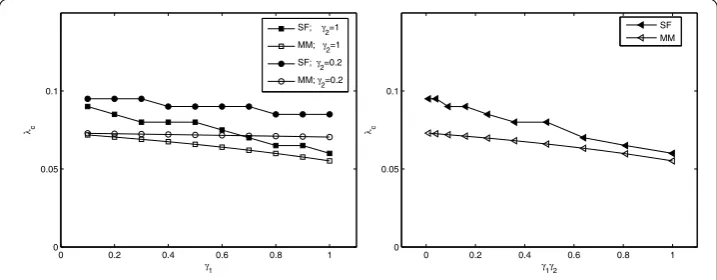
In Figure , we illustrate the variation of the epidemic thresholdλcwith respect to the parametersγ andγ both for stochastic simulations (SS) and also for mean-field (MF)
Figure 1 Illustration of the variation of the epidemic threshold with respect to the parametersγ1
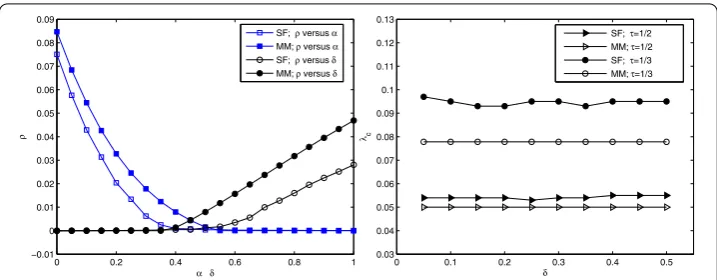
Figure 2 Illustration of the variations of the final infected density and the epidemic threshold with respect to the parametersαandδ.Left: Plot ofρversusαandδ. When consideringρversusα, we set
δ= 0.5; when consideringρversusδ, we setα= 0.4. Right: The variation of the infection thresholdλcwith respect toδover BA scale-free network for differentτ=αδ+δ. Other parameters are chosen asγ1=γ2= 0.6, β= 0.8 andk= 10.
predictions formula (). It is clear that the epidemic thresholdλcdecreases asγ(orγ) in-creases. We thus conclude that reducing the contacts between individuals and vectors can effectively control the spread of the disease over networks. From this angle, the stochastic simulations agree well with the mean-field predictions. The discrepancy between these is also shown in our simulations, we can see the stochastic simulations are slightly larger than the theoretical predictions for thresholdλc, which is likely to be due to a distribu-tion cutoff effect on a finite size network [] and other neglected factors (for instance, network is static and has degree-correlations). Moreover, one can find that for larger in-fection ratesγandγ, the error between stochastic simulation and theoretical predictions is smaller, which is likely to be attributed to the contacts homogeneity between individuals and vectors.
Figure illustrates the variations of the final infected densityρ(left) and the epidemic thresholdλc (right) with respect to parametersαandδ, respectively. It is clear that the discrepancy remains for the effect of a finite size network. The theoretical prediction of formula () shows that for different parametersαandδ, the epidemic thresholdλcis un-changed as long asτ = δ
α+δ is unchanged. From Figure we can see that the stochastic simulations are in accordance with mean-field predictions disregarding the slight fluctu-ations for the effect of the stochastic factor. Also, one can see that the larger direct im-munization rateα, the larger the epidemic threshold is from Figure (right). Namely, the direct immunization can increase the critical threshold of epidemic spreading on complex networks and reduce the prevalence of infectious disease, which agrees with the results of paper []. Consequently, we can prevent the disease spreading by improving immuniza-tion strength.
Figure 3 The variation of the stable densities of infected nodes with respect to infection rateλfor BA scale-free network, whereα= 0.83,β= 0.7,δ= 0.71,γ1= 0.45,γ2= 0.54.
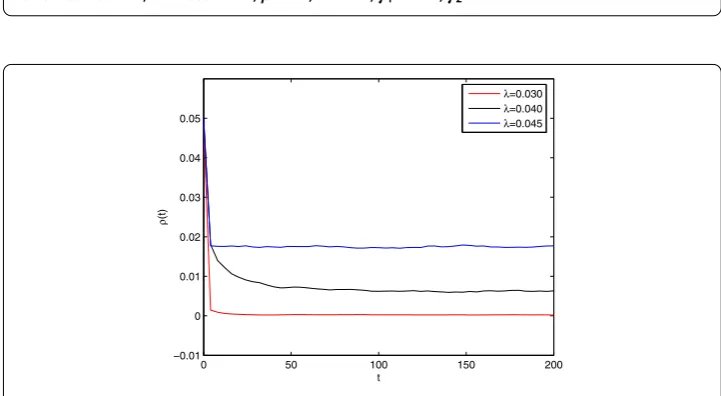
Figure 4 The total densities of infected nodes that change as time series on BA scale-free network withk= 20, whereα= 0.83,β= 0.8,δ= 0.7,γ1= 0.60,γ2= 0.60.
predictions, we think the stochastic simulations are reasonably consistent with the theo-retic results.
5 Conclusions
In order to better explain the mechanism of spreading of epidemics, we have investigated a novel SIRS model with direct immunization via two infection mechanisms in this pa-per. The model is approximately described by the mean-field method neglecting contact duration.
From simulations as above, we can find that the discrepancies between stochastic sim-ulations and theoretical predictions remain for the effect of a finite size network [] and stochastic factors. Disregarding these slight errors, we think that the numerical simulations confirm to the theoretical results, and the mean-field approach is of effec-tiveness. Especially, one can see that the larger transmission rates from infected vec-tors to susceptible individuals γ or from infected individuals to susceptible vectorsγ, the better the simulations accord with the mean-field predictions. Just as mentioned above, this may attribute to the homogeneity of contacts between individuals and vec-tors.
Competing interests
The authors declare that they have no competing interests.
Authors’ contributions
All authors contributed equally to the writing of this paper. All authors read and approved the final manuscript.
Author details
1College of Sciences, Jiujiang University, Qianjin East Road, Jiujiang, 332005, China.2School of Mathematics and Computing Science, Guilin University of Electronic Technology, Guilin, 541004, China.
Acknowledgements
This research was jointly supported by NSFC Grant 11401274 and the Natural Science Foundation of Jiangxi Province (Grants 20142BDH80027 and 20132BAB201012). RZ Yu was also supported by the Foundations of Jiangxi Education Bureau (Grants GJJ12617 and GJJ13714).
Received: 10 October 2014 Accepted: 3 March 2015 References
1. Pastor-Satorras, R, Vespignani, A: Epidemic spreading in scale-free networks. Phys. Rev. Lett.86, 3200-3203 (2001) 2. Pastor-Satorras, R, Vespignani, A: Epidemic dynamics and endemic states in complex networks. Phys. Rev. E63,
066117 (2001)
3. Yang, M, Chen, GR, Fu, XC: A modified SIS model with an infective medium on complex networks and its global stability. Physica A390, 2408-2413 (2011)
4. Pastor-Satorras, R, Vespignani, A: Epidemic dynamics in finite size scale-free networks. Phys. Rev. E65, 035108 (2002) 5. d’Onofrio, A: A note on the global behavior of the network-based SIS epidemic model. Nonlinear Anal., Real World
Appl.9, 1567-1572 (2008)
6. Fu, X, Small, M, Walker, DM, Zhang, H: Epidemic dynamics on scale-free networks with piecewise linear infectivity and immunizations. Phys. Rev. E77, 036113 (2008)
7. Xia, C, Wang, Z, Sanz, J, Meloni, S, Morenoc, Y: Effects of delayed recovery and nonuniform transmission on the spreading of diseases in complex networks. Physica A392, 1577-1585 (2013)
8. Wang, L, Dai, GZ: Global stability of virus spreading in complex heterogeneous networks. SIAM J. Appl. Math.68, 1495-1502 (2008)
9. Yang, R, Wang, BH, Ren, J, Bai, WJ, Shi, ZW, Xu, W, Zhou, T: Epidemic spreading on heterogeneous networks with identical infectivity. Phys. Lett. A364, 189-193 (2007)
10. Li, K, Small, M, Zhang, H, Fu, X: Epidemic outbreaks on networks with effective contacts. Nonlinear Anal., Real World Appl.11, 1017-1025 (2010)
11. Ball, F, Neal, P: Network epidemic models with two types of mixing. Math. Biosci.212, 69-87 (2008) 12. Volz, E: SIR dynamics in random networks with heterogeneous connectivity. J. Math. Biol.56, 293-310 (2008) 13. Kiss, IZ, Green, DM, Kao, RR: The effect of contact heterogeneity and multiple routes of transmission on final epidemic
size. Math. Biosci.203, 124-136 (2006)
14. Lou, J, Ruggeri, T: The dynamics of spreading and immune strategies of sexually transmitted diseases on scale-free network. J. Math. Anal. Appl.365, 210-219 (2010)
15. Miller, JC: A note on a paper by Erik Volz: SIR dynamics in random networks. J. Math. Biol.62, 349-358 (2011) 16. Xia, C, Wang, L, Sun, S, Wang, J: An SIR model with infection delay and propagation vector in complex networks.
Nonlinear Dyn.69, 927-934 (2012)
17. Valdez, LD, Macri, PA, Braunstein, LA: Intermittent social distancing strategy for epidemic control. Phys. Rev. E85, 036108 (2012)
18. Wu, Q, Fu, X, Small, M, Xu, X-J: The impact of awareness on epidemic spreading in networks. Chaos22, 013101 (2012) 19. Molesworth, AM, Cuevas, LE, Connor, SJ, Morse, AP, Thomson, MC: Environmental risk and meningitis epidemics in
Africa. Emerg. Infect. Dis.9(10), 1287-1293 (2003)
20. Wang, Y, Jin, Z, Yang, Z, Zhang, Z-K, Zhou, T, Sun, G-Q: Global analysis of an SIS model with an infective vector on complex networks. Nonlinear Anal., Real World Appl.13, 543-557 (2012)
21. Shi, HJ, Duan, ZS, Chen, GR: An SIS model with infective medium on complex networks. Physica A387, 2133-2144 (2008)
23. Busenberg, S, Cooke, KL: Periodic solutions of a periodic nonlinear delay differential equation. SIAM J. Appl. Math.35, 704-721 (1978)
24. Xia, C, Liu, Z, Chen, Z, Yuan, Z: SIRS epidemic model with direct immunization on complex networks. Control Decis. 23, 468-472 (2008) (in Chinese)
25. Diekmann, O, Heesterbeek, JAP, Roberts, MG: The construction of next-generation matrices for compartmental epidemic models. J. R. Soc. Interface7(47), 873-885 (2010)
26. Diekmann, O, Heesterbeek, JAP, Roberts, MG: On the definition and the computation of the basic reproduction ratio
R0in models for infectious diseases in heterogeneous populations. J. Math. Biol.28, 365-382 (1990) 27. Barabási, AL, Albert, R: Emergence of scaling in random networks. Science286, 509-512 (1999)