©
DOI: 10.1534/genetics.104.033993
Combining Data From Multiple Inbred Line Crosses Improves the Power and
Resolution of Quantitative Trait Loci Mapping
Renhua Li, Malcolm A. Lyons,
1Henning Wittenburg,
2Beverly Paigen and Gary A. Churchill
3The Jackson Laboratory, Bar Harbor, Maine 04609 Manuscript received July 26, 2004 Accepted for publication November 17, 2004
ABSTRACT
Rodent inbred line crosses are widely used to map genetic loci associated with complex traits. This approach has proven to be powerful for detecting quantitative trait loci (QTL); however, the resolution of QTL locations, typicallyⵑ20 cM, means that hundreds of genes are implicated as potential candidates. We describe analytical methods based on linear models to combine information available in two or more inbred line crosses. Our strategy is motivated by the hypothesis that common inbred strains of the laboratory mouse are derived from a limited ancestral gene pool and thus QTL detected in multiple crosses are likely to represent shared ancestral polymorphisms. We demonstrate that the combined-cross analysis can improve the power to detect weak QTL, can narrow support intervals for QTL regions, and can be used to separate multiple QTL that colocalize by chance. Moreover, combined-cross analysis can establish the allelic states of a QTL among a set of parental lines, thus providing critical information for narrowing QTL regions by haplotype analysis.
Q
UANTITATIVE trait locus (QTL) analysis is a phe- identify the gene (Glazier et al. 2002; Abiola et al.2003). This seemingly straightforward strategy has notype-driven, experimental approach to identify
genomic regions that harbor polymorphisms affecting proven to be challenging in many cases (Nadeauand Frankel2000), although more optimistic views on the the distribution of a measurable trait in a mapping
pop-ulation. Knowledge of the number, location, and effects situation have also been expressed (Korstanje and Paigen2002).
of the genetic loci underlying variability in a trait can
aid our understanding of the biochemical basis of the Many common diseases in humans including osteopo-rosis, atheroscleosteopo-rosis, diabetes, and hypertension are trait. Despite the power of QTL analysis, the mapping
approach has some limitations. Detection of a QTL with known to be complex—determined by the interaction of multiple genetic and environmental factors. Rodent desirable power and accuracy in an inbred line cross
depends on the genetic diversity between the parental inbred lines can model human disease traits and inbred line crosses provide a powerful approach to mapping strains, heritability of the trait, the size of the cross, and
the density of genetic markers (Kao andZeng1997). the genetic loci associated with these diseases (Paigen 1995). In many instances, disease-related traits have In a single intercross or backcross, it may be difficult
been studied in multiple mouse crosses. We propose a to distinguish multiple tightly linked QTL from a single
strategy to improve the power and resolution of QTL QTL of large effect. Furthermore, the QTL support
mapping by utilizing the combined information in two interval may be large, typically 20–40 cM for mouse
or more inbred line crosses. These crosses may or may crosses. Investigators often encounter difficulty when
not include parental lines in common. In any single they attempt to narrow the QTL region. Adding markers
cross of two strains, we are limited to discovering only is helpful but resolution is fundamentally limited by the
loci that show allelic variation between those strains. By number of recombination events in the cross
popula-looking at multiple crosses, we can sample more allelic tion. The direct approach to narrowing a QTL region
variation, and thus we have an opportunity to detect is to pursue mapped loci as targets for positional cloning
additional loci that can be implicated in a disease model. by isolating the QTL region on a fixed background in
If QTL appearing in multiple crosses represent the same a congenic strain, using additional crosses to fine map,
ancestral polymorphic loci, then by combining crosses and then applying techniques such as BAC rescue to
we can achieve greater sample size and power for de-tecting and localizing these shared QTL.
1Present address:The University of New South Wales, School of Bio- Statistical methods for QTL analyses of mapping pop-technology and Biomolecular Sciences, Sydney, 2052, Australia. ulations derived by crossing two inbred parental strains
2Present address:Department of Medicine II, University of Leipzig,
are well developed (LanderandBotstein1989;Haley 04103 Leipzig, Germany.
andKnott1992;Jansenand Stam1994; Zeng1994;
3Corresponding author:The Jackson Laboratory, 600 Main St., Bar
Harbor, ME 04609. E-mail: [email protected] SenandChurchill2001). Multiple-strain crosses and
the combination of multiple crosses each from two in- ever, it is not possible to knowa priorithe allelic states of QTL and different QTL in the same cross may have bred parental strains have been explored as methods
for QTL detection using multiple-allele models (Zeng different patterns of alleles across the parental strains. The strategy proposed here can exploit the power of a 1994; Liuand Zeng2000). Several reports describing
combined QTL analysis have appeared recently (Wall- biallelic model but does not lose information or restrict the possible allelic states of the QTL.
inget al.2000;Hitzemannet al.2003;Parket al.2003) and we expect this trend to continue. When a cross involves two inbred strains, only two alleles are
segregat-MATERIALS AND METHODS ing at any given locus. However, in outbred crosses or
multiway crosses, it is usual to assume that multiple Combined-cross analysis overview:A combined-cross analy-alleles are segregating at any given locus. The statistical sis involves several steps of data processing and interpretation. Details of each step are provided in the sections that follow. models required represent a straightforward extension
Here we provide an overview to tie the various steps together. of the usual two-allele models. For example, Rebai et
It is important to emphasize that this is not a rigid prescription.
al.(1994) adapted the regression method (Haleyand
Each combined data analysis will present unique challenges
Knott1992) to the case of intercross populations de- and the process of interpretation should be adaptive and inter-rived from a diallele of multiple inbred lines. However, active.
A preliminary step to combining crosses is to carry out an multiple-allele modeling of the background genetic
vari-analysis of each individual cross. This will provide a sense of ance in this setting may become formidably complex
the number and locations of QTL, their mode of inheritance, and can impact the overall power to detect QTL.
Ignor-and direction of effects. If the individual crosses are small, ing background genetic variation may lead to biases in which may be the case if the experiment was designed with estimates of QTL location and effects (Zouet al.2001). the intent to combine the data, they may have low power to detect QTL. A less stringent assessment of the presence of An interesting proposal to map QTL by genetic
back-QTL may be appropriate at this stage. AsharedQTL is one ground interactions in a set of three intercrosses
involv-that occurs in all of the crosses. Thus the locus must be poly-ing three parental strains was put forth byJanninkand
morphic within each pair of parental lines represented in the
Jansen(2001;JansenandStam1994). Multiple-allele set of crosses. Across-specificQTL will occur in only one or in models are general because they can accommodate any a subset of the crosses. If a cross-specific QTL occurs in more than one but not all of the crosses, it can be analyzed as a pattern of inheritance but this generality can result in
shared QTL on the subset of crosses in which it does occur. a loss of power to detect QTL.
The goals of a combined-cross analysis are to identify shared Inbred laboratory mouse strains are known to have
and cross-specific QTL and to improve the localization of originated from a mixed but limited founder population shared QTL.
(Silver1995;Becket al.2000). The genomes of these The next steps are merging the data and running a genome-wide scan analysis on the combined data. It is assumed that strains were predicted to be a mosaic of regions with
the phenotype data are measuring the same trait in all crosses. origins that can be traced back to a few subspecies (
Bon-Some care must be taken to scale data before merging them.
homme1986). The mosaic structure of variation in the
An indicator variable,cross, is created and included along with laboratory mouse genome was recently evidenced by any other covariates that may be relevant to the analysis. The single-nucleotide polymorphism (SNP) analyses indicat- genotype data are merged using a binary encoding that reflects the expected allele types of asharedQTL. This encoding may ing that inbred laboratory mouse strains are largely
de-be based on the parental phenotypes. Now we can carry out rived from two original subspecies (Mus mus domesticus
a combined-cross genome scan usingcrossas an additive covari-andM. m. musculus) with limited contributions fromM.
ate (Comb1) to detectsharedQTL. Then we carry out a
ge-m. castaneus. Indeed, for most of the regions investi- nome scan usingcrossas an interactive covariate (Comb2) to gated, only two different ancestral haplotypes were ob- detectcross-specificQTL. A significant change in the LOD score (⌬LOD1) between these scans indicates that a QTL has cross-served among nine strains (Wadeet al.2002). This
ob-specific effects. servation suggests that we may be able to improve the
The final steps involve a local analysis of each chromosome power and resolution of QTL detection by combining
that was identified in the combined data genome scans. We data from two or more inbred line crosses that involve test for presence of two or more linked QTL by computing multiple strains by assuming a common biallelic mode the change in likelihood between the one QTL and the two QTL scans (⌬LOD2) on each chromosome of interest. High-of inheritance. Even in cases where the locus in question
resolution plots of the single and pairwise scans can indicate is not strictly biallelic, the effects of a shared QTL may
the presence of multiple QTL even when a formal test is not behave as a biallelic locus having only “high” and “low”
significant. The local analysis is intended to clarify the nature alleles. of QTL that have already been declared to be significant in In this article, we report a simple but effective ap- the genome-wide scans. In addition, one should consider the estimated effects of the QTL in the individual and combined proach for improving the power and resolution of QTL
crosses. A set of QTL allele-effect plots at critical locations detection using combined data from two or more inbred
along a chromosome can help to resolve linked and cross-strain crosses. We propose a binary encoding based on
specific QTL.
How-Figure1.—Box plots of the HDL phenotype by cross. Logarithmic, square-root, and untransformed data are shown.
abbreviations used in this article) are PERA/Ei (P), I/LnJ (I), Integration of genetic marker data:Genetic map positions for markers in each of the crosses in this study were retrieved DBA/2 (D), CAST/Ei (C), and 129S1/SvImJ (S). The four
crosses, three of which have been previously described, are from the Mouse Genome Database (http://www.informatics. jax.org). When multiple crosses share the same set of markers,
P⫻I (Wittenburget al. 2003), P⫻D, C⫻D (Lyonset al.
2003a), and C⫻S (Lyonset al.2003b). Mice in each of the integration of the marker genotype data is straightforward. However, data may be merged even if different markers were crosses were assayed under high-fat diet conditions (Khanuja
et al.1995) for plasma high-density lipoprotein (HDL) choles- used, provided that a reliable map order and approximate genetic map positions (in centimorgan units along each chro-terol. The P⫻ I cross includes 305 mice genotyped at 107
markers; P⫻D has 324 mice and 97 markers; C⫻D has 278 mosome) are known. Genetic distances between marker loci may vary somewhat from cross to cross but the precise location mice and 109 markers; C⫻S has 277 mice and 100 markers.
Crosses P⫻I and P⫻D include both sexes but crosses C⫻ of markers on the genetic map has little practical impact on QTL analysis. Correct relative ordering of markers is crucial D and C⫻ S include only males. In each of the crosses, F2
progeny were obtained from F1parents using both directions for combining the genotype data. To merge the data sets in
this study, we computed a set of 128 multiple imputed geno-of crossing,e.g., P⫻I and I⫻P, where the first letter denotes
the strain of the maternal parent of the F1mice used to gener- types on a dense (2-cM) grid of genomic locations, using the
same grid for each cross. We then merged the imputed data ate the F2progeny. Further details are provided in the
refer-ences listed above. sets and carried out QTL analysis using the method of Sen
andChurchill(2001). In principle the same analysis could
Combining the phenotype data: Plasma HDL cholesterol
was measured in milligram per deciliter units as described in be carried out using an EM algorithm (LanderandBotstein
1989; Kao and Zeng 1997), but the simplicity of merging
(Lyons et al. 2003a). Both the mean and the variance of
HDL cholesterol varied significantly across the four intercross imputed data sets is appealing in this application.
Binary encoding of alleles for combined-cross analysis:The populations. Box plots of the raw and transformed data
(Fig-ure 1) indicate that a logarithmic transform overcorrects the power of the genome-wide combined-cross analysis is achieved by recoding of the parental alleles to a binary allelic pattern. variance heterogeneity, whereas square-root transform, an
in-termediate between the logarithmic and untransformed data, The choice of recoding schemes will depend on the particular set of crosses under consideration. In our example the crosses stabilizes the variance in HDL levels. Transformation of data
is often applied to achieve approximate normality of residual form a chain (I⫻P⫻D⫻C⫻S) in which the phenotypes of the parental strains are alternating. Strains P and C have effects. In a combined-cross analysis, crosses with greater
vari-ability in the phenotype will have a greater influence. Thus, high HDL cholesterol and strains I, D, and S have low HDL cholesterol levels. This suggests a binary recoding of alleles it is important to stabilize the variances in this setting. If no
simple transformation is able to achieve this, data could be as shown in Figure 2.
In a combined-cross analysis any two strains that are paired standardized within crosses before combining. In this case,
we used the square-root transform of HDL in all subsequent in an individual cross should have distinct codes (i.e., all crosses are A⫻B) and an indicator for the cross should be retained analyses.
QTL mapping methods (single-cross analysis):We carried in the recoded data. In this way we can ensure that no informa-tion is lost. The original identity of any genotype can always out genome-wide scans for both main-effect and interacting
QTL in individual crosses using the method of Sen and
Churchill(2001). Logarithm of odds ratio (LOD) scores
were computed at 2-cM intervals across the genome and sig-nificance was determined by permutation testing (Churchill
and Doerge 1994). Following the guidelines proposed by
LanderandKruglyak(1995) we interpret the 0.05 and 0.63
levels as significant and suggestive, respectively. (Note that in the original reports of these crosses we used a more stringent definition of suggestive QTL,P⬍0.10, genome-wide adjusted.) Simultaneous-search genome scans for all pairs of markers were carried out to detect epistatic interactions (Sen and
Churchill 2001; Sugiyama et al. 2001). Significant
QTL-by-QTL interactions are detected as locus pairs with significant (P ⬍ 0.05, genome-wide adjusted) joint LOD score and a significant (P⬍0.001, unadjusted) interaction component.
Support intervals for QTL localization were computed by the Figure2.—Binary encoding of alleles for combined-cross analysis of HDL.
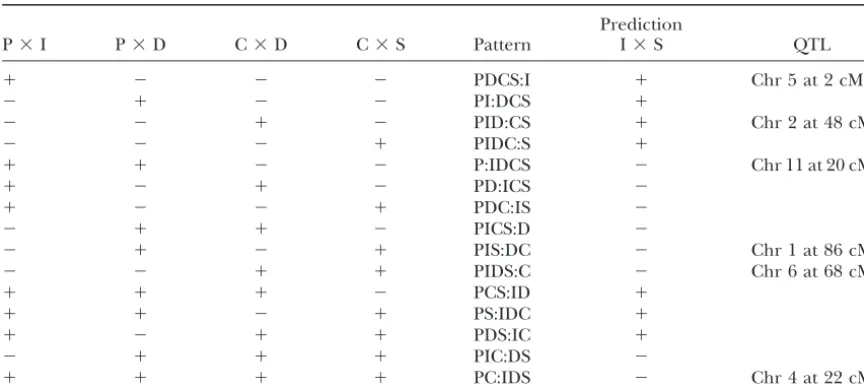
TABLE 1
Decoding binary allele patterns from QTL peaks
Prediction
P⫻I P⫻D C⫻D C⫻S Pattern I⫻S QTL
⫹ ⫺ ⫺ ⫺ PDCS:I ⫹ Chr 5 at 2 cM
⫺ ⫹ ⫺ ⫺ PI:DCS ⫹
⫺ ⫺ ⫹ ⫺ PID:CS ⫹ Chr 2 at 48 cM
⫺ ⫺ ⫺ ⫹ PIDC:S ⫹
⫹ ⫹ ⫺ ⫺ P:IDCS ⫺ Chr 11 at 20 cM
⫹ ⫺ ⫹ ⫺ PD:ICS ⫺
⫹ ⫺ ⫺ ⫹ PDC:IS ⫺
⫺ ⫹ ⫹ ⫺ PICS:D ⫺
⫺ ⫹ ⫺ ⫹ PIS:DC ⫺ Chr 1 at 86 cM
⫺ ⫺ ⫹ ⫹ PIDS:C ⫺ Chr 6 at 68 cM
⫹ ⫹ ⫹ ⫺ PCS:ID ⫹
⫹ ⫹ ⫺ ⫹ PS:IDC ⫹
⫹ ⫺ ⫹ ⫹ PDS:IC ⫹
⫺ ⫹ ⫹ ⫹ PIC:DS ⫺
⫹ ⫹ ⫹ ⫹ PC:IDS ⫺ Chr 4 at 22 cM
Column 5 lists all possible bipartitions of QTL alleles among five strains. In Columns 1–4⫾indicates the presence/absence of a QTL peak in a cross. Column 6 shows the predicted presence/absence of a QTL peak in cross I⫻S and the last column lists QTL found in this study. Chr, chromosome.
be recovered by knowing which cross the animal came from a peak can be ambiguous. It is helpful to examine the “shape” of the LOD curve to detect clues that multiple linked QTL and which strains are coded as A and B in that cross. Any
crosses between two strains that would both be coded as A may be present. The direction of locus-specific allele effects in each cross can provide additional evidence regarding the (or B) should be left out of a combined-cross analysis as they
will be uninformative. parental distribution of QTL alleles.
Linear models, LOD scores, and genome scans:In a simple Having selected a recoding scheme for combining crosses,
we must immediately acknowledge that not all QTL in the genome scan, we make a comparison between two linear mod-els of the data,
cross will share the same distribution of allelic states across the set of parental lines. Indeed, transgressive QTL for which
yi⫽ 0⫹εi (1)
a low parent may contribute a high allele are common.
Recod-ing focuses our search on the most likely QTL configurations. y
i⫽ 0⫹ 1Qi⫹εi, (2)
At the same time we need to ensure that we do not miss QTL
that have other allele distributions across the strains. QTL whereyiare the phenotypes,0and1are regression
coeffi-cients, andεiare normal errors. The indexiruns through all
that fail to meet our expectations can still be detected and
analyzed as described below. We considered the possibility of individuals in the cross(es). We allow the QTL, represented by genotypesQi, to scan over a grid of locations covering the
genome-wide scans using all possible binary recoding of
al-leles. However, this approach raises issues of multiple testing genome and plot a LOD score to summarize the evidence for a QTL at each location. The LOD score, in this case, is the that are likely to offset any advantages of the binary QTL
model. difference in the log10likelihood values between models (1)
and (2), where the individual model likelihoods are
max-Decoding allelic distributions from QTL peaks:Suppose we
have carried out genome scans on several individual crosses. imized with respect to the regression coefficients. If, instead of maximizing, we average overjwith respect to a Bayesian
Ideally we will know for each cross whether the QTL is present
or absent. In practice, there will be a gray area and this could prior distribution, we obtain the log posterior density of the QTL location (Sen and Churchill 2001). Note that Qi is
lead to some ambiguity in interpretation. If a QTL is present,
the parental strain must carry different alleles and, if it is treated as a “dummy variable.” For a backcross, Qi may be
coded simply as 0 or 1 but for an intercross,Qiwill be
repre-absent, parental strains will carry the same allele or alleles
that do not differ in effect. Thus the pattern of presence or sented by two indicator variables and1will have two
compo-nents. This convention helps us to avoid unnecessarily compli-absence of QTL peaks provides information about the allelic
distribution across the strains in a set of crosses. When the cated notation. The actual states of the genotypes represented by Qi cannot be observed directly. These must be inferred
crosses form a chain, it is possible to uniquely determine the
allelic distribution of a QTL from the pattern of presence or from marker data and phenotype values. Proper analysis re-quires that the QTL genotypes should be treated as missing absence in the individual cross genome scans (see Table 1).
If the chain is closed to form a loop of crosses (by adding data and an EM, imputation, or other “missing data” algorithm
(Schafer1997) should be used to compute the maximized
cross I⫻S in this case), a confirmatory prediction is obtained.
This redundant information could provide a check of the likelihood. The problem of constructing missing data algo-rithms for QTL analysis has been thoroughly addressed biallelic model. For other sets of crosses several allelic
distribu-tions may be consistent with the observed pattern of QTL (LanderandBotstein1989; KaoandZeng1997;Senand
Churchill2001). Thus, we can focus on the statistical model
peaks. In practice, some care is needed to properly interpret
a pattern of QTL peaks in multiple crosses. Whereas significant linking genotype to phenotype without having to worry about the details of the computations.
The simple genome scan explicitly assumes that a single I and a low allele in cross P⫻D. The LOD score contrasting model (5) and model (3) can be used to construct a genome QTL is affecting the phenotype. In general a phenotype may
be influenced by multiple QTL as well as by factors such as scan (Comb2) for QTL that show any pattern of effects, not necessarily the pattern implied by the binary encoding of sex or treatment variables and interactions among any of these.
How do we go beyond simple genome scans to incorporate a alleles.
The problem of establishing significance levels for genome richer class of models in our search for QTL?
First consider the introduction of a covariate into a genome scans has been extensively studied. Our preferred method is to use permutation analysis (ChurchillandDoerge1994). scan. Including a term for an additive covariate in each of
models (1) and (2) we obtain the pair of linear models: When performing the permutations, it is important to retain the pairing of phenotypes and covariates (e.g.,crossandsex). yi⫽ 0⫹ 1Xi⫹εi (3) If the X chromosome is scanned, permutations should be
stratified bysexto avoid “illegal” genotypes. Stratification by yi⫽ 0⫹ 1Xi⫹ 2Qi⫹εi. (4)
cross preserves the covariance structure of the combined crosses. A combined-cross analysis involves construction of A genome scan based on the LOD score contrasting models
(3) and (4) accounts for the effects of a covariate that may several genome scans. The scans are not independent and we have applied genome-wide adjusted thresholds on a per-scan be a factor (such as sex) or a continuous covariate (such
as body weight) that has an additive effect on the average basis. The significant QTL are selected using stringent criteria from the combined scans (Comb1 and Comb2). The individ-phenotypic value. Multiple covariates can be included and
QTL at fixed, unlinked locations can be included as covariates ual cross scans are used primarily for decoding the QTL allelic distributions and may be interpreted more liberally using a in a scan.
The QTL effect may depend on the state of a covariate. For suggestive threshold for significance.
Testing cross-specific QTL: If a QTL is detected in the example, a QTL may have an effect only in male mice in a
cross that includes both sexes. To model this we include a genome scan using model (5), we can test for cross-specific effects by computing the change in LOD score between mod-QTL-by-covariate interaction term in the linear model:
els (5) and (4) at the peak location of the model (5) (Comb2) yi⫽ 0⫹ 1Xi⫹ 2Qi⫹ 3QiXi⫹εi. (5) genome scan. We refer to this test statistic as⌬LOD1. It will
be large for any QTL that deviates from the predicted pattern To make inferences about covariate-dependent QTL effects,
of allele effects. one must consider all three models, (3), (4), and (5). One
We use the asymptotic chi-square distribution of the likeli-reasonable approach is to scan the QTL position computing
hood-ratio statistic to establish the significance of⌬LOD1. We the LOD score contrasting model (5) with model (3). This
have not applied any multiple test correction because the test provides a peak LOD score at the most likely position of the
is carried out at a single, fixed locus. To convert a LOD score QTL. We then compute the change in likelihood between
to the chi-square scale, compute2⫽2 ln(10LOD), where ln
models (4) and (5) at the peak position obtained under model
is the natural logarithm. The degrees of freedom for the chi (5) as a test for the QTL-by-covariate interaction.
square are determined by the difference in the number of
Genome scans for combined crosses:Suppose we are
inter-free parameters between the models being compared. In the ested in QTL that may be shared across two or more inbred
example below,⌬LOD1 has 6 d.f. and the 0.05 LOD critical line crosses and we have recoded the alleles as described
value is 2.73. above. We can employ the set of linear models (3), (4), and
Resolving linked QTL:When we observe coincident QTL (5) to construct genome scans. In this caseXiis a cross
indica-in two or more crosses it is always possible that these are tor. Model (3) represents the null hypothesis of no QTL and
distinct QTL that have colocalized by chance. This situation model (4) represents a shared QTL. Includingcross(Xi) as
could be described by a model, an additive covariate accounts for differences in the average
phenotype between crosses but the QTL effect is assumed to y
i⫽ 0⫹ 1Xi⫹ 2Q1i⫹ 3Q1iXi⫹ 4Q2i⫹ 5Q2iXi⫹εi,
be the same in all crosses. The LOD score contrasting models (6) (3) and (4) is used to construct a genome scan (Comb1) for
shared QTL. with two cross-specific QTL. We can fit this multiple-QTL model using a simultaneous scan of all locus pairs on a single Thecrossterm in these models plays the same role as the
polygene term in Liu and Zeng (2000). In a single inbred chromosome. The maximum LOD obtained in the pairwise scan can be compared to the maximum LOD obtained in the line cross, all individual progeny are equi-correlated and the
correlation structure can be safely ignored. When multiple single-locus scan using model (5). The difference in log10
likelihoods provides a test (⌬LOD2) for two QTL. This ap-crosses are combined this is no longer true and the cross
term is important to avoid bias in estimation and to obtain a proach may be modified depending on the circumstances. For example, if we suspect that there are two linked QTL, powerful test with the correct type I error level (Zou et al.
2001). This covariance interpretation suggests that it may be one shared and one cross-specific, we could drop one of the QTL-by-crossinteraction terms from model (6). It is also possi-reasonable to treatcrossas a random term in a mixed linear
model. However, we are looking at a small number of crosses ble to scan a chromosome using a three-QTL model. Significance of⌬LOD2 can establish the presence of multiple and these crosses are the focus of our inference. Thus, we
have chosen to treatcrossas a fixed effect following the recom- linked QTL that might otherwise appear to be a single shared QTL. The computation involves scanning the QTL locations mendation ofZouet al. (2001).
QTL effects may vary from cross to cross. For example, the under both models. Hence multiple testing is an issue. The comparison is made between two models with different num-QTL may be absent in one cross but present in another. Model
(5) includes aQTL-by-cross interaction term that allows each bers of QTL whose locations are free to vary. This leads to a situation where the usual assumptions of likelihood-ratio test-genotype in each cross to have its own effect. This recapitulates
the multiple-allele model and is essentially identical to the ing do not apply (SelfandLiang1987) and we cannot rely on standard asymptotic results. Furthermore, the null model multiple-allele model ofLiu andZeng(2000). When some
of the crosses share strains in common, model (5) is slightly [model (5)] in this test includes a QTL so it is not obvious how permutation analysis can be applied. Therefore, we simulated more general than the multiple-allele model. For example,
Figure3.—Genome scans for individual and combined-cross analyses. They-axis represents the LOD score. Individual crosses are as labeled. Comb1 is the model (3)vs.model (4) LOD score. Comb2 is the model (3)vs.model (5) LOD score. Significance thresholds are 0.05 and 0.63 levels (based on 1000 permutations) and are indicated by dashed lines.
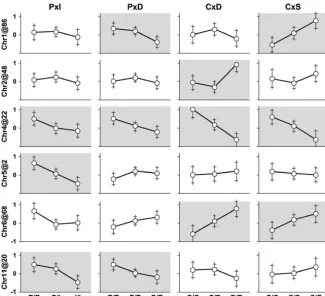
the data using model (5) and computed⌬LOD2 1000 times (chromosomes 5 and 11). Figure 4 shows allele-effect to establish the critical values. These appear to depend on plots for each of these QTL in each cross. Test statistics both the QTL effect size and the chromosome size but, for
and support intervals are summarized in Table 2. the cases considered here,⌬LOD2 values that exceed 4.5 may
Among the QTL detected, chromosome 4 stands out as be regarded as significant evidence for two linked QTL. It is
the most significant and it appears to be the only QTL important to emphasize that failure to achieve significance
does not conclusively establish that there is only a single QTL. shared among all four crosses. In the follow sections we Linked QTL can be difficult to separate. Thus, even a modestly describe the local analysis for each of these six QTL significant result should be regarded as an indication that regions in order of their significance. In addition there multiple loci may be involved, because of the implications
is suggestive evidence for QTL on each of chromosomes for the further steps in identifying the genes,e.g., breeding
7, 9, 15, 17, and 18 in at least one of the crosses. How-congenic mouse strains or analysis of candidate genes.
ever, we did not investigate these loci further.
Chromosome 4:Chromosome 4 presents a significant QTL in the combined-cross scans and it is significant RESULTS
or nearly so in each of the individual crosses (Figure
Figure 4.—Allele-effect plots. Rows in the grid show QTL peak locations and col-umns show crosses. Shaded parts indicate evidence for a QTL in the individual crosses. They-axis on each part is square root of HDL cholesterol centered on the cross-specific mean. Error bars are⫾1 SE.
with parental phenotypes. The combined-cross support has a peak at 86 cM but it is bimodal with a minor peak at 50 cM. The test for cross-specific effect (⌬LOD1 ⫽ interval based on the shared-QTL model (Comb1) is
16–28 cM. This represents a substantial narrowing of 7.8,P⬍0.001) indicates that this QTL is not consistent with the binary encoding. On the basis of the assump-the QTL region toⵑ10 cM.
Chromosome 1:Chromosome 1 presents a significant tion of a single shared QTL, the most likely biallelic distribution is PIS:DC. Higher HDL levels are associated LOD score in the region around 86 cM in the
combined-cross genome scan (Comb2) and significant peaks in with the P and S alleles (Figure 4).
We carried out a secondary analysis using only crosses crosses P⫻D and C⫻S. The C⫻S LOD curve is
uni-modal with a peak at 76 cM. The P⫻D LOD curve also P⫻ D and C ⫻ S and encoded the alleles as PS:DC.
TABLE 2
HDL QTL summary
Chr P⫻I P⫻D C⫻D C⫻S Comb1 Comb2 ⌬LOD1 ⌬LOD2
1 5.72, 86 cM 4.82, 76 cM 1.23, 86 cM, 10.51, 86 cM 9.28* 3.83
(70–94) (66–98) NS (76–90)
2 5.68, 48 cM 1.66, 46 cM, 9.21, 48 cM 7.60* 3.09
(40–56) NS (42–56)
4 3.41, 24 cM 3.17, 20 cM 6.86, 20 cM 3.65, 22 cM 16.34, 22 cM 18.51, 22 cM 2.18 3.49
(10–44) (8–34) (10–34) (0–36) (16–28) (16–28)
5 5.51, 0 cM 0.86, 0 cM, 6.00, 2 cM 5.18* 4.25
(0–10) NS (0–14)
6 4.25, 68 cM 4.06, 68 cM 9.67, 68 cM 5.63* 4.54*
(42–74) (48–74) (46–74)
11 3.23, 28 cM 2.91, 34 cM 2.83, 26 cM 5.80, 20 cM 3.19* 4.05
(10–54) (6–46) (14–44) (12–48)
peak at 48 cM in the combined-cross genome scan (Fig-ure 3, Comb2). A similar peak occurs in cross C⫻ D but there is no evidence for a chromosome 2 QTL in any of the other crosses. The test for cross-specific QTL (⌬LOD1⫽7.60, P⬍ 0.001) is significant. Effect plots suggest that a recessive D allele is associated with high HDL in cross C⫻D. We conclude that the chromosome 2 QTL is cross-specific with allele distribution PID:CS. The QTL is segregating in only one cross so there is no further advantage to combining cross data in this case. The QTL support interval based on cross C⫻D is 40– 56 cM.
Chromosome 6:Chromosome 6 presents a significant peak at 68 cM in the combined-cross scan (Figure 3, Comb2). Significant peaks are also in the shared-QTL scan (Figure 3, Comb1) and in cross C⫻D. A suggestive peak occurs in cross C⫻ S at 70 cM. In crosses P⫻ I and P⫻D, chromosome 6 does not reach the suggestive level. The cross-specific QTL test (⌬LOD1⫽5.63,P⬍
0.001) is significant and the allele-effect plots (Figure 4) confirm that chromosome 6 is not a shared QTL. We conclude that the chromosome 6 QTL has allele distribution PIDS:C, where the C allele is associated with lower HDL. The alternative coding PIC:DS cannot be definitively ruled out in light of the consistent but weak evidence for a QTL present in cross P⫻ D.
Chromosome 5:Chromosome 5 presents a suggestive peak at 0 cM in the combined-cross scan (Comb2) and
Figure5.—Localization of the chromosome 4 QTL for four a significant peak in cross P⫻I. The cross-specific QTL
individual crosses and combined crosses. The QTL alleles are
test (⌬LOD1 ⫽ 5.2, P ⬍ 0.001) is significant and is encoded as PC:IDS. The solid curve is the LOD score and the
confirmed by the allele-effect plots (Figure 4). We con-dashed curve is the posterior probability density of the QTL
location. Triangles indicate markers that were genotyped in clude that chromosome 5 allele distribution is I:PDCS the individual crosses and the 2-cM-spaced tick marks indicate with the I allele contributing an additive effect associ-the location of imputed pseudomarkers. Shaded boxes delimit ated with lower HDL levels. As this QTL appears only 95% support intervals for the QTL location.
in cross P⫻I, there is no advantage to combining data. The chromosome 5 support interval based on cross P⫻ I is 0–10 cM.
For this analysis,⌬LOD1 ⫽ 0.06 (P ⫽ 0.99), which is
consistent with a shared QTL. The test for two QTL Chromosome 11: Chromosome 11 presents sugges-tive peaks at 26 and 20 cM, respecsugges-tively, in the com-(⌬LOD2⫽1.84, NS) does not suggest the presence of
multiple QTL. However, there are a number of reasons bined-cross scans (Figure 3). The cross-specific test (⌬LOD1⫽ 3.19,P⫽ 0.023) is only marginally signifi-why we should remain open to the possibility of multiple
linked QTL in this region. First, we note that the peak cant. The individual cross scans show peaks that are nearly significant in crosses P⫻ I and P⫻ D whereas LOD scores in the individual crosses differ in location
by 10 cM. Second, the combined-cross support interval the crosses C⫻ S and C⫻D present no evidence for a QTL on chromosome 11. Together with the allele (68–102 cM; Figure 6, Comb1) is not substantially
nar-rower than the interval obtained by analyzing cross P⫻ effects (Figure 4), these observations suggest that the chromosome 11 QTL most likely has a P:IDCS allele D alone. Finally, the combined LOD curve is not
uni-modal. In a separate study Wang et al. (2004) have distribution.
On this assumption, we recoded the alleles and com-shown that a polymorphism in Apoa2 (at 92 cM) is
responsible for the C⫻S QTL. Strains P and D do not bined crosses P⫻ I and P⫻D. The cross-specific test in this case (⌬LOD1⫽0.57,P⫽0.85) is consistent with differ at the causal polymorphism in Apoa2. The most
likely candidate for the P⫻D QTL is an uncharacterized a shared QTL and there is no evidence for multiple QTL (⌬LOD2⫽1.72, NS). The support interval based locus that lies 6 cM proximal to Apoa2 (B. Paigen,
personal communication). This example underscores on the shared-QTL model (Figure 6, Comb1) spans the region from 20 to 44 cM, still quite broad but narrower the importance of critically examining the LOD curves
in a combined-cross analysis and the care that must be than the individual cross support intervals.
Pairwise genome scans identified an interaction be-taken in the interpretation of nonsignificant test results.
Figure6.—Posterior density of chromosome 1 (left) and chromosome 11 (right) QTL locations after recoding as shared QTL on a subset of the crosses. QTL alleles on chromosome 1 are encoded as PS:IDC. QTL alleles on chromosome 11 are encoded as P:IDCS. Details are as in Figure 5.
peak was detected in cross C⫻D at chromosome 4 at or made explicit. New software tools are available that enable an analyst to carry out explicit and general linear 24 cM and chromosome 11 at 20 cM. The LOD for a
two-QTL model with interaction is 12.08 (P ⬍ 0.05, modeling of QTL (R/qtl,Bromanet al.2003; pseudo-marker,SenandChurchill2001). These tools present genome-wide adjusted). The component of the LOD
attributable to interaction alone is 4.53 (P ⫽ 0.0003, an opportunity to explore the architecture of complex traits in greater depth than ever before. Combined-cross unadjusted). An allele-effect plot for the interaction is
shown in Figure 7. The pattern of the interaction sug- analysis is just one of many possible applications that can be developed.
gests that a homozygous CC genotype on chromosome
11 is required for the effect of chromosome 4 to be The binary encoding strategy described here is espe-cially promising for application using the common expressed in this genetic background.
A second interacting locus pair was detected in cross strains of inbred laboratory mice due to the effectively biallelic nature of many polymorphic loci (Wadeet al.
C⫻ S between two loci on chromosome 11 at 10 and
25 cM. The two QTL plus interaction LOD score is 14.27 2002). Combining data from two or more inbred line crosses on the basis of a binary allele-effects model may (P⬍0.05, genome-wide adjusted) and the component
of the LOD attributable to the interaction is 12.86 (P⬍ be applicable to other diploid organisms with similar breeding history to the laboratory mouse. The key as-0.001). Tightly linked and interacting QTL are always
suspect. Closer inspection of this interaction revealed sumption is that there is a substantial prior probability that two common QTL alleles will be shared among the that the mouse with highest HDL level among all crosses
(HDL⫽378 mg/dl, Figure 1) has a pair of recombina- parental lines. tion events on proximal chromosome 11 and this is the
only mouse with genotype (CC/SS⫽ AA/BB) at these loci. In light of the singular nature of this event, we are inclined to disregard the finding. However, it does hint at the possibility that the suggestive QTL region on chromosome 11 region may harbor a more complex genetic architecture than we can resolve with these crosses.
Figure7.—Interacting allele effects between the
chromo-some 4 and chromochromo-some 11 QTL in cross C⫻D. The two DISCUSSION leftmost parts show the main effects of QTL on chromosomes 4 and 11 and the rightmost part shows their joint effect. The Linear models are implicitly used in genome scans vertical scale is the square root of HDL. Points indicate the and in most QTL analyses. However, the central role of mean phenotype for each genotypic group and the bar
A combined-cross analysis may be conducted as apost the parental strain phenotypes (e.g., “in silicomapping”; Grupe et al. 2001) are likely to miss many important
hoc meta-analysis of existing data. However, there may
be some advantages to planning multiple-cross mapping features of the genetic architecture of complex traits. The results obtained with the test for multiple QTL experiments. Eliminating potential confounding factors
and conducting the crosses in a controlled, uniform ⌬LOD2 in this study were somewhat disappointing. A previous study using an advanced intercross design environment minimizes gene-by-environment
interac-tions and increases the likelihood that shared QTL will (Wanget al.2003) suggested that chromosomes 1 and 5 are likely to harbor multiple HDL QTL. However, as be detected. There are tradeoffs to consider. A typical
mapping study is constrained by the total number of these QTL appear to be tightly linked in coupling phase, the combined intercrosses do not provide sufficient res-individuals that can be generated and phenotyped.
Gen-erating progeny from multiple strains offers an advan- olution to separate the effects. The evidence for multi-ple linked QTL on chromosome 6 is consistent with our tage in that more QTL can be detected. However, as
we have seen in the example here, some of these QTL previous analysis of this QTL (Lyons et al. 2003a). In other studies (M. A.Lyons, R. Li, G. A. Churchilland will be segregating in only a subset of the total progeny
and this will reduce the power compared to a single- B. Paigen, unpublished results) we have successfully resolved multiple linked QTL with unambiguously sig-cross study of the same total size. For example, four
crosses of 250 individuals each should provide reason- nificant⌬LOD2 results. For the purpose of combining crosses we recommend liberal interpretation of this test able power to detect QTL that account for 5–10% of
the total variance even if allelic differences are limited and careful attention to other sources of evidence. In the combined-cross analysis we make an assumption to just one of the crosses. On the other hand, a single
cross with 1000 progeny should have power to detect regarding the biallelic nature of QTL that occur in more than one cross. These assumptions may not be always QTL with effect sizes on the order of 2% of total variance
but fewer loci are likely to be segregating. correct but they move us forward. The conclusions of a combined-cross analysis are intended to provide guid-The advantages of combined-cross analysis are
in-creased power for detecting QTL and improved localiza- ance in follow-up studies. The possibility of multiple linked QTL and multiple alleles at a single locus must tion of shared QTL. As demonstrated in our example,
these gains may be modest and will not by themselves always be kept in mind.
In conclusion, we have described and demonstrated provide gene-level resolution of QTL. We propose that
combined-cross analysis could serve as a preliminary the utility of combining multiple crosses for QTL map-ping. This technique offers an opportunity to better step to QTL localization by haplotype analysis (Wade
et al. 2002; Wiltshire et al. 2003). A combined-cross utilize existing data from resource-intensive breeding crosses and should have immediate benefits for QTL analysis can (usually) determine the parental allelic
states on the basis of the pattern of QTL found in the analysis studies in the laboratory mouse. Application of the analysis techniques described here should improve individual crosses. Knowledge of the parental alleles can
be leveraged to achieve very high resolution of QTL the power and resolution of QTL studies and will pro-vide further insights into the genetic determinants of location by comparing the haplotypes of the parental
lines in the QTL support interval to the predicted the complex phenotypes.
biallelic pattern. In many instances this could provide We are thankful to Saunak Sen, Karl Broman, and Hao Wu for resolution of a QTL to a very small and manageable their contributions in the development of the software. This work is supported by National Institutes of Health grants GM070683 and
number of genes for follow-up studies. Some allowance
HL55001. The American Physiological Society and the American Liver
must be made for the existence of third alleles in crosses
Foundation supported M.A.L. and Deutsche Forschungsgemeinschaft
that include wild-derived mouse strains. In our example, provided support for H.W. the CAST/Ei strain could potentially contribute alleles
that are distinct from the other, standard inbred strains.
It is interesting to note that most of the QTL defined LITERATURE CITED in our example were not consistent with the pattern
Abiola, O., J. M. Angel, P. Avner, A. A. Bachmanov, J. K. Belknap of allelic effect predicted by the parental phenotypes. et al., 2003 The nature and identification of quantitative trait
loci: a community’s view. Nat. Rev. Genet.4:911–916.
Indeed, each of our QTL showed a distinct distribution
Beck, J. A., S. Lloyd, M. Hafezparast, M. Lennon-Pierce, J. T. across the parental lines. This should not be surprising,
Eppiget al., 2000 Genealogies of mouse inbred strains. Nat.
as there is no reason (e.g., selection) that HDL-related Genet.24:23–25.
Bonhomme, F., 1986 Evolutionary relationships in the genus Mus.
QTL should show clustering of allelic types within
Curr. Top. Microbiol. Immunol.127:19–34.
strains. A mixture of alleles is likely to contribute to
Broman, K. W., H. Wu, S. SenandG. A. Churchill, 2003 R/qtl:
buffering of important phenotypes. The common obser- QTL mapping in experimental crosses. Bioinformatics19:889–
890.
vation of transgressive segregation in intercross
popula-Churchill, G. A., andR. W. Doerge, 1994 Empirical threshold
tions suggests that parental lines with low phenotypes
values for quantitative trait mapping. Genetics138:963–971.
can often contribute high alleles and vice versa. We Glazier, A. M., J. H. NadeauandT. J. Aitman, 2002 Finding genes
that underlie complex traits. Science298:2345–2349.
Grupe, A., S. Germer, J. Usuka, D. Aud, J. K. Belknapet al., 2001 Park, Y. G., R. Clifford, K. H. BuetowandK. W. Hunter, 2003 Multiple cross and inbred strain haplotype mapping of complex-In silico mapping of complex disease-related traits in mice.
Sci-ence292:1915–1918. trait candidate genes. Genome Res.13:118–121.
Rebai, A., B. GoffinetandB. Mangin, 1994 Approximate thresh-Haley, C., and S. A. Knott, 1992 A simple regression method
for mapping quantitative trait loci in line crosses using flanking olds of interval mapping tests for QTL detection. Genetics138:
235–240. markers. Heredity69:315–324.
Hitzemann, R., B. Malmanger, C. Reed, M. Lawler, B. Hitzemann Schafer, J., 1997 Analysis of incomplete multivariate data. Mono-graphs on Statistics and Applied Probability 72. Chapman & Hall,
et al., 2003 A strategy for the integration of QTL, gene
expres-sion, and sequence analyses. Mamm. Genome14:733–747. London.
Self, S. G.,andK-Y Liang,1987 Asymptotic properties of maximum Jannink, J. L., andR. Jansen, 2001 Mapping epistatic quantitative
trait loci with one-dimensional genome searches. Genetics157: likelihood estimators and likelihood ratio tests under nonstan-dard conditions. J. Am. Stat. Assoc.82:605–610.
445–454.
Sen, S., andG. A. Churchill, 2001 A statistical framework for quan-Jansen, R. C., andP. Stam, 1994 High resolution of quantitative
titative trait mapping. Genetics159:371–387. traits into multiple loci via interval mapping. Genetics136:1447–
Silver, L., 1995 Mouse Genetics. Oxford University Press, Oxford. 1455.
Sugiyama, F., G. A. Churchill, D. C. Higgins, C. Johns, K. P. Kao, C. H., andZ. B. Zeng, 1997 General formulas for obtaining the
Makaritsis et al., 2001 Concordance of murine quantitative MLEs and the asymptotic variance-covariance matrix in mapping
trait loci for salt-induced hypertension with rat and human loci. quantitative trait loci when using the EM algorithm. Biometrics
Genomics71:70–77.
53:653–665.
Wade, C. M., E. J. Kulbokas, 3rd, A. W. Kirby, M. C. Zody, J. C. Khanuja, B., Y. C. Cheah, M. Hunt, P. M. Nishina, D. Q. Wanget
Mullikinet al., 2002 The mosaic structure of variation in the
al., 1995 Lith1, a major gene affecting cholesterol gallstone
laboratory mouse genome. Nature420:574–578. formation among inbred strains of mice. Proc. Natl. Acad. Sci.
Walling, G. A., P. M. Visscher, L. Andersson, M. F. Rothschild, USA92:7729–7733.
L.Wanget al., 2000 Combined analysis of data from quantitative Korstanje, R., andB. Paigen, 2002 From QTL to gene: the harvest
trait loci mapping studies: chromosome 4 effects on porcine begins. Nat. Genet.31:235–236.
growth and fatness. Genetics155:1369–1378. Lander, E., andL. Kruglyak, 1995 Genetic dissection of complex
Wang, X., I. Le Roy, E. Nicodeme, R. Li, R. Wagneret al., 2003 traits: guidelines for interpreting and reporting linkage results.
Using advanced intercross lines for high-resolution mapping of Nat. Genet.11:241–247.
HDL cholesterol quantitative trait loci. Genome Res.13:1654– Lander, E. S., andD. Botstein, 1989 Mapping Mendelian factors
1664. underlying quantitative traits using RFLP linkage maps. Genetics
Wang, X., R. Korstanje, D. HigginsandB. Paigen, 2004
Haplo-121:185–199.
type analysis in multiple crosses to identify a QTL gene. Genome Liu, Y., andZ. B. Zeng, 2000 A general mixture model approach
Res.14:1767–1772. for mapping quantitative trait loci from diverse cross designs
Wittenburg, H., M. A. Lyons, R. Li, G. A. Churchill, M. C. Carey involving multiple inbred lines. Genet. Res.75:345–355.
et al., 2003 Primary roles of FXR and ABCG5/8 in cholesterol Lyons, M. A., H. Wittenburg, R. Li, K. A. Walsh, G. A. Churchill gallstone susceptibility in inbred mice: evidence from quantitative
et al., 2003a Quantitative trait loci that determine lipoprotein trait locus analysis. Gastroenterology125:868–881.
cholesterol levels in DBA/2J and CAST/Ei inbred mice. J. Lipid Wiltshire, T., M. T. Pletcher, S. Batalov, S. W. Barnes, L. M.
Res.44:953–967. Tarantino et al., 2003 Genome-wide single-nucleotide
poly-Lyons, M. A., H. Wittenburg, R. Li, K. A. Walsh, M. R. Leonard morphism analysis defines haplotype patterns in mouse. Proc.
et al., 2003b New quantitative trait loci that contribute to choles- Natl. Acad. Sci. USA100:3380–3385.
terol gallstone formation detected in an intercross of CAST/Ei Zeng, Z-B., 1994 Precision mapping of quantitative trait loci. Genet-and 129S1/SvImJ inbred mice. Physiol. Genomics14:225–239. ics136:1457–1468.
Nadeau, J. H., andW. N. Frankel, 2000 The roads from phenotypic Zou, F., B. S. YandellandJ. P. Fine, 2001 Statistical issues in the variation to gene discovery: mutagenesis versus QTLs. Nat. Genet. analysis of quantitative traits in combined crosses. Genetics158:
25:381–384. 1339–1346.
Paigen, K., 1995 A miracle enough: the power of mice. Nat. Med.