DOI: 10.1534/genetics.106.057521
A Dbf4p BRCA1 C-Terminal-Like Domain Required for the Response to
Replication Fork Arrest in Budding Yeast
Carrie Gabrielse,* Charles T. Miller,*
,†Kristopher H. McConnell,
‡Aaron DeWard,*
Catherine A. Fox
‡and Michael Weinreich*
,1*Laboratory of Chromosome Replication, Van Andel Research Institute, Grand Rapids, Michigan 49503,†Cell and Molecular Biology Graduate Program, Michigan State University, East Lansing, Michigan 48824 and‡Department of Biomolecular Chemistry,
University of Wisconsin Medical School, Madison, Wisconsin 53406
Manuscript received February 22, 2006 Accepted for publication March 10, 2006
ABSTRACT
Dbf4p is an essential regulatory subunit of the Cdc7p kinase required for the initiation of DNA rep-lication. Cdc7p and Dbf4p orthologs have also been shown to function in the response to DNA damage. A previous Dbf4p multiple sequence alignment identified a conserved40-residue N-terminal region with similarity to theBRCA1C-terminal (BRCT) motif called ‘‘motif N.’’ BRCT motifs encode100-amino-acid domains involved in the DNA damage response. We have identified an expanded and conserved 100-residue N-terminal region of Dbf4p that includes motif N but is capable of encoding a single BRCT-like domain. Dbf4p orthologs diverge from the BRCT motif at the C terminus but may encode a similar secondary structure in this region. We have therefore called this theBRCT andDBF4 similarity (BRDF) motif. The principal role of this Dbf4p motif was in the response to replication fork (RF) arrest; however, it was not required for cell cycle progression, activation of Cdc7p kinase activity, or interaction with the origin recognition complex (ORC) postulated to recruit Cdc7p–Dbf4p to origins. Rad53p likely directly phos-phorylated Dbf4p in response to RF arrest and Dbf4p was required for Rad53p abundance. Rad53p and Dbf4p therefore cooperated to coordinate a robust cellular response to RF arrest.
D
NA replication in eukaryotic organisms is precisely controlled so that the genome is duplicated only once per cell cycle, thus ensuring the accurate inher-itance of the genetic information (for reviews see Bell and Dutta 2002; Stillman 2005). Origins of replica-tion initiate DNA synthesis no more than once per cell cycle because of a temporal separation of replication initiation into mutually exclusive phases (reviewed in Diffley and Labib 2002). In the first phase, as cells enter G1, initiation proteins assemble at origins of rep-lication into ‘‘prereplicative complexes’’ (pre-RCs), which contain origin recognition complexes (ORCs), Cdc6p, Cdt1p, and the heteromeric MCM helicase. In the sec-ond phase, Cdc7p–Dbf4p and cyclin-dependent kinases promote the initiation of DNA synthesis from these pre-RCs, signaling the beginning of S-phase.Many studies provide ample evidence for the critical role that Cdc7p–Dbf4p has in promoting replication initiation (reviewed in (Sclafani2000). Cdc7p–Dbf4p kinase is required for origin firing throughout S-phase (Boussetand Diffley1998; Donaldsonet al. 1998) by promoting a late step in replication initiation (Diffley
et al. 1994) before origin unwinding (Geraghtyet al. 2000). Although the relevantin vivosubstrates of Cdc7p–
Dbf4p kinase are unknown, it has been suggested that the MCM proteins are important Cdc7p–Dbf4p initia-tion targets on the basis of a number of observainitia-tions, including the isolation of a cdc7 suppressor mutation that maps to the MCM5gene (Hardyet al. 1997) and the finding that multiple MCM proteins are in vitro
Cdc7p–Dbf4p substrates (Lei et al. 1997; Sato et al. 1997; Brown and Kelly 1998; Jiang et al. 1999; Roberts et al. 1999; Weinreichand Stillman1999). An attractive model that explains many observations is that Cdc7p–Dbf4p kinase activates the MCM helicase within the pre-RC to promote duplex unwinding, which then rapidly leads to DNA polymerase loading (Tanaka and Nasmyth 1998; Aparicio et al. 1999; Zou and Stillman2000) as well as the association of additional replication proteins (Kanemakiet al. 2003; Takayama
et al. 2003).
Dbf4 protein is clearly required for cell cycle pro-gression and for activity of the Cdc7p kinase subunit (Kitadaet al. 1992; Jacksonet al. 1993) but precisely how it contributes to the biological roles of Cdc7p kinase is unclear. Previous alignments of Dbf4 orthologs revealed several regions of high relatedness (Landis and Tower1999; Takedaet al. 1999) that have been termed motifs N, M, and C, on the basis of their posi-tion within the protein (Masaiand Arai2000). Motif M is critical for interaction with the kinase subunit in
Schizosaccharomyces pombeand thus essential for viability 1Corresponding author:Van Andel Research Institute, 333 Bostwick Ave.
NE, Grand Rapids, MI 49503. E-mail: [email protected]
(Oginoet al. 2001; Funget al. 2002). Dbf4p residues en-compassing motif M interact similarly with the Saccha-romyces cerevisiaeCdc7p by a two-hybrid analysis (Dowell
et al. 1994; Hardy and Pautz 1996). Motif N is im-portant for the response to DNA damage. Several dele-tion mutants affecting motif N of theS. pombehomolog, Dfp1p, are viable but sensitive to hydroxyurea (HU), UV light, and the alkylating agent, methyl methanesulfo-nate (MMS) (Ogino et al. 2001; Fung et al. 2002). Interestingly, motif N (ScDbf4p residues 135–179) shares similarity with an 40-amino-acid N-terminal region of the BRCA1 C-terminal (BRCT) motif (Masai and Arai 2000), originally discovered as a tandem repeat in theBRCA1 breast cancer susceptibility gene (Koonin et al. 1996) and present in many proteins involved in DNA repair (Bork et al. 1997; Callebaut and Mornon1997). The significance of this sequence similarity has not been completely addressed, but these observations raise the intriguing possibility that Dbf4p orthologs contain abona fideBRCT domain (or related domain) that plays a role in the DNA damage response.
ScDbf4p and SpDfp1p are also likely effectors of the replication checkpoint since both proteins are phos-phorylated in a Rad53p/Cds1p-dependent manner fol-lowing replication fork (RF) arrest (Weinreich and Stillman 1999; Takeda et al. 2001). ScCdc7p–Dbf4p has lowered kinase activity (Weinreichand Stillman 1999) and is no longer chromatin associated (Pasero
et al. 1999) following RF arrest, but how these relate to the Rad53p-dependent phosphorylation of Dbf4p is unknown. In addition, Rad53p interacts with the N-terminal 296 amino acids of Dbf4p through its FHA1 and FHA2 domains (Duncker et al. 2002), phosphor-ylates Dbf4pin vitro(Kiharaet al. 2000), and has been reported to regulate Dbf4p independently of its check-point activity (Dohrmannet al. 1999).
The N-terminal third of Dbf4p also encodes origin-and ORC-interaction domains (Dowell et al. 1994; Dunckeret al. 2002). Although to date no one has re-ported a direct physical interaction of the Cdc7p–Dbf4p kinase at origins of replication by chromatin immuno-precipitation, such an interaction seems very likely on the basis of the variety of data detailed above. Since the Dbf4p N terminus (containing motif N) interacts with replication origins (Dowellet al. 1994) and with ORC (Dunckeret al. 2002), it might be essential for targeting the kinase to replication origins. However, since the Dfp1p motif N (Funget al. 2002; Oginoet al. 2001) is not required for viability but a deletion affecting motif N in the mouse is lethal (Yamashita et al. 2005), it remains an open question exactly what residues of the budding yeast Dbf4p N terminus are required for its essential role in DNA replication and what significance motif N has for DNA replication or repair. A detailed analysis of the Dbf4p N terminus would help resolve these issues.
Here we performed a systematic analysis of the S. cerevisiae Dbf4p N terminus and showed that the N-terminal 265 amino acids of Dbf4p were dispensable for DNA replication, but nonetheless encoded at least two distinct functions related to RF arrest. Interestingly, we identified an 100-amino-acid region of similarity among Dbf4 orthologs (ScDbf4p residues 117–218) that included the BRCT-like sequences in motif N (ScDbf4p residues 135–179) plus a new 31-amino-acid region C-terminal to motif N. This new block of similarity was unique to Dbf4 proteins but differed from BRCT-containing proteins. We propose that this expanded 101-residue region encodes a variant of the BRCT domain that is required for the response to RF arrest. We call this region theBRCT andDBF4 similarity (BRDF) motif. A second region preceding the BRDF motif (between resi-dues 65 and 109) was required for Rad53p-dependent phosphorylation of Dbf4p following RF arrest. However, the loss of Rad53p phosphorylation did not confer an in-creased sensitivity to RF arrest, suggesting that Rad53p phosphorylated Dbf4p for an aspect of chromosome metabolism separable from maintaining the integrity of the arrested RF. Thus the N terminus of Dbf4p contains two distinct regions required for different aspects of the cellular response to RF arrest but not for its essential role in DNA replication.
MATERIALS AND METHODS
Construction of yeast strains, plasmids, baculoviruses, and growth media:All yeast strains are derivatives of W303 or were backcrossed at least four times to W303 from the parental strain and are listed in Table 1. Genetic manipulation and trans-formation of yeast was done using standard techniques. The
kanMX6deletion strains forTEL1and DUN1were obtained from Research Genetics (Birmingham, AL). The deleted al-leles were PCR amplified, and the DNA fragments were trans-formed into W303-1A in one step (Rothstein1983) and then confirmed by PCR and phenotypic analysis. YPD denotes rich medium containing 1% yeast extract, 2% peptone, and 2% glucose. FOA is synthetic complete medium containing 1 mg/ ml 5-fluoroorotic acid. Drugs were added directly to media before pouring at the indicated concentrations.
DBF4 deletions and point mutations were constructed by QuikChange (Stratagene, La Jolla, CA) on pMW489. The deletions introduced anNcoI site at the initiating methionine. pMW489 is pRS415 containing DBF4 on a genomic 2.5-kb
MluI–XbaI fragment (Table 2). For each mutation, the entire
DBF4 sequence on the plasmid was verified by sequencing. Baculovirus transfer plasmids encoding DBF4 deletions (on a NcoI–NotI fragment) were constructed in pAcSG2 and baculoviruses were generated using the Baculo Gold kit (BD Biosciences), plaque purified, and then amplified to high titer. The wild-type DBF4, HACDC7, and ORC viruses have been described previously (Bellet al. 1995; Weinreichand Stillman1999). Selecteddbf4mutations were integrated at thedbf4DTkanMX6locus of M895 using the following method. HindIII–XbaI fragments containing full-lengthDBF4ordbf4 de-letion derivatives were cotransformed into M895 together with pRS415. Leu1
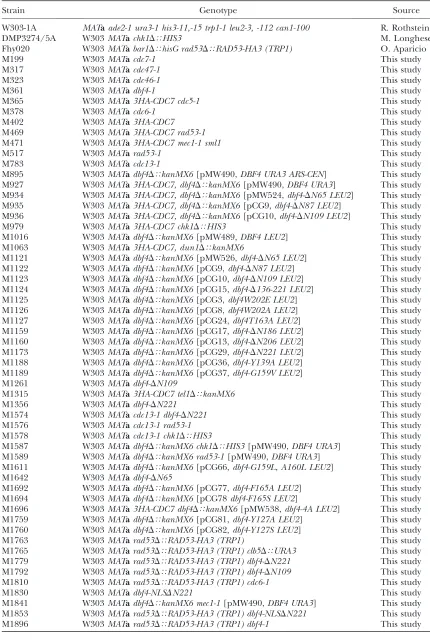
TABLE 1
Yeast strains used in this study
Strain Genotype Source
W303-1A MATaade2-1 ura3-1 his3-11,-15 trp1-1 leu2-3, -112 can1-100 R. Rothstein
DMP3274/5A W303MATachk1DTHIS3 M. Longhese
Fhy020 W303MATabar1DThisG rad53DTRAD53-HA3 (TRP1) O. Aparicio
M199 W303MATacdc7-1 This study
M317 W303MATacdc47-1 This study
M323 W303MATacdc46-1 This study
M361 W303MATadbf4-1 This study
M365 W303MATa3HA-CDC7 cdc5-1 This study
M378 W303MATacdc6-1 This study
M402 W303MATa3HA-CDC7 This study
M469 W303MATa3HA-CDC7 rad53-1 This study
M471 W303MATa3HA-CDC7 mec1-1 sml1 This study
M517 W303MATarad53-1 This study
M783 W303MATacdc13-1 This study
M895 W303MATadbf4DTkanMX6[pMW490,DBF4 URA3 ARS-CEN] This study M927 W303MATa3HA-CDC7, dbf4DTkanMX6[pMW490,DBF4 URA3] This study M934 W303MATa3HA-CDC7, dbf4DTkanMX6[pMW524,dbf4-DN65 LEU2] This study M935 W303MATa3HA-CDC7, dbf4DTkanMX6[pCG9,dbf4-DN87 LEU2] This study M936 W303MATa3HA-CDC7, dbf4DTkanMX6[pCG10,dbf4-DN109 LEU2] This study
M979 W303MATa3HA-CDC7 chk1DTHIS3 This study
M1016 W303MATadbf4DTkanMX6[pMW489,DBF4 LEU2] This study
M1063 W303MATa3HA-CDC7, dun1DTkanMX6 This study
M1121 W303MATadbf4DTkanMX6[pMW526,dbf4-DN65 LEU2] This study M1122 W303MATadbf4DTkanMX6[pCG9,dbf4-DN87 LEU2] This study M1123 W303MATadbf4DTkanMX6[pCG10,dbf4-DN109 LEU2] This study M1124 W303MATadbf4DTkanMX6[pCG15,dbf4-D136-221 LEU2] This study M1125 W303MATadbf4DTkanMX6[pCG3,dbf4W202E LEU2] This study M1126 W303MATadbf4DTkanMX6[pCG8,dbf4W202A LEU2] This study M1127 W303MATadbf4DTkanMX6[pCG24,dbf4T163A LEU2] This study M1159 W303MATadbf4DTkanMX6[pCG17,dbf4-DN186 LEU2] This study M1160 W303MATadbf4DTkanMX6[pCG13,dbf4-DN206 LEU2] This study M1173 W303MATadbf4DTkanMX6[pCG29,dbf4-DN221 LEU2] This study M1188 W303MATadbf4DTkanMX6[pCG36,dbf4-Y139A LEU2] This study M1189 W303MATadbf4DTkanMX6[pCG37,dbf4-G159V LEU2] This study
M1261 W303MATadbf4-DN109 This study
M1315 W303MATa3HA-CDC7 tel1DTkanMX6 This study
M1356 W303MATadbf4-DN221 This study
M1574 W303MATacdc13-1 dbf4-DN221 This study
M1576 W303MATacdc13-1 rad53-1 This study
M1578 W303MATacdc13-1 chk1DTHIS3 This study
M1587 W303MATadbf4DTkanMX6 chk1DTHIS3[pMW490,DBF4 URA3] This study M1589 W303MATadbf4DTkanMX6 rad53-1[pMW490,DBF4 URA3] This study M1611 W303MATadbf4DTkanMX6[pCG66,dbf4-G159L,A160L LEU2] This study
M1642 W303MATadbf4-DN65 This study
M1692 W303MATadbf4DTkanMX6[pCG77,dbf4-F165A LEU2] This study M1694 W303MATadbf4DTkanMX6[pCG78dbf4-F165S LEU2] This study M1696 W303MATa3HA-CDC7 dbf4DTkanMX6[pMW538,dbf4-4A LEU2] This study M1759 W303MATadbf4DTkanMX6[pCG81,dbf4-Y127A LEU2] This study M1760 W303MATadbf4DTkanMX6[pCG82,dbf4-Y127S LEU2] This study
M1763 W303MATarad53DTRAD53-HA3 (TRP1) This study
M1765 W303MATarad53DTRAD53-HA3 (TRP1) clb5DTURA3 This study M1779 W303MATarad53DTRAD53-HA3 (TRP1) dbf4-DN221 This study M1792 W303MATarad53DTRAD53-HA3 (TRP1) dbf4-DN109 This study
M1810 W303MATarad53DTRAD53-HA3 (TRP1) cdc6-1 This study
M1830 W303MATadbf4-NLSDN221 This study
M1841 W303MATadbf4DTkanMX6 mec1-1[pMW490,DBF4 URA3] This study M1853 W303MATarad53DTRAD53-HA3 (TRP1) dbf4-NLSDN221 This study
to score loss of the kanMX6 marker. The resulting GenS candidates were confirmed as correct recombinants following PCR amplification of theDBF4locus.
Yeast immunoprecipitation and Western blotting: Immu-noprecipitation of 3HACdc7–Dbf4 proteins was done as de-scribed previously (Weinreich and Stillman 1999). The immunoprecipitate was separated on a 10% SDS–PAGE gel, blotted, and probed with rabbit polyclonal antisera against GST–Cdc7 (1:4000) and GST–Dbf4 (1:1000) in 13 phosphate-buffered saline containing 0.1% Tween and 1% dry milk.
Cell cycle analysis and preparation of whole-cell extracts:
FACS analysis of DNA content was as described (Weinreich and Stillman1999). Whole-cell extracts were prepared using a TCA extraction method (Foianiet al. 1994) from 10 ml of cells. Five percent of the whole-cell extract was separated on 10% SDS–PAGE gels, blotted, and probed with the 12CA5 anti-body against the HA epitope (1:5000) or as above. Ponceau S staining of the blot confirmed equal protein loading in the samples being compared.
Two-dimensional origin mapping: Two-dimensional (2-D) origin mapping was performed as described (Friedmanand Brewer1995; PalaciosDeBeeret al. 2003). In addition, DNA was enriched for replication intermediates with BND cellulose (Sigma, St. Louis), after restriction digestion to release the origin fragment of interest.
Co-immunoprecipitation of ORC and Cdc7–Dbf4 proteins from Sf9 cells:Sf9 cells were co-infected at an MOI¼10 with baculoviruses expressing ORC, HACdc7p, and Dbf4p deriva-tives. After 48 hr, soluble whole-cell extracts were prepared and immunoprecipitated using a monoclonal antibody against the Orc3p subunit that immunoprecipitates the ORC. After ex-tensive washing, the immunoprecipitate (IP) was split in half, separated on parallel 10% SDS–PAGE gels, blotted, and probed with monoclonal antibodies against the Orc1-6p subunits or Cdc7p and Dbf4p polyclonal antisera, as described above. IP-kinase assay of HACdc7p–Dbf4p and Dbf4p deletion de-rivatives was performed as described (Weinreichand Stillman 1999). Mouse monoclonal antibodies against each of the ORC subunits were raised against recombinant ORC purified from Sf9 cells (Bellet al. 1995) and are ORC-3E9 (a-Orc1p), ORC-8D3 (a-Orc2p), ORC-9E9 (a-Orc3p), ORC-1B1 (a-Orc4p), ORC-1A6 (a-Orc5p), and ORC-2F7 (a-Orc6p).
RESULTS
A multiple sequence alignment revealed that Dbf4p orthologs contain a variant of the BRCT motif:BRCT motifs, found in many proteins involved in DNA repair, share only 4–5 highly conserved amino acids within the consensus. However, several hydrophobic residues are also conserved throughout the motif (Borket al. 1997; Callebaut and Mornon 1997) and these residues help determine the secondary structural elements in BRCT protein structures (Zhanget al. 1998; Williams
et al. 2001; Jooet al. 2002). For simplicity, the conserved BRCT regions are termed here I–IV since variable-length insertions can occur between each region. Our initial ClustalX alignment (Thompson et al. 1997) of seven Dbf4 proteins revealed the close similarity to BRCT regions II–III among all orthologs, as was pre-viously reported (Masai and Arai 2000) (Figure 1A). An insertion of 12 amino acids in the budding yeast Dbf4p protein between regions I and II produced a better alignment to the other Dbf4 proteins over region I and also revealed that several BRCT motif residues and additional residues were conserved among the Dbf4 orthologs. We noted that the aligned ‘‘IYFD’’ sequence in region I of the budding yeast Dbf4p was absolutely conserved among five yeasts from the Saccharomyces genus but the sequence of the 12 amino acids between BRCT regions I and II was less conserved among these same species (not shown). This provided additional support for the significance of the region I alignment in Figure 1A. Thus, Dbf4 orthologs closely match the BRCT consensus over regions I–III.
Sequences encoding BRCT region IV were not pres-ent, indicating why Dbf4 orthologs have not been previously identified asbona fidemembers of this protein family (Borket al. 1997; Callebautand Mornon1997) and are not present in the Pfam protein domain data-base of BRCT-containing proteins (http://www.sanger. ac.uk/cgi-bin/Pfam/getacc?PF00533). Interestingly, how-ever, we found a new 31-amino-acid block of high similarity among Dbf4 proteins C-terminal to region III (region IVa; Figure 1A) that was unique to Dbf4
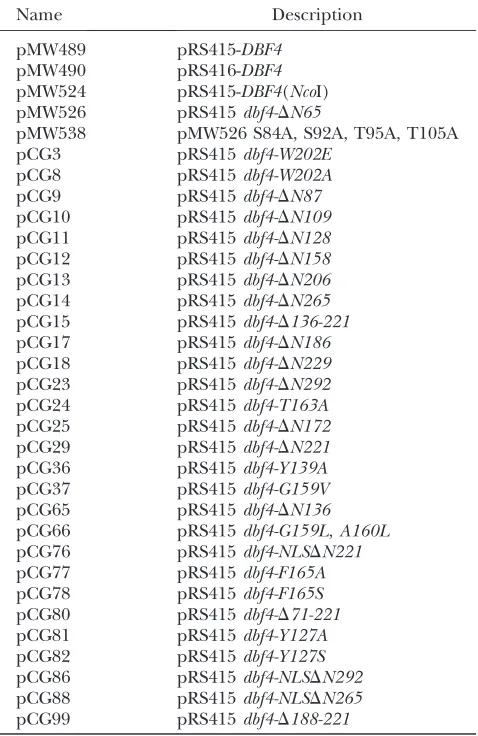
TABLE 2
Plasmids used in this study
Name Description
pMW489 pRS415-DBF4
pMW490 pRS416-DBF4
pMW524 pRS415-DBF4(NcoI) pMW526 pRS415dbf4-DN65
pMW538 pMW526 S84A, S92A, T95A, T105A
pCG3 pRS415dbf4-W202E
pCG8 pRS415dbf4-W202A
pCG9 pRS415dbf4-DN87
pCG10 pRS415dbf4-DN109
pCG11 pRS415dbf4-DN128
pCG12 pRS415dbf4-DN158
pCG13 pRS415dbf4-DN206
pCG14 pRS415dbf4-DN265
pCG15 pRS415dbf4-D136-221
pCG17 pRS415dbf4-DN186
pCG18 pRS415dbf4-DN229
pCG23 pRS415dbf4-DN292
pCG24 pRS415dbf4-T163A
pCG25 pRS415dbf4-DN172
pCG29 pRS415dbf4-DN221
pCG36 pRS415dbf4-Y139A
pCG37 pRS415dbf4-G159V
pCG65 pRS415dbf4-DN136
pCG66 pRS415dbf4-G159L,A160L
pCG76 pRS415dbf4-NLSDN221
pCG77 pRS415dbf4-F165A
pCG78 pRS415dbf4-F165S
pCG80 pRS415dbf4-D71-221
pCG81 pRS415dbf4-Y127A
pCG82 pRS415dbf4-Y127S
pCG86 pRS415dbf4-NLSDN292
pCG88 pRS415dbf4-NLSDN265
orthologs. This sequence was as conserved as the BRCT-like sequences in regions I–III (Figure 1C) yet showed little primary sequence similarity to region IV of the BRCT motif. We have called the expanded region of similarity encompassing regions I–III and region IVa the
BRCT and Dbf4p similarity (BRDF) motif. The pre-viously described motif N (Masaiand Arai2000) is con-tained within our alignment and is indicated in Figure 1A for the budding yeast and other orthologs. Therefore, we propose that Dbf4p family members encode a vari-ant of the BRCT domain composed of N-terminal BRCT-like sequences followed by a Dbf4p-specific structure.
The Dbf4p BRDF motif was dispensable for viabil-ity:The N terminus of Dbf4p is capable of interacting with origins (requiring residues 1–241 as measured by a one-hybrid assay) (Dowell et al. 1994) and ORCs (residues 1–296 by two-hybrid and GST pull-down assays) (Dunckeret al. 2002), suggesting that the con-served motif N (residues 135–179) encodes an origin-targeting domain and therefore might be essential for viability. To determine directly the Dbf4p N-terminal
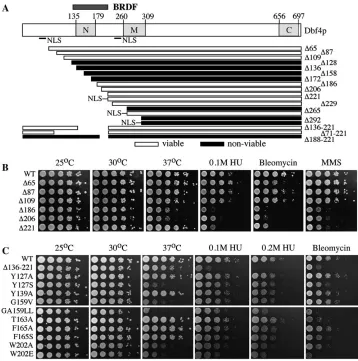
residues that were essential for viability we tested a series of truncation mutants spanning the N-terminal 292 amino acids of Dbf4p for their ability to rescue the viability of a yeast strain containing a dbf4DTkanMX6 (Figure 2A). Mutants that lacked the first 221 or 229 amino acids, and thus deleted the predicted BRDF motif, complemented the dbf4D albeit with somewhat slower growth rates. The mutants that deleted to residues 265 or 292 did not provide for yeast viability. However, since Dbf4p contains two putative nuclear localization signals (NLSs) at positions 55–61 and 251– 257, these mutants might not be viable because the Dbf4 proteins are not localized to the nucleus. Therefore, we added a single copy of the SV40 NLS onto the 221, 265, and 292 Dbf4p deletion derivatives and tested their ability to provide the essential function of Dbf4p. The SV40 NLS rescued the slower-growth phenotype of the
dbf4-DN221 mutant (see below) and rescued the in-viability of the dbf4-DN265 mutant but not the
the first 265 amino acids of Dbf4 (which removes five residues within motif M) was provided by a heterologous NLS. The deletion mutant removing the majority of motif M was not viable, providing evidence that motif M encodes sequences essential for Dbf4p function.
These data were consistent with Dbf4p containing a single BRCT-like domain predicted by the sequence alignment in Figure 1A. The deletion mutants to positions 109 and 221 that bracketed the BRDF motif or the internal deletion mutants that removed this entire motif (Figure 2, B and C) were viable and had stable growth phenotypes at all temperatures. This indi-cated that the BRDF motif was not required for an essential role in DNA replication. We note, however, that six N-terminal Dbf4p truncations that fell within regions I–IVa gave rise to mutants that were either nonviable or temperature sensitive (ts), at first suggest-ing that this domain was essential for viability. A deletion mutant that removed just region IVa was also inviable. However, inspection of the sequence alignment in Figure 1A shows that these deletions truncated Dbf4p within predicted secondary structural elements of the BRDF motif (Figure 1A, solid arrows) and would therefore be predicted to be structurally destabilizing. Importantly, we were unable to detect the Dbf4
N-ter-minally truncated proteins to residues 136, 158, 172, or 186 in a wild-type background (not shown), indi-cating that these proteins were destabilized. In sum-mary, the Dbf4p BRDF motif is not essential for DNA replication inS. cerevisiaebut deletions within this motif destabilize the protein and are nonfunctional, consis-tent with the interpretation that the BRDF motif en-codes a dispensable folded domain.
Deletions through the BRDF motif impaired cell survival in response to DNA-damaging agents: The N terminus of SpDfp1p has been implicated in the re-sponse to DNA damage and RF arrest (Takeda et al. 1999; Oginoet al. 2001; Funget al. 2002) as have the fission and budding yeast Cdc7p kinase subunits (Njagi and Kilbey1982a,b; Takedaet al. 1999; Weinreichand Stillman1999; Pessoa-Brandaoand Sclafani2004). Therefore, we determined whether the ScDbf4p BRDF was important for the response to DNA damage and RF arrest by measuring the survival of dbf4 N-terminal deletion mutants following exposure to a variety of DNA-damaging agents. We examined sensitivities to the alkylating agent MMS, the radiomimetic drug bleomy-cin, short-wave UV light that induces pyrimidine dimers, and HU, which causes fork arrest (Figure 2B). The deletion mutants up to amino acid 109 showed little Figure 2.—The BRDF motif was required for response to DNA-damaging agents. (A)
sensitivity to any of these agents. However, the trunca-tion mutants that deleted Dbf4p residues to 186, 206, or 221 (removing a part or all of the BRDF motif) exhibited sensitivity to MMS, bleomycin, and HU (Figure 2B). How-ever, these same mutants exhibited no increased sensi-tivity to 254 nm UV light over the range of 5–250 mJ/cm2 (data not shown). Therefore, deletion of the Dbf4p BRDF motif affected the response to only some forms of DNA damage.
Point mutations within conserved amino acids of the BRDF motif produced sensitivity to DNA-damaging agents: To further explore the hypothesis that Dbf4p contained a single BRCT-like domain, we made amino acid substitutions within conserved residues of the BRDF motif predicted by our alignment and tested sensitivity of the resultingdbf4mutants to DNA-damaging agents (Figure 2C). These were compared to the phenotypes of a dbf4 mutant containing an internal deletion of the BRDF motif (D136–221). As controls, the Y139A and T163A mutations affecting Dbf4p residues that are not conserved among all orthologs produced little sensitiv-ity to MMS (not shown) or HU, although the T163A mutation conferred sensitivity to bleomycin.
We summarize several mutations affecting conserved residues in regions II and IVa. A double leucine mutation was constructed within the highly conserved ‘‘GG/GA’’ sequence of BRCT proteins that is absolutely conserved among Dbf4p proteins. Importantly, this G159L A160L mutant exhibited substantial sensitivity to HU and bleo-mycin (Figure 2C). We also made W202A and W202E mutations that alter a conserved hydrophobic residue in
region IVa that is unique to Dbf4p orthologs. These point mutations also conferred sensitivity to HU and bleomycin that was similar to a deletion of the BRDF motif (Figure 2C). Since point mutations in both regions II and IVa give rise to similar mutant phenotypes, this provides evidence that the entire BRDF motif defined by our alignment is required for the response to genotoxic stress. It is important to note that although the BRDF motif was not essential and its deletion did not result in a ts phenotype (Figure 2C), some mutations within this domain clearly did give rise to ts phenotypes. Therefore, at least at 37°, the ts mutants had impaired the essential function of Dbf4p, presumably through indirect effects on Dbf4p stability as stated above.
The dbf4-DN221 mutant is defective for DNA rep-lication: We tested directly whether the dbf4-DN221
mutant had DNA replication and initiation defects by comparing the growth rate, cell cycle progression, and initiation activity of thedbf4-DN221mutant to the wild type anddbf4-NLSD221mutant. Thedbf4-DN221mutant had a markedly slower growth rate than wild type (Figure 3A), delayed S-phase entry (20 min later than wild type), and progressed slowly through S-phase, completing S-phase40 min after the wild type (Figure 3B). Since DBF4is essential for the initiation of DNA replication and not for any other known process, these phenotypes were most consistent with a decrease in its essential initiation activity. We tested this directly by neutral/neutral two-dimensional agarose gels to exam-ine replication intermediates at theARS306andARS501
origins. In the wild type, the replication intermediates at Figure 3.—Deletion of the BRDF motif causes growth and DNA replication defects that are rescued by an NLS. (A) Growth curves of WT(W303-1A),
dbf4-DN65 (M1642), dbf4DN109
(M1261), dbf4-DN221(M1356), and dbf4-NLSDN221 (M1830) at 25°. (B) W303-1A, M1356, and M1830 were arrested in G1-phase with a-factor, released into the cell cycle at 25°, and then ana-lyzed by flow cytometry. (C) Two-dimensional gels of W303-1A, M1356, and M1830 at the
these origins consist of bubble arcs and a high ratio of large forks to small forks, since they fire in almost every cell cycle. Thedbf4-DN221mutant, however, is compro-mised for initiating DNA replication at the ARS501
origin and is less efficient at activating ARS306 com-pared to the wild type (Figure 3C). Importantly, addi-tion of the NLS to thedbf4-DN221mutant complemented many of these defects. Thedbf4-NLSDN221mutant had a nearly wild-type growth rate (Figure 3A), S-phase entry and progression (Figure 3B), exhibited wild-type origin firing atARS306, and had partially restored origin firing atARS501(Figure 3C). Therefore, thedbf4-DN221mutant is impaired for DNA replication likely due to inefficient nuclear localization.
Initiation mutants are generally sensitive to MMS but not to HU or bleomycin: Although dbf4mutants affecting the BRDF motif conferred sensitivity to HU and bleomycin, replication initiation mutants were not in general sensitive to these agents. However, all the initiation mutants we tested were sensitive to MMS, raising the possibility that the MMS sensitivities ofdbf4
deletion mutants affecting the BRDF motif might be a secondary consequence of their decreased initiation activity. We examined the DNA damage sensitivity phe-notypes of five different initiation mutants and the inte-grateddbf4-DN221allele to the wild-type strain (Figure 4A). The initiation mutants displayed a variety of pheno-types in the presence of HU. For instance, cdc47-1
(encoding a mutation in Mcm7p) exhibited a profound sensitivity to HU,dbf4-DN221was 100-fold more sensi-tive than wild type, whereascdc46-1(encoding a muta-tion in Mcm5p) andcdc6-1exhibited little sensitivity to HU. In contrast, all of the initiation mutants (including
dbf4-1) behaved identically in response to MMS expo-sure. A concentration of 0.01% MMS had little effect on viability of the mutants; however, they were extremely sensitive to 0.033% MMS compared to wild-type cells (Figure 4A). This MMS concentration induces the intra-S-phase checkpoint (Paulovichand Hartwell1995), which slows replication fork progression and also in-hibits late origin firing (Santocanale and Diffley 1998; Shirahige et al. 1998). Since the initiation mutants already have a lowered frequency of replication initiation, it is not unexpected that a further reduction in origin firing and slower replication fork dynamics induced by the intra-S-phase checkpoint were lethal.
Since addition of an SV40 NLS rescued the viability of thedbf4-DN265mutant (Figure 2A) and largely restored wild-type growth and S-phase progression to the
dbf4-DN221 mutant (Figure 3) we wondered whether the various drug sensitivities caused by removing the BRDF motif might result from compromised initiation activity of thedbf4-DN221protein due to a nuclear localization defect. Therefore, we compared the growth properties and DNA damage sensitivities of the wild-type strain to the dbf4-DN109, -DN221, and -NLSDN221 alleles in-tegrated at theDBF4 locus. As we suspected, the NLS rescued the MMS sensitivity of thedbf4-DN221mutant (Figure 4B), indicating that its MMS sensitivity was not directly due to the loss of the BRDF motif. The dbf4-NLSDN221 mutant also had wild-type sensitivity to bleomycin but in contrast, retained the HU sensitivity of the originaldbf4-DN221mutant (Figure 4C). These data suggested that the BRDF motif functions principally in response to RF arrest. A high-copy plasmid contain-ing dbf4-DN221 had little effect on the DNA damage Figure4.—Sensitivity of initiation mutants to DNA-damaging agents. (A) Tenfold serial dilutions of saturated cultures were spotted onto YPD plates containing the indicated compounds and scored after 3 days at 25°: WT(W303-1A), dbf4-DN221
(M1356),cdc7-1(M199),dbf4-1(M361),cdc6-1(M378),cdc46-1(M323), andcdc47-1(M317). (B and C) WT(W303-1A) and integrated
phenotypes or growth rate (not shown), indicating that increased dbf4-DN221 gene dosage could not explain the complementation of the growth rate or the MMS and bleomycin sensitivities as seen by addition of the SV40 NLS. Therefore, HU sensitivity was the only unique drug sensitivity caused by loss of the BRDF motif; the MMS and bleomycin sensitivities were likely indirect consequences of compromised DNA replication in the
dbf4-DN221mutant (Figure 3).
Dbf4p deletions formed Cdc7p–Dbf4p complexes that interacted with ORC and retained kinase activity:
An N-terminal 296-amino-acid Dbf4p fragment interacts with ORC, predominantly through the Orc2p subunit (Dunckeret al. 2002) and the N-terminal 241 amino acids are required for anin vivoone-hybrid interaction with origins that depend on ORC (Dowellet al. 1994), suggesting that motif N may encode an origin interac-tion domain. If the Dbf4–ORC/origin interacinterac-tions were essential to recruit the Cdc7p–Dbf4p kinase to origins, then one would predict that the N-terminal region of Dbf4p would be critical for yeast viability. However, both the dbf4-DN221 anddbf4-NLSDN265mutants provided for yeast viability. This strongly suggested that the N-terminal 265 amino acids were dispensable for the rep-lication initiation function of Cdc7p–Dbf4p kinase (other than to provide nuclear localization) and that the two-subunit kinase either retained its interaction with ORC or was recruited to origins through an ORC-independent mechanism. We therefore tested whether wild-type and N-terminally deleted Dbf4 proteins coexpressed with the Cdc7p kinase subunit were equally capable of interacting with ORC by co-immunoprecipitation. ORC and HACdc7p were coexpressed with various versions of Dbf4p in insect cells and ORC was immunoprecipitated using a monoclonal antibody against the Orc3p subunit. The truncated Dbf4 proteins retained the ability to
bind Cdc7p, activate Cdc7p–Dbf4p autophosphoryla-tion (Figure 5A), and promote Mcm2p phosphorylaautophosphoryla-tion (Figure 5B), including the dbf4-DN292p mutant that deleted motif M. However, the dbf4-D265 and
dbf4-D292 kinase complexes were less efficient at Mcm2p phosphorylation than wild type. Cdc7p expressed to-gether with Dbf4p, dbf4-DN109p, dbf4-DN206p, or dbf4-DN221p co-immunoprecipitated with ORC with similar efficiencies (Figure 5C). (Since dbf4-DN221p has virtually the same mobility in SDS gels as HACdc7p, we probed for Dbf4p alone and confirmed its presence in the co-IP.) The ORC interaction was also retained with HACdc7p complexes containing dbf4-DN265p or dbf4-DN292p (not shown). These data indicated that Cdc7p–Dbf4p derivatives lacking the Dbf4p BRDF motif with or without motif M retained the ability to interact with ORC and activate Cdc7p kinase activity.
One might argue that the HU or DNA damage sensitivity caused by removing the BRDF motif was a result of markedly altered Dbf4p levels. However, the representative dbf4-DN65,dbf4-DN109, and dbf4-DN221
alleles integrated at the DBF4 locus produced similar amounts of Dbf4p to wild type (Figure 5D), indicating that the phenotypes we observed were not due to sig-nificantly altered Dbf4p expression.
Mec1p and Rad53p were required for Dbf4p phos-phorylation in response to RF arrest: Dbf4p is phos-phorylated following RF arrest and this phosphorylation requires the Rad53p checkpoint kinase (Weinreich and Stillman 1999). Since there are several kinases downstream of Rad53p that could phosphorylate Dbf4p
in vivowe surveyed all checkpoint kinases (reviewed in Zhou and Elledge 2000) that play a role in the response to RF arrest or DNA damage for their ability to induce Dbf4p phosphorylation in response to HU (Figure 6, A and B). Only the rad53-1 mutation Figure 5.—The BRDF motif was not required for activation of Cdc7p kinase activity or for an interaction with ORC. (A) Immu-noprecipitates from baculovirus-infected Sf9 cells expressing HACdc7p and the indicated Dbf4 proteins were visualized by Western blotting or for kinase ac-tivity after incubation with [g-32P]ATP or (B) also with 200 ng of Mcm2p. (C) Extracts from Sf9 cells expressing ORC and vari-ous HACdc7p-Dbf4p derivatives were immunoprecipitated with an Orc3p monoclonal antibody and then visualized for the Orc1–6 subunits or Cdc7p–Dbf4p in the extracts and IPs. (D) Dbf4p Western blot on yeast whole-cell extracts of integrated dbf4 dele-tion mutants: W303-1A(WT), M1642(dbf4-DN65), M1261(
completely abolished the Dbf4p phosphorylation. The
mec1-1 mutation in the yeast ATR homolog greatly diminished the HU-induced Dbf4p phosphorylation. However, deletion of the ATM-related kinase, Tel1p, the Dun1p kinase, or the Chk1p kinase had no effect on Dbf4p phosphorylation. The essential polo kinase Cdc5p is regulated by Rad53p (Sanchez et al. 1999); however, a cdc5-1 temperature-sensitive mutant still showed the wild-type Dbf4p phosphorylation in re-sponse to HU (Figure 6A). Since Mec1p is required for the activation of Rad53p (Sanchezet al. 1996) and Rad53p can bind (Dunckeret al. 2002) and phosphor-ylate Dbf4pin vitro(Kiharaet al. 2000), these genetic data support the model that Rad53p directly phosphorylated Dbf4p in response to replication stress. However, we cannot rule out the existence of another kinase down-stream of Rad53p that actually phosphorylated Dbf4p. This analysis allowed us to placeDBF4within the genetic diagram shown in Figure 6B.
We found that a region preceding the BRDF motif in Dbf4p was important for its Rad53p-dependent phos-phorylation. Wild-type and mutant HACdc7p–Dbf4p complexes that lacked portions of the Dbf4p N terminus were immunoprecipitated from yeast following expo-sure to HU and then probed for Cdc7 and Dbf4 pro-teins. Similar to the wild-type protein, dbf4-DN65p was phosphorylated following exposure to HU as evidenced by its reduced electrophoretic mobility (Figure 6C). In contrast, the dbf4-DN87p was partially shifted and the dbf4-DN109p did not shift following HU exposure, suggesting that the bulk of Dbf4p phosphorylation was prevented. There were two faint shifted bands above dbf4-DN109p after exposure to HU, indicating that it can be phosphorylated, although inefficiently. There-fore, important determinants for Dbf4p phosphoryla-tion map between residues 65 and 109. There are two serines and two threonines (but no tyrosines) between amino acids 65 and 109 that may be phosphorylated directly by Rad53p. A dbf4 quadruple mutant that changed all four S/T residues to alanine (‘‘4A’’) in the
dbf4-DN65 protein was still phosphorylated in response to HU (Figure 6C). This suggested that Rad53p phos-phorylation sites occur C-terminal to residue 109 and that residues 65–109 were required for a functional interaction with Rad53p perhaps by binding directly to Rad53p. Since dbf4-D109p was no longer substantially phosphorylated by Rad53p, one would predict that the
dbf4-DN109 mutant would be sensitive to HU if the Rad53p phosphorylation was important for the Dbf4p response to RF arrest. However, thedbf4-DN109mutant was not HU sensitive (Figures 2 and 4), suggesting that Rad53p phosphorylation of Dbf4p did not influence the repair of stalled RFs but influenced some other Cdc7p– Dbf4p activity.
Deletion mutants of the Dbf4p N terminus were synthetically lethal with rad53-1, mec1-1, and chk1D:
Since all of the known checkpoints involving Rad53p were operating in the absence of the Dbf4p BRDF mo-tif (supplemental Figure 1 at http://www.genetics.org/ supplemental/) several possibilities were considered. It was possible that this motif regulated Rad53p activity or that it was involved in the direct repair of arrested RFs, or both. To begin an investigation of these possibilities, we sought to understand the genetic relationship betweenMEC1,RAD53,CHK1, andDBF4by construct-ing double mutants of the checkpoint alleles with various dbf4-DN alleles. There were no synthetic inter-actions with thedbf4-DN65mutant. However, the
dbf4-DN109 and dbf4-D136-221 mutants were synthetically lethal with rad53-1 but not with mec1-1 or chk1D. Synthetic lethality was observed between dbf4-DN221
andrad53-1,mec1-1, andchk1D. We verified these syn-thetic lethal interactions using plasmid shuffle strains (Figure 7A). Importantly, the mec1-1 and rad53-1 syn-thetic lethal interactions were not relieved by deleting
109 prior to the BRDF motif (but important for Rad53p phosphorylation of Dbf4p) were synthetically lethal withrad53-1but not with mec1-1 orchk1D. These data support a functional genetic interaction between Rad53p and the Dbf4p N terminus.
The BRDF motif was not required for Rad53p activation but DBF4 was required for normal Rad53p expression:It was possible that thedbf4-DN221mutant was synthetically lethal withmec1-1,rad53-1, andchk1D
because this strain accumulated a greater number of arrested RFs, which required activation of the Mec1p, Rad53p, and Chk1p kinases to prevent entry into ana-phase until replication was complete (Zhouand Elledge 2000). Consistent with this we found that thedbf4-DN221
mutant activated Rad53p during S-phase and surpris-ingly, that Dbf4p was required for normal Rad53p expression levels. Following RF arrest, Rad53p is acti-vated following Mec1p-dependent phosphorylation that is evident as a notable mobility shift in SDS–PAGE gels. Therefore, we examined Rad53p abundance and acti-vation in synchronous cultures of the WT,dbf4-DN109,
dbf4-DN221, andclb5Dstrains passing through S-phase (Figure 7B). We examined theclb5Dstrain as a control since it has a prolonged S-phase (Schwoband Nasmyth 1993) and is also synthetically lethal withrad53Dsml1D, likely reflecting a requirement for activated Rad53p in late S-phase (Gibson et al. 2004). Wild-type cells arrested with a-factor had low levels of Rad53p (Sanchez et al. 1996). Upon release and progression through S-phase and G2/M, Rad53p accumulated in
the unphosphorylated form. Similar results were seen for the dbf4-DN109 mutant. The clb5D mutant had comparable Rad53p levels to the wild type and Rad53p was shifted to the phosphorylated form during S-phase (Gibsonet al. 2004). We saw a similar pattern of Rad53p expression in the dbf4-DN221 mutant during the cell cycle, albeit with significantly lower levels of Rad53p compared to the wild type (the blot for this mutant represents a longer exposure relative to the other strains). Rad53p was phosphorylated beginning at 80 min following the G1 release coincident with middle to late S-phase, which indicated that a sufficient level of RF arrest or DNA damage was occurring to activate Rad53p.
Since Rad53p expression was affected in the
dbf4-DN221 mutant we also examined whether RF arrest would activate Rad53p in this mutant. Whole-cell extracts from asynchronous cells were examined for the Rad53p abundance and the Rad53p mobility shift at 0, 1.5, and 3 hr following the addition of HU (Figure 7C). Although once again we saw significantly reduced levels of Rad53p in thedbf4-DN221mutant compared to the wild-type or thedbf4-DN109strains, Rad53p shifted to the slower-migrating form at 1.5 and 3.0 hr follow-ing addition of HU in all three strains, indicatfollow-ing that Rad53p was activated by replication stress in the mu-tants. Therefore, the Dbf4p N terminus was not re-quired for the activation of Rad53p; however, it was apparently required for normal Rad53p levels. Since an ectopic NLS rescued many of the replication defects Figure 7.—The DBF4 BRCT motif genetically interacted with
RAD53 and wild-type Dbf4p was important for Rad53p abundance. (A) M1587(chk1Ddbf4D), M1589 (rad53-1 dbf4D), or M1841(mec1-1 dbf4D) were transformed with the indicated DBF4 LEU2 plasmids and streaked onto selective plates. No growth on FOA indicates a syn-thetic lethal interaction. (B)
RAD53-HA3 strains containing WTDBF4(M1763) or integrated
that we noted for thedbf4-DN221 mutant, we also ex-amined Rad53p levels in the dbf4-NLSDN221 mutant and thecdc6-1anddbf4-1initiation mutants to test whether a loss of the BRDF motif itself or compromised DNA replication reduced Rad53p. Thedbf4-NLSDN221 mu-tant had wild-type Rad53p abundance (Figure 7D), suggesting that Rad53p levels were not affected by loss of the BRDF motif itself but rather by de-creased Dbf4p nuclear localization (and presumably less Cdc7p–Dbf4p kinase). Consistent with the interpretation that Dbf4p promotes Rad53p abundance, the dbf4-1
mutant also had decreased Rad53p but the cdc6-1
initiation mutant had wild-type Rad53p levels (Figure 7D). In summary, thedbf4-DN221mutant likely required checkpoint activation during S-phase to delay anaphase, thus providing one explanation for the synthetic lethal interactions with mec1-1, rad53-1, and chk1D. Further-more, the BRDF motif was not required for Rad53p activation in response to RF arrest but wild-type Dbf4p was required to maintain Rad53p abundance.
DISCUSSION
We have identified an expanded and conserved motif among multiple Dbf4p orthologs composed of both BRCT and non-BRCT consensus residues. Our extensive deletion and point mutant analysis argued that this motif was dispensable for the essential initiation activity of Dbf4, but was required for the response to RF arrest. The only essential Dbf4p sequences in the first 292 residues were provided by an NLS and motif M. Since mutants deleting motif M still bound to and activated Cdc7p kinase activity in vitro and allowed a Cdc7p– Dbf4p interaction with ORC, motif M could be required to phosphorylate essential substrates or to fully activate Cdc7p kinase activityin vivo.
Dbf4p interaction with ORC and origins:The N-ter-minal 221 amino acids of Dbf4p (that contain motif N) were dispensable for its essential role in DNA rep-lication, stimulation of Cdc7p kinase activity, and a Cdc7p– Dbf4p interaction with ORC, indicating that these residues were not required for Cdc7p–Dbf4p kinase targeting to its essential replication substrates. Further-more, although required for viability, the N-terminal 292 amino acids of Dbf4p were also not required for the Cdc7p–Dbf4p interaction with ORC interaction or Cdc7p kinase activity. A recent report (Varrin et al. 2005) provides evidence supporting the conclusion that an N-terminal interaction between Dbf4p and ORC is dispensable for cell viability. Specifically, an internal deletion of motif N allows viability even though motif N is required for an efficient two-hybrid interaction with Orc2p. These data combined with the data presented in our report, in which we show that mutant Cdc7p–Dbf4p complexes lacking motif N bind efficiently to ORC, provide compelling evidence that the Dbf4p N terminus is dispensable for interactions between Cdc7p–Dbf4p
and ORC. We postulate that Cdc7p–Dbf4p kinase is targeted to ORC/origins through redundant interac-tions. This idea is consistent with previous data suggest-ing that both Dbf4p and Cdc7p interact with ORC (Hardy1996; Dunckeret al. 2002) and that Cdc7p is present on the chromatin in the absence of the Dbf4p subunit (Weinreichand Stillman1999). A precedent for this exists in the literature since both the cyclin and the kinase subunits of Cdks contribute to substrate binding (Morgan1995; Zhuet al. 1995). We can only speculate on the function of the previously described Dbf4p N-terminal–ORC/origin interaction: it might re-flect a redundant mechanism for Cdc7p kinase target-ing to origins, it could perform a regulatory role preventing Cdc7p–Dbf4p interaction with origins (Pasero
et al. 1999; Dunckeret al. 2002), or it might be required for targeting to a subset of origins.
Dbf4p contains a variant of the BRCT motif impor-tant for the cell’s ability to respond to DNA damage:
Earlier examinations of Dbf4p orthologs revealed an 40-amino-acid N-terminal region of similarity called CDDN2 (Landisand Tower1999) or motif N (Takeda
et al. 1999). This region was later found to share ho-mology with the N terminus of the BRCT motif (Masai and Arai2000). BRCT motifs are present in single or tandemly repeated copies in many proteins involved in the DNA damage response and structural comparisons among several BRCT domains indicate that they share a common fold (Gloveret al. 2004). On the basis of this significant observation, we searched more explicitly for an extended region of homology that would match a BRCT motif since these encode 100-amino-acid do-mains. We generated an expanded N-terminal Dbf4p alignment and identified additional similarity surround-ing motif N. This included a significant30-amino-acid block of similarity C-terminal to motif N, which, how-ever, diverged from the BRCT consensus. On the basis of this alignment and extensive analysis ofdbf4mutants, we suggest that this expanded region of similarity (that we term the BRDF motif) encodes a domain within Dbf4p involved in the response to RF arrest.
We positioned the structural elements from the crystal structure of the Brca1 BRCT repeats (Williams
et al. 2001) above the Dbf4 multiple sequence alignment for regions I–III (Figure 1A). It should be noted that thea2-helix following region III in Brca1 makes intra-domain contacts between the two BRCTrepeats (Williams
b-sheet–a-helix–a-helix secondary structure through the conserved region IVa (Figure 1A) corresponding to the secondary structure at the C-terminal end of the BRCT motif (b4–a3). The fungal orthologs are likewise predicted to encode an a-helix–a-helix structure in region IVa with similar positioning to thea-helices for the vertebrate species. Remarkably, the seconda-helix for the orthologs was predicted to terminate precisely at the end of the BRDF motif that we independently defined on the basis of a multiple sequence alignment. Although structural prediction is certainly not conclu-sive evidence, our analysis supports the notion that Dbf4 proteins may encode a BRCT-like domain. Significantly, our mutational and deletion analysis further supported the assignment of a single BRCT-like motif required for the response to RF arrest.
The Brca1 BRCT tandem repeat is a phosphopeptide-binding module (Mankeet al. 2003; Yuet al. 2003) and therefore, one important role for BRCT domains in general may be to recognize proteins phosphorylated by checkpoint kinases in response to DNA damage. Since a tandem BRCT repeat was shown to interact with phosphoproteins, it is unclear whether a single BRCT repeat or the predicted Dbf4p BRDF domain will also bind phosphopeptides. A Dbf4p BRDF domain could target Cdc7p kinase for repair of specific DNA lesions that cause replication fork stalling or directly to the stalled replisome since it phosphorylates many compo-nents of the replication fork in vitro, including MCM proteins, Cdc45p, and DNA polymerasea(Leiet al. 1997; Satoet al. 1997; Brown and Kelly1998; Jianget al. 1999; Roberts et al. 1999; Weinreichand Stillman 1999; Nougaredeet al. 2000). Since Rad53p promotes MCM stability at stalled forks (Cobb et al. 2005) and Dbf4p is downstream of Rad53p, it is tempting to spec-ulate that Cdc7p–Dbf4p kinase phosphorylates the MCM helicase following fork arrest to promote MCM stability or influence helicase activity.
Loss of the Dbf4p BRDF motif did not affect Rad53p activation: We found that the Dbf4p BRDF domain was not required for Rad53p activation in response to HU. Amino acids 1–296 of Dbf4p interact with the Rad53p FHA1 and FHA2 domains (Duncker
et al. 2002), strongly suggesting that Cdc7p–Dbf4p kinase interacts directly with Rad53p.RAD53alleles also have genetic interactions withCDC7(Dohrmannet al. 1999) and these authors show that RAD53 alleles have de-creased Dbf4p abundance (Dohrmannet al. 1999). We observed the reciprocal interaction, since adbf4mutant lacking the BRDF domain had less Rad53p. However, this was not due to the loss of the BRDF domain itself, since addition of an NLS to theDBRDF mutant restored wild-type Rad53p levels. The reduction in Rad53 pro-tein, which also occurs in the dbf4-1 mutant, might therefore be attributable to decreased Dbf4p levels within the nucleus. It was not an indirect effect of fewer S-phase cells in the mutant since we observed lowered
Rad53p in synchronous cells proceeding through S-phase and after arresting cells in S-S-phase with HU. Furthermore, it cannot be due to decreased origin firing since anorc2-1mutant that reduces genomewide origin firing by 30% has wild-type Rad53 protein levels (Shimada
et al. 2002) as does acdc6-1mutant (Figure 7D). Since depletion of the fission yeast Cdc7p kinase subunit, SpHsk1p, results in a defect in SpCds1p (or ScRad53p) activation (Takeda et al. 2001) it appears that both Cdc7p–Dbf4p yeast homologs affect aspects of Rad53p/ Cds1p activity, but they may accomplish this through different mechanisms.
Rad53p phosphorylation of Dbf4p in response to RF arrest:Dbf4p phosphorylation in response to RF arrest was genetically dependent on MEC1 and RAD53 but not their downstream effectors, suggesting that Rad53p directly phosphorylated Dbf4p. Residues 65–109 within Dbf4p were required for its Rad53p-dependent phos-phorylation in response to replication fork stalling. Interestingly, thedbf4-DN109mutant was essentially wild type for growth, S-phase progression, and the response to various DNA-damaging agents, suggesting that Rad53p phosphorylation of Dbf4p did not contribute directly to repair of stalled forks or DNA damage. This mutant was nonetheless synthetically lethal with rad53-1 (but not
mec1-1 or chk1D), suggesting that Rad53p controls an essential process requiring either Dbf4p or another ef-fector. Since Rad53p is required to inhibit late replica-tion origin firing in response to DNA damage or HU (Santocanaleand Diffley1998; Shirahigeet al. 1998), a clear and consistent possibility with the above data is that Rad53p phosphorylation inhibits Cdc7p–Dbf4p activation of late replication origins. However, the mechanism underlying the synthetic lethal interac-tion between rad53-1 and dbf4-DN109 remains to be determined.
In conclusion, although Cdc7p–Dbf4p kinase is essen-tial for the initiation of DNA replication, ample evi-dence indicates that it promotes other aspects of chromosome metabolism. We propose that the Dbf4p regulatory subunit contains a variant of the BRCT motif that might target the kinase to arrested RFs and might also help direct a functional interaction with the Rad53p checkpoint kinase. Cdc7p kinase also functions in error-prone repair sincecdc7alleles are hypomutable (Njagi and Kilbey 1982a,b). This activity ofCDC7 oc-curs in the branch of theRAD6epistasis group (Kilbey 1986) devoted to translesion repair (Pessoa-Brandao and Sclafani2004), suggesting that Cdc7p–Dbf4p might modulate the process of translesion DNA synthesis. Cdc7p–Dbf4p kinase also promotes centromeric cohe-sion inS. pombe(Bailiset al. 2003) and in Xenopus oper-ates in a DNA-damage checkpoint pathway (Costanzo
We thank Leland Hartwell, Maria Pia Longhese, Rodney Rothstein, and Oscar Aparicio for generously providing yeast strains; Ping Zhao and Brian Cao for production of monoclonal antibodies at Van Andel Research Institute (VARI); and Eric Xu and James Keck for input on the alignment and BRCT structure representation in Figure 1. This work was supported by the VARI, Michigan Economic Development Corporation award GR-205/085P1000549 to M.W., and National Institutes of Health grant GM056890 to C.A.F.
LITERATURE CITED
Aparicio, O. M., A. M. Stout and S. P. Bell, 1999 Differential
assembly of Cdc45p and DNA polymerases at early and late ori-gins of DNA replication. Proc. Natl. Acad. Sci. USA96:9130– 9135.
Bailis, J. M., P. Bernard, R. Antonelli, R. C. Allshireand S. L.
Forsburg, 2003 Hsk1-Dfp1 is required for
heterochromatin-mediated cohesion at centromeres. Nat. Cell. Biol.5:1111–1116. Bell, S. P., and A. Dutta, 2002 DNA replication in eukaryotic cells.
Annu. Rev. Biochem.71:333–374.
Bell, S. P., J. Mitchell, J. Leber, R. Kobayashiand B. Stillman,
1995 The multidomain structure of Orc1p reveals similarity to regulators of DNA replication and transcriptional silencing. Cell83:563–568.
Bork, P., K. Hofmann, P. Bucher, A. F. Neuwald, S. F. Altschul et al., 1997 A superfamily of conserved domains in DNA damage-responsive cell cycle checkpoint proteins. FASEB J.11:68–76. Bousset, K., and J. F. Diffley, 1998 The Cdc7 protein kinase is
re-quired for origin firing during S phase. Genes Dev.12:480–490. Brown, G. W., and T. J. Kelly, 1998 Purification of Hsk1, a
mini-chromosome maintenance protein kinase from fission yeast. J. Biol. Chem.273:22083–22090.
Callebaut, I., and J. P. Mornon, 1997 From BRCA1 to RAP1: a
widespread BRCT module closely associated with DNA repair. FEBS Lett.400:25–30.
Cobb, J. A., T. Schleker, V. Rojas, L. Bjergbaek, J. A. Terceroet al.,
2005 Replisome instability, fork collapse, and gross chromo-somal rearrangements arise synergistically from Mec1 kinase and RecQ helicase mutations. Genes Dev.19:3055–3069. Costanzo, V., D. Shechter, P. J. Lupardus, K. A. Cimprich, M.
Gottesman et al., 2003 An ATR- and Cdc7-dependent DNA
damage checkpoint that inhibits initiation of DNA replication. Mol. Cell11:203–213.
Diffley, J. F., and K. Labib, 2002 The chromosome replication
cy-cle. J. Cell Sci.115:869–872.
Diffley, J. F., J. H. Cocker, S. J. Dowelland A. Rowley, 1994 Two
steps in the assembly of complexes at yeast replication origins
in vivo. Cell78:303–316.
Dohrmann, P. R., G. Oshiro, M. Tecklenburgand R. A. Sclafani,
1999 RAD53regulates DBF4 independently of checkpoint func-tion inSaccharomyces cerevisiae. Genetics151:965–977.
Donaldson, A. D., W. L. Fangmanand B. J. Brewer, 1998 Cdc7 is
required throughout the yeast S phase to activate replication ori-gins. Genes Dev.12:491–501.
Dowell, S. J., P. Romanowskiand J. F. Diffley, 1994 Interaction of
Dbf4, the Cdc7 protein kinase regulatory subunit, with yeast replication originsin vivo. Science265:1243–1246.
Duncker, B. P., K. Shimada, M. Tsai-Pflugfelder, P. Paseroand
S. M. Gasser, 2002 An N-terminal domain of Dbf4p mediates
interaction with both origin recognition complex (ORC) and Rad53p and can deregulate late origin firing. Proc. Natl. Acad. Sci. USA99:16087–16092.
Foiani, M., F. Marini, D. Gamba, G. Lucchini and P. Plevani,
1994 The B subunit of the DNA polymerase alpha-primase complex inSaccharomyces cerevisiaeexecutes an essential function at the initial stage of DNA replication. Mol. Cell. Biol.14:923– 933.
Friedman, K. L., and B. J. Brewer, 1995 Analysis of replication
in-termediates by two-dimensional agarose gel electrophoresis. Methods Enzymol.262:613–627.
Fung, A. D., J. Ou, S. Buelerand G. W. Brown, 2002 A conserved
domain ofSchizosaccharomyces pombedfp1(1) is uniquely required
for chromosome stability following alkylation damage during S phase. Mol. Cell. Biol.22:4477–4490.
Geraghty, D. S., M. Ding, N. H. Heintz and D. S. Pederson,
2000 Premature structural changes at replication origins in a yeast minichromosome maintenance (MCM) mutant. J. Biol. Chem.275:18011–18021.
Gibson, D. G., J. G. Aparicio, F. Huand O. M. Aparicio, 2004
Di-minished S-phase cyclin-dependent kinase function elicits vital Rad53-dependent checkpoint responses inSaccharomyces cerevi-siae. Mol. Cell. Biol.24:10208–10222.
Glover, J. N., R. S. Williamsand M. S. Lee, 2004 Interactions
be-tween BRCT repeats and phosphoproteins: tangled up in two. Trends Biochem. Sci.29:579–585.
Hardy, C. F., 1996 Characterization of an essential Orc2p-associated
factor that plays a role in DNA replication. Mol. Cell. Biol.16:
1832–1841.
Hardy, C. F., and A. Pautz, 1996 A novel role for Cdc5p in DNA
replication. Mol. Cell. Biol.16:6775–6782.
Hardy, C. F., O. Dryga, S. Seematter, P. M. Pahl and R. A.
Sclafani, 1997 mcm5/cdc46-bob1bypasses the requirement for
the S phase activator Cdc7p. Proc. Natl. Acad. Sci. USA 94:
3151–3155.
Jackson, A. L., P. M. Pahl, K. Harrison, J. Rosamondand R. A.
Sclafani, 1993 Cell cycle regulation of the yeast Cdc7 protein
kinase by association with the Dbf4 protein. Mol. Cell. Biol.13:
2899–2908.
Jiang, W., D. McDonald, T. J. Hopeand T. Hunter, 1999
Mam-malian Cdc7-Dbf4 protein kinase complex is essential for initia-tion of DNA replicainitia-tion. EMBO J.18:5703–5713.
Joo, W. S., P. D. Jeffrey, S. B. Cantor, M. S. Finnin, D. M.
Livingstonet al., 2002 Structure of the 53BP1 BRCT region
bound to p53 and its comparison to the Brca1 BRCT structure. Genes Dev.16:583–593.
Kanemaki, M., A. Sanchez-Diaz, A. Gambusand K. Labib, 2003
Func-tional proteomic identification of DNA replication proteins by in-duced proteolysisin vivo. Nature423:720–724.
Kihara, M., W. Nakai, S. Asano, A. Suzuki, K. Kitada et al.,
2000 Characterization of the yeast Cdc7p/Dbf4p complex pu-rified from insect cells. Its protein kinase activity is regulated by Rad53p. J. Biol. Chem.275:35051–35062.
Kilbey, B. J., 1986 cdc7alleles and the control of induced
mutagen-esis in yeast. Mutagenmutagen-esis1:29–31.
Kitada, K., L. H. Johnston, T. Sugino and A. Sugino,
1992 Temperature-sensitivecdc7mutations ofSaccharomyces cer-evisiaeare suppressed by theDBF4gene, which is required for the G1/S cell cycle transition. Genetics131:21–29.
Koonin, E. V., S. F. Altschuland P. Bork, 1996 BRCA1 protein
products. . .functional motifs. Nat. Genet.13:266–268. Landis, G., and J. Tower, 1999 TheDrosophilachiffon gene is
re-quired for chorion gene amplification, and is related to the yeast Dbf4 regulator of DNA replication and cell cycle. Development
126:4281–4293.
Lei, M., Y. Kawasaki, M. R. Young, M. Kihara, A. Suginoet al.,
1997 Mcm2 is a target of regulation by Cdc7-Dbf4 during the initiation of DNA synthesis. Genes Dev.11:3365–3374. Manke, I. A., D. M. Lowery, A. Nguyenand M. B. Yaffe, 2003 BRCT
repeats as phosphopeptide-binding modules involved in protein targeting. Science302:636–639.
Masai, H., and K. Arai, 2000 Dbf4 motifs: conserved motifs in
ac-tivation subunits for Cdc7 kinases essential for S-phase. Biochem. Biophys. Res. Commun.275:228–232.
Morgan, D. O., 1995 Principles of CDK regulation. Nature374:
131–134.
Njagi, G. D., and B. J. Kilbey, 1982a cdc7–1a temperature sensitive
cell-cycle mutant which interferes with induced mutagenesis in
Saccharomyces cerevisiae. Mol. Gen. Genet.186:478–481. Njagi, G. D., and B. J. Kilbey, 1982b Mutagenesis incdc7strains of
yeast. The fate of premutational lesions induced by ultraviolet light. Mutat. Res.105:313–318.
Nougarede, R., F. D. Seta, P. Zarzovand E. Schwob, 2000
Ogino, K., T. Takeda, E. Matsui, H. Iiyama, C. Taniyamaet al.,
2001 Bipartite binding of a kinase activator activates Cdc7-related kinase essential for S phase. J. Biol. Chem.276:31376–31387. Palacios DeBeer, M. A., U. Muller and C. A. Fox, 2003
Dif-ferential DNA affinity specifies roles for the origin recognition complex in budding yeast heterochromatin. Genes Dev.17:1817– 1822.
Pasero, P., B. P. Duncker, E. Schwoband S. M. Gasser, 1999 A role
for the Cdc7 kinase regulatory subunit Dbf4p in the formation of initiation-competent origins of replication. Genes Dev.13:2159– 2176.
Paulovich, A. G., and L. H. Hartwell, 1995 A checkpoint
regu-lates the rate of progression through S phase inS. cerevisiaein re-sponse to DNA damage. Cell82:841–847.
Pessoa-Brandao, L., and R. A. Sclafani, 2004 CDC7/DBF4
func-tions in the translesion synthesis branch of theRAD6epistasis group inSaccharomyces cerevisiae. Genetics167:1597–1610. Roberts, B. T., C. Y. Ying, J. Gautierand J. L. Maller, 1999 DNA
replication in vertebrates requires a homolog of the Cdc7 protein kinase. Proc. Natl. Acad. Sci. USA96:2800–2804.
Rothstein, R. J., 1983 One-step gene disruption in yeast. Methods
Enzymol.101:202–211.
Sanchez, Y., B. A. Desany, W. J. Jones, Q. Liu, B. Wang et al.,
1996 Regulation of RAD53 by the ATM-like kinases MEC1
andTEL1in yeast cell cycle checkpoint pathways. Science271:
357–360.
Sanchez, Y., J. Bachant, H. Wang, F. Hu, D. Liuet al., 1999 Control
of the DNA damage checkpoint by Chk1 and Rad53 protein kinases through distinct mechanisms. Science286:1166–1171. Santocanale, C., and J. F. Diffley, 1998 A Mec1- and
Rad53-dependent checkpoint controls late-firing origins of DNA repli-cation. Nature395:615–618.
Sato, N., K. Araiand H. Masai, 1997 Human and Xenopus cDNAs
encoding budding yeast Cdc7-related kinases:in vitro phosphor-ylation of MCM subunits by a putative human homologue of Cdc7. EMBO J.16:4340–4351.
Schwob, E., and K. Nasmyth, 1993 CLB5andCLB6, a new pair of B
cyclins involved in DNA replication in Saccharomyces cerevisiae. Genes Dev.7:1160–1175.
Sclafani, R. A., 2000 Cdc7p-Dbf4p becomes famous in the cell
cy-cle. J. Cell Sci.113(12): 2111–2117.
Shimada, K., P. Paseroand S. M. Gasser, 2002 ORC and the
intra-S-phase checkpoint: a threshold regulates Rad53p activation in S phase. Genes Dev.16:3236–3252.
Shirahige, K., Y. Hori, K. Shiraishi, M. Yamashita, K. Takahashi et al., 1998 Regulation of DNA-replication origins during cell-cycle progression. Nature395:618–621.
Stillman, B., 2005 Origin recognition and the chromosome cycle.
FEBS Lett.579:877–884.
Takayama, Y., Y. Kamimura, M. Okawa, S. Muramatsu, A. Sugino et al., 2003 GINS, a novel multiprotein complex required for chromosomal DNA replication in budding yeast. Genes Dev.
17:1153–1165.
Takeda, T., K. Ogino, E. Matsui, M. K. Cho, H. Kumagai et al.,
1999 A fission yeast gene, him1(1)/dfp1(1), encoding a reg-ulatory subunit for Hsk1 kinase, plays essential roles in S-phase initiation as well as in S-phase checkpoint control and recovery from DNA damage. Mol. Cell. Biol.19:5535–5547.
Takeda, T., K. Ogino, K. Tatebayashi, H. Ikeda, K. Araiet al.,
2001 Regulation of initiation of S phase, replication checkpoint signaling, and maintenance of mitotic chromosome structures during S phase by Hsk1 kinase in the fission yeast. Mol. Biol. Cell
12:1257–1274.
Tanaka, T., and K. Nasmyth, 1998 Association of RPA with
chromo-somal replication origins requires an Mcm protein, and is regu-lated by Rad53, and cyclin- and Dbf4-dependent kinases. EMBO J.17:5182–5191.
Thompson, J. D., T. J. Gibson, F. Plewniak, F. Jeanmouginand D. G.
Higgins, 1997 The CLUSTAL_X windows interface: flexible
strategies for multiple sequence alignment aided by quality anal-ysis tools. Nucleic Acids Res.25:4876–4882.
Varrin, A. E., A. A. Prasad, R. P. Scholz, M. D. Ramerand B. P.
Duncker, 2005 A mutation in Dbf4 motif M impairs
interac-tions with DNA replication factors and confers increased resis-tance to genotoxic agents. Mol. Cell. Biol.25:7494–7504. Weinreich, M., and B. Stillman, 1999 Cdc7p-Dbf4p kinase binds
to chromatin during S phase and is regulated by both the APC and theRAD53checkpoint pathway. EMBO J.18:5334–5346. Williams, R. S., R. Greenand J. N. Glover, 2001 Crystal structure
of the BRCT repeat region from the breast cancer-associated pro-tein BRCA1. Nat. Struct. Biol.8:838–842.
Yamashita, N., J. M. Kim, O. Koiwai, K. Arai and H. Masai,
2005 Functional analyses of mouse ASK, an activation subunit for Cdc7 kinase, using conditional ASK knockout ES cells. Genes Cells10:551–563.
Yu, X., C. C. Chini, M. He, G. Merand J. Chen, 2003 The BRCT
domain is a phospho-protein binding domain. Science 302:
639–642.
Zhang, X., S. Morera, P. A. Bates, P. C. Whitehead, A. I. Coffer et al., 1998 Structure of an XRCC1 BRCT domain: a new protein-protein interaction module. EMBO J.17:6404–6411. Zhao, X., E. G. Mullerand R. Rothstein, 1998 A suppressor of
two essential checkpoint genes identifies a novel protein that negatively affects dNTP pools. Mol. Cell2:329–340.
Zhou, B. B., and S. J. Elledge, 2000 The DNA damage response:
putting checkpoints in perspective. Nature408:433–439. Zhu, L., E. Harlow and B. D. Dynlacht, 1995 p107 uses a
p21CIP1-related domain to bind to cyclin/cdk2 and regulate in-teractions with E2F. Genes Dev.9:1740–1752.
Zou, L., and B. Stillman, 2000 Assembly of a complex containing
Cdc45p, replication protein A, and Mcm2p at replication origins controlled by S-phase cyclin-dependent kinases and Cdc7p-Dbf4p kinase. Mol. Cell. Biol.20:3086–3096.