Copyright2000 by the Genetics Society of America
Structure-Function Analysis of Yeast mRNA Cap Methyltransferase and
High-Copy Suppression of Conditional Mutants by AdoMet Synthase
and the Ubiquitin Conjugating Enzyme Cdc34p
Beate Schwer,* Nayanendu Saha,
†Xiangdong Mao,
†Hsiao-Wang Chen* and Stewart Shuman
†*Department of Microbiology and Immunology, Weill Medical College of Cornell University, New York, New York 10021 and†Molecular Biology Program, Sloan-Kettering Institute, New York, New York 10021
Manuscript received December 9, 1999 Accepted for publication April 14, 2000
ABSTRACT
Here we present a genetic analysis of the yeast cap-methylating enzyme Abd1p. To identify individual amino acids required for Abd1p function, we introduced alanine mutations at 35 positions of the 436-amino acid yeast protein. Two new recessive lethal mutations, F256A and Y330A, were identified. Alleles F256L and Y256L were viable, suggesting that hydrophobic residues at these positions sufficed for Abd1p function. Conservative mutations of Asp-178 established that an acidic moiety is essential at this position (i.e., D178E was viable whereas D178N was not). Phe-256, Tyr-330, and Asp-178 are conserved in all known cellular cap methyltransferases. We isolated temperature-sensitive abd1 alleles and found that abd1-ts cells display a rapid shut-off of protein synthesis upon shift to the restrictive temperature, without wholesale reduction in steady-state mRNA levels. These in vivo results are consistent with classical biochemical studies showing a requirement for the cap methyl group in cap-dependent translation. We explored the issue of how cap methylation might be regulated in vivo by conducting a genetic screen for high-copy suppressors of the ts growth defect of abd1 mutants. The identification of the yeast genes SAM2 and SAM1, which encode AdoMet synthase, as abd1 suppressors suggests that Abd1p function can be modulated by changes in the concentration of its substrate AdoMet. We also identified the ubiquitin conjugating enzyme Cdc34p as a high-copy abd1 suppressor. We show that mutations of Cdc34p that affect its ubiquitin conjugation activity or its capacity to interact with the E3-SCF complex abrogate its abd1 suppressor function. Moreover, the growth defect of abd1 mutants is exacerbated by cdc34-2. These findings suggest a novel role for Cdc34p in gene expression and engender a model whereby cap methylation or cap utilization is negatively regulated by a factor that is degraded when Cdc34p is overexpressed.
T
HE m7GpppN cap of eukaryotic mRNA is synthe- paratus that abrogate their catalytic activity are lethal in vivo (Fresco and Buratowski 1994; Schwer and sized by three enzymatic reactions: (i) the 5⬘tri-phosphate end of nascent pre-mRNA is hydrolyzed to Shuman 1994; Shuman et al. 1994; Mao et al. 1995, 1996;Shibagakiet al. 1995;WangandShuman1997; a diphosphate by RNA triphosphatase; (ii) the
diphos-phate end is capped with GMP by GTP:RNA guanylyl- Ho et al. 1998b).
The role of the cap in yeast mRNA metabolism has transferase; and (iii) the GpppN structure is methylated
by AdoMet:RNA-(guanine-N7)-methyltransferase. The been addressed by studying the consequences of genetic inactivation of the cap guanylyltransferase using temper-capping apparatus of the budding yeast Saccharomyces
cerevisiae consists of separate triphosphatase (Cet1p), ature-sensitive ceg1 mutants. Failure to guanylate yeast mRNAs results in their accelerated decay through the guanylyltransferase (Ceg1p), and methyltransferase
agency of the 5⬘exoribonuclease Xrn1p (Schweret al. (Abd1p) gene products (Shibagakiet al. 1992;Maoet
1998a). Deletion of XRN1 largely ameliorates the decay al. 1995;Tsukamotoet al. 1997;Hoet al. 1998a). Cet1p
phenotype, but does not bypass the requirement for and Ceg1p interact in vivo and in vitro to form a
bifunc-Ceg1p for cell growth. The implication is that stable tional triphosphatase-guanylyltransferase complex,
where-unguanylated mRNAs are not functional in vivo. Avail-as Abd1p is a monomeric methyltransferAvail-ase (Itohet al.
able genetic evidence indicates that the cap is not re-1987;Mao et al. 1995;Ho et al. 1998a;Lehman et al.
quired for 3⬘polyadenylation of yeast mRNAs (Fresco
1999). RNA capping is essential for yeast cell growth; i.e.,
and Buratowski 1996; Lo et al. 1998; Schwer et al. mutations of the triphosphatase, guanylyltransferase, or
1998a). Biochemical data show no role for the cap in methyltransferase components of the yeast capping
ap-yeast pre-mRNA splicing in vitro, and genetic evidence indicates that the cap facilitates, but is not required for, pre-mRNA splicing in vivo (Fresco and Buratowski
Corresponding author: Stewart Shuman, Molecular Biology Program,
1996;Schwer andShuman1996a).
Sloan-Kettering Institute, 1275 York Ave., New York, NY 10021.
E-mail: [email protected] We have initiated a genetic analysis of the
and gel-purified to separate the vector from the excised wild-(Glu-170, Gly-174, Asp-178, Asp-194, Arg-206, and
Tyr-type ABD1 sequence. (The p358-ABD1-3⬘plasmid is a deriva-254) are conserved in the cap methyltransferases of tive of p358-ABD1 [described inMaoet al. 1995] that contains Schizosaccharomyces pombe (Pce1p), Candida albicans a 3⬘flanking 530-bp BamHI-XbaI fragment corresponding to the 3⬘untranslated region of ABD1 gene.) The ligation mix-(Ccm1p), and humans (Hcm1p;Saha et al. 1999; see
ture was transformed into Escherichia coli DH5␣. After amplifi-Figure 1). In this study, we extended the alanine scan
cation in vivo, a pooled plasmid library was prepared from to 35 new positions of Abd1p and have thereby
identi-ⵑ24,000 ampicillin-resistant colonies harvested directly from fied two additional side chains (Phe-256 and Tyr-330) the agar plates. This DNA library was transformed into the that are essential for Abd1p function in vivo. abd1⌬strain YBS6 (MAT␣ leu2 ura3 lys2 trp1 his3 abd1::hisG p360-ABD1;Maoet al. 1995). Trp⫹transformants (n⫽1300) Delineation of structure-activity relationships,
al-were selected at 25⬚and then patched on 5-FOA medium at 25⬚ though valuable, does not instruct us regarding the role
to eliminate the wild-type ABD1 allele on the URA3 plasmid. Of of Abd1p in gene expression and whether cap
methyla-the transformants, 40% were unable to grow on 5-FOA. The tion may be regulated in vivo. To address these issues, surviving Ura⫺isolates were replica-plated and incubated at
we have isolated a collection of temperature-sensitive 25⬚(permissive temperature) and 37⬚(nonpermissive temper-(ts) abd1 alleles and found that abd1-ts cells display a ature). Those able to grow at 25⬚but not at 37⬚were selected. Plasmid DNA was recovered from 31 candidate ts mutants, rapid shut-off of protein synthesis at the restrictive
tem-amplified in vivo in E. coli DH5␣, and retested for the condi-perature, without a global decline in mRNA levels.
tional growth phenotype by plasmid shuffle. In this way, we These genetic findings are consistent with the classic obtained a collection of 22 abd1-ts mutants. Of these mutant biochemical studies of Shatkin and colleagues showing a abd1 clones, 10 were mapped at the nucleotide level by DNA requirement for the cap methyl group in cap-dependent sequencing. Multiple missense mutations in the abd1 gene were noted in every case (see Figure 2). The 10 CEN TRP1 abd1-translation in vitro (Muthukrishnan et al. 1975). We
ts plasmids were transformed into YBS10. Trp⫹transformants performed a genetic screen for high-copy suppressors
were plated on 5-FOA to eliminate the CEN URA3 ABD1 of the ts growth defect of abd1 mutants. We report that
plasmid.
growth at the restrictive temperature can be restored Temperature shift and measurement of protein synthesis by overexpression of AdoMet synthase (Sam2p or by pulse-labeling: Yeast cells were grown in supplemented minimal medium lacking methionine (SC-Met) at 25⬚. One-Sam1p) or the ubiquitin conjugating enzyme Cdc34p.
half of each culture was removed and shifted to 37⬚by rapid Potential positive and negative regulatory mechanisms
addition of an equal volume of SC-Met medium preheated to are discussed.
52⬚. Incubation was continued thereafter at 37⬚. The re-maining half of each culture was mixed with an equal volume of SC-Met medium at 25⬚. At 0, 20, 40, 60, and 120 min post-MATERIALS AND METHODS
shift, 2-ml aliquots of the cultures were removed, mixed with 8Ci of [35S]methionine (1175 Ci/mmol; Dupont NEN), and
Site-directed mutagenesis and test ofABD1function by
plas-incubated for 10 min at 37⬚or 25⬚. Incorporation of labeled
mid shuffle:Missense mutations in the ABD1 gene were
pro-methionine was measured by hot trichloroacetic acid (TCA) grammed by synthetic oligonucleotides as described (Wang
precipitation (Peltzet al. 1992). The pulse-labeling was termi-andShuman1997). Mutated ABD1 genes were inserted into
nated by adding ice-cold 100% TCA to a final concentration the yeast plasmid pSE358-5⬘(CEN TRP1). Expression of ABD1
of 10%, after which the mixtures were placed on ice for 10 in this context is driven by its natural promoter. The presence
min and then heated at 70⬚ for 20 min. The samples were of the desired mutation was confirmed in every case by
se-subsequently filtered through glass fiber filters (GF/C; 24 mm quencing the entire ABD1 insert; the occurrence of
PCR-gen-in diameter, 1.5-m pore size), which were washed with 20 erated mutations outside the targeted region was thereby
ex-ml of 5% TCA and with 10 ex-ml of 95% ethanol and then dried. cluded. p358-ABD plasmids bearing missense mutations of
The bound radioactivity was quantitated by liquid scintillation ABD1 were introduced into the abd1⌬ yeast strain YBS10
counting. The data were corrected for the background level (MAT␣leu2 ura3 lys2 trp1 his3 abd1::LEU2 p360-ABD1). YBS10
of nonspecific [35S]methionine retention on the filters, which contains an extrachromosomal copy of ABD1 on a CEN URA3
was determined by pulse-labeling cells that had been preincu-plasmid (p360-ABD1). Trp⫹ transformants were selected at
bated for 30 min at 25⬚in cycloheximide (125g/ml) prior 30⬚on medium lacking tryptophan. Individual colonies were
to adding [35S]methionine. patched on medium lacking tryptophan. Cells from each patch
SDS-PAGE analysis of pulse-labeled polypeptides:
Pulse-were then streaked on medium containing 0.75 mg/ml of
labeling was performed as described above. After quenching 5-fluoroorotic acid (5-FOA). The plates were incubated at
was recovered by centrifugation at 13,000 rpm for 20 min at the following criteria: (i) conservation in other cellular 4⬚. The pellets were washed with 1% TCA, followed by three cap methyltransferases; (ii) proximity to residues known cycles of washing with ethyl ether. The samples were dried
to be essential for Abd1p function, especially those in a vacuum centrifuge and then resuspended in SDS-PAGE
within the putative AdoMet-binding motif I (Figure 1); sample buffer. The samples were heated for 5 min at 95⬚
and then electrophoresed through a 10% polyacrylamide gel and (iii) the potential for ionic, polar, or hydrophobic containing 0.1% SDS. The gels were dried and autoradio- side-chain interactions with AdoMet or the GpppN cap
graphed. substrates. We particularly targeted conserved aromatic
RNA analysis:Yeast cells were grown in SC-Met at 25⬚to an
residues (e.g., Tyr-207, Phe-250, Phe-256, Phe-279, Trp-A600of 0.2–0.4. After withdrawing an aliquot (time zero), an
305, Phe-314, Tyr-330, Tyr-416, Phe-419, and Phe-421) equal volume of SC-Met medium preheated to 52⬚was added
to the rest of the culture to adjust the temperature abruptly in light of recent crystallographic findings for several to 37⬚. The cultures were transferred to a 37⬚incubator. Ali- proteins involved in cap formation or cap recognition quots were removed at 1, 2, and 3 hr after temperature shift. that the protein-bound cap guanine is stabilized by The cells were harvested by centrifugation and stored as cell
base-stacking interactions with aromatic amino acids pellets at⫺80⬚. RNA was isolated from thawed resuspended
(Ha˚kanssonet al. 1997;Hodelet al. 1997;
Marcotrigi-cells by extraction with hot phenol (Herricket al. 1990). The
anoet al. 1997). RNA was ethanol-precipitated and resuspended in TE (10
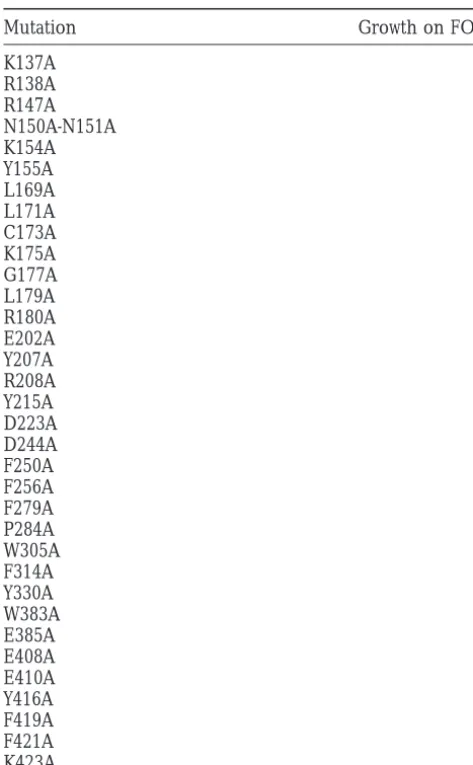
mmTris-HCl, pH 7.5, 1 mmEDTA). RNA concentration was The 33 singly mutated ABD1-Ala alleles and 1 doubly calculated on the basis of A260. Aliquots (25–30 g of total mutated allele (ABD1-N150A/N151A) were cloned into RNA) of each RNA preparation were electrophoresed through
CEN TRP1 vectors under the control of the ABD1 pro-a formpro-aldehyde/1% pro-agpro-arose gel. The gels were photogrpro-aphed
moter, transformed into an abd1⌬ strain containing a under short-wave UV illumination to visualize ethidium
bro-CEN ABD1 URA3 plasmid, and then tested for function mide-stained RNA. The RNA was then transferred to a Hybond
membrane (Amersham, Piscataway, NJ). Radiolabeled probes by plasmid shuffle. Of the mutants, 32 were functional were prepared by using a random priming kit according to in vivo; i.e., the Trp⫹ transformants formed
wild-type-the instructions of wild-type-the vendor (Boehringer Mannheim, Indi- sized colonies on medium containing 5-FOA (Table 1). anapolis). Hybridization was performed as described
(Her-All of the 31 viable single Ala mutants formed wild-type-ricket al. 1990). Hybridized probe was visualized by
autoradi-sized colonies on YPD medium at 18⬚, 25⬚, 30⬚, and 37⬚ ography of the membrane. Where indicated, the strength of
the hybridization signal was quantitated by scanning the mem- (not shown). The N150A-N151A double mutant dis-brane with a FUJIX BAS1000 Bio-Imaging analyzer. played a slow growth phenotype at 18⬚ (not shown).
RNase protection: RNase protection analysis of poly(A)⫹ Two of the mutants, F256A and Y330A, failed to grow
ABD1, SAM2, and CDC34 RNA was performed using an RNase
on 5-FOA (Table 1). The lethal F256A or abd1-protection kit according to the instructions of the vendor
Y330A alleles did not exert a dominant negative effect (Boehringer Mannheim). [32P]GMP-labeled antisense RNA
on cell growth when introduced into a wild-type ABD1 probes were synthesized in vitro by T7 or SP6 RNA polymerase
from the following pTOPO-Blunt-based plasmid templates: (i) strain. The F256A and Y330A proteins were completely pAbd1 containing a 137-bp ABD1 insert from nucleotides⫹44 insoluble when expressed in bacteria (not shown); thus, to⫹151 [⫹1 being the start of the ABD1 open reading frame
we were unable to assess the mutational effects on cap (ORF)], (ii) pSam2 containing a 139-bp SAM2 insert from
methyltransferase activity in vitro. The equivalent ala-nucleotides⫹39 to⫹169, and (iii) pCdc34 containing a
163-nine mutants of human cap methyltransferase Hcm1p bp CDC34 insert from nucleotides⫹51 to⫹213. Total RNA
was isolated from cells grown at 30⬚in SC-Ura medium to an (F291A and F354A) are defective in cap methylation in A600of 0.7–0.8. Poly(A)⫹RNA was isolated by oligo(dT) affinity vitro (Sahaet al. 1999).
chromatography using Dynabeads-Oligo(dT)25 according to Structure-activity relationships at essential residues of the instructions of the vendor (Dynal). Poly(A)⫹RNA samples
Abd1p:Alanine substitution, which eliminates the side (1g) were annealed in separate reactions to the
207-nucleo-chain beyond the-carbon, provides an indication of tide ABD1 probe, the 242-nucleotide SAM2 probe, or the
261-nucleotide CDC34 probe. The RNase digests were analyzed by the importance of the side chain for protein function, electrophoresis through a 6% polyacrylamide gel containing but does not reveal the properties of the missing side 7 m urea in TBE. 32P-Labeled DNA restriction fragments
chain that are important. This was addressed by intro-(pBR322 MspI digest) served as size markers.
ducing conservative substitutions at the newly defined essential residues, Phe-256 and Tyr-330, and at position Asp-178, which was shown previously by alanine scan-RESULTS
ning to be important for Abd1p function (Mao et al.
Alanine-scanning mutagenesis of yeast cap methyl- 1996). Phe-256 was replaced by tyrosine or leucine and
Figure1.—Mutational analysis of Abd1p. The amino acid sequence of S. cerevisiae Abd1p from residues 110 to 436 is aligned with the homologous segments of the C. albicans (Ccm1p), human (Hcm1p), and S. pombe (Pcm1p) cap-methylating enzymes (Sahaet al. 1999). Gaps in the sequences are indicated by dashes. The C termini are indicated by asterisks. The six amino acids in Abd1p deemed essential by prior mutational analyses are denoted by arrowheads. Nonessential amino acids in Abd1p are denoted by exclamation points. The Abd1p residues subjected to alanine scanning in the present study are indicated by dots. Newly defined essential residues Phe-256 and Tyr-330 are highlighted in boxes. Methyltransferase motifs I, Ia, II, and III are shown in shaded boxes.
effect on cell growth (Table 2). Hence, the acidic moiety A total of 10 abd1 mutant DNA clones were se-quenced. Multiple missense mutations in the abd1 gene is critical at this position.
Temperature-sensitive mutants of yeast cap methyl- were noted in every case (Figure 2A). Although several
of the missense changes were encountered more than
transferase: To examine the role of the cap methyl
group in vivo, we isolated a collection of temperature- once, the 10 abd1-ts alleles represented independent isolates, insofar as each mutant clone contains unique sensitive abd1 alleles from a pool of mutagenized ABD1
clones. To do this, we performed PCR amplification of mutations not found in the other mutant clones. The 67 missense mutations were unevenly distributed within the ABD1 gene under reaction conditions designed to
promote nucleotide misincorporation by Taq polymer- the 436-amino acid Abd1 polypeptide (Figure 2B). Mu-tations were underrepresented in the N-terminal segment, ase. The PCR products were restricted and cloned into
a CEN TRP1 expression plasmid, so as to replace the which is nonessential for cap methyltransferase activity. Mutations were absent from the essential AdoMet bind-wild-type ABD1 gene (under the control of its natural
promoter) with the PCR-mutagenized DNA. After am- ing motif (Figure 2B). Most of the mutations were lo-cated in the carboxyl portion of the enzyme. We surmise plification in vivo in E. coli, a pooled library of CEN TRP1
DNAs was transformed into yeast containing wild-type that none of the 60 amino acids that were mutated can be considered strictly essential for Abd1p function in ABD1 on a URA3 plasmid. After selection for Trp⫹
growth at 25⬚, followed by selection on 5-FOA to elimi- vivo, because every allele supported cell growth at 25⬚. No effort was made to determine which, if any, of the nate the wild-type allele, individual isolates were
screened for growth at 37⬚. We obtained a collection of many mutations might be singly responsible for the conditional phenotypes. All 10 abd1-ts alleles were reces-abd1-ts isolates that were temperature sensitive, i.e., they
readily formed colonies at 25⬚, but not at 37⬚. Plasmid sive to wild-type ABD1; i.e., growth at 37⬚ could be re-stored to the abd1-ts strains by transforming them with DNA was recovered from all conditional isolates and
TABLE 1 unclear. We therefore conducted a preliminary pheno-typic characterization of two abd1-ts mutants, abd1-8 and
Effect of alanine mutations onABD1functionin vivo
abd1-5, both of which grow normally at 25⬚, but display a tight growth arrest at 37⬚. We first analyzed the rate
Mutation Growth on FOA
of protein synthesis. In the experiment shown in Figure
K137A ⫹⫹⫹ 3, yeast cells were grown in methionine-free medium at
R138A ⫹⫹⫹
25⬚. The cultures were then split such that one-half
R147A ⫹⫹⫹
was mixed with an equal volume of 25⬚ medium and
N150A-N151A ⫹⫹⫹
maintained thereafter at permissive temperature,
K154A ⫹⫹⫹
Y155A ⫹⫹⫹ whereas the other half of the culture was adjusted
imme-L169A ⫹⫹⫹ diately to 37⬚and maintained thereafter at
nonpermis-L171A ⫹⫹⫹ sive temperature. Aliquots of the 25⬚and 37⬚ cultures
C173A ⫹⫹⫹ were exposed to [35S]methionine for a 10-min pulse at
K175A ⫹⫹⫹
the time the cultures were split (time zero) and at
vari-G177A ⫹⫹⫹
ous time intervals thereafter. Protein synthesis was
quan-L179A ⫹⫹⫹
titated by the incorporation of [35S]methionine into
hot-R180A ⫹⫹⫹
E202A ⫹⫹⫹ TCA-insoluble material during the 10-min pulse. The
Y207A ⫹⫹⫹ level of incorporation at each time point was normalized
R208A ⫹⫹⫹ relative to the incorporation at time zero and plotted
Y215A ⫹⫹⫹ as a function of the time of initiation of the pulse. The
D223A ⫹⫹⫹
data shown in the figure represent the average of three
D244A ⫹⫹⫹
separate experiments (with error bars shown). It can
F250A ⫹⫹⫹
be readily appreciated that the rates of protein synthesis
F256A ⫺
F279A ⫹⫹⫹ by ABD1, abd1-8, and abd1-5 cells were unaffected by
P284A ⫹⫹⫹ splitting the cultures at 25⬚(Figure 3B). Protein
synthe-W305A ⫹⫹⫹ sis by the wild-type cells was unperturbed after shift to
F314A ⫹⫹⫹ 37⬚, whereas the rates of protein synthesis by abd1-8 and
Y330A ⫺
abd1-5 cells declined sharply to 28% of the time zero
W383A ⫹⫹⫹
values by 20 min post-shift to 37⬚. At 40–120 min
post-E385A ⫹⫹⫹
shift, methionine incorporation was reduced to 17% of
E408A ⫹⫹⫹
E410A ⫹⫹⫹ the time zero value (or 12% of the incorporation of
Y416A ⫹⫹⫹ ABD1 cells after 2 hr at 37⬚; Figure 3A). The distribution
F419A ⫹⫹⫹ of pulse-labeled polypeptides was analyzed by SDS-PAGE
F421A ⫹⫹⫹ (Figure 3C). The polypeptide profile was qualitatively
K423A ⫹⫹⫹
and quantitatively unchanged when wild-type ABD1 cells were shifted to 37⬚. In contrast, abd1-8 and abd1-5 cells experienced a progressive and general inhibition of (not shown). We observed that the abd1-ts alleles had polypeptide synthesis over 2 hr at 37⬚.
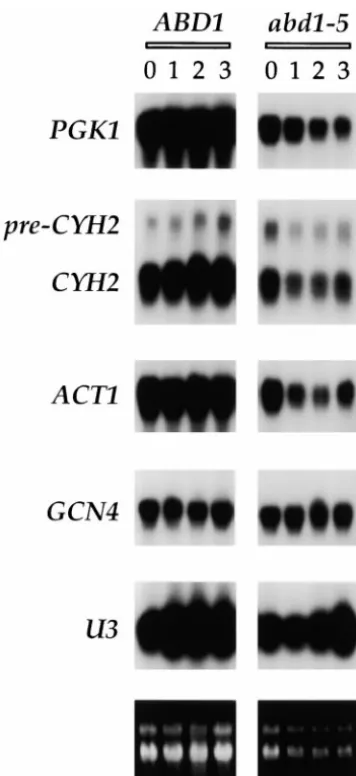
different thresholds for thermal inactivation in vivo. We next performed a Northern analysis of RNA iso-Most of the mutants were sick or dead even at 34⬚(see lated from ABD1 and abd1-5 cells before and after shift
Figure 6). to 37⬚. The results indicated that steady-state levels of
Conditional inactivation ofABD1inhibits protein syn- four different mRNAs were either unaffected or
mod-thesisin vivo:Although the cap methyltransferase activ- estly reduced at the restrictive temperature (Figure 4). ity of Abd1p is required for cell viability, the specific GCN4 mRNA abundance was unaffected; i.e., the level roles played by the cap methyl group in vivo are still of GCN4 transcript at 3 hr post-shift (as percentage of the initial level at time zero) was 83% for wild-type ABD1 cells compared to 93% for abd1-5 cells. ACT1 and PGK1
TABLE 2
mRNA levels were stable after shift of ABD1 cells to 37⬚,
Effect of conservative substitutions on whereas in abd1-5 cells, ACT1 and PGK1 RNA levels at
ABD1functionin vivo 3 hr post-shift were 39 and 31%, respectively, of the
pre-shift values. U3 snRNA levels were not altered
signifi-Mutation Growth on FOA
cantly in abd1-5 cells after the shift to 37⬚.
D178E ⫹⫹⫹ With respect to pre-mRNA processing, we did not
D178N ⫺ detect an increase in the level of unspliced ACT1
precur-F256Y ⫹⫹⫹ sor in the abd1-5 mutant after shift to 37⬚. However, we
F256L ⫹⫹⫹ noted consistently that the relative amounts of unspliced
Y330F ⫹⫹⫹
pre-CYH2 transcript vs. mature CYH2 mRNA [expressed
Y330L ⫹⫹⫹
Figure2.—abd1-ts mutants. (A) The coding changes detected in each of 10 abd1-ts alleles are listed. (B) The mutations are annotated above the sequence of the wild-type Abd1 protein. Amino acids that were altered more than once in the ts collection are underlined. Amino acids identified by alanine scanning as essential for Abd1p function are denoted by dots. The putative AdoMet binding motif is shaded.
abd1-5 cells at the permissive temperature. In ABD1 cells being that such suppressor genes might encode proteins that either interact physically or functionally with the grown at 25⬚, pre-CYH2 RNA constituted 9% of the total,
whereas in abd1-5 cells at 25⬚, the unspliced precursor cap methyltransferase or else impact on cap-dependent RNA transactions in vivo.
accounted for 27% of total CYH2 transcript (Figure 4).
The distribution of spliced vs. unspliced CYH2 RNA did We tested whether the CEG1 gene encoding the gua-nylyltransferase component of the yeast capping appara-not change significantly after shift to 37⬚. In ABD1 cells
at 37⬚, pre-CYH2 was 12% of the total. In abd1-5 cells tus could act as a dosage-dependent abd1 suppressor. A 2 URA3 plasmid containing CEG1 was transformed at 1, 2, and 3 hr post-shift to 37⬚, pre-CYH2 was 28–32%
of the total. Similar increases in pre-CYH2 at permissive into three abd1 mutant strains (abd1-42, abd1-16, and abd1-37) and the Ura⫹cells selected at 25⬚were tested and restrictive temperatures were observed for abd1-8
cells (not shown). Thus, the increase in pre-CYH2 in for growth at 34⬚and 37⬚. We found that none of these abd1-ts alleles was suppressed by 2CEG1 (not shown). abd1 cells at permissive temperature (relative to ABD1
cells) was not exacerbated by the shift to the restrictive These findings are consistent with the earlier observa-tions that Abd1p isolated from yeast cell extracts is a temperature. This suggests that defective splicing of
CYH2 RNA is not the cause of the ts growth defect in monomeric enzyme (Maoet al. 1995) that is not associ-ated physically with the guanylyltransferase. Two other the abd1 mutants. Rather, our experiments point to
defective protein synthesis as the limiting transaction. genes, CES1 and CES4, that act as high-copy suppressors of ts guanylyltransferase mutations (Schwerand
Shu-This is consistent with long-held views about the
require-ment for the cap methyl group in cap-dependent trans- man 1996b; Schwer et al. 1998b) were tested in the same three abd1-ts strains and found not to be capable lation initiation (Muthukrishnanet al. 1975).
Isolation of multicopy suppressors of ceg1-ts muta- of suppressing the ts methyltransferase mutations (not
shown). The CET1 gene encoding the RNA triphospha-tions:We exploited the newly isolated conditional
Figure 3.—Effect of abd1-ts mutations on protein synthesis. ABD1, abd1-8, and abd1-5 cells were grown at 25⬚in synthetic medium lacking methionine. After growth to A600of 0.2–0.4, the cultures were split and ei-ther shifted abruptly to 37⬚(A) or maintained at 25⬚ (B). Ali-quots were withdrawn at the times indicated and pulse-labeled for 10 min with [35S]methionine. Incorpora-tion of label into hot-TCA-insoluble material was deter-mined by liquid scintillation counting. The extents of pulse-labeling were normalized to the value at time zero (defined as 1.0). The plotted data repre-sent the average of three inde-pendent experiments; stan-dard error bars are shown. (C) SDS-PAGE analysis of pulse-labeled polypeptides. Pulse-labeling of ABD1, abd1-8, and abd1-5 cells with [35 S]methio-nine was initiated at the indi-cated times post-shift to 37⬚. Acid-insoluble material was de-natured in SDS and then elec-trophoresed through a 10% polyacrylamide gel containing 0.1% SDS. An autoradiogram of the dried gel is shown. The positions and sizes (kilodal-tons) of coelectrophoresed marker polypeptides are indi-cated at the left.
guanylyltransferase mutants (Hoet al. 1998a), also failed 34⬚. Four genomic clones retested faithfully. Restriction mapping of the genomic inserts revealed that these four to suppress the abd1-ts mutants after transformation with
a 2CET1 plasmid (not shown). clones derived from two distinct genetic loci, which we provisionally named CMS1 and CMS2 (CMS⫽cap meth-In light of the above findings suggesting that genetic
interactions of the triphosphatase and guanylyltransfer- yltransferase suppressor). CMS1 was isolated in abd1-15. CMS2 was recovered three times, twice in abd1-37 and ase do not overlap with the cap methyltransferase, we
initiated a screen for novel genes that would act as high- once in abd1-35. Analysis of the two suppressor genes is presented below.
copy suppressors of conditional abd1 mutations. The
screen entailed transformation of several of the abd1-ts Suppression of cap methyltransferase mutations by
AdoMet synthase: DNA sequencing of the borders of
strains with a 2plasmid-based wild-type genomic DNA
library and selection for Ura⫹colonies that grew at 34⬚. the genomic insert in the 2 CMS1 plasmid revealed that the suppressor gene was located on chromosome We analyzed at least 10 positives for each of the abd1-ts
strains that were transformed with the 2library. Plas- IV between coordinates 1452295 and 1461657. This 9.4-kbp region includes three known genes, SAM2 (AdoMet mid DNA was recovered from individual yeast colonies
and transformed into E. coli. Diagnostic restriction en- synthase), LPP1 (lipid phosphate synthase), and PSP1 (a high-copy suppressor of mutations in DNA polymerase), zyme digestion of the plasmids recovered from bacteria
revealed whether wild-type ABD1 had been selected. along with two ORFs of unknown function (YDR504C and YDR506C) and a partial ORF of unknown function Candidate suppressors that did not contain the ABD1
Figure5.—Dosage suppression of abd1-8 by AdoMet syn-thase. abd1-8 cells were transformed with 2URA3 plasmids containing either ABD1, SAM2, or SAM1 under the transcrip-tional control of the TPI1 promoter. Control abd1-8 cells were transformed with the 2 URA3 vector. Ura⫹ transformants were selected and grown in liquid SC-Ura medium at 25⬚. The A600was adjusted to 0.1. Aliquots (5l) of serial 10-fold dilutions of the cell suspensions were spotted onto SC-Ura agar medium. The plates were photographed after incubation for 3 days at 25⬚or 34⬚.
2vector grew at 25⬚, but not at 34⬚; cells transformed with a wild-type ABD1 gene grew well at both tempera-tures. The 2SAM2 clone restored growth at 34⬚(Figure 5) and also improved growth at 37⬚(not shown). The efficacy of high-copy suppression by SAM2 was some-what greater when expression was driven by the TPI1 promoter than when its expression was under the con-trol of its natural promoter (not shown); we presume this reflects the strength of the TPI1 promoter.
The 2URA3 TPI-SAM2 plasmid did not display strict allele specificity, but rather was capable of suppressing Figure4.—Effect of abd1-5 on steady-state RNA levels. ABD1 all of the abd1-ts alleles, albeit not to the same extent. and abd1-5 cells were grown in liquid culture at 25⬚and then Some of the abd1 alleles were restored to growth at 34⬚ shifted to 37⬚. Cells from the same culture were harvested
and 37⬚, whereas others (e.g., the most severely affected prior to shift (time zero) and at 1, 2, and 3 hr after shift to
allele abd1-20) were suppressed only at the lower restric-37⬚. Total RNA was isolated for Northern blot analysis. The
agarose gel was stained with ethidium bromide (bottom) prior tive temperatures of 30⬚, 32⬚, or 34⬚(not shown). Thus, to transfer of the RNA to a membrane. Blots were probed for the strength of suppression correlated roughly with the mRNAs derived from PGK1, CYH2, ACT1, and GCN4 genes severity of the ts phenotype.
and for U3 snRNA. Hybridized32P-labeled probe was visualized
To exclude the possibility that overexpression of by autoradiography of the membrane.
AdoMet synthase was genetically bypassing ABD1, we constructed a 2 TRP1 TPI-SAM2 plasmid and trans-formed it into a yeast strain in which the chromosomal AdoMet synthase, the enzyme that forms AdoMet from
methionine and ATP (Thomaset al. 1988). AdoMet is ABD1 gene is deleted and growth is contingent on main-tenance of a CEN URA3 ABD1 plasmid. The 2 TRP1 the substrate for cap methylation by Abd1p. Restriction
fragments of the insert were subcloned into YEp24 and TPI-SAM2 transformants were unable to form colonies on medium containing 5-FOA (not shown); hence retested for abd1 suppression. Suppression was observed
with a 2.86-kbp fragment and a 1.75-kbp fragment, both SAM2 overexpression is not bypassing the requirement for cap methyltransferase for yeast cell growth. of which contained SAM2 (not shown).
Final identification of the suppressor locus was The S. cerevisiae SAM1 gene encodes a second isozyme of AdoMet synthase; the amino acid sequence of Sam1p achieved by cloning the SAM2 ORF into a 2 URA3
yeast vector in which SAM2 expression is driven by the is 92% identical to that of Sam2p (Thomaset al. 1988). A 2 plasmid containing SAM1 under the control of constitutive TPI1 promoter. Suppression of the abd1-8
mutation by the 2 TPI-SAM2 construct is shown in the TPI1 promoter was just as effective as the SAM2 clone in restoring growth of abd1-8 at the restrictive Figure 5. Serial 10-fold dilutions of abd1-8 cells were
SAM1 in the suppressor screen may reflect either its scarcity in the genomic library used or lack of saturation of the screen.
Suppression of cap methyltransferase mutations by
exogenous AdoMet:The simplest explanation for
sup-pression of abd1 mutations by overexsup-pression of AdoMet synthase is that elevated intracellular levels of the methyl donor either stimulate the activity of the mutant Abd1p enzymes or stabilize the mutant Abd1p proteins at the restrictive temperature. A more elaborate explanation would be that AdoMet synthase interacts directly with Abd1p. If the former model is correct, then it should be possible to suppress the abd1-ts mutations by an alter-native route that provides AdoMet without increasing the levels of AdoMet synthase. S. cerevisiae can actively take up AdoMet from the medium; moreover, it has been reported that exogenous AdoMet lowers the ex-pression of SAM1 and SAM2 in strains that are wild type for both AdoMet synthase loci (Thomasand Surdin-Kurjan1991). In light of this information, we tested whether exogenous AdoMet would enhance the growth of the abd1-ts strains at the restrictive temperature. In the experiment shown in Figure 6, serial dilutions of wild-type ABD1 cells and the 10 abd1-ts mutants were plated in parallel at 34⬚on control agar medium and on agar plates that had been overlaid with AdoMet (BailisandRothstein1990). The growth of the
abd1-Figure6.—Suppression of abd1-ts mutations by exogenous 23, abd1-37, abd1-41, abd1-5, abd1-8, abd1-15, and abd1- AdoMet. ABD1 and abd1-ts cells were grown in liquid YPD 16 strains was clearly improved in the presence of exoge- medium at 25⬚. The A600was adjusted to 0.1. Aliquots (3l) of serial 10-fold dilutions of the cell suspensions were spotted nous AdoMet (Figure 6). Growth of abd1-20, which is
onto YPD agar medium (control) and YPD agar medium over-the most severe of over-the ts mutations, was not enhanced
laid with 0.25 ml of a 10-mg/ml solution of AdoMet to achieve by AdoMet at 34⬚ (Figure 6), but was improved when
a final concentration ofⵑ0.1 mg/ml (⫹AdoMet). The plates growth was tested at 30⬚(not shown). abd1-42, the mild- were photographed after incubation for 4 days at 34⬚. est conditional mutant, which grows well at 34⬚, was
accordingly unaffected by AdoMet at this temperature;
however, the growth defect of abd1-42 at 37⬚was partially Definitive identification of the suppressor locus was accomplished by cloning the 295-amino acid CDC34 ameliorated by AdoMet (not shown). These findings
suggest that an increase in the available AdoMet sub- ORF into a 2URA3 vector in which CDC34 expression is driven by the TPI1 promoter. Suppression of the abd1-8 strate is likely responsible for the suppression of abd1-ts
mutations by SAM2 or SAM1 overexpression. Only abd1- mutation by CDC34(1-295) is shown in Figure 7. abd1-8 cells transformed with the 2 vector grew at 25⬚, but 35 was not appreciably suppressed by exogenous AdoMet.
Suppression of cap methyltransferase mutations by not at 34⬚; cells transformed with a wild-type ABD1 gene grew well at both temperatures. The 2CDC34(1-295)
CDC34: CMS2 was isolated three times in the high-copy
suppressor screen. Sequencing of the margins of the clone restored growth at 34⬚(Figure 7) and also at 37⬚ (not shown).
genomic inserts in the three different 2CMS2 plasmids
revealed that the suppressor gene was located on chro- CDC34 was capable in high copy of suppressing all of the abd1-ts alleles. As with SAM2, the strength of mosome IV. The three inserts extended from genome
coordinates 554800 to 567450, 560860 to 567450, and suppression by CDC34 correlated with the severity of the ts phenotype of the individual mutants. A 2TRP1 551880 to 567081, respectively. The 6.2-kbp overlap
re-gion includes one known gene, CDC34 (an essential E2 TPI-CDC34 plasmid was unable to confer growth of an abd1⌬ strain on medium containing 5-FOA. Thus, ubiquitin conjugating enzyme), along with two ORFs of
unknown function (YDR055W and YDR056C) and a CDC34 overexpression is not bypassing the requirement for ABD1.
partial ORF of unknown function (YDR057W).
Restric-tion fragments of the inserts were subcloned into YEp24 The ubiquitin conjugating activity of Cdc34p is
essen-tial for abd1 suppression: Cdc34p is an E2 ubiquitin
and retested for abd1 suppression. Suppression was
TPI1 promoter. The C95S and C95A changes abolished the capacity of CDC34 to suppress abd1-8 (Figure 7). Hence, we conclude that formation of the Cdc34p-Ub intermediate and its transfer to an idoneous acceptor are essential for abd1 suppression.
Cdc34p catalyzes both intramolecular and intermo-lecular ubiquitin transfer reactions (Banerjee et al. 1993;Goeblet al. 1994). In the intramolecular autoubi-quitination reaction, Ub is transferred from Cys-95 to a lysine residue to form a branched multiubiquitin con-jugate. The sites of autoubiquitination have been local-ized to any of four lysines (Lys-273, Lys-277, Lys-293, Figure7.—Dosage suppression of abd1-8 by Cdc34p. The and Lys-294) in the C-terminal region of Cdc34p ( Ban-domain structure of the 295-amino acid ubiquitin conjugating erjeeet al. 1993). To test if Cdc34p autoubiquitination enzyme is shown (see text for details). abd1-8 cells were
trans-was relevant to abd1 suppression, we constructed a series formed with 2 URA3 plasmids containing the indicated
of C-terminal truncation mutants of CDC34 and tested CDC34 alleles under the transcriptional control of the TPI1
promoter. Control abd1-8 cells were transformed with the 2 their suppressor function. 252) and CDC34(1-URA3 vector. Ura⫹transformants were selected and grown in 218) were just as effective as full-length CDC34 in sup-liquid SC-Ura medium at 25⬚. The A600was adjusted to 0.1. pressing abd1-8, even though the potential sites of auto-Aliquots (5l) of serial 10-fold dilutions of the cell suspensions
ubiquitination were eliminated from the truncated gene were spotted onto SC-Ura agar medium. The plates were
pho-products (Figure 7). Thus, it is the intermolecular ubi-tographed after incubation for 3 days at 25⬚or 34⬚.
quitin conjugating activity of Cdc34p, not the autoubi-quitination function, that is essential for abd1 suppres-sion.
Sic1p, which is an inhibitor of the Cdc28p-cyclin protein
kinase complexes that are required for the G1-S transi- An N-terminal segment from residues 1 to 209 is suf-ficient for Cdc34p function in vivo (Mathiaset al. 1998), tion. Sic1p ubiquitination results in its degradation and
consequent activation of the Cdc28p-cyclin protein ki- whereas the protein segment from residues 1 to 170, which comprises a catalytic domain conserved among nase. Cdc34p functions in conjunction with an E3
com-plex, SCF, containing Cdc53p, Skp1p, and one of several E2 enzyme, cannot sustain cell growth (Kolmanet al. 1992;Silveret al. 1992; Figure 7).Mathiaset al. (1998) F-box proteins (e.g., Cdc4p, Grr1p, or Met30p; Bai et
al. 1996; Feldmann et al. 1997; Skowyra et al. 1997; have shown that the essential region of Cdc34p from residues 171 to 209 mediates the interaction of Cdc34p
Kaiseret al. 1998;Pattonet al. 1998). The F-box
com-ponent is implicated in recognizing the protein target with Cdc53p and the F-box protein Cdc4p in vivo. We find that overexpression of CDC34(1-218), which in-for Cdc34p-mediated ubiquitination. Yeast proteins that
are targeted for decay via a Cdc34p/SCF ubiquitination cludes the Cdc53p/Cdc4p binding domain, is active in abd1 suppression, whereas CDC34(1-174), which lacks pathway include Sic1p, Far1p, Cln2p, Gcn4p, Swe1p,
Cdc6p, Cdc4p, and Grr1p (Kornitzeret al. 1994;Des- the interaction domain, is nonfunctional (Figure 7). The implication of these data is that the Cdc34p exerts
haies et al. 1995; Drury et al. 1997; Feldmann et al.
1997;Henchozet al. 1997;Skowyraet al. 1997;Kaiser its abd1 suppressor function in the context of an E2-E3 complex. The intervening truncation mutant CDC34(1-et al. 1998;ZhouandHowley1998).
The biochemical properties and domain structure of 194) is nonfunctional in abd1 suppression (Figure 7), presumably because residues 195–209 are critical for Cdc34p have been analyzed in considerable detail.
Ubi-quitin transfer by E2 enzymes entails the formation of a the interaction of Cdc34p with E3 components.
Suppression ofabd1by AdoMet synthase and Cdc34p
covalent thiol ester intermediate between an E2 cysteine
Figure 8.—Dosage suppression of abd1-8 by AdoMet syn-thase and Cdc34p is independent of the ABD1 promoter. TPI-abd1-8 and TPI-abd1-15 cells were transformed with a 2URA3 vector or 2URA3 plasmids containing the indicated genes driven by the TPI1 promoter. Ura⫹transformants were se-lected and grown in liquid SC-Ura medium at 25⬚. The A600 was adjusted to 0.1. Aliquots (5l) of serial 10-fold dilutions of the cell suspensions were spotted onto SC-Ura agar medium. The plates were photographed after incubation for 2.5 days at 37⬚.
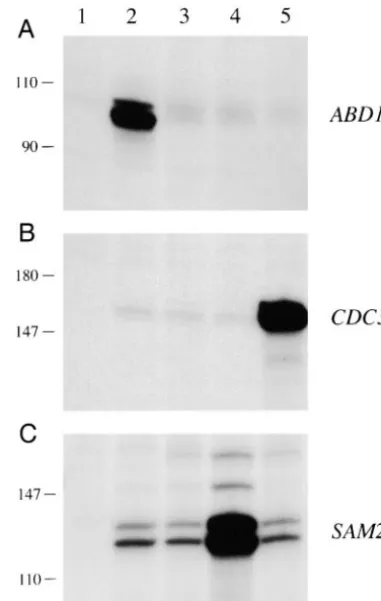
Figure9.—Lack of transcriptional crosstalk between Ado have indicated that yeast cell growth is dependent on
Met synthase and Cdc34p. Poly(A)⫹RNA isolated from yeast a threshold level of cap methyltransferase activity (Mao
cells bearing 2URA3 plasmids that contained either ABD1 et al. 1996;WangandShuman1997). In this light, we
(lane 2), no gene insert (lane 3), TPI1-SAM2 (lane 4), or questioned whether the conditional phenotype of our TPI1-CDC34 (lane 5) was annealed to radiolabeled antisense mutants might be sensitive to the levels of abd1 expres- ABD1, CDC34, or SAM2 probes (as specified to the right of each panel). Labeled RNAs protected from digestion from sion. Accordingly, we placed several of the abd1-ts alleles
RNase were resolved by PAGE and visualized by autoradiogra-under the control of the strong constitutive TPI1
pro-phy. A control RNase protection reaction lacking yeast RNA moter and introduced these genes on CEN TRP1
plas-is shown in lane 1 of each panel. The positions and sizes (in mids into yeast cells in lieu of the resident CEN URA3 nucleotides) of radiolabeled size markers are indicated on the ABD1 plasmid. Each of the TPI1-abd1 mutants remained left of each panel.
temperature sensitive (i.e., unable to grow at 37⬚, the original restrictive temperature in the mutant selection
scheme), but cell growth was improved at lower temper- that the salutary effects of increased AdoMet and Cdc34p do not occur through the ABD1 promoter, but atures (30⬚and 34⬚) that were either semipermissive or
nonpermissive for the abd1 alleles when driven by their are more likely to reflect posttranscriptional effects on Abd1p itself or downstream transactions involving the natural promoter (not shown). If, as implied by this
result, the ts phenotype is sensitive to abd1 gene expres- cap methyl group.
This hypothesis is supported by RNase protection sion levels, then the key question is whether high-copy
abd1 suppression by AdoMet synthase and Cdc34p is analysis of the steady-state levels of poly(A)⫹ ABD1 mRNA in cells that overexpress AdoMet synthase or mediated through transcriptional effects on the ABD1
promoter. If so, then one predicts that AdoMet synthase Cdc34p (Figure 9). Whereas the basal level of ABD1 transcript (Figure 9A, lane 3) was increased dramatically and Cdc34p will be unable to suppress the TPI-abd1-ts
phenotype. In fact, the opposite scenario was observed; by the introduction of ABD1 on a multicopy plasmid (Figure 9A, lane 2), the introduction of multicopy plas-i.e., 2 plasmids containing SAM2, SAM1, or CDC34
clearly did suppress the growth defect of TPI-abd1-8 and mids containing SAM2 (Figure 9A, lane 4) or CDC34 (Figure 9A, lane 5) elicited no change in the abundance TPI-abd1-15 cells at 37⬚(Figure 8). The CDC34 mutants
CDC34(C95S) and CDC34(1-174) were inactive in TPI- of ABD1 mRNA. Control RNase protection experiments confirmed that the steady-state levels of CDC34 and abd1-8 suppression (not shown), just as they were in
suppressing abd1-8 driven by its own promoter. 2plas- SAM2 mRNAs were themselves increased by increased CDC34 and SAM2 gene dosage (Figure 9B, lane 5, and mids containing the CET1 or CEG1 genes were also
agar medium. The plates were photographed after in-cubation at 25⬚ (for 4.5 days), 30⬚(for 3.5 days), and 32⬚or 37⬚(for 3 days).
The results in Figure 9 also reveal a lack of crosstalk geted to 61 positions of Abd1p located within the C-terminal catalytic domain. The eight residues found at the transcriptional level between AdoMet synthase
and Cdc34p. Overexpression of AdoMet synthase had to be essential for Abd1p function (Glu-170, Gly-174, Asp-178, Asp-194, Arg-206, 254, Phe-256, and Tyr-no effect on the steady-state level of CDC34 mRNA
(Fig-ure 9B, compare lanes 3 and 4). More important, the 330) are conserved in the cap methyltransferases from other fungi, including S. pombe Pcm1p and C. albicans overexpression of CDC34 did not increase the level of
mRNA encoding AdoMet synthase (Figure 9C, compare Ccm1p (Figure 1). cDNAs encoding the human cap methyltransferase have been identified recently (
Pil-lanes 3 and 5). (The SAM2 antisense probe will detect
both SAM1 and SAM2 mRNAs.) We infer that the sup- lutla et al. 1998;Tsukamoto et al. 1998;Saha et al. 1999). The 476-amino acid human enzyme (Hcm1p) pression of abd1 mutations by overexpression of CDC34
does not occur via upregulation of SAM gene expres- displays extensive sequence conservation with the 436-amino acid yeast Abd1p protein. Expression of the sion.
Phenotypic synergy of abd1 and cdc34 mutations:If HCM1 gene in yeast complements the abd1⌬mutation
abd1 suppression by Cdc34p overexpression reflects a (Saha et al. 1999). On the basis of the mutational role of Cdc34p in cap methylation or m7G cap-depen- analysis of Abd1p,Saha et al. (1999) identified by ala-dent pathways, then we might expect a partial loss-of- nine-scanning mutagenesis 8 amino acids of Hcm1p function mutation of Cdc34p to exacerbate the growth (Asp-203, Gly-207, Asp-211, Asp-227, Arg-239, Tyr-289, phenotype of abd1 cells. To test for mutational synergy, Phe-291, and Phe-354) that are essential for human cap we constructed isogenic abd1⌬CDC34 and abd1⌬cdc34-2 methyltransferase function in vivo in yeast. These are strains containing CEN plasmid-borne ABD1 or abd1 al- the equivalents of the 8 positions essential for Abd1p. leles. cdc34-2 cells display a temperature-sensitive growth What does mutational analysis tell us about cap meth-phenotype caused by a single Cdc34p missense mutation yltransferase function? It is remarkable that alanine sub-of Gly-58 to Arg (Liu et al. 1995). ABD1 cdc34-2 cells stitutions at 53/61 positions had no effect on Abd1p grew normally at 25⬚to 32⬚but failed to grow at 37.5⬚ function in vivo, even though most of the nonessential (Figure 10). The cdc34-2 mutation clearly enhanced the residues are conserved among the cellular cap methyl-conditional lethality of the abd1-37 strain, such that it transferases (Figure 1). The eight essential amino acid was no longer able to grow at 30⬚and 32⬚(Figure 10). residues are candidates to comprise the active site. But (Note that 2CDC34 was isolated originally as a suppres- what is their role in substrate recognition or catalysis? sor of abd1-37.) The cdc34-2 mutation also enhanced Essential residues Glu-170, Gly-174, and Asp-178 are lo-the growth defect of abd1-15 cells at 30⬚and 32⬚(Figure cated within or immediately flanking a putative AdoMet 10). Mutational synergy between cdc34-2 and abd1-42 or binding motif VL(D/E) ⫻ G⫻ G ⫻ G, which is con-abd1-5 was apparent at 32⬚ (Figure 10). These results served among AdoMet-requiring methyltransferases suggest that Abd1p and Cdc34p act in a common (KaganandClarke 1994). This sequence element is
pathway. referred to as motif I (Figure 1).
A database search byWangandShuman(1997) with the segment of Abd1p from residues 168 to 194 illumi-DISCUSSION
nated a distinct subfamily of 31 methyltransferases with diverse substrate specificity that display strict conserva-Structure-function relationships in cellular cap
Glu-170, Gly-174, and Asp-194 of Abd1p. They discerned mRNA from premature exonucleolytic decay, the methyl group appears to be less critical for mRNA stabil-a second conserved element, motif Istabil-a (FIGID in Abd1p),
located just downstream of motif I (Figure 1). Motif Ia ity, as inferred from steady-state mRNA levels after shift to restrictive temperature. For example, GCN4 mRNA includes Asp-194, which is required for Abd1p function.
In other methyltransferases, motif Ia is separated from levels in abd1-5 cells were unaffected 3 hr after shift to 37⬚; this contrasts with the decline in GCN4 mRNA to motif I by a nonconserved spacer of 12–15 amino acids.
A recent survey of the S. cerevisiae proteome byNiew- 3% of the pre-shift level in ceg1-13 cells after 3 hr at 37⬚ (Schwer et al. 1998a,b). Other specific transcripts in
mierzycka and Clarke (1999) identified 33
Abd1p-like methyltransferases in yeast that contain motifs I abd1-5 cells were reduced modestly after the shift to 37⬚. The in vivo half-lives of “stable” yeast mRNAs such as and Ia with appropriate spacing. The fact that essential
Abd1p residues Glu-170, Gly-174, and Asp-194 are PGK1, ACT1, and CYH2 are on the order of 25–45 min at 37⬚(Herricket al. 1990;Beelmanet al. 1996); hence, broadly conserved in methyltransferases with diverse
methyl acceptor specificities argues that they serve a we can infer that the majority of mRNA detected in abd1 cells at 3 hr post-shift was transcribed at the restrictive common role, i.e., interaction with the methyl donor
AdoMet. temperature. In principle, the mRNAs made at 1–3 hr
post-shift in abd1 cells should be 5⬘ guanylylated, but
Niewmierzycka andClarke (1999) also discerned
other methyltransferase motifs, including motif II not methylated at N7. Confirmation of this prediction is hampered by the lack of straightforward methodology (FPCDIVST in Abd1p) and motif III (SLKIGGHFFG in
Abd1p). Motifs II and III are present in the cellular cap to distinguish GpppN-cap vs. m7GpppN-cap structures on specific yeast mRNAs. It is possible, even likely, that methyltransferases (Figure 1). Although several of the
conserved side chains that define motifs II and III have inactivation of Abd1p also affects mRNA guanylylation, because concomitant methylation, or lack thereof, in-been subjected to alanine substitution in Abd1p, none
of the residues analyzed are essential for Abd1p function fluences the yield of guanylylated RNA synthesized by RNA guanylyltransferase. In the absence of cap methyla-in vivo. Thus motifs II and III are unlikely to contribute
directly to catalysis by Abd1p. tion, the yield of blocked 5⬘ RNA termini formed by RNA guanylyltransferase is reduced by 60% (Martin
Sequence gazing indicates that essential Abd1p
resi-due Asp-178 immediately flanking motif I is found in and Moss 1975; Shuman 1990). This occurs because: (i) the cap guanylate of GpppRNA is easily transferred only 3 out of 31 Abd1p-like proteins (Wangand
Shu-man 1997). Furthermore, none of the 25 different E. from GpppRNA back to the enzyme and then to PPi in a reversal of the capping reaction (i.e., capping enzyme coli methyltransferases aligned byKoonin et al. (1995)
contains an acidic residue at this position. However, has decapping activity in the absence of cap methyla-tion) and (ii) N7 methylation of the cap guanylate ren-Asp-178 is strictly conserved among the cap
methyltrans-ferases. In the same vein, the 250-FCLHYAF-256 seg- ders the reaction irreversible and therefore drives the overall equilibrium toward cap formation (Martinand ment of Abd1p, which contains two functionally
impor-tant residues and is well-conserved in cellular and viral Moss1976;Shuman1982;Hoet al. 1996). The variable effects of abd1 inactivation on steady-state levels of indi-cap methyltransferases (Figure 1), is not widely
encoun-tered in other methyltransferases. This suggests that the vidual transcripts may be an indirect consequence of different efficiencies of cap guanylylation in the absence Asp flanking motif I and the two distal aromatic residues
in FCLHYAF contribute uniquely to cap methylation, of cap methylation, i.e., because unguanylylated yeast mRNAs are rapidly turned over in vivo (Schweret al. perhaps by interacting with the GpppN cap structure
of the RNA methyl acceptor. Crystal structures of two 1998a).
We consider it unlikely that defective mRNA transport enzymes involved in cap formation, Chlorella virus
guany-lyltransferase (Ha˚kanssonet al. 1997) and vaccinia virus was responsible for the protein synthesis defect seen in abd1 cells at the restrictive temperature, insofar as abd1-8 cap-specific nucleoside 2⬘O-methyltransferase (Hodel
et al. 1997; Hu et al. 1999), and the crystal structure and abd1-5 cells did not accumulate poly(A)⫹RNA in the nucleus after shift to 37⬚; the intracellular distribution of of the cap-binding translation initiation factor eIF4E
(Marcotrigiano et al. 1997) reveal that the protein- poly(A)⫹ RNA in the abd1 mutants at the restrictive temperature was indistinguishable from that of ABD1 bound cap guanine is stabilized by base-stacking
interac-tions with aromatic amino acids. Efforts to crystallize a cells (C. SaavedraandC. Cole,personal communica-tion). Note also that FrescoandBuratowski(1996) yeast cap methyltransferase are underway.
Inactivation of Abd1p affects yeast protein synthesis: did not detect poly(A) accumulation in the nucleus of ceg1-ts cells at the restrictive temperature. A reasonable The shut-off of protein synthesis in abd1-ts cells is
detect-able at 20 min post-shift to 37⬚and fully manifest at 40 inference from these collective data is that neither the cap guanylate nor the cap methyl group is required for min post-shift. Inactivation of Ceg1p elicits the same
decrement in the rate of yeast protein synthesis mRNA transport in yeast. Thus, a parsimonious explana-tion for the growth defect is that mRNAs made at the (Schweret al. 1998a), yet the abd1 and ceg1 RNA
sued in the context of future studies of the role of is caused by a specific block at the initiation step. We
cannot exclude a model in which Abd1p might perform AdoMet in RNA binding and catalysis by Abd1p. Note that the assays of these parameters have not yet been an essential methyl transfer function unrelated to
mRNA cap formation, but we regard such a scenario as established for the wild-type Abd1p; hence, a complete characterization of the ts mutants is beyond the scope unduly complicated.
Potential for regulation of cap methylation and cap- of the present genetic study.
A novel mode of regulation is suggested by the find-dependent transactions:The issue of whether (and how)
cap methylation might be regulated has received scant ings that abd1-ts mutations are suppressed by overexpres-sion of the ubiquitin conjugating enzyme Cdc34p and attention. Potential regulatory events include: (i) those
that affect the transcription or stability of the mRNA that Cdc34p overexpression has no effect on the steady-state levels of mRNAs encoding Abd1p or AdoMet syn-encoding cap methyltransferase, (ii) those that
influ-ence the targeting of the cap methyltransferase to the thase. Given that Cdc34p-mediated ubiquitination is known to target yeast proteins for intracellular proteoly-transcription apparatus, and (iii) those that affect the
activity of the cap methyltransferase. sis, we posit a model whereby cap methylation or cap utilization is negatively regulated by a factor that is de-Genome-wide analyses of mRNA transcript levels in
S. cerevisiae cells have shown that ABD1 mRNA does graded when Cdc34p is overexpressed. This implies a balance between the normal function of Abd1p and a not vary during the mitotic cell cycle (Choet al. 1998;
Spellman et al. 1998). ABD1 transcription in mitotic putative antagonist of cap methylation or m7G-depen-dent transactions that is deranged in favor of the antago-cells is affected by mutations in RNA polymerase II itself
(as expected) and by mutations in transcription factor nist in abd1-ts cells at the restrictive temperature. The ts growth defect of abd1 cells is exacerbated in a cdc34-2 components Kin28p, Srb4p, and Taf17p. ABD1
expres-sion is unaffected by mutations in Srb5p, Srb10p, Swi2p, background, presumably because the antagonist is stabi-lized when Cdc34p function is diminished. A more elab-Taf145p, and Gcn5p (Holstegeet al. 1998).
Cap methyltransferase is targeted to nascent pre- orate alternative model, which we do not exclude, is that ubiquitination by Cdc34p positively regulates mRNAs by direct binding of Abd1p to the
carboxyl-terminal domain (CTD) of the largest subunit of RNA Abd1p function, either by ubiquitination of Abd1p itself or ubiquitination of a putative Abd1p activator, such polymerase II (McCracken et al. 1997). The
Abd1p-CTD interaction depends on Abd1p-CTD phosphorylation; that the Ub modification leads to a gain of function for the target protein rather than proteolysis.
therefore cap methylation might be regulated by the
dynamics of CTD phosphorylation and dephosphoryla- The key issues raised by the inhibitor model are: (i) the identity of the target protein that, when ubiquiti-tion during transcripubiquiti-tion elongaubiquiti-tion.
The catalytic activity of Abd1p could conceivably be nated by Cdc34p, relieves the abd1-ts phenotype and (ii) whether it is cap methylation or m7G cap utilization modulated by: (i) changes in the concentrations of the
substrate AdoMet or the inhibitory reaction product that is affected by the target protein. We initially consid-ered the possibility that alterations in the level or func-AdoHcy or (ii) protein-protein interactions that affect
enzyme activity. There is precedent for protein-medi- tion of certain translation initiation factors might affect the abd1-ts phenotype. Yeast p20 (Caf20p) is a repressor ated stimulation of cap methylation by vaccinia capping
enzyme, whereby the low basal methyltransferase activity of cap-dependent translation initiation that competes with eIF4G for binding to the m7G cap-binding protein of the catalytic D1 subunit is stimulated 50- to 100-fold
by its association with the regulatory D12 subunit (Hig- eIF4E (Cdc33p; Altmann et al. 1997; de la Cruz et al. 1997; Ptushkina et al. 1998). We found that: (i)
manet al. 1994;MaoandShuman1994).
This study suggests the plausibility of regulation by disruption of the CAF20 gene did not ameliorate the abd1-ts growth phenotype; (ii) introduction of CAF20 substrate concentration, i.e., via our finding that abd1-ts
mutations are suppressed by overexpression of AdoMet on a 2plasmid did not exacerbate the abd1-ts growth phenotype; and (iii) transformation of abd1-ts cells with synthase and by provision of exogenous AdoMet.
ubiquitin-conjugating enzyme is ubiquitinated and
phosphory-TPI1 promoter also did not ameliorate the conditional
lated in vivo. Mol. Cell. Biol. 14: 3022–3029.
growth defect (B. Schwer,unpublished results). Thus, Ha˚kansson, K., A. J. Doherty, S. ShumanandD. B. Wigley,1997 we suspect that suppression of the abd1-ts phenotype X-ray crystallography reveals a large conformational change dur-ing guanyl transfer by mRNA cappdur-ing enzymes. Cell 89: 545–553.
(and by inference Cdc34p suppression) is not mediated
Henchoz, S., Y. Chi, B. Catarin, I. Hershkowitz, R. J. Deshaies
through the eIF4E-p20 axis. Future experiments to ad- et al., 1997 Phosphorylation- and ubiquitin-dependent degrada-dress potential regulators of Abd1p will include: (i) bio- tion of the cyclin-dependent kinase inhibitor Far1p in budding
yeast. Genes Dev. 11: 3046–3060.
chemical identification of proteins in yeast extracts that
Herrick, D., R. ParkerandA. Jacobsen,1990 Identification and
interact with purified recombinant Abd1p and (ii) a comparison of stable and unstable mRNAs in Saccharomyces cerevis-genetic screen for chromosomal suppressors of abd1-ts iae. Mol. Cell. Biol. 10: 2269–2284.
Higman, M. A., L. A. ChristenandE. G. Niles,1994 The mRNA
mutations, with the expectation that recessive
ex-(guanine-7-) methyltranferase domain of the vaccinia virus
tragenic suppressors might identify the putative inhibi- mRNA capping enzyme: expression in Escherichia coli and struc-tor targeted by Cdc34p. tural and kinetic comparison to the intact capping enzyme. J.
Biol. Chem. 269: 14974–14981. We thank Dr. Adam Bailis for a genomic clone of SAM1 and advice
Ho, C. K., J. L. Van EttenandS. Shuman,1996 Expression and on AdoMet supplementation. The cdc34-2 strain was obtained from Dr. characterization of an RNA capping enzyme encoded by Chlorella Desi Dimova. Susanne Schneider provided expert technical assistance. virus PBCV-1. J. Virol. 70: 6658–6664.
This work was supported by National Institutes of Health grant Ho, C. K., B. SchwerandS. Shuman,1998a Genetic, physical, and
GM52470. functional interactions between the triphosphatase and
guanylyl-transferase components of the yeast mRNA capping apparatus. Mol. Cell. Biol. 18: 5189–5198.
Ho, C. K., Y. PeiandS. Shuman,1998b Yeast and viral RNA 5⬘ triphosphatases comprise a new nucleoside triphosphatase family.
LITERATURE CITED
J. Biol. Chem. 273: 34151–34156.
Altmann, M., N. SonenbergandH. Trachsel,1989 Translation Hodel, A. E., P. D. Gershon, X. N. Shi, S. M. WangandF. A. in Saccharomyces cerevisiae : initiation factor 4E-dependent cell-free Quiocho,1997 Specific recognition of an mRNA cap through system. Mol. Cell. Biol. 9: 4467–4472. its alkylated base. Nature Struct. Biol. 4: 350–354.
Altmann, M., N. Schmitz, C. BersetandH. Trachsel,1997 A Holstege, F. C. P., E. G. Jennings, J. J. Wyrick, T. I. Lee, C. J. novel inhibitor of cap-dependent translation in yeast: p20 com- Hengartneret al., 1998 Dissecting the regulatory circuitry of petes with eIF4G for binding to eIF4E. EMBO J. 16: 1114–1121. a eukaryotic genome. Cell 95: 717–728.
Bai, C., P. Sen, K. Hofmann, L. Ma, M. Goeblet al., 1996 SKP1 Hu, G., P. D. Gershon, A. E. HodelandF. A. Quiocho,1999 mRNA
connects cell cycle regulators to the ubiquitin proteolysis machin- cap recognition: dominant role of enhanced stacking interactions ery through a novel motif, the F-box. Cell 86: 263–274. between methylated bases and protein aromatic side chains. Proc. Bailis, A. M.,andR. Rothstein,1990 A defect in mismatch repair in Natl. Acad. Sci. USA 96: 49–54.
Saccharomyces cerevisiae stimulates ectopic recombination between Itoh, N., H. Yamada, Y. KaziroandK. Mizumoto,1987 Messenger
homeologous genes by an excision repair dependent process. RNA guanylyltransferase from Saccharomyces cerevisiae : large scale
Genetics 126: 535–547. purification, subunit functions, and subcellular localization. J.
Banerjee, A., L. Gregori, Y. XuandV. Chau,1993 The bacterially Biol. Chem. 262: 2989–2995. expressed yeast CDC34 gene product can undergo
autoubiquiti-Kagan, R. M.,andS. Clarke,1994 Widespread occurrence of three nation to form a multiubiquitin chain-linked protein. J. Biol. sequence motifs in diverse S-adenosylmethionine-dependent Chem. 268: 5668–5675.
methyltransferases suggest a common structure for these en-Banerjee, A., R. J. DeshaiesandV. Chau,1995 Characterization zymes. Arch. Biochem. Biophys. 310: 417–427.
of a dominant negative mutant of the cell cycle
ubiquitin-conju-Kaiser, P., R. A. L. Sia, E. G. S. Bardes, D. J. LewandS. I. Reed, gating enzyme Cdc34. J. Biol. Chem. 270: 26209–26215. 1998 Cdc34 and the F-box protein Met30 are required for degra-Beelman, C. A., A. Stevens, G. Caponigro, T. E. LaGrandeur, L.
dation of the Cdc-inhibitory kinase Swe1. Genes Dev. 12: 2587– Hatfieldet al., 1996 An essential component of the decapping
2597. enzyme required for normal rates of mRNA turnover. Nature
Kolman, C. J., J. TothandD. K. Gonda,1992 Identification of a
382:642–646.
portable determinant of cell cycle function within the carboxyl-Cho, R. J., M. J. Campbell, E. A. Winzeler, L. Steinmetz, A. Conway
terminal domain of the yeast CDC34 (UBC3) ubiquitin
conjugat-et al., 1998 A genome-wide transcriptional analysis of the mitotic
ing (E2) enzyme. EMBO J. 11: 3081–3090. cell cycle. Mol. Cell 2: 65–73.
Koonin, E. V., R. L. Tatusov andK. E. Rudd, 1995 Sequence de la Cruz, J., I. Iost, D. KresslerandP. Linder,1997 The p20
similarity of Escherichia coli proteins: functional and evolutionary and ded1 proteins have antagonistic roles in eIF4E-dependent
implications. Proc. Natl. Acad. Sci. USA 92: 11921–11925. translation in Saccharomyces cerevisiae. Proc. Natl. Acad. Sci. USA
Kornitzer, D., B. Raboy, R. G. KulkaandG. R. Fink,1994
Regu-94:5201–5206.
lated degradation of the transcription factor Gcn4. EMBO J. 13: Deshaies, R. J., V. ChauandM. W. Kirschner,1995 Ubiquitination
6021–6030. of the G1 cyclin Cln2p by the Cdc34p-dependent pathway. EMBO
Lehman, K., B. Schwer, C. K. Ho, I. RouzankinaandS. Shuman, J. 14: 303–312.
1999 A conserved domain of yeast RNA triphosphatase flanking Drury, L. S., G. PerkinsandJ. Diffley,1997 The Cdc4/34/53
the catalytic core regulates self-association and interaction with pathway targets Cdc6p for proteolysis in budding yeast. EMBO
the guanylyltransferase component of the mRNA capping appara-J. 16: 5966–5976.
tus. J. Biol. Chem. 274: 22668–22678. Feldmann, R. M. R., C. C. Correll, K. B. KaplanandR. J. Deshaies,
Liu, Y., N. Mathias, C. N. SteussyandM. G. Goebl,1995 Intra-1997 A complex of Cdc4p, Skp1p, and Cdc53p/cullin catalyzes
genic suppression among CDC34 (UBC3) mutations defines a ubiquitination of the phosphorylated CDK inhibitor Sic1p. Cell
class of ubiquitin-conjugating catalytic domains. Mol. Cell. Biol.
91:221–230.
15:5635–5644. Fresco, L. D.,andS. Buratowski,1994 Active site of the mRNA
Lo, H., H. Huang and T. F. Donahue, 1998 RNA polymerase capping enzyme guanylyltransferase from Saccharomyces cerevisiae :
I-promoted HIS4 expression yields uncapped, polyadenylated similarity to the nucleotidyl attachment motif of DNA and RNA
mRNA that is unstable and inefficiently translated in Saccharomyces ligases. Proc. Natl. Acad. Sci. USA 91: 6624–6628.
cerevisiae. Mol. Cell. Biol. 18: 665–675.
Fresco, L. D.,andS. Buratowski,1996 Conditional mutants of
Mao, X.,andS. Shuman,1994 Intrinsic RNA (guanine-7) methyl-the yeast mRNA capping enzyme show that methyl-the cap enhances,
transferase activity of the vaccinia virus capping enzyme D1 sub-but is not required for, mRNA splicing. RNA 2: 584–596.