ABSTRACT
HONEYCUTT, BARBI TART. Students' Perceptions and Experiences in a Learning
Environment that Uses an Instructional Game as a Teaching Strategy. (Under the direction of Dr. Beth Wilson.)
The purpose of this study was to describe and interpret students’ perceptions and experiences in a learning environment that included a game as a teaching and learning tool. Researchers indicate learning environments are powerful forces that influence students’ perceptions and experiences of the educational process, yet few studies have analyzed college students’ perceptions of the learning environment in higher education settings.
This qualitative study used hermeneutic phenomenology to understand how students experienced a learning environment that included an educational game as part of the course curriculum. This study occurred in an introductory level course in Parks, Recreation and Tourism Management at North Carolina State University, and the game designed for the course was called Leisureopoly. Thirty students agreed to share their insights and
experiences about their perceptions of this type of learning environment. Using the students’ written reflections, two peer observers’ feedback, and a personal research journal, data were triangulated to serve as a mechanism for reducing bias and ensuring accuracy of the data.
learning environment. Twenty-nine of the students mentioned Leisureopoly in their
Students' Perceptions and Experiences in a Learning Environment that Uses an Instructional Game as a Teaching Strategy
by
Barbi T. Honeycutt
A dissertation submitted to the Graduate Faculty of North Carolina State University
In partial fulfillment of the Requirements for the degree of
Doctor of Philosophy In
Parks, Recreation and Tourism Management
Raleigh, NC 2005 Approved by:
____________________________________ Chair of Advisory Committee
____________________________________ ____________________________________
BIOGRAPHY
ACKNOWLEDGEMENTS
First, I would like to say “thank you” to my husband and to my parents. This has been a long process of self-discipline and self-discovery, and you have been with me every step of the way. You have all made sacrifices so I could reach my goal. I owe you one.
I also want to take the opportunity to thank all of my committee members for their hard work, guidance, inspiration, and support. Dr. Beth Wilson provided endless amounts of patience and support as I tried to narrow my focus and find a manageable dissertation topic. Dr. Larry Gustke helped me clarify my research agenda and offered words of wisdom through the ups and downs of this whole process. Dr. Doug Wellman offered great advice, contacts, and moral support as I struggled to figure out how to tread down this path called the “scholarship of teaching.” I owe a very special thank you to Dr. Marilee Bresciani for being extremely supportive. Not many people would be willing to travel between Texas and North Carolina just for a graduate student. Dr. Edwin Lindsay shared much of his time and energy in helping me understand how to think about new innovations in the classroom. And finally, thanks to Dr. Karla Henderson (my “honorary committee member”) for helping me make sense of the world of qualitative research.
A special thanks to Annette Moore and Jerusha Bloyer for taking time out of their busy lives to serve as my peer observers for this research project. And thank you to all of my fellow graduate students for the much needed support, humor, and friendship.
TABLE OF CONTENTS
Page
LIST OF TABLES... vii
LIST OF FIGURES ... viii
CHAPTER 1: INTRODUCTION AND PROBLEM STATEMENT...1
Educational Games ...2
Rationale for Research Project...3
Background for Leisureopoly ...4
Learning Outcomes for Leisureopoly ...5
Research Framework ...6
Bracketing the Researchers’ Assumptions...6
Teaching Philosophy...7
Concluding Thoughts...9
CHAPTER 2: LITERATURE REVIEW ...11
Teaching and Learning in Higher Education ...11
Experiential Education...12
Educational Games ...13
Rogers’ Experiential Learning Theory ...15
Educational Games and Rogers’ Theory ...19
Classroom Learning Environment Research ...20
Moos’ Conceptual Framework for Evaluating Educational Environments ...24
Conducting Classroom Environment Research: A Brief Description of Quantitative and Qualitative Techniques...26
Quantitative Research Approach: CUCEI ...27
Qualitative Research Approach ...30
Theoretical Framework: Phenomenology...32
Phenomenology: Collecting Data and Writing the Results ...35
Educational Games and the Classroom Learning Environment ...37
Benefits of Educational Games...39
Challenges of Educational Games ...42
Challenges of Game Research ...44
Debriefing ...46
Educational Games in Parks, Recreation and Tourism Management...51
CHAPTER 3: METHODS...53
Research Questions...54
Hermeneutic Phenomenology ...55
Trustworthiness: Validity, Reliability and Objectivity...57
Background Information and Description of Leisureopoly ...59
Leisureopoly, Version I (Summer, 2003) ...60
Leisureopoly, Version II (Fall, 2003) ...63
Leisureopoly, Version III (Summer, 2004)...64
Leisureopoly, Version, IV (Fall, 2004)...65
Leisureopoly, Version V (Spring, 2005)...68
Data Collection ...70
CHAPTER 4: FINDINGS AND INTERPRETATIONS...73
Description of Participants...73
Analysis of Codes and Themes...74
Findings Section I: Analysis of Major Themes ...76
Analysis of Theme #1: Environment ...76
Analysis of Theme #2: Activity...80
Analysis of Theme #3: Student Characteristics ...84
Analysis of Theme #4: Knowledge...87
Analysis of Theme #5: Instructor Characteristics...90
Analysis of Theme #6: Structure ...93
Findings Section II: Analysis of the Leisureopoly Game ...97
Introducing Leisureopoly...97
Playing Leisureopoly ...100
After Leisureopoly ...106
Findings Section III: Analysis of Themes Related to Research Questions ...109
Analysis of Research Question #1 ...109
Analysis of Research Question #2 ...111
Analysis of Research Question #3 ...114
Community in the Classroom ...115
The Perception of Time ...116
The Idea of Winning ...117
Leisureopoly’s Influence on Attendance ...119
Findings Section IV: Final Reflections on the Learning Environment...120
A Student-Centered, Supportive, and Interactive Learning Environment ...121
Section V: Limitations ...124
CHAPTER 5: DISCUSSION, IMPLICATIONS, AND FUTURE RESEARCH ...126
Implications...128
Implications for Introductory Courses ...129
Implications for Assessment ...130
Implications for Learning Environment Research ...131
Implications for Educational Games...132
Implications for Higher Education...132
Recommendations for Leisureopoly ...133
Future Research ...135
Final Thoughts ...137
REFERENCES ...143
LIST OF TABLES
LIST OF FIGURES
CHAPTER 1
INTRODUCTION AND PROBLEM STATEMENT
Much emphasis has been placed on the quality and effectiveness of undergraduate education at research universities. In particular, introductory courses are receiving more attention since these courses provide the foundations for student performance throughout college and on the job. Research indicates the most critical and influential time for students’ development is during their first year in college (Komives, Woodard and Associates, 2003). Introductory courses “set the stage” for what is to be expected as students matriculate through the curriculum. As a result, researchers are beginning to focus on elements of introductory courses and how such courses can be improved to enhance student development and learning in the college classroom. This is evident in the creation of first-year inquiry programs and first-year college programs where the intent is to involve students in critical thinking, reflection, and application of the course content to real world problems.
Although students in introductory undergraduate classes may be interested in the subject, they may not be engaged with the material or the environment. Freshmen come to college with over twelve years of experience as students, and they expect their college studies will simply be the last rite of passage before they move on with their lives
(Leamnson, 1999). Traditional-aged college students often view the college classroom as an extension of their high school experiences where the teacher is the “expert” and the student’s role is to passively learn (Evans, Forney & Guido-DeBrito, 1998; Leamnson, 1999). As a result of these experiences, some students come to college without an understanding of their role in the learning process in the college environment. Many are afraid to take
educational experiences. Students either do not know how, or simply do not care, to make connections with their life experiences in ways that are meaningful to their education.
Introductory courses present educators with the unique opportunity to capture students’ attention and interest during a time when they can be most influenced and before they have time to develop poor study habits in college. Introductory courses can be designed with innovative teaching and learning approaches where students are motivated and inspired to take responsibility for their learning.
Educational Games
In the 1960’s, researchers began exploring the use of games in military and
government settings. Games soon attracted the attention of leaders in education who saw the value of experiential education approaches in enhancing student motivation and
understanding in educational settings. During the 1980’s, more researchers explored and analyzed the use of games in the classroom. Games have the power to transform the learning environment. Elements of cooperative learning, competition, excitement, curiosity, and creativity can be embedded into one gaming experience to produce a learning environment different from those to which most students are accustomed.
Students in college and know how to play school (Leamnson, 1999). They know their role is to listen, take notes, and repeat the information on a test. They are unsure of environments that challenge this notion and require them to think critically, apply a theory, analyze a concept, or reflect on an experience. This type of learning breaks the traditional rules of playing school, yet some students seem to thrive in this type of learning
Most research makes anecdotal connections to using games in the classroom, and there is no evidence to suggest games have a direct impact on students’ learning any more than a traditionally taught, lecture-based course.
Rationale for Research Project
Gaming research is in need of a conceptual framework to support the use of instructional games in the classroom. Qualitative research methodologies can enrich the evidence gained from using games in a learning environment. Studies do not exist where an instructional game has been systematically treated as the variable from which to measure the changes that occur in a classroom. More studies need to be designed to understand the perceptions and experiences of the participants involved in a game in a classroom environment.
The potential match between instructional gaming and classroom environment research, combined with the theoretical foundation of Rogers’ experiential learning theory and Moos’ conceptual framework, provide powerful perspectives from which to view how games impact students’ experiences in and perceptions of the classroom learning
environment. The potential for identifying critical characteristics of learning environments that instructors should consider when becoming designers of learning experiences may be enhanced by using qualitative research techniques. A qualitative research design is a good way to examine how learning environments change and how students experience a particular teaching technique.
teaching and learning methods, but few design systematic studies for publication. This is an area in the profession that needs further exploration. Research on instructional games in parks, recreation, and tourism management has been limited to environmental awareness and natural resource management issues. No research has been conducted on the use of
instructional games as a teaching strategy in parks, recreation, and tourism management education. No research has been conducted on how the learning environment changes as a result of educational games in the classroom and how these environments influence student learning and development. Finally, no research has been conducted on the interpretation of students’ experiences in an introductory parks and recreation course.
Background for Leisureopoly
In the Introduction to Parks, Recreation and Tourism Management (PRTM) course at North Carolina State University, students are introduced to fundamental definitions, theories, historical concepts, and current issues related to leisure and recreation in our society. As with most introductory courses, students are curious about the major and the profession. Towards the end of the course, I emphasize the leisure service system and how to distinguish between the many types of leisure service organizations. Students indicate this is the
determining factor in helping them decide whether or not to major in PRTM and which areas they are most interested in. As a result of their feedback, I emphasize this section of the course.
during class. Then, I began to rethink the way I presented the material. After brainstorming with a fellow graduate student and reflecting on my own undergraduate experience, I
designed an instructional frame game called Leisureopoly (Appendix A). It is loosely based on the popular Monopoly© board game (Honeycutt, 2004).
Learning Outcomes for Leisureopoly
There are numerous learning outcomes for this type of game, depending on the specific topics covered in the course. Here are a few examples of the outcomes I created for this version of the game:
1. Students recognize the differences in leisure service organizations. 2. Students are able to create a mission statement for their agency.
3. Students use the mission statement to guide the decision-making process of developing their leisure service agency.
4. Students apply the coursework to their specific agency, giving them a realistic perspective of how theories, concepts, and ideas are used outside of the classroom. 5. Students experience the internal and external pressures of managing a leisure service
organization.
6. Students compete for resources, just as leisure service organizations compete for resources.
7. Students use budgeting and accounting skills to manage financial resources. 8. Students meet and interact with other students in the class.
Several researchers have commented that educational games based on Monopoly© have negative outcomes in the classroom because of the competitiveness involved in the activity (Gredler, 1992; Greenblat, 1981; Stolovitch, 1980). However, by designing the game around learning outcomes, competition can become a positive element in the classroom
environment. Students are a reflection of our society, and they are competitive by nature. An instructor can design a game to use competition in a way that can enhance students’ motivation. A game designed to adhere to educational outcomes can result in an experience that provides a positive and unique opportunity for students to become increasingly involved in the classroom and show increased responsibility for their learning.
Research Framework
This study gave me the opportunity to describe and interpret students’ experiences in an introductory course that uses a game for teaching and learning. Through systematic analysis and reflection, I have explained how the inclusion of Leisureopoly in an introductory course influences students’ learning and their perceptions of the classroom environment. This study was based on the core assumptions of phenomenology, which positions the researcher within the research. Through this process, I have been able to strategically analyze my position and role in the classroom.
Bracketing the Researcher’s Assumptions
I chose to use PRT 152 as the setting for this study because I enjoy teaching this introductory course. I have dedicated several years of time and energy learning to create a classroom environment that inspires and encourages students to become active, self-directed learners. What began as a review game for the final exam in PRT 152 grew into my
dissertation topic and has laid the framework for future research. The idea of exploring the impact of the learning environment originated from my teaching philosophy.
Teaching Philosophy
As an instructor in the classroom, I want my role to be to guide and facilitate. I prefer to uncover the path of learning that is not predetermined by some standard set of rigid
requirements. However, recognizing that a facilitator’s role is to guide the learning process, there is need for some structure and control to insure the overall goals of the class are being met. There should be balance so the structure does not override the surprise of what might be learned from open discussions. In addition, I want my perspective on teaching to be learner focused, or as defined by Pratt (1998), the “developmental perspective”, where the students are the driving forces behind the class, not the material. At this point in my teaching career, I am trying to work towards that goal.
warns motivations can become barriers to learning, he simply encourages the educator to “increase the motivators and decrease the barriers” (p. 39). How is this done? I think this is done by understanding who your students are and why they are here to begin with.
From what I have experienced, there is no “typical” college student. Every aspect of college students’ lives varies from one individual to another. Their backgrounds, language, heritage, prior knowledge, age, level of commitment, motivation, willingness to learn, willingness to try, personal interests, and professional interests separate one student from another. What they have in common is that they all are likely to be in my class—at the same time. College students have numerous responsibilities outside of the classroom, and creating a learning environment conducive to their lifestyles can be a challenging task for the
instructor.
For many college students, practical hands-on learning experiences related to the “real world” motivates learning and gives them a reason to associate the new knowledge with their prior experiences (Cantor, 1992). Students enrolled in the parks, recreation and tourism management curriculum need this type of practical “real world” application in the classroom. The field lends itself nicely to the fusion between theory and practice, and most professionals within the industry are eager to share their knowledge with students. As I become more comfortable with my position as an instructor and with the subject matter, I want to direct classes in a variety of ways. I want to continue to experiment with role-playing, case studies, games, simulations, panel discussions, problem-based learning, and other methods of
Research indicates that college students have a variety of reasons for learning. Some are at the university to get a degree solely for the purpose of finding a job. Others are here to avoid the workforce. Some are here to learn as much as they can about any given subject matter, just as long as they are learning something new. As instructors, we cannot control all of the forces that motivate people to learn, but we can create an environment that is
supportive and encouraging for all learners. Students need to feel a sense of safety in order to contribute their opinions and ideas to a group of strangers. They need to know their contributions in the classroom will be taken into consideration and treated with respect.
I constantly look for ways to create this sense of community in the classes I teach. I always enjoy finding creative ways to express an idea, and the satisfaction I feel when a student understands the concept is the best reward I know. The relationships I build with my students are more important to me than how much of the subject we cover. Since I became a student at North Carolina State University, the professors in the Parks, Recreation, and Tourism Management department have welcomed me with open arms. They believe in me, encourage me, and have seen the possibilities even I have not quite figured out yet. This type of environment is what makes learning possible, and this is the type of environment I want to continue to be a part of, both as a student and as an instructor.
Concluding Thoughts
My experience creating and developing Leisureopoly has changed the way I look at the teaching and learning environment in my classes. This game works with my teaching style and personality, and it also keeps the course material fresh and new. I have been
CHAPTER 2 LITERATURE REVIEW
The purpose of chapter two is to provide an in-depth review of the literature related to teaching and learning in higher education. This chapter balances the historical foundations with current issues related to teaching and learning in the introductory college classroom. Teaching and Learning in Higher Education
Much research has been conducted on teaching and learning in the college classroom (Angelo & Cross, 1993; Bonwell and Eison, 1991; Boyer, 1997; Evans, Forney & Guido-DeBrito, 1998; Jensen, 1995; Lazerson, Wagener & Shumanis, 2000). Across disciplines, college teachers are becoming increasingly aware of how students learn, what motivates them to achieve, and what pedagogical approaches help students make connections between the material and their experiences (Meyers and Jones, 1993; Bonwell and Eison, 1991; Greer, 1977). Numerous studies have emerged on topics such as learning styles and teaching
methods which demonstrates the dedication many instructors have to enhancing teaching and learning in the college classroom (Angelo & Cross, 1993; Bonwell and Eison, 1991; Jensen, 1995).
Against Teaching”, Spence (2001) declared, “We won’t meet the needs for more and better higher education until professors become designers of learning experiences and not teachers” (p. 12).
Learning is defined as both a product and as a process. Behaviorists and psychologists view learning as a change in behavior resulting from an experience, which results in new knowledge (Leamnson, 1999). Change in behavior can be observed or measured to illustrate that learning has indeed occurred. However, some processes, such as conditioning or habitual repetition, result in behavioral changes, but not necessarily as the result of an experience that generated or was predicated on new knowledge (Milhollan & Forisha, 1972). Additionally, we should be question whether or not learning has occurred when the change in behavior is not actually demonstrated or performed. Some researchers argue that learning can occur in the way an individual thinks about an idea, even if he or she has not had the opportunity to demonstrate the new knowledge. Many theorists focus on the individual processes in which people make sense of information, integrate and possibly generate new knowledge from an experience (Milhollan & Forisha, 1972; Rogers, 1969). Placing emphasis on the process rather than the product presents opportunities for viewing learning from a developmental perspective, emphasizing positive growth and change resulting from experiences and reflection.
Experiential Education
efforts must be made to reflect on the connections between the learning objectives and the experience itself. Experiential learning can occur outside of the classroom; however, in this study, I emphasize experiential learning activities specifically in terms of the classroom setting.
Experiential education has its place in higher education, where students come to the college classroom with vast amounts of experiences and beliefs that offer rich opportunities for discussion and experimentation. Meyers and Jones (1993) explained, “Students, no matter what their age, need opportunities to engage in activities—with teachers, fellow students, and materials—that help them create their own mental structures and test them, thus making better sense of the world around them” (p. 20). Experiential education changes the traditional learning environment and places the students and their experiences in the center of the learning process.
Educational Games
Before intensive study of educational games occurs, there should be a general understanding about how games are defined and classified. Terminology related to
educational games is used interchangeably throughout the literature, resulting in confusion when assessing the impacts of such a strategy on the teaching and learning process
(Greenblat & Duke, 1981). Descriptive terms such as “simulation games”, “game-simulations”, “gaming simulations, “gaming”, “games with simulated environments”, “instructional games” and “educational games” present much confusion for those studying games as educational tools (Greenblat & Duke, 1981).
Simulations are designed to be representative of an actual social system that exists outside of the classroom, complete with realistic goals, objectives, resources, and
consequences (Greenblat & Duke, 1981). Games, however, are interactive environments, either realistic or contrived, where there is competition, rules, rewards and a specific outcome (Anderson, 1998; Dempsey, Haynes, Lucassen & Casey, 2002; Greenblat & Duke, 1981). Some games may be intellectually challenging, but they are not designed to teach or enhance learning in the educational setting (Greenblat & Duke, 1981). Other games are educationally beneficial, but they may not be designed to replicate a “real world” social system outside of the classroom. The most important aspect of effective educational games is that they must correspond with the learning outcomes of the course and have meaningful learning
objectives, either embedded throughout the playing of the game or addressed during post-game reflection (Anderson, 1998; Dempsey, Haynes, Lucassen, & Casey, 2002).
(Greenblat, 1988; Stolovitch, 1980; Thiagarajan and Stolovitch, 1980). Thiagarajan and Stolovitch (1980) explain, “ [Frame games] are those games that are deliberately developed to provide a content-free instructional structure on which can be loaded locally relevant content” (p. 98). Frame games have numerous educational benefits. They help students generate awareness about current issues, discover new insights, learn basic facts (lower-level thinking skills), and apply higher order thinking skills such as integration, synthesis, and problem-solving (p. 104). Additionally, frame games are less time consuming to design because the basic structure of the game already exists. The key is to appropriately alter the subject area and rules of play to coincide with the intended course goals and objectives. Rogers’ Experiential Learning Theory
Carl Rogers is best known for his concept of the person-centered approach to therapy, which led to his application of a new perspective in education appropriately recognized as “student-centered learning” (Kirschenbaum, 1979; Rogers, 1969; Thorne, 1992). Rogers conceptualized his student-centered approach as one where the teacher is no longer viewed as the “expert” and students become the central focus instead. Given favorable conditions and supportive environments, Rogers believed all humans are inherently capable of obtaining some level of self-actualization (Thorne, 1992). Although his concept of self-actualization is not new, Rogers is highly regarded in education for the application of his approach to
student-centered learning environments.
Rogers viewed learning on a continuum ranging from cognitive (meaningless) to experiential (significant). Cognitive learning includes academic knowledge such as
Kirschenbaum, 1979). In experiential learning, there are four qualities which facilitate and enhance the learning process. It (a) requires the learners’ personal involvement; (b) is based upon direct practical, social, personal or research problems that relate to the learners; (c) is self-evaluated by the learners; and (d) has pervasive effects on the learners (Rogers, 1969). Rogers referred to traditional, rigid approaches to education as “self-defeating systems” that prescribe too many limitations and restrictions, resulting in loss of creativity and curiosity that ultimately affects students’ learning and development (Rogers, 1969). However, through experiential learning approaches, education moves from relying too heavily on the cognitive aspects of student learning to the more significant types of learning as determined by the students’ own interests and curiosities (Rogers, 1969).
In experiential education, the role of the teacher is not to present all the facts, but to facilitate learning by enhancing interpersonal relationships through a supportive learning environment. Rogers (1969) suggested five strategies for facilitating learning: (a) Create a positive climate for learning, (b) clarify the purposes of the learners, (c) organize and present learning resources, (d) balance the intellectual and emotional aspects of learning, and (e) share feelings and thoughts with learners, but not dominate the conversation or learning process. This type of climate encourages interpersonal relationships, and students become increasingly self-directed in their approach to learning (Rogers, 1969; Sprinthall, 1987).
Rogers (1969) believed that humans are basically trustworthy individuals who depend on relationships and social interactions. He thought our lives move from dependence to independence, and our natural tendency is to move towards some higher level of
social beings within the world. In educational settings, these psychological and social relationships influence the teaching and learning process, and it is through these social interactions that students realize their potential (Rogers, 1969; Kirschenbaum, 1979; Sprinthall, 1987). Rogers (1969) stated, "The facilitation of significant learning rests upon certain attitudinal qualities which exist in the personal relationship between the facilitator and the learner" (p. 106). In any educational setting, personalities, emotions and reactions can enhance or hinder the learning environment, resulting in positive or negative learning experiences.
Rogers built on John Dewey's philosophy of education, where experience, engagement and reflection significantly influence one’s learning, and the learning
environment has a direct impact on students’ academic success (Kirschenbaum, 1979; Smith, 2001). According to Sprinthall (1987), “Studies have shown that nonsupportive, critical, and negative classroom ‘climates’ have adverse physiological and psychological effects on the pupils” (p. 301). However, Sprinthall (1987) argued that it could not be concluded that learning is exclusively related to Rogers’ principles. Learning is individualized. It can and does occur on some level under the worst possible conditions and in other situations that are not considered experiential or self-directed.
to listen to themselves and to others and to allow themselves to experience what is happening without feeling threatened” (p. 34). Students at this level should be able to acknowledge their feelings, emotions, and everyday experiences as being relevant and integral to their learning (Millholan & Forisha, 1972). Experiential education helps them make the
connections between the relevance of their own experiences, the experiences and attitudes of others, and how the process contributes to their own learning.
Rogers (1969) mentioned throughout his research that our society is one of continual change. He believed the goal of our educational system should be to produce social beings who are in the midst of their own change and development. Students should have the abilities to formulate their own questions and make contributions towards improving and enhancing society (Rogers, 1969). The process of teaching alone does not do this. In
experiential education, Rogers visualized the need to shift from simply “teaching” students to facilitating their learning, growth and development in more meaningful ways.
Rogers believed humans reconstruct their self-concepts to make sense of the world around them (Thorne, 1992). The ability to adjust to the demands of social expectations or environmental changes is important to exist in society, and educational settings have their own demands as well. Each instructor, each classroom, and each experience presents new challenges to the students, and the well-adjusted, knowledgeable students can succeed and learn in any environment. However, Rogers maintained that an experiential, supportive, challenging and compassionate learning environment will lead to enhanced student
Given the influence of positive learning environments, Rogers challenged educators to move from focusing on teaching to focusing on the facilitation of learning. The goal should be to guide students and help them realize their own potential. If education is to be viewed as a developmental process, where positive growth and change occurs as the result of learning, then educators must recognize that students’ levels of development may interfere with experiential education. Students may not be developmentally capable of taking
responsibility for their learning in ways that are meaningful (Sprinthall, 1987; Thorne, 1992). It is the educator’s responsibility to facilitate this development process by establishing a sense of community through social and interpersonal relationships to create favorable conditions from which learning can occur (Rogers, 1969).
Educational Games and Rogers’ Theory
Rogers’ concepts are often referenced throughout education literature as fundamental approaches to thinking about the teaching and learning process; however, a review of the literature revealed only two articles where researchers specifically designed studies based on Rogers’ theory. Utterback (1985) based her study on Rogers’ theory in enhancing affective learning and analyzing group dynamics in secondary school students. Miller (2001) used Rogers’ learning theory and person-centered approach in the development and analysis of web-based instruction.
Few studies have connected educational games with Rogers’ theory of experiential education. Most studies cite Kolb and Dewey, with references to Piaget and Lewin
perspectives on education provide support and explanation for the use of games as a teaching method to enhance students’ learning. The use of educational games meets all four of
Rogers’ qualities for facilitating and enhancing the learning process in experiential
education: (a) Games require the learners’ personal involvement; (b) they can be based upon direct practical, social, personal or research problems that relate to the learners; (c) they allow students the opportunity to evaluate their own progress and success; and (d) they make lasting impressions on learners because games are unique, fun and challenging (Anderson, 1998; Greenblat & Duke, 1981; Squire, 2002; Thiagarajan and Stolovitch, 1980).
Experiential education, specifically games, reverses the traditional teaching and learning model where students passively receive information from the instructor and are then tested on their mastery of the material. With games, students are placed in the center of the issue where they must take action first, apply their knowledge, and then make generalizations to other contexts (Anderson, 1998; Greenblat & Duke, 1981). The fundamental concept of Rogers’ theory of experiential education is this emphasis on the learner, and well-designed games begin with the students’ own experiences, knowledge, and beliefs. When viewed in connection with educational games, Rogers’ theory provides an interesting approach from which to plan, design, implement and reflect on the use of games and how the classroom environment changes when games are introduced into the classroom.
Classroom Learning Environment Research
Rogers’ emphasis on the importance of positive learning environments parallels the time when educational researchers began systematically studying the impacts of the
learning process (Fraser, 1986; Fraser, 2002; Moos, 1979; Vahala, 1994; Walker, 2003). Walker (2003) stated, “The learning environment has a strong influence on student outcomes and plays an important role in improving the effectiveness of learning from the level of the institution down to the level of the individual classroom” (p. 1). Instructors who seek to improve the effectiveness of teaching and learning should view the learning environment as a critical component of students’ overall educational experience (Fraser, 1986).
Learning environment research encompasses a broad range of disciplines, from the architectural design of institutions to the psychological and social climates that exist within individual classrooms (DeYoung, 1977; Fraser, 1986; Moos, 1979; Vahala & Winston, 1994). The majority of research on classroom environments has been conducted in elementary and secondary school settings (DeYoung, 1977; Fraser, 1986; Treagust and Fraser, 1986a & 1986b; Vahala & Winston, 1994). Prior to the late 1970’s, few studies attempted to analyze the impact of the learning environment in higher education classrooms. In these studies, researchers emphasized the quality of the instructor rather than the social, psychological and intellectual development of students (DeYoung, 1977).
Over the past twenty years, researchers have begun directing their focus towards the college classroom learning environment and its influence on students’ learning, social
development, satisfaction and personal growth. Most researchers study students’ perceptions of psychosocial dimensions of the classroom environment based upon Moos’ conceptual framework (Fraser, 1986; Myint, 2001; Moos, 1979; Vahala & Winston, 1994; Walker, 2003). Fraser (2002) offered further explanation, “Classroom environment dimensions have been used as criterion variables in research aimed at identifying how the classroom
matter, the nature of the school-level environment and the type of school” (p. 13). Researchers are interested in students’ perceptions and experiences within a classroom environment. By focusing on the students’ perceptions, the researcher is allowed to see the classroom environment “through the eyes of the participants, rather than through the eyes of an external observer” (Aldridge, Fraser, & Huang, 1999).
Classroom environment research has a varied and diverse history. Much of the research in this field has been conducted on the role of the learning environment in meeting student learning outcomes in the classroom, throughout the curriculum, and at the
institutional level (Fraser, 1986; Fraser, 1998). Fraser (2002) stated, “The strongest tradition in past classroom environment research has involved investigation of associations between students’ cognitive and affective learning outcomes and their perceptions of psychosocial characteristics of their classrooms” (p. 8). Although Fraser (2002) studied the impacts of technology on learning environments, few studies have used classroom environment instruments to measure the impact of an educational innovation on students’ perceptions, satisfaction, and cognitive development (Fraser, 1998; Fraser 2002).
Other researchers have taken a different approach by analyzing how classrooms differ between types of higher education institutions. Rather than focusing on one classroom, Vahala and Winston (1994) studied the differences in classrooms from a sample of research universities, liberal arts and community colleges. They found significant differences in students’ perceptions of classroom environments based upon the type of institution and their academic disciplines.
The importance of students’ perceptions cannot be overlooked. Research designs incorporating the perceptions of students from their point-of-view allows data to be collected that outside observers could miss. Students have experiences from many different
classrooms making them accurate judges of the learning environment as it relates to them. Although an objective observer is valuable, analyzing students’ perceptions and experiences within the learning environment is important. In learning environment research, these perspectives are referred to as alphapress and beta press. Alpha press is the learning environment as viewed by an outside observer. Beta press is the learning environment as viewed by the internal participants (Nair & Fisher, 2001). In a well-designed study, both perspectives should be taken into consideration to achieve a more accurate description of the learning environment (Nair & Fisher, 2001). Objective indexes are appropriate measures of the learning environment, but there is also a need to tell the whole story of students’
experiences and provide supporting evidence that the instrument is accurately measuring students’ perceptions.
from the quantitative instruments. According to Fraser (1986), future research is needed designing “experimental studies in which the environment is deliberately changed in specific ways in order to establish more clearly the causal effects of these changes on students’ outcomes” (p. 187). Research findings thus far indicate the need to continue focusing on the impacts of various types of learning environments in an effort to improve student learning outcomes (Fraser, 2002). Learning environment research remains vibrant and active within the education literature; however, much remains to be done in higher education settings. Future research is needed using multiple methods including experimental designs, qualitative and quantitative research designs, and the combination of external observers and student-perceived observations (Aldridge, Fraser, & Huang, 1999; Fraser, 1986; Fraser 2002). Moos’ Conceptual Framework for Evaluating Educational Environments
One of the most widely recognized researchers in learning environment research is Rudolf Moos, a professor of Psychiatry at Stanford University (Dorman, 1992; Fraser, 1986). Moos’ research in educational environments is grounded in his earlier work on how
psychosocial environments influence human behavior (Dorman, 2002; Moos, 1979). Moos studied a variety of human environments including hospitals, work environments, prisons, classrooms, and university residence halls to understand how these environments are
explaining that classrooms are social environments that have “personalities” of their own (Moos, 1979; Walker, 2003). Given the mixture of students’ personalities, instructors’ teaching styles and the numerous variables contained within a classroom, trying to
conceptualize and systematically study such dynamic environments is a challenging task. Early researchers began to categorize elements of the learning environment in the hopes of creating a more systematic approach to capturing what makes a learning environment successful or unsuccessful.
Moos’ (1979) conceptual framework presents a systematic approach to studying learning environments. This framework is based upon two broad categories of systems present in any human environment: the Environmental System and the Personal System. The Environmental System includes the physical setting, organizational factors, human aggregate and social climate. The Personal System includes sociodemographics,
expectations, personality, and coping skills. Learning environments can be analyzed from any one of these individual perspectives; however, Moos’ primary interest is the social climate present within the classroom and how that climate impacts students’ learning.
Moos (1979) measures social climate using three dimensions: Relationship
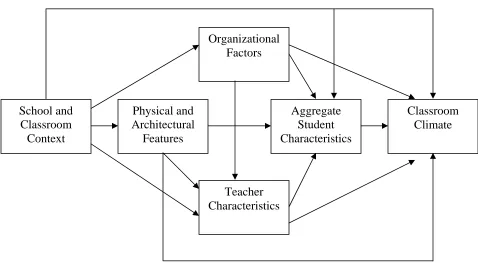
Figure 1: A Model of the Determinants of Classroom Climate (Reproduced with permission from R. Moos, 2005)
This model suggests there are numerous variables that can have an impact on the classroom environment. It should be understood that this model only shows the
unidirectional flow of one variable to another, when in reality, the variables can relate be inter-related resulting in a much more complex system.
Conducting Classroom Learning Environment Research: A Brief Description of Quantitative
and Qualitative Techniques
Learning environment research has traditionally been conducted using quantitative research methods (Fraser, 1986). Dozens of scales, inventories, and survey instruments have been created to assess the classroom learning environment; however, until the mid-1980’s, all of them were designed to measure the environments in elementary and secondary settings. With the existence of so many classroom environment scales, more research was needed to
School and Classroom Context
Organizational Factors
Physical and Architectural
Features
Aggregate Student Characteristics
Classroom Climate
test and revise these instruments in a variety of institutions and classroom settings. In response to the need for more systematic research design in higher education settings, researchers began creating a variety of classroom environment scales designed to
methodologically measure the learning environment in colleges and universities. Several different scales have emerged, including the Teaching and Learning Environment
Questionnaire (TLEQ), the Inventory of University Classroom Environment (IUCE), the Preferred College Classroom Environment Scale (PCCES), the College Classroom
Environment Scale (CCES), the What is Happening in This Class? Questionnaire (WIHIC) and the College and University Classroom Environment Inventory (CUCEI).
Quantitative Research Approach: The CUCEI
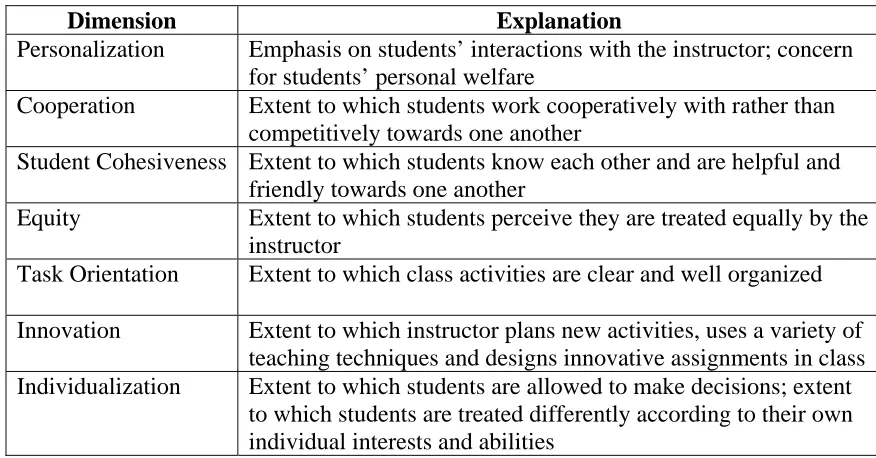
The CUCEI is the most widely used scale for assessing college classroom environments. Developed in 1986 by Treagust and Fraser, the College and University Classroom Environment Inventory (CUCEI) was the first scale designed to evaluate both the actual and preferred college classroom environments (Treagust & Fraser, 1986a & 1986b). The CUCEI was designed specifically for small college classrooms containing approximately thirty students or fewer. It originally contained 49 questions, with the same number of questions relating to each of the seven dimensions (Treagust & Fraser, 1986a & 1986b). Respondents recorded their level of agreement on a 4-point Likert scale format consisting of strongly agree, agree, disagree, or strongly disagree, and the scoring direction was reversed for half of the questions.
The original CUCEI was developed based on four main criteria. First, the researchers analyzed all the dimensions contained in existing instruments for secondary education
conceptual framework: relationship, personal growth and systems maintenance. This led to the final version of the original CUCEI which contained seven psychosocial dimensions: Personalization, Involvement, Student Cohesiveness, Satisfaction, Task Orientation,
Innovation, and Individualization. Third, college teachers and students were included in the initial development process through interviews and were asked to comment on early drafts of the instrument. Finally, researchers considered the overall economy of the instrument, ensuring a relatively small number of reliable scales and questions that could be answered in a timely manner (Treagust & Fraser, 1986a & 1986b).
Table 1: Explanation of the Psychosocial Dimensions Measured in the CUCEI
Dimension Explanation Personalization Emphasis on students’ interactions with the instructor; concern
for students’ personal welfare
Cooperation Extent to which students work cooperatively with rather than competitively towards one another
Student Cohesiveness Extent to which students know each other and are helpful and friendly towards one another
Equity Extent to which students perceive they are treated equally by the instructor
Task Orientation Extent to which class activities are clear and well organized
Innovation Extent to which instructor plans new activities, uses a variety of teaching techniques and designs innovative assignments in class Individualization Extent to which students are allowed to make decisions; extent
to which students are treated differently according to their own individual interests and abilities
Nair & Fisher (2001) conducted reliability and validity tests on the personalized form of the CUCEI. Researchers determined that each of the seven dimensions has acceptable levels of internal consistency using either the individual or the class mean as the unit of analysis.. Discriminant validity was measured for each of the seven dimensions to determine if all seven dimensions were actually needed in the instrument. Researchers determined that although there are overlapping features of a learning environment, there were enough
differences between the dimensions to justify including all seven of them in the revised personalized form of the CUCEI (Nair & Fisher, 2001). The personalized version of the CUCEI was also tested to determine if it could differentiate between classrooms. Each dimension was significant at the p<0.01 level between classrooms indicated that the personalized form of the CUCEI is capable of differentiating between classrooms (Nair & Fisher, 2001).
Although the CUCEI is not the most recent scale to measure the learning
classrooms around the world. One of the most recent trends in learning environment
research is to measure how different groups within a setting perceive a learning environment. Logan (2003) used the CUCEI to measure how the computing learning environment differs for boys and girls. In this study, Logan (2003) found that students’ perceptions of the computer learning environment vary based upon gender and the type of school. More importantly, Logan’s research validated the CUCEI’s capability to measure perceptions of sub-groups within a learning environment, opening the possibilities for more diverse experiments and research designs using the CUCEI.
New research continues to emerge using the CUCEI to measure the college learning environment, especially with the increase in online courses and new ideas of how a “learning environment” is defined. An extensive literature review uncovered a variety of settings, applications and opportunities for continued research using the CUCEI; however, no studies were found using CUCEI to measure the learning environment in a classroom that uses a game as a teaching and learning tool.
Qualitative Research Approach
Qualitative research offers a different perspective from which to analyze learning environments. The questions on the CUCEI were phrased to asked students their perceptions of, not necessarily their experience in, the actual classroom environment. To study students’ experiences in a learning environment, qualitative research methods offer ways to gather richer, more detailed data.
naturalistic, meaning it is collected in the field or setting, with careful consideration of the context within which the action is taking place. Data collected from qualitative approaches are rich and descriptive, and samples are usually smaller than those used for more traditional quantitative research designs.
Qualitative researchers are not concerned with testing a hypothesis or making predictions about a phenomenon. The goal is not to predict human behavior, but to promote social change through rigorous analysis, reflection, and in-depth meaning (Bogdan & Bilken, 1998). This type of research is categorized under the interpretive paradigm, which,
according to Henderson (1991) assumes that “social reality is multiple, divergent, and interrelated” (p. 24). Henderson (1991) explains, “Within this [interpretive] paradigm, the dynamic qualities of research emerge in the course of framing questions, immersion in the discovery of evidence, and interpreting meaning of data” (p. 25).
Further, qualitative researchers should aim to explain one hundred percent of the variance in a study” (138). This philosophy is different from the quantitative approaches that have been used in traditional social science research.
There are many approaches to conducting studies using qualitative research. Techniques such as interviews, observation, writing, and discussion provide numerous opportunities to collect and analyze a situation from the participant’s frame of reference. Sometimes it is not appropriate to rely exclusively on numbers and statistics to discover what occurs in an environment, and qualitative research provides the framework and structure from which to uncover the essence of what happens, how people feel, what people think, and what the underlying processes mean in terms of social and psychological process.
Theoretical Framework: Phenomenology
One approach to conducting qualitative research is the application of techniques from a phenomenological perspective. Phenomenology is actually the name for an entire
philosophical movement that originated as early as the 18th century and has continued to grow and evolve (Husserl, 1980; Spiegelberg, 1975). It is both a philosophy and a theoretical approach to research design in human science studies that use qualitative methods.
Manen (1990) explained, “Phenomenology is the systematic attempt to uncover and describe the structures, the internal meaning structures, of lived experience” (p. 10). Spiegelberg’s (1975) definition stated, “[Phenomenology] is the direct investigation and description of phenomena as consciously experienced, without theories about their causal explanation and as free as possible from unexamined preconceptions and presuppositions” (p. 3). In his book Introduction to Phenomenology, Sokolowski (2000) stated, “Phenomenology is the science that studies truth” (p. 185).
Second, it is important to understand how phenomenology differs from other qualitative research approaches. Van Manen (2002) compared phenomenology to other qualitative designs explaining, “Phenomenology differs from the various human science approaches such as ethnography, symbolic interactionism, and ethnomethodology in that phenomenology makes a distinction between appearance and essence…This means that phenomenology always asks the question of what is the nature or meaning of something” (van Manen, 2002). With phenomenology, it is important to understand that the individual is a fundamental part of the environment, and each individual has a different meaning for what is “real” or “true” based upon his or her perspective, experience, beliefs, values and ideas. This is known as the “lifeworld” for that individual (Husserl, 1980; van Manen, 1990). It is the goal of a phenomenological researcher to capture this perspective by describing the essence of one’s lifeworld based upon the particular time and setting.
Finally, it is important to understand how that phenomenology is complex, diverse and applicable in a variety of settings. There are generally six orientations to
phenomenology, one of which is hermeneutic phenomenology (Sokolowski, 2000).
involves explanation and interpretation (Sokolowski, 2000; Stuckey, et. al., 2002; van Manen, 1990; van Manen, 2002). In hermeneutic phenomenological design, the goal is not only to describe the essence of an experience, but also to interpret meanings of events based upon the participant’s perspective. Like other human sciences, phenomenology is concerned with searching for meaning or trying to make sense of a given situation (van Manen, 1990). Van Manen (1990) stated, “[P]henomenology does not produce empirical or theoretical observations or accounts. Instead, it offers accounts of experienced space, time, body, and human relation as we live them” (p. 184). Phenomenology is not used for prediction or comparison. For these reasons, outlining rigid methods is not recommended since the study needs to be open to interpretation and flexible to each individual’s experience.
Dickie (1999) used hermeneutic phenomenology to understand the lived experience of being a distance learner. In a unique approach, the author analyzed her own experience and those of three other students to explore how distance education is experienced. Using a narrative format, Dickie (1999) uncovered the connections between distance education, lifelong learning and personal development as expressed through her own personal story and those of her co-researchers.
Phenomenology has been used in recent studies to learn more about students’ experiences in classrooms. Borges, Silva and Cunha (2004) used hermeneutic
phenomenology to explore students’ experiences and responses to a variety of teaching and learning techniques in engineering. They were interested in exploring whether or not knowledge was a process of construction or deconstruction. Through the use of a variety of teaching and learning techniques, they were able to connect students’ experiences and higher performance to student centered learning activities using hermeneutic phenomenology. Finney (2000) used a phenomenological approach to determine the meaning of success as experienced by students in statistics courses. Finney’s (2000) study confirmed the
importance of using qualitative rather than quantitative approaches when the goal is to understand students’ perceptions or experiences in a setting.
Phenomenology: Collecting Data and Writing the Results
undergraduate students. Students were asked to write in narrative format about their
experience when using a library. The prompting question was open ended and structured so as to allow students to freely describe their experience using their own wording and
language. Researchers then used content analysis and thematic analysis to uncover the meaning of library experiences for undergraduate students. This study demonstrated the effectiveness of using data collection techniques beyond interviews when conducting phenomenological research.
When writing a study using a phenomenological design, it is accepted practice to write in first person, sometimes using narratives, personal stories, anecdotes and
autoethnographies (Ellis, 2000; van Manen, 1990). The purpose is to accept the role of the researcher as a critical element in the study, and usually this is documented through personal journals. According to Pepper and Thomas (2002), “[T]his approach provides the
opportunity for researchers to intertwine their personal experiences with the professional aspects in an attempt to sort out their findings” (p. 159). Two relevant articles were found using autoethnography and learning environment research.
still situated herself in the study and used personal experiences and reflections to make connections between the students’ experiences and her knowledge of theoretical and conceptual models.
These studies allowed the researchers to collect richer, more detailed data connected to the purpose of discovering meaning. When the purpose of a study is to glean meaning from an experience, then phenomenology provides the lens through which to describe and interpret that experience from a variety of perspectives.
Educational Games and the Classroom Learning Environment
Research in gaming and simulation literature indicates that incorporating games into the classroom changes the learning environment (Boocock, 1968; Thatcher, 1986). Those who use games for educational purposes realize the game changes their classrooms, but an intensive database search reveals there are no studies in the gaming literature which have directly or systematically addressed exactly how the learning environment changes with the introduction of games into the classroom. In one article, Kriz (2003) discusses the role of games in learning environments to change social systems and create a learning environment that is interactive and problem based. Kriz (2003) explains how games can be designed as dynamic models that represent realistic systems and processes; however, in this particular article, he does not systematically test these observations. Few studies, if any, have been able to adequately support of deny the value of games as a teaching strategy or explain exactly how the inclusion of games changes the learning environment (Squire, 2002).
contains many variables including the learner, the teacher, the context, and the course
material (Thatcher, 1986). Within this environment, games can exist, but what works for one group may not work for another (Dustin, 1977). Games are dynamic, and they require flexibility, openness, and a willingness to explore a variety of discussions that may lead to increased opportunities for learning. Instructors who use games must be willing to let go of some of their control and be willing to let the game and conversations take whatever paths lead to the students’ learning (Thatcher, 1986). Research indicates the relationships between instructors and students change to more positive interactions as a result of this open and welcoming environment (Greenblat & Duke, 1981). In essence, as recommended by Spence (2001), the teacher who uses games to teach becomes the designer of the learning experience, where the activity is focused on the learners, not on the instructor.
Given the unstructured and more relaxed environment, the use of games requires a redefinition of the traditional assumptions and roles of the students and the teacher. In the gaming environment, the instructor and students play different roles than they do in
Benefits of Educational Games
Instructors and educational researchers report numerous benefits when incorporating educational games into the learning environment. Although educational games began in elementary school settings, their use in college environments has proven to be beneficial since adult learners perform well when the teacher is taken out of the traditional teacher dominated environment (Anderson, 1998; Boocock, 1968; Maidment & Bronstein, 1973). Games are unique and fun, and they offer different ways to present course material to students. Many of the earlier studies in gaming emphasized significant increases in student motivation, interest and engagement when games were used as teaching tools in the
classroom (Dustin, 1977; Greenblat & Duke, 1981; Kirk, 2004; Thiagarajan, 1973). Studies typically focused on the outcomes of the game, such as test scores, and most research designs used a control group as basis for comparison and to support the benefits of incorporating games into the classroom.
Current research appears to be moving beyond simply assessing the product of game design to increased emphasis on the learning process. Students have demonstrated improved critical thinking skills and increased understanding of the dynamics of complex social
systems and relationships (Greenblat & Duke, 1981; Kriz, 2003; Thiagarjan, 1973). The use of games has also been linked to an increase in students’ retention of material and long-term skill application (Greenblat, 1988; Greenblat & Duke, 1981; Kashibuchi & Sakamoto, 2001; Kirk, 2004; Specht, 1991). Games help students bridge the gap between theory and practice, and lead to future application of discipline-specific skills (Kriz, 2003; Thiagarajan, 1973).
learning typically measured in pre- and post-test research designs (Thiagarajan, 1973). Cognitive learning occurs when students make the connections between the game and the course content. However, this is not the only type of learning that is embedded in
educational games. Well-designed games have the increased benefit of addressing affective learning as well, which can be equally as important to student development as cognitive learning. Affective learning helps learners develop the ability to identify their own and other people’s feelings, beliefs, values and attitudes (Dustin, 1977; Kashibuchi & Sakamoto, 2001; Thiagarajan, 1973; Thiagarajan & Stolovitch, 1978). Educational research emphasizes the importance of emotions in student learning and development (Jensen, 1995; Thatcher, 1986). Games can capture these emotions and use them as important elements of the learning process to demonstrate realistic complexities of situations outside of the classroom.
Anderson’s (1998) study combined both the cognitive and affective learning outcomes. Anderson (1998) hypothesized that students would perceive the gaming environment as less threatening and more enjoyable than a lecture-based course, thus increasing their ability to learn. The research supported this hypothesis, and the results indicated the gaming method increased student exam scores by 11.4% over those who were taught using only the lecture-based course. Students also responded they were more likely to take risks in the game setting since the learning environment was more open and less
Well-designed games can also be designed to simultaneously address a variety of learning styles within one well-designed activity (Dempsey, Haynes, Lucassen & Casey, 2002; Thatcher, 1986). In a study intended to assess the instructional applications of game design for adults, participants representing all four of Kolb’s learning styles were able to learn effectively using educational games (Dempsey, et al, 2002). Krits’ (1991) study went a step further and analyzed behavior by personality type using the Myers-Briggs inventory to divide students into groups as part of the analysis of a natural resources management game. Games enhance cooperative learning and team building, and they encourage learners to work towards a common goal (Dustin, 1977; Thiagarjan, 1973; Kirk, 2004). Because games give students instant feedback on student performance, they can also be used to help students practice or refine knowledge and skills and to help review key concepts (Anderson, 1998). Games help instructors identify gaps or weakness in students’ knowledge and reinforce new relationships between important or complex concepts (Gredler, 1992; Greenblat, 1988; Greer, 1992; Kirk, 2004). Research indicates games also enhance group dynamics and aid in the development of socialization and communication skills (Boocock, 1968; Greenblat & Duke, 1981; Kirk, 2004). Others studies support the idea that games lead to increased understanding and demonstration of discipline specific skills, especially in training and development settings (Greenblat & Duke, 1981; Thiagarajan, 1978).
The purpose of their research was to determine if a game has greater impacts on the students’ efficacy than the use of case studies. They found significant evidence of enhanced self-efficacy in students who participated in a strategic management game (Thomson and Dass, 2000). The case studies method resulted in increased learning as well; however, this approach enhanced writing skills rather than improvements in self-efficacy.
Although the purpose of this study is to specifically analyze the use of educational games, it is valuable to consider the benefits associated with simulated gaming environments as well since they are so similar. In simulations, the activity is designed to reproduce a realistic issue or situation in a controlled environment (Greenblat & Duke, 1981).
Simulations are cost-effective strategies for demonstrating real-world environments where participants can take risks and make mistakes with hypothetical consequences from which learning can occur (Greenblat & Duke, 1981; Thiagarajan, 1973). Additionally, simulation games allow students to feel the experience of complicated “real world” situations in a relatively short amount of time (Thiagarajan, 1973).
Challenges of Educational Games
The use of educational games in the classroom is not a new phenomenon; however, some educators are reluctant to give credibility to such a teaching strategy, especially in the college environment. Games that are misused or used solely for entertainment purposes have given this type of teaching strategy a negative reputation (Gredler, 1992; Greenblat, 1981; Kirk, 2004; Maidment, 1973; Petranek, 2000). For some, entertainment in education is not appropriate, and the notion that learning can be fun is for other settings outside of academia. Games are time consuming to create and play, and some environments do not lend