OPERATIONAL COMPLEXITY IMPACT ON QUALITY AND PERFORMANCE OF ELECTRICAL AND ELECTRONICS INDUSTRY IN MALAYSIA
NASUHA LEE BINTI ABDULLAH
A dissertation submitted in partial fulfilment of the requirements for the award of the degree of
Doctor of Engineering (Engineering Business Management)
Razak School of Engineering and Advanced Technology Universiti Teknologi Malaysia
Specially dedicated to
ACKNOWLEDGEMENTS
~In the name of Allah, the Most Gracious and the Most Merciful~ Alhamdulillah, all praise be to Allah for granting me the knowledge, strength and patience in completing this dissertation. There is no God but Allah and Muhammad is the messenger of Allah.
I would like to express my appreciation to both my supervisors, Associate Prof. Dr. Khairur Rijal Jamaludin and Dr. Hayati Habibah Abdul Talib for their trust, dedication and guidance. I am also thankful for the knowledge shared by Prof. Ir. Dr. Sha’ari Yusoff, Associate Prof. Dr. Abdul Rahman Abdul Rahim and Dr. Norhayati Mohmad Zakuan. I would also like to thank the management and staff of UTM Razak School who have rendered their support throughout my study in UTM.
I am grateful to Prof. Dr. Rosni Abdullah, former Dean, School of Computer Sciences (CS), USM for giving me the opportunity to learn and start a new career. I am blessed to have Puan Rosnah Idrus as my mentor and friend who never fail to cheer me on. My sincere thanks to Prof. T. Ramayah, Dr. Ahmad Suhaimi and Dr. Umi Kalsom for sharing their knowledge and experiences. I would also like to extend my appreciation to the current management and staff of School of CS, USM for their kind support and concern.
I express my warm thanks to my former bosses, colleagues and friends in Sony and Flextronics for sharing their thoughts and their participation in this study. Without them, this study may take longer to complete. I am thankful for the support from Mr. Lee Kim San and Puan Nurul Izzah Tan Abdullah of NationGate Solution (M) Sdn. Bhd. for the opportunity to work with them. I am sincerely grateful to my good friend, Dr. Khor Minee for the inspiration and assistance.
ABSTRACT
ABSTRAK
TABLE OF CONTENTS
CHAPTER TITLE PAGE
DECLARATION ii
DEDICATION iii
ACKNOWLEDGEMENTS iv
ABSTRACT v
ABSTRAK vi
TABLE OF CONTENTS vii
LIST OF TABLES xiii
LIST OF FIGURES xv
LIST OF ABBREVIATION xvii
LIST OF APPENDICES xx
1 INTRODUCTION 1
1.1 Background of Research 1
1.2 Problem Statement 3
1.3 Research Questions 4
1.4 Research Objectives 4
1.5 Research Scope 5
1.6 Significance of Research 5
1.7 Structure of Thesis 6
2 LITERATURE REVIEW 8
2.1 Introduction 8
2.2 Overview of E & E Manufacturing Industry in Malaysia
2.2.1 Structure of E & E Industry 9
2.2.2 Type of Businesses 11
2.2.3 Operational Characteristics of OEM and CM
12
2.3 Effective QM Implementation in E & E Industry 14
2.4 Quality Management 15
2.4.1 Overview of QM Literature 15
2.4.2 Definition of QM- ‘What’ 17
2.4.3 Impact of QM practices on Performance – ‘Why’
21
2.4.4 QM Implementation – ‘How’ 25
2.4.5 QM Others– ‘Who-When-Where’ 28
2.4.6 QM Research in Malaysia 29
2.5 Operational Complexity 32
2.5.1 Definition of Operational Complexity 32 2.5.2 Review of Operational Complexity
Frameworks in Manufacturing
33
2.6 Research Gap 36
2.7 Summary 38
3 RESEARCH METHODOLOGY 39
3.1 Introduction 39
3.2 Research Paradigm 39
3.2.1 Overview of Quantitative Research Methodology
40
3.3!!!!Research Design 41
3.4 Structure of Research Methodology 42 3.5 Operationalisation of Variables 44
3.5.1 QM practices 44
3.5.2!!Operational Performance 47
3.6 Research Framework 50
3.6.1 Proposed Framework 51
3.6.2 Multidimensional Construct 53
3.6.3 Hypotheses Development 55
3.7 Development of Research Instrument 57
3.7.1 The Questionnaire 57
3.7.2 Reliability of Instrument 64
3.7.3 Validity of Instrument 64
3.7.4 Common Method Bias 65
3.7.5 Pretesting of Questionnaire 66
3.7.5.1!!Expert Validation 67
3.7.5.2!!Pilot Test 69
3.8!!!!Data Collection 69
3.8.1!!Sampling Frame 69
3.8.2!!Sampling Size 71
3.8.3!!Data Collection Techniques 73
3.8.4!!Response Rate 75
3.9!!!!Data Analysis 76
3.9.1!!Data Examination 77
3.9.2!!Preliminary Analysis 77
3.9.3 Statistical Analysis 78
3.9.3"#!!Structural Equation Modeling 79 3.9.3.2!!Justification of PLS-SEM over
CB-SEM
80
3.9.4!!PLS-SEM Procedure 81
3.9.4.1!!Model Specification (Stage 1 and stage 2)
81
3.9.4.2!!Data Preparation (Stage 3 and stage 4)
3.9.4.3!!Assessing the Measurement Model (Stage 5)
83
3.9.4.4!!Assessing the Structural Model (Stage 6)
85
3.9.4.5!!Advance Analysis (Stage 7) 87 3.9.4.6 Interpretation of Results (Stage 8) 90 3.9.5!!Data Analysis Process Flow 91
3.10 Summary 92
4 DATA ANALYSIS 93
4.1 $ntroduction 93
4.2 Data Examination 93
4.3 Preliminary Analysis 94
4.4!!!!Demographic Profile of Respondents 96
4.4.1!!Types of Businesses 97
4.4.2!!Types of Ownership 97
4.4.3!!Number of Employees 98
4.4.4!!Types of Products 98
4.4.5!!Number of Years in Operation 99
4.4.6!!Accreditation 100
4.4.7!!Positions in the Companies 101 4.4.8!!Willingness to Participate in Future
Research
101
4.5!!!!Assessment of Measurement Model 102
4.5.1!!Construct-Types 102
4.5.2!!Reliability and Validity of First-order Constructs
103
4.5.3 Reliability and Validity of Second-order Constructs
109
4.6!!!!!Assessment of Structural Model 113
4.6.2 !!Summary of Structural Model 116
4.7!!!!Testing of Hypotheses 116
4.7.1!!Testing of Hypotheses H1 and H2 117 4.7.2!!Testing of Hypotheses H3, H3a and H3b 117
4.7.3!!Testing of Hypothesis H4 121
4.8 Summary 122
5 DISCUSSIONS AND IMPLICATIONS 123
5.1!!!!Introduction 123
5.2 Findings on SEM Model 124
5.2.1 QM practices Model 124
5.2.2 Operational Performance Model 126 5.2.3 Operational Complexity Model 127
5.2.4 Overall Model 128
5.3 Recapitulation of Research Questions 128 5.4!!!!Relationship between QM practices and
Operational Performance
130
5.5!!!!Relationship between Operational Complexity and Operational Performance
132
5.6!!!!Moderating Effect of Operational Complexity on QM practices and Operational Performance Relationship
136
5.7!!!!Operational Complexity Level between CM and OEM
138
5.8!!!!Summary 140
6 PROPOSED IMPLEMENTATION 141
6.1!!!!Introduction 141
6.2!!!!Background of Proposed System 142 6.2.1!!Concept of Proposed System 143
6.3!!!!System Overview 144
6.3.2!!Administration Tool 147
6.4!!!!Prototype of QAEZ 1.0 148
6.4.1!!Customer Complaint Module 149
6.4.2!!Administration Tool 157
6.5!!!!Summary 160
7 CONCLUSIONS AND RECOMMENDATIONS 162
7.1!!!!Introduction 162
7.2!!!!Theoretical Contributions 162
7.3 !!!Practical Contributions 163
7.4!!!!Dissemination of Knowledge through Publications 164 7.5!!!!Fulfilment of Research Objectives 164 7.6!!!!Limitations of the Research and Recommendations
for Future Research
166
7.6.1! Data Collection 166
7.6.2!!Construct Operationalisation 167 7.6.3! Interpretations of Unsupported Hypotheses 167
7.7!!!!Conclusion 167
REFERENCES 169
LIST OF TABLES
TABLE NO. TITLE PAGE
2.1 Structure of E & E industry (MIDA, 2012) 11 2.2 Comparison of operational characteristics between
OEM and CM (Sousa and Voss, 2007) 13
2.3 Comparison of QM practices review studies against MBNQA framework
20
2.4 QM practices-performance studies 23
2.5 Previous studies in QM contingency research 26
2.6 QM research in Malaysia 30
2.7 Research gap in Malaysia E & E industry 37
3.1 Previous studies based on MBNQA framework 45
3.2 Dimensions of complexity based on previous studies 50 3.3 Justification of operational complexity as a moderator 53
3.4 Measurement items for QM practices 59
3.5 Measurement items for operational performance 62 3.6 Measurement items for operational complexity 63
3.7 Summary of pretest results 67
3.8 Category of E & E manufacturing industry 71 3.9 Number of minimum responses needed by state and
region
73 3.10 Number of questionnaire needed for each state 74
3.11 Response rate 76
3.12 Statistical software used 78
3.13 Justification to use PLS-SEM 80
3.14 Reflective measurement model assessment criteria
(Hair et al. 2014b) 84
3.15 Structural model assessment criteria (Hair et al.
2014b)
4.1 Summary of final dataset 94
4.2 Descriptive statistics 96
4.3 Types of businesses 97
4.4 Types of ownership 97
4.5 Cross tabulations of types of ownership and types of businesses
98
4.6 Number of employees 98
4.7 Categories of product types 99
4.8 Number of product types 99
4.9 Cross tabulations of number of product types and types of businesses
99
4.10 Number of years in operation 100
4.11 Number of accreditations 100
4.12 Cross tabulations of number of accreditations and types of businesses
100
4.13 Positions in the companies 101
4.14 Willingness to participate in future research 101
4.15 Construct-types 103
4.16 Psychometric properties for first-order constructs 106 4.17 Discriminant validity for first-order constructs 108 4.18 Psychometric properties for QM practices 109 4.19 Output of collinearity diagnostic in SPSS 111 4.20 Psychometric properties for second-order constructs,
OC and OP 113
4.21 Hypotheses test results of H1 and H2 117
4.22 Hypothesis test result of H3 119
4.23 Hypotheses test results of H3a, H3b 120
4.24 Hypothesis test result of H4 122
4.25 Summary results of hypotheses testing 122
5.1 Association of QM practices with first-order constructs
125 5.2 Correlation of first-order construct in QM practices 125 5.3 Correlation of first-order construct in operational
performance 127
LIST OF FIGURES
FIGURE NO. TITLE PAGE
1.1 Conceptualisation of problem statement 4
2.1 Total approved investment in 2013 for E & E
Industry (MIDA, 2014) 10
2.2 Concepualisation of QM research stream 17
2.3 Framework for complexity and manufacturing performance (Flynn and Flynn, 1999)
34 2.4 Two-dimensional complexity framework (Vachon
and Klassen, 2002)
35 2.5 Impact of supply chain complexity on plant
performance (Bozarth et al., 2009)
36
2.6 Contribution area of this study 38
3.1 Structure of research methodology 43
3.2 Research framework 51
3.3 CB-SEM versus PLS-SEM (Henseler et al., 2009) 79 3.4 Procedure in PLS-SEM (Hair et al., 2014b) 81 3.5 Reflective and formative measurement model 82 3.6 Types of second-order constructs (Hair et al., 2014b) 88 3.7 Second stage of 2–stage approach (Hair et al.,
2014b) 88
3.8 Interaction effect for moderator (Hair et al., 2014b) 89 3.9 Two-stage approach for formative moderator (Hair et
al., 2014b)
90
3.10 Flowchart of data analysis process 91
4.1 Full model with path coefficients in smartPLS 104
4.2 QM practices as second-order construct 109
4.3 Operational complexity (OC) and operational
performance (OP) as second-order construct 110
4.5 Operational complexity (OC) and operational
performance (OP) with t value 112
4.6 Second stage of 2-stage approach with path coefficient
114 4.7 Second stage of 2-stage approach with t value 115
4.8 Structural equation model 116
4.9 Model with single indicator 118
4.10 Interaction model with path coefficient and R2 118
4.11 Interaction model with t value 119
4.12 Effect of OC on QM-OP 120
4.13 Mann-Whitney test from SPSS output 121
6.1 Concept of QAEZ 144
6.2 QAEZ development plan 145
6.3 Flowchart of customer complaint module 147
6.4 QAEZ login page 148
6.5 QAEZ home page 149
6.6 Customer complaint module 149
6.7 Create customer complaint report 150
6.8 Containment action page 151
6.9 Containment action page with pop-up message 152
6.10 Create 8D report 152
6.11 Manage report page 153
6.12 8D report approval page 154
6.13 8D report approval page with pop-up message 154
6.14 Summary report sorted by customer 155
6.15 Summary report sorted by status 156
6.16 Open query page 156
6.17 Administration tool page 157
6.18 Register new user 158
6.19 Manage user log page 158
6.20 Edit user page 159
6.21 Email notification 159
LIST OF ABBREVIATION
8D - Eight discipline
AFTA - Asean free trade area AVE - Average variance extracted
CAS - Complex adaptive system
CB-SEM - Covariance based SEM
CF - Customer focus
CM - Contract manufacturer
COMPLI - Complicatedness
CR - Composite reliability
DV - Dependent variable
E & E - Electrical and electronics
EFQA - European federation quality award EMS - Electronics manufacturing service ETP - Economic transformation programme FMM - Federation of Malaysian manufacturers
GB - Gigabyte
GHz - Giga hertz
GNI - Gross national income
HR - Human resource focus
IA - Information and analysis
IBM - International Business Machines Corporation IMP - Inventory management performance
ISO - International standard for organization
IT - Information technology
IV - Independent variable
LED - Light emitting diodes
LVS - Latent variable score
MATRADE - Malaysia External Trade Development Corporation MBNQA - Malcolm Baldridge National Quality Award
MIDA - Malaysia Investment Development Authority MITI Ministry of International Trade and Industry MPC - Malaysia Productivity Center
NA - Not applicable
NKEA - National key economic area
NSM - NationGate Solution (M) Sendirian Berhad
OC - Operational complexity
OEM - Original equipment manufacturer
OMPCR - Operation management practice contingency research
OP - Operational performance
OPC - Cost (operational performance) OPD - Delivery (operational performance) OPF - Flexibility (operational performance) OPQ - Quality (operational performance) PCB - Printed circuit board
PLS - Partial least square
PM - Process management
PV - Photovoltaic
QA - Quality assurance
QAEZ - Integrated quality management system
QC - Quality control
QM - Quality management
QP - Quality performance
R & D - Research and development SEM - Structural equation modelling SERVQUAL - Service quality
SME - Small and medium size enterprise
SP - Strategic planning
SPSS - Statistical package for social sciences
UNCERT - Uncertainty
LIST OF APPENDICES
APPENDIX TITLE PAGE
A Questionnaire 186
B Summary of comments from expert validation 193
C List of revised items in questionnaire 195
D Sample size recommendation for a statistical power of 80% (Hair et al., 2014b)
199
E Sample of email invitation 200
F Cover letter 201
G Data with z score between +/- 3 and +/-4 203
H Test of normality 205
I Skewness and kurtosis 206
J Classification of product type 208
K Form for expert opinion 209
L Sample of email to the expert 213
M Summary of expert opinion on research findings 214
CHAPTER 1
INTRODUCTION
1.1 Background of Research
The business world is now hyper-competitive and borderless (Corbett, 2004). Excellence is measured by best in the world instead of best in class and competition is just a mouse-click away (Corbett, 2004). Companies are forced to restructure their processes from the traditional vertical-integrated, self-sufficient structure to specialized and knowledge-driven structure in order to respond to such performance-driven environment (Corbett, 2004). It is practically impossible to have best-in-world expertise in house for every process (Corbett, 2004). Hence, if any external party could run a specific process with a lesser cost, then the external party should run it. This act is called outsourcing. In the manufacturing industry, the party that outsources is known as the original equipment manufacturer (OEM) while the party that provides the service is known as contract manufacturer (CM), electronic manufacturing service (EMS) provider (Mucha, 2008), or simply the subcontractors (Sousa and Voss, 2007). The term contract manufacturer (CM) will be used throughout this writing.
management, training for all levels of employees in quality discipline and conducting continuous quality improvement projects. These three elements are part of the total quality management (TQM) concepts, which resulted from the evolution of quality awareness when quality principles are integrated into management system (Evans and Dean, 2003; Gryna et al., 2007). Today, the concept of TQM has extended beyond manufacturing and adopted by service, health care, public sector, finance and education sector (Ooi et al., 2011). In Malaysia, the introduction of QM concept is
spearheaded by the foreign OEMs who have setup many facilities through foreign direct investment especially in the electrical and electronics (E & E) manufacturing industry. The industry has been the main contributor to the Malaysian economy since its inception in the 1960s (MATRADE, 2014).
1.2 Problem Statement
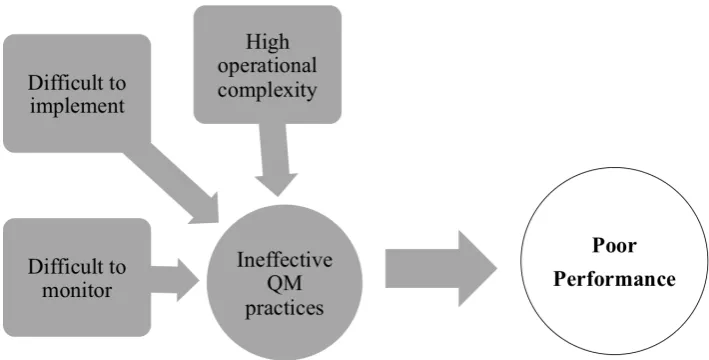
The recent spate of recalls due to CMs’ poor quality control has triggered the needs to seriously include quality risk in outsourcing decision instead of merely focusing on reducing cost (Gray et al., 2009a; Gray et al., 2009b; Lu et al., 2012). It also generated research in why QM practices could not ‘guarantee’ quality and improve operational performance. Based on operations perspective, CM and OEM have distinct operation characteristics (Sousa and Voss, 2007). CM seems to have a higher operational complexity compared to OEM due to the nature of its business model. CM has to deal with diverse customers from various industries. They are expected to run low-volume, high-mix types of operations and subject to frequent change in production plan and delivery schedule. Moreover, OEM tends to have influence over internal operations decisions in CM plant (Webster et al., 1997) such as the selection of part suppliers, quality control criteria, process control method and production schedule. This influence creates high level of task uncertainty in the CM environment and the immediate effect is the high intensity of information exchange or communication across all levels of operations between OEM and CM (Galbraith, 1973). Hence, operational complexity could be the contextual variable that is impacting the relationship between QM practices and operational performance. In addition, it is a known fact that effective QM practices are difficult to implement, measure and observe (Macdonald, 1996; Sousa and Voss, 2002). Moreover, it is much more difficult to codify it in contracts with CMs (Gray et al., 2009a).
Figure 1.1 Conceptualisation of problem statement
1.3 Research Questions
The following are the research questions guiding this study.
i. Do QM practices contribute to operational performance in Malaysia’s E & E manufacturing industry?
ii. Does operational complexity contribute to operational performance in Malaysia’s E & E manufacturing industry?
iii. Does operational complexity impact the relationships between QM practices and operational performance in Malaysia’s E & E manufacturing industry? iv. Do CMs and OEMs have different level of operational complexity in
Malaysia’s E & E manufacturing industry?
1.4 Research Objectives
The following are the objectives for this study.
i. To examine the relationship between QM practices, operational complexity and operational performance in Malaysia’s E & E manufacturing industry. ii. To develop a framework for QM practices, operational complexity, and
iii. To compare the operational complexity level between OEMs and CMs in Malaysia’s E & E manufacturing industry.
iv. To explore the results of the findings in a local CM and propose a practical solution.
1.5 Research Scope
This research focused on the implementation of QM practices in Malaysia’s E & E manufacturing industry, which consists of all sizes of companies from both CMs and OEMs. The respondents are senior executives representing the E & E manufacturing companies operating in Malaysia producing electronics components, electronics consumer products, electronics industrial products and electrical products. The product classification is according to the Malaysian Industrial Development Authority (MIDA). Based on this classification, a list of E & E manufacturers is compiled using the directory provided by Malaysia External Trade Development Corporation (MATRADE) and Federation of Malaysian Manufacturer (FMM). The MATRADE directory (MATRADE, 2013) is assessable online while the FMM directory (FMM, 2011) is purchased from local bookstore. The list consisting 858 manufacturers is used as the population frame representing the E & E manufacturers in Malaysia. Therefore the result of this finding is only generalisable to those manufacturers in the list. Disproportionate stratified random sampling technique is used so that each geographical region in Malaysia is represented. The minimum number of responses is determined for each region before full-scale data collection is conducted.
1.6 Significance of Research
contingency approach, the focus would be to understand the contextual factors influencing QM practice-performance relationships (Sousa and Voss, 2008). In this study, the contextual factor is operational complexity. This study will reduce the gap in QM related empirical studies in Malaysia in which the majority of the literature focused on direct QM practices-performance relationships. In addition, the study also contributes to the application of partial least square structure equation modelling (PLS-SEM) in operations research. PLS-SEM is an emerging data analysis technique that is gaining popularity for its ability to handle non-normal data, highly complex model and its lesser demand in sample size (Henseler et al., 2009; Hair et al., 2011b; Hair et al., 2014a).
The model developed in this study would provide insights to the practitioners on the impact of operational complexity on the performance of their companies. By understanding the relationships between QM practices, operational complexity and operational performance, practitioners would be able to implement effective QM practices and improve the companies’ operational performances.
1.7 Structure of Thesis
This thesis is organised into seven chapters. Chapter one provides the background of the study. It also includes the problem statement, research questions, research objectives, scope and significance of the research. Chapter two gives a review of literature on the three main variables identified in this study, mainly, QM practices, operational complexity and operational performance as well as background on the E & E manufacturing industry in Malaysia. Chapter three covers the research methodology. It starts with research paradigm, research design and structure of research method. Then it discusses operationalization of each variable, which leads to the proposed research framework, research hypotheses, research instrument, data collection and finally the data analysis procedures.
REFERENCES
Abdullah, A. (2010). Measuring TQM implementation: a case study of Malaysian SMEs.Measuring Business Excellence. 14 (3), 3-15.
Abdullah, M. M. B., Uli, J. and Tari, J. J. (2009). The importance of soft factors for quality improvement and organisational performance. International Journal of Productivity and Quality Management. 4 (3), 366-382.
Abdullah, M. M. and Tari, J. J. (2012). The Influence of Soft and Hard Quality Management Practices on Performance. Asia Pacific Management Review. 17 (2), 177-193.
Agus, A. (2004). TQM as a Focus for Improving Overall Service Performance and Customer Satisfaction: an Empirical Study on a Public Service Sector in Malaysia.Total Quality Management & Business Excellence. 15 (5-6), 615-628. Agus, A. and Hassan, Z. F. (2011). Enhancing production performance and customer
performance through total quality management (TQM): strategies for competitive advantage. Procedia-Social and Behavioral Sciences. 24, 1650-1662.
Agus, A., Krishnan, S. K. and Kadir, S. L. S. A. (2000). The structural impact of total quality management on financial performance relative to competitors through customer satisfaction: A study of Malaysian manufacturing companies. Total Quality Management. 11 (4-6), 808-819.
Ahire, S. L., Landeros, R. and Golhar, D. Y. (1995). Total quality management: a literature review and an agenda for future research. Production and Operations Management. 4 (3), 227-306.
Ahmad, M. F., Yusof, S. R. M. and Yusof, N. M. (2012). Comparative Study Of Quality Practices Between Japanese And Non–Japanese Based Electrical And Electronics Companies In Malaysia: A Survey.Jurnal teknologi. 47 (1), 75–89. Ahmad, M. F., Zakuan, N., Jusoh, A., Yusof, S. and Takala, J. (2014). Moderator
effect of Asean Free Trade Agreement (AFTA) between TQM and business performance.Procedia Social and Behavioral Sciences. 129, 244-249.
Akter, S., D'ambra, J. and Ray, P. (2011a). An Evaluation Of PLS Based Complex Models: The Roles Of Power Analysis, Predictive Relevance And GOF Index
Seventeenth Americas Conference on Information Systems. 4-7 August 2011 Detroit, Michigan, USA.
Akter, S., D'Ambra, J. and Ray, P. (2011b). Trustworthiness in mHealth Information Services: An Assessment of a Hierarchical Model with Mediating and Moderating Effects Using Partial Least Squares (PLS). Journal Of The American Society For Information Science And Technology, 62, 100-116.
Armstrong, J. S. and Overton, T. S. (1977). Estimating Nonresponse Bias in Mail Surveys.Journal of Marketing Research. 14, 396-402.
Arumugam, V., Ooi, K-B. and Fong, T-C. (2008). TQM practices and quality management performance: An investigation of their relationship using data from ISO 9001:2000 firms in Malaysia.The TQM Journal. 20 (6), 636-650.
Ashby, W. R. (1958). Requisite variety and its implications for the control of complex systems.Cybernetica 1(2), 83-99.
Ashmos, D. P., Duchon, D. and Mcdaniel Jr, R. R. (2000). Organizational responses to complexity: the effect on organisational performance. Journal of Organizational Change Management. 13 (6), 577-595.
Awang, Z. and Ariffin, J. T. (2012). Reserach Proposal: A Comprehensive Guide in Writing a Research Proposal. UiTM Press.
Baron, R. M. and Kenny, D. A. (1986). The Moderator-Mediator Variable Distinctionin Social Psychological Research: Conceptual, Strategic, and Statistical Considerations.Journal of Personality and Social Psychology. 51 (6), 1173-1182.
Becker, J-M., Klein, K. and Wetzels, M. (2012). Hierarchical Latent Variable Models in PLS-SEM: Guidelines for Using Reflective-Formative Type Models. Long Range Planning.45, 208-225.
Beer, M. (2003). Why Total Quality Management Programs Do Not Persist: The Role of Management Quality and Implications for Leading a TQM Transformation.Decision Sciences. 34 (4), 623-642.
Boisot, M. and Child, J. (1999). Organizations as adaptive systems in complex environments: The case of China. Organization Science, 10, 237-252.
Bozarth, C. C., Warsing, D. P., Flynn, B. B. and Flynn, E. J. (2009). The impact of supply chain complexity on manufacturing plant performance. Journal of Operations Management. 27 (1), 78-93.
Brown, D. and Wilson, S. (2005). The Black Book of Outsourcing. John Wiley & Sons.
Burian, P. E., Rogerson, L. and Maffei, F. R. S. (2010). The Research Roadmap: A Primer to the Approach and Process. Contemporary Issues in Education Research. 3(8), 43-57.
Calinescu, A., Efstathiou, J., Schirn, J. and Bermejo, J. (1998). Applying and Assessing Two Methods for Measuring Complexity in Manufacturing. The Journal of the Operational Research Society. 49 (7), 723-733.
Carlisle, Y. and Mcmillan, E. (2006). Innovation in organisations from a complex adaptive systems perspective. Emergence: Complexity & Organization. 8 (1), 2-9.
Chang, S-J., Witteloostuijn, A. V. and Eden, L. (2010). From the Editors: Common method variance in international business research. Journal of International Business Studies 41, 178-184.
Chin, W. W. (1998). The partial least squares approach for structural equation modeling.. In: Marcoulides, G.A. (Ed.), Modern Methods for Business Research.
(pp. 295-336).Mahwah, NJ: Lawrence Brlbaum Associates.
Chin, W. W., Marcolin, B. L. and Newsted, P. R. (1996). A Partial Least Squares Latent Variable Modeling Approach for Measuring Interaction Effects: Results from a Monte Carlo Simultion Study and Voice Mail Emotion/Adoption Study.
Chong, A. Y., Chan, F. T., Ooi, K-B. and Sim, J-J. (2011). Can Malaysian firms improve organisational/ innovation performance via SCM? Industrial Management & Data Systems. 111 (3), 410-431.
Cohen, J. (1988). Statistical power analysis for the behavioral sciencies. (2nd ed.). Hillsdale, New Jersey: Lawrence Erlbaum.
Corbett, M. F. (2004). The Outsourcing Revolution: Why It Makes Sense and How to Do It Right. Dearborn Trade Publishing.
Corredor, P. and Goñi, S. (2011). TQM and performance: Is the relationship so obvious? Journal of Business Research. 64 (8), 830-838.
Creswell, J. W. and Clark, V. L. P. (2007). Designing and Conducting Mixed Methods Research. Thousand Oaks: Sage Publications.
Crosby, P. (1984). Quality Without Tears. New York: Mc Graw Hill. Crosby, P. (1996). Quality is Still Free. New York: Mc Graw Hill.
Curkovic, S., Melnyk, S., Calantone, R. and Handfield, R. (2000). Validating the Malcolm Baldrige National Quality Award Framework through structural equation modelling. International Journal of Production Research. 38 (4), 765-791.
Dale, B. G., Zairi, M., Van Der Wiele, A. and Williams, A. R. T. (2000). Quality is dead in Europe – long live excellence - true or false? Measuring Business Excellence. 4 (3), 4-10.
Das, A., Handfield, R. B., Calantone, R. J. and Ghosh, S. (2000). A Contingent View Of Quality Management—The Impact Of International Competition On Quality.
.Decision Sciences 31 (4), 649-690.
Dawson, J. F. (2013). Moderation in Management Research: What, Why, When, and How.Journal of Business and Psychology. 1-19.
Dean, J. W., Jr. and Bowen, D. E. (1994). Management Theory and Total Quality: Improving Research and Practice through Theory Development.The Academy of Management Review. 19 (3), 392-418.
Deming, W. E. (1986). Out of the Crisis. Massachusetts Institute of Technology, Center for Advanced Engineering Study, Cambridge.
Diamantopoulos, A. and Winklhofer, H. M. (2001). Index construction with formative indicators: an alternative to scale development. Journal of Marketing Research. 269-277.
Diamantopoulos, A. (2006). The error term in formative measurement models: interpretation and modeling implications. Journal of Modelling in Management. 1 (1), 7-17.
Diamantopoulos, A., Riefler, P. and Roth, K. P. (2008). Advancing formative measurement models.Journal of Business Research. 61 (12), 1203-1218.
Donaldson, L. (2001). The Contingency Theory of Organizations. Thousand Oaks: Sage Publication.
Dooley, K. J., Johnson, T. L. and Bush, D. H. (1995). TQM, chaos and complexity. Human Systems Management. 14 (4), 287-302.
Ebrahimi, M. and Sadeghi, M. (2013). Quality management and performance: An annotated review. International Journal of Production Research. 51 (18), 5625-5643.
Edwards, J. (2008). To prosper, organisational psychology should... overcome methodological barriers to progress.Journal of organisation Behaviour 29, 469-491.
Elmaraghy, W. H. and Urbanic, R. J. (2003). Modelling of manufacturing systems complexity.CIRP Annals - Manufacturing Technology. 52 (1), 363-366.
EPU (2014). The Malaysia Economy in Figures 2013. [Report]. Malaysia, Economic Planning Unit (EPU), Prime Minister’s Department Malaysia.
Evans, J. R. and Dean, J. W. J. (2003). Total Quality, Management, Organization, and Strategy. (3rd ed.) Australia: Thomson.
Feigenbaum, A. V. (1991). Total Quality Control. (3rd ed.) New York: McGraw Hill. Ferdows, K. and De Meyers, A. (1990). Lasting Improvements in Manufacturing
Performance : In Search of a New Theory.Journal of Operations Management. 9 (2), 168-184.
Field, A. (2009). Discovering Statistic Using SPSS. (3rd ed.) Los Angeles: Sage. Flynn, B. B., Schroeder, R. G. and Sakakibara, S. (1994). A framework for quality
Flynn, B. B. and Flynn, E. J. (1999). Information-Processing Alternatives for Coping with Manufacturing Environment Complexity. Decision Sciences. 30 (4), 1021-1052.
FMM (2011). FMM Directory 2011: Malaysian Industries. (42nd ed.). Malaysia: Federation of Malaysian Manufacturers (FMM).
Foster, S. T. (2010). Managing Quality, Intergrating the Supply Chain. (4th ed.). Boston: Pearson.
Fotopoulos, C. V. and Psomas, E. L. (2010). The structural relationships between TQM factors and organisational performance. The TQM Journal. 22 (5), 539-552.
Frizelle, G. and Woodcock, E. (1995). Measuring complexity as an aid to developing operational strategy. International Journal of Operations & Production Management. 15 (5), 26-39.
Gabriel, A. J. (2007). The effect of internal static manufacturing complexity on manufacturing performance. Doctor Philosophy, Clemson University, Ann Arbor.
Galbraith, J. (1973). Designing Complex Organizations. Reading: Addison-Wesley Publishing Company.
Garvin, D. A. (1986). Quality problems, policies, and attitudes in the United States and Japan: an exploratory study. The Academy of Management Journal. 29 (4), 653-673.
Geisser, S. (1975). The predictive sample reuse method with applications.Journal of the American Statistical Association. 70 (350), 320-328.
Ghobadian, A. and Gallear, D. (2001). TQM implementation: an empirical examination and proposed generic model.Omega. 29 (4), 343-359.
Gray, J. V., Roth, A. V. and Tomlin, B. (2009a). The Influence of Cost and Quality Priorities on the Propensity to Outsource Production.Decision Sciences. 40 (4), 697-726.
Gray, J. V., Roth, A. V. and Tomlin, B. (2009b). Quality risk in outsourcing: Evidence from the U.S. drug industry. Ohio State University Working Paper, Fisher College of Business .
Guastello, S. J., Dooley, K. J. and Goldstein, J. A. (1995). Chaos, organisational theory, and organisational development. In Abraham, F. D. and Gilgen, A. R. (Eds.) Chaos Theory in Psychology (pp. 267-278). Westport: Praeger.
Guimaraes, T., Martensson, N., Stahre, J. and Igbaria, M. (1999). Empirically testing the impact of manufacturing system complexity on performance. International Journal of Operations and Production Management. 19 (12), 1254-1269.
Hair, J. F., Black, W. C., Baew, B. J. and Anderson, R. E. (2011a). Multivariate data analysis. (7th). Pearson.
Hair, J. F., Ringle, C. M. and Sarstedt, M. (2011b). PLS-SEM: Indeed a Silver Bullet.Journal of Marketing Theory and Practice. 18 (2), 139-152.
Hair, J. F., Sarstedt, M., Hopkins, L. and Kuppelwieser, V. G. (2014a). Partial Least Squares Structural Equation Modeling (PLS-SEM): An Emerging Tool in Business Research.European Business Review. 26 (2), 106-121.
Hair, J. F., Hult, G. T. M., Ringle, C. and Sarstedt, M. (2014b). A Primer on Partial Least Squares Structural Equation Modeling (PLS-SEM). Los Angeles: SAGE Publications.
He, Z., Hill, J., Wang, P. and Yue, G. (2011). Validation of the theoretical model underlying the Baldrige criteria: Evidence from China. Total Quality Management & Business Excellence. 22 (2), 243-263.
Henseler, J. and Chin, W. W. (2010). A comparison of approaches for the analysis of interaction effects between latent variables using partial least squares path modeling.Structural Equation Modeling. 17 (1), 82-109.
Henseler, J., Ringle, C. M. and Sinkovics, R. R. (2009). The Use of Partial Least Squares Path Modeling in International Marketing. In: Sinkovics, R. R. and Ghauri, P. N. (Eds.) Advances in International Marketing. (pp. 277-319). Bingley: Emerald.
Hietschold, N., Reinhardt, R. and Gurtner, S. (2014). Measuring critical success factors of TQM implementation successfully–a systematic literature review. International Journal of Production Research. 1-19.
Hofstede, G. (2001). Culture’s Consequences: Comparing Values, Behaviors, Institutions, and Organizations Across Nations., Thousand Oaks CA: Sage Publications.
Hofstede, G. (2014). Cultural Tool Country Comparison. The Hofstede Centre. Retrieved November 6, 2014, from http://geert-hofstede.com/malaysia.html Hunt, S. D., Sparkman, J., Richard D. and Wilcox, J. B. (1982). The Pretest in
Survey Research: Issues and Preliminary Findings Journal of Marketing Research. 19 (2), 269-273.
Intel (2010). Intel Marks 40 years in Malaysia. Intel Free Press. Retrieved June 10, 2014, from http://www.intelfreepress.com/news/intel-marks-40-years-in-malaysia/2384
Islam, M. and Karim, A. (2011). Manufacturing practices and performance: Comparison among small-medium and large industries. International Journal of Quality & Reliability Management, . 28 (1), 43-61.
Jarvis, C. B., Mackenzie, S. B. and Podsakoff, P.M. (2003). A Critical Review of Construct Indicators and Measurement Model Misspecification in Marketing and Consumer Research.Journal of Consumer Research. 30 (2), 199-218.
Jayaram, J., Ahire, S. L. and Dreyfus, P. (2010). Contingency relationships of firm size, TQM duration, unionization, and industry context on TQM implementation—A focus on total effects. Journal of Operations Management. 28 (4), 345-356.
Jeyaraman, K. and Teo, L. K. (2010). A conceptual framework for critical success factors of lean Six Sigma: Implementation on the performance of electronic manufacturing service industry. International Journal of Lean Six Sigma. 1 (3), 191-215.
Jitpaiboon, T. and Rao, S. S. (2007). A meta-analysis of quality measures in manufacturing system. International Journal of Quality & Reliability Management. 24 (1), 78-102.
Johanson, G. A. and Brooks, G. P. (2010). Initial Scale Development: Sample Size for Pilot Studies.Educational and Psychological Measurement 70 (30), 394-400. Johnson, R. E., Rosen, C. C. and Djurdjevic, E. (2011). Assessing the Impact of Common Method Variance on Higher Order Multidimensional Constructs. Journal of Applied Psychology. 96 (4), 744–761.
Kaynak, H. (2003). The relationship between total quality management practices and their effects on firm performance. Journal of Operations Management. 21 (4), 405-435.
Kaynak, H. and Hartley, J. L. (2008). A replication and extension of quality management into the supply chain. Journal of Operations Management. 26 (4), 468-489.
KPM. (2010). MyBrain15. Kementrian Pendidikan Malaysia (KPM). Retrieved Jun 19, 2014, from https://biasiswa.moe.gov.my/MyBrain15/index_myphd.php Kull, T. J. and Wacker, J. G. (2010). Quality management effectiveness in Asia: The
influence of culture.Journal of Operations Management. 28 (3), 223-239.
Kumar, V. and Boyle, T. (2001). A quality management implementation framework for manufacturing-based R&D environments.International Journal of Quality & Reliability Management. 18 (3), 336-359.
Kumar, V., Choisne, F., Grosbois, D. D. and Kumar, U. (2009). Impact of TQM on company's performance. International Journal of Quality & Reliability Management,. 26 (1), 23-37.
Lau, R. S. M., Zhao, X. and Xiao, M. (2004). Assessing quality management in China with MBNQA criteria. International Journal of Quality & Reliability Management 21 (7), 699-713.
Lee, S. M., Zuckweiler, K. M. and Trimi, S. (2006). Modernization of the Malcolm Baldrige National Quality Award.International Journal of Production Research. 44 (23), 5089-5106.
Levy, D. (1994). Chaos theory and strategy: Theory, application and managerial implications.Strategic Management Journal. 15, 167-178.
Lu, Y., Ng, T. and Tao, Z. (2012). Outsourcing, Product Quality, and Contract Enforcement.Journal of Economics and Management Strategy, 21, 1-30.
Macdonald, J. (1996). TQM - does it always work? Some reasons for disappointment.Managing Service Quality. 6 (5), 5-9.
Mackenzie, S. B., Podsakoff, P. M. and Jarvis, C. B. (2005). The problem of measurement model misspecification in behavioral and organisational research and some recommended solutions.Journal of Applied Psychology. 90 (4), 710. Mahmud, Z. (2009). Handbook of Research Methodology: A Simplified Version.
Mapes, J., Szwejczewski, M. and New, C. (2000). Process variability and its effect on plant performance. International Journal of Operations and Production Management. 20 (7), 792-808.
MATRADE. (2013). Malaysia Products Directory Malaysia External Trade Development Corporation (MATRADE). Retrieved Jan 22, 2013, from http://www.matrade.gov.my/en/foreign-buyers/find-malaysian-suppliers-a-service-providers/malaysian-products-directory
MATRADE. (2014). Electrical and Electronics. Malaysia External Trade
Development Corporation (MATRADE). Retrieved June 7, 2014, from
http://www.matrade.gov.my/en/foriegn-buyers-section/69-industry-write-up--products/557-electrical-a-electronics
McKelvey, B. (1999). Self-organisation, complexity catastrophe, and microstate models at the edge of chaos. In Baum, J.A.C. and McKelvey, B. (Eds.)
Variations in Organization Science: In Honor of Donald T. Campbell. (pp. 279-307). Thousand Oaks, SAGE.
Michaels, M. (1991) Chaos Constructions: A Neural Net Model Of Organization.
Proceedings Of the first Annual Chaos Network Conference, 1991. 79-83.
MIDA. (2007). Malaysian EMS Advantage. Malaysia Investment Development
Authority (MIDA. Retrieved August 7, 2011, from
http://www.mida.gov.my/beta/pdf/EMS Bro.pdf
MIDA. (2012). Industries in Malaysia-Electrical and Electronics Industry.Malaysia Investment Development Authority (MIDA). Retrieved June 8, 2014, from http://www.mida.gov.my/env3/index.php?page=ee
MIDA. (2014). Malaysia Investment Performance Report 2013. Malaysia: Malaysia Investment Development Authority.
Milgate, M. (2001). Supply chain complexity and delivery performance: An international exploratory study.Supply Chain Management. 6 (3/4), 106-118. MITI. (2014). Industry Excellence Award. Ministry of International Trade and
Industry (MITI). Retrieved November 3, 2014, from
http://www.miti.gov.my/cms/content.jsp?id=com.tms.cms.section.Section_702c 0e2a-c0a81573-30c830c8-bb1fe734
Mucha, S. E. (2008). Find It. Book It. Grow It.: A Robust Process for Account Acquisition in Electronics Manufacturing Services. PennWell Corporation. Muhammad, A., de Bruijn, E.J, Douglas, A and Fisscher, O. a. M. (2009). Why
quality management programs fail: A strategic and operations management perspective. International Journal of Quality & Reliability Management. 26 (8), 778-794.
Mustapha, M. R., Muda, M. S. and Hasan, F. (2011). A Survey of Total Quality Management in the Malaysian Small and Medium Sized Manufacturing Companies. International Journal of Humanities and Social Science. 1 (2), 118-122.
Nair, A. (2006). Meta-analysis of the relationship between quality management practices and firm performance - implications for quality management theory development.Journal of Operations Management. 24 (6), 948-975.
Naveh, E. and Marcus, A. (2004). When does the ISO 9000 Quality Assurance Standard Lead to Performance Improvement? Assimilation and Going Beyond. . IEEE Transactions on Engineering Management. 51 (3), 352-363.
Netemeyer, R. G., Bearden, W. O. and Sharma, S. (2003). Scaling procedures: Issues and applications. Sage.
NIST (2011). Are we making progress? In US Department of Commerce, (Ed.).
Baldridge Performance Excellence Program. USA: National Institute of Standard and Technology (NIST).
Novak, S. and Eppinger, S. D. (2001). Sourcing by Design: Product Complexity and the Supply Chain.Management Science. 47 (1), 189-204.
Nunnally, J. C. and Bernstein, I. H. (1994). Psychimetric Theory. New York: McGraw Hill.
Ooi, K-B., Arumugam, V., Safa, M. S. and Bakar, N. A. (2007). HRM and TQM: Association with Job Involvement.Personnel Review. 36 (6), 939-962.
Ooi, K.-B., Arumugam, V., Teh, P.-L. and Chong, A. Y.-L. (2008). TQM practices and its association with production workers. Industrial Management & Data Systems. 108 (7), 909-927.
Ooi, K-B., Lin, B., Teh, P.-L. and Chong, A. Y-L. (2012). Does TQM Support Innovation Performance in Malaysia's Manufacturing Industry? Journal of Business Economics and Management. 13 (2), 366-393.
Ou, C. X., Davison, R. M., Zhong, X. and Liang, Y. (2010). Empowering Employees through Instant Messaging.Information Technology & People. 23 (2), 193-211. OYLM (2014). About Us. OYL Manufacturing Company Sendirian Berhad.
Retrieved July 25, 2014, from http://www.oyl.com.my/oylm/about_us.html Parasuraman, A., Zeithaml, V. A. and Berry, L. L. (1985). A Conceptual Model of
Service Quality and its Implications for Future Research. Journal of marketing. 49 (4), 41-50.
PEMANDU (2010). Chapter 11: Revitalising the Electronics and Electrical Sector.
In: PEMANDU. (ed.) Economic Transformation Programme: A Roadmap for
Malaysia. Malaysia: PEMANDU.
PEMANDU. (2014a). Overview of ETP. Performance Management & Delivery Unit
(PEMANDU). Retrived June 6, 2014, from
http://etp.pemandu.gov.my/About_ETP-@-Overview_of_ETP.aspx
PEMANDU (2014b). Annual Report 2013: Economic Transformation Programme. Malaysia: Performance Management and Delivery Unit (PEMANDU) Prime Minister's Department.
Peng, D. X. and Lai, F. (2012). Using Partial Least Squares in Operations Management Research: A Practical Guideline and Summary of Past Research. Journal of Operations Management. 30 (6), 467-480.
Podsakoff, P. M., Mackenzie, S. B., Podsakoff, N. P. and Lee, J.Y. (2003). Common Method Biases in Behavioral Research: A Critical Review of the Literature and Recommended Remedies.Journal of Applied Psychology. 88 (5), 879-903. Podsakoff, P. M., Mackenzie, S. B. and Podsakoff, N. P. (2012). Sources of Method
Bias in Social Science Research and Recommendations on How to Control It. Annual Review of Psychology. 63, 539-569.
Quek, E. E. and Yusof, S. R. M. (2003). A Survey Of TQM Practices In The Malaysian Electrical And Electroncis Industry. Total Quality Management. 14 (1), 63-77.
Rafael, A. (1990). Dr Deming, The American Who Taught the Japanese About Quality. New York: Simon and Schuster.
Rahman, M. N. A. and Tannock, J. D. T. (2005). TQM Best Practices: Experiences of Malaysian SMEs. Total Quality Management & Business Excellence. 16 (4), 491-503.
Ramayah, T., Yan, L. C. and Sulaiman, M. (2005). SME e-readiness in Malaysia: Implications for Planning and Implementation. Sasin Journal of Management. 11 (1), 103-120.
Ramayah, T., Mohamad, O., Omar, A., Marimuthu, M. and Yeap, J. A. L. (2012). Green Manufacturing Practices and Performance among SMEs: Evidence from a Developing Nation. In: de Pablos, P. O. (ed.) Green Technologies and Business Practices: An IT Approach (pp. 208-225). US: IGI Global.
Reed, R., Lemak, D. and Montgomery, J. (1996). Beyond Process: TQM Content and Firm Performance. Academy of Management. 21 (1), 173-202.
Riesenberger, C. A. and Sousa, S. D. (2010). The 8D Methodology: An Effective Way to Reduce Recurrence of Customer Complaints. Proceedings of the World Congress on Engineering 2010. 30 June – 2 July. London, UK, Vol III.
Ringle, C. M., Wende, S. and Will, A. (2005). SmartPLS 2.0. http://www.smartpls.de.
Rungtusanatham, M., Forza, C., Filippini, R. and Anderson, J. C. (1998). A Replication Study of a Theory of Quality Management Underlying the Deming Management Method: Insights from an Italian Context. Journal of Operations Management. 17 (1), 77-95.
Salaheldin, S. I. (2009). Critical Success Factors for TQM Implementation and their Impact on Performance of SMEs. International Journal of Productivity and Performance Management. 58 (3), 215-237.
Saraph, J. V., Benson, P. G. and Schroeder, R. G. (1989). An Instrument for Measuring the Critical Factors of Quality Management. Decision Sciences. 20 (4), 810-829.
Schroeder, R. G., Bates, K. A. and Junttila, M. A. (2002). A Resource-Based View of Manufacturing Strategy and the Relationship to Manufacturing Performance. Strategic Management Journal. 23 (2), 105-117.
Schwandt, A. (2009). Measuring organisational complexity and its impact on organisational performance – A comprehensive conceptual model and empirical study. Doctor Philosphy, Technical University of Berlin, Berlin.
Sekaran, U. (2007). Research Method for Business, A Skill Building Approach. (4th ed.) India: John Wiley & Sons.
Shaari, J. A. N. (2010). Barriers to Implement TQM in Japanese Way: A Study on Companies in Malaysia.International Review of Business Research Papers 6(5), 400-410.
Sila, I. (2007). Examining the Effects of Contextual Factors on TQM and Performance Through the Lens of Organizational Theories: An Empirical Study. Journal of Operations Management. 25 (1), 83-109.
Sila, I. and Ebrahimpour, M. (2002). An investigation of the total quality management survey based research published between 1989 and 2000: A literature review. International Journal of Quality & Reliability Management,,
19, 902-970.
Sila, I. and Ebrahimpour, M. (2005). Critical Linkages among TQM Factors and Business Results. International Journal of Operations & Production Management. 25 (11), 1123-1155.
Sitkin, S., Sutcliffe, K. and Schroeder, R. (1994). Distinguishing Control from learning in Total Quality Management: A Contingency Perspective. Academy of Management Review. 19 (3), 537-564.
Sivadasan, S., Efstathiou, J., Frizelle, G., Shirazi, R. and Calinescu, A. (2002). An Information-Theoretic Methodology for Measuring the Operational Complexity of Supplier-Customer Systems. International Journal of Operations & Production Management. 22 (1), 80-102.
SME Corp. (2012). Definition of SMEs. SME Corporation Malaysia (SME Corp.).
Sousa, R. (2003). Linking Quality Management To Manufacturing Strategy: An Empirical Investigation Of Customer Focus Practices. Journal of Operations Management. 21 (1), 1-18.
Sousa, R. and Voss, C. A. (2001). Quality Management: Universal or Context Dependent? Production and Operations Management. 10 (4), 383-404.
Sousa, R. and Voss, C. A. (2002). Quality Management Re-Visited: A Reflective Review and Agenda for Future Research. Journal of Operations Management. 20 (1), 91-109.
Sousa, R. and Voss, C. A. (2007). Operational Implications of Manufacturing Outsourcing for Subcontractor Plants: An Empirical Investigation.International Journal of Operations & Production Management. 27 (9), 974-997.
Sousa, R. and Voss, C. A. (2008). Contingency Research in Operations Management Practices.Journal of Operations Management. 26 (6), 697-713.
Sroufe, R. and Curkovic, S. (2008). An Examination Of ISO 9000:2000 and Supply Chain Quality Assurance.Journal of Operations Management. 26 (4), 503-520. Stone, M. (1974). Cross-Validatory Choice and Assessment of Statistical Predictions.
Journal of the Royal Statistical Society. Series B (Methodological). 111-147. Sundram,V. P. K., and Chandran, V.G.R. (2009). A Simple Guide for Business
Undergraduates: Research Methods. Shah Alam: University Publication Centre, UiTM
Talib, F., Rahman, Z. and Qureshi, M. N. (2011). Analysis of Interaction among the Barriers to Total Quality Management Implementation Using Interpretive Structural Modeling Approach. Benchmarking: An International Journal,. 18 (4), 563-587.
Talib, H. H. A. (2011). Amalan Pengurusan Kualiti Di Kalangan Perusahaan Kecil
dan Sederhana Industri Pemprosesan Makanan di Malayhsia. Doctor
Philosophy, Universiti Kebangsaan Malaysia, Bangi.
Talib, H., Ali, K. and Idris, F. (2013). Quality Management Framework for the SME's Food Processing Industry in Malaysia. International Food Research Journal. 20 (1), 147-164.
Thawesaengskulthai, N. (2010). An Empirical Framework For Selecting Quality Management and Improvement Initiatives,. International Journal of Quality & Reliability Management,. 27 (2), 156-172.
Thiagaragan, T. and Zairi, M. (2001). A Proposed Model of TQM Implementation Based on Empirical Study Of Malaysian Industry. International Journal of Quality & Reliability Management,. 18 (3), 289-306.
Tsai, W-C. and Lai, Y-C. (2010). Strategic Implications from Complexity Science Perspective.Journal of Global Business Management. 6 (2), 1-10.
Urbach, N. and Ahlemann, F. (2010). Structural Equation Modeling in Information Systems Research Using Partial Least Squares. Journal of Information Technology Theory and Application. 11 (2), 5-40.
Utterback, J. M. and Abernathy, W. J. (1975). A Dynamic Model of Process and Product Innovation.Omega. 3 (6), 639-656.
Vachon, S. and Klassen, R. D. (2002). An Exploratory Investigation of the Effects Of Supply Chain Complexity on Delivery Performance. Engineering Management, IEEE Transactions on. 49 (3), 218-230.
Webster, M., Alder, C. and Muhlemann, A. P. (1997). Subcontracting Within The Supply Chain for Electronics Assembly Manufacture. International Journal of Operations & Production Management. 17 (9), 827-841.
Wetzels, M., Odekerken-Schroder, G. and Van Oppen, C. (2009). Using PLS path Modeling for Assessing Hierarchical Construct Models: Guidelines and Empirical Illustration.MIS Quarterly. 33 (1), 177-195.
Yeung, A. C. L., Cheng, T. C. E. and Lai, K-H. (2005). An Empirical Model for Managing Quality in the Electronics Industry. Production and Operations Management. 14 (2), 189-204.
Yusof, S. R. M. and Aspinwall, E. (2000). A Conceptual Framework for TQM Implementation for SMEs.The TQM Magazine. 12 (1), 31-37.
Yusuf, Y., Gunasekaran, A. and Dan, G. (2007). Implementation of TQM in China and Organization Performance: An Empirical Investigation. Total Quality Management & Business Excellence. 18 (5), 509-530.
Zairi, M. (2013). The TQM Legacy – Gurus’ Contributions And Theoretical Impact,
.The TQM Journal. 25 (6), 659-676.
Zakuan, N. M. (2009). Structural Analysis of Total Quality Management, ISO/TS16949 and Organizational Performance in Malaysian and Thailand Auomotive Industry. Doctor Philosophy, Universiti Teknologi Malaysia, Skudai. Zhang, D., Linderman, K. and Schroeder, R. G. (2012). The Moderating Role of
Contextual Factors on Quality Management Practices. Journal of Operations Management. 30 (1-2), 12-23.
Zhang, D. and Wu, S. J. (2014). The Focus of Quality Management Practices: A National Culture Perspective. International Journal of Business and Management. 9 (2), p91.
Zhang D., Linderman K. and Schroeder, R. G. (2014). Customizing Quality Management Practices: A Conceptual and Measurement Framework. .Decision Sciences. 45 (1), 81-114.