Elephant Vocalization Direction of Arrival
Estimation under Acoustic Sensor Network
with Impact of Error Rectification Method
M.Devaki#1
Assistant Professor, Department of Multimedia and Information Technology, Sree Ramu College of Arts and Science,
Coimbatore, India#1
ABSTRACT: Elephant Localization and estimating Direction of Arrival is one of the essential research focuses in our Acoustic Sensor Network. In our work, we compare real time data and offline data collected by passive acoustic sensor at 3 different forests for estimating Direction of Arrival and localization using enhanced hyperbolic circular array. Using MATLAB WAVE tool we performed data pre- processing(A/D conversion, Filtering and Compression) and analyze the various external factors affecting the sound propagation and localization accuracy. Simulation and real time experimental results shows that difference in temperature and wind speed shows the major impact on localization and error accuracy. Our results shows that unexpected changes occurred in metrological parameters strongly affects the DOA localization, RootMeanSquareError(RMSE) and error constant factor accuracy. Using the Nearest Neighbour Search algorithm the Average estimated and expected location for real time and tool data and RMSE error are rectified and attain the nearest error margin within Metres.
KEYWORDS: acoustic sensor; hyperbolic circular array; RootMeanSquareError; Nearest Neighbour Search; Error Margin..
I. INTRODUCTION
Like Humans, In matriarchal society Elephants are living and it is a social beings caring for their young ones. Asian Elephants is considered to be the last remaining stronghold of the Indian sub-continent. It is home to more than half the global Asian elephant population with more than 26,000 elephants, in the wild. The government has accorded it the status of the ‘National Heritage Animal’ and has undertaken several conservation Measures because of valuing the important niche that elephant has come to occupy in the socio-cultural milieu of the Indian society. Elephant conservation still remains an uphill task even though Despite best efforts of the government, the society and the people at large, elephant conservation still remains an uphill task
Major Threats to Elephants: 1. Fragmentation and degradation of elephant habitat loss. 2.Illegal killing (for Ivory Trade), train accidents (Safety measures are introduced in Railway Budget 2013), and electrocution etc. 3.Human-Elephant Conflict(HEC)[1]-[4].
Origin of the problem
Elephant and human were built with a long tradition of interdependence up until contemporary times however, today human elephant conflict HEC has become one of the most significant socio,ecological problems in some parts of the world. The conflict primarily is a consequence of frequent attacks from crop riding elephants on the rural agricultural communities. The consequences of HEC made loss of human lives or permanent disability, damage to the properties and cultivation while making negative attitude towards the elephants.
"The Union environment and forests ministry has agreed to set up a National ElephantConservationAuthority"TimesofIndia,10Sep2010”).
"Indian authorities have now decided to declare the elephant its "national heritage animal" and to afford it the same level of protection as bestowed upon the mighty tiger"(TheIndependent,2Sep2010”)[16].
Necessity of the problem
Elephants are significant contribution to tourism revenue in many countries in South Africa and Asia, they have a substantial part of our cultural and historical heritage and they give us pleasure to behold. Elephant play a role as a symbol for the need for conservation of wildlife and nature. According to Tamil Nadu State Level Workshop on Elephant Corridors and Human Elephant Conflict mitigation held at The State Forest Service College Coimbatore on April 10, 2010. It was organized by Wildlife Trust of India with support from Tamil Nadu Forest Division and Project Elephant (MoEF). Here are few important points discussed in the Workshop:
R.Kannan, Conservator of Forests, Coimbatore Division
1. 56 elephants lost its lives from 2006 in CBE Division. 12 were electrocuted and 4 in Railway accidents.
2. 29 Human lives lost in 2009. 3. 11 human lives lost in 2010 so far. 4. 95 human lives lost from 2001.
5. 277 crop damage claims received from farmers in 2009.
6. 180.8 kms of solar fencing from 2001. 350 kms are vulnerable areas[16].
Elephants are valuable in their own right. Therefore, interest has been growing in detecting elephant for safety. The rest of the paper is structured as follows. Chapter 2 discusses the existing approaches for finding the Direction of Arrival. Chapter 3 explains the drawbacks of existing methodology. Chapter 4 reveals the Advantages of Proposed Methodology. Chapter 5 outlines the Results and Analysis. Finally, Chapter 6 concludes the paper.
II. LITERATURESURVEY
Specific target DOA estimation in forest is one of the essential sensor network applications in forest. Estimating DOA for an acoustic source of narrow band sources where origin of the source is far away from the sensor array optimal algorithm are processed in existing techniques such as multiple signal classification (MUSIC) the minimum variance method of Capon , estimation of signal parameters via rotational invariance technique (ESPRIT) and more. Better performance was achieved at higher the SNR. The standard method for estimating DOA is ML method[5]-[7].
Observed parameters are essential for formulating likelihood function. Estimation of ML with respect to all unknown parameters, which may include the source DOA angles, the signal covariance, and the noise parameters by maximizing the likelihood function. There are different optimization techniques available in literature for optimization of ML function like AP-AML, simulated annealing (SA) , genetic algorithms (GA) fast EM and SAGE algorithms and a local search technique e.g. Quasi-Newton methods. The evolutionary algorithms like genetic algorithm , particle swarm optimization and simulated annealing can be designed to optimize the ML function. Genetic algorithm and particle swarm optimization had already used as a global optimization technique to estimate the DOA for uniform array[14]-[15].
III.EXISTING METHODS AND DRAWBACKS
Before the arrival of Acoustic Sensor there are several traditional ways to monitor the elephant near the forest first, x-band radars are normally used to monitor elephants. Antennas are essential components of all equipment that uses radio. They are used in systems such as radio broadcasting, broadcast TV, communication receivers, radar, cell phones and satellite communication, wireless microphones, Bluetooth enabled devices, wireless communication network and RFID tags. One drawback is that the radar can’t distinguish between elephants even though it can monitor animal several kilometres away.
Second, Human observer track animal with binoculars or cameras etc
Third, Commercial trackers-GPS+satellite uploads : Unfortunately, for a large number of sensor nodes, straight forward solution of adding GPS to all nodes in the network is not feasible, because in the presence of densed forests, mountains or other obstacles that block the LOS from GPS satellites, GPS cannot be implemented. The power consumption of GPS will reduce the battery life of the sensor nodes and also reduce the effective life time of the entire network. In a network with large number of nodes, the production cost factor of GPS is an important issue. Sensor nodes are required to be small. But the size of GPS and its antenna increases the sensor node form factor[5]-[8]. For these reason an accurate solution of GPS is required which is cost effective, rapidly deployable and can operate in diverse environment. A new product from NAVSYS called track tag seems promising but does not provide real time data. Now peer-to-peer technology based sensor network seems to very attractive option.
Fourth , infrared cameras are used to monitor animals. However, cameras do not work well under bad weather conditions and cannot provide animal species information[1]-[4].
RECENT TECHNIQUES TO TRACK MOVEMENT OF ELEPHANTS ( The Hindu Dated– JULY-1-2013) - Under the new warning system infrared rays would pass between two pillars that will be installed along the conflict – prone pockets, especially in well known exit points.
SHORT MESSAGE SERVICES - Whenever an elephant passes through the pillars, the disruption in infrared rays will trigger a Short Message Service (SMS) to five pre-determined mobile numbersThe following Figure 1. represents the taxonomy of our proposed system
IV.PROPOSEDMETHODOLOGY
Problem Statement: Let us consider an circular array of (n) omnidirectional acoustic sensor to sense the random signal( x) generation from single acoustic source target localization(l) generated signal from same time(t) and same direction(d)[12]-[13]. The sensors are circularly covered 3 kms on the forest, w be the direction in which sensor is located, L be the network life time. External factors such as temperature (EFT) and wind speed (EFW) affecting the random signal generated from target localization. And this paper analyses the possibility of distinguish two close correlative signals using MUSIC algorithm by pre-processing the data algorithm is basically a searching algorithm that is used to select a sensor which has the maximum no of uncovered nodes for n number of sensors so that the minimum energy consumption is possible[9]-[10].
In case of a tie two sensor has to sense equal no of targets so that it can select the sensor with higher remaining energy life. Energy consumed by a sensor are sensing energy and communication energy. The sensing energy is the energy spent in sensing whereas the communication energy is the energy spent in communication between two sensors for transferring the data and hence we can say that sensing energy is less than the communication energy and the remaining energy left in the sensor is known as the residual energy. It combines the exploitation of past results with the exploration of new results to get an optimum solution. By using the uncovered function , greedy algorithm can implement innovative searching about the sensor nodes. The structure of the greedy algorithm can be described as a loop consists of a sensor followed by a sequence of sensing range and the remaining battery life of a sensor. In a loop the rate of sensing range and the remaining battery life of a sensor are fixed. The loop continues until it meets some stopping condition like execution time, optimal result etc. In general the problem which should be solved is to detect and locate n -th radiating sources by using an array of m -th passive sensors Because formulate problem will be considered as hydrolocation problem so, the radiating sources will be understood as the moving ships which are emitting hydro acoustics well known. So the main objectives, is to calculate the estimator of direction of sound wave arrival. Next assumption in conducted consideration is that the number of sources n is known. Because of the expensive cost of GPS module mentioned above, only a small portion in number of the sensors have this module and all the rest of sensors must locate themselves under the range-based scheme. Now the sensors start to communicate with their neighbours within the communication ranges to setup a network. They also estimate the distances to their neighbours, several of which are location-known due to the installed GPS modules. The location-unknown sensors then run a program to locate themselves and send their locations to the military base by transferring packages of information via other sensors. But it is not just that since the more important mission is to locate the objects that emit sound signals within the monitoring area[11]-[14].
Each sensor may be programmed to wake up when sound signals are detected at some threshold level and begin collecting the sound data. The wireless sensor network then, by some way, must locate the sources moving in it. The first problem is: how the sensors can locate themselves to transfer this information to the base given the estimated ranges to their neighbours and to several beacons. The second problem is how they can work with the base to locate multiple moving sources while the data load is big due to high sampling frequency and the data is the convolved mixtures with Doppler effect. This assumption can be done because in this paper we do not treat the detection problem, but only the problem of DOA estimation. The last assumption is that the sensors are linear dynamic elements with this paper tries to deal with the problem of positioning multiple moving source.
V.RESULTS AND ANALYSIS
MATLAB WAVE tool and anaysed the overall accuracy of DOA estimation for real time and simulated data. Figure 2 shows the overall DOA accuracy for real time data (96%)and simulated data 92% accuracy.
Fig 2 :Over all accuracy range for real time and simulated data :
Fig 3 :Accuracy of Existing method 90.572
Fig 4 :Accuracy of Proposed algorithm: Online average value=9.666 Mts , Offline average value=11.0305 Mts, Diff online and offline average=1.364 Mts
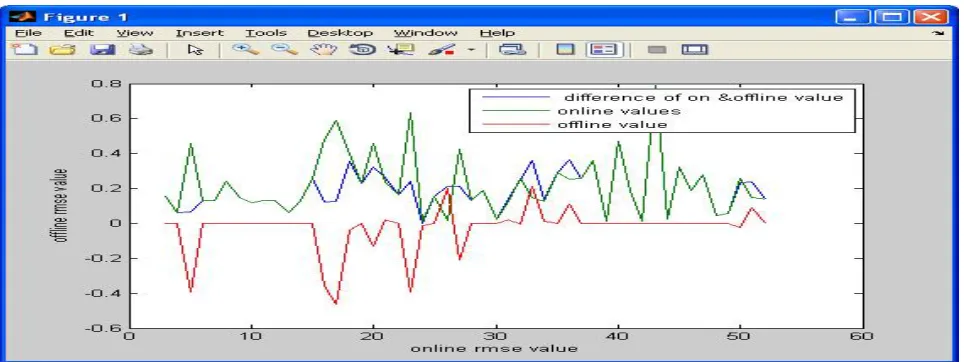
Fig 6: Average Difference between RMSE real time and offline data
Our proposed results show that due to several external factors the direction of arrival estimation or source localization error are affected within few meters. The accuracy of elephant localization error mainly depends on temperature and wind speed. Using standard deviation the accuracy of real time average value 9.66 Mts and Simulated tool average value 11.030Mts and difference between real time and tool data average value is 1.3Mts. in real time data collection increase in temperature and wind speed gradually affects the DOA estimation by 1Mts. Using nearest neighbor search algorithm the sensor are grouped by their minimum distance and estimate the ECF(error constant factor). The wind, temperature and sudden changes occurred in environment are significantly affects the localization accuracy. Average Difference between Approximate ECF for real time and simulated data error margin are -5.824Mts and overall error margin lie between +/- 0.11Mts.
VI.CONCLUSION AND FUTURE SCOPE
This paper, we proposed a methodology for estimating direction of arrival and error analysis for outdoor atmospheric conditions using hyperbolic partial circular array. Our DOA estimation results shows that the impact of temperature, wind and unexpected changes affects the accuracy of elephant localization. The SNR, RMSE error and ECF also plays the major role in localization error accuracy. In real time and tool generated implementation the localization error constant factor is estimated as -0.11Mts(-5.824/50). In future our work enhances in two directions (i) decreasing the error constant factor(-0.11Mts) (ii) Simultaneously monitor and estimating the direction of arrival for more than one source from opposite direction.
REFERENCES
[1] M.Mayilvaganan and M.Devaki, “Direction Of Arrival Estimation and Error Analysis for Wireless Sensor Networks”. In International Journal of Emerging Trends and Technology in Computer Science March-April 2013,Volume 2, Issue 2, , ISSN 2278-6856.
[2] M.Mayilvaganan and M.Devaki, “Comparitive Study Between Real time and Offline data for Target Localization and Direction of Arrival Estimation Accuracy”. In international journal of Computer Science and Management Research.
[3] M.Mayilvaganan and M.Devaki, “Elephant Vocalization Direction of Arrival Estimation and external factors Affecting Wave propagation using Acoustic Sensor network. In International Journal of Innovative Research in Computer and Communication Engineering , june 2013, Volume 1, Issue 4ISSN 2320-9801.
[4] M.Mayilvaganan and M.Devaki, “Preliminary Study of Outddoor Positioning Acoustic Source direction Of Arrival”. In International Journal of Emerging Trends and Technology in Computer Science , March-April 2013, Volume 2, Issue 2ISSN 2278-6856.
[8]W. R. Langbauer, K. B. Payne, R. A. Charif, L. Rapaport, F. Osborn, “African elephants respond to distant playbacks of low-frequency conspecific calls”, J. Exp. Biol. 157: 35-46, 1991.
[9] J. Haitsma and T. Kalker, “A Highly Robust Audio Fingerprinting System,” in Proceedings of the International Symposium on Music Information Retrieval, Paris, France, 2002.. (2004).pp 1-2
[10]Cano, P., E. Batlle, T. Kalker, and J. Haitsma. 2005. A review of audio fingerprinting. The Journal of VLSI Signal Processing pp.2-3
[11] Haitsma, J., T. Kalker, and J. Oostveen. 2001. Robust audio hashing for content identification. Proc. Of the Content-Based Multimedia Indexing pp 3-4.
[12]S.Poornachandra, B.Sasikala Digital Signal ProcessingDigital Signal Processing, copyright 2006, Vijay Nicole imprints Private Limited. ISBN: 81-8209-.pp 4-5.
[13]M. Brandstein and D. Ward, Eds., Microphone Arrays: Signal Processing Techniques and Applications, Springer, 2001. Pp 4-6
[14].B.Somanathan Nair., Digital Signal Processing Theory, Analysis and digital Filter Design(textbook) prentice hall of india private limited. pp4-6
[15] Chetan R.Dongarsane and A.N.Jadhav2 Simulation Study on DOA estimation Using MUSIC Alogirthm. In Inernational Journal Of technology and Engineering Systems jan-March 2011 Vol2 No 1.