Volume 5, No. 5, May-June 2014
International Journal of Advanced Research in Computer Science
RESEARCH PAPER
Available Online at www.ijarcs.info
Evaluating the Performance of Audio Watermarking using Digital Delay Attack
Sukhwinder Kaur, Vijay Kumar Banga
Department of Electronic and Communication Engineering Amritsar College of Engineering and Technology
Amritsar, Punjab, India.
Abstract: A digital watermarking is a technique, which is used to defensive digital information like images, videos and audio as it provides copyright tenure. Digital watermarking emerges as techniques for defending the multimedia data from copyright infraction. It is a method for classification multi-media data, for example digital images, text documents, video and audio clips, by trouncing secret information in the data. In this paper various audio watermarking techniques are discussed. Audio watermarking is supplementary difficult than image watermarking due to the lively incomparability of hearing power over the visual field. The embedded watermark is a binary image. The different encryption and decryption techniques are used for hiding the secret image so no one concealing their existence. The embedding of an encryption watermark is distributed uniformly in the areas of low frequencies components is that these components energy is high enough to embed the watermark in such a way that the watermark is inaudible and it should not easy to remove. The various watermark techniques DCT, DWT, LSB have been designed and implemented in MATLAB tool. Various performance metrics has been taken for experimental purpose. It has been found that without attack and with digital delay attack DWT using HAAR is quite effective technique over others.
Keywords: Watermarking, DCT, DWT, LSB.
I. INTRODUCTION
An audio signal is a demonstration of sound typically as an electrical voltage. The audio frequencies of the audio signals have in the range of roughly 20 to 20,000 Hz (the limits of human hearing). Audio signals may be synthesized directly, or may originate at a transducer such as a microphone, loudspeakers, musical instruments, pickup convert an electrical audio signal into sound. Digital representations of audio signals exist in a variety of formats. Audio signals may be characterized by parameters such as their bandwidth, power level in decibels (dB), and voltage level. The relation between power and voltage is determined by the impedance of the signal lane, which may be single-ended or balanced .In the recent years with the development of internet technology it’s very easy to accessing the unauthorized digital or multimedia information. For the protection of multimedia unauthorized information watermark technique is used. Watermarking is an imperceptible or hidden information in an audio or an image ,or any object of value. In this process embedding any information in a signal is very difficult to remove .An watermark is a unique electronic identifier typically used to identify ownership of copyright. [1] Watermarking has become increasingly important to enable copyright defense and tenure verification. Digital watermarking is a technique by which copyright information is embedded into the host signal in a way that the hidden information is imperceptible and robust against intentional and unintentional attacks.
Watermarking is a technique through which the secure information is carried without undignified the quality of the original signal. Watermarking is mainly used for secret point to point communication between two parties. Watermarking is one type of steganography techniques whose primary goal is the protection of the object rather than the invisibility of the object. The watermarking technique has better robustness. A watermarking system would embed an
amount of information that cannot be altered or removed without making the object entirely ineffectual. A watermarking system involves substitution between capacity and security. The technique consists of two blocks:
(i)Embedding block (ii) Extraction block In the embedding block the embedded object is known as watermark, the watermark embedding medium is termed as the original signal or cover object and the modified object is termed as embedded signal or watermarked data. In the extraction block watermarking technique that does not use the watermark during extraction process. Blind watermarking technique is used for extract the hidden information at the receiver end.
performed without any transformation. Watermarking is employed on the original samples of the audio signal.
II. DISCRETE WAVELET TRANSFORM (DWT)
Wavelet Transform gives the time-frequency demonstration of the signal. DWT provides the sufficient information for both analysis and fusion signal and is easier to implement. A complete structure of wavelet contains domain processing analysis block and a synthesis block. Analysis or decomposition block decomposes the signal into wavelet coefficients. The reconstruction process is the inverse of decomposition process. [3] here, the block takes the decomposed signal and synthesizes (near) original signal. The original signal is decomposed in the analysis block and the signal is reconstructed using the synthesis block. Filters used in the analysis and synthesis block.
The function of 1-level discrete wavelet transform decomposition is to separate high pass and low pass components. Thus, process involves passing the time-domain signal through a high pass filter and down sampling the signal obtained yields detailed coefficients and, passing through low pass filters and down sampling generated approximate coefficients. There are different types of DWTs presented depending on the type of chosen basis function. DWT filters are also classified based on the number of fading moments.
DWT can be expressed as
Reconstruction formulae for the DWT can be given as
C is a constant which has nothing to do with signal.
A. Dwt With Haar:
HAAR is the fundamental orthogonal wavelet filter. The scaling purpose, wavelet purpose with its low and high pass filters. It can be inferred from this figure that the low and high pass filters for disintegration and reconstruction are orthogonal. The significant property of HAAR Wavelet is any real function can be approximated. In addition to that, the implementation is easy as there are two components in the filter design and require less precision. The vanishing moments for HAAR wavelet is 1 and is the fundamental wavelet. [4] HAAR wavelet is extensively used in image compression applications due to its simple wavelet and scaling functions.
a. Watermark Embedded process DWT with HAAR
wavelet:-
In the embedded Watermarking process with HAAR wavelet transform the original audio signal used as a input data. Than load the watermark data .Encrypt the watermarking data using the chaos sequence. In the next step decompose the original audio signal in wavelet transform. In the embedded process at the output the received signal is called watermarked audio signal.DWT produces two sets of coefficients the approximated coefficients and the detailed coefficients.
b. Watermark extraction process DWT with HAAR
wavelet:-
In the extraction process with HAAR wavelet transform is the contrary of the embedding process. It is implicit that the watermark as well as the see value is existing at the receiver end to the authorized users. The operation of channel separation is applied on the watermarked data to produce discrete wavelet transform is applied on the watermarked data to generate the approximate coefficients and detail coefficients. After that the related function is applied on the original data, and generate it’s both coefficients [4], first approximate coefficients and second detail coefficients. With the both coefficient approximate coefficients and the detail coefficients of watermarked data and original data, we could extract watermark data through watermark extracting process.
III.DISCRETE COSINE TRANSFORM (DCT)
Discrete cosine transform (DCT) is a technique for converting a signal into basic frequency components. The DCT can be engaged on both 1 dimensional and 2 dimensional which are properties of discrete wavelet transform. DCT uses only cosine purpose of assorted wave numbers are basis function and operates on actual values and supernaturalcoefficients. DCT of a 1-dimensional (1-d) sequence and the restoration of original signal from its DCT coefficients termed as inverse discrete cosine transform (IDCT) can be computed using equations [5]. The fundamental applications of DCT are audio compression and signal compression. The mainly useful applications of two-dimensional (2-d) DCT are the audio compression and encryption.The embedding image data into the audio signal and additive audio watermarking algorithm based on DCT domain. AC DCT coefficients engage in recreation different manipulate in robust and inaudibility. In this DCT based audio watermarking technique first, we decompose the audio into no overlapping blocks (eight data per block). Then every block performs the DCT operation: watermark is embedded by modulating AC DCT coefficient. Every block is embedded one bit message.The properties of DCT are de-correlation, energy compaction, separability, symmetry and orthogonality. DCT packs the energy of the signal into the low frequency regions which provides an option of dropping the size of the signal without degrading the quality of the signal.
a. Watermark Embedded process with DCT:-
Providing that carrier is an original audio signal containing copies of sampling statistics, we divide the audio signal by fixed length, on condition that that each audio statistic embedded into pixel information of watermark. In the strategy of watermark embedding as a practical audio-watermark system, robust and inaudibility are the basic requirements. Generally the watermark information will be embedded in low intermediate coefficient of discrete cosine transform (DCT) on account of its greater value, so the impact of watermark embedding is very slight, but also with sufficient robustness and suppression.
b. Watermark Extraction process with DCT:-
This process is the converse of embedding process. In this process divide the audio signal by fixed length, providing that the length of each audio statistic and then perform DCT transform of each section. Extraction the 3thAC coefficient and recover the digital watermarking information of each section[6]. Method of one-dimension watermarking sequence during the Pseudorandom back-transforming, then revert it to the two-dimension watermarking information and get the watermarking image information.
IV. LEAST SIGNIFICANT BIT(LSB)
Least significant bit technique is used for embedding the digital watermark into audio signal. This technique is one of the common techniques engaged in signal processing applications. The LSB coding method embeds a message in the least significant bits of the host audio signal. The number of used LSB increases the depth of the modified LSB layer becomes larger; the risk of masking the embedded message statistically detectable increases and perceptual transparency of stego object is decreased. Hence, there is a boundary for the amount of bits in each one Sample of the host audio that can be used to embed messages. It is based on the switch of the LSB of the carrier signal with the bit pattern from the watermark noise. The robustness depends on the number of bits that are being replaced in the host signal [7]. This type of technique is commonly used in image watermarking because, each pixel is represented as an integer therefore it will be simple to substitute the bits. The audio signal has real values as samples, if converted to an integer will degrade the quality of the signal to a great extent. The embedding operation on the LSB is performing on the subset. The extraction operation extracts the watermarked data by reading the values of these bits from the watermarked audio bit stream. The foremost benefit of the LSB coding technique is a very high watermark channel bit rate, utilize of only one LSB of the host audio samples gives a capacity of 44.1 kbps .In the extraction process its need to all the samples of the watermarked audio that were used during the embedding process.
V. LITERATURE REVIEW
Chen Xuesong et al. (2008)[8] has proposed that embedding audio watermark into an audio signal was researched in the DWT province and an algorithm of additive audio watermarking based on SNR adaptive to verify a scaling parameter. The intensity of embed watermark based on the Human Audio System is greatest as
much as feasible and a balance between robustness and imperceptible. The watermarking signal can be extracted by blind detection in the receiving end. Yan Yang et al. (2009) [9] has proposed the novel technology of embedding image data into the audio signal and additive audio watermarking algorithm based on DCT domain.AC DCT coefficients play different influence in robust and inaudibility. In this proposed method the experimental results demonstrate that the watermark is inaudible and this algorithm is robust to common operation of digital audio signal processing, such as low pass filtering, smoothing, adding noise and so on.
Singhal, A et al. (2011) [10] Digital watermarking is the process of embedding copyrighting information into digital media frame. They are preferred to be imperceptible to the end users. Singhal, A et al. propose a novel audio watermarking technique. The algorithm proposed uses multilevel wavelet decomposition, DCT and SVD (Singular Value Decomposition) to achieve robustness and inaudibility. Mat Kiah et al. (2011) [11] with the increasing usage of digital multimedia, the security of intellectual property rights problem has become a very important issue.
Every day, thousands of multimedia files are being uploaded and downloaded. Therefore, multimedia copyrights become an important issue to keep the intellectual property for the authors of these files. Mat Kiah et al. has discussed the domains of digital audio steganography, the properties of H.A.S, the audio and the digital representation transmission environments, and its software metric. A.R.Elshazly et al.(2012) [12] has discussed to improve security and robustness of digital audio watermarking algorithms, based on mean-quantization in DWT domain. The algorithm has a good security because only the authorized can detect the copyright information embedded to the host audio signal. The watermark can be blindly extracted without knowledge of the original signal.
The method provides both embedding and extraction solutions. Janardhanan et al. (2013)[14] has discussed digital audio watermarking involves the procedure of embedding into a host audio signal, a perceptually perceptible digital signature carrying a message concerning the host signal. A method of digital audio watermarking using wavelet transform is functional to watermark Indian classical songs. Investigations were performed using Haar, Daubechies and Symlet wavelets for time-frequency decomposition of the audio signal in order to embed watermark bits into the wavelet coefficients. Simulations are performed with embedding at different levels of wavelet transform and the results are encouraging with Daubechies wavelet. Robustness of the algorithm was also analysed by including additive white Gaussian noise, denoising, and resampling. Jani, Yatish Y. et al.(2014)[15] has discussed globalization and internet are the two major reasons for fast dispersion of the multimedia information and appropriate to that tenure and exclusive rights of multimedia files are not generally protected by the providers. Digital watermarking is one of the top ways for exclusive rights protection. Researchers are trying to formulate new techniques that increase the protection, Robustness and many more effects.
VI. COMPARITATIVE ANALYSIS
[image:4.595.313.561.177.255.2]In order to do performance evaluation of the different audio watermarking techniques; MATLAB tool issued in this paper. The results are taken by without any attack and also with digital delay attack to check the performance of audio watermarking techniques.
Table 1 Signal to Noise Ratio Evaluation
Sound Name
DWT LSB Dct
Quanti--Zation
Dwt Haar
Sound1 57.2218 63.7842 55.8757 81.6948
Sound2 62.6465 72.9561 47.6099 86.3061
Sound3 66.5257 79.1534 58.0646 92.3544
Sound4 57.1016 63.7826 55.1090 83.5334
Sound5 61.4342 61.3489 35.3860 79.8865
[image:4.595.326.545.315.503.2]Table 1: is showing the quantized analysis of the signal to noise ratio. As signal to noise ratio need to be increase therefore the DWT HAAR is showing the better results than the available methods as signal to noise ratio is less in every case.
Figure 1: SNR of DWT, LSB, DCT Quantization & DWT HAAR
Figure1. has shown the analysis of the signal to noise ratio of different audio signal using audio watermarking by DWT transform (Blue Color), watermarking by DWT HAAR transform (Magenta Color), watermarking by LSB transform (Green Color), by watermarking DCT QUANTIZATION (Red Color). It is very clear from the plot that there is increase in SNR value of audio with the use of DWT HAAR over other methods. This increase represents improvement in the signal quality of the audio.
Table 2 Bit Error Rate Evaluation
Audio Name
DWT LSB Dct
Quanti--Zation
Dwt Haar
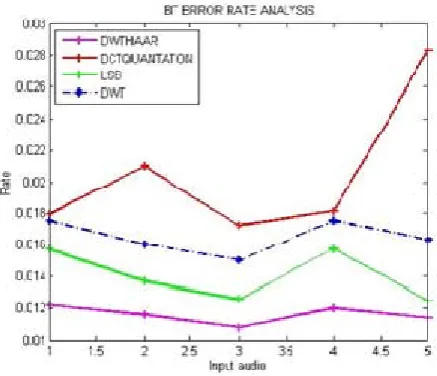
Sound1 0.0175 0.0157 0.0179 0.0122
Sound2 0.0160 0.0137 0.0210 0.0116
Sound3 0.0150 0.0126 0.0172 0.0108
Sound4 0.0175 0.0157 0.0181 0.0120
Sound5 0.0163 0.0125 0.0283 0.0114
Table 2: is showing the quantized analysis of the BER. A bit error rate need to be reduced therefore the DWT HAAR is showing the better results than the available methods as bit error rate is more in every case.
Figure 2: Ber Of Dwt , Lsb, Dct Quantization & Dwt Haar
[image:4.595.31.289.427.505.2]Figure2. has shown the analysis of the BER of different audio signal using audio watermarking by DWT transform (Blue Color), watermarking by DWT HAAR transform (Magenta Color), watermarking by LSB transform (Green Color), by watermarking DCT QUANTIZATION (Red Color). It is very clear from the plot that there is decrease in BER value of audio with the use of HAAR method over other methods. This decrease represents improvement in the signal quality of the audio.
Table 3 Mean Square Error Evaluation
Audio Name
DWT LSB Dct
Quanti--Zation
Dwt Haar
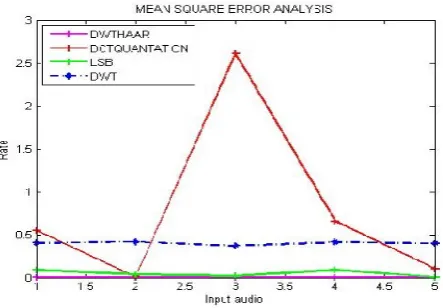
Sound1 0.4041 0.0892 0.5509 0.0014
Sound2 0.4209 0.0392 0.0113 0.0018
Sound3 0.3721 0.0203 2.6111 0.0019
Sound4 0.4153 0.0892 0.6570 0.0021
Sound5 0.4025 0.0057 0.1016 0.0009
[image:4.595.41.274.578.770.2] [image:4.595.311.562.652.729.2]Figure 3: Mse Of Dwt, Lsb, Dct Quantization & Dwt Haar
[image:5.595.53.275.56.210.2]Figure3. has shown the analysis of the MSE of different audio signal using audio watermarking by DWT transform (Blue Color), watermarking by DWT HAAR transform (Magenta Color), watermarking by LSB transform (Green Color), by watermarking DCT QUANTIZATION (Red Color). It is very clear from the plot that there is decrease in MSE value of audio with the use of DWT HAAR over other methods. This decrease represents improvement in the objective quality of the audio.
Table 4 Root Mean Square Error Evaluation
Audio Name
DWT LSB DCT
Quanti--Zation
DWT HAAR
Sound1 0.6357 0.2986 0.7422 0.0380
Sound2 0.6487 0.1980 3.6635 0.0426
Sound3 0.6100 0.1426 1.6159 0.0312
Sound4 0.6444 0.2986 0.8106 0.0307
Sound5 0.0163 0.0758 4.7288 0.0306
Table 4 is showing the comparative analysis of the RMSE. Table has clearly shown that is less in our case therefore the DWT HAAR has shown significant results over the other available methods.
Figure4. has shown the analysis of the RMSE of different audio signal using audio watermarking by DWT transform (Blue Color), watermarking by DWT HAAR transform (Magenta Color), watermarking by LSB transform (Green Color), by watermarking DCT QUANTIZATION (Red Color). It is very clear from the plot that there is decrease in RMSE value of audio with the use of DWT HAAR method over other methods. This decrease represents improvement in the objective quality of the audio.
Figure 4: Rmse Of Dwt, Lsb, Dct Quantization & Dwt Haar
Table 5. Root Mean Square Error Evaluation with Digital Delay Attack
Audio Name
DWT LSB DCT
Quanti--Zation
DWT HAAR
Sound1 0.6494 922.7066 0.7423 0.0381
Sound2 0.6594 850.5693 3.6638 0.0018
Sound3 0.6488 734.2383 1.6159 0.0417
Sound4 0.6101 922.7109 0.8106 0.0308
[image:5.595.315.561.68.163.2]Sound5 0.6483 745.6578 12.7297 0.0334
Table 5 is showing the comparative analysis of the root mean square error with digital delay attack by using different watermarking techniques. Table has clearly shown that is less in our case therefore the DWT HAAR has shown significant results over the other watermarking methods.
Figure 5: Rmse Of Dwt, Dwt Haar, Lsb, Dct Quantization With Digital Delay Attack
[image:5.595.38.281.357.444.2]Figure5. has shown the analysis of the RMSE of different audio signal using audio watermarking by DWT transform (Blue Color), watermarking by DWT HAAR transform (Magenta Color), watermarking by LSB transform (Green Color), by watermarking DCT QUANTIZATION (Red Color). It is very clear from the plot that there is decrease in RMSE value of audio with the use of audio watermarking technique DWT HAAR over other watermarking methods. This decrease represents improvement in the objective quality of the audio signal.
Table 6 Signal To Noise Ratio Evaluation with Digital Delay Attack
Audio Name
DWT LSB DCT
Quanti--Zation
DWT HAAR
Sound1 57.0369 6.0147 55.8755 81.6698
Sound2 62.6462 0.2937 47.6093 86.2877
Sound3 66.5251 0.3766 58.0645 89.8337
Sound4 57.2201 6.0164 55.1089 83.4999
Sound5 61.2468 0.0309 35.3854 87.0153
[image:5.595.311.560.609.696.2]Table 6 is showing the quantized analysis of the SNR with
[image:5.595.52.261.615.766.2]Figure 6: SNR of DWT, DWT HAAR, LSB, DCT QUANTIZATION with Digital Delay Attack
[image:6.595.319.557.177.265.2]Figure6 has shown the analysis of the SNR of different audio signal using audio watermarking by DWT transform (Blue Color), watermarking by DWT HAAR transform (Magenta Color), watermarking by LSB transform (Green Color), by watermarking DCT QUANTIZATION (Red Color). It is very clear from the plot that there is increase in SNR value of audio with the use of DWT HAAR over other methods. This increase represents improvement in the objective quality of the audio.
Table 7: Mean Square Error Rate Evaluation with Digital Delay Attack
Audio Name
DWT LSB DCT
Quanti--Zation
DWT HAAR
Sound1 0.4217 8.5139 0.5509 0.0015
Sound2 0.4209 7.2347 13.4232 0.0018
Sound3 0.3722 1.5333 58.0645 0.0017
Sound4 0.4041 8.5140 55.1089 9.5170
[image:6.595.329.561.329.516.2]Sound5 0.4202 5.5601 162.0449 0.0011
Table 7 is showing the quantized analysis of the MSE with digital delay attack. As mean square error need to be reduced therefore the DWT HAAR is showing the better results than the available methods as mean square error is more in every case.
Figure 7: MSE of DWT, DWT HAAR, LSB, DCT QUANTIZATION with Digital Delay Attack
Figure7 has shown the analysis of the MSE of different audio signal using audio watermarking by DWT transform (Blue Color), watermarking by DWT HAAR transform (Magenta Color), watermarking by LSB transform (Green Color), by watermarking DCT QUANTIZATION (Red Color). It is very clear from the plot that there is decrease in MSE value of audio with the use of DWT HAAR method over other methods. This decrease represents improvement in the objective quality of the audio.
Table 8. Bit Error Rate Evaluation With Digital Delay Attack
Audio Name
DWT LSB DCT
Quanti--Zation
DWT HAAR
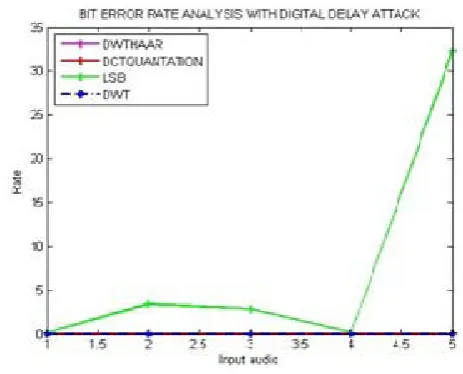
Sound1 0.0175 0.1663 0.0179 0.0122
Sound2 0.0160 3.4033 0.0210 0.0116
Sound3 0.0150 2.8556 0.0172 0.0111
Sound4 0.0175 0.1662 0.0181 0.0120
Sound5 0.0163 32.3370 0.0283 0.0115
Table 8 is showing the quantized analysis of the BER with digital delay attack. A bit error rate need to be reduced therefore the DWT HAAR is showing the better results than the available methods as bit error rate is more in every case.
Figure 8: BER of LSB, DWT ,DWT HAAR & DCT QUANTIZATION with Digital Delay Attack
Figure8. has shown the analysis of the BER of different audio signal using audio watermarking by DWT transform (Blue Color), watermarking by DWT HAAR transform (Magenta Color), watermarking by LSB transform (Green Color), by watermarking DCT QUANTIZATION (Red Color). It is very clear from the plot that there is decrease in BER value of audio with the use of DWT HAAR method over other methods. This decrease represents improvement in the objective quality of the audio.
VII. CONCLUSION
[image:6.595.31.287.417.491.2]One can also use audio watermarking for copy right protection.The various watermark techniques DCT, DWT, LSB have been designed and implemented in MATLAB tool. Various performance metrics has been taken for experimental purpose. It has been found that without attack and with digital delay attack DWT using HAAR is quite effective technique over others.
In near future some more attacks will also be considered. However no modification is done in existing algorithm in near future we will integrate two existing audio watermarking algorithms.
VIII. REFERENCES
[1] Gold, Ben, Nelson Morgan, and Dan Ellis. Speech and audio signal processing: processing and perception of speech and music. John Wiley & Sons, 2011
[2] Gopalan , Kaliappan. "Audio steganography using bit modification." Multimedia and Expo, 2003. ICME'03. Proceedings. 2003 International Conference on. Vol. 1. IEEE, 2003
[3] Wang, Xinkai, et al. "A norm-space, adaptive, and blind audio watermarking algorithm by discrete wavelet transform." Signal Processing 93.4 (2013): 913-922.
[4] LENG, Xiao-Xu, and Jun XIAO. "A robust zero-watermarking algorithm based on HAAR wavelet and normalization." Journal of Graduate University of Chinese Academy of Sciences 3 (2013): 021.
[5] Yin, Chao, and Shujuan Yuan. "A Novel Algorithm for Embedding Watermarks into Audio Signal Based on DCT." Proceedings of the International Conference on Information Engineering and Applications (IEA) 2012. Springer London, 2013.
[6] Wang, Rangding, et al. "A Novel Audio Aggregation Watermarking Algorithm Based on Copyright Protection." International Journal of Computational Intelligence Systems ahead-of-print (2013): 1-13.
[7] Chadha, Ankit, and NehaSatam. "An Efficient Method for Image and Audio Steganography using Least Significant Bit (LSB) Substitution." arXiv preprint arXiv:1311.1083 (2013).
[8] LI, Yan-ping, Zhen-min TANG, and Bo QIAN. "Audio watermark algorithm robust to desynchronization based on speech parameter model." Computer Engineering 9 (2008): 066.
[9] Yang, Yan, Rong Huang, and MintaoXu. "A Novel Audio Watermarking Algorithm for Copyright Protection Based on DCT Domain." Electronic Commerce and Security, 2009. ISECS'09. Second International Symposium on. Vol. 1. IEEE, 2009
[10] Singhal, Achintya, Anurag Narayan Chaubey, and Chandra Prakash. "Audio watermarking using combination of multilevel wavelet decomposition, DCT and SVD." Emerging Trends in Networks and Computer Communications (ETNCC), 2011 International Conference on. IEEE, 2011
[11] .Mat Kiah, M. L., et al. "A review of audio based steganography and digital watermarking." International Journal of Physical Sciences 6.16 (2011): 3837-3850.
[12] Elshazly, A. R., M. M. Fouad, and M. E. Nasr. "Secure and robust high quality DWT domain audio watermarking algorithm with binary image." Computer Engineering & Systems (ICCES), 2012 Seventh International Conference on. IEEE, 2012
[13] Ghobadi, Alireza, et al. "Blind audio watermarking for tamper detection based on LSB." Advanced Communication Technology (ICACT), 2013 15th International Conference on. IEEE, 2013
[14] Janardhanan, C. M., and C. Sathish Kumar. "Performance Analysis of Discrete Wavelet Transform based Audio Watermarking on Indian Classical Songs." International Journal of Computer Applications 73 (2013).