© 2014, IJCSMC All Rights Reserved 1216 Available Online atwww.ijcsmc.com
International Journal of Computer Science and Mobile Computing
A Monthly Journal of Computer Science and Information Technology
ISSN 2320–088X
IJCSMC, Vol. 3, Issue. 5, May 2014, pg.1216 – 1222
REVIEW ARTICLE
A Simplified Review on Fast HSV
Image Color and Texture Detection
and Image Conversion Algorithm
Monika Deswal
1, Neetu Sharma
2Ganga Institute of Technology and Management, Kablana, Jhajjar, Haryana, India
ABSTRACT
In order to identify the perceived qualities of texture and color in a building mathematical models for object a optimized and efficient algorithm ‘A Fast HSV Image Color and Texture Detection Algorithm’ based on col-or intensity using Artificial Intelligence and fuzzy Logic is presented in this paper. We will be using colcol-or intensity method over conventional method. The ‘Fast HSV Image Color and Texture Detection Algorithm’ focuses to integrate the detection of image color with detection of texture using AI and Fuzzy logic. Color detection has been among the widest research area in the field of computer science. In computer vision, there are several pre-existing color models for describing the specification of the colors such as RGB, CMY and HSV. This paper presents detection of color using HSV-based (hue, saturation, value) color model since it greatly decreases the size of color and grey-scale information of an image .This paper can be treated as a reference for getting in depth knowledge of the Color detection and texture detection.
Keywords: Red Green Blue (RGB), Cyan Magenta Yellow (CMY), Hue Saturation Value (HSV), Commission international del’ Eclairage (CIE), Content Based Image Retrieval (CBIR)
1.
Introduction
This paper focuses on two things color and texture of modelled object.
Color: We have to focus to detect objects in different colors and shapes in an active vision circumstance, many commonly used computer vision algorithms are included and some of them are developed in several previous thesis and projects. In computer vision, there are several pre-existing color models for describing the specification of the colors such as RGB, CMY and HSV. This thesis uses HSV-based (hue, saturation, value) color model since it greatly decreases the size of color and grey-scale information of an image. A set of isolated points are clustered into objects by color extraction. Hue filtering is used to segment the specified color.
Texture: In many machine vision and image processing algorithms, simplifying assumptions are made about the uniformity of intensities in local image regions. However, images of real objects often do not exhibit regions of uniform intensities. For example, the image of a wooden surface is not uniform but contains variations of intensities which form certain repeated patterns called visual texture.
© 2014, IJCSMC All Rights Reserved 1217
parts.These tasks are performed on a large set of images which were collected as a benchmark for the problem of scene understanding. The final system is able to reliably identify cars, pedestrians, bikes, sky, road, buildings and trees in a diverse set of images. [2]
Textures provide important characteristics for surface and object identification from aerial or satellite photographs, biomedical images and many other types of images.[6]
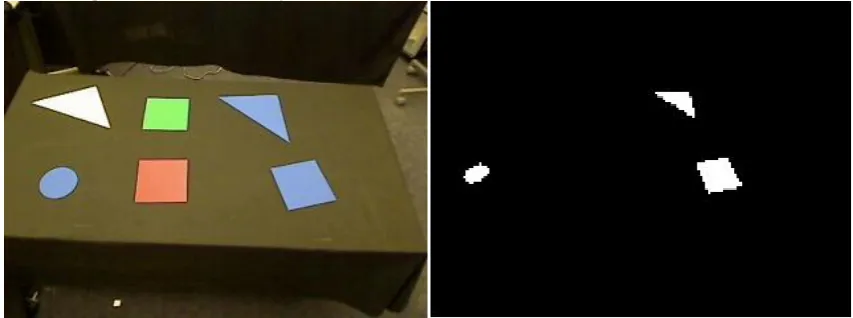
In computer vision, there are several pre-existing color models for describing the specification of the colors such as RGB, CMY and HSV. This thesis uses HSV-based (hue, saturation, value) color model since it greatly decreases the size of color and grey-scale information of an image. A set of isolated points are clustered into objects by color extraction. Hue filtering is used to segment the specified color. When the value of hue is set, a mask is applied to the image. In a binary image, when the value of pixels satisfy a specified criterion, such as hue, the value transformed by masking. Function is set to zero which shows in white color; otherwise. All the pixels in the appointed hue range are marked as foreground which are shown in white and other pixels are marked as background are shown in black.
figure 1 – shows only blue objects in detection
© 2014, IJCSMC All Rights Reserved 1218
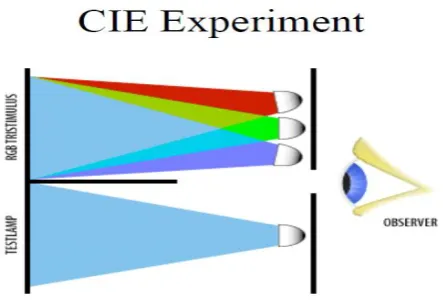
Fig 2-CIE Experiments
© 2014, IJCSMC All Rights Reserved 1219
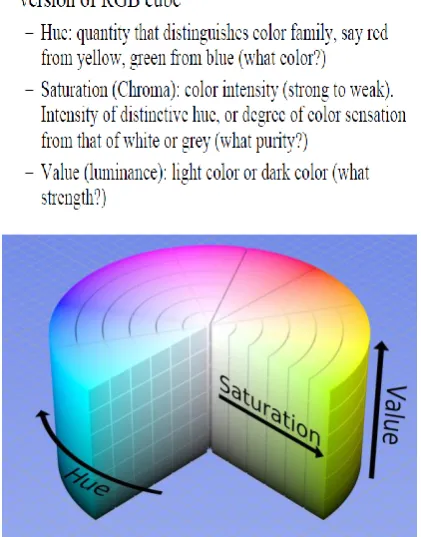
FIG : HSV PRESENTATION
1.2 Color model conversions
Conversion between RGB and HSV
The HSV color model can be considered as a different view of the RGB cube. Hence the values of HSV can be considered as a transformation from RGB using geometric methods. (See Figure 2-9) The diagonal of the RGB cube from black (the origin) to white corresponds to the V axis of the hex cone in the HSV model. For any set of RGB values, V is equal to the maximum value in this set. The HSV point corresponding to the set of RGB values lies on the hexagonal cross section at
deter-© 2014, IJCSMC All Rights Reserved 1220
mined by calculating the relative position of the point within each sextant of the hexagon. The values of RGB are defined in
the range [0, 1], the same value range as HSV. The value H is the ratio converted from 0 to 360 degree.
1.3 Color Model Pros and Cons
• RGB
+ Cartesian coordinate system + linear
+ hardware-based (easy to transform to video) + tristimulus-based
- hard to use to pick and name colors - doesn‟t cover gamut of perceivable colors
- non-uniform: equal geometric distance ---unequal perceptual distance • CIE
+ covers gamut of perceived colors
+ based on human perception (matching experiments) + linear
+ contains all other spaces
- non-uniform (but variations such as CIE Lab are closer to Munsell, which is uniform)
- xy-plot of chromaticity horseshoe diagram doesn‟t show luminance Color Model
2.
Background
Recognition task to which we extend the SMF set is the detection of nonshape-based objects, i.e., trees and buildings. This is essentially a texture recognition task:after segmenting the images, we recognize the texture of each segment. We demonstrate that the SMF features outperform other state-of-the-art algorithms. Finally, we offer a platform for context computation inside the same unified framework
The three capabilities, shape-based object detection, texture-based object detection and context computa-tion, form a complete system that serves as a robust base for scene understanding architectures.[1]
One of the most interesting perceptual abilities of the human visual system is to assign the same colors to objects under dif-ferent lighting conditions. In other words, a human observe looking at a certain scene perceives the colors of surfaces in a consistent way, although the spectral distribution of the illuminant may vary considerably. This degree of independence of perceived object color on the illuminating spectrum is called color constancy.
the method developed, an estimate of illuminant in the scene is computed, which allows the computation of color con-stant descriptors of the pixel values in the image. In addition, we show a method ofcomputing the actual reflectances of the materials in the scene out of the computed color descriptors.[2]
Most work on skin detection is based on modelling the skin on different color spaces. This paper explores the use of texture as a descriptor for the extraction of skin pixels in images. For this aim, we analyzed and compared a proposed color-based skin detection algorithm (using RGB, HSV and YCbCr representation spaces) with a texture-based skin location algorithm which used a measure called Spectral Variation Coefficient (SVC) to evaluate region features.
This paper presented and compared both a colorbased algorithm (using RGB, HSV and YCbCr representation spac-es) and a texture-based algorithm (usingthe Spectral Variation Coefficient) for skin detection on color images.[3] A fastgeometry figure recognition algorithm based on edge pixel point eigenvalues had been presented earlier in which polygon apexes and its rank orders are quickly recognized.firstly based on the different variation laws of the eigenvalues of polygon apexes and other pixel point and the exact shape recognition of the polygon is fin-ished
The simulation result shows the algorithm merits such as recognizing rich kinds of figure, lower
computa-tional complexity, higher processing speed, no pre-setting template. [4]
The computer vision strategies used to recognize a fruit rely on four basic features which characterize the object: intensity,
color, shape and texture.
© 2014, IJCSMC All Rights Reserved 1221
Texture analysis is fundamental to many applications suchas automated visual inspection, biomedical image pro-cessing, Content Based Image Retrieval (CBIR) and remote sensing
This paper describes an algorithm for texture feature extraction using wavelet decomposed coefficients of an image and its complement[6]
A color-texture is a “chromatic or colored structural pattern” and a color-texture combined cue can be defined as “the visible
radiant power and visual regular structural pattern using which an observer may distinguish between two objects”.
The proposed system combines the effect of color and texture will be more effective and is therefore more desirable.[7]
The wavelet domain features have been intensively used for texture classification and texture segmentation with encouraging results. More of the proposed multi-resolution texture analysis methods are quite successful, but all theapplications of the texture analysis so far are limited to gray scale images. This paper investigates the usage ofwavelet transform and neural network ensembles for color texture classification problem.
The proposed scheme iscomposed of a wavelet domain feature extractor and ensembles of neural
net-works classifier.[8]
Human recognize a multitude of objects and images with little effort. The more often a person sees an object the more he gets familiar with it. The system utilizes three major steps in object recognition namely image pro-cessing, ANN processing and interpretation.
Study proved that the optimum lighting condition opted for the system is at 674 lumens with an accuracy
of 99.99996072%.[9]
Hue is one of the main properties of a color, defined technically (in the CIECAM02 model), as "the degree to which a
stimu-lus can be described as similar to or different from stimuli that are described as red, green, blue, and yellow,"[1] (the unique
hues). Orange and violet (purple) are the other hues, for a total of six, as in the rainbow: red, orange, yellow,green, blue,
violet.
The other main correlatives of color appearance are colorfulness, chroma, saturation, lightness, and brightness.[10]
IMAGE classification is the problem of assigning one or
multiple labels to an image based on its content. This is astandard supervised learning problem: given a training setof
la-beled images, the goal is to learn classifiers to predictlabels of new images.
This paper dealt with the problem of color constancy, or the fact that the perceived color of surfaces tends to remain constant despite changes in illumination that alter the intensities reflected off the surfaces.[11]
3.
Conclusion
Our review paper will review the basic concepts and various methods and techniques for processing textured and color of
object of models.We will separate HUE, Saturation and Value Bands, Texture of an HSV image . Color is a prevalent
prop-erty of most physical surfaces in the natural world. It also arises in many applications such as satellite imagery and printed
documents. Many common low level vision algorithms such as edge detection break down when applied to images that
con-tain textured surfaces. It is therefore crucial that we have robust and efficient methods for processing textured images. It is
therefore crucial that we have robust and efficient methods for processing textured images to be implemented. Texture and
color processing will be applied to practical application domains such as automated inspection and camera imagery. It is also
going to play an important role in the future as we can see from the promising application of texture to a variety of different
© 2014, IJCSMC All Rights Reserved 1222
References
[1] Stanley Bileschi and Lior Wolf The Center for Biological and Computational Learning,Massachusetts Insti-tute of Technology,Cambridge, MA 02138.Email: bileschi,[email protected].‟A Unified System For Object Detection, Texture Recognition, and Context Analysis Based on the Standard Model Feature Set‟
[2] Ron Gershon, Allan D. Jepson*, and John K. Tsotsos* Department of Computer Science University of To-rontoToronto, C A N A D A M5S 1A4 ‟ From [R,G,B] to Surface Reflectance:Computing Color Constant De-scriptors in Images‟
[3] A. Conci, E. Nunes Instituto de Computao, Universidade Federal Fluminense, Niteri, [email protected] J.J. Pantrigo, A. Snchez Departamento de Ciencias de la Computacin, Universidad Rey Juan Carlos, 28933 Ma-drid, Spain
[email protected],[email protected]„COMPARING COLOR AND TEXTURE BASEDALGO-RITHMS FOR HUMAN SKIN DETECTION‟
[4] Wenqing Chen, Leibo Yao2, Jianzhong Zhou, Hongzheng Dong „A Fast Geometry Figure Recognition Al-gorithmBased on Edge Pixel Point Eigenvalues‟
[5] S.Arivazhagan, R.Newlin Shebiah, S.Selva Nidhyanandhan, L.Ganesan „ Fruit Recognition using Color and Texture Features‟
[6] P.S.Hiremath, S. Shivashankar, and Jagadeesh Pujari „WAVELET BASED FEATURES FOR COLOR TEXTURECLASSIFICATION WITH APPLICATION TO CBIR‟Dept. of P.G.Studies and Research in Com-puter Science,Gulbarga University, Gulbarga, Karnataka, India.
[7] Vidya Manian, Ramón Vásquez „Approaches to color and texture based image classification‟Department of Electrical and Computer Engineering Univer sity of Puerto Rico, Mayagüez, PR 00681-9042
[8] Abdulkadir Sengur „ Color texture classification using wavelet transform and neural network ensem-bles‟Firat University, Department of Electronics and Computer Science, 23119, Elazig, Turkey
[9] Jerome Paul N. Cruz, Ma. Lourdes Dimaala, LaureneGaile L. Francisco, Erica Joanna S. Franco, Argel A. Bandala, Elmer P. Dadios Department of Computer Science Polytechnic University of the Philippines Manila, Philippines „Object Recognition and Detection by Shape and Color Pattern Recognition Utilizing Artificial Neu-ral Networks‟
[10]www.google.com‟Hue,saturation and Value of an Image‟